Lesson: Be Careful With Cofounders, You Haven’t Seen Their True Colors Yet

While doing some research for a different post I came across this golden nugget from Paul Graham. His post was titled What startups are really like – and it’s the truth. In it he describes how he sent all his founders an email asking what surprised them about starting a startup. Their number 1 response was around cofounders. Boy can I relate!

1. Be Careful with Cofounders

This was the surprise mentioned by the most founders. There were two types of responses: that you have to be careful who you pick as a cofounder, and that you have to work hard to maintain your relationship.

What people wished they’d paid more attention to when choosing cofounders was character and commitment, not ability. This was particularly true with startups that failed. The lesson: don’t pick cofounders who will flake.

Here’s a typical response:

You haven’t seen someone’s true colors unless you’ve worked with them on a startup.

The reason character is so important is that it’s tested more severely than in most other situations. One founder said explicitly that the relationship between founders was more important than ability:

I would rather cofound a startup with a friend than a stranger with higher output. Startups are so hard and emotional that the bonds and emotional and social support that come with friendship outweigh the extra output lost.

We learned this lesson a long time ago. If you look at the YC application, there are more questions about the commitment and relationship of the founders than their ability.

Founders of successful startups talked less about choosing cofounders and more about how hard they worked to maintain their relationship.

One thing that surprised me is how the relationship of startup founders goes from a friendship to a marriage. My relationship with my cofounder went from just being friends to seeing each other all the time, fretting over the finances and cleaning up shit. And the startup was our baby. I summed it up once like this: “It’s like we’re married, but we’re not fucking.”

Several people used that word “married.” It’s a far more intense relationship than you usually see between coworkers—partly because the stresses are so much greater, and partly because at first the founders are the whole company. So this relationship has to be built of top quality materials and carefully maintained. It’s the basis of everything.

This hit home given the fact that I am going through this issue currently. I have never been married but it really does feel like a divorce. Respecting the unnamed (and by no means is this a personal attack), I can only tell you how disappointed I am in this individual. And maybe I am just disappointed in the overall outcome but I can’t help but be bothered at how it ended, with one of us making a B-line for the door once it was obvious this was actually going to take some hard work. For the sake of our “kids” it’s a good thing I am still around to help them grow and mature.

Let this be a lesson to all entrepreneurs and silicon valley wannabe founders out there:

Life is tough and unfair.

Startups are a hell of a lot tougher and more unfair.

Most ALL startups and iPhone applications DON’T GO VIRAL overnight. They take a shit ton of work and thus require a shit ton of commitment.

And know this: the founder who stuck it out and eventually grew a company to be large and successful is more wise, more battle tested and way more respected in the community than an overnight success who usually had no idea why he was successful. That person will fail to repeat it when he tries again because as an overnight viral success you don’t understand what worked and what didn’t. It just happens.

The time-tested individual builds lifelong skills along with a treasure trove of wisdom he can then apply to any other endeavor with a high potential of success. So if you are a founder I would suggest you swallow the pill and make long term commitments your goal.

Please, give success a fighting chance.
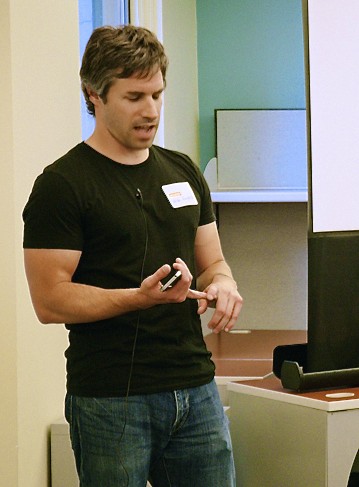
90 Seconds To Life – Suprising Lessons Learned Winning A Pitch Competition

thump thump….  thump thump…..  thump thump…….  My heart rate was starting to rise.

As I looked around the room I noticed it overflowing with people.  There must have been hundreds….

Was I sure I could recall the points I wanted to make as I stood on the platform?  

Was I actually going to make sense to these people?

Feet don’t fail me now…!

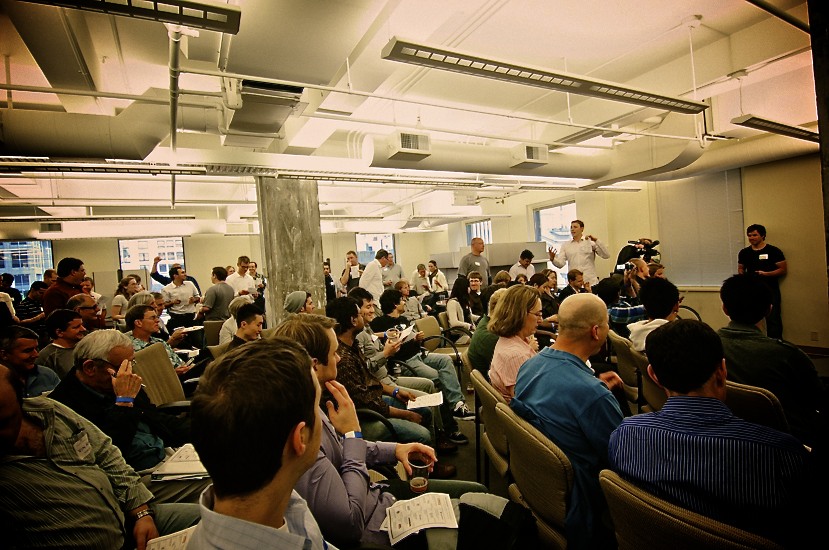
SURF Incubator recently held their launch party at the offices in the Exchange building on 2nd and Marion.  It was a great night with many lasting memories, the biggest being the pitch competition.  Ten different founders each took the spotlight and had 90 seconds to pitch their startup, with the audience voting at the end for their favorite, or the one with the clearest value proposition.

Turns out I won pitching my startup, Seconds!

All the participants deserve recognition and needless to say there will be some great stuff emerging out of SURF for years to come.  But as I look back on the experience that night, a few things become clear and I felt I needed to get them out before they fade away down stream like most other good thoughts tend to do nowadays.

I discovered those 90 seconds taught me more than I ever would have thought a small collection of seconds could.  Some of the lessons were clear as day in the moment, and some took a few days to really sink in.  Here’s what I found:

Deliver

Back in high school I played soccer on a team (West Valley – Yakima) and for a coach that will both go down in history as one of the best.  We were nationally ranked, in the state championship game all 4 years and won 3 of those times.  It was an amazing dynasty and a truly talented team.  Whenever I think back on that experience, one of the main things I remember is our coach would have us 1) determine and publicly state on the outset what we will accomplish that season and 2) have us memorize and repeat certain statements throughout the season.

One of those statements was “I come through when I need to” and it has stuck with me to this day.

What does that statement actually mean?  My take is it’s a commitment to deliver in the moment.  There are certain times in your life you find yourself in a binary situation.  Either I deliver on this (whatever it is) and X will happen, or I don’t deliver on this and Y will happen.  Back then it was scoring goals and winning state championships.  But today as a CEO, it could mean company existence, other people’s jobs, millions of dollars and possible notoriety in the community.   As I stood up there last week it became crystal clear the difference between successful people and unsuccessful people is simply a matter of delivering when the time calls for it.

Speak with them in mind

Whenever you are talking to a group of people it’s probably a good idea to assume they know very little.  This is not a “I’m smarter than they are” comment (trust me, that’s not the case here) but more of a generalization of the crowd.  Even at the SURF pitch event, where the average person at least knows something about technology, it’s just a fact that getting technical is not going to come across well.

In this instance, the crowd was the judge so if winning them over is the goal you must talk from their point of view.  Clearly describing how your solution benefits their life goes a lot farther than a basic technical description of the product.

To all the engineers out there, sorry to burst your bubble but most people don’t want to know HOW it works.  They want to know WHY it works.  People are naturally emotional and mostly irrational.  They are very selfish inside and want to know how things benefit THEM first and foremost.  If there is no connection within, there will be no clear value proposition to them.

I realized this is as true in a pitch competition as it is in the overall business world.  Lacking a clear value proposition – one that can be quickly understood and easily shared with others – is the death of many startups.

Have fun

I don’t know about you but I have noticed a drastic increase in pressure, speed and intensity to my life.  That might be the startup roller coaster I jumped on last year but as I look around I see it with others too.  Are our mobile devices driving us insane?  Does the habit of swiping and checking if someone has messaged us or tweeted something useful really make us happier?  I have a creeping suspicion the always on, always wired, running around needing to do this or that lifestyle is truly messing with our psyche.

For those reasons and more I have really tried to embrace the have fun mentality.  I do believe you can build a great, successful startup and still have fun.  If you see me around you will probably notice a smile on my face.  This is not by accident.  I really try to bring myself to smile, say hi to people, shake hands and see the better part of life in others.  Life is just more fun that way.

The night of the launch party and the pitch event I noticed a lot of the other participants nervous, which in reality threw them off their game.  I consciously made an effort to acknowledge my ‘fight or flight‘ response, but rather than let it get to me I embraced it.  I let it in, leveraged it to help me be more in the moment.  I used it to show my passion and deliver on point.  I actually said to myself, “Nick, look around man… this is fun!”  (OK, a few beers didn’t hurt to calm the nerves either but I digress).

It’s amazing what you can learn in just 90 seconds.  I know these life lessons will stick with me forever and hope they might make a difference in your life as well.

@jnickhughes

The Proper Way Give An Acceptance Speech By SURF Incubator Pitch Contest Winner

What a great launch party SURF Incubator had last week.  More than 300 people attended the event.  It was awesome.  We hung out.  We drank.  We socialized and networked.  We even had a pitch competition, where 10 chosen founders from SURF startups had 90 seconds to explain their concept to the crowd.

The attendees voted after everyone was done.

And we won!  Seconds wins 2 tickets to fly down to San Francisco to attend the DEMO conference in Oct.

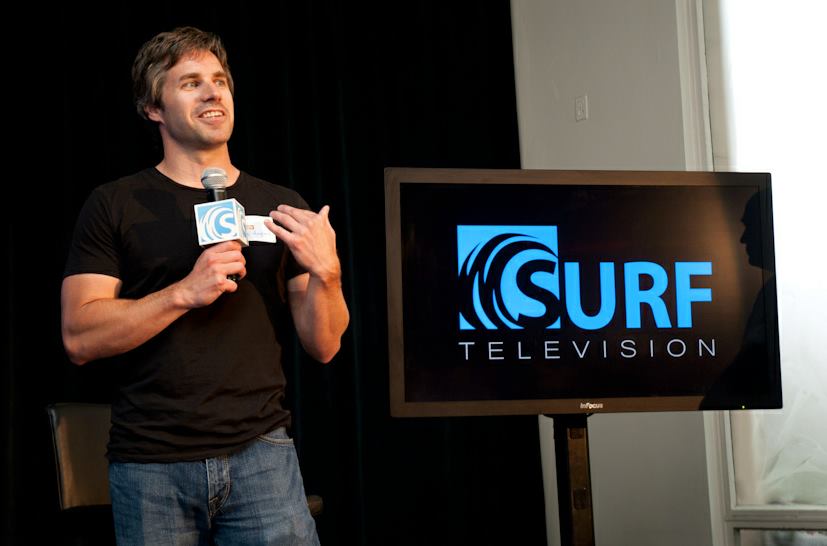
Here’s a video of my acceptance speech, where I am not totally sure at the moment I knew exactly what to say…  but deflecting my own praise and edifying SURF seemed to be what instantly came to mind.  When in doubt, edify the organizer.

(my portion starts about 4:30 into the video)

Below are some images from the event and to find more pictures: bit.ly/SURFphotos

waiting to pitch

giving the pitch

shaking hands with Seaton Gras, founder of SURF 

giving acceptance speech

Do You Think SF or NYC Public Transportation System Could Use This?

I keep having a reoccurring problem.  My Orca Card – Seattle’s version of the public transportation pass – seems to run out of money a very inopportune times.  On my way to an important meeting downtown.  Balance $0.00.  Getting on the bus to go home later at night.  Balance $0.00.

To keep in better control of my finances I choose to not have it automatically refilled each month, so I am at the mercy of knowing how much is on my card at any one time and if more money is needed, I must take time out of my day to go put more on it.  We have learned the majority of cards in circulation are not automatically refilled.

I either have to go online and pay, which takes 24 hours to process.  Or I have to walk to a physical location around town and make a payment at a kiosk.  It sucks.

Why can’t I just pay on the fly and put money back on the card?

Why can’t I be notified if my balance is getting low?

Others around Seattle have this problem, I know this because that is how we were pointed toward initiating talks with Sound Transit.  I have to believe others in additional metro areas around this country are frustrated by the same inconvenience.  That is why we are now starting to work with Sound Transit on a solution involving mobile payment in Seconds and a pilot is set to roll out in the coming months.

Below is a video of how it works.  Pretty smooth, eh?

I wonder if anyone in San Francisco, New York or any other metro area would want to refill their transit pass in Seconds?

http://youtu.be/PCbfu9ajbpk

Thinking Of Quitting? Ask yourself this.

I have those quittin’ thoughts every know and then.   Even the ones at the top think it’s ok for Startup CEOs, to be ‘Scared Sh*tless’ Sometimes.

CEO coach Jerry Colonna says: “I encourage people to own up to the fact that they’re figuring it out, that you’re inventing new things, and that sometimes you’re going to get it wrong. When you admit it, it makes it OK. No one has gone to school to be a CEO–you don’t learn this except by getting in there and figuring it out.”

That’s damn right: No one has gone to school to learn how to be a CEO.  The lessons happen each and every day and it’s scary as sh*t.

I have been at that point many times, and currently going through a pretty challenging stretch as Seconds matures from an infant startup to a growing but clumsy kid.

I have been at the point of not being able to pay my rent on time.

I have had to “eat light” some nights.  In fact, I have not even been able to eat at all because there was no money left.  I have had to ask myself many times, “is this really worth it?”

But what do you do when you have these thoughts of quitting?  How do you forge forward towards building your dream and making things happen?

You ask yourself this:  

How would I think about myself in 50 years if I give up now.  Take the easy route and go get a normal job or do something else?  Will I be proud of that decision and the person I became?

Or would I be more proud of myself because I dug down deep, knowing most people just give up way too easy.  How about putting one more foot in front of the other, forge ahead and make that extra phone call or email?  Who know’s, you might just be one more at bat away from a home run.

I think you know the answer.

SURF Incubator Launch Party Happening Friday June 22nd. And It’s Gonna ROCK!

The unofficial mantra at SURF is: Get inspired. Explore ideas. Start companies.   It’s crazy how you feel it the moment you walk through the doors.  Although SURF Incubator opened its doors at the end of April, they were busy accepting startups and inviting them to join the party even before the April 30th opening.

What once was a quite space with more empty desks than people walking around has now turned into a bustling center for early founders and tech startups.  Somehow I feel a lot more at home in SURF than I ever have at coffee shops or other temporary offices around Seattle.  More than 25 startups have joined the team and remaining spaces are quickly being claimed by others.  In fact, there is so much interest they doubled the tenant base over the last 2 months and Neil Bergquist believes “with about 150,000 square feet of vacant space in this building there’s no reason why we can’t take all this space.”

It’s now time to have a launch party and make the launch official.

The night is dedicated to Seattle’s startup community and specifically to (us) entrepreneurs who are taking the risks necessary to advance our vibrant ecosystem.  It’s about time we were honored!  They expect quite a few in attendance and in an effort to accommodate SURF took an additional 2,000 square feet in the building for the launch party and startup demo.

From the sound of it – it’s gonna ROCK.

The event will feature a Startup Demo Competition, successful entrepreneurs, and the investors and companies who support them. Attendees will also have the opportunity to network with the SURF community, which includes resident startups, entrepreneurs, mentors, and sponsors. A few SURF resident startups will be selected to give a three-minute demo presentation in front of local media and hundreds of attendees. The crowd will choose the best pitch via a text-voting system and the winning team will be featured in GeekWire and flown to Silicon Valley for DEMO Fall 2012.

Register for the Launch Party.

AGENDA

5:00 – 7:00 Meet the startups, Tours, Brewery and Winery exhibit, Hors d’oeuvres
6:00 – 6:30 Startup Demo
7:00 – 7:30 Keynote and program
7:30 – 9:00 Network, Brainstorm, Celebrate

Current SURF Startup Tenants


More Impressive Is The Successful Founder Who Took The Road Less Traveled

An amazing story is going around right now about a high school senior who has been accepted to Harvard.  What’s more notable is that she was basically from little means in high school and even homeless for her entire senior year.  Even more admirable is how she tried to live a normal life despite her situation, playing sports and partaking in extracurricular activities right along with her peers.

Dawn grew up in a ramshackle home with no electricity and no running water. She often went days, even weeks without showering. She and her brother Shane — who was equally studious in his schoolwork — would walk 20 minutes to a public park to fetch water.

“We would get water jugs and fill them up at the park, using the spigots in the bathroom. And we would use that to flush the toilet or cook with. Stuff like that,” she says.

She confided in a staff member at school. She had trouble doing homework at nighttime because her home had no electricity and she couldn’t afford candles. It was difficult to read in the dark.

Obviously Dawn is not a startup founder, but I think about stuff like this a lot since I am going through something similar.  Do I have it as bad as Dawn?  No, for sure not.  But am I sacrificing a lot and going through hardships to see my dream come true?  Yes, for damn sure.

It’s funny, the naiveté one has when starting a company can be their best friend because if they knew how hard it would be or what it actually takes to succeed, they probably wouldn’t even start.  Especially for the one’s who aren’t cut from the same mold as others they are competing against.

The Well Worn Path Of Tech Founders

A kid grows up playing with computers and rather than playing sports, and he focused on writing the most code he possibly could rather than getting the most girls he possible could.  Other students view him as an outcast or a nerd.  He goes to college, usually Stanford or MIT or some other prestigious school and studies engineering or Computer Science.  Once he graduates he usually receives employment offers from Google, Microsoft, Facebook or other large and successful technology companies.  And now he wants to start a company.  On paper he’s a prime candidate to be successful.

Unknown to most first time founders is how much this well worn path is valued.  It’s cred.  It’s validation.  “He worked at Google so he knows how to build a company” investors, bloggers and others assume.  Money is easier to come by when you take the well worn path.  Attracting engineering talent is not as big of deal if you have the ‘generally accepted credentials’.  People just assume you and your company will be a success.

But is that really true?

Google can help an engineer polish their skills and become one of the best in the wold at their trade.  But what does Google teach an engineer about building a company?  Or Microsoft?  I’m no expert but BIG corporations are about the farthest thing from scrappy, early stage startups.

I am more impressed with successful founders who took the road less traveled.  The ones who didn’t go to Stanford.  The ones who might not have a solid network of investors and engineers right out of the gate but work like hell and take 50 coffee meetings each year just to get to know other entrepreneurs.  The ones who work 2x as hard and 2x as smart as others to get to where they are now.

I love the person who looks impossible in the eye and basically says “f-you, i’m doing it anyway!”  The person who changes paths mid-journey because he knows the one he’s on is too worn down from all the others who preceded him.

Impressive is the one who cuts his own path.

And isn’t that what an entrepreneur actually does?  They shrewdly navigate the business ecosystem to give themselves the greatest advantage possible with the least amount of resources and against all odds.  Most impressive to me are the ones who started the lowest and finished the highest.

The Road Not Taken

Robert Frost

Two roads diverged in a yellow wood,
And sorry I could not travel both
And be one traveler, long I stood
And looked down one as far as I could
To where it bent in the undergrowth;

Then took the other, as just as fair,
And having perhaps the better claim
Because it was grassy and wanted wear,
Though as for that the passing there
Had worn them really about the same,

And both that morning equally lay
In leaves no step had trodden black.
Oh, I marked the first for another day!
Yet knowing how way leads on to way
I doubted if I should ever come back.

I shall be telling this with a sigh
Somewhere ages and ages hence:
Two roads diverged in a wood, and I,
I took the one less traveled by,
And that has made all the difference.

Speaking Of Crappy Facebook Ads, I Hope They Can Do Better Than This

Seriously, is this what Facebook thinks is going to increase their advertising revenue?  Is this what they were pitching on Wall Street as they were preparing investors during their IPO road show?

“Hey, yea we have ads.  They’re really effective!  This is what we show our users.”  {look to right}

You may or may not use Facebook very much.  I really don’t compared to Twitter and Linkedn.  You may or may not glance over to the side to look at the Ads on the right side of the page.  For once, I did both of those just now and look what they are showing me.

Amazing huh, I wonder what would happen if I actually did click on one of those… maybe a new girlfriend?  Thanks Facebook!

With all this talk of the market pulling away from the now public social network and Facebook shares falling to new lows each week, I wonder when they will figure it out?

Because of their massive user base (almost a billion people) and what comes with it (massive page views) they generated roughly $4 billion of revenue last year.  But with ads like this I suggest there really isn’t much innovation going on in the business front.  Is this what the smartest engineers in Silicon Valley are doing with their talent?

Their future on the mobile device posses other challenges, mainly in the fact that it’s harder to get all those hook up, singles and boyfriend needed ads onto my small screen.  (OK, to be fair there is a save the world from poverty ad on there so all is not lost).

Good luck Facebook, you’re gonna need it.  And hey Mark, if the marriage doesn’t turn out I don’t think you’ll have a problem finding another girl. {look to right}

How To Build Your Startup By Hacking Demo Videos For Customer Development

Having a great idea and building a startup from scratch is hard stuff.   Once you are up and running, actually attracting customers can be even harder.

So why not have some fun with it?  The best way to get new customers is to act like you already have them!

At Seconds, rather than walking into meetings with potential customers empty handed or with boring marketing materials, we decided to hack the process by creating use case demos specifically for the customer.  We quickly shoot and piece together one minute videos showing a person paying the business in Seconds.  (see below for a few examples.)  This way they see it first hand rather than listening to 30 minutes of a sales pitch without the faintest idea of how it actually works.   Who wants to do that?

So how can you do the same?

1) Brainstorm….
Its what we all like to do anyway, daydream… just focus it on a few key points you want to get across.

2) Put it into a script

Ask yourself, “What do you want them to remember?”  Having an idea is one thing… putting it on paper is a whole other thing.  Try and capture your ideas on paper while you’re in the Brainstorm process and get them organized into EXACTLY what you want to get across to your audience.

I feel that this is the most difficult step in this whole process… so, don’t get frustrated when your idea doesn’t end up the way you thought it would… trust me, its happened to me.

3) Determine how to present it
Now, the fun part! How are you going to present this in visual way?  You need to play to your strengths so determine what you are great at and what you should leave behind.  Are you good with images? live action video? or animations? Pick pick one and go with it.

If you don’t have the camera equipment, use something as simple as and iPhone, which works quite well and it’s what the videos below we’re shot with.  Also, Keynote is easy to use (it has basic movement animations… it works much better than you would think). Make sure to show the simplicity of your product, don’t display a ten minute long tutorial of which someone has to watch it five times to understand what is going on.  This never goes over well.

4) Sounds…
While voice overs work very well sometimes, you don’t necessarily need to have a voice telling people what they’re watching.  Brief text can actually draw their attention into the video even more because they have to read it.  And some light music is usually good though… just to break the  awkward silence.

5) Tweaks
Oh, trust me… you will have to tweak this stuff before its ready to be deployed! Just expect it and work through the kinks.

6) Repeat with new use cases
Once you’ve accomplished it once with a video that works, remember how you did it and the script format you used.  If it worked once it will probably work again!

Rental Payment in Seconds – Property Management

Paying Transit Card in Seconds – City Transit Authority

People Actually ‘DO’ Want To Make Mobile Payments If It’s Easy Enough

I had a good feeling as the month of May was progressing we would be seeing some awesome Seconds numbers.  But since we are now into June and I was able to get some time to crunch the entire May results, I am astounded by what we are seeing.

For those of you who do not know, Seconds is a fast and easy way to make payments with your mobile device.  We automate payments through words sent in simple text messages (cool Siri video below) and shorten a minutes worth of transaction time into just a few seconds.

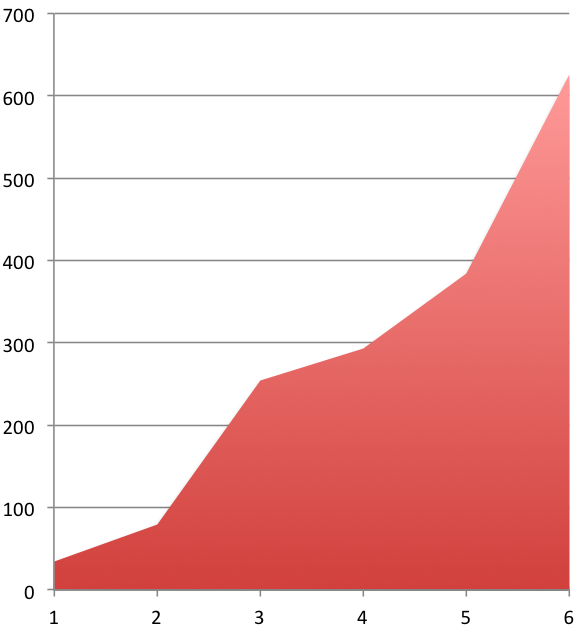
Below are a few charts specific to our pilot test around mobile payments.  The first one is for total monthly transactions and as you can see, the growth from January through May is accelerating.  (Chart actually starts with early testing in December.)  In fact, the change from April to May is most impressive.   In April we had 384 transactions and in May we completed 615 transactions.  Blow-out month for sure!

Monthly Transactions

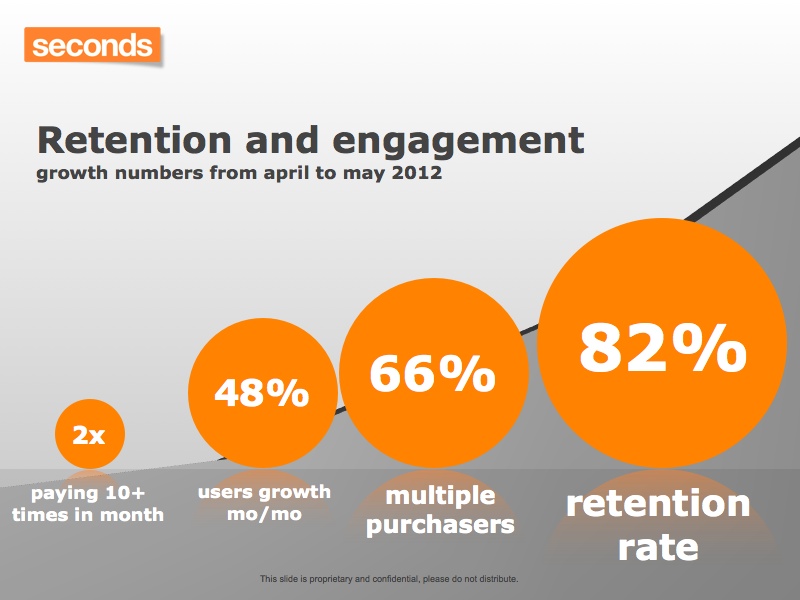
Going further in depth on the numbers, some very interesting consumer observations emerge.  We took the entire user population and parsed out categories based on the number of times an individual made a transaction.  Specifically, we evaluated May and compared it to the previous month of April to see if we could identity any trends in usage.  Here’s what we found:

Findings:

1. The number of people making 10 or more transactions in a month DOUBLED!  This means as months go by people become more comfortable with using the system and more apt to make a quick purchase in Seconds.

2.  The overall user base grew 48% from April to May.  We continue to gain more users who easily jump into the system and start making payments using their mobile device.  Uploading payment credentials securely in the cloud just once is all it takes for a new user to start using Seconds.

3.  Roughly 2 out of 3 Seconds users are multiple purchasers.   This means they returned within the month and transacted at least twice using Seconds.  This is a very good sign.

4.  An astounding 82% retention rate is HUGE!  More than 8 out of 10 users in the month of May were users in the month of April, proving that we are not seeing much drop off once an individual enters the system and starts using Seconds.   Although adding new users is a driving force, more important is the ability to retain the ones you have already attracted.

Our assumptions are continually proven true and the lessons here are manifold.  When offered a quick and easy way to complete a transaction using their mobile device, people do it!  And time goes on people are more comfortable with making more payments by simply sending a text message.

Now, what if you could pay your rent that way?  Or refill your transit card?  Or rent a movie?  Or all the other areas of your life you want to take care of in Seconds.  That is why mobile payments are set to be a $1 trillion industry by 2016 and automated application-to-person payments are an estimated $100 billion industry.  We are only getting started.

http://youtu.be/4czAm7h6i10

It’s Not If (But When) Your Startup Slides Sideways You’ll Find Your True Potential

Boy has it been a challenging couple of months.  The title of the post might be a bit misleading, suggesting my company is indeed going nowhere fast.  This is a wrong assumption.  It’s definitely going somewhere, we are growing 50% month over month and just posted record numbers again, but just as a car can slip and slide when it hits a patch of black ice so can a young startup.

It’s not if (but when) the sliding occurs the true leader will emerge.  Let me just tell you what happens in a typical startup.

A. People sit around and think about cool new ideas

B. Those people start prototyping and building a product

C. Once they realize they want to jump into this more intently, they find a few more people and form a team

D. At some point the group formally incorporates and makes the company official

E.  The people associated are listed as founders and as such, receive incentive to stick around via stock

F.  (Most founders) think they are the next Facebook and think their product will magically spread virally to millions of people

G. Then it doesn’t

H.  Then shit hits the fan and everyone finds out it’s actually tough to grow a business

I.  Only then will you finally find out what people are made of.

J.  Only then, when it’s actually work and things don’t come as easy, the pretenders will leave

K.  And only at this time the leader will emerge and help the company find it’s true path

Look, life is tough.  Things don’t always work out as planned.  But does that mean you just up and quit, to simply move on to the next thing that you think might magically make your dreams come true?

I don’t believe so.  I believe it takes Blood, Sweat, and Tears for anything materially positive and truly great to be created.  This has always been true but it’s even more so today.  Why?  Because it’s too damn easy to build a product and start a company today.   There has to be a distinction between the minor leagues and the major leagues; jumping straight to the majors just doesn’t happen often enough to be a believable story for your life.

What’s the minor leagues?  Hacking, dinking around and building crazy products.

What’s the major leagues?  Building a business and an organization around the product which adds value to our world.

If you ever wonder who’s the leader in a group, just light a bomb (figuratively) and throw it directly into the center of the team. Watch someone run and they are the weak link.  They are not the leader.  Whoever stays has leadership qualities within them.  And whoever stands up, starts taking hold of the situation and determines the path forward – well they are the true leader.

It’s funny, when everything is great and everyone’s slapping backs and high-fiving there’s almost no need for leaders.  Everything seems to move forward with little direction or effort.  But just wait till something happens.  Leaders find their calling and establish their potential when things start going sideways.

I think it’s amazing that leaders emerge during crisis.  I also think it’s fitting and believe it’s how the world should work.

But please do yourselves and your co-founders a favor next time you want to start a company.  Look each other in the eye and ask yourselves what kind of player you are?  Minor or major?  Weak link or leader type?  It will save quite a bit of time and grief on the others.

@jnickhughes

What If You Could Pay Your Transit Pass With A Simple Text Message?

Have you ever been waiting for the bus only to realize you have no money left on your Orca card, or whatever they call the transit pass in your city?   Maybe you realize you are at zero balance as you are leaving the house and have to grab a few dollars in change just so you can pay for your bus into work?

Yeah, it’s not fun!  And that is why we are changing it.

Now you can refill your transit pass in Seconds.

http://youtu.be/PCbfu9ajbpk

The Main Problems with Mobile Payments, and Why I Started Seconds

I recently connected with someone at X.com and have been able to get some articles published on my view of mobile payments and the opportunities that lie ahead.  If you are not aware, X.com is part of the Xconomy/PayPal commerce network.  Below is a section from my first article:

Curiosity is actually what drove me to start a company. It all began by my observing how consumers interact with merchants; their tendency to repeat interactions particularly caught my attention. Isn’t it funny how we go to the same coffee shops, restaurants, retail stores, gas stations, websites, and other consumer activities each day? In fact, we do this so much that the person at the counter who “swipes” your card actually recognizes you and may even know your name.

Although loyalty started my entrepreneurial journey, it didn’t end there. I started to think a bit deeper about what people typically do each time they go to the coffee shops, restaurants, retail stores, or gas stations—yep, make a payment! Amazingly, payments are the one data point that can trace a consumer’s path through our economy and organize commercial actions, habits, relationships, and trends. Imagine being able to quickly aggregate and see all those data points in your own life—things like where you spend your money, how much, when, buying what, and how often. Now imagine seeing that on a merchantwide level. How about a worldwide level?

This thinking drove me not only to start a payments company, but also to figure out how to create the fastest way to transact and interact with merchants using a mobile device. Transactions and interactions driven through a simple text message take only a few seconds. I believe that if you speed up a traditionally laborious process, make it available to the widest range of people possible, and emancipate the data to be used in adding value to the system, great things will happen.

The article goes on to review the last 20 or 30 years of innovation in payments and then talks about a few of the current challenges in mobile payments, namely the fact that a full 75% of the world is being forgotten by most of the new payment platforms.  Go ahead, read the entire article.

Culture Is One Of The Most Important Aspects Of An Embryonic Startup

I continually think about what kind of culture I am building within the Seconds team.  We are still a rag-tag founding team, some full time and some very part time, most on the west coast but some outside of Seattle.  Yet setting a strong and distinct culture at this embryonic and incubation stage of the company is one of the most important things a founder can do.

I read this the other day and it made me pause and reflect on how to better create culture within my team.  From Blake Master’s notes on Peter Thiel’s CS 183 class:

Good company culture is more nuanced than simple homogeneity or heterogeneity. On the homogeneity side, everyone being alike isn’t enough. A robust company culture is one in which people have something in common thatdistinguishes them quite sharply from rest of the world. If everybody likes ice cream, that probably doesn’t matter. If the core people share a relevant and unique philosophy about something important, you’re onto something.

Similarly, differences qua differences don’t matter much. In strong company cultures, people are different in a way that goes to the core mission. Suppose one key person is on an ice cream only diet. That’s quirky. But it’s also irrelevant. You want your people to be different in a way that gives the company a strong sense of identity and yet still dovetails with the overall mission. Having different kinds of problem-solvers on a team, for example, can make for a stronger culture.

SURF Incubator Already Barrelling With Numerous Startups and Entrepreneurs

As you might have heard, Seconds is one of the first tenants to stake claim on high value territory in Seattle’s newest tech hub SURF Incubator.  They officially opened their doors April 30th but already we are seeing some solid action emerging from within.   We’ve only been in there a few weeks, but here’s some highlights from a few early  SURF tenants I was able to get some time with in between  the craziness of startup life.

Knotis, which helps you discover great deals from businesses you’ll love, is one of the initial launch tenants.  CEO McLean Reiter says he chose SURF because “their mission is to help startups launch as quickly as possible so they can get out on their own, which is pretty much every statups’ goal.”

For background, knotis is reviving the concept of the digital coupon by taking the marketing strategy originated by Asa Candler with Coca-Cola and infusing it with 21st century tools. They are calling this new take on coupons an Online Social Incentive and merchants can now easily create as many as they wish at the low monthly cost (as opposed to the Groupon style of massive revenue share which can be detrimental to businesses). Merchants can share these self-generated OSI’s in online banner ads or through their social media channels like Facebook and twitter.

Knotis is doing business differently and intelligently by charging its merchants a low, flat-rate of $14 per month, and if the merchant doesn’t make a sale during the month, they are not even charged! “That’s just company culture,” says 28 year old founder, McLean Reiter. “We want to help local businesses thrive!”

Asked about why he favors SURF, McLean adds “My favorite thing so far is that everyone is there for the same reason – to succeed – and other entrepreneurs and developers, although busy, are still willing to help other teams achieve success.”

Another early startup is Shopobot, a better search engine for shopping. For example, stores are constantly changing their prices (even day to day), and they make it clear when it’s the right time to buy – which can save people a lot of money. At their heart they’re an analytics company, and  using their data and UI to give people an edge when shopping online.

According to one of the founders Dave Matthews, they went through more of an accelerator in San Francisco before coming back up to Seattle.  “When we started Shopobot we went through an incubator in San Francisco called AngelPad, which was super helpful for doing the demoday / launch / fundraising push. It was really hands-on with all the companies in the program moving on the same schedule towards launch. Now that we’re past that phase, SURF is a great spot for us to focus on our product and growth – while getting the benefits that come from a shared space.”

He notes they wanted to work in a shared space for the unexpected conversations, and meeting other people working on startups. “SURF has the right balance for us of lots of meetups and events and other teams working here, but we still get our private area to focus as a team.”

Lastly is Pandamonium Games, who just announced a Kickstarter project called The End Saga: Revival.   In short, it’s a 90’s style mobile role-playing game, bottling the best of that era and sticking it into a beautiful mobile gaming experience. Using the art of nexxing to build new items, while you amass a team of fighters, magicians or rogues to take out the evil Ismata.    (You should go check it out on Kickstarter!)

Jimmy Gambier from Pandamonium Games says “We chose SURF because we’re not big enough to have a dedicated office space and yet meeting in coffee shops was getting old. I’d also visited places in the Valley like Dogpatch Labs were you can feel the sense of community in the air. We wanted a place where we could bond with like minded people and companies.”

Digging a little deeper on why they chose the Kickstarter/crowd-funding route , Gambier said they went with Kickstarter because they wanted to go directly to the community versus spending their precious time pitching to investors. “We would rather spend the next 6 months heads down on our product instead of raising money.”  I can attest to that!

Gambier believes Kickstarter is the next evolution in investment, as you can receive instant market validation which helps you determine if you are heading in the right direction.  Interestingly, he sees a side benefit from crowd funding platforms.  “Building a fanbase is also crucial for the kind of game we’re working on. We’re catering to a hardcore gamer audience and we thought building that user base early would be wise.”

Through his words it’s obvious Jimmy couldn’t resist the entrepreneurial pull and is the exact person SURF and other incubators need to help cultivate a great community of founders.  “I had been involved in startups in the past and had an unshakeable desire to start a gaming company. It almost seems like there wasn’t anything else worth doing. The art of building a fun game has fascinated me for years and continues to as I learn more about the craft.”

If you are like me, you’re probably not familiar with Pandamonium Games, a scrappy Seattle based games startup who loves RPGs. They’ve made a couple of social games before, but this is their most ambitious game to date. The team has worked at places such as Nintendo, Wizards of the Coast, Amazon and a large MMO company.

Here’s Jimmy’s take on their quick history:

“For the past two years, we’ve been a small but committed team working in the social games space. When Glen Matsushita and I met at Tully’s in Bellevue, Washington, in 2009 to brainstorm our first title, we had never built a game before or worked together as a team. By the end of the first month, we had settled on using the Facebook platform to create Champions of Justice, a superheroes game. We brought on a couple of guys who had worked at Wizards of the Coast—a publisher of fantasy and science-fiction based role-playing games, board games, and collectible card games—to help with the art and writing, and went to work.

“The company was founded on the principle that there is a place for hardcore games in the next evolution of gaming.We made a couple of games along the way—neither a major hit—and are now working on our third title. Whether or not this will be our breakthrough in what has become a highly competitive market, we have the same passion and dedication that got us into the business in the first place. In fact, as we’ve gotten more experience, we’re getting better with each iteration and this title has been the most fun to work on since we’ve carved out more definitive roles and skill sets among the three founders.”

It’s early days for SURF Incubator and I look forward to meeting (and possibly writing about) many more startup founders.  If you are interested in SURF office space, feel free to visit their website and send them a note.

Incredibly Insightful Words From Peter Thiel’s CS183 Class, via Blake Masters

Here is an incredibly insightful thought from Peter Thiel on progress and innovation.

Teaching vertical progress or innovation is almost a contradiction in terms. Education is fundamentally about going from 1 to n. We observe, imitate, and repeat. Infants do not invent new languages; they learn existing ones. From early on, we learn by copying what has worked before.

That is insufficient for startups. Crossing T’s and dotting I’s will get you maybe 30% of the way there. (It’s certainly necessary to get incorporation right, for instance. And one can learn how to pitch VCs.) But at some point you have to go from 0 to 1—you have to do something important and do it right—and that can’t be taught. Channeling Tolstoy’s intro to Anna Karenina, all successful companies are different; they figured out the 0 to 1 problem in different ways. But all failed companies are the same; they botched the 0 to 1 problem.

What is he saying?

Peter is saying this doesn’t lead to innovation: “From early on, we learn by copying what has worked before.” Innovation cannot be taught and copying leads us nowhere.  Innovation is, by definition, creating the new…  Successful companies figure things out as they go, they learn from small insights early and often.  This is why no two successful companies are exactly the same, since they go from 0 to 1 in different ways.

Read more on Blake’s blog.

The 2 Slides in Seconds Pitch Deck That Will Knock Your Socks Off

Over 4 billion people around the world don’t hold a smartphone or have the ability to download a native payment app, but that shouldn’t exclude them from the mobile payment experience.  All signs are pointing towards payments following the changes mobile technology is bringing to the rest of the world, and if history has anything to say about it a new platform will have to be built from the ground up.  That is why  we are building Seconds.

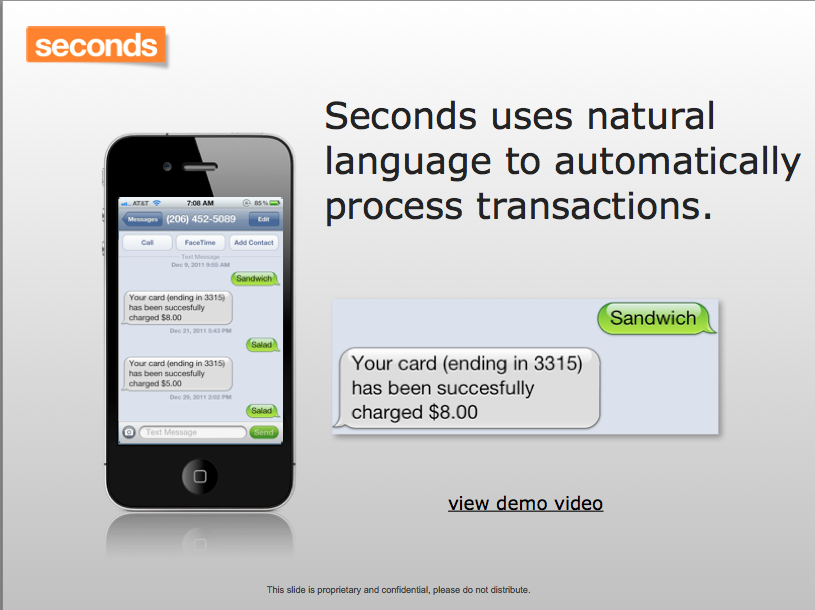
Seconds is mobile payments using the most intuitive experience we have on our mobile devices – text messaging.

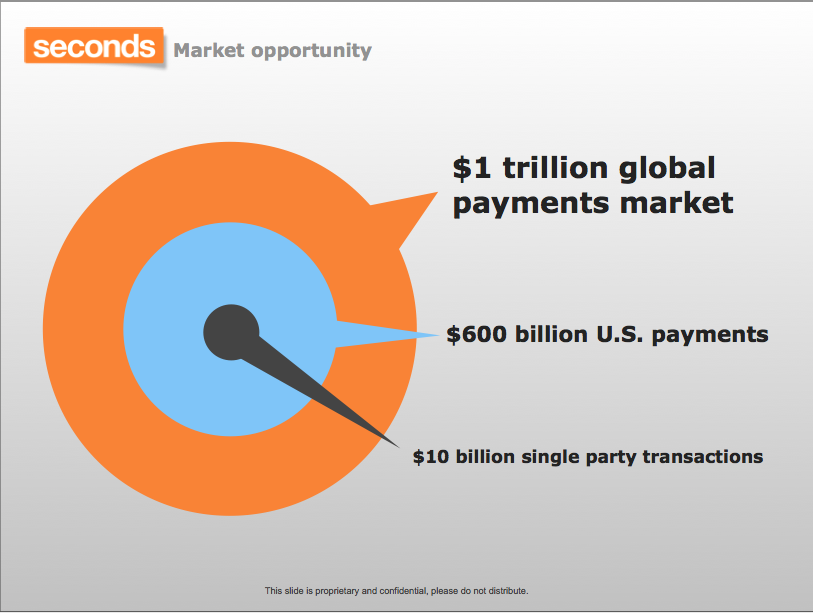
Using the Seconds platform, brands have the ability to identify specific keywords that when sent to their Seconds number automatically trigger transactions for the accurate amount.  We see a whole new payments market opening up where no human being has to be on the other side receiving the payment.  We call these experience Single Party Transactions and they are estimated to grow to almost $10 billion by 2016.

How cool is Seconds?  Here are 2 slides that will knock your socks off.

view demo video

Mobile transactions will drastically change our society and the market for paying by mobile device is said to be well over $1 trillion by 2015.  Most significant will be the transformation in how we use our mobile devices in everyday commerce.

This Slide Shows Exactly Why It’s An Incredible Time To Start A Mobile Company

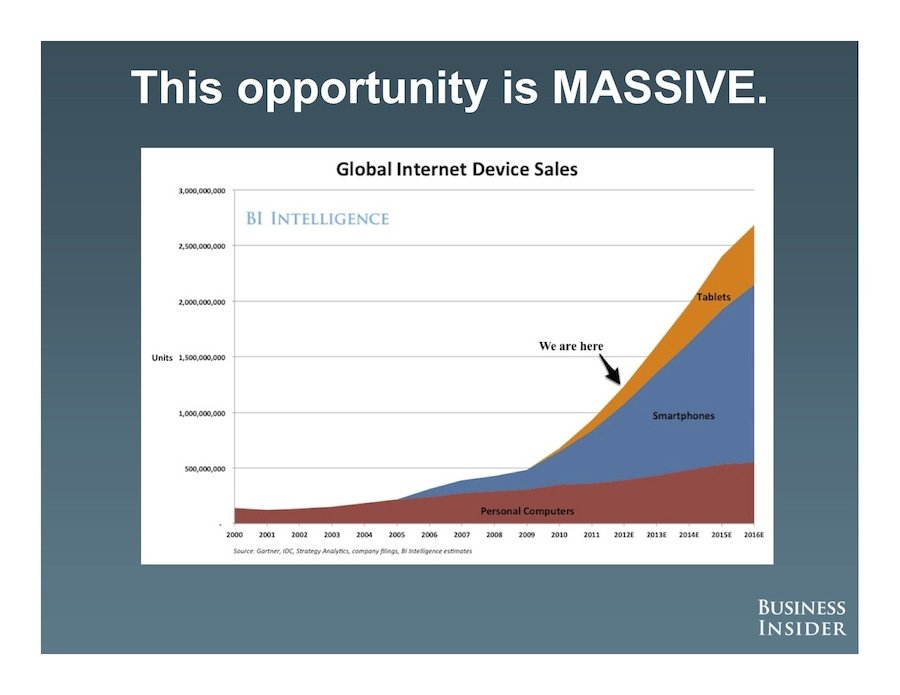
This is truly an amazing time.  This one slide from a recent Business Insider presentation is the main reason why I started Seconds.  We are seeing a revolution around mobile devices and every industry will experience immense changes, whether they like it or not.  Payments are no exception and it’s going to be a wild ride baby!

Your Life Happens In Seconds (Video)

We live our life as a collection of seconds.  Why should it take any longer to make a purchase or connect with brands we care about?

At Seconds, we built a system to drive secure payments through text messages, allowing someone to quickly make a instant and automatic transaction by simply texting a keyword to a merchant.  Amazingly, it only take a second to send a text message.

Think about it, a merchant can now ping your mobile phone with a message informing you to complete the transaction by simply responding with a specific prompt. How would they know to do that? Your phone number can now become your payment credential, and since they can instantly reach you via short message from pretty much anywhere in the world, payments have no limitations.

Imagine how things will change when we all can interact and transact with any brand in the world in Seconds?

Holy Crap! One Year Ago Today My Life Was Completely Different

One year ago today – May 1st 2011 – I officially walked away from my previous career and made the leap into entrepreneurship.  These last 365 days have been some of the most exciting, rewarding and scary times of my life.  Back then, I was sitting at a desk in a fitness facility at the Boeing Company, working as a physiologist.  Today, I sit here as the CEO of a tech company making waves in the mobile payments space, talking to investors and multi-billion dollar companies.  Oh, how things can change in a year…

Some experiences of the past year:

  • Quit my full-time job and gave up a steady paycheck
  • Had no idea how I was going to pay my bills…
  • Watched the gig I thought I was transitioning to disappear
  • Launched this blog and started reaching people around the world
  • Started contributing the BusinessInsider.com
  • Was basically a free agent over the summer, just focusing on writing on here
  • Had no idea how I was going to pay my bills…
  • Was one-day away from taking a COO role at a startup in New York, when…
  • My soon to be co-founder reached out to me through a random email in August
  • I sat down and over coffee determined we should start a company
  • We formed Seconds in early September
  • We released our beta product late fall, early winter
  • At first, we focused on text messaging between customers and local merchants
  • At the beginning of January we started gaining attention and media
  • Ran out of money
  • Had no idea how I was going to pay my bills…
  • Through February and March we kept expanding our vision and writing about it
  • We made the change to focus on mobile payments driven through text messages
  • We now field inquiries and interest from around the world and look to expand Seconds
  • I now write guest posts on the most popular tech blogs around
  • and people now look at me as a though leader and actually listen to what I have to say

So much more happened over the course of the last year but I will stop there.  I want to make something very clear: your life is what you make of it.  I have completely transformed my life in the last 365 days and I sit here today in awe of what I have been able to do.  We are (close) to being finalists in national recognition for being one of the top innovative companies of 2012.  I could’t have dreamed of this just one short year ago.  This transition has not been easy – actually the most difficult thing I have ever done in my life – but it’s not impossible.

You can do anything you set your mind to, never forget that.