Wow! Seconds Growing At More Than 150% Month Over Month

One thing you learn when starting a company is how difficult it actually is getting things off the ground.  Inertia is your worst enemy.  An object (or technology) at rest will stay at rest.  Your goal is to muster enough energy and usage to launch the rocket into orbit so you can get to the other side of inertia, where an object in motion stays in motion – that is until something gets in it’s way.

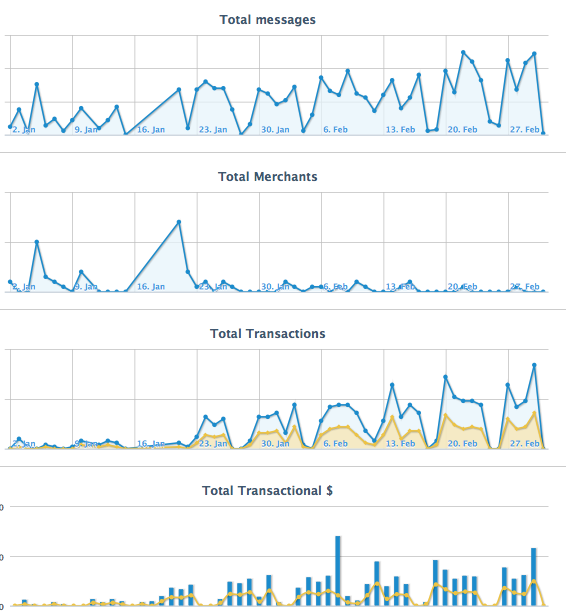
The rocket ship has launched and Seconds is on a tear.  Here are some graphs and statistics for the first two months of 2012 and as you can see, things are starting to take off.   The first image is a screenshot of our internal stats page, measuring Jan – Feb.  As you can see, usage , messaging and transactions are all on an upward trajectory.  Something to note here is the fact that all of this usage and growth is 100% organic, meaning we have spent nothing for customer acquisition.  Imagine if we put fuel on the fire?

Hey investors, you want traction?  Here you go…

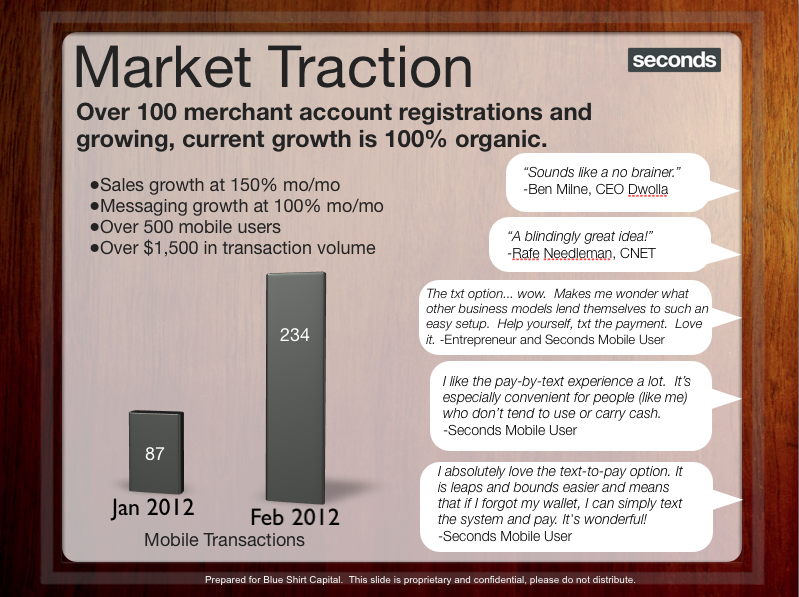
Next, here is one of my favorite slides from a recent pitch deck.  It sums up our traction, month to month growth as well as response from early customers and partners.  Our Pay-By-Text mobile transactions grew more than 150% from January to February and as of March 2nd, are showing no signs of slowing down!  You can read more about the mobile transactions here, but suffice it to say we are onto something.  Don’t just take it from me – based on our innovative concept we are currently in talks with a very major credit card company to roll out something quite exciting later this year.

5 Startup Founder Rules To Live By

Apparently, Twitter co-founder Biz Stone makes all Twitter employees adopt seven rules when they join the company.  I though these were quite interesting, especially Leave space for the unknown. When I read these rules it made me sit back and think about what might be my rules.

1.  Be Original – Originality is rare today, being truly unique sets you apart from all the rest and makes you attractive to others.

2.  Don’t Ever Quit, Just Refocus – Obstacles and frustration are part of the game.  Refocusing after a setback will help you find meaning and your next milestone.

3.  High Risk-High Reward – We only have so much time on earth to make a difference, why not opt to make the most out of it.  Unfortunately high rewards require high risk.  Fortunately, most choose to risk very little leaving you with a lot of opportunity.

4.  Live Authentically –  Things have a way of coming back around so living authentically alleviates lots of future problems.

5.  Turn Complexity Into Simplicity – Successful products and technical innovation is all about simplifying the complex.  Do that and everything else takes care of itself.

@jnickhughes

Build Your Boat Now Before The Mobile Tsunami Washes You Away

The wave is coming. Like a tsunami that starts miles off shore, unnoticeable to the human eye in the middle of the ocean but gradually builds up speed and power as it gets closer to land, a mobile tidal wave is most definitely building. And it’s forming right in front of our very eyes.

You may have noticed people aren’t looking up very much anymore. No, when you see a person nowadays they are most likely looking down at their hand. Next time you are on public transportation, in a restaurant, at the mall or any other pubic (or private) place, take your eyes off your device and just watch people. It will blow you away how often people look at their mobile devices.

So as I was doing some recent market research I came across quite possibly the most staggering collection of mobile usage and commerce statistics in the world. It’s well worth your review if you want to know where the world is going. Since it takes quite a while to swim through I have pulled out some of the most impressive stats and wrapped them into a conversation about the mobile web. Spoiler alert: You’re gonna get wet!

6 Billion Mobile Devices

There are approximately 5.9 billion mobile subscribers, which is roughly 87 percent of the world population. Mobile subscriptions outnumber fixed lines 5-to-1. Also, there are now 1.2 billion mobile Web users worldwide, based on the latest stats for active mobile-broadband subscriptions. Did you notice the ratio difference between mobile subscribers and mobile web users? It is easy to see why the experts predict that mobile Web usage will overtake PC-based Web usage very soon and why it would be a good idea to have a real mobile strategy.

Many of those mobile Web users are mobile-only, meaning they do not, or very rarely use a desktop, laptop or tablet to access the Web. Even in the US 25 percent of mobile Web users are mobile-only. In mature markets, the mobile Web will be a leading technology for business to consumer (B2C) mobile applications and should be part of every organization’s business strategy. If you are a merchant or a local business you need to pay attention and build that dang boat, a figurative term for your mobile site and interactive mobile experience utilizing an app, mobile browser or text.

8 Trillion Text Messages

Speaking of text messaging. Over 8 trillion text messages were sent in 2011, overtaking voice minutes and making it the worlds most popular mobile communication medium. We have yet to see the biggest impact SMS and messaging will have on our society. A2P, application to person SMS, is expected to overtake person to person SMS in 2016. A2P messaging includes messages between applications and customers in financial services, advertising, marketing, business administration, ticketing, television voting, and other automated systems. This nascent market should not be overlooked – by 2016 A2P messaging is estimated being worth more than $70 billion.

Global expenditure on mobile advertising was approximately $3.6 billion in 2009, and is estimated to grow to $38 billion in 2015 and the worldwide mobile messaging market will reach $334.7 billion by 2015. For any businesses this is significant or a number of reasons, namely to identify the most cost effective platforms to utilize in their mobile commerce.  People respond differently to different types of mobile marketing, proven by studies in the UK and France, where they found opt-in SMS gets the best results, and in Germany mobile Web ads got the best results.  It seems time sensitive special offers or discounts (especially mobile coupons) were most likely to lead to a purchase.

$1 Trillion of Mobile Payments

Most significant will be the transformation in how we use our mobile devices in everyday commerce. Mobile ad spend worldwide is predicted to sky rocket to $20.6 billion in 2015, driven by search ads and local ads. A logical evolution for mobile search is towards mobile transactions. Once the connection has been established through the mobile device, brands can build up much more detailed profiles of users compared to online and plan follow-up campaigns accordingly. In 2009, there were 81.3 million people worldwide using their mobile device to make payments and it is estimated by the end of 2014, this is forecasted to rise to nearly 490 million. Mobile transactions will drastically change our society. The market for paying by mobile device could be well over $1 trillion by 2015.  Simply put, that is HUGE!

Now we know a flood is coming so let’s go back to thinking about your boat. If you were building an actual boat, would it be smart to build only to float in salt water? Probably not. Then why are we building systems and business only for specific devices and operating systems? If you follow that logic you will definitely drown when the tidal wave hits since 95 percent of the worldwide mobile device market is not an Apple.  It would be best to build your boat – a mobile-optimized web experience – looking beyond a single device to maximize reach.  Do it and you will surely rise with the tide.

@jnickhughes

How Seconds Makes Your Phone Number Your New Payment Identity

The device you hold in your hand has more potential to change your life than you think.  We find that no more fascinating than with the future of payments.  With Seconds, consumers create an account which is tied to their device and identified by their phone number.  After quickly connecting a payment credential to the Seconds account and with necessary PIN codes or security layer in place, making transactions can be as simple as giving your phone number.

Now you can leave your wallet at home!

It can also be a quick as sending a short text.  We have already proved that one with our Pay-By-Text system and plan to roll out more pilot tests.  (Please reach out to me if you are interested!)

Imagine how much better life will be when we are not held back by plastic cards and old school paper bills and coins.  Innovative mobile payment platforms such as Seconds break the chain requiring physical presence and disassociate proximity from transaction.  A whole new world of payments is opening up.

Go on a run and pay for a gatorade at the local market by giving your number

Send a quick text to pay for gas without having to have your credit card.

Pay for groceries by typing in your phone number

Pay your rent by texting ‘RENT – 1,000’ to your landlord’s Seconds number

Square up the food bill with your friend by texting ‘PAY – 20’ to their phone

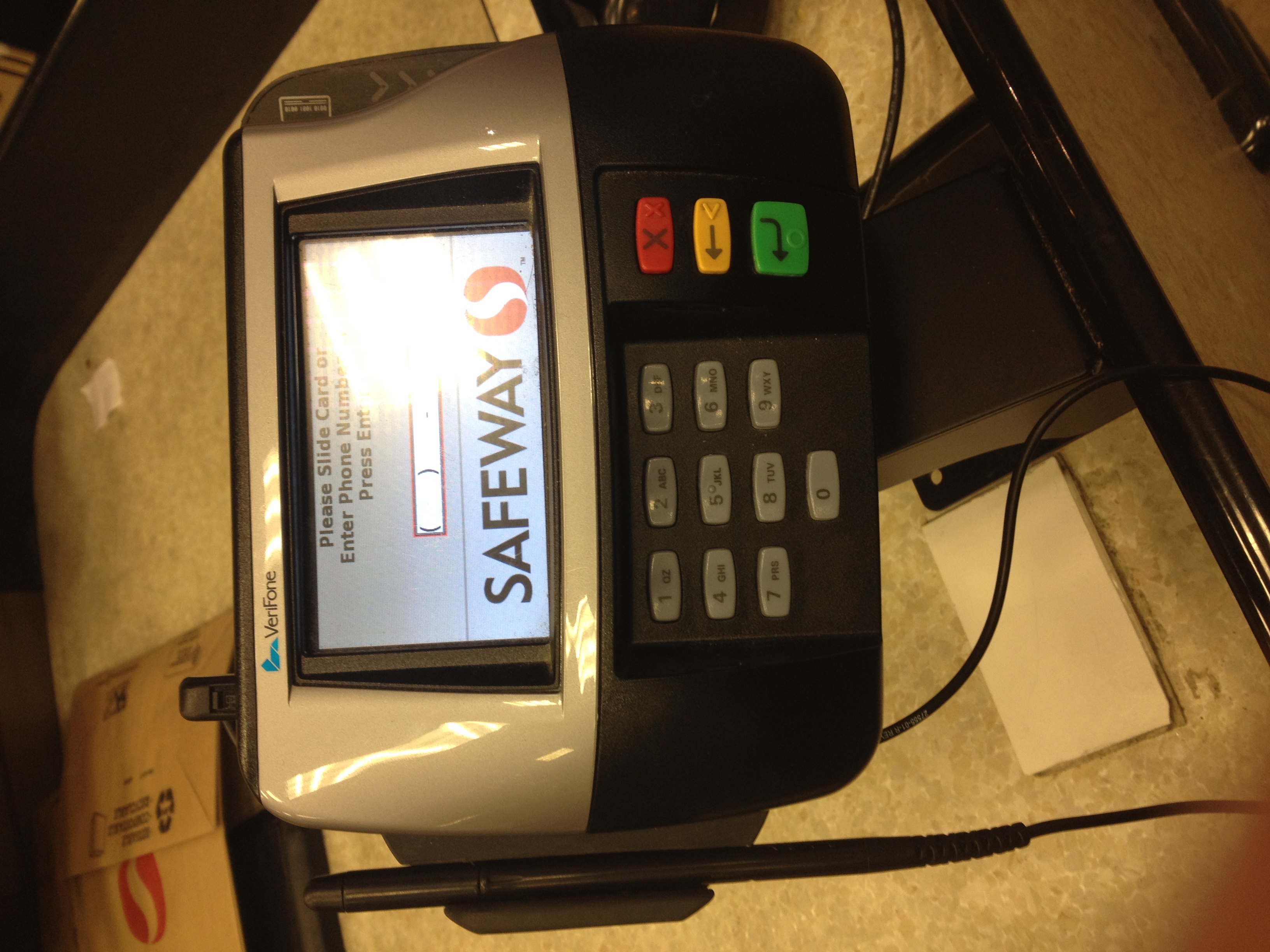
We are not too far off from this scenario and even right now we are programed to type in our phone number to identify our “buying club cards” such as this one at Safeway.  I think you are starting to see where things are going… maybe Safeway was onto something??  I think we are too!

@jnickhughes

To All The Doubters Out There: My Past Does Not Determine My Future

Today I was informed by one of my advisors someone I previously spoke with in the investment community thought less of me, or looked down upon me and my business mainly because of my background and my previous career as a personal trainer.

This is after the individual had been very forthright in the meeting about how unique our concept was and how impressive we are currently positioned.

Let me be perfectly clear: my past does not determine my future.

Whatever someone studied or whomever they previously worked for has little effect on what they will do going forward.  Does it influence them, yes.  But does mean they are not capable of achieving other things outside of the specific industry?  No.

It’s what we have determined we will do in the future that has the greatest influence on what happens in the future.

For all the doubters out there, let’s go ahead and get it all on the table.

No, I am not a CS major or a Stanford grad with an MBA.   Yes I studied exercise physiology in college, and became a strength coach working all levels of the industry – from professional sports teams to athletic clubs and on to corporate fitness centers.

No, I didn’t come directly out of college and join a fast growing technology company.  Yes, I bumped along as a trainer only to use any and all spare time (ask any of my past girlfriends) reading and studying the latest developments in technology and the web.

No, I didn’t succeed at my first attempt at a startup.  I didn’t sell my first company to Google or Microsoft and I did not make F-you money in my early 20’s.  Yes, my first startup failed.  We failed miserably.  We had no idea what we were doing and naively thought we could actually launch a company when we were all still working full time.  Boy were we wrong.

No, I was not raised in wealthy family so I would be close to seed capital and afforded the luxury of launching my company with my grandfathers/fathers/uncles/stepfathers/father-in-laws/bothers/cousins money.  Yes, I am now learning the “intangible” game of raising money by networking, connecting with people, illustrating our unique value in the marketplace and proving we are actually a great business opportunity.  And heads are starting to turn.

No, we are not launching a social site that within the first few weeks is amazingly spreading throughout the Harvard campus without any of our help… and magically is a hit with all the college kids.  And one where you have no idea the business value for the first few years of existence.  Yes, we have built a platform so valuable we see small mom and pop shops as well as large corporations wanting to be a part of it.  One in which we figured out how to make enough noise in just 3 short months after launching our product that we already find ourselves sitting across the table from NOT ONE BUT TWO multinational, multibillion dollar corporations – in different industries – wanting to somehow work together.  The one I talked with today is probably in the back pocket of most of my doubters.

For all the doubters out there who are still reading but think I might still be missing something I will put you at ease and let you know that even though I studied exercise physiology in school, all is not lost.  Here is my take away and how I see it in the business world.

Business, like the Human Body, is all about efficiency

Inefficiency will kill any living organism and it’s also true with any business organization.  It’s the bane of any corporations existence and it’s also why you hear about six sigma, downsizing and social collaboration tools.  Finding ways to make internal processes less laborious and easier to navigate will make employees more efficient.  Fixing bugs and reworking the user experience of a website will streamline transactions and generate more revenue.  Anyway you look at it, the human body always seeks to carry out processes with the least amount of energy possible.  So does a business.

You must keep working or you will fade away

We all understand the concept of strengthening muscles – you must break them down to build them up.  Exercise is vital to the human body and you must keep placing stress on the cardiac system to experience health benefits.  Well, that’s true for the business as well.  Name any business where it’s acceptable to coast along with no input and expecting to get something out of it.  Even a piece of Real Estate needs upkeep if it is going to bring a return to the investor.  You must keep working on a business, on yourself and your team if you are to experience continued success.

Sometimes Pain is good

We all know the feeling… the first mile of the run after a long hiatus, the last two reps of the exercise we though would be way to heavy, or the morning after soreness from a kick-butt workout.  Yea, it hurts all right.  But most of the time its damn good pain because your body is replenishing itself and growing stronger.

Well if you think starting a business is all sun and roses you are in for a little treat.  It sucks.  It hurts.  You get tuned down more times than you can remember.  You have people questioning you, your product, positioning, vision, funding status, your team and everything else under the sun.  It takes twice as long as you think it will to achieve certain milestones.  But the pain is good for you.  See, you learn from all that doubt and questioning and through all of the crappy stuff you get stronger and become a better entrepreneur.  Trust me, I am one strong individual.

I may not be the most “polished” “tie wearing” “Stanford MBA” or “Y-combinator grad” CEO you find strutting around Silicon Valley.  And quite frankly I know I have a lot more to learn.  But I am glad I am not the above described.  I am quite happy with my past, because as I have just illustrated it provided me with a unique perspective I can successfully transition into my new life as an tech entrepreneur.

And for the doubters…. keep on.  I dare you.

@jnickhughes

Anyone Promoting NFC Is Fighting The Right Battle With The Wrong Weapon

Using NFC (Near Field Communication) to pay for something is not much different than swiping your credit card on a terminal.

Anyone fighting the battle to improve payments will agree it’s an all-out war against the decades old practice of using plastic cards and a centuries old tradition of paper and coins.  These payment methods are so ingrained in our everyday life we hold on to our wallets like our lives depend on it.  So how are we going to transition into the cashless society everyone keeps talking about?

Enter NFC, or Near Field Communication, which can be loosely described  as chips built into our mobile devices that transfer information to another device when  placed at a specific distance from a reader.  Some think this is the future of mobile payments, and some don’t.  I think ReadWriteWeb’s Dan Rowinski says it best:

 From a technological perspective, near field communications (NFC) is one of the most powerful and prominent innovations to come about in the last several years. But from a functional, real world standpoint, NFC is a technology without a clear-cut purpose. What problems does it actually solve? When it comes payments, how much different is a tap with your smartphone than a swipe of your debit card? What about the ability to open doors or share content with your friends? There are solutions already available on mobile devices for many of these “problems.” So, what is the real future for NFC?

Even before I put my gear on, saddled up my horse and rode it directly in the middle of the mobile payments battlefield I questioned NFC as the next big thing in payments.  Why?  Because using NFC to pay for something is not much different than swiping your credit card on a terminal.  Although there is more to the technology, like the ability to include services and software in the payment experience, I believe it is not fundamentally going to change the payment industry for a number of reasons.

Problem 1: Hardware Requirement In Phones

Your ability to swipe your phone and pay for something (via NFC) is dependent first and foremost on you having an NFC enabled device.  This is determined by an NFC chip placed inside your mobile phone when it was assembled.   The majority of phones on the planet carried by most people are not NFC enabled.  Although millions of phones will be shipped this year with an NFC chip inside, it will pale in comparison to the number of phones currently being used that lack the technology.  The mobile device you hold in your hand should not qualify you to purchase a product.

Just as SMS texting technology has nothing to do with your specific device, your ability to pay via your mobile device should not rest on the fact that you are “NFC” enabled.  In fact, what if SMS technology was not just for messaging between friends and family but actually carried a transaction between two parties – be it friends or customers/merchants?  More than 8 trillion text messages were sent around the world last year and those were pretty much all words between people.  It will be interesting to see how a communications technology that is already prevalent and widely used around the world can be leveraged for quick payments.  It’s would be adopted a lot quicker than a technology that will take at least three to five years to get traction and requires a big investment in hardware by merchants.

Problem 2: Hardware Requirement For Merchants

The second biggest requirement for an NFC transaction to work is the merchant must have an NFC enabled terminal so you can swipe your phone.  Expecting consumers to purchase new mobile phone hardware every 2 or 3 years is not too much to ask, but thinking merchants are going to upgrade their point of sale terminals to enable NFC mobile payments is outrageous.  Being on the front lines of servicing local merchants, I personally know these proprietors will do almost anything to not have to spend money upgrading their payment terminals.

And since technology is moving so fast these days the hardware that comes out this year will be ancient in a few short years.  So what are businesses supposed to do then?  Not accept mobile transactions anymore?  Requiring local business owners to upgrade their terminals every couple of years is a losing proposition.

Like anything, the answer is not more hardware but better software.  That is why even though PayPal is experimenting with NFC in some capacity moving forward, the company ultimately believes that the technology is a step backward when it comes to point-of-sale transactions.  Web enabled software connecting customers to merchants for communication and transaction is what will win the battle for mobile payments.  The solution that eventually goes deep into “main street America” will not depend on any new hardware that needs to be replaced every few years, but will leverage existing technologies and networks already in place and which are cost effective to both merchants and consumers.

Problem 3: Your Physical Presence is  STILL Required

Something I am not sure most have thought about when considering the payment experience is the concept of presence.  Many NFC supporters will talk about the security of NFC, meaning it’s safer because you have to be there and swipe to make transaction, similar to how most credit cards work today.  Although that is true, unfortunately this does not make the payments industry any more efficient than it already is.  Even when using a “new” technology like NFC, physical presence is still a requirement.  The point of a new transaction experience is to replace a wallet full of cards, not create new cards or re-create the card present experience.

What happens if I want to pay for something like tickets to an event, a dinner I want delivered to my house, or my rent due every month for my apartment?  Based on the requirements of Google Wallet and NFC, I have to do what I have done for the last 20 years and actually be present to use the payment technology, or call and read them my credit card numbers.

Even Erick Schonfeld agrees: “Waving a card (or phone, for that matter) over a reader is not a huge improvement in ease or convenience to simply swiping a credit card. Credit cards work. More importantly, people know how they work. They are not going to stop swiping and start waving without some incentive to do so.”

At Seconds, we believe the future of payments will be found in your ability to make payments regardless of your physical presence.  That is why we are very excited about our Pay by Text technology, we see a whole new world of payments when you disassociate proximity from transaction.

Whatever happens in war for mobile payments one thing is for sure, the battlefield will see many warriors and the ultimate winner will own a very large territory.

@jnickhughes

Like It Or Not, Here’s How Your Startup Proves Evolution (Controversial)

It’s crazy to think a simple idea of starting a company can prove the controversial concept of evolution.  Yet, like it or not here’s how it does.

Before I go in depth on the idea of evolution in the business world, my disclaimer:

This may be controversial so let’s put aside our beliefs and perspectives on faith or religion and speak only on the concept of evolution, as in the Darwin perspective as we know it.  Ya know, natural selection and all associated phenomena.  I am not an expert on the subject and will not pretend to be here.  I only want to bring  upthe concept of evolution into the context of entrepreneurship and building successful companies.  

An interesting observation is how most world changing technologies or ideas actually start as thoughts and go through a transformation into ideas, onto sketches on napkins, to prototypes, to working models, and onto businesses.  Although almost too obvious to note, all things must start with a thought.  A spark of genius.  An idea.

*ding*

That idea, brilliant or stupid, is just the beginning of a (un)predictable path towards life and eventual death.  If in the right place at the right time, and the right decisions are made to take advantage of opportunities, the idea will transform into something more visceral and experience an extended life.  If not, most likely the idea will die a quick death into obscurity.

This is why you hear “ideas are everywhere” and “execution is everything”.  I can just hear Darwin whisper similar words in the same vein.  In his context, execution would have referred to “the strong” or “genetically enhanced”.  Not to get sexual, but if a highly attractive and sexually active member of a species “executed” properly, they would have passed on their genes to influence the gene pool and the evolution of their species.

Your startup must mirror the same as the highly attractive and sexually active member to survive.  What do I mean?  You need to be attractive to customers, users, investors, media and potential employees to succeed.  If not, you will never be discovered and will eventually die.  Attractiveness can come in many forms but the most obvious one is your unique idea.  Does it make sense?  Is it something most people would be attracted to and want to use?  Does it elicit emotions of excitement or intrigue?  Is it unique enough to not be lost in the clutter of all the other same “species”.

Also required to be attractive is the core members of the founding team.  Is there expertise on the market subject?  Are there proven individuals who get results, or more referred to as JFDI?  Are they fun to be around?  Do they attract people to them or do they drive others away?  This is huge, since any successful startup finds ways to attract employees, investors, users and media attention.

That is why you hear investors say “we invest in people, not ideas.”

Your start up must aggressively mate as well.  Wha??  Yes, I said your company must be promiscuous and interact with other companies if it wants to be successful.  This is how you integrate within the larger framework of the ecosystem and spread your gene pool for future generations.  Facebook is the best example of this with their open graph and the like buttons found all over millions of websites.  Their tentacles are everywhere and indeed they have solidified their gene pool in our world for decades to come.  Do other companies find your startup attractive enough to mate?

How do I know all this and why the heck am I thinking about evolution and your startup having sex with another startup?

We once were the ugly duckling but quickly evolved into a better suited mammal geared to mate with the royalty of the land.  My company Seconds, was originally named Order SM and intended to be a mobile ordering startup for the food industry.  (All S & M jokes aside, the name was supposed to be meant for SMS ordering).   It became clear the name and the basic concept needed to evolve if we were going to continue.  Yet this was not our intention initially, it naturally happened as others started to interact on the platform and suggest use cases outside of our original plan.

Last fall we released out beta product and our initial customers provided enough feedback to realize we were onto something A LOT BIGGER than we originally planned.  We realized ordering was a form of communication – just one aspect of the iteration between merchant and customer.  Questions were another part of the relationship.  Requests and thank you follow ups from merchants were also a part of natural communications.  And the biggie – transactions – are at the very core of the relationship between customers and merchants.

It was at this point we decided to change the name and the fundamental value proposition.  Seconds – quick communications and mobile commerce.  Helping merchants and customers more easily interact and transact.  We are providing consumers a unique mobile commerce identity that will span the entire globe.  And we are giving merchants the ability to identify those most important to their business.

We realized the world was mutating right before our eyes, but one “species” was going to be left behind unless we did something about it.  More than 8 trillion text messages were sent around the world last year, yet none to local businesses or merchants.  It’s crazy to think we can text our friends and family with the widely popular communication medium, yet you or I cannot communicate via text with our favorite local coffee shop or the 5 star resort we intend to visit next week.  We are changing that, and  have quickly found ourselves in talks with everything from emerging startups to multinational, multibillion companies.

Just as Darwin found “one species does change into another” as he looked at Galápagos mockingbirds from different islands, startups must go through phases of transformation if they are to succeed.

The idea that your initial idea – in it’s most basic genetic form – will be required to mutate into a different species for survival has to be understood by founders and investors.  This is more generally called the Pivot, and Lean Startup proponents such as Eric Ries have graciously helped our community unearth one of the most powerful phenomenons to hit the business culture to date.

I think that is enough talk on companies having sex for today.

@jnickhughes

How Facebook Will Conquer Your Real World Identity

When Facebook released their S-1 announcing their intent to go public, Mark Zuckerberg left no doubt in anyone’s mind they have taken over our digital world.  According to Hitwise, Facebook now accounts for 1 in every 5 pageviews on the web (in the U.S.). It’s crazy to think Facebook wasn’t visionary in the revolutionary sense of the word, they just recognized the world needed a real directory of people, not merely another site to attract users. And indeed, they nailed it. The goal of making its social graph portable and fundamental to the fabric of the Web – and your virtual identity – has certainly been realized.

But can Facebook extend its reach outside the wired world and into your real world? Actually, I don’t think that’s the right question to ask. Maybe the better question is “HOW will Facebook extend its reach into your real world?”

It would seem they are on a tear and the facts are staggering. Hitwise found Facebook.com is now seeing one out of every eleven of their visits coming from the U.S., and 1/5 of all pageviews online in the U.S. takes place on Facebook.com. Their monthly actives grew 21% over the past four months. They are now seeing about 850 million users each month, with half accessing on their mobile device. In 2011, they earned almost $4 billion in revenue and of that, exactly $1 billion was profit. In the S-1 filing, Zuckerberg even goes to the lengths of declaring their intent to fundamentally rewire the way the world works, from interpersonal interactions to commerce to even government.

Facebook’s current revenue is driven mostly by advertising, and analysts are postulating about what exactly led Facebook to IPO.  Maybe it’s a desire to steer where advertising is going, to hopefully make it more personal and relevant for consumers.  But make no mistake, Facebook is already one of the most valuable companies on the planet because of the information they gather.   Age, gender, current city, hometown, employers, education, friends, interests, and now in-app activity and commerce habits are all reasons Facebook is worth an estimated $100 billion.

Yet advertising might not always be their bread and butter since it can only take you so far (just look at what other businesses Google is trying to create) and diversification is the name of the game if you want to protect your longterm business.

This brings us to a natural progression in the digital ecosystem – from advertising to payments. Within the S-1 they revealed their virtual Payments business is already bringing in $557 million in revenue per year. From the filing, Facebook writes that “we may seek to extend the use of Payments to other types of apps in the future.” Although not specific about these other apps, one could think they could include anything that somehow integrates with Facebook.
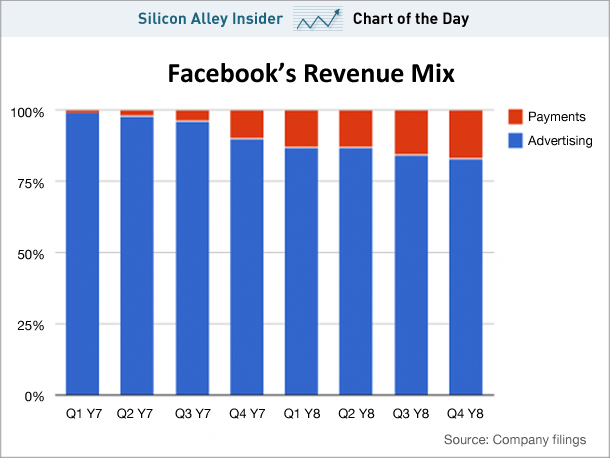
So it would seem Facebook is on pace to take over the world….. except one big side note, the mobile device. Analysts and the media are already pointing out Facebook has discovered their Kryptonite, which would be the fact that even though almost half of all their users are accessing Facebook from their mobile device, they are generating almost zero revenue from mobile usage.

Facebook risks being left behind as the world turns more of their attention to their mobile devices. Also found in the S-1, Facebook goes to great lengths to admit they have no current way to monetize mobile “We do not currently directly generate any meaningful revenue from the use of Facebook mobile products. Accordingly, if users continue to increasingly access Facebook mobile products as a substitute for access through personal computers…our revenue and financial results may be negatively affected.”

So while Facebook sees mobile as critical to its future growth, the growing number of people accessing the social network via mobile devices (again, 450 million!) could negatively impact its advertising revenue unless it is able to begin monetizing its mobile usage.

This should not be taken lightly, as anyone in the industry knows mobile is growing at a rapid pace and it’s only going to accelerate. Techcrunch cofounder and guest author Keith Teare, who is General Partner at his incubator Archimedes Labs and CEO of newly funded just.me, eloquently puts it:

The reason this risk factor jumps out of the page – for me – is that this trend to growing mobile use is inevitable. What is more, it will be both rapid and enormous. How do we know this? Well, human beings are flocking to mobile platforms in droves. This is happening to such an extent that Kleiner Perkins partner Mary Meeker went on the record almost 1 year ago to say that we are now in the 5th major technology cycle of the past half century (mainframe; mini-computer; desktop; internet and now mobile) and that mobile traffic will “grow 26 times over the next 5 years”

Mobile is The Final Frontier to Our Real Life Identity

It has been determined the most valuable network in the digital world is all your personal connections, collected and put together to form the social graph.  Expansive and data rich, this network connects you and me in a way we never would have been able to do before Facebook hit our screens.

But offline, this is not the case since transactions are the fullest expression of commercial interaction. Offline, the most valuable network is comprised of all the loose connections of merchant/customer relationships around the world, all together representing the GDP.  Broken down to each individual, possibly named the commercial graph, one can start to see patterns and degrees of separation forming.

The mobile device is the most direct and personal connection between our digital world to our physical world. We carry them with us all the time and feel naked if we leave them at home. Their use history is a picture perfect snapshot of who we are, made complete with our media and content preferences in addition to our personal calling and messaging history. Your cell phone contact history is, quite frankly, your true and actual real world social network. The location information (what is seen and not seen by the public) draws a direct path of your everyday footsteps. Like it or not, your mobile device is the crystal ball into your existence – a pure blend of your virtual and physical self.

Yet, Facebook has not figured out how to crack that crystal ball. Yes you can access Facebook proper via your mobile device… but it is still within their digital walls. I am curious as to when Facebook’s tenticals will reach outside those walls and into our physical world. And more interestingly, if not Facebook… then who else will it be?

We Express Relationships With Businesses Via Transactions

In the physical world, the truest expression of our commercial relationship with a businesses is through transaction.  If I like a product, I don’t push a button on the shelf right by where its sitting, I buy it.  If I am attracted to a city and want to stay at a nice hotel, I book the room.  Wouldn’t it be great to directly connect with merchants we care about in our life to make those interactions and transactions much easier?  Wouldn’t it be great if it operated similar to what we have become accustomed to in out digital social worlds?  Unfortunately, we cannot indicate a preferred long term relationship with a merchant, both interactional and transactional, driven through our mobile devices (Not yet that is).

With more than 8 trillion text messages sent last year around the world, and the U.S. alone seeing more than a fourth of those messages, messaging is the most predominant use for our mobile device. Research suggests messaging is still growing and arguably this won’t change for the foreseeable future. What if texting wasn’t just meant for communication, but also designed for transaction? It has been estimated that worldwide mobile payments (m-payments) will be over US$1 trillion by 2015. That is one BIG market if I have ever seen one.  And a market any serious digital media company should be focused on.

So if mobile is only going to be more important as time goes on, if our real world identities are tied to our mobile device and if transactions are the most valuable market in the world, it would make sense the next war for supremacy lies right where those three battlefields intersect.

Anyone want to suggest what Facebook has in store in the coming years to deliver returns for their shareholders? If their goal really is to fundamentally rewire the way the world works, from interpersonal interactions to commerce to even government, they need to do more than just show us ads in our news feed.

The advantages to going public at $100 billion is everyone who was a shareholder “before” the IPO will make a nice return on their investments – both time and money. The downfall of going public valued at $100 billion is that for anyone who is a shareholder “after” the IPO is going to need to see that valuation increase drastically to achieve a positive return. How is Facebook going to do that? The multi-trillion dollar worldwide market of physical world payments is probably Facebook’s best bet at making those returns come true.

Your virtual identity is arguably still up for grabs but at this point the front runner is Facebook with almost 1 billion users worldwide. The question is who will own your real world identity?

Even more interesting is wondering if we can fight for our real world identity or will we succumb to the greatest virtual social network on earth overtaking our physical world as well?
The Future Of Mobile Payments: Text A Word And Pay For Something

Imagine a world where by simply texting a word like “Sandwich” will result in a quick and seamless transaction so you could  go about your day.  Think about how much easier our lives would be if we didn’t have to wait in line, handle cash or be turned away from food or beverage if we don’t have our wallets in hand.

What if texting wasn’t just meant for communication, but also designed for transaction?

Today, most people take more precautions about carrying their mobile devices than carrying their wallets or purses.

The new question is: if your house is on fire what do you grab, your wallet or your phone?

I bet the answer is an overwhelming “phone”, since we do almost everything with our mobile devices and very soon we won’t be needing a wallet.

Our vision at Seconds is to make it easier for merchants and customers to interact and transact.  This is no more apparent than when looking at our latest innovations on the mobile payment front: Pay by Text.

Here’s how it works.

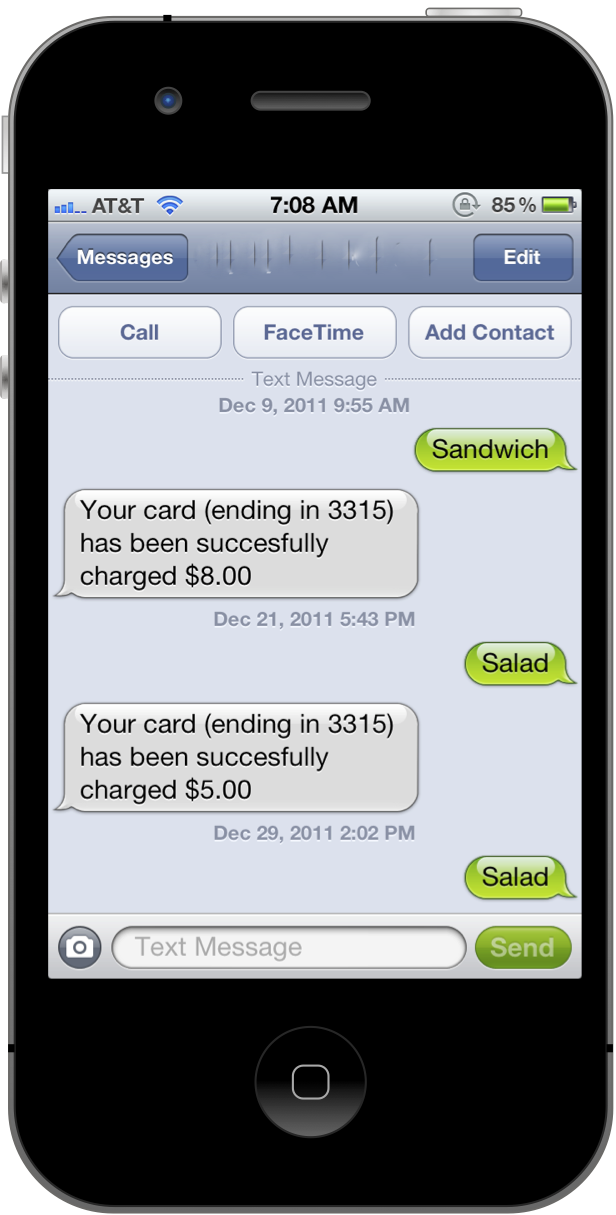
Once a mobile user sets up a Seconds account and attaches a payment card, they now can simply pay for the desired product with a one word text to the merchant’s Seconds number, in this case it would be the word “Sandwich”.  The resulting text a few seconds later will inform the user they indeed have been successfully charged X amount.  Done.

Important Note: This is not carrier billing, where you place the transaction onto your cell phone bill.  Seconds is completely separate from the carrier and a stand alone mobile payment system.

We are currently one month into a pilot program with a customer testing the functionality and perfecting the process.   Each week we are seeing more and more mobile transactions through Pay by Text, and if things keep going the way they are now this could become the default payment method outside simple food offerings.

Roll with me for a moment.  Imagine going to a movie and rather than waiting in line for the teller to give you a ticket you just simply text “Mission Impossible 4” to the box office and the next thing you know you have paid for the movie and are sent the secret code to enter via text.

Or how about the next time to your favorite band is in town…. do we really have to deal with the whole Ticketmaster ordeal?  Why can’t I send a text to the concert organizer with a simple “Said Band Name” and pay for the price of admission.

Okay, here’s a great one…. how about anything to do with hospitality?  Already, when you check in to a hotel they ask for your contact information, namely a cell phone number.  By running on the Seconds platform the can now open a quick and easy channel for you to text and pay for room service, any and all products… not to mention your room.  Or what about on a Vegas Casino floor….

So, what about NFC?

The problem with NFC technology is you actually have to be in physical proximity for the transaction to work.  The whole point of “Near Field Communication” is touching or swiping your device on a reader which will result in a transaction.  But what happens if I want to pay for something when I am not actually at the specific location or can’t get within a few inches of the reader?  What if it’s ecommerce, which will become more prevalent as time goes on?  Although it might have its place, it looks as if NFC  underwhelms and under-delivers.

That is why we are very excited about our Pay by Text technology, we see a whole new world of payments when you disassociate proximity from transaction.  It’s going well right now and the future is looking very bright for Seconds.

@jnickhughes

Hey Engineer, If You Want To Start Your Dream Company Read This Now!

I recently wrote a guest post on Mashable titled  5 High-Risk, High-Reward Steps to Starting Your Dream Company, where I squash conventional the wisdom of starting a company.  The article is quite extensive with real world examples, but this is a short list of the steps I identified one must take if they really want to commit to starting their dream company.

1. Quit Your Job

Conventional wisdom suggests, “Don’t quit your day job” while you start your new venture; only jump over when it shows promise. Unfortunately, this decision can be a recipe for disaster.  I say quit and get to work on your vision.

2. Don’t Follow The Crowd

Oddly enough, once most entrepreneurs abandon a “normal life” and set out on their own paths, they then look at what others are doing in the industry and opt to imitate instead of originate.  Following others will only get you lost in the crowd. Why not be unique and stand out from the all the rest?

3. Join Strangers, Not Friends

Conventional wisdom encourages you to bring together a few friends — people you already know and trust — to help launch your new company.  In reality, starting a company is tough and many things can go wrong. Don’t let friendship get in the way as you pursue your dream.

4. Launch A Buggy Product

Which situation will produce better results: a perfect web application that took nine months to launch, or a buggy but working prototype released in four weeks that gets immediate attention from early test users?  Think about it…

5. Build A Board of Advisors — Now

Conventional wisdom says that entrepreneurs don’t need to report to anyone. On the contrary. Developing a board of advisors as soon as possible will help keep a company on the right path.

Read the entire article on Mashable, 5 High-Risk, High-Reward Steps to Starting Your Dream Company.

@jnickhughes

I Was Just Told “You would not have made it through the weekend”

“You would not have made it through the weekend”

Today the dentist told me I would have been in the hospital and would have been lucky to make it through last weekend had I not made an emergency appointment to get an infected wisdom tooth removed last Friday instead of this coming Tuesday.

“These infections kill people you know?” “Once it reaches other areas of your body it causes irreversible damage.”

I am now left to ponder: Is the all out pursuit for your dream worth dying a preventable death?

After putting off dealing with a bum wisdom tooth for way too long I was hit with an infection deep in the root of one of my wisdom teeth. It was the worst and most painful thing I have ever dealt with. It started as some dull pain at the beginning of the year upon which I would take some Ibuprofen and dealt with it. But it grew worse and hit an 11 out of 10 on the pain scale last weekend. The infection started spreading quickly throughout my jaw, became very swollen and unbearable. On the left that is me , swollen and taken over by infection the day before the surgery. It was terrible, not to mention extremely dangerous. I couldn’t think straight, add much value or even lead a team meeting with any energy at all.

Frustratingly, it hit the same week we were planning a meeting with some angel investors and so I was initially trying to hold the pain off, have the meeting on Friday and get it taken out the next Tuesday. Well from what I experienced and what I know now, I don’t think I would have made it to Tuesday. Once an infection like that spreads to other parts of your head, neck and chest… you’re done.

On Friday, at the same time as the others were at the investor meeting, I went and had surgery to get the tooth taken out. And whoa do I feel better! I am a bit swollen from the extraction but infection free and really feel like a new man.

Lesson learned: deal with your health issues up front, some things are more important than the business you are building. I can be guilty of putting everything aside to focus on the main thing in front of me so this was a wake up call to be aware of creeping health issues.

Dodged a bullet on that one.

As an entrepreneur still trying to make it I don’t have the extra cash for insurance right now so I just pushed it off thinking it would take care of itself. I did not want to let anything get in the way of important meetings and work as we prepare to move Seconds forward with strategic partners and investors.

But what is more important than your health and wellbeing? Please take it from me, get your health issues in line. Take some time off if needed. Use credit or a loan if you feel you cannot afford to spend the money to get an ailment taken care of.

Do not end up like that idiot on the left with a weird growth on his face.

@jnickhughes

10 Simple Steps To Making A Kick Ass Explanation Video For Free!

Since Seconds is currently self funded, we have a pretty tight budget when it comes to PR and media exposure. But thankfully we have a “make your own for free… and pretty soon others will come around to make it for you later” mentality.

So when it came time to get a basic explanation video up on our site, we decided to do it ourselves rather spending money on a contracted specialist or video generating sites like broadcast2world.com.

Problem was, we really didn’t know where to start. That is where the creativity of Seconds team member Brent Crocker came in. He used Keynote to animate  and produce it, and while not the greatest App to animate a video with it got the job done. Basic image overlaying works great!

Judge for yourself, the video is at the end of the post. Here’s how he did it!

First get a solid script:

1: Determine what points do you want to make and write them down.

2: Think of a way to explain those points to your audience in a concise way.

3: have someone else on your team read through it, ask people if they understand it! This should be at least the start of your script…

Then Make the recording

5. I find that almost every major change to the script happened while I was making recordings… its something about hearing yourself in the recording.

note : I actually use the mic in the Apple headphones to do all my recording, so don’t make the excuse that you don’t have the right equipment! Record short sections of the script and pieced them together, its better to have short recordings to play with!

Determine what animation or imagery will go with the script:

6: Now is when you should be making the visual aspect of you film, after you know what you’re trying to say and how long it takes to say it!

7. With little time you should be able to make some kind of scene with an image editor, I used PixelMator, but anything that can create a clear background will work. Basically, if you can draw it, you can make it this way…

note: Try and figure out what best tells your audience what you’re saying with an image or animation.

Create some simple animations

8. For most scenes you will need a background and something to orient you (like a desk, building, or I even used a couch), but don’t make the scene too busy. Overlay your orienting image over some kind of basic background, black, white, textured, clouds… it up to you.

9. To create an image, grab a texture image like paper, cloth, or rock in the color you want (you can also adjust the color in the image editor). Then cut it to the shape you want. Make sure the image has a transparent background so you can overlay it on other images.

note: you can choose to make it look slightly 3D, but if you want to get through it quickly keeping to 2D animations works the best.

10. Most animations can be done in a program like Keynote/PowerPoint, along with scene changes. Moving images onto the screen and resizing as they come in to give the idea its getting closer. This gives your video some great movement so you can bring to focus the points you are trying to make. You don’t need to make fancy animations to get your point across, just use the animations to move through your points.

note:  focus on creating images that look good, but aren’t too hard to make.  This whole process should take you a week at the most.

Set the recording over your video and get the timing tuned in and you’re ready to post!

The Best VC Pickup Line Ever, According to CNET

This is awesome!

Seconds was covered by CNET journalist  and he opens the article with:

“Nick Hughes, the CEO of , has the best VC pickup line I’ve ever heard: “Last year, 2 trillion SMS messages were sent in the U.S., and not one reached a local business.”

Read the article here.

Seattle Against SOPA – Stand Up and Fight on Jan. 18th

The future of the Seattle tech community (and the internet as a whole) is in jeopardy.   Congress is rushing to pass both the  Stop Online Piracy Act (SOPA), H.R. 3261 and Protect Intellectual Property Act (PIPA) S.968, which will have drastic and unintended repercussions on law abiding U.S. web businesses.

Zac Cohn is helping to organize a number of gatherings to take collective action and let the state legislation know what you think.  Their goal: “to talk to people on the streets, educate them about the dangers of SOPA/PIPA, and then convince them to take out their cell phones and call their Senators and Representatives right there, on the sidewalk.”

Here’s a little background:

The Internet and information technologies have created a renaissance in startup innovation in Seattle. Thousands of Seattleites have been inspired to become entrepreneurs creating thousands and thousands of new jobs and offering professionals in many of Seattle’s traditional industries the opportunity to start new careers participating in the 21st century global economy.

However, Congress is in the process of rushing through legislation which will not only severely damage the Internet as a marketplace and platform for entrepreneurship and open innovation, but will also seriously impact the ability of our Seattle tech community to continue to generate jobs, grow and flourish. Within the next two weeks, the US Senate is planning to bring the Protect Intellectual Property Act (PIPA) S.968 to the floor for a series of votes to ensure its passage.

This legislation would give the government and corporations the ability to censor the net in the name of protecting creativity simply by convincing a judge that a site is “dedicated” to copyright infringement. PIPA would give the government and corporations the ability to shut down any site connected to an accused copyright infringer. Its companion legislation in the House, the Stop Online Piracy Act (SOPA), H.R. 3261, contains many similar problems, as well as threatening ordinary users with jail for streaming any copyrighted work – even just video of themselves singing a pop song.

If you’re still in the dark on SOPA, this is an excellent explainer video from Up With Chris Hayes on MSNBC that will very quickly bring you up to speed

More importantly, the legislation amounts to a wholesale re-engineering of the open web in a way that would allow the US government to prosecute Internet users without due process, which in turn would discourage innovation, limit investment, and hurt the our economic future.

You can read and hear more about this dangerous and hurtful legislation here: FightForTheFuture.org/pipa orAmericanCensorship.org.

For more info and to get involved, go to SeattleAgainstSOPA.com.

How To Make A ‘Bet The Company’ Decision

There are times in the journey as a founder you may find yourself in a decision that becomes a “bet the company” decision.

These  decisions are not easy by any means but as the statement points to they have the power to determine the outcome of your company.

Make the wrong choice and you might place your startup in such a compromising position it may never recover.  But make the right choice and you have just changed the trajectory of your company, and possibly history.  No doubt these decisions created the Intels, Apples, Facebooks and Googles of the world.

So how do you know when you are siting face to face with a bet the company decision?

First off, you will know by the all too familiar gut feeling that something big is about to happen.  More weight will be on your shoulders and you will hesitate making a snap judgement because you recognize this could be pivotal and you need more information before making the decision.

You will be saying things like “shit… don’t screw this up” and “finally, this is our chance!”

You also will most likely be pressured by outside influences, whether it’s another company wanting to make a deal or market influences putting pressure on your next move.  Bet the company decisions usually take the form of “if X than Y” outcomes, where X is you and Y is another company or market entity.

Lastly, you will sense that things will be different after this decision is made and there will be no going back.  It’s like the “talk” in a relationship…. something will change going forward for better or worse.

Here are some things to think about when making a bet the company decision:

  • What do we have to gain by this decision?
  • What do we have to lose by this decision?
  • What is our current trajectory and how would this decision affect it?
  • If we don’t move forward, what happens next?
  • Will the brand take a hit, or will it be improved as a result?
  • Can we afford NOT to do it?  Can we afford TO DO it?
  • Who is affected outside our walls by this decision?

Next, draw out scenarios for all possible outcomes, lay them out  and evaluate each according to your business goals.  Most of the time there is not really one “right” answer you are looking for but more of a “what makes the most sense at this time” answer you can move forward with.

Finally, after deliberation and evaluation you must go with your gut instinct.  Making a “bet the company” decision will surely change the direction of your company but the decision must be made confidently.  Once made, there shouldn’t be any looking back, only forward.  If things don’t work out later on you will be presented with other options to make another decision at that time, but currently your thinking must remain on the present decision at hand.

If it’s not obvious by now I have been presented with a “bet the company” decision and still determining how best to approach it.  I can’t wait to tell… but for the time being I will let you off the hook.   Thanks for letting me think out loud and I hope you are now more confident in your “bet the company” decision.

@jnickhughes

One Big Problem: The Worlds #1 Search Engine Is Not The Worlds #1 Social Network

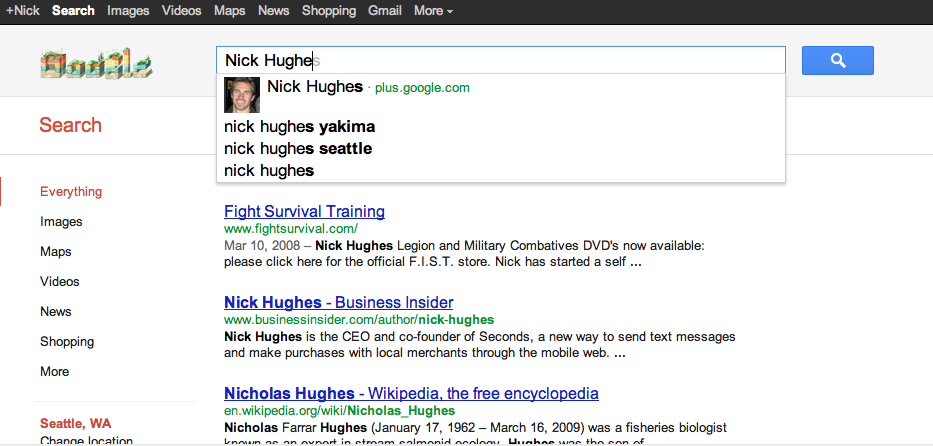
Google just made a big, bold move and integrated Google+ profiles into their search results.  Yesterday, Google launches Personal Results,Profiles in Search, and People and Pages, new features of its core search product that mark the real beginning of Google’s social search era.

It looks something like this:

The big problem with this is that Google, the worlds best place to search and find information, is assuming my Google+ profile is the most relevant social profile about me and so it should be surfaced first.  Well, I will tell you this:  It’s not.   I rarely (if ever) update Google+ with links, updates and information.   LinkedIn, Facebook, and Twitter are better representations of me and my interests.

Sorry Google.  You are not my default social identity.

When Google+ launched months ago there was a strong reaction around the fact that we don’t need another social profile to keep updated.  There are already too many and this fact still remains true today.  Interestingly, I have seen less Google+ requests lately than I did last fall.

I bet this is the same for millions of other people.  I bet more people keep Facebook, Twitter and LinkedIn updated and informed than their Google+ profile.

Am I correct?

@jnickhughes

Here’s Google’s Homepage 1999 vs. 2012. Can You Tell The Difference?

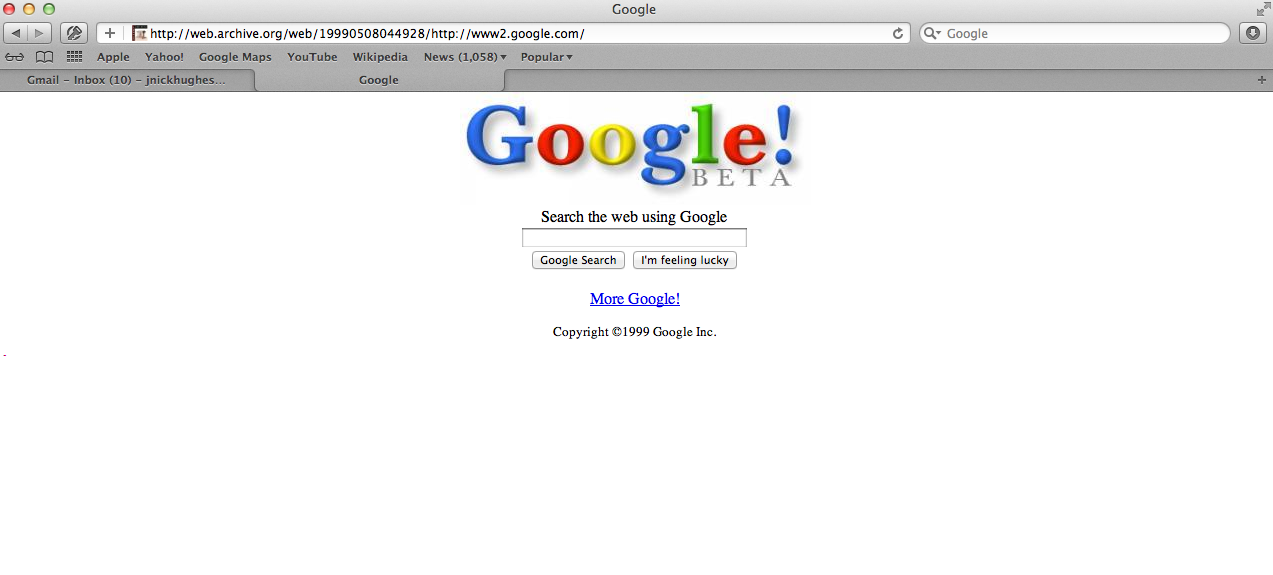
Today’s design lesson:  Don’t change what’s working.  Here are two screenshots of Google’s homepage; one from May 1999 and one from January 2012.  See much difference?

1999

2012

May 1999 was almost 13 years ago!  The web has changed dramatically since then, yet Google’s search experience hasn’t.  This is a huge lesson for anyone looking to get traction.  One of the most difficult aspects of brining a product to market is user education – meaning after they hear about your product how easily do they start using it.  It’s important because when a user knows how to use a product or service they will tell others about it.

If they can’t use it, they won’t tell anyone.  It’s that simple.

Google has done many thing correctly, but arguably the best was to design their user interface so anyone could use it.  I bet your Grandma knows how to use Google.  I bet your child knows as well.

Can you say that about your web or mobile service?  Are you making it as easy as possible to use your product?

Want Hyper Hockey Stick Growth? You Must First Endure The Blade

We all love to talk about the companies experiencing massive user growth in a short period of time, generally referred to as hockey stick growth.  Twitter experienced it.  Facebook saw it happen.  Of course Google did as well.  All great companies at one time went from a small unknown startup with no users to a well known company with a massive user base.

A few startups currently experiencing meteoric hockey stick growth are Instagram and Tumblr, incidentally interviewed at a recent Techcrunch Disrupt about managing hockey stick growth.

As fascinating as the hockey stick growth can be, something intriguing happens immediately before the growth period.   Not talked about because it’s not as sexy, Something must be happening before the massive uptick in usage or the uptick wouldn’t happen at all.

So what is it?

I call it the blade.  As you can see, the hockey stick on the right has a flat section (the blade), an angle (the inflection point), and the  rising handle (growth phase).  The blade is the most critical point for any startup because if they get over it alive they move on to the crazy hockey stick growth phase.

Although the Techcrunch Disrupt interview is great and both founders offer a number of insights as to what its like to go through the insane hockey stick growth periods, they don’t really talk about the blade.  My guess is because it’s not as exciting as hockey stick growth.  In fact, it’s tough.  So tough it will make or break a startup.

Blades Require Heat

When referring about a hockey stick, deciding on a blade may be one of the most important decisions a hockey player can make.  The makeup of a hockey stick blade will determine how durable it is and how much stress it can withstand.  A blade — the bottom portion of a hockey stick that may be curved or straight — can help determine the way a player is able to control a hockey puck.  Wood blades today are frequently covered with a composite material, such as Kevlar. Kevlar is a strong, fiber substance that is designed to be used in high stress situations.

Being made of composite, hockey stick blades are malleable and can be shaped to a players advantage.  All it takes is heat.  When a player heats a blade, they can curve it and shape it to their liking.

As if you didn’t know… startups are situations of ridiculously high stress and immense pressure.  It’s almost like you sign up saying ”let’s see how hot it can actually get.”  As part of a startup, you are trying to create the most with the least amount of money, which leads to tremendous financial heat.  You feel heat trying to force the product down people’s throats, working towards product market fit. The pressure is on to prove a specific customer for your product before time runs out.  Lots of late nights, pivots, redesigns and tough conversations will create friction and heat amongst the team.

The blade period – the period of time after launch but before massive usage growth – is one of the most challenging times a team can go through.  Yet, therein lies the test.  The blade test for a startup team involves a number of points: to observe reality that the product is not an overnight hit, listen to feedback, watch available usage metrics, identify what is working and what isn’t, agree on changes to be made, make the changes, reposition the product, polish the messaging and many many others.

The key is to do all this without losing your mind and going crazy.

This situation is extremely difficult for a young team to get through, and that is why most startups don’t make it.  Failed startups don’t ever get to the position of hockey stick growth because they could manage the heat on the blade.   It’s like a right of passage. Show me a (successful) company that did not get over the blade.  The only way to get from launch to hockey stick growth is to get through the heat and over the blade.

Blades Are Short

If done correctly, the blade is just a phase in the life of the company; the shorter, the better.  Flat growth actually shouldn’t last very long if the founders are quick to make needed adjustments to the product, positioning, messaging, and user acquisition strategies.  When great products hit the market, people take notice and users are attracted.

It may be all relative, but some startups only last a few months on the blade, some last years.  Most are somewhere in between.  What does it take to get off the blade?  As I was researching about hockey stick growth, I found this article about the internet and how it finally hit hockey stick growth.  Interesting to note:

The Internet served an important role for a limited number of users, but it had serious barriers to entry. It displayed its messages in monochrome text; no color, no pictures. The Internet had to become pretty and easy. Lessons to be learned include that ease of use, attractive displays, entertainment value, cost-effectiveness, and genuinely new utility are the keys to type-one hockey stick growth.

The goal is to shorten the blade and reach inflection as soon as possible.  Notice how the above statement clearly illustrates the internet grew quickly once it became easy to use, was cost effective, entertaining and useful (of course this is referring to the world wide web.)  These characteristics are  what every startup is searching for in their product.

A lot of the blade comes from not knowing what to change, but a few major points come to mind.  Correct positioning in the market will allow for your product to actually be found by the right audience.  Finding the correct messaging will help the right people/customers to understand your value proposition and start using your product.  As your user base grows, features that help current users share your product will lead to new users.  And the correct distribution model will aide all other aspects and amplify growth.  As these are fairly general, it is for the fact that each action will be unique to your specific offering.

Not to be overlooked, part of putting yourself in the right position for hyper growth is building the right team.  It’s not about hiring, it’s about finding the right talent.  The correct people in the right positions at the right time will only help to shorten the blade and get a startup to hyper growth.

Blades are Remembered

Although any founder or early employee will tell you growth is what they are looking for, the times on the blade is are always the ones the remember the most.   Tony Hsieh, Zappos CEO recalls the early days when they almost didn’t make it…. many times over in his book Delivering Happiness.  It’s a great read for any startup founder or early employee, as he re-lives all the challenging (and fun) times Zappos endured.  You can almost feel the sharpness and heat of the blade they got over.

Microsoft co-founder and fellow Seattle resident Paul Allen spends the majority of his book recalling the Early days of Microsoft, the struggles and challenges they faced on the blade.  I was not aware of all the times he and Bill were scared, feeling little hope for the future of their company.  Can you imagine Paul Allen or Bill Gates fretting over $100?  But… we all know the rest of the story.  I’m just glad they went through it at one time in their life as well!

So the blade is a fact of startup life.  The only questions are: how much heat can you take?  What will you do to shorten it so you can get on with growing your company?  And what crazy stories will you be telling when you do make it over the blade?

@jnickhughes