More Humanity, Less Technology

A few recent experiences have spurred my thinking on the subject of humanity vs technology.  Some of this will seem inevitable and some of it will seem commonsense to you.  Some of it might even go against the grain of what you are currently working on right now.  My purpose is to get you thinking about how you go about your life using technology – by yourself and around others.

I am not sure if it’s just me but I feel we are starting the upswing on what will be viewed as the turning point in our society.  We will never have a “slower” life than we do today.   Cell phones allowing us to talk to and message anyone in the world was just the beginning of this movement.  Now, we have really powerful mobile computers in our pockets which basically bring the entire world to us – instantly – with a touch of a finger.  In a not so distant future we will be wearing these computers on our wrists (I hope not) or our faces with such innovations like Google Glass.  Will brain implants one day do away with any device or hardware required to access all the worlds information?

Fashion faux pas aside, I think these technical advancements are inevitable yet at the same time very scary.

What seems to bother me is what will happen to our humanity as all these technical advancements come into our lives.  We already deal with the quick “phone, text and email check” at the dinner table or during a conversation with someone else.

Is it lost on our society that this action is actually quite rude to the other person you are sitting with?  I know I am guilty of frequently swiping my iPhone and seeing what I missed over the last 5 or 10 minutes.  In reality, it simply says to the other person, “you are not very important to me and I am wondering what other bits of information I can quickly scan to keep my attention.”

What will happen when we were a pair of glasses with a screen ever-present right in front of us?

I am afraid we, as a society, are not prepared for this use of technology.  Socialogically, we are trained to observe people and gauge them via non-verbal cues as to how we are connecting with them.  Are they threatened, scared, turned on, tuned out, distracted, interested, ect…   The human eyes/mind/body instantly calculates all these millions of inputs and tells us what is going on within this specific human interaction.  We live our lives on non-verbal human cues.

These thoughts hit my mind the other day as I read an interesting article in the New York Times with the idea that Friends don’t let friends lose their capacity for humanity.  It raises the same alarming points I am mentioning here.

Ironically, as tech advances to help us “connect” with others we seem to be moving farther away from actually connecting with them – on a human level.  Does a text message saying “hi” do more than a slightly extended eye-gaze between two interested individuals?  Absolutely not.  I can learn more in 2 seconds looking at woman than 100 text messages sent from her iPhone.  All those text messages just create more questions and uncertainty between the two people.

The second experience happened yesterday as I was chatting with friend.  She mentioned how she was a natural introvert and she really needed to get out more, get away from her monitor and into social situations more often.  According to her she has a tendancy to lose track of time when she gets into her work and feels more at home in front of the screen.

I understand what see is saying but I also counter with the fact that she actually feels more at home across the table from me looking into a human eye and enjoying a face to face chat.  That is why she said she needs it more often.  There are just certain things we see/say/do which will never be replaced with technology.  Even Skyping with others doesn’t actually feed our appetites for human connection.  Like it or not you are addicted to dopamine – a chemical released when you interact with other human beings – and you will withdraw from society if you do not get enough on a consistent basis.

All this has me thinking deeper on what technology means for us humans and how we should use it in our daily lives.  More interesting is the fact that as time goes on and technology continues to move us “forward” we will actually desire more of these authentically human encounters.

Our society depends on it.

As I continue my path in the technology sector and build experiences around the web and mobile devices I make sure I keep one foot firmly planted in the area of Humanity so I don’t end up losing it.  I hope others do too, it would be a shame if we all just ended up always looking down at our mobile devices tweeting about the fact that we are feeling alone in a crowd.

Spring Is In The Air And Something New Is Upon Us

This post is part wind-down announcement and part new product news.

We started Seconds (back then called Order SM) in September 2011 with the goal to experiment around mobile – text ordering at local restaurants.   Our assumption was people would want to simply text “burrito” to their local mexican restaurant and then be able to swing by and grab it without having to wait in line for their food pay with a physical credit card.  Everything would be taken care of in the background on the web.

We learned a ton, but the biggest thing was both merchants and customers really liked being able to just pay for something by sending at text and not mess with all the other communication crap, so we ended up moving towards specifically focusing on a mobile payment system.   We changed the name to Seconds and rolled it out in Jan 201n2.   We saw a dramatic market interest in our unique take on payments, receiving inbound request from almost every continent in the world.   Unfortunately, we weren’t able to secure capital it required to scale our team and out product and so we basically stalled out at the end of the year.

Rather than being a Zombie-startup, I decided it was best we make better use of each members skill set (go get paying gigs) and wind down the operations on Seconds, as a mobile payment startup.  This means we are not taking new customers or putting in new work around the product.  It also means we are retaining the IP and tech, placing it on the shelf for a while as we determine the next phase for our ideas.  As I said to the team when we made this decision, “with each passing day, people will only get more comfortable with mobile payments and we’ll make more and more mobile payments as the months and years go on.  I don’t think this is the end of the line for our ideas, just not the right time and place for Seconds as it is today.”

This was definitely a tough decision and one I probably put off for a few months not wanting to accept the reality of the situation.

For all you who know me personally you will be quite familiar with my challenges as I built Seconds.  It is not easy to be a founder, no matter how “rock star” it may be described nowadays.  It’s lonely.  It’s stressful.  It stretches you in ways you will never imagine.  It mentally challenges you to the point where you actually think you are crazy (and probably could be) yet just normal enough to not be committed.

Frequent readers will recall my many posts on what it’s like to be a founder.  Rollercoaster is an understatement, mainly because when you get off the ride you say to yourself “wow, that was crazy fun” and then simply go back to your normal, unaffected life.  No so when you jump head first into your life as an entrepreneur.  There are scars from this journey that will take years for me to fully recover from.

With that said, we are not finished.  Strangely, I am scarred yet more excited and more prepared for future success.  A backstory will help you understand what is about to transpire from here on out.

About 7 weeks ago the Seconds team took the Super Bowl Weekend and entered Sports Hack Day, a 3-day hackathon to see who can build to coolest thing using sports oriented data.  What a weekend.  It was full of late nights, massive brainstorming and beer infested hacking.  Although we didn’t end up winning any prizes or awards, we emerged from the weekend with a kernel of a cool idea that as sports fans we just wanted to use as we went about our life.

“What if you predict – or make a call – on any stat, play or outcome of a sporting event, and in Twitter fashion simply be able to shoot it out into the social sphere telling the world you think ‘X’ will happen in this game.  If correct, your score would go up.  If wrong, it would go down.  You could then challenge friends with a simple finger swipe on your phone and then go back to watching the game.  And what if we could then determine who knew the most about sports by this running number, similar to a Klout score but for sports.”

We liked the idea so much we decided to continue to work on the concept after the weekend concluded.  I couldn’t get it out of my head and as a sports fan I wanted to use it – like really bad.  I don’t normally play fantasy sports leagues because it feels like such a commitment of time and mental energy.  But if I could simply make a few predictive calls on my mobile as to what I think will happen in the Bulls vs Knicks game tonight, and show my friend I know more about sports than he does, I’m into that.  It’s addictive.

So the 3 of us wondered what it would look like and continued to build it out.  It ended up more of an undertaking than we realized and has required many late nights over the last month.  We are now almost ready to release it to the world and see what happens.  That is all I will be saying until we announce the release very shortly, but needless to say we are interested to see what the world thinks.

As for me, I will be hired here soon and will have new daily responsibilities with another company.  Am I excited to join another company?  Yes.  Do I wish I was full time (and paid) in my own company, not having to work for someone else?  Yes indeed.  Will it just take a little more time until that happens?  For sure.  Will I give up on pursuing my creative side as an entrepreneur?  Hell no.  Do I realize my time building Seconds is pretty much the only reason I will be hired into this next position?  Yep.  It’s not lost on me all this has been worth it no matter the financial outcome or the pain associated.

Spring is in the air; no better time to emerge towards a new direction and pursue an exciting new opportunity.

The Code Of Culture

Culture is a interesting animal.  It can be the difference between attracting world class talent or settling for sub par standards.  In a word, it’s paramount to a company’s success.

Just as an engineer uses a specific language and types characters into the terminal to create a product, so does the founder as he embeds certain principles and characteristics into an organization to create a unique company culture.

Culture happens if you know it or not.  Be careful founders, you reap what you sow.  Better plug in the right code as early as you can.

Today I stumbled upon the greatest presentation on company culture I have ever seen.  It’s great.  It’s comes from HubSpot, and accomplishes its goal of making me want to work for them.

In fact, it also accomplished its goal of helping me form my perspective on how to cultivate culture within my own organization.

I hope it does for you too.

Why Do We Do Our Best Work For Free?

Why do we do our best work for free?

The question has been sitting in my mind lately as I contemplate the current entrepreneurial climate in addition to my current situation.  I don’t have a job – I own a company.  As an un-funded startup at the moment we are not paying any salaries to anyone on the team, thus we are working for free.

Let me say it another way: we are working long and hard hours, quite often late into the night or early into the morning, and doing it all for no money at all (well, none right now anyway.)

So why do we do this?

It goes against normal human motivations, which includes the “you give me X per hour for me doing Y for you” mentality.  The thinking seems to go something like, “well, I don’t really want to show up here to do this thing each day but since they are paying me money I guess I will do it.”

That’s the workers mentality.

There’s nothing wrong with it and people who think that way are rightfully doing their duty as a family member, societal member and taxpayer.  And it allows the circle of life to continue around and around…

Fortunately or unfortunately, there is another motivation that drives human behavior and it’s called creativity.  People who are Creatives have a yearning to build and create something from nothing – to see the future before it happens and then go forth and create it out of thin air.  Often times this happens outside of work and does not originate from the “doing X for Y” agreement so the result does not create immediate monetary value for the individual.

Yet they keep doing it.

mad_scientist_at_work_come_on_in_funny_door_sign_ornament-p175291926278339191b7flz_400And more often than not this is the area they excel in their life.  It’s the area they are most excited about and can’t wait to get back to once they are off the clock if they have a day job or other responsibilities.

It’s also the area where they do their best work.

I think they do their best work in these areas because it’s driven by passion, not money. Do you think Thomas Edison clocked his hours in his laboratory?  Or looked at his watch and said to himself “phew… only one more hour and I’m free to go grab a beer with the dudes!”

No way.

The time he devoted to his craft was driven by curiosity, passion and purpose.  He was a scientist first, capitalist second, employee never.  And amazingly, he was paid handsomely for his work in the end because of the quality.  I believe this was due to the fact his motivations were rooted on his standards and not anyone else’s.

This can be said about any artist, musician, entrepreneur or individual who pursues their passion regardless of immediate returns.

I noticed this in my own life recently, as we were diligently working on some new things.  No one is paying me, expecting me to show up at a certain time or demanding the project be done on a certain date.

No one but me.  It’s my standard I am working against.  It’s my passion to work on something challenging, to see it through and learn a hell of a lot in the process.

I noticed this last night as I walked to the coffee shop where I was meeting up with my CTO.  Honestly, I couldn’t think of anything or anywhere else I wanted to be at the moment.  I had to just stop and appreciate the realization we are all not quite so different than Thomas Edison cranking away in his laboratory.

And the craziest thing about it is the fact that when we hold ourself to the highest standard possible, we tend to deliver a high quality finished product.   To do otherwise would be to go against your very self, against your own standards and integrity.

This is when you know you are onto something and in due time you will see the rewards.

If you want to do high quaility work, do it for free.  And when you start to work for free you may eventually be surprised at who will pay you handsomely.

If A Blind Kid Can Play Football, We Have No Excuses

This video couldn’t have come across my screen at a better time.  If a blind person can have the resolute to play high school football, then we all need to re-evaluate how we are approaching challenges in our lives.

“If you imagine a disability as a crutch – don’t use the disability as a crutch, use it as a leg and start running.” – Charlie Wilks

The Best Thing About Falling Is You Can’t Tell Which Way Is Down

mel

Keeping with my recent trend of metaphors, a typical comment you hear from the startup community is “I just took the leap”, meaning someone just left their cushy job and took a huge risk to start a company.

Starting a company can be one of the most exciting times in life, just like the first time you strap a chute on your back and jump from a plane 10,000 feet above the ground.

It can also be one of the scariest.

When you jump to start something new you have no idea how far/close rock bottom actually is and most of the time you are spinning around trying to find equilibrium.  In fact, I used the metaphor almost 2 years ago when I jumped from my job (without a chute nonetheless) and went full time into life as a founder.  And boy has it been a ride worthy of the skydive analogy.  Although I have never jumped from a plane, I can understand what it’s like and why it’s so crazy/awesome/scary.

An interesting phenomenon happens after you jump from your job to a life of entrepreneurship.   You find yourself free falling towards the ground with an awkward, uneasy feeling mixed with both excitement and fright.  Deep down in the pit of your stomach you know it was the right decision but right at the moment your conscious mind is telling you otherwise.

In fact, it’s not telling you.   It’s shouting at you!  Consequently, you don’t actually know which way is down.

This happens for many reasons but mainly because you get so used to the stressful up and down feelings of “falling” it starts to feel like you are floating, just as a skydiver is basically trying to float by balancing an equilibrium in the air.

Your daily routine gets flipped on its head. Your finances start doing weird things and you are wondering if and when the “ground” will actually be hit.  Your personal life is either non-existant or very much challenged.  You find yourself second-guessing your current pursuit for happiness and wondering if you are on the right path.  You find yourself in situations you would have never thought possible, such as talking to investors about millions of dollars and internally saying to yourself “holy crap I have never seen that much money before, what the hell am I thinking!”  It becomes normal to work until 2am and then sleep in, only to have to reschedule the phone calls you were supposed to have in the morning.

AND YET…

You are running your own show.  You can find, recruit and hire anyone you want to join your team.  You determine when and where your meetings will be held, and what time they will start.  You start reading articles with you and your company’s name mentioned in it.  You field emails and calls from multinational companies interested in your product.  You are asked to speak at industry events and local meetups.  You start to see increased interest and engagement with your product, and find yourself quietly saying “it actually works! ” And finally, with an increase in usage comes an increase in revenue so you can start to pay your bills and float your company operations.

Ahhh… the visceral feeling of weightlessness takes over your body.

You now see why the analogy of not knowing which way is down is a damn good one for the startup founder.   The song When You’re Falling by Afro Celt Sound System best sums up “the leap” and is a favorite of mine.

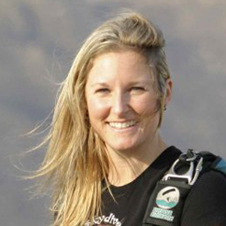
I have always been fascinated with skydiving so it was great to recently connect with Melanie Curtis, founder of HighComms.com, and a professional skydiver.  No doubt, she has a life you wish you had whether you are an extreme athlete or someone who has a passion for life and loves helping the people. She is also an entrepreneur.  I thought it would be great to take a dive with her to get her story, her perspectives on life as a leaper and how she came to entrepreneurship.

Melanie began her career  in NYC and LA working at a major investment bank for 5 years.  She enjoyed it yet found herself spending all her money on skydiving (her first love) so much so that she got good enough to quit the big-time job and go full-time in the sport. As for me, I’m definitely a freedom seeker with my first passion in life being skydiving.  Theres nothing more free than jumping out of an airplane, flying…  yeah, it’s not for the faint of heart, but it’s also a true gateway to the good stuff in life, both literally and figuratively.”

Over the subsequent 9 years, she inadvertently made quite a name for herself in the sport, which was something she didn’t even know was possible going in to it.   She has traveled the world going to drop zones, connecting with their local communities and teaching them how to fly well, stay safe, and have as much fun as possible in the sky. She says diving brings joy, fun, and freedom to the world at large through connected and transformative personal experiences.

“All of my skydiving success has been absolutely, positively, 100% rooted in my passion and love for the sport and community. In that gratuitous, authentic love and joy.  I simply lucked out that my parents instilled me with an over-the-top work ethic and ridiculous personality, two things essential for success in skydiving it seems. haha”

Mel-head-down-skydiving-group-pic

After a couple years of introspection knowing that full-time skydiving wouldn’t make her deeply happy forever, she discovered life coaching, went through a very intense and awesome program ipeccoaching.com and began to build her way up to her next major leap.

“Even though I had the best job in skydiving (I got paid a salary to jump with my friends and organize cool events and theme parties), at the end of 2010 I took the second major leap in my professional life, quit that job and went into business for myself, founding Highcomms.com.”

What is Highcomms.com I wondered?  Their Mission Statement states: “We strive to change the world one person at a time through transformative personal relationships that help people identify and authentically live their core values. (ie. Live the dream. LTD. Word.)”

Melanie notes that yes, what’s in parentheses is actually part of the mission statement.  “Highcomms.com is my coaching business.. both skydive coaching and life coaching… it’s me… my approach to life, what I’ve learned finding the path to this completely free, mobile, and balanced lifestyle I now lead, and how I now can help others find and live their version of ‘the dream’ too.”

The name “highcomms” comes from past conversations with one of her best friends back in the day.  Anytime they hadn’t talked for a while they would text each other “comms.” As in communication.  Like, “hey, we haven’t talked in a while, it’s time, let’s do this…”   One day we’re talking and I get all fired up and say something along the lines of this, “I’m not just about comms… I’m about HIGH comms… full-on, meat-and-potatoes conversations, fully putting yourself out there, unabashed authenticity…” and whatever else I said. ”

And so it began.

It’s obvious Melanie excels in the type of conversation that helps people get to important answers, and see them through to actual life change.   She helps people see the pathways to their own leaps, helps them see ways through whatever might be holding them back.  Also, she helps them figure out and uncover what they really want to do with their lives by setting action goals and  holding them accountable to doing it, every single week.

She typically works with one-on-one clients in the US and abroad over the phone and Skype, and this past year they have finally got their website set up to continue to offer online classes/education/webinars to help bring coaching tools to people who may not be able to afford the more expensive 1-on-1 service.

“This has been the natural evolution of my life-coaching business, given all my experience teaching with my skydive coaching for so many years. I even brought on my best friend and educational consultant, Carolyn Chow, as a partner to help me grow this side of the business and ensure the class content is structured in the best possible way for clients/customers.”

As I gathered information a few lessons popped out from the back and forth I had with Melanie.

The impossible is possible.

I know that sounds super cliche, but think about it as someone who’s never jumped out of an airplane before.   We tend to think about doing it, and it seems totally impossible, like we’ll surely die.  And then we do it and not only do we LIVE, but we have the most fun of our lives, enter a community that thrives on that same freedom and fun, and that cracks our mind wide open.  Skydiving teaches you the impossible is possible, something I’ve had internalized inside me from a very young age.

The belief that I really can do anything has given me the courage every time I’ve come to a bigger precipice in life.  It’s the same thing with entrepreneurship.   As soon as I actually had the conscious thought that I could go into business for myself, be my OWN boss, it wasn’t instantaneous by any means, but the idea was all it took.  Here’s an article Melanie wrote on this very thing topic.

We all need help from others.

I most definitely stay fully immersed in my life coaching work, and have a life coach myself.  Just because I’m an “expert” doesn’t mean I’m not human..  I’m such a believer in life coaching as something that truly helps anyone no matter their situation.  I use all the skills I’ve learned in my coaching, experience, education, and I see all of the stuff that I go through as opportunity to learn more, share more, and connect more with my customers and clients.  Here’s another article Melanie wrote that speaks to entrepreneurial stress.

There’s lots of opportunity in helping people

Where I think Highcomms.com can go in the future is expanding into more of the self-help aspects of business. Carolyn and I are working to expand the online education portion of the business, currently recording new classes that will go up for sale ongoing. 

I’m writing my first book as we speak and plan to have it published by the end of this year, with the goal of increased reach, credibility, and presence in the industry. We know we could expand into workshops and stuff like that, but we’re all about keeping our lifestyle free and mobile, we really love the online stuff.  So perhaps maybe one big workshop a year, maybe two, so it’s not a huge time constraint on our lives.

Next time you feel yourself free falling – whether jumping from a plane or off a cliff towards your next venture – just remember anything is possible.  Or better yet… just remember to pull the chute early so you can fully enjoy the ride.

*If you are interested in your story being told here, feel free to reach out to me.

Hey Facebook, Can You Please Make The News Feed This Easy To Customize?

The noise!  Ah, the noise!

Part of what is so frustrating about Facebook is how annoying and noisy the news feed can be.  I can only deal with so many baby pictures and silly posts and or how little Joey just couldn’t go to bed tonight.  Or random pictures of people I don’t know…  Somewhere, deep down somewhere in Facebook there are thoughtful posts and pictures from friends I actually want to hear from.

So I am asking Facebook to help us help ourselves to use Facebook more by giving us full control of the news feed.  I want to customize it as I wish based on characteristics of both my friends and type of posts.  I am sure they would appreciate us using Facebook more, but the number 1 complaint I hear from people is it’s just not relevant anymore.

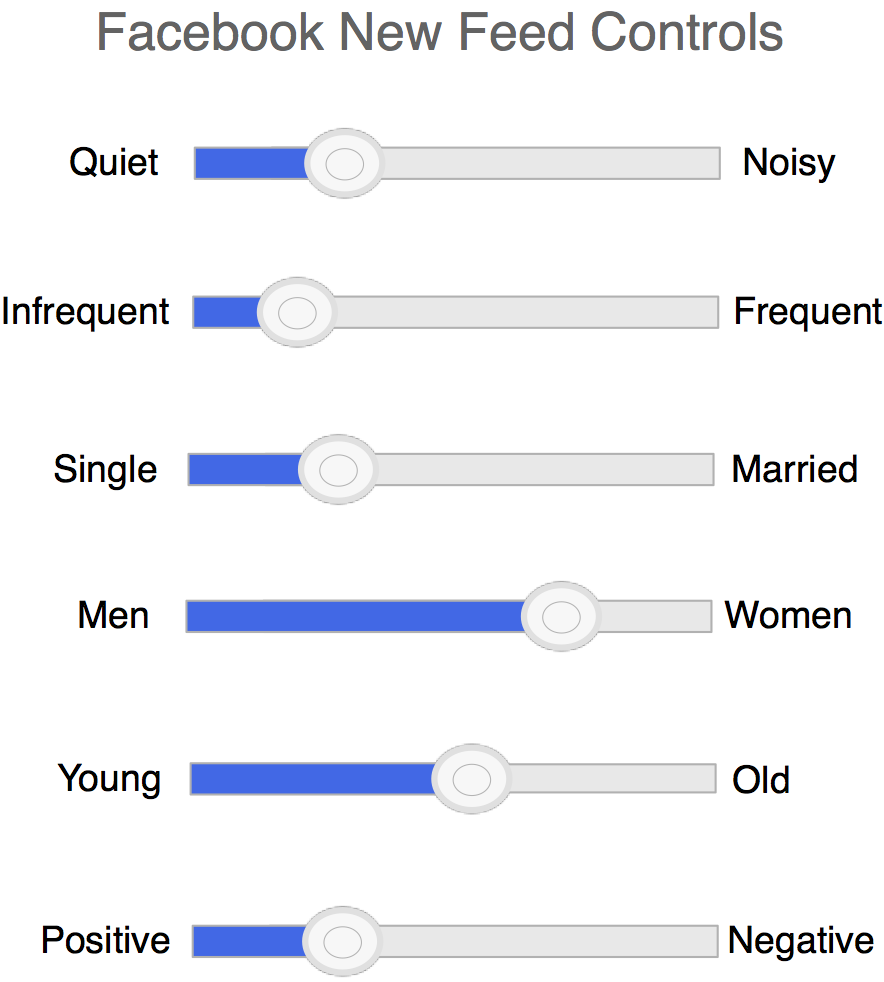
Imagine being able to simply slide a bar to tune out those annoying over-sharers without doing the awkward unfriending or having to hide them.  What about wanting to see more posts (and pictures) of women?  Or men?  What if you could organize it more positive updates rather than see people vent and rant (which by the way doesn’t make my day any better when I read those).

My vision of it is below.  Share on Facebook and Twitter if you agree and maybe we can help make this happen sooner than later.

new feed sliders

How To Lead A Volunteer Army Into Uncharted Territory

You may have heard the description of founding a company is like leading a volunteer army.  I couldn’t agree more and want to dive deeper into the analogy to see if we can pull out some nuggets.

It’s true, most startups are formed by individuals who are passionate about their idea.  But, the fact is passion does not actually get the work done and they cannot do it all on their own.  They will need to attract other talented individuals who fill gaps in their skills to join the cause if they want to see it succeed.

Interestingly, this is where leadership comes into play.   Leadership is simply defined as influence – nothing more, nothing less.  A true leader has influence over others in their decisions and actions, resulting in the followers taking action based on the input and example from the leader.

Said another way, the founder’s ability to influence others to join him in his pursuits will solely determine if those people will actually join, and in the end will determine the outcome of the startup.  Early in the startup phase it’s quite likely  there is no capital available to pay each person’s salary.  Thus, people will need to volunteer their time and efforts for the cause and making it even more challenging for a founder to attract the right people.

So how (and more importantly why) will others volunteer for a desolate and untested startup, one that might even be in its idea phase?  What does it take to attract, influence and retain the talent required to succeed in your startup?

George Washington statue

Looking back into the history of the United States we can study great leaders and learn how they were able to lead a volunteer army.  George Washington is the epitome of the leader – strong, confident and influential.  He was the perfect leader for our country at a time where the talent he needed to attract were pretty much all volunteers.  Here’s a bit on Washington from Wikipedia:

Although Washington never gained the commission in the British army he yearned for, in these years the young man gained valuable military, political, and leadership skills. He closely observed British military tactics, gaining a keen insight into their strengths and weaknesses that proved invaluable during the Revolution. He demonstrated his toughness and courage in the most difficult situations, including disasters and retreats. He developed a command presence—given his size, strength, stamina, and bravery in battle, he appeared to soldiers to be a natural leader and they followed him without question.

Washington learned to organize, train, drill, and discipline his companies and regiments. From his observations, readings and conversations with professional officers, he learned the basics of battlefield tactics, as well as a good understanding of problems of organization and logistics.  He gained an understanding of overall strategy, especially in locating strategic geographical points.

As you can see, George Washington was exactly what the American colonies were looking for in someone to lead them to freedom.  He was strong in stature and in character.  He was knowledgeable in the tactics required for success in warfare.  He studied relentlessly – on his own men, on the competition, on the geography, and on organizational principles.  He didn’t let politics get in the way of his purpose, which was to win the war and emancipate the new country towards their new found freedom.

Washington was a true leader.  Drilling down a bit further, you can see Washington basically had three roles during the war:

First, he was the predominant leader and man in charge of the American forces.  In 1775–77, and again in 1781 he led his men against the main British forces. Although he lost many of his battles, he never surrendered his army during the war, and he continued to fight the British relentlessly until the war’s end.  He plotted the overall strategy of the war, in cooperation with Congress.

Second, he was charged with organizing and training the army. He recruited regulars and assigned Baron and General Friedrich von Steuben, a veteran of the Prussian general staff, to train them.  Eventually, he found capable officers, like General Nathanael Greene and his chief-of-staff Alexander Hamilton. The American officers never equaled their opponents in tactics and maneuver, and consequently they lost most of the pitched battles. The great successes resulted from innovative strategy , at Boston (1776), Saratoga (1777) and Yorktown (1781), came from trapping the British far from base with much larger numbers of troops.

Third, and most important, Washington was the embodiment of armed resistance to the Crown—the representative man of the Revolution. His enormous stature and political skills kept Congress, the army, the French, the militias, and the states all pointed toward a common goal. By voluntarily stepping down and disbanding his army when the war was won, he permanently established the principle of civilian supremacy in military affairs. And yet his constant reiteration of the point that well-disciplined professional soldiers counted for twice as much as erratic amateurs helped overcome the ideological distrust of a standing army.

Sounds like a CEO and leader to me.  Although there are many others, here are 3 principles to keep in mind as you lead your volunteer army.

Unprecedented

The idea must be moving, unprecedented and important to the individuals involved.  No one wants to sacrifice for something we already see everyday.  People want to be part of something big, amazing and unique.  Many years down the road people simply want to be able to say to their friends “yeah, I was there at the beginning and we started it”

The main reason George Washington was able to attract volunteers to join the cause was because they were fighting for their own freedom and literally making history at the same time.

Dedication

A leader must be as dedicated – perhaps the most dedicated – to the cause if they are going to be an effective leader.  Followers will always be more influenced when leaders lead by example.  People don’t care much about what you say but will look more intently on what you do.  Dedication means working harder than others.  Dedication means fighting all the way to the end.  It means not leaving your co-founders the instant you sense things will be harder than you initially thought.  Simply put, a leader will attract and retain talent when the talent doesn’t even question the leader’s dedication.

Washington lead by example and publicly displayed his dedication to the cause of independence.  It is clear no one under him questioned or doubted his dedication, and in the end, by not giving up on the war Washington and the colonies were able to squeak out an unthinkable victory and changing history forever.

Empathy

Empathy is the ability to understand and  feel how others are feeling.  It’s the ability to “walk a mile in their shoes” and “see from their perspective.”  Being an empathic leader helps you understand what others in your organization are thinking, feeling and doing.

Why is this important?  Well, people hate to be told what to do when the person who is barking orders has no idea what is actually going on in the individuals life.  It shows lack of perspective and lack of reality.  Instead, if the person giving the orders actually understood the reality of the other person, they can then amend their orders with more realistic expectations.  The leader will know what is possible and what isn’t.  They will be able to adjust the deliverables, understand appropriate timeframes, delegate important responsibilities, and find others to do the job in the end if that is what’s needed.

A clueless leader is an ineffective leader.

George Washington knew exactly what his troops were going through because he was right there with them.  He spoke to them and often dined with them.  He traveled with them and camped with them.   He “walked many the miles in their shoes” so in the end he empathetically understood their reality and intuitively knew what they were capable of.

Leadership is truly an art, not a science.  It takes courage, strength and dedication.  It also takes someone willing to walk the extra mile with their followers so they fully understand who they are dealing with.

Who Wants To Be Written About? I Have Writers Block And I’m Taking Requests!

Writers block!

If you are a frequent reader to this blog you will occasionally read posts about other entrepreneurs.  I like to write about specific startups and entrepreneurs I find interesting.   I am looking for more!

Here are a few posts covering startups and founders:

If SkyGlue is the CIA, HasOffers is the Godfather

ZappBug Dissected: The Crazy Story About Turning Bed Bugs Into A ‘Killer’ Business

What It’s Like Inside SURF Incubator After A “Wild And Unforgettable” Year

If you are an early stage founder or startup that has not received a lot of media attention, here’s your chance to be covered.  I have a decent following and if the post is well received you could be highlighted in front of thousands of readers.

Email me at jnickhughes @ gmail.com or twitter – @jnickhughes with what you are doing and why I should write about you.

This should be fun.


How Will You Measure Your Life?

For your Sunday viewing.

Here are two really great videos on Clayton Christensen and disruptive innovation.  The first is an interview given by Mark Suster, a VC and two time entrepreneur, as a wide ranging conversation with Clayton at a recent Startup Grind event.

The second video is a TED talk by Christensen on his latest research titled “How will you measure your life?”  Great stuff and very much worth the time to watch.


What It’s Like Inside SURF Incubator After A “Wild And Unforgettable” Year

Screen Shot 2013-02-24 at 6.52.04 PMIt’s 4:45pm on a cold and wet Thursday afternoon in downtown Seattle. Perplexed and a bit agitated as I walk down 2nd Avenue , I find myself rushing back to the office like I’m late for an important meeting. Being February – still cold and rainy in Seattle – it’s not a good day to be trekking back across a PNW city. In fact, it’s blistering cold. You know those days where it’s a wind-whipping-your-face type of evening, making your walk that much worse. A better idea would be to stop and wait inside a warm building for a cab or grab an Uber.

But I don’t care! It’s happy hour at 5pm at SURF and I ain’t missin’ out!

Over the past few weeks, I have been reflecting on my last 12 months and I cannot talk about the year without mentioning SURF. SURF Incubator opened their first full time location in Seattle almost a year ago and Seconds had the opportunity to be a tenant pretty much from the day they officially opened.

I wanted to take a moment and review the last year with SURF Incubator, what they are about and what they are looking to do next, because I believe it’s one of the best things to happen to Seattle’s tech scene in quite a while and you should probably hear it right from the source.

To begin with I must admit I wouldn’t be here today – not only writing this but as a startup – if it weren’t for SURF Incubator and the support of the two individuals running the show, Seaton Gras and Neil Bergquist. If only to speak for the larger group, I feel the support, encouragement and the SURF community is truly a blessing for an early stage startup still trying to find its way.

Seconds could easily be the prototypical startup Seaton loosely refers to when he describes SURF and its story of survival, evolution and filling a need for early stage startups.

According the Seaton:

“For three years, prior to being in the Exchange Building, I ran SURF Incubator at numerous locations – including Regus, friends’ offices, FiberCloud, restaurants, coffee shops and even my condo’s meeting room. It was a wonderful time to experiment with different ‘products’ from consulting and meetings to networking and roundtable discussions.”

“The sad thing was that I did not have enough square footage to offer any long-term working space for my members. Even so, the membership in my two Meetup groups continued to grow and was more than 1,000 strong when I began looking in earnest for a permanent large space to call home and fulfill the bigger vision that I had for SURF Incubator.”

For those who aren’t familiar with SURF, it provides office space for tech-oriented startups so they don’t have to work out of their homes or in random coffee shops around Seattle. They host events, organize meetups, partner with local service providers (legal, recruiting, etc…) and help young fledging startups with the nuances of getting out of the gate on the right foot.

Maui Huge Wave

Realizing SURF needed a permanent home, Seaton secured office space in the Exchange building in Downtown Seattle and officially opened their doors in April 2012. “Now, with the new location at the Exchange Building with more than 15,000 square feet, we have been able to create and/or host some amazing events. Having a permanent location has really helped SURF Incubator do much more. We have also been able to host some wonderful happy hour events as well as some fantastic networking parties and meetups.”

Four years into their journey and almost a year into their permanent residence (and seeing it first hand) I can say Seaton and Neil have pulled it off. I am quite impressed and it’s only the beginning. Walk down to any coffee shop or talk to entrepreneurs at various events and their ears perk up when you mention you are a SURF startup. It is obvious SURF has exceeded expectations of both their tenants as well as the greater Seattle startup community.

But more waves are forming on the horizon.

SURF just announced their biggest deal to date, and in my opinion have just set in motion a chain of events no one inside SURF could have predicted. The newly announced B2B accelerator 9Mile Labs will be taking residence inside SURF and holding their 3-month program in SURF’s office space.

This is great news and you can literally feel the change taking hold inside SURF. It’s like we just dipped down on the rollercoaster and are now speeding up the other side.

According to Gras, 9Mile Labs was attractive for a few major reasons. First, they are unique because they are focusing on Business-to-Business startups and are offering follow-on support. “Their program was of particular interest to me because they offer more than just a 3-month program. Three months, in my opinion, is not enough time to really gain adequate traction and in the B2B space, this is even more of an issue. So, I think it is wonderful that 9Mile Labs is looking at 3-months to Demo Day, followed by 3 months of continued support.”

And although 9Mile Labs is a newly formed accelerator, they have already gathered amazing traction and a strong board of mentors. The long list of high-quality mentors is very impressive and will positively impact 9Mile startups as well as the larger SURF community. “These mentors offer a vast amount of experience and since experience can make all the difference for a startup, it’s a great opportunity for the chosen group of 9 startups,” Gras added.

Very true: with experienced professionals by your side startup founders are much less likely to make fatal mistakes.

The 9Mile Labs deal cannot be understated. For a fairly new incubator space still in its infancy, SURF just further solidified its place in the larger Seattle tech ecosystem. In addition, by partnering with an “accelerator” program SURF now expands the opportunities it can offer early-stage entrepreneurs.
IMG_0008

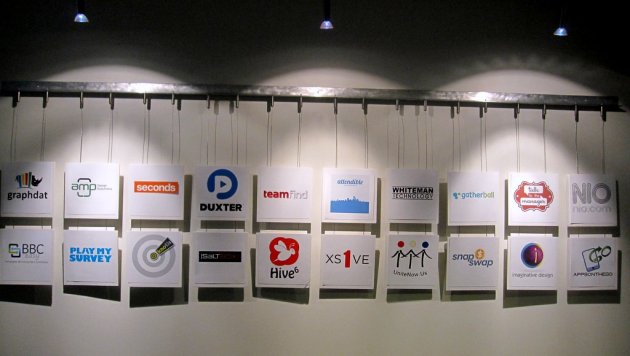
Every day is unique at SURF. With the diverse companies inviting friends, families, customers and advisers to take a tour, we have always a different mix of people. The companies run the full gambit from medical and educational to gaming and cloud services (and payments!) and any given day you will find yourself in a conversation with someone who can teach you about a new industry or business model.

In addition to local visitors, people from more than 30 countries have stopped by for a tour.

This is especially interesting for Seaton, since he spent so many years traveling around the world. “For me, it is such a pleasure to get to meet these wonderful entrepreneurs, get to learn about their plans and see their vision unfold. And sometimes, I get to ‘lend a hand’ by sharing my own perspective, which was learned the hard way … my own struggles with building my businesses,” said Seaton.

According to Neil Bergquist, the year has been “Wild, it’s nothing what I expected but has become everything I wanted it to be!” He also added it has been a huge learning experience for not only him but also the entire SURF management team.

To say the last 12 months have been wild is an understatement. My take is it’s quite possibly the best place to plant yourself as an early-stage founder in Seattle looking to soak up startup knowledge and wisdom. You could meet possible cofounders like I did, engage in numerous happy hours and gatherings, learn from various service professionals and continuously meet interesting people. All those are important, especially when you are just getting out of the gate.

“During the last 12-months, we have held about 200 events. Topics covered included two main areas: Business Development and Programming. For the business development, we had professionals present detailed informative sessions on marketing, corporate formation, intellectual property, employment issues, graphic art, go-to-market strategy and much more. For the Programming side, we held meetings where programming languages were discussed and demonstrated. For example, Ruby on Rails, PHP, MySql, Scala, Android, HTML5, XCode and Windows8.”

So what’s next for SURF?

Neil mentioned expansion is on the horizon but the need to operationalize (which comes with growth) is paramount. They will soon be adding a complex educational program for members – both in programming and business development. Seaton strongly believes programmers need to constantly learn about the new features of their particular programming language and hopes the education can be supported by a grant.  “These languages are very dynamic with new features added almost every day. Without vigilant study, a programmer may actually go backwards and may ultimately ship an obsolete project. I know this … because it has happened to me.”

He’s totally right. No matter how seasoned an entrepreneur may be there is always a need to learn the latest perspectives. For example, Twitter and other social media tools have forever changed the way businesses promote their products, services and even their existence. We all, regardless of age or experience, need continual education on how to leverage the latest technical advancements.

I can tell you 12 months ago I had no idea I would be sitting here thanking these two individuals for not only opening their doors for me and my team but changing the Seattle startup landscape in the process. It’s amazing what they have accomplished in such a short period of time and I can only imagine what this next year will bring.

I know one thing for sure – those typical “two guys in a coffee shop”, even though they are working dutifully, are definitely making a mistake.

Blood + Sweat + Tears + Code + Polish + Sales + Luck = Startup

Startups are tough…..  Here’s a simple equation to get you headed in the right direction.

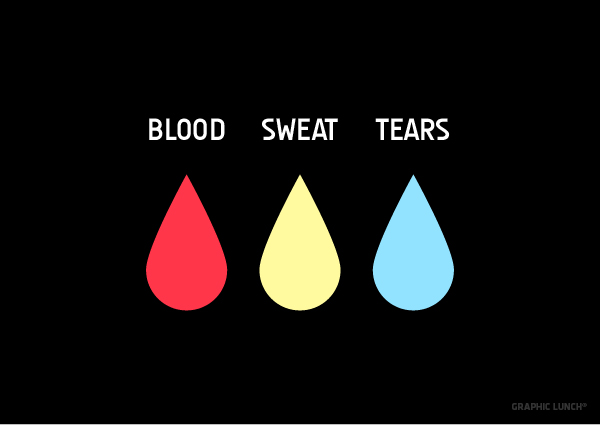
Blood + Sweat + Tears + Code + Polish + Sales + Luck = Startup

BloodSweatTears_02

Blood – Like an initiation to a gang, founders basically cut their hand and make their pledge to build a successful company.  No Blood, No Commitment.

Sweat – A massive work ethic and a JFDI attitude  will be required to break down all barriers and knock down all doors along the way.  Better bring your gloves, water bottle and a sweat towel.

Tears – You will feel pain.  You will cry.  It’s ok.  A better way to think about it is if you haven’t cried because of your startup experience you are on the road to nowhere.  Comfort doesn’t equal success.

Code – Something needs to be built and someone needs to code it.  Piecing together other services or just pulling API’s is not defensible long term.  Figure out what you – and only you – can create and then protect the IP.  Once you build the secret sauce you can outsource all other technical needs of the product.

Polish – Design is quickly becoming the great differentiator between the good, the bad and the ugly of technology.  User experience, or how the end user interfaces and understands your product, should be your number one focus.  If a user doesn’t enjoy using your product why should they tell their friend to use it?

Sales -Plain and simple, customers pay the bills.  A startup’s need for sales and marketing talent is still undervalued in today’s technical heavy Silicon Valley.  Minus a large investment, your startup will wither on the vine if no revenue is ever generated.  And if VC’s ever do invest they will want to see revenues, so either way sales and marketing are a core function of startup success.

Luck – Perhaps the most important of all is luck, which unfortunately is out of the hands of the founders.   But the saying goes “you make your own luck” so being in the right place, at the right time, in the right market, talking to the right people and releasing the right product all can be influenced by the founders.  The more chances you take the more lucky you get so get out there and get discovered.

Pretty simple stuff.

Marley Said It Best: Tears In Our Eyes Burn While We Wait For Our Turn

One of my favorite songs is Waiting In Vain by Bob Marley.  I cannot put my finger on why I like it so much but smooth rhythms coupled with intriguing lyrics make for a timeless classic.

I heard it today on the way into the office and it got me thinking about one of the strongest lines in the song, “tears in my eyes burn while I’m waiting for my turn.”   Although one could see many different angles on Marley’s claim, I sense he is in pain from a past lover he hopes to reconnect with once again.  And before you pass it off as just another heartbroken lyric I should point out another way to think about.  He’s waiting around, frustrated, waiting on someone or something to happen and not living the life right in front of him.  He’s so distraught he can’t do anything else.

I think entrepreneurs can identify with that, can’t we.

Deep down in the song I see some interesting lessons from Bob Marley.  Entrepreneurs are very strong individuals but they are also very impatient animals.  We want (and even believe) good things will happen to us quickly and with the least amount of effort.  This is simply not true and fatal to the entrepreneur if not fully understood.  Good things take time to develop.

We also tend to get very emotionally wrapped up in what we are doing and when things don’t go our way it can be devastating.  So, the usual result is we pound away against the brick wall as we complain about our circumstances to anyone who will listen.

That’s no good for anyone.

It’s pretty easy to find yourself waiting in vain for your turn.  Your startup or career might not be on the growth trajectory you had initially hoped for and now you find yourself frustrated with each passing day.  You may find yourself – more or less – waiting for the big thing to happen to your rather than going out and actually making it happen.

“Why didn’t he invest in our company?  Can’t he see we’ll be the next Facebook?!”

“No one wants to use our product… what am I doing wrong?”

Notice these are coming from a negative direction… Unfortunately, if you are asking questions in vain you are heading down the wrong path.  These are simply the wrong questions and the wrong perspective to build your company with.

The questions you should be asking include:

“why were users attracted to this idea in the first place?  What problem or issue is still there we need to solve?  Is it maybe we just haven’t found the fully baked solution?  How can we take a slightly different view of the problem we are trying to solve?”

As you can see, these questions lead to positive outcomes, breakthroughs or new discoveries and will help any entrepreneur or startup get better aligned.

Yes, I even felt myself in this mentality lately and have made a commitment to stop at the moment notice I am going that direction.

Don’t wait in vain.  Just go out and make it happen.

Should He Stay In Grad School Or Start His Own Company?

Below is my response to a recent email I received from a follower asking some very important questions as he ponders his own entrepreneurial journey.   While I was responding to him it occurred to me you too might be grinding over the same issues.  So here’s my answers to his questions.

His questions are in bold.

I am curious if you are having the same thoughts and if you agree with my positions.

=====

Hey ______,

Great to meet you and thanks for reaching out with your questions. Glad you are a fan of Seconds!  First off I commend you for considering a direction as a founder. It’s one of the most exciting experiences of your life, but also will probably be the most scary and challenging. Just know I wouldn’t second guess myself for the world!

1. I’m toying with the idea of quitting grad-school and going full-time on my 4 month old startup..what is your philosophy on the value of education in school vs education via building a business?

If you are serious about your startup, quit school now. In my opinion, grad school will always be there – but your window of opportunity in tech/business will not always be there. Business climates change, technology moves forward, your solution (the idea) will probably not be applicable in its current state a few years from now so if you see something right now – go for it. You will also learn a hell of a lot more about the real world and how to live a successful life when you fully commit to building your startup. The ability to build a product, how to evaluate the market, figure out your product positioning, learning the ins and outs of VC’s and raising capital to fund your business, talking with larger companies when doing business development deals, hiring, firing, leading a team of people, conflict management, doing reviews and salary negotiations, budgeting, cap table/equity allocations, etc…

Do you think grad school will actually give you those experiences in a hards on, real life environment?

2. Do you think it’s possible to build a meaningful business in this modern age of automation without hiring anyone?

It is possible to build a profitable, cash flow business without hiring anyone. If you are technical and can build out the tech side of things, than yes you might be able to go at it alone. And this is probably what you should do until you can affordably bring on others to help you.

In terms of meaningful business and company, I would have to say it will require others to fill in the gaps and help you create the right culture for your company. In my opinion, meaning comes from purpose, passion and culture. It’s the “why” of the organization. “why does your company exist?” is the question you will need to answer. Even in today’s high-tech automated world, there are things only us humans can do, and do well. I would suggest finding others to help you fill those gaps.

Plus, life is more fulfilling when you have others there to experience it with.

3. What’s the hardest thing you’ve ever done as an entrepreneur?

Ironically, the hardest thing I have done as an entrepreneur is quit my job and going out on my own to build a sustainable company. It’s like being a trapeze artist without the safety net, and it can be really scary. Truth be told, Seconds is not all the way there yet and I am still fighting in the trenches of entrepreneurship, trying to build my company as well as survive through life. It’s a full contact sport. You have to be ready to do more than you ever thought you could with less money than you ever thought was possible and with it taking longer than you ever thought it would.

But to me, that is the most fulfilling aspect of being a founder. You get to overcome insurmountable odds and do things most people are too afraid to do. You get to live your own “Rudy” story. I don’t look at entrepreneurship as a way to get rich or famous, which happens from time to time. I look at it as a duty to move our society forward; a positive contribution to our world. And in the end, that is one of the most rewarding feelings anyone can be given.

Hope that helps!

Ultimately The Tech Needs To Disappear

In this video Hosain Rahman, CEO of Jawbone talks with Kevin Rose on subjects ranging from Jawbone’s startup phase and the future of wearable technology.

About 30 mins into the conversation when referring to Up, their new wearable wristband movement tracker, Hosain mentions something about how ultimately technology just needs to disappear.  More specifically, he says people are most concerned about the look and feel of technology they are wearing over what it does for them.  Only if they feel comfortable and believe it is stylish will they then fall in love with idea of wearing it each day.

It’s a great insight into how to both build something people will WANT to use as well as something that actually WORKS.

Although we are not building wearable technology products, this is something I have been thinking more about recently.  The best technology basically disappears or is very subtle in operation in the background, allowing an person to more easily go about their life.

Think about Uber.  You click your location and put away your phone.  Then a short time later a black car arrives, you get in, they drive to your destination and then you simply get out of the car.  Payment and credit is all taken car of in the back end and out of sight of the consumer.  It’s beautiful.

This is a great conversation and you get the feeling Jawbone is going to be a major player in the coming wave of wearable technology.

Seconds Is The Fastest Mobile Payment Method Involving Dwolla Or A Credit Card

As the name suggests, Seconds is the fastest way to make a mobile payment using either Dwolla (digital cash from bank account) or a credit card.

If you are familiar with Seconds you may already know you a transaction can be completed by simply texting the merchant phone number with a keyword (that they previously set up) or any dollar amount value you wish.  With an account already created and payment credential already in place, the transaction instantly takes place securely in the cloud and you are done!

No text boxes to mess with, pinching and zooming or other hassles.

It’s that easy.  Watch this video to see just how easy Seconds payments are…

If you are walking through the mobile web experience for the first time with no previous Seconds account, you will see below we’ve made it a piece of cake to complete.

Click here if you are interested in accepting payments in Seconds >

Go to getseconds.com

payment1

Find the merchant.

payment2

Input the amount.

payment3

Complete payment with Dwolla.

payment4

Or complete payment with credit card.

payment5

It’s that easy.

Click here if you are interested in accepting payments in Seconds >

Is It Possible To Be An Entrepreneur And Not Be Selfish?

Going through a recent state of self reflection a few things became clearer to me.   One of them is how much being an entrepreneur brings out the selfish side of human beings.  Recent experiences have held a mirror to my face to illustrate this in my own life so I am genuinely asking the question, “is it possible to be an entrepreneur and not be selfish?”

It’s an interesting and possibly shocking question, I know.  Pardon me while I think out loud on the subject.

Breaking it down further one sees where two worlds collide – personal and professional – blurring into 0ne and the same, resulting in the entrepreneurial individual acting very selfish.  They instinctually strive to get what they want both in business and in their personal life. Most early stage founders are scrappy, shrewd and manipulating. Why? Because that is how you end up getting what you want.  The fact is you have to be scrappy and find any opportunity you can to move your interests forward against a world suggesting otherwise.   If not, people will doze you over with their own agenda and force you into a life you don’t want to live.

That angst for being dozed over, for those uninitiated, is the root reason entrepreneurs exist.  The problem lies in when one cannot turn it off once they leave the office.  I think the reason why they can’t is because “leaving the office” just doesn’t happen as an early stage entrepreneur.

An unfortunate reality can be found in the tension created between the good hearted and the driven. Through my self reflection I started to evaluate both those stances and realized it can be very difficult to be good hearted; giving-in and acquiescing to everybody in your life while at the same time driving headstrong to give up everything for your dream as an entrepreneur.  The math just doesn’t work.

After all, selflessness can be defined as putting yourself last, which taken at face value runs counter to what entrepreneurship means to each individual. People start businesses to feed their own needs first. More specifically, Bill Gates didn’t set out  at 19 years old with the vision to donate all his wealth to the less fortunate and cure the world of disease. He set out to become one of the greatest technologist and capitalists the world has ever seen, all the while serving his self interests (and his company) earning massive wealth in the process. Based on stories from co-funders and early employees he was quite selfish in his ways. It was only after he made his billions and conquered the world (figuratively) that he decided to give it back, maybe realizing how selfish he had been during his early years in business.  It’s quite easy to be selfless when you already have everything you want.

The same selfish description has been reported with the late Steve Jobs.

The Characteristics of an Entrepreneur

-Head strong
-narrowly focused
-determined
-hard working
-persuasive
-self absorbed
-obsessed
-delusional

Notice that if all you did was replace the title of list above with “The Characteristics of a Selfish Person” it would still make sense. This is when I realized I am not only an entrepreneur but I am a selfish person. For someone who prides himself on being a “good hearted person” this is a tough pill to swallow.

It may not be good news for everyone involved but I think its important to understand it and possibly unravel how to work/live with someone who suffers the entrepreneurial disease.

Founders
Newly minted entrepreneurs, or people considering starting their own journey as a founder need to take note of the inherent flaws. You may already posses those characteristics and believe you were born to be an entrepreneur but if you don’t take account and ownership of your DNA, it will be a rough go.  Starting a new venture is very difficult and not for the faint of heart.  It also is not for the selfless, since the ability to overcome the massive inertia requires A LOT of inward focus – which means less time spent focusing on others in your life. You will self evaluate. You will self doubt. You will self organize and self determine. A lot goes on inside the mind of an entrepreneur focusing on their “personal” situation and thus replaces thoughts involving others.

You need to know this, anticipate it and determine how you will live with it.  Others suggest work life balance and the like (which to an extent I do agree with) but at some point you will need to pick which direction you will lean.  Thinking you will be able to lean both directions at the same time is futile.  Be prepared to make A LOT of sacrifices for a period of time in your life.

Family
Family members of an entrepreneur need to understand Entrepreneurship is a disease, and the symptoms are all listed above. Given that, practice a healthy balance of both understanding these inherent flaws in the person you love and firmness in your own principles.  This will help you navigate the unknown road ahead. You need to be ready for challenging circumstances, tough conversations and compromises from both sides.

You also should know that yes, most of time you are right and we are wrong.   But we are actually seeing it from a skewed perspective – similar to how a schizophrenic might argue something you have no idea what they are talking about.  So rather than fighting about right or wrong, gray or grey, work with us in how we can move forward with the least amount of collateral damage possible.  You should also read this book by Brad Feld – Startup Life: Surviving and Thriving in a Relationship with an Entrepreneur.

Friends
Close friends of entrepreneurs should know that although we try our best we are going to drop the ball, especially during the early stages.  We will not be able to hang all the time, go on trips with you to cool places or grab drinks on a regular basis.  Trust me when I tell you your founder friends really do want to grab drinks but they feel inferior if they need to depend on you to pick up the tab.  We also work crazier hours than your 8-5 job so don’t be surprised when you text at 8 or 9pm and we’re still hacking away in the office.  Most importantly, we just need your support and secretly we dream of hanging out as if nothing has changed from the “back in the day”.

After all this you may be wondering why entrepreneurs give up so much and risk their livelihood?  We do it because we love the challenge and firmly believe we were supposed to do it, whatever that means…

You may also think I am off base with all this selfish talk, maybe even saying to yourself “not true… I’m an entrepreneur and I’m not selfish”.  As with all things, this topic is not black or white but probably a smearing of grey (or gray).

I am curious of your perspective.

Evolution Of A Founder: Up, Down, Up, Down, Up, Down, Sideways, Up, Down…

Much has been written about the founding experience yet I still feel like more needs to be said about the journey.  Since it is unique to all of us, no one article or blog post will be a sufficient summary of what to do and how to do it.

Life is never that easy.

Hilly RoadThe thing is, you will read one post from someone who is on the upswing, just having raised millions of dollars of funding or sold to Facebook and they’re all giddy about life.  Good for them!

Next article you will hear from someone who has just seen their business tank and is reeling in pain and defeat. Bummer for them.  You will start to notice it’s up and down, up, down, up, down and maybe a little sideways sliding in the middle of all of it.

I think the best approach (and the one I am employing) is to make a daily habit of reading other people’s perspectives and experiences, especially as founders and investors.  This helps me achieve and maintain a pulse of how to best navigate the choppy waters ahead.  I don’t pretend to know everything and don’t expect any one person to know it all either.  So, I make it a habit to cast a wide net on my daily learning.  I grab from other founders and entrepreneurs.  I pull from investors and VC’s whom I have an affinity for in their writings.  I gauge how the startup community is doing based on TechCrunch, Pandodaily, GigaOm, TheNextWeb, VentureBeat, BusinessInsider and other media outlets.  I cast a wide net, gather the information, digest it and make it my own.

The beauty of entrepreneurship is that it is unique in circumstances for each one of us.  Some of us have it easier.  Some of us have it harder.  Some were born into money and instantly have financial backers for their projects.  The rest of us – we must feel and find our way through the room with no lights on.

You, as an entrepreneur, need both perspectives.  You need to learn about how to deal with the good, the bad and the ugly if you are going to survive as an entrepreneur.  Om Malik, founder of GigaOm wrote a great piece recently on his journey as a founder.  Below, I have grabbed a few lessons I saw in it I felt were pretty telling:

Lesson Learned: You have to walk before you run. As a founder, you often don’t understand the gulf between your vision of the future and the reality in which a business exists. It is important to find the right balance between the two.

Lesson Learned: Shun consensus. Don’t be shy about making difficult decisions. If you have conviction, zig when everyone is zagging. After all, the worst that can happen is that you fail. If you don’t try, you don’t fail. You don’t fail, you don’t learn. You don’t learn, you will have failed anyway.

Lesson Learned: People who believe in you also want to succeed. They will work better if you encourage them, not micromanage them. Empower them to win.

Expanding on what Om is eluding to, I believe founders don’t really understand what they are getting themselves into and where they are going right out of the gate.  And that is OK, even expected.  At the time of founding (the)Facebook, how was Mark Zuckerberg supposed to know he was going to create one the largest web service in the world, reaching over 1 billion people (and still growing) making him a billionaire.

No way he could have known that.  If he knew that it would have scared him so much he probably wouldn’t have continued.

Yet he walked before he ran.  He knew he needed to get other smart people around him to help build out his vision.  He started by just focusing on Harvard.  Then Yale.  Then the Ivy League.   Then other universities.  Then high schools.  Then everyone.  Walking.  Before.  Running.

At times, it’s almost easier for founders to have too large of vision and be blinded by what they see.  They end up frozen by the blindness and not even focusing on the right foot being placed in front of the left.  If you didn’t catch it, that’s all that is required for walking.

Right, Left, right, left….

If you don’t try, you don’t fail. You don’t fail, you don’t learn. You don’t learn, you will have failed anyway.  

A truer sentence has never been written.  Failing, or learning, is the essence of entrepreneurship and must be embraced by anyone setting out on the journey.   Success is only a result of entrepreneurship.  I think we get those two facts confused as we blindly pursue our ventures, pushing forward with all our might and not taking into account what we are learning in the process.

I am lightyears ahead of where I was when I started Seconds just 15 months ago.  Yet, if I am not careful I will take a bianary view of my last 15 months and see there has not been a huge round of funding raised, acquisition to Google or IPO on the NASDAQ.

Does that mean I failed?  Hell no.

But that is what the media tries to tell us when they write posts saying “XYZ shuts down!”  StartupX fails to raise money, CEO quits

I urge you to dive deeper into the details when you read that stuff, since they are playing the age old game of news reporting. If you dive further into the story, researching the founders and finding their blogs, you will learn a lot more about the journey and probably the real reason why they chose to go a different direction.  Although lack of resources lead to dying companies, those founders will teach you more about how to start and grow a company than any “XYZ startup raises $10m series A” funding article will ever teach you.

Study the ups and the downs and figure out how others navigated the choppy waters of entrepreneurship.  Cast a wide net and allow all perspectives to sink in to your subconscious so you can make it your own.  No one person or blog post can tell you how it is and what to do.  It takes years to learn all there is to this game.

Actually you will never learn it all.  Just enough to be dangerous.

The White Screen Of Death Can Be A New Beginning of Sorts…

Well, I was greeted with the white screen of death on my MacBook Pro the other day. Similar to the blue screen of death on the Windows machine, the white screen of death means something has gone terribly wrong. It’s Apple’s way of saying “you will not be able to use this machine.”

Regardless of the situation, the reality is you are handcuffed. You are sidelined. You are “S.O.L.” as they say.

iMac-ScreenOfDeath

And it sucked.

It got me thinking how tied we are to our devices and how drastic the ramifications seem to be if something goes wrong. I don’t necessary like this dependence but the more I think about it the more I realize there is not much we can do.

Are we really at that point in society where a broken machine means a broken life? If your laptop goes down, will you still be able to be productive each day? If you are like me, the sad reality is probably not.

What would happen if your current device was stolen, lost or died? And what about the information on it? Would the information on it be lost forever?

Laptops Need TuneUps Too

As I diagnosed my situation it became clear the issue was with the OS and I was needing to re-install a new operating system.

For background, this machine was given to me by my co-founder when we started Seconds about 16 months ago. It is a 4-year old MacBook Pro, which he had used previously for his dev work before he upgraded. As he gave it to me I realized it was stack full of apps and programs used for development work – stuff I wouldn’t really be using. I also noticed it was running Lion, an older version of the operating system for Apple. I basically got lazy and didn’t upgrade when Mountain Lion came out.

During the last year or so I started to notice the ‘stress’ on the system and felt this specific outcome was approaching in the near future. I was also seeing that pesky pinwheel more and more (which I have to say is one of the most frustrating things). It was only a matter of time before the straw broke.

It broke on Sunday and I was sidelined.

Anyways, my current CTO Justin help me re-install the operating system. We went through the process and booted it up only to see a brand new experience with none of my old files there. They were all gone!

The amazing thing is I wasn’t upset.

Being Smart And Use The Cloud

When I was handed the keys to Seconds as the CEO (and handed this machine at the same time) I made a conscious decision to start storing all my important docs in the cloud. The combination of using Dropbox, Google, gmail, and Google Drive has allowed me to have pretty much everything at my fingertips, safe and ready to use on whatever web connected device I am using. I do recall a few random docs and images on my hard drive which are now gone. But nothing which would be devastating to my life or my business.

If you have not made this decision you must make it now. Do not save anything to your hard drive any more, save it to a cloud storage service. If you must save to something physical, go get a extra hard drive and start the habit of backing up once a week. But do not make the fatal mistake of saving something important to a mortal machine. You will regret it sometime in the near future.

So I am back to square one with this machine. There’ s a small amount of apps on here right now but not much more. I will need to download some design/wireframe/task oriented apps that I use during our product development cycles, but that is about it.

But it feels great to have the machine back up and running. I shedded the excess weight. The machine runs faster, and with the new OS Mountain Lion it feels swifter and more up to date. It feels like a new machine.

It also feels like a new beginning.

At times, we just need to press the “restart” button and start fresh like I have done that with my machine.

Maybe it’s something you can do in other areas of your life as well.

Entrepreneur, You Must Realize It’s Best To Live With Your Doubt

We all have doubts.  Knowing this truth, it’s better to come to grips and embrace it rather than run away from those doubts.  All they will do is haunt you.

I recently read an interesting post written by Franscisco Dao touching on the concept of living with doubt.  It’s very much worth the read.  This paragraph in particualar really struck me.

The truth is most entrepreneurs never overcome their doubt. In fact, the day you overcome all doubt is likely the day you become blinded by your delusions of control and perhaps even greatness. What entrepreneurs really learn to do is live with doubt. And learning to live with doubt, being able to accept doubt, is a much more powerful thing because it allows you to continue questioning assumptions while still moving forward in the face of uncertainty.

Living with doubt.

What does that mean?

I take it as instruction to embrace your fears and doubts; leaning into the pain of challenge instead of running away from it.  This mentality allows you to become truly authentic in your ways with yourself and other people.  It allows you to be fully human, to accept that you are not superman and you have troubles, challenges, struggles just like everyone else.  I hope you realize you can talk about your worries and fears with others.  It’s ok, it’s human.

Just this week I met with another entrepreneur looking for some direction and advice since he is going through the same “stuff” as I have been recently.  Namely, his startup is taking a bit longer to get off the ground and attaining a sustainable operation, so in the mean time he is seeing the end of his financial runway approaching – fast.  “What do I do?!” he was asking me.

No doubt, I am in the same boat.

Here’s what I told him:

To tell you the truth, more startup founders are in that boat than not.  Most founders are struggling with massive pressure from every angle of their life – business, family, friends, financial, social, etc – and are scared as to what will happen in the coming weeks, even if they don’t tell you.  You are not alone, you just have to navigate it.

The point I grabbed on to most from Francisco’s post is the fact that a majority of founders feel like frauds when the reflexively respond to people’s question of “how are things going?”  Inevitably, they say “Great!” “Crushing it” or something else that eludes BS confidence and fakery just so they can move on to a different topic.

But it’s ok.

It’s ok to be humble.  It’s ok to let your guard down.  It’s fine to say things like “things are tough dude!”and ask what they did when they found themselves in that situation.

Because you know what?  The truth is life is hard, especially as an entrepreneur.

Anything else is BS.