I Was Just Told “You would not have made it through the weekend”

“You would not have made it through the weekend”

Today the dentist told me I would have been in the hospital and would have been lucky to make it through last weekend had I not made an emergency appointment to get an infected wisdom tooth removed last Friday instead of this coming Tuesday.

“These infections kill people you know?” “Once it reaches other areas of your body it causes irreversible damage.”

I am now left to ponder: Is the all out pursuit for your dream worth dying a preventable death?

After putting off dealing with a bum wisdom tooth for way too long I was hit with an infection deep in the root of one of my wisdom teeth. It was the worst and most painful thing I have ever dealt with. It started as some dull pain at the beginning of the year upon which I would take some Ibuprofen and dealt with it. But it grew worse and hit an 11 out of 10 on the pain scale last weekend. The infection started spreading quickly throughout my jaw, became very swollen and unbearable. On the left that is me , swollen and taken over by infection the day before the surgery. It was terrible, not to mention extremely dangerous. I couldn’t think straight, add much value or even lead a team meeting with any energy at all.

Frustratingly, it hit the same week we were planning a meeting with some angel investors and so I was initially trying to hold the pain off, have the meeting on Friday and get it taken out the next Tuesday. Well from what I experienced and what I know now, I don’t think I would have made it to Tuesday. Once an infection like that spreads to other parts of your head, neck and chest… you’re done.

On Friday, at the same time as the others were at the investor meeting, I went and had surgery to get the tooth taken out. And whoa do I feel better! I am a bit swollen from the extraction but infection free and really feel like a new man.

Lesson learned: deal with your health issues up front, some things are more important than the business you are building. I can be guilty of putting everything aside to focus on the main thing in front of me so this was a wake up call to be aware of creeping health issues.

Dodged a bullet on that one.

As an entrepreneur still trying to make it I don’t have the extra cash for insurance right now so I just pushed it off thinking it would take care of itself. I did not want to let anything get in the way of important meetings and work as we prepare to move Seconds forward with strategic partners and investors.

But what is more important than your health and wellbeing? Please take it from me, get your health issues in line. Take some time off if needed. Use credit or a loan if you feel you cannot afford to spend the money to get an ailment taken care of.

Do not end up like that idiot on the left with a weird growth on his face.

@jnickhughes

10 Simple Steps To Making A Kick Ass Explanation Video For Free!

Since Seconds is currently self funded, we have a pretty tight budget when it comes to PR and media exposure. But thankfully we have a “make your own for free… and pretty soon others will come around to make it for you later” mentality.

So when it came time to get a basic explanation video up on our site, we decided to do it ourselves rather spending money on a contracted specialist or video generating sites like broadcast2world.com.

Problem was, we really didn’t know where to start. That is where the creativity of Seconds team member Brent Crocker came in. He used Keynote to animate  and produce it, and while not the greatest App to animate a video with it got the job done. Basic image overlaying works great!

Judge for yourself, the video is at the end of the post. Here’s how he did it!

First get a solid script:

1: Determine what points do you want to make and write them down.

2: Think of a way to explain those points to your audience in a concise way.

3: have someone else on your team read through it, ask people if they understand it! This should be at least the start of your script…

Then Make the recording

5. I find that almost every major change to the script happened while I was making recordings… its something about hearing yourself in the recording.

note : I actually use the mic in the Apple headphones to do all my recording, so don’t make the excuse that you don’t have the right equipment! Record short sections of the script and pieced them together, its better to have short recordings to play with!

Determine what animation or imagery will go with the script:

6: Now is when you should be making the visual aspect of you film, after you know what you’re trying to say and how long it takes to say it!

7. With little time you should be able to make some kind of scene with an image editor, I used PixelMator, but anything that can create a clear background will work. Basically, if you can draw it, you can make it this way…

note: Try and figure out what best tells your audience what you’re saying with an image or animation.

Create some simple animations

8. For most scenes you will need a background and something to orient you (like a desk, building, or I even used a couch), but don’t make the scene too busy. Overlay your orienting image over some kind of basic background, black, white, textured, clouds… it up to you.

9. To create an image, grab a texture image like paper, cloth, or rock in the color you want (you can also adjust the color in the image editor). Then cut it to the shape you want. Make sure the image has a transparent background so you can overlay it on other images.

note: you can choose to make it look slightly 3D, but if you want to get through it quickly keeping to 2D animations works the best.

10. Most animations can be done in a program like Keynote/PowerPoint, along with scene changes. Moving images onto the screen and resizing as they come in to give the idea its getting closer. This gives your video some great movement so you can bring to focus the points you are trying to make. You don’t need to make fancy animations to get your point across, just use the animations to move through your points.

note:  focus on creating images that look good, but aren’t too hard to make.  This whole process should take you a week at the most.

Set the recording over your video and get the timing tuned in and you’re ready to post!

The Best VC Pickup Line Ever, According to CNET

This is awesome!

Seconds was covered by CNET journalist  and he opens the article with:

“Nick Hughes, the CEO of , has the best VC pickup line I’ve ever heard: “Last year, 2 trillion SMS messages were sent in the U.S., and not one reached a local business.”

Read the article here.

Seattle Against SOPA – Stand Up and Fight on Jan. 18th

The future of the Seattle tech community (and the internet as a whole) is in jeopardy.   Congress is rushing to pass both the  Stop Online Piracy Act (SOPA), H.R. 3261 and Protect Intellectual Property Act (PIPA) S.968, which will have drastic and unintended repercussions on law abiding U.S. web businesses.

Zac Cohn is helping to organize a number of gatherings to take collective action and let the state legislation know what you think.  Their goal: “to talk to people on the streets, educate them about the dangers of SOPA/PIPA, and then convince them to take out their cell phones and call their Senators and Representatives right there, on the sidewalk.”

Here’s a little background:

The Internet and information technologies have created a renaissance in startup innovation in Seattle. Thousands of Seattleites have been inspired to become entrepreneurs creating thousands and thousands of new jobs and offering professionals in many of Seattle’s traditional industries the opportunity to start new careers participating in the 21st century global economy.

However, Congress is in the process of rushing through legislation which will not only severely damage the Internet as a marketplace and platform for entrepreneurship and open innovation, but will also seriously impact the ability of our Seattle tech community to continue to generate jobs, grow and flourish. Within the next two weeks, the US Senate is planning to bring the Protect Intellectual Property Act (PIPA) S.968 to the floor for a series of votes to ensure its passage.

This legislation would give the government and corporations the ability to censor the net in the name of protecting creativity simply by convincing a judge that a site is “dedicated” to copyright infringement. PIPA would give the government and corporations the ability to shut down any site connected to an accused copyright infringer. Its companion legislation in the House, the Stop Online Piracy Act (SOPA), H.R. 3261, contains many similar problems, as well as threatening ordinary users with jail for streaming any copyrighted work – even just video of themselves singing a pop song.

If you’re still in the dark on SOPA, this is an excellent explainer video from Up With Chris Hayes on MSNBC that will very quickly bring you up to speed

More importantly, the legislation amounts to a wholesale re-engineering of the open web in a way that would allow the US government to prosecute Internet users without due process, which in turn would discourage innovation, limit investment, and hurt the our economic future.

You can read and hear more about this dangerous and hurtful legislation here: FightForTheFuture.org/pipa orAmericanCensorship.org.

For more info and to get involved, go to SeattleAgainstSOPA.com.

How To Make A ‘Bet The Company’ Decision

There are times in the journey as a founder you may find yourself in a decision that becomes a “bet the company” decision.

These  decisions are not easy by any means but as the statement points to they have the power to determine the outcome of your company.

Make the wrong choice and you might place your startup in such a compromising position it may never recover.  But make the right choice and you have just changed the trajectory of your company, and possibly history.  No doubt these decisions created the Intels, Apples, Facebooks and Googles of the world.

So how do you know when you are siting face to face with a bet the company decision?

First off, you will know by the all too familiar gut feeling that something big is about to happen.  More weight will be on your shoulders and you will hesitate making a snap judgement because you recognize this could be pivotal and you need more information before making the decision.

You will be saying things like “shit… don’t screw this up” and “finally, this is our chance!”

You also will most likely be pressured by outside influences, whether it’s another company wanting to make a deal or market influences putting pressure on your next move.  Bet the company decisions usually take the form of “if X than Y” outcomes, where X is you and Y is another company or market entity.

Lastly, you will sense that things will be different after this decision is made and there will be no going back.  It’s like the “talk” in a relationship…. something will change going forward for better or worse.

Here are some things to think about when making a bet the company decision:

  • What do we have to gain by this decision?
  • What do we have to lose by this decision?
  • What is our current trajectory and how would this decision affect it?
  • If we don’t move forward, what happens next?
  • Will the brand take a hit, or will it be improved as a result?
  • Can we afford NOT to do it?  Can we afford TO DO it?
  • Who is affected outside our walls by this decision?

Next, draw out scenarios for all possible outcomes, lay them out  and evaluate each according to your business goals.  Most of the time there is not really one “right” answer you are looking for but more of a “what makes the most sense at this time” answer you can move forward with.

Finally, after deliberation and evaluation you must go with your gut instinct.  Making a “bet the company” decision will surely change the direction of your company but the decision must be made confidently.  Once made, there shouldn’t be any looking back, only forward.  If things don’t work out later on you will be presented with other options to make another decision at that time, but currently your thinking must remain on the present decision at hand.

If it’s not obvious by now I have been presented with a “bet the company” decision and still determining how best to approach it.  I can’t wait to tell… but for the time being I will let you off the hook.   Thanks for letting me think out loud and I hope you are now more confident in your “bet the company” decision.

@jnickhughes

One Big Problem: The Worlds #1 Search Engine Is Not The Worlds #1 Social Network

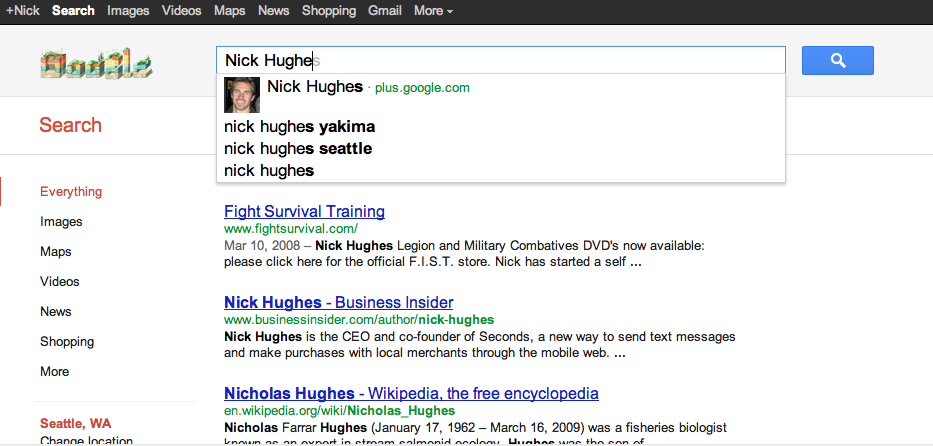
Google just made a big, bold move and integrated Google+ profiles into their search results.  Yesterday, Google launches Personal Results,Profiles in Search, and People and Pages, new features of its core search product that mark the real beginning of Google’s social search era.

It looks something like this:

The big problem with this is that Google, the worlds best place to search and find information, is assuming my Google+ profile is the most relevant social profile about me and so it should be surfaced first.  Well, I will tell you this:  It’s not.   I rarely (if ever) update Google+ with links, updates and information.   LinkedIn, Facebook, and Twitter are better representations of me and my interests.

Sorry Google.  You are not my default social identity.

When Google+ launched months ago there was a strong reaction around the fact that we don’t need another social profile to keep updated.  There are already too many and this fact still remains true today.  Interestingly, I have seen less Google+ requests lately than I did last fall.

I bet this is the same for millions of other people.  I bet more people keep Facebook, Twitter and LinkedIn updated and informed than their Google+ profile.

Am I correct?

@jnickhughes

Here’s Google’s Homepage 1999 vs. 2012. Can You Tell The Difference?

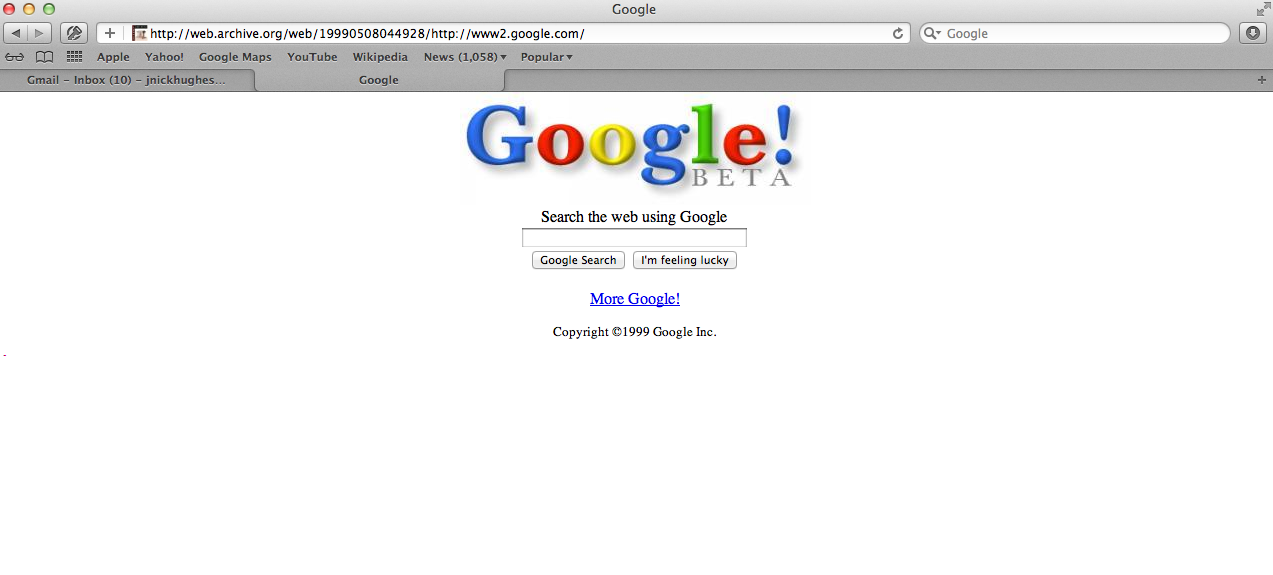
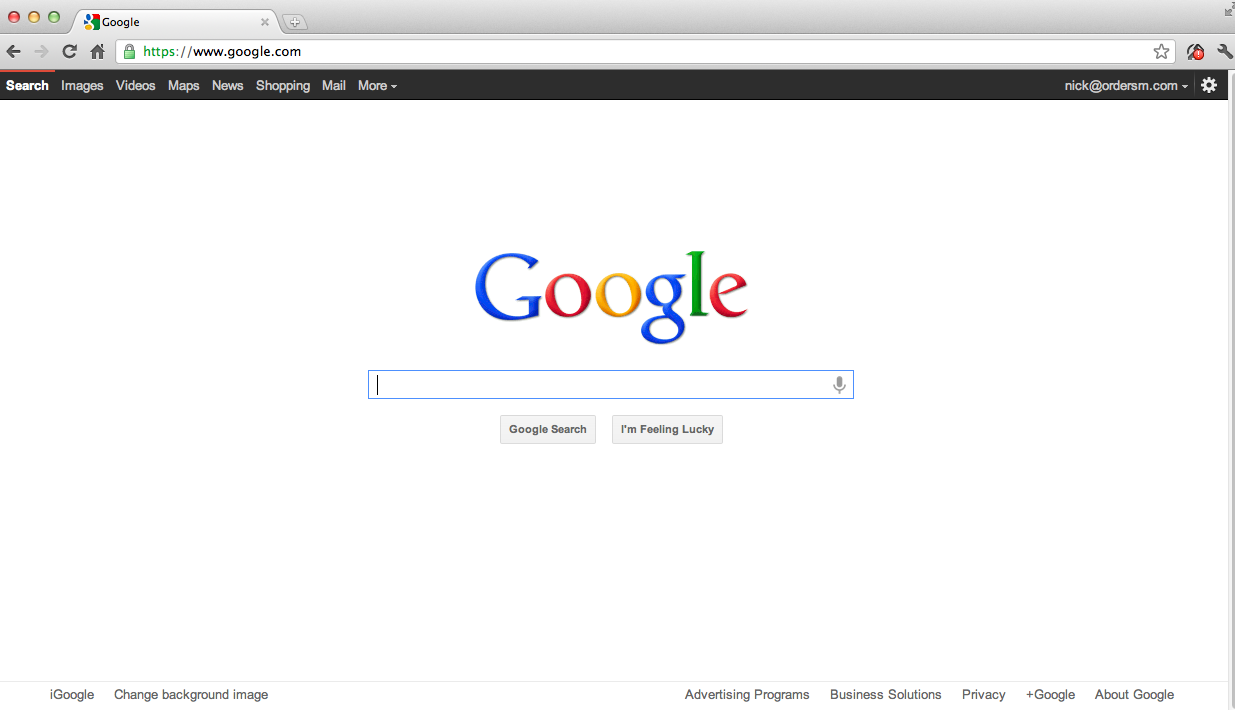
Today’s design lesson:  Don’t change what’s working.  Here are two screenshots of Google’s homepage; one from May 1999 and one from January 2012.  See much difference?

1999

2012

May 1999 was almost 13 years ago!  The web has changed dramatically since then, yet Google’s search experience hasn’t.  This is a huge lesson for anyone looking to get traction.  One of the most difficult aspects of brining a product to market is user education – meaning after they hear about your product how easily do they start using it.  It’s important because when a user knows how to use a product or service they will tell others about it.

If they can’t use it, they won’t tell anyone.  It’s that simple.

Google has done many thing correctly, but arguably the best was to design their user interface so anyone could use it.  I bet your Grandma knows how to use Google.  I bet your child knows as well.

Can you say that about your web or mobile service?  Are you making it as easy as possible to use your product?

Want Hyper Hockey Stick Growth? You Must First Endure The Blade

We all love to talk about the companies experiencing massive user growth in a short period of time, generally referred to as hockey stick growth.  Twitter experienced it.  Facebook saw it happen.  Of course Google did as well.  All great companies at one time went from a small unknown startup with no users to a well known company with a massive user base.

A few startups currently experiencing meteoric hockey stick growth are Instagram and Tumblr, incidentally interviewed at a recent Techcrunch Disrupt about managing hockey stick growth.

As fascinating as the hockey stick growth can be, something intriguing happens immediately before the growth period.   Not talked about because it’s not as sexy, Something must be happening before the massive uptick in usage or the uptick wouldn’t happen at all.

So what is it?

I call it the blade.  As you can see, the hockey stick on the right has a flat section (the blade), an angle (the inflection point), and the  rising handle (growth phase).  The blade is the most critical point for any startup because if they get over it alive they move on to the crazy hockey stick growth phase.

Although the Techcrunch Disrupt interview is great and both founders offer a number of insights as to what its like to go through the insane hockey stick growth periods, they don’t really talk about the blade.  My guess is because it’s not as exciting as hockey stick growth.  In fact, it’s tough.  So tough it will make or break a startup.

Blades Require Heat

When referring about a hockey stick, deciding on a blade may be one of the most important decisions a hockey player can make.  The makeup of a hockey stick blade will determine how durable it is and how much stress it can withstand.  A blade — the bottom portion of a hockey stick that may be curved or straight — can help determine the way a player is able to control a hockey puck.  Wood blades today are frequently covered with a composite material, such as Kevlar. Kevlar is a strong, fiber substance that is designed to be used in high stress situations.

Being made of composite, hockey stick blades are malleable and can be shaped to a players advantage.  All it takes is heat.  When a player heats a blade, they can curve it and shape it to their liking.

As if you didn’t know… startups are situations of ridiculously high stress and immense pressure.  It’s almost like you sign up saying ”let’s see how hot it can actually get.”  As part of a startup, you are trying to create the most with the least amount of money, which leads to tremendous financial heat.  You feel heat trying to force the product down people’s throats, working towards product market fit. The pressure is on to prove a specific customer for your product before time runs out.  Lots of late nights, pivots, redesigns and tough conversations will create friction and heat amongst the team.

The blade period – the period of time after launch but before massive usage growth – is one of the most challenging times a team can go through.  Yet, therein lies the test.  The blade test for a startup team involves a number of points: to observe reality that the product is not an overnight hit, listen to feedback, watch available usage metrics, identify what is working and what isn’t, agree on changes to be made, make the changes, reposition the product, polish the messaging and many many others.

The key is to do all this without losing your mind and going crazy.

This situation is extremely difficult for a young team to get through, and that is why most startups don’t make it.  Failed startups don’t ever get to the position of hockey stick growth because they could manage the heat on the blade.   It’s like a right of passage. Show me a (successful) company that did not get over the blade.  The only way to get from launch to hockey stick growth is to get through the heat and over the blade.

Blades Are Short

If done correctly, the blade is just a phase in the life of the company; the shorter, the better.  Flat growth actually shouldn’t last very long if the founders are quick to make needed adjustments to the product, positioning, messaging, and user acquisition strategies.  When great products hit the market, people take notice and users are attracted.

It may be all relative, but some startups only last a few months on the blade, some last years.  Most are somewhere in between.  What does it take to get off the blade?  As I was researching about hockey stick growth, I found this article about the internet and how it finally hit hockey stick growth.  Interesting to note:

The Internet served an important role for a limited number of users, but it had serious barriers to entry. It displayed its messages in monochrome text; no color, no pictures. The Internet had to become pretty and easy. Lessons to be learned include that ease of use, attractive displays, entertainment value, cost-effectiveness, and genuinely new utility are the keys to type-one hockey stick growth.

The goal is to shorten the blade and reach inflection as soon as possible.  Notice how the above statement clearly illustrates the internet grew quickly once it became easy to use, was cost effective, entertaining and useful (of course this is referring to the world wide web.)  These characteristics are  what every startup is searching for in their product.

A lot of the blade comes from not knowing what to change, but a few major points come to mind.  Correct positioning in the market will allow for your product to actually be found by the right audience.  Finding the correct messaging will help the right people/customers to understand your value proposition and start using your product.  As your user base grows, features that help current users share your product will lead to new users.  And the correct distribution model will aide all other aspects and amplify growth.  As these are fairly general, it is for the fact that each action will be unique to your specific offering.

Not to be overlooked, part of putting yourself in the right position for hyper growth is building the right team.  It’s not about hiring, it’s about finding the right talent.  The correct people in the right positions at the right time will only help to shorten the blade and get a startup to hyper growth.

Blades are Remembered

Although any founder or early employee will tell you growth is what they are looking for, the times on the blade is are always the ones the remember the most.   Tony Hsieh, Zappos CEO recalls the early days when they almost didn’t make it…. many times over in his book Delivering Happiness.  It’s a great read for any startup founder or early employee, as he re-lives all the challenging (and fun) times Zappos endured.  You can almost feel the sharpness and heat of the blade they got over.

Microsoft co-founder and fellow Seattle resident Paul Allen spends the majority of his book recalling the Early days of Microsoft, the struggles and challenges they faced on the blade.  I was not aware of all the times he and Bill were scared, feeling little hope for the future of their company.  Can you imagine Paul Allen or Bill Gates fretting over $100?  But… we all know the rest of the story.  I’m just glad they went through it at one time in their life as well!

So the blade is a fact of startup life.  The only questions are: how much heat can you take?  What will you do to shorten it so you can get on with growing your company?  And what crazy stories will you be telling when you do make it over the blade?

@jnickhughes

Why Twilio Will Kill AT&T

Can AT&T remain the 20th century communications powerhouse we came to love (and hate)?  Or will they eventually relinquish their throne to an up-and-comer with a better grip of today’s communication technology needs?

This question can be heard reverberating around the business world like a never-ending echo throughout the grand canyon.  If there is one company that can displace the conglomerate with respects to providing a basic communication platform for the general public, I think it could be Twilio.

Twilio provides infrastructure APIs for businesses to build scalable, reliable voice and text messaging apps.  They provide all this so cost effectively they are seeing massive growth and are a powering a new class of startups, ones that extend their technology to touch almost every part of our society.

To realize my words aren’t mere blasphemy, it’s paramount to grasp the difference between two types of innovation: sustaining and disruptive, these types being best described in The Innovators Dilemma by author Clayton Christensen.  Sustaining innovations are improvements that make the product better, but do not threaten its market.  Disruptive innovation, conversely, threatens to displace a product altogether.  It’s the difference between the electronic typewriter, which improved the typewriter, or the word processor, which supplanted it.

AT&T is the Typewriter.  Twilio looks to be the Word Processor.

The history of AT&T is well documented in the book The Master Switch by Tim Wu.  He describes how the great telephony company, started by Alexander Graham Bell, navigates an incredible path towards dominating the communication wires for most of the 20th century.

What strikes me interesting when I read the great history of AT&T is the repugnance of anything innovative on top of their communications platform.  Was being protective and narrow minded regarding innovation just en vogue thinking of the times?  Or was this perspective so ingrained in the company culture led by visionary (and monopolist) Theodore Vail that it grew stronger as decades past?

They exhibited classic sustaining innovation characteristics.  According to Wu: “AT&T, as an innovator, bore a serious genetic flaw, it could not originate technologies that might, by the remotest possibility, threaten the Bell system.  Disrpuptive technologies, those that might even cast a shadow of uncertainty over the business model, were simply out of the question.”   

More interesting is to wonder if this still the case today?  AT&T is hard at work protecting their lot – cell phones, digital TV, Internet, and the traditional phone service.   So hard at work they are, they fought to acquire close competitor T-Mobile, just another chapter in the centuries long monopolistic story.  Losing the acquisition places AT&T at an interesting crossroads, where they must look in the mirror and choose what type of communications company they should be going forward.   They also seem to be backpedaling on data usage, specifically text messaging, at a time when messaging seems destined to become our main mode of communication.

The real question is are they embracing the new way of business, opening up and encouraging disruptive innovation, from themselves and also from others?  Or are they still about sustaining innovation and stifling anything would that attack their own den?

Twilio, on the other hand  was created to be built upon.  They have innovation running through their veins and pouring out their ears.  Why?  Because they understand the new rules of business – better in the long run to open up, provide basic communication technology to the masses and empower innovative ideas as a platform rather than remain closed and stifle anything that might attack their business model.  They understand technology moves faster than they do so the best position to be in is as a platform.  They understand they will touch more end users by encouraging innovation using their service.  An even better way to think about Twilio’s business model is it’s all about disruptive innovation.

How did Twilio get traction in such a challenging communications ecosystem dominated by the likes of AT&T?  According to  Quora:

One answer points to how developer friendly they are and how much they are ingrained  in the emerging startup culture. “Twilio’s API is beyond awesome. It’s light, it’s fast, and there is no shortage of documentation. They’ve built this from the ground up with developers in mind.  

Also, Danielle Morrill is everywhere, all the time, and doing everything. It seemed like every event I attended she would be there preaching the Twilio gospel. If she wasn’t speaking at the event she was probably in the crowd hacking with other attendees, giving out Twilio account credits, or showering people with Twilio merch (stickers, shirts, etc).  There’s no doubt in my mind that without her contribution to the company we would be looking at an entirely different Twilio today

Even investor Fred Wilson mentioned in early 2010 the unique nature to Twilio and why they have grown so quickly.  “We believe that one way to build a large network of web users is to build something that makes developers’ lives easier. And Twilio does exactly that. It masks all the complexity of telephony into a finite number of API calls that web developers can use to build apps quickly and easily.”  

USV partner Albert Wenger takes it a step farther,  “Twilio has accomplished even more. It has made telephony a bona fide citizen of the Internet, by working on the basis of URLs. This is a profound transformation. Not only does it mean that web development skills can now be applied to telephony. But more importantly, telephony is changing from a closed to an open system in which adding new capabilities now becomes as simple as chaining together web service requests.”

The stance about being developer friendly is exactly why I believe the future is shining brightly for Twilio and particularly cloudy for traditional communications companies like AT&T.

Imagine if AT&T would have realized it’s not enough to just provide people the ability to communicate, but the opportunity to build communication platforms on top of their own platform?  I can only imagine if they were empowering thousands of small and large companies to embrace and extend their technology for the sake of innovation.  Supporting such things as offering $20,000 cash prizes at Hackathons, like this one happening at the upcoming CES, helps get the ball rolling but AT&T’s reluctance to embrace the disruptive technologies and attitudes is classic innovators dilema in action.

New companies building on top of Twilio’s communication functionality have the opportunity to bring communications to the masses for incredibly low cost – if not free.  Seconds, the startup I co-founded last fall is offering messaging functionality to merchants so they can quickly communicate with customers and transact through their mobile device.  Merchants and businesses, the other half of society, have yet to experience the tremendous benefit of messing and quick text communications, and it’s ripe for disruption. I’m not seeing AT&T offering text messaging to local businesses the way the offer it to mobile subscribers.

Twilio even has a small investment fund to encourage startups to expand using their platform.   The startups receiving investment from the first fund include:

Magnolia Prime, which delivers voice messages to elderly patients, as configured by the patient’s clinician or caregiver. Callyo, also quite practical, aims to offer multifaceted crisis, emergency and tip line options for police departments. knockknock, targeted at businesses and consumers, routes phone systems to put consumers in touch with the customer service reps at the companies they want to speak with. FastCall411 aims to be the aide of the local salesman with call recording, analytics and lead scoring, while Volta serves as an A/B testing framework for outbound phone calls. And WorkersNow expedites the hiring process around contract construction gigs. Less practical, but more fun is applying Twilio’s texting capabilities to the sexting fancies of teens and young adults. Qwipd, for instance, can be used to convey flirtatious, albeit controlled, text messages with choose-your-own-ending flavor.

A major Twilio success recently came from GroupMe, born from TC disrupt in 2010 and purchased by Skype for a reported $85 million a year later.  They were powered by Twilio.

Twilio recently raised a $17 million Series C round of funding to maintain momentum after a big year, and continue hiring aggressively. The San Francisco-based company grew from 25 employees to nearly 100 in 2011, and increased its customer base by 400% to reach 75,000 developers.  Their usage has be nothing but astounding; notice the growth chart to the right.  After a few price drops in 2010 Twilio saw volume skyrocket and hasn’t looked back since.  They also recently announced an international expansion, to Canada and Europe so by no means will this trend slow down.

My question is:  What does Twilio look like in 5 years if they keep attracting young, innovating startups to leverage their communications platform for dirt cheap to bring radical change to our society?

The end goal for Twilio is to “open the black box of telecom, and move the world away from the legacy of Cisco and Microsoft’s big expensive [hardware] that you put in your closet and watch age. We’re reinventing with the cloud, and it gets better every time we deploy code.”

And what does AT&T look like in 5 years if they don’t do the same?  But what if they do?  Something is going to have to give…

@jnickhughes

Hey Uber, I Like Your Ride… But Not Sure It’s Worth The $143 You Charged Me

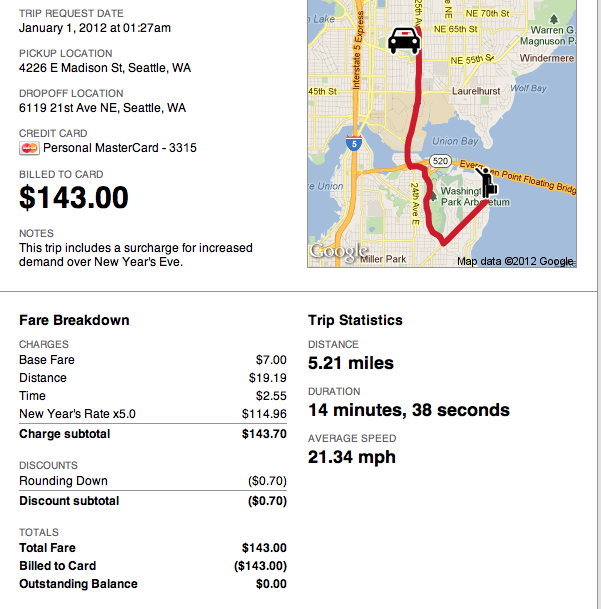
I was charged $143 for a 5 mile Uber ride New Years Night and I am understandably not happy about it.

I like Uber, have been a fan for quite some time, a frequent rider and a brand advocate.  I am one of those people who pulls out my iPhone to show my  (low tech) friends a totally cool and new way to get a ride somewhere.

But maybe not so much anymore.

I feel like Uber was deceitful and lacked transparency on this decision.  Also, I think they did it on purpose to take advantage of their riders.  Uber made a recent business change they call “surge pricing” which is meant to be put in place on nights where demand greatly outpaces supply.  In basic terms, the more cars being hailed at a certain time leaves less cars left to pick up others.

So what to do?  Uber thinks the best decision is to jack up prices.  They call this a surcharge.  This is the email receipt I received afterwards.

When I hear the words surcharge, I think of a $10 fee or possibly something to that extend.  Uber thinks a surcharge is X times the ride amount is the appropriate way go.  Although they are stating they placed notifications and alerts at the point of opening the app and standing behind their decision,  I think it’s bullshit and here’s why.

I knew Uber would be more expensive New Years night.  They sent an email on the 28th, stating they proposed New Years change…. but conveniently  forgot to mention how much they would be increasing the rates.  My feeling is they did this on purpose, knowing if riders preemptively knew they would be charged up to 5X the normal rates they wouldn’t have even considered Uber.

Heres the email content:

We’ve only been in the Emerald City for a few short months but we’re already getting your patterns down. Whether you’re headed to the latest craft cocktail bar or going back to a well loved dive, you’re zipping around in Ubers like you own this city. Now that the mother of all party nights is upon us we know you’ll have a few glasses (read: bottles) of bubbly, and the last thing you want to do is call AAA for that tow-of-shame. We’re ramping up like crazy with the sole intent of providing a safe, convenient and stylish ride for as many Seattleites as possible on New Year’s Eve.

New Year’s Eve is what we call a *surge event* at Uber. This means we expect to see a massive demand spike and a supply shortage at the same time. During these events like NYE or Halloween there is a run on private cars in most cities and in order to ensure there are enough cars on the system (read: aka an Uber experience), we’ll be enabling surge pricing on New Year’s in a similar fashion to Halloween 2011. This means that rates on New Year’s Eve will likely increase during peak times of demand BUT when demand subsides or more supply becomes available, rates will automatically drop and you will ALWAYS know if there is a price increase before you request an Uber.

Champagne wishes and Uber dreams,

As you can read, how this was to be executed and the result on me, as the rider, is not mentioned.  All that was noted was that there was a possibility of an increase in rates based on increase in demand.  This is not transparency. Yes, they were on the right track about notifying riders and Uber followers about the change, but the particular way they calculated and executed this was totally wrong.

Uber has stated they used a dynamic pricing structure which may have been changing by the minute.  How the hell do riders know whether it’s going to be the same price or 5X the normal rates?  This is exactly why Taxi rates are controlled so closely, so no one gets out of control and starts jacking riders without their knowledge.  If Uber is going to cross the chasm to mainstream America they need to clean up this messy execution.

I could go on and on… but I won’t. I know I am not the only one pissed on this matter.  My point is transparency is not just a vague email or a short notification at a point in time where the rider has little other choices at hand.

@jnickhughes