Name Change! Introducing Our New Name – Seconds

As conversations evolved and our company matured over the last few months, an interesting theme started to emerge – we are more than just a platform for ordering.  Ordering is just one action a customer takes when they interact with a local merchant; thy also communicate, purchase, refer to friends, find information.  We realized an order cannot happen unless a connection has been established. Once a connection is established, communication usually follows.  In that vein, we have decided to change our name to Seconds.

Frankly, Seconds is a much more brandable name than Order SM.  Throughout our search for a new name we kept coming back to the themes of repeatability, quickness and efficiency.  Seconds brings to mind “wanting more” and “very quickly”, two very strong foundational characteristics to build a consumer oriented product around.

Our entire concept has revolved around repeatability and loyalty.  If you like a restaurant, coffee shop, taxi driver, or any other product or service, it’s a strong possibility you want to go back and repeat your experience.  With that in mind, we created what was originally named Order SM.  We wanted to make it dead simple to communicate and transact again with a favorite local merchant.  Now, the term Seconds will be branded as a way to connect and quickly repeat your customer experience.  Use Seconds to quickly have that non-fat latte you like so much (and order every single time!)

The Realization of the web only speeding up (in fact, our lives seem to be increasing in speed) was also a cornerstone to the name change.  We envision a not so distant future where a user checks Seconds to see the local community activities – from coffee house purchases, to the latest taxi cab whereabouts, to what’s the hot happy hour tonight – all in real time up to the second.  You now see where this thing could go….

Functionality of the current product is not changing and the only enhancements will be cosmetic in nature.  A new logo where the old ones resided, replacing all Order SM content with Seconds content will be most of our enhancements.  But, with this new branding comes an incredible new opportunity – a consumer facing experience.  Be on the lookout for new developments in what will eventually become a whole new local consumer experience.

“Hey, I’ll Have The Usual.” The Emergence Of Consumer Repeatability

Let’s face it, life as a consumer today can be somewhat frustrating.  Given the advancements in mobile phones, the social web and auto-payments, by 2011 one would think interacting with local merchants would be a bit more,  shall I say… enjoyable.

Yet here we are, still required to actually think about where we are going to eat, look up the merchant online, make the call, hope they answer, talk to the person (with possible language barriers), repeat the same thing I told them last time, read each number of my credit card and expiration date out loud, and then wait for my order with no idea when it will be ready.

Ever sit back and watch people as they are waiting for food in a restaurant or service at a local merchant?  You’ll notice heir heads are down, palms out and thumbs moving.  Most people I speak with seem tired of wasting precious moments of their life standing in line or being idle waiting for something; inevitably they resort to grabbing the closest thing they can find for distraction.  Indeed, they are using some device to surf the web, text a friend or read an email.

In light of the recent $50 million Series E funding for GrubHub and all the hoopla over the daily deals space, I thought I would evaluate the state of the local commercial market and the current web options.  Semil Shah does a fantastic job of starting a conversation about what is emerging on the merchant side of the equation, but since the local market is quite deep with numerous verticals this post will focus on the local restaurant and ordering experience from an end consumer  point of view.

My goal is three-fold:  First to describe where the market is currently; second to illustrate the inherent problems, and lastly to give an idea on the direction of where the local space is heading based on consumer and general societal trends.

The Current Local Consumer Experience

The current local consumer experience can be summed up by the word “discovery”.  Observing the options established thus far, most are built for a consumer to use when they are looking for a “new ” food experience.  Apparently we  have become obsessed with creating a plethora of ways to find the new, whatever  it may be.  Also interesting is the realization that most are already antiquated because they were designed with the online consumer in mind with little consideration of the mobile experience.  This is why, as you will see below, web based ordering and communications with local establishments has yet to experience mainstream adoption.

Online Ordering

  • GrubHub, SeamlessWeb, Snapfinger and many others allow users to place orders online with local restaurants.

Daily Deal Sites

  • Groupon, LivingSocial and the others bring users massively discounted deals on random things around the local community

Table Reservations

  • OpenTable is the king of online reservations for local restaurants

Local Recommendations

  • Yelp, Urban Spoon and a few others allow people to research comments and recommendations on local places of interest

Social Discovery apps

  • Downloadable apps help users find new places,including places others have checked into and commented on

It is obvious with a little research in the online ordering space for instance, a great chasm  still exists.  There are about 500,000 restaurants in the U.S. and 90,000 in canada. About half are chain (franchise) stores. About half the chains supposedly have some kind of online and/or mobile online ordering system (custom apps) but as we go into these stores to inquire about online ordering, nobody at the store knows what we are talking about.  SnapFinger has over 500,000 restaurants in it’s directory but you can only use it’s online ordering for about 30,000 of them. Grubhub (including it’s aquisitions –> CampusFood and AllMenus) has about 300,000 in it’s directory but only about 25,000 you can use online ordering. Eat24Hours estimates it has about 12,000 signed up for online ordering but when you check their directory there are lots and lots of restaurants listed as “closed”.

Going further, the user experience with current mobile ordering apps is atrocious.  Here is an experience I had recently during a trip to San Francisco in which I reported back to our team .  (specific names have been removed)

Mobile Ordering App A. To put it bluntly, they sucked.  And their execution, amongst many others, is why “mobile commerce” has not taken off.  The experience is just terrible and based on their current model there are just too many wires left unconnected.  When I got to  (local restaurant) I asked the guy at the counter if they accepted mobile ordering and payments and he said NO with a questioning look on his face. Interesting, I thought…  because there they were right on the app.

Using a nicely designed mobile app I was able to browse many different cities, restaurants, categories, menus, etc.. I found (local restaurant) and after minutes of clicking and scrolling I ended up trying to buy a “beer” (didn’t allow me to actually determine what kind I wanted) from the mobile app as I sat right outside the restaurant on the patio.  Yet, after going through the entire process and once I clicked purchase…. nothing happened. Pay $4 and nothing else?  No one communicated back to me and no one brought out my beer.  Seriously, nothing happened!  Weirdly, I received a message from ______ through the app the next day saying “Hi Nick”.  I responded with ” Hello” and then nothing else came back. This experience was just ridiculous….

Amazingly, this not-to-be-mentioned mobile app is being touted as a hot new app with great potential.  Unfortunately I must disagree.  The current online ordering websites are not any better, here is an perspective from a recent correspondence I had with a user of an online ordering site.

“…Should mention one more thing about online ordering at a restaurant with lots of chain stores. Most of the time you have to go to the brand (i.e. Subway, Five Guys, Pizza Hut, PF Changs, etc.) home website and then enter a zip code or some kind of locator information after which you find a store to order from. It’s not a local experience. It’s a top down kind of thing. I don’t think patrons like that. If I want to order something at the PF Changs in Bellevue, why do I have to navigate through all the PF Changs around the world?  I’m in bellevue. Just show me the bellevue PFChangs.

So, bottom line is the only tried and true option for a consumer is to just look up a phone number and call ahead or show up in person – ya know, what we did back in 1970.  This is a growing hassle and something needs to be done.

The Everyday Consumer

There is a certain disconnect right now in respect to 1) how we live as consumers and 2) available mediums for local merchants to connect with customers.  It might help to review a few obvious aspects of the local consumer experience that, when brought to light, will allow us to discuss what is now possible.   When I closely evaluate someone going about their everyday life I see peculiar phenomena not currently leveraged by technology.  First, people frequent the same places on an ongoing basis.  They go to the same coffee shops, restaurants, retail outlets, etc… you get the picture.  We are creatures of habit and if you stop for a moment in your own life you will start to see how you do this as well.   Second, at these places we mostly order the same things – lattes, pepperoni pizzas, t-shirts… you get the picture.  Again, we are very habitual creatures.  Think about what types of things you are ordering repeatedly…  Third, people love to be identified, called by name and have “uniquely personalized” experiences.  We love to feel special, to feel “in” and to feel like we have been upgraded.  When you walk into a bar or restaurant, how much better do you feel when the address you by first name?  And lastly, we are naturally mobile.  We are increasingly on the fly, in a hurry and the ever growing demand is that all aspects of our life keep up with our dizzying pace – using technology.  When was the last time you left the house without your mobile phone?

With all that being said, a quick glance back to the current state of the local consumer will show a void in the space becoming clearer.  Why is it that even though we are habitual consumers, all the consumer oriented options are built for discovery?  Why is it the industry is obsessed with bombarding our email boxes with half off deals at places we will never go?  Why is it that most local businesses live and die by their “loyal” customers, yet they keep getting trapped in the push oriented advertising?  Ask them, they will tell you they mostly see they same people week in and week out.  This was very interesting to us at Order SM.  On the consumer side, we found they want control of who connected with them and marketed to them.  We also found they demand immediacy when they want their food.  The current options for customers are anything but immediate.

The everyday consumer expects a frictionless interaction, one without miscommunications and mistaken orders.  The everyday consumer sends A LOT more texts than phone calls, and would greatly appreciate text based communications with local merchants, rather than having to speak to someone on the phone.  (funny we have become this type of society).  And consumers seek personalized interactions with local merchants, having them remembering previous orders creates an incredible consumer experience.  Ironically, with advancements in technology there seems to be is a growing desire for the way it was “back in the day”.

Where the Local Experience Is Going  –  “I’ll Have The Usual”

The era of Repeatability is now upon us.  All the pieces are in place – mobile devices, the mobile web, personalized networks and now direct web integration with local merchants.  Since almost all people carry some type of mobile device, customers now have a medium to communicate with their favorite local merchants, just like they communicate with their friends.  Now that we understand the everyday consumer, the idea of consumer repeatability driven through the mobile web starts to really make sense.  Being able to text “I’ll have the usual” to a local restaurant and everything else is taken care of behind the scenes is now possible.  Very Possible.

Think about it: just pull up the last correspondence in your phone and quickly send off a message to your favorite restaurants or cafes and say “Hey, I’ll have what I had last time, it was great!”  Since order history is provide in detail they will be able to respond with “got it Nick, your sandwich will be ready in 5 min…. Pay now or pay when you get here”.  Then you swing by, grab the order and go about your day.

Repeatability.  I have written previously on how utilities make the world go around.  This seems to be another area where utility comes into play – quick and easy communications with local merchants.  “Just make it easier for me to repeat the things I do each day of the week” is a statement I am starting to hear more often.  Just as the landline has been a century old utility for local merchants, something else is starting to displace wired communication – wireless communications.

That’s just kindergarden stuff.  Now imagine if that information was (anonymously) shot out to a public feed, where ALL orders and commercial information was aggregated and displayed (possibly twitter style) so people could quickly see what types of things were being ordered, purchased  and shared in a local area – in real time!  One could drill down into a specific cafe and see what is “hot” that day.  And if I found something interesting in that feed… with one simple touch I could purchase the same thing.  It’s now possible.

What if a merchant could know all their customers by name?  What if they could visually see Joe is a very loyal customer, this is his 55th visit, has an aggregated total spend of $1,445, his usual order is the #1 and tips well. To this merchant Joe is a very valuable customer.  Again, building around repeatability is now starting to make a lot of sense.

To make this a reality we need to get over this group deal stuff.  Loyalty is not found by offering bottom barrel prices; it is earned by providing quality products with great service.  Part of “great service” is meeting consumers at their level, and opening communication channels so they can connect with you.  Loyalty is going to be one of the most important actions in the next decade and every company – from small mom and pop shops to large tech behemoths – are looking for better ways to keep their customers.

@jnickhughes

The Start It Series: How To Build A #Winning Team

Start It is a documentary series on how Order SM, an early stage mobile commerce startup, is approaching the launch of their company.  It is intended as a helpful guide to anyone looking to build or grow a startup in today’s fast paced technology space. 

What you read may counter “generally accepted” startup practices in Silicon Valley or elsewhere but that’s what happens when you are a bit different. We are not Stanford Grads; we are not ex-Googlers; we are located in Seattle, not San Francisco; and we did not start off with a large network or initial funding sources. We are 21st century entrepreneurs and this is our story.  It’s a good bet most of you are none of those things either so we hope this may help you get off the ground.  Please feel free to reach out with comments or questions.  This is the second of many posts in the Start It Series.

In the previous post How To Establish A Vision Worth Pursuing we covered how important vision is to the  success of startup.  You really need to know where you are going before you start the journey.  But once you figured that out,  the next question to ask is Who will go with me?  Or more importantly, what do I actually need to get done and who are the right people to help make it come true?

The story of the 1980 U.S. Olympic Hockey team can teach us a lot about leadership and team building. The movie Miracle details how the coach Herb Brooks (played by Kurt Russell) led the 1980 U.S. Olympic hockey team to victory over the seemingly invincible Russian squad. For many reasons Miracle is one of my favorite movies and Herb Brooks has been a great example to me of how to approach building a team.  His leadership approach is astounding as he prepares the team to take on what seems to be an insurmountable odds.  One moment in the movie stopped me right in my tracks.  Herb picks his team by bringing together a bunch of random players – young players and no-names –  going against the wisdom of his assistant coaches and team advisors.  The conversation went something like this:

Herb’s assistant: This is the final roster?  You’re kidding me, right?  This is our first day, Herb. We’ve got a week of this. What about the advisory staff? Aren’t they supposed to have a say in this?  You’re missing some of the best players.”

Herb responds: I’m not looking for the best players, Craig. I’m looking for the right players.

The last sentence says it all:  I’m not looking for the best players, I am looking for the right players.  You get a sense Herb knows what he is doing and understands just who should be in each position.  He had spent countless hours studying the opposition and knowing EVERY player he might possibly have on his team before he actually knew he was to coach the team.  Once the opportunity came to him he knew exactly which players were going to be on the team and why.  Ultimately, his strategy proved correct and his story illustrates why building the TEAM is one of the most important tasks a leader must undergo.

Counter-intuition, we see it all the time in sports.  Very rarely do “dream teams” with massive payrolls win championships yet most organizations try to land the biggest names and highest paid players.  Another great lesson can be observed in the recent movie (and book by Michael Lewis) Moneyball.  In the early 2000’s the average payroll of a Major League Baseball franchise was growing like a weed.  Oakland A’s General Manager Billy Beane came to realize if they were going to compete with the Yankees of the world, they needed to play a different game.  So he re-wrote the rules.

With a little “number crunching” help from his assistant he discovered success in baseball was not a result of big bats, MVP’s and inflated contracts, but actually due to higher on-base percentage.  Quite frankly, the more each player got on base the more likely he was to score.  And  baseball games are won by scoring more runs than the other team.  T

His assistant said: “Your goal shouldn’t be to buy players. Your goal should be to buy wins. In order buy wins, you need to buys runs.”

He started looking at the concept TEAM in a whole new way.  Countering the opinions of others and risking his job, he gutted the team of high-cost players and found younger, cheaper and more teachable players who fit into his game plan.  Like Herb, he didn’t want the best players he wanted the right players.  He the found players who not only got more done, but got it done at a tenth of the cost.  The A’s went on to win a record 20 games in a row and were one of the winningest teams of the 2000’s.

So my question, what is required for your team to win?  And who can just get it done?  Is it an all-start team or is it a team who can JFDI?  The founder who takes responsibility for forming a young team needs to have as much conviction as Herb when they are “picking their team”.  It’s easy when starting off to fall into the trap of looking for the best “dev talent” or “hot shot serial entrepreneur” when in reality you need to find the right players and place them in their correct roles.  Success for a start-up means actually launching a product and experiencing growth in usage.  This requires with speed and efficiency, and the optimal team is one where everyone plays a specific part for a specific reason so they can ship a product and grow a business.  JFDI.

Ask yourself: “Why do I want this person on the team and what are they going to own?”

I not saying don’t look for the best people you can possibly get.  Who wouldn’t want to have a team comprised of the best people you can find tackling a big problem?  Of course look for greatness in your people. But there is something counterintuitive about finding the “best”.  Unfortunately some of the best people around the world (in anything) are the most difficult people to work with.  At best these people are great at what they do and can really make a team shine.  But at worst, these people can become a cancer within the group and bring down the entire team.  It is the founder (leader’s) responsibility to make sure their company stays afloat and successfully gets to market .  You must mitigate as many risks as possible and because people can be one of your biggest liabilities, this issue cannot be overlooked.

The Startup Triad

If you are looking to build a technology or web startup you will mostly likely fall into the general founding position of needing a techie, a designer and a business guy.  Important: You may officially have more or less than 3 founders on your legal documents, that is up to you.  Why three individuals?  Why can’t a single founder do it all?  Well, most technical startups require specific skills and numerous areas of expertise.  It’s safe to say no one is great at all three descriptions and anyone trying to start something alone is wasting their time.  Do yourself a favor and find some complimentary teammates.

Here’s an approach to forming a solid founding team for those who are just staring out:

Founder 1: The Technical Engineer – the one who writes code and builds the product.

Founder 2: The UX Designer –the one who makes the product usable and look good from the end users point of view.

Founder 3: The Business Developer – the one who develops the business strategy and finds the money.

These roles are required to build anything that resembles a tech startup.  You need someone to think of the strategy, someone to build the product and someone to make it usable.  The key is finding the sweet spot where all three overlap.

Note: Don’t make the fatal mistake and think you can cut corners here.   As the leader, if you haven’t found someone for each of those 3 roles, drop everything and go find them.

The Order SM Founding Team – We have taken the triad approach to forming the Order SM team.

Jacques Crocker: The Technical Engineer

Jacques is an amazing Rails Jedi who worked hours on end to piece together Order SM earlier this summer.  He owns the code and with his expertise he has single-handedly changed the game by creating this incredible product.  Every startup needs to have a Jedi.

Gary Windels: The UX Designer

A extensive background in design has given Gary an eye for simplicity and elegance and is a strong compliment to Jacques’s engineering skills.  He always centers his designs on the end user’s perspective, and does so with well grounded reasons as to why design will make or break your product.   Every startup needs “end user eyes”.

Nick Hughes: The Business Developer

As the business developer I focus Order SM on value creation.  I answer questions such as “how and where does our technology add value to the current business ecosystem?”  “Who are our customers?”  Where are we going to find them?”  “How much does it cost to operate our product and can we create enough value to charge more than our cost?”  Every startup needs someone laser focused on the how, where and when of value creation.

Look for to the next post in the Start It Series, here is the previous post on vision in case you missed it.

@jnickhughes

Flickr image courtesy of chipgriffin


Order SM Takes Home The Second Place People’s Choice Award at Seattle Beta!

The first annual Seattle Beta was held on Tuesday October 11th, and Order SM took home second place on the people’s choice.  We were highlighted in TechnologyWeek:

Seattle Beta held its first event last night. It turned out great , the whole room was packed and there were plenty of people buzzing about the new companies.  13 companies were listed on the roster. The format was an open room with many booths. It was very casual and everyone was mingling the whole night. We only got interrupted once by Softlayer who was a sponsor, they wanted to announce an open bar for 15 minutes. The 13 companies were 9Slides, Cloak, Govpinion, Habit Labs, KindleGraph, MobileAppTracking, Omnom, OfferUp, OrderSM, ReadyPulse, Timber Software, Toolz.me, and Wiavia. The venue was packed and it was hard to walk from room to room.

 Order SM placed second among 13 Seattle startups, and it was a solid second place.  The results came from an email the day after:

We’d like to give a special thank you to the demoers, and announce the results of the voting you did with those poker chips.

The demo that got the most chips was HasOffers, showing off  www.mobileapptracking.com, with 95 chips.

In second place was OrderSM (thanks for helping route our drinks!) with 80 chips.

In third place was OfferUp with 56 chips.

Jay from TechnologyWeek was on hand and actually placed an order through Order SM.  His experience:

I used OrderSM last night to order a beer, it is a service that allows customers to text simple orders directly to the staff. This company is showing a lot of good effort to bring their product to market. The service remembers who you are and when you text in the future it uses that knowledge to facilitate making the process faster. They have plans to incorporate payment into the service as well. It is as simple as texting, “Bring 2 Blue Moons please”. I did this last night, I got a text back, “Sure thing Jay, where are you at?”. Me: “Backroom.” Five minutes later the beer was delivered directly to me and I didn’t need to leave the conversation I was in. Look for our article on this company shortly.

In addition to Jay, we saw a number of orders placed using Order SM and the attendees were quite impressed with the entire concept.  This event result was just another moment of truth for the Order SM team, proving once again we have a great product with a strong value proposition.

Open Vs Closed: Should You Publicly Blog About Your Company Strategy?

Here’s a scary thought:  Write about your company, product and vision in public to tell everyone what you are doing and where you are going as a company.

Not many founders embrace an open approach to starting their companies.  In fact, they brag about being quiet and secretive, “We are in stealth right now so I really can’t expand on what we are doing.”  Most do this because they think someone is going to take their idea and steal their thunder.

Well, hate to tell ya but the world has changed.   More information is created each day than we can even fathom, and with ideas a dime a dozen proper execution is really the main strategic advantage now.

Wouldn’t it be easier to grow a startup if it were more publicly evaluated?

Why Closed Is Not Smart

The most difficult time for a company and its founders ‘s when it is being formed.  Since it’s so new, naturally nobody knows about it.  If your goal for this new company is to quickly achieve a sustainable model – one which allows for either proof of concept (investors) or proof of customers (revenue) – then stealth is the worst position to be in.  Stealth means no one knows about you and will never find out about you.   This means death for a young company and it’s founders.

Why Being Open Is A Strategic Asset

Momentum is to startups what spinach was to Popeye.  Being open, noisy and developing a brand voice creates much needed attention and momentum for a young startup.  By initially making your own noise you set the stage for others to start making noise for you.  This is called PR.   If no one is doing your PR for you, then do it yourself.  Are you in an interestingly new, rapidly growing or controversial market?  Pick an angle, stand behind it and write about it.  Think of it as building a repository of published thoughts and perspectives, leading others to easily finding your voice.  As your market continues to evolve, they will start to remember your name and your company.  You will emerge as a market leader, an expert (in their eyes) and a solid contact when others start to write on the topic.  Your company will naturally fit into ” one of the main companies doing X” statements.

Obviously there comes a time when certain information is best kept behind company walls.  But, who knew keeping things secret would be such a disadvantage when you are just starting?  I am interested in getting a conversation started here on what people think about open vs closed.

So what do you think?  Should You Publicly Blog About Your Company?

@jnickhughes

Innovate Around “Deadly Sins” And Other Golden Nuggets from StartupDay In Seattle

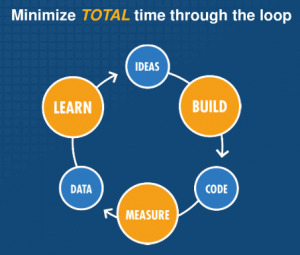
According to Wikipedia, the lean startup is defined as:

the method advocates the creation of rapid prototypes designed to test market assumptions, and uses customer feedback to evolve them much faster than via more traditional product development practices, such as the Waterfall model. It is not uncommon to see Lean Startups release new code to production multiple times a day[2], often using a practice known as Continuous Deployment[3].

According to Eric Ries, this might be satisfactory.  But he believes the Lean Startup is defined as:

An experiment.

I recently attended StartupDay in Seattle, where speakers touched on a variety of subjects to help early stage founders and would be entrepreneurs along their startup path.  As the keynote speaker, Reis explained how the process of building a startup is evolving from the waterfall ideology to a more agile and lean approach.

“Your goal is to determine if there is a cheaper way to test and validate your assumptions.”

Ries hammered home the idea that a startup really is just an experiment, where you are testing a set of assumptions as cheap as possible.  If proven wrong, you “pivot” towards a new set of assumptions and continue down the path of establishing a scalable and repeatable business model.

“The goal is to Reduce the time between pivots, increase odds and runway so your company can survive until you find a repeatable and scalable model.”

He also noted the new approach to The startup Way, focusing on four areas of the company.

  • people
  • culture
  • process
  • accountability

Among a number of new terms, Validated Learning jumps out at me as something to internalize.  It is a process on determining value and waste… Then optimize accordingly.  Find the value (what is working) and do more of it.  Find the waste (what is not) and put it aside, leave it behind.  Sounds pretty simple, right?  Well yes.  Yet it is funny how so many startups fail because they did not get to the point of repeatable value creation.  What Reis is saying is “get to this point as fast as you can”.  So measure everything.  Study it and validate your learning.

To sum it up, here are 3 things to focus on if you are a founder:

  • Establish the baseline MVP
  • Tune the engine
  • Pivot or persevere

Other notable speakers include:

Brian Wong
Kiip – As a young founder, Wong laid out six thoughts to help first time entrepreneurs on their journey.

1. Set the direction
2. Law of serendipity
3. You = motivator
4. Won’t have a clue
5. No time to spend
6. Crazy things

Rand Fishkin

SEOmoz – Rand spoke on the challenging topic of Failure, noting that it happens to all of us and how we approach it will determine our success.

  • Fail early
  • Have metrics
  • Fail survivably

Ask yourself the hard questions

  • do we have wrong assumptions?
  • do we have the wrong people?
  • odds we screw up again?
Glenn Kelmann
Redfin -Glenn had some great advice on how best to approach the initial stages of your product, everything from focusing on “problems in your life” to “deadly sins”.
  • Build off of others ideas
  • Delight the first user
  • Focus on Seven deadly sins

Employees Want More Recognition Over More Money. Here’s How With Facebook

I think we we can all admit: corporate life can be at times, just plain boring.  That might be the main reason a large number of employees tend to meander over to social sites such as Facebook or Twitter to see what is going on outside the firewall.

But are social technologies really a distraction?  Or can they be used to actually enhance the morale and engagement of the workforce?

The Taraci Social MediaMgr™, from Taraci Motivation, is an incentive marketing application that allows organizations to host and run employee incentive marketing programs entirely through Facebook.  It allows an organization to integrate the social and communications tools of Facebook into traditional incentive marketing programs.  Their vision is to transform how organizations run incentive programs by helping them fully integrate the power of social media.

“According to Gallop , about 10% of employees are highly engaged and since profitability is tied to employee attitude and moral, it’s more important than ever to motivate employees,” says Tom Taraci.

Basically, they help corporations leverage Facebook to offer employee incentives to keep them happy.

Well, if you can’t beat em, join em!

It’s an intelligent move, leveraging Facebook to get more from your work force rather than just firewall it.  The underlying message sent to employees when blocking a site like Facebook is one of distrust.  Using Taraci Social MediaMgr let’s your employees know “you get it” and “you understand.”

For example, the ‘like’ feature can be used to show friends and family a product users like within the catalog. Opinions can be posted to the wall. Participants can also ‘send’ messages to friends, family and co-workers to get feedback on their product selection or to let them know about their achievements in the workplace.

Current Incentives can include:

  • Length of service — Rewards employees on their employment anniversary date
  • Sale incentives — Rewards salespeople for reaching their goals
  • Wellness programs — Rewards employees for achieving health & fitness goals
  • Safety programs — Rewards workers for reducing workplace accidents, reducing absenteeism
  • Recognition programs — Rewards employees for accomplishing a specific task, or tasks, over a period of time
  • Referral programs — Rewards employees or customers for recommending a new client
  • Loyalty Programs – Rewards employees for length of service to an organization
  • Casino Players Clubs – Rewards casino players with points for dollars wagered which can be redeemed for merchandise.

Incentive 2.o?

In the past, incentive programs were hosted on a standalone web site or simply through a printed catalog.  For corporations, it’s now possible to communicate real-time incentive marketing program updates, from adding rewards to celebrating winners.  Program administrators can also engage in a daily two-way dialogue with participants, not feasible with traditional online or print incentive programs.

It’s not a secret employees are spending more and more time on Facebook throughout the work day.   Corporations are realizing they need to join them in their environment, not just block the site.  The application is designed to improve corporations’ presence in social media by building their corporate communities and increasing the number of their followers on Facebook. By hosting the incentive program on corporate Facebook pages, there’s finally a way for corporations to connect with employees in an effective way through Facebook.

How it works

1 – A branded incentive marketing catalog is created for the corporation’s Facebook page by Taraci Motivation

2 – Once the program is officially launched, participants are directed to the corporation’s official Facebook Page

3 – By entering their username and password, employees can see their point totals and redeem rewards.

Recognition Over Money?

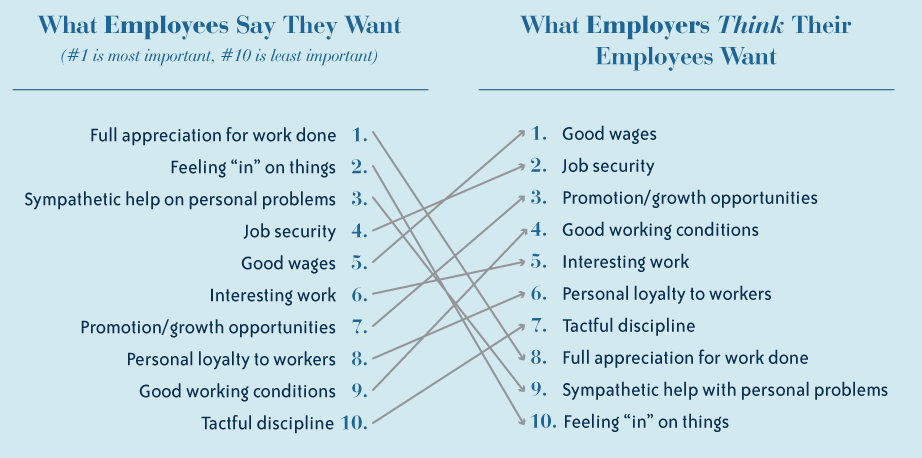
During this tough economic climate it’s more important than ever to motivate employees who are frustrated due to many factors, including constant downsizing, lack of promotions and salaries being frozen.   A simple  “Good Job” or public employee appreciation in front of other employees on a social application will go a long way to keep employees happy.    Looks like Taraci Motivation understands how employees actually feel, here is an interesting list of what employees say they want compared to what employers think employees want.  Quite the disconnect if you ask me.

Employees just want to be recognized.  They want it over more money, more interesting work, job security, or good working conditions.

Seriously, just telling your employees they are doing a good job, more publicly and more often will greatly increase your company morale.  I wish my last employer knew that.  Oh well…

According to Taraci, the response to the Taraci Social Media Mgr has been tremendous.  The Taraci Motivation Mgr was first released in May 2011 and enhancements are continually being added to the application. “We’re  set to launch a number of new programs on Facebook in Q4 and continue to be in active discussions with a variety of category leaders in travel, shipping, entertainment, finance, marketing, consumer products and services, and more.”

From the looks of it, maybe more corporations should look into Taraci Motivation.  I hope so… with 10% of the workforce highly engaged, companies need to do whatever it takes to keep their best employees happy.  I know I am.

@jnickhughes

NYC, Seattle or Silicon Valley? If You’re A Flounder It Don’t Matter

Every so often a proverbial argument reverberates around the tech world.

It will sound something like “How can we be more like Silicon Valley?”  or, “New York is now a more hip Silicon Valley”

We here in Seattle have even gotten some flack lately from predominant VC’s trying their best to state their respect for the city at the same time point out it’s obvious flaws.  That is a difficult position to hold for sure.

Then this was written last weekend on GeekWire.  Choice quote: What we do need is to go and build some fucking companies.

I must say I was a bit taken back with Kirill’s approach.  It just felt like someone blowing his hardest in an effort to make a forest fire burn stronger.

But ya know, I do agree with Kirill  in principal.  Yes, we all need shut up and go build some companies.  And let me also agree with others who are stating “there is just something unique about the valley… and as a founder you should start your company here.”  It does not take a genius to realize there are certain subtle aspects about Silicon Valley which can help founders build great companies.

But let me frame this argument slightly differently: If a founder builds the next billion dollar company outside the valley, is he in fact a better entrepreneur since he did it without the resources and luxury of Silicon Valley?  What if he did it without going to Stanford?  How about without being part of the latest YC batch?

I say Yes.

Or read differently: are we just mind-sweeping ourselves into thinking since we aren’t in Silicon Valley we cannot build great technology companies.  Although not the entire reason, I believe this is playing a somewhat significant role in the perception of the “Silicon Valley Only Success.”

Let me go on record as saying there is more than one city in the country.  There are also millions of people who (currently employer or unemployed) are not in the valley and would almost die for a great opportunity.  There is also something called the web, something that has connected humans and money like nothing ever before in history.  My point: proximity is getting less and less important is time goes on.

But Nick, why the typo in the title?

Being a Founder is one thing.  I think that describes the ones who start companies and instantly compare themselves to Silicon Valley . They use the word Founder like it’s a surname.  They are worried about “who funds them, who’s party they are going to, who will be their next prominent acquisition, who is writing about them, etc.. ”  Founders get sucked into tunnel vision, influenced by group think and worried what the Jones’s are doing.   They have two eyes looking straight ahead and focused on the ground.

Don’t get me wrong, these things are important to the success of a company.  But they are not the only thing  just as makeup, dresses and friends don’t really make the ultimate girl.

Being a Flounder is a whole other level of entrepreneur.  They have one eye on the ground and one on the horizon.  Ever notice flounders (the fish) seem to be looking in two directions at once?  That’s called vision.  And I believe the best entrepreneurs always have one eye on the ground (present) and one eye on the horizon (future).  They are Flounders.

A Flounder isn’t bothered by where he builds his empire.  He just builds it.  He doesn’t care if his company isn’t written about as the next hottest thing.  He builds it large enough and becomes the largest thing.  Flounders have such a strong sense of purpose they attract others to join the mission and turn any naysayer on their head with amazing and consistent results.  Flounders have an eerie way of being calm in the storm, so much so they freak you out.  Why?  Flounders can see what you can’t.

So next time you start to fall into the Founder hole, think Flounder.  Think Vision.  Think about seeing with one eye here and one eye over there on the horizon.  You will start to realize most of the B.S. all other founders are talking/bitching/complaining about really, in the end, doesn’t add up to much.  With better perspective Flounders see the big picture and stay the course.

@jnickhughes

How To Stop The Insanity, CEO Style

Being a first time CEO can be confusing, intimidating and downright scary.

You have a hundred things to do and no idea which way to look.  Email this person…. talk to that person.  Introduce yourself to another potential investor or partner.    There are so many different people to connect with but it’s difficult to determine the ones you really should to spend your precious and limited time with.

You also need to deal with legal, financial, organizational, strategic and other parts of the company on a daily basis yet might not be fully comfortable with each area of the business.

You look in the mirror , shake your head and whisper “ha, I’m the CEO?”  Yes, you are and everything now rides on your shoulders.

The crazy thing with being a first time CEO is you really don’t know what you don’t know.  This is a blessing and a curse.  Blessing because if you were able to get a glimpse all the things you don’t understand you would probably turn and run for the door.  It’s a curse since there are quite a few important aspects of building a business which require keen awareness and solid judgment, which by definition rookies just don’t have.   It is at this stage where we lean on others who have gone before us to help give perspective and a nudge in the right direction.   I don’t pretend to know these things since I too am “technically” a first time CEO and on the constant lookout for helpful mentors.  [I say technically because my first startup was a failed attempted at a bootstrapped startup.  We didn’t even get to seed stage so although I grew through it, it really wasn’t much more than a warm-up.  It’s safe to say I am now entering the open seas with only my compass in my hand.]

So how do you keep your sanity amongst all this madness?  I reached out polled a few fellow young founders and asked them to give some thoughts on the matter.

Phillip Estrada Reichen, CEO of LocalUncle.

Maintaining focus is all about saying “NO”. Sounds easy in theory, but in practice it’s harder than most people think. Saying NO means leaving out product features that you’ve been dreaming about because you have to hit a certain deadline. It means saying NO to reading everything that is being written/said about your industry and accepting the fact that you’ll have to maneuver the best you can with the limited information that you have. Saying NO also means not working on your other five great ideas and keep executing just this one thing that you chose to do at this point in time. Even when you hit your lowest lows (oh, and you will hit them) and you’ll want to throw everything away, saying NO means not giving up and stick to your initial idea.

In order to stay sane and not be overwhelmed and burn out you need to get off the grid regularly. Exit the Matrix. Don’t do anything work related. This is especially hard if you work in mobile/web because you can work from anywhere at anytime. Go running in the park without iPod or iPhone (no music allowed! just listen to the “real”, offline world for a couple of minutes). Get home after work and do not go online till the next day. Read a book, cook a meal or draw a painting. No matter how much work there needs to be done, you have to have non-electronic, non-work related hobbies or activities like that to stay healthy and balanced. 

Chris Lynch, CEO of Thoughtful.co

A friend of mine said it best: a startup is a marathon, not a sprint. Know where you’re going, and then tell yourself it’s going to be hard. But even then, know it will be more difficult than you imagined. That being said, I’ve noticed that people deal with stress in a number of ways, but there is a common trait among CEOs in startups that always is true: they can take a lot of stress and keep pushing forward. In some ways it doesn’t surprise me, because a startup is a Herculean task.

Great advice from emerging leaders in their respective industries.  I will provide four strong points to consider and add my perspective for trying to stop the insanity.

Movement

Philip alluded to this one and I strongly concur – getting off the grid and back into the physical world is probably the best way to stay sane.  Get outside [or on the treadmill] and get some movement.  Expending energy is the best way to decompress and release all the pent up tightness within your body.  Basically, when we sit at a desk in front of our screens all day long our bodies are placed under continual stress.  This stress, if not released in a healthy manner, constantly builds up and will cause us to crack under pressure.

If you are feel like you have “had it up to here” and just need a break, you are burned out and need to start moving more often.  I mean every day.  Go on walks, hikes, run, play a recreation sport, unplug… whatever you do, get away from the office and just do it.  Your body and mind will be so much clearer when you return.

Prioritize

As I stated before, most CEO’s just feel overwhelmed.  It helps if you can list out the top 3 things you need to get done each day, and only focus on those things.  I mean don’t think about any other task.  Only when you accomplish those top 3 things should you move on to doing anything else.  How do you determine the top 3?  Look at the overall direction of your company, determine what is mission critical and what YOU, THE LEADER, can only do and go do it.  Then delegate the rest.  Try this for a week and see what happens.  I guarantee you will feel like you are doing less yet more seems to be getting done.  Amazing.

Socialize

Getting out and connecting with people [should be] a CEO’s main objective.  Why?  Since they generally are the face of the company and it is up to the leader to fill out the team, socializing connect you with more people quite frankly, it just comes with the CEO territory.  The side effect of socializing is you will start to learn more about how people work, how they think, and whom you would like to eventually join your team.

Being social also releases chemicals called endorphins, which are required to carry out natural processes within your metabolic system.  Interestingly, if you lack adequate amount of social interaction your body will start shutting down.  That might sound a bit drastic, but the premise is still true – we all need social interactions to maintain our sanity.  Get out and have some fun every once in a while.

Mentorship

First time CEO’s have it tough: we lack the foresight to understand what is in front of us at the same time lacking the hindsight of lessons learned from a previous experience to help us make better decisions.  Amazingly, there are individuals who have gone and done it before and look to pay it forward by mentoring young leaders in their field.  If you are a first time CEO and serious about moving forward in your life, you must go find someone willing to give you some of their time.  Ask them questions, detailed and specific questions related to your unique situation and then shut up.  Just sit and listen.  Record the conversation if possible.  Then check in with them every few weeks or month and provide them some context of how you are using their lessons to positively influence your life.

Oh, and one last thing: if you respect someone’s time, they will give you more… if you disrespect their time, they will never give you another minute.

Now, stop the insanity.

@jnickhughes

Image courtesy of Flickr user My Melting Bryan.

One Leader Steps Down, This Leader Steps Up

Today I learned the hard news Steve Jobs was stepping down as CEO of Apple, the worlds most valuable company and the envy of any honest person in the business of technology.  Like most people, I looked at Jobs as more a Saint, Monk, or Prophet; less of a businessperson.  Is this fair or even right?  Who knows… but he is truly one of a kind and I really don’t know what to say at this point.  What I do know is he set a damn high bar for me and all other leaders.  Thanks Steve.

So much is being written regarding the amazing performance of Steve Jobs I think I will leave it to them to tell you his story.

Instead, I will tell you mine.

You have no idea how many sleepless nights (in Seattle no less) have been spent tossing and turning, just wishing a great engineering team was standing behind my vision.  I have known for some time now a grand and transformational “something” is stuck deep down in my soul and needs others to help pull it out.  For so long I felt I just needed the right pieces to fall into the right place.  For so long it felt like a hope, a dream or a far off story only found true reading through Inc. magazine or TechCrunch or Silicon Alley Insider.

Well that dream has finally come true.

I have chosen to accept an offer to become CEO and co-founder of a promising startup here in Seattle, one just about to hit the public radar.  It really is like a dream come true and the vision we are setting forth is nothing short of transformational.  Keep an eye on this one.

A little Background – Loyaltize

Years ago something hit me like a ton of bricks and I had a vision:  The local economy was one of the one the last holy grail industries of the internet, not fully transformed by the consumer web as we know it today and ripe for change.  I also realized businesses function by and large through customer loyalty.  Most people intuitively understand 80% (or a majority) of a businesses revenue comes from 20% (or a minority) of their customer base.  This is natural and it will never change, you can ask Vilfredo Pareto on that one.

I also noticed local consumers have distinct relationships with specific businesses, and come-hell-or-high-water they will do business with them.  People have favorite restaurants, coffee shops, wine stores, clothing retailers, gyms, etc…  Why not reorganize the local economy around the consumer and their ability to dictate relationships and interactions with their favorite entities.  Allow them to choose who/what to follow and who/what to stay connected to and receive information from.  Ya know, around the loyal customers and their view of the local economy.   Why not Loyaltize?

Understanding that fact, it baffles me why the hell new “advertising” and “group coupons” and other crazy schemes keep popping up every day claiming to increase revenues, profits, customer bases and all other things push media in an effort to bring MORE customers in the door.  It ain’t about “offers” people.  To me, that is just ass backwards to how it actually works.

Businesses don’t want more flaky one-night stands, they want more long term relationships.

When I looked at the current technologies, business practices and the state of the local economy I saw inefficiency, ineffectiveness and little change from 20 or even 30 years ago.   I am sure I was not the only person who saw an opening, but I am positive no one has my exact vision.

Except This Guy

I was recently approached by a talented local engineer here in Seattle who wondered if I would be willing to talk about my ideas on Loyaltize.  He thought we had the same vision.  What he didn’t know was I had as so much given up on my dream of Loyaltize as the summer had progressed.  You see, I did have a startup at one time – a bootstrapped company we threw together called Loyaltize – but after failed attempt on version 1 we backed off and the team dispersed early this year.  Trying to build a startup while being employed full time is not the path for success (at least not for me).   Trust me, after almost 5 years of blood, sweat and tears, it’s a little tempting to throw in the towel and walk on home.

As some of you may know, in May I said “F-it“, kicked my full time job to the curb and doubled down on myself as an entrepreneur.  I figured one thing out – if I don’t fully believe in myself and do whatever it takes to succeed – why would anyone else believe in me?  Why would they believe enough to join or invest?  I also figured I would rather die knowing I tried everything possible to make my vision come true rather than feel regret as the years went by.

Side note: I also started writing on here, Business Insider and other publications, proving to be the smartest decision of my life.  No joke.

Throughout this summer I entertained different business ideas, different roles, different industries and even different approaches to business.  Nothing felt right.

Well, as we spoke that day something woke up in me and it felt as if an old friend had just come back into my life.  I am sure it was obvious to him as well.   The blood started rushing to my head and the vision started to come back to life.  I said to myself “I am home and it is time“.

Since timing is everything I will refrain from naming the company or any others involved.  But keep your eyes open, you will soon start seeing and hearing about it.  Our vision is eerily similar to what you read above and mark my words: your local consumer experience will drastically change in the next five years. 

Today I enter the next phase of my life.  As CEO of a new company, with a new life and a world of potential in front of it. I am set to make the best of it, whatever that means… be it lessons learned, acquisition, IPO or lifelong employment/retirement.

As I step up to be the leader of this company – and a leader in the technology industry as a whole – I cannot let go of the irony this day holds with the greatest leader the business world has ever witnessed stepping down.  But I must since life always has it’s way of moving forward.

It seems fitting that Steve Jobs said it so eloquently: “We believe that people with passion can change the world… for the better.  And it’s those people who are crazy enough to believe they can change the world, actually do.”  

Will do, Steve.

@jnickhughes

Twitter, Linkedin, Facebook or Google+ Which Provides More Value?

Social applications have taken our world by storm the last few years and have indeed proven they are important utilities in our lives. I think it is safe to say some are mere vanity and fun; some are valuable resources to help us move forward in our life pursuits.

The question is: which is which?

I have to say LinkedIn – with the ability to keep me connected with important people in my industry, help distribute my writing as well as bring me updated with relevant industry articles and information each day – has positioned itself as the most valuable network in my life.  Consumer Privacy concerns aside, the future looks HUGE for LinkedIn.  I use LinkedIn pretty much every day, somehow someway.

Twitter is a close second.  It has helped distribute information as well as loosely connect me with thousands of people.  It’s potential to change the world is still largely untapped.  I check Twitter every day.

Facebook does not provide $100 billion worth of value in my life… do I really care about what all my old high school friends and other acquaintances are doing?  Harsh, yes.  But apparently it’s not very valuable to me.  It’s just something of a courtesy check every day or day to see the what’s going on in my friends lives.  But the problem is – I’m really not engaged with the network.  Will this change?

Google+ just seems to be skidding along right now with no real value proposition above and beyond all the others mentioned.  It is worthless to me at this point.  What say you?

I don’t care the valuation of each as a company; I am wondering which provides the most value to you as a user – every day.  I have a feeling the one with the highest valuation is not providing the most value… do you agree?   Answer why you feel the way you do in the comments.

@jnickhughes

Twitter

LinkedIn

Facebook

Google Plus

If You Think Your Weird Startup Deserves $500,000 – Read This Now!

Lighter Capital, a recently re-branded funding option, describes themselves as Entrepreneurs Funding Entrepreneurs.  They just announced they have up to $500,000 available and are looking to seed a “weird and Explosive” company.

According to Randall Lucas, Finance + Product, ” We’re a “lighter” approach to capital than the marble and granite of the banks, plus we try to keep a “lighter” attitude.  We help growing small businesses accelerate with access to small but meaningful amounts of capital, typically $100-500k.”  

They have a revenue-based lending structure which allows us to fund companies more quickly than banks and the structure is more flexible for entrepreneurs.  “We don’t buy shares, and we don’t look for traditional loan structures — instead, we buy a small % of the company’s revenues, up until some cap, as our repayment stream.  So we share the risks with the entrepreneur, and we are 100% aligned with the company on juicing revenue growth.”

I love their approach to investing in startups.   The problem they are attacking is the limited access to capital problem most startups face.  First, banks aren’t lending and the traditional debt structure is too restrictive during economic uncertainty (ie: can’t commit to debt payments if you aren’t sure about sales outlook).

Also, the VC model really only works for the “home-runs” so this approach makes sense for great businesses that make money but aren’t swinging for the fences. “We think businesses that make $1-5m/ year in revenue are great businesses and our long term vision is to make it super fast and simple for those businesses to get capital.”  They believe a company that’s doing $1 or $2 or $3 M in revenue, with potential to go to $10 M or $20M, is still an awesome opportunity and deserves access to capital.

“Our ultimate vision is to hook up this market opportunity with our technology back-end — and to help make “Capital-as-a-Service” a reality for these companies”, says Andy Sack, CEO.  In other words — the “lighter” version of going to meet 30 different VCs in Silicon Valley, or or putting on a tie to go to meet a banker, is to be able to apply online, from your couch, in your boxers, and get funded on a Sunday afternoon.

The idea is starting to spread.  Press, social media, brokers, partners, and referral networks of friends and business contacts are starting to talk about Lighter Capital (formerly RevenueLoan) as leaders in the Revenue-based Finance market.

Lighter Capital is aggressively putting their capital to work.  They’ve already put $1.1 M out in a number of investments, so they are already generating revenue and actively investing the rest of our first $6 M in capital.

Currently we get most of our deals through word of mouth and organic traffic on our site, but with the rebrand we’re really pushing to fund companies completely online

The Team – it’s a really entrepreneur-based team, they’ve all worked for startups before so they’ve seen the funding process first-hand.We are a pretty wacky, fun bunch … and not just saying that” says Randall.

If you are a startup and think you deserve $500,000, go here right now!

Social Search Series Part IV: Will Quora Be More Valuable Than Google?

Social Search Series: This summer I am embarking on a journey through on the emerging web of Social Search. Traditionally known as the Questions & Answers industry, this category is currently being transformed by social and mobile technologies. No more asking a site questions and finding old answers.  I believe the future of the web is ingrained in the dynamic interdependence of social and informational networks. This is part IV of the series.  For background, check out the previous articles Part I here and  part IIand Part III here.

Googling may be the most popular way we currently search for information but mark my words, it will not be the primary way you find information in the future.  The previous articles in this series describe how the web has changed, grown exponentially, become more social and ultimately more difficult for traditional search engines to index.  That means you, as a user, are usually getting the wrong end of the search stick.

This article is about what keeps Google up shivering at night – the future of search lies not in what you know, but in who you know.

The search environment is splintering and I am postulating the next generation of search will reside within your network of contacts.  I call it Social Search.  In my first article a graph was used to illustrate four quadrants separating the field of emerging social search startups.  In my third article I talked about the first quadrant, Location Relevance, and what happens when you combine social, location and.  It looks as if a few associated startups, LOCQL and Localmind, are positioned well to change the very way we interact and search locally.

Quadrant: Location Agnostic

The next subcategory in social search can be referred to as Location Agnostic.  Some social search applications do not integrate location-based technologies into their functionality, but more or less originate around specific topics and expert knowledge.  Although these applications are location agnostic, they still can be relevant to many users and possibly become large search companies.  Refer back to my original post for the entire list, but here I will cover two of the best positioned startups.

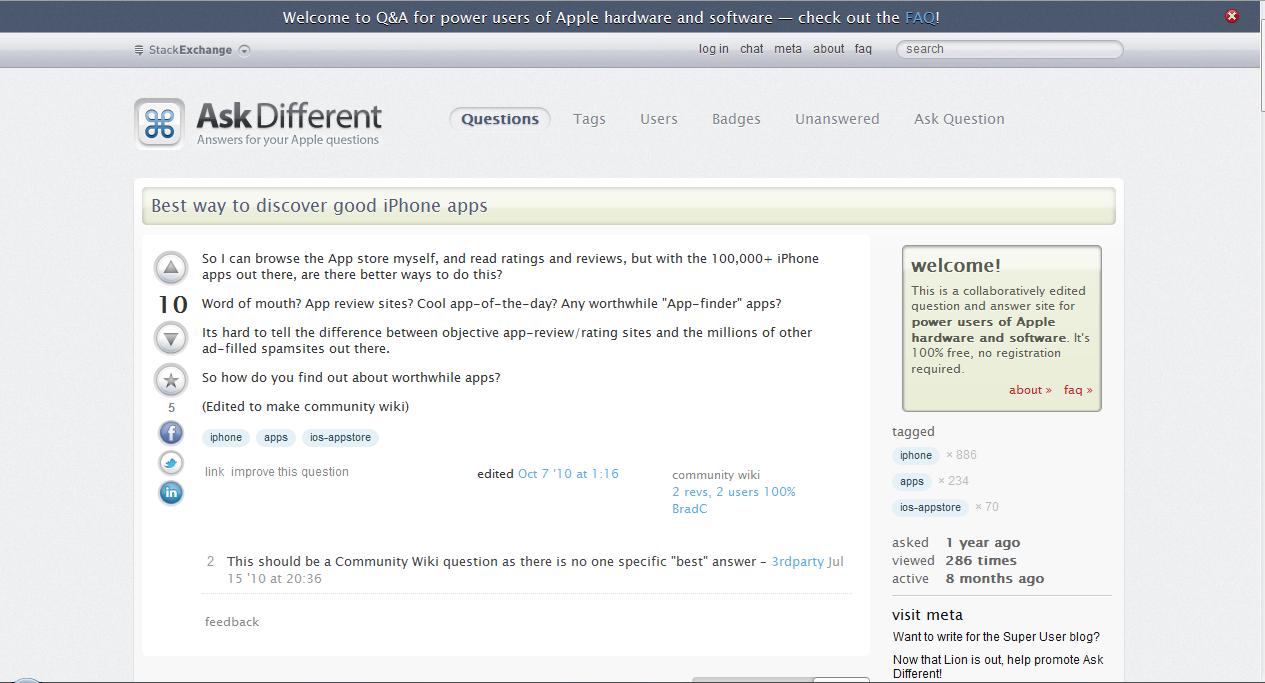
StackExchange

Originally designed for professional and enthusiast programmers, Stackoverflow has emerged as one of the leaders in the social search space.  The StackExchange Network encompasses an additional 57 social sites like cooking, photography, etc.  Each of these sites is uniquely focused on it’s specific topic, and is called a “StackExchange”.  Collectively they are the StackExchange Network and with nice growth numbers now see almost 15 million users each month.

Here’s how it works: After someone asks a question, members of the StackExchange community propose answers. Others vote on those answers. Very quickly, the answers with the most votes rise to the top. You don’t have to read through a lot of discussion to find the best answer.
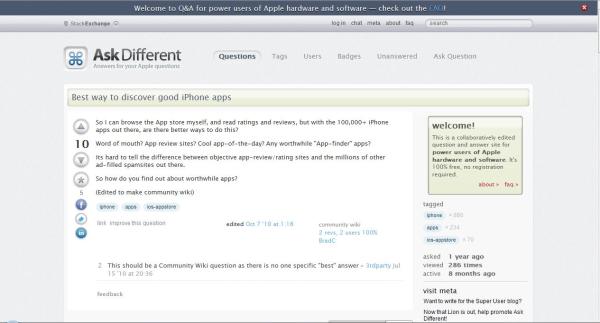
The growth of StackExchange is just another proof point aimed directly to replace swimming through the vast sea of links on the web, most of which are content farms or spam.  Simply put, these new approaches help people find better information quicker.  The unique take on mining expert knowledge for user search and discovery is quite clearly the future of search.  It is what I have been referring to over the past few articles “the future of search lies within your network of contacts“.

According to co-founder/CEO Joel Spolsky, the old question and answer model became flawed.  “I sort of feel like the first generation of Q&A sites, Yahoo Answers, WikiAnswers, and those, ended up accidentally being used for entertainment purposes. If you look at Yahoo Answers, it’s being used as a chat for teenage girls. It’s not really being used to get answers.”

StackOverflow’s answer is to focus on experts“We only select verticals where we have a critical mass of a couple hundred experts in the domain. We’re only interested in the domains where there’s something to learn – a corpus of knowledge, there’s a canon of knowledge, and people sharing knowledge are called experts.”

So why do I believe the future of search lies in a networks like StackExchange?  When experts are willing to divulge their knowledge, a site is able to collect and organize it, and more and more people start to use and share the information – *bing* the picture starts to become clearer.

Interestingly, Spolsky might not fully agree with my vision just yet.  “Our expectation is for the most part, people like to type their questions into Google and they’re not going to go to a specific site that often.”  Maybe he just can’t imagine a world where you could start following these experts, ones who you can look upon to bring you specific knowledge in areas of personal interest? In that world you wouldn’t have to go to Google anymore.  And what if you could infuse your social contacts in a way that…

Quora
QuoraQuora, founded by former Facebook employees, aims to build THE go-to application for the world’s wisdom and knowledge.  The cool thing about Quora is not only can you search and vote answers up or down, you can follow well known individuals as they continue to add their knowledge to the site.  Quora is combining the best of questions, answers, social contacts and search in an effort to build out a rich knowledge platform rivaled by no one.

They are the new Silicon Valley darling, garnering much attention and valuations around $1 billion yet still remaining a fraction of the size of StackExchange. Thus far they have maintained their focus on the relatively smaller tech community and it’s unknown if they can uphold their quality of answers as they grow in quantity of questions.

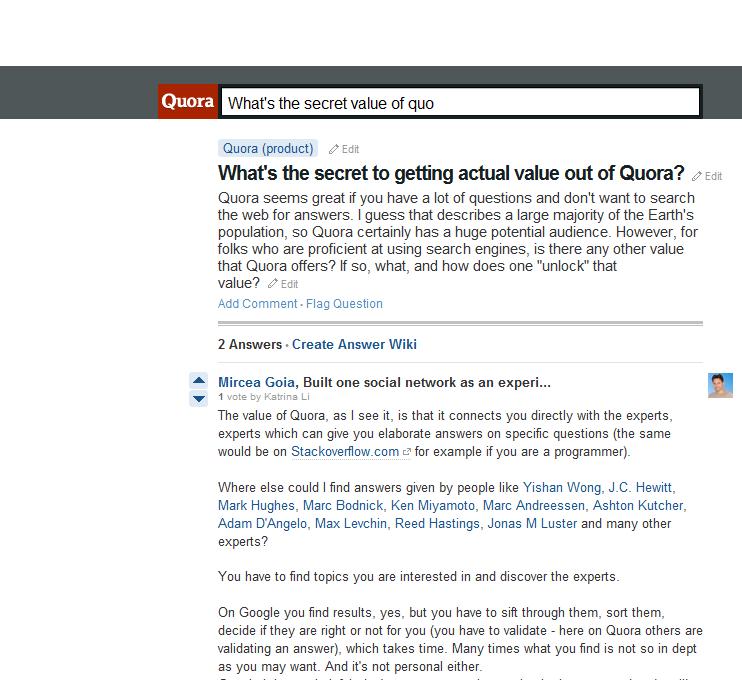
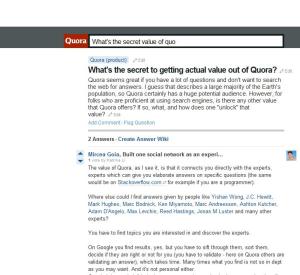
I searched Quora on the secret to getting actual value out of Quora, and as if on cue, here is an answer from Mircea Goia, a Web developer and web consultant (image above:

The value of Quora, as I see it, is that it connects you directly with the experts, experts which can give you elaborate answers on specific questions (the same would be on Stackoverflow.com for example if you are a programmer).

Where else could I find answers given by people like Yishan Wong, J.C. Hewitt, Mark Hughes, Marc Bodnick, Ken Miyamoto, Marc Andreessen, Ashton Kutcher, Adam D’Angelo, Max Levchin, Reed Hastings, Jonas M Luster and many other experts?

You have to find topics you are interested in and discover the experts.

On Google you find results, yes, but you have to sift through them, sort them, decide if they are right or not for you (you have to validate – here on Quora others are validating an answer), which takes time. Many times what you find is not so in dept as you may want. And it’s not personal either.

The greatest thing about these new search services is the best results and answers are voted to the top by other knowledgeable users, providing a much better user experience when observing results.  No more 10 links to a page.  No more SEO crap, where you see the first 10 results yet know they are there because someone knew how to “optimize” the site.  Superior optimization does not lead to superior information.

Although Quora currently attracts a relatively small user base, it might be to their advantage at this stage of the game.   As Yahoo answers became flooded with users, the the quality of information went way down, rendering the service meaningless to any serious web query.  If Quora can correctly harness the cornerstones of expert knowledge, social sharing and social discovery, as well as manage an appropriate growth curve becoming valuable to more and more web users, they have an opportunity to challenge the traditional search incumbents.

The value in Quora seems to be in what most see as in its incredible potential.  Semil Shah, recently on his own Social Search kick as well, has put the future of Quora best:

When all of these Quora threads are tagged in context within topics and subtopics, it builds out the site’s ultimate secret weapon: Topic Ontology. The ontology built so far within Quora is staggering.  For many topics in traditional verticals, the site has already mapped out all the relevant topics and subtopics, tagged them against other relevant pages, and created an entire hidden architecture of related pages that are all built into its own system with little to no contamination. Think of these topics as plates on a planet, rubbing against one another and moving over time to form entire new land masses — this is how fundamentally groundbreaking Quora could be for the web.

As I noted last time, research has shown that subjective queries can be monetized at 5x – 10x higher than objective queries.  It doesn’t take a rocket scientist to see where all this is going, Shah agrees: “advertisements that are targeted against specific Quora threads will know everyone who has subscribed to that thread, their explicit interests, and related questions. That alone on an ad-model basis could be worth billions of dollars.”  The problem incumbents face is these types of platforms are so different they are usually built from the ground up using a whole new infrastructure, not tacked onto an existing search tool.  I wonder if Google and Microsoft have asked “What’s The future of Search?” on Quora lately?

The question remains – What will happen to Google’s dominant search position as these new platforms grow and take shape?  If history repeats itself, Google will be moved aside as another platform takes over (or a multitude of platforms share space in a more equal search market).  Once dominant IBM shed it’s power position to Microsoft.  Aol, valued at one time around $160 billion, lost it’s early web dominance to Google.  Facebook has emerged and has a stranglehold on the social networking space with a very interesting future ahead of them.

What Shah and myself are trying to get people to understand is this: “At the same time, no matter what, behind the scenes, Quora is slowly learning about our interests (both explicit and implicit), they way we use language, and our intent through search, following, and voting, using all of this information to perhaps reorganize the web and lay a new foundation for years to come.”  Same could be said about Facebook.  These are interesting times to say the least.

Look for my next post in this Social Search Series, as I determine if long term information still has a search value on today’s real time web.

@jnickhughes

First Ever: Seattle vs NYC DJ Battle And Dance Party on Turntable.fm This Thursday Night

This is AWESOME!  A first of its kind and history in the making.

Seattle DJ ‘s will do battle against NYC DJ ‘s for turntable.fm supremacy, with an accompanying Dance Party physically and virtually both in Seattle and NYC.  The fun begins at 8pm and will go to 1am the next morning in their own respective timezones.  They will time shift the battle, so NYC will start at 9PM EDT and go ahead and Seattle will begin at 9PM PDT. After the event the winners will be posted on the Turntable Battle leader board.

Anyone not in Seattle or NYC can go to turntablebattle.com on July 28th to join in and listen to the two battle rooms .

Here are some event details:

  • 10 DJs on turntable.fm
  • 5 DJs on-stage at each location
  • 2 Physical Rooms (One in Seattle another in NYC)
  • 2 Virtual Room both in turntable.fm
  • House, Techno, Electo House and Dubstep – with some surprises thrown in there.
  • Battle Starts at 9:00 PM PDT

Tickets for the Seattle event are on sale here.

Tickets for the New York event are on sale here.

DJs who will be involved in NYC are posted here:

DJs who will be involved in Seattle are posted here:

What is Turntable Battle?

Turntable Battle (TTB) is a site that focuses on bridging the physical and virtual worlds of DJ Battles and dance parties using turntable.fm.  They host multi-city events across the world that pull music enthusiasts together both in dance clubs and virtual dance rooms. TTB wants to elevate and extend the user experience by letting people know which DJs are on-top of the leader-boards, providing interactivity between two different venues during an event as well as highlight fresh, innovative music from up incoming music producers and DJs.

Founder Ali Daniali has a vision of using Turntable.fm to transform the current DJ industry.  “I envision TTB just getting better every time we put on an event that moves attendees and engages them in a way they haven’t before. We feel that if we can put on events that people can’t get anywhere else, they will come back for more!

Talk about innovation being the mother of necessity.  “TTB came out a need I had when I wanted to attend a NYC dance party and the flight was around $800. So I said to myself I’ll just have my own dance party!  Then I had the next epiphany, to pit us against NYC in a DJ Battle.

During the event attendees within the virtual world on turntable.fm have the opportunity to AWESOME the DJ, giving them a point. You can only vote once for each DJ playing.  TTB will tally the points for each room and announce the winning city on the turntablebattle.com website.  Winning DJs get exclusive prizes from TTB.

The Seattle event will have one DJ selected from a DJ Battle which happened exclusively on turntable.fm this past week.  The tournament had 5 rounds, with the first four events pre-qualifying DJs for Round 5. The winner of Round 5 will move on to perform either on-stage or virtually at the main event on the 28th.  Information about the on-going DJ Battle can be found here.

Daniali is excited at the prospect of Turntable Battle and looks forward to putting on others around the nation.  “My focus now is to build a meaningful company that produces events at very high quality level that bring people together and makes them happy.”

He is thinking about doing some of these battles next – LA vs. Vegas or Denver vs. Dallas or Atlanta vs. Miami.  You can vote on these soon on turntablebattle.com.

You Know What’s Sexy? This Profitable Startup

Ya know, the web is an interesting place where anything seems possible and innovative new applications recreate the very world we live in.  Each day, entrepreneurs flock to it in hopes to create wealth akin to the 19th century American gold rush.  Understandably, it’s tempting to want to reach for the stars and invent a sexy, new, innovative web application.  Yet for every thousand or so businesses created, usually only one actually turns a profit.

It just so happens one of them is ResourceWebs, and anyone wanting to actually make money on the web might want to sit up in their chair and pay attention.  Class is now in session.

ResourceWebs is a network of targeted niche websites, each offering an education resource for its users – hence the name ResourceWebs.  As unique consumer properties they focus on a specific topic and are filled with a variety of high quality content, tools, and resources.  Some of their fastest growing and most popular properties include: railroad.net, solcomhouse.com, famousbirthdays.com, moonphases.info and mpgfacts.com.

Evan Britton, company President and a 12 year internet marketing veteran whom has worked within several successful entrepreneurial endeavors (and a Business Insider contributor as well), says focus and quality are the keys to a successful web content business. 

“On the web today many web properties spread themselves thin by focusing on everything.  We learned it’s about quality not quantity, as the properties which we invested and nurtured the most have become the most successful, while the smaller and more automated properties have slowly died off.

The world of content sites has flipped recently as Google Panda came out with 23 questions for webmasters to consider.  Google says that it looks for articles written by enthusiasts, that it wants articles related to the interests of the site’s visitors and that it more values websites which are a recognized authority on the topic.  Basically, it’s trying to clean up the web.

“This has been our vision all along, to focus on niches that we felt we could truly make an impact on, and not spread ourselves thin by trying to cover topics not directly related to our niche verticals.” 

Monetizing these sites has put ResourceWebs in an elite class – profitable web companies.  Putting to use highly targeted contextual ads ResourceWebs is able to generate significant monthly income organically from the more than 3 million visits and 10 million page views.  Britton wasn’t specific on revenue but did mention ResourceWebs monthly revenue is in the five figures with a goal to hit the low six figures soon.

Starting Small and Staying Lean

Contrast Britton’s approach with one of the latest web bombs – Color.  Color built a photo sharing app for a mobile device, raised $41m before even launching a product, was valued at over $100m pre-launch and created mass hysteria prior to any market traction.  All that unnecessary crap ultimately led to Color falling flat on its face.  Considering all the hysteria, Color never generated much traction or any revenue nor was it even clear how it would ever be a profitable company.   Maybe I shouldn’t be too harsh, they were valuable for at least one thing – teaching us how not to launch a company.

“Our goal with ResourceWebs has been to keep the business profitable throughout each stage of the company.  Doing this may have taken us longer to grow – but it assured that we were growing an endeavor which would indeed be profitable.” Britton maintains this might not be as sexy as other startups but is by far more dependable and sustainable.

I say dependability, sustainability and profitability are damn sexy!

Britton is keeping his options open but seems quite satisfied where they are as a business.  “Seeking outside funding is always an option, but right now we aren’t looking for any further acquisitions and we are able to invest in our properties each month as the business has low overhead and very solid monthly income.”

Know Where Your Startup Could Fail

Britton’s approach to ResourceWebs should be an example to all of us web entrepreneurs.  Below is a chart displaying the top 20 reasons startups fail from an article describing in detail the top reasons for startup failure found in post-mortem studies.   Whether Britton knows it or not, he took care of the top six right out of the gate.  Successful companies generally don’t pop up overnight, must focus on a finding and fitting a market need, listen and cater to their customers, find some sort of ability to generate revenue early on and should be grown and marketed organically so they can achieve a sustainable and profitable status.  Besides understanding green is the color of money, the guys at Color don’t seem to have a clue.  Maybe they should study this image.

Located in Santa Monica, CA, ResourceWebs is a small operation tightly ran by Evan.  The gatekeeper for each of the properties, Dr. Robert Amodeo, is the IT Manager who holds a doctorate in engineering from UCLA.  Prior to joining ResourceWebs, Robert worked as a programmer and IT manager in the UCLA math department.  North of that they have a team of writers who cover specific properties in which they have the most passion, something Britton notes to be a winning formula.  “All in all, we learned that you can find success through tackling a niche if you have passion, maintain focus, and create value.”

So my question is if ResourceWebs is attracting millions of visitors each month, minting millions of dollars each year, highly profitable and growing steadily, why are investors still flushing money down the drain on nebulous startups who can’t figure out what they are doing or how to generate any revenue?

ResourceWebs may not be as sexy as some of the new startups out there, but you know what is sexy?  That’s right, a profitable company.

Social + Location + Real time + These 2 Startups = The Future of Search

Social Search Series: This summer I am embarking on a journey through on the emerging web of Social Search.  Traditionally known as the Questions & Answers industry, this category is currently being transformed by social and mobile technologies.  No more asking a site questions and finding old answers.  I believe the future of the web is ingrained in the dynamic interdependence of social and informational networks.  This is part III of the series.  For background, check out Part I and part II.

Social, although hot right now, is not the only technology transforming the web today.  Location-based social search applications are bridging the gap between our online and offline worlds – and in doing so creating a whole new way for people to find and use information.

This post dives into the new territory of Location Relevant Social Search.

We first determined the traditional question and answer model is now insufficient, since the system doesn’t know your exact location, who your friends are or have any contextual understanding of your query.   The resulting answers are typically of low quality and relevance proving a broken model.

Additionally, search technology needs renovating and although Google is currently King of the Search Land they still have a lot to do if they want to hold onto their throne.  Basically, the amount of information on the web is growing so quickly that even the major search engines are bringing back mostly meaningless results.

I am postulating the next generation of search will reside within your network of contacts, and I call it Social Search.  In my first article a graph was used to illustrate four quadrants separating the field of emerging social search startups.  The first quadrant revolves around Location Relevance and it looks as if a few associated startups are positioned well to change the very way we interact and search online.

First, a few tenets we can stand on when talking about Location based social search applications:

  • Most of the worlds information is generated, organized and stored by human beings
  • People generating information are always at a specific location found with exact coordinates
  • So naturally, generated information always has specific geographical data attached to it
  • Combining those data sets: Search + Social + Location + Context = Maximum Relevance

In a related post, Evan Britton noted “the goal of real time search engines is to inform the public of what is going on right now.  By adding location data, internet users can be specifically informed as to the happenings in a city.”  Indeed, real time search results are incomplete without geographical data included in the context.  Location relevance completes the equation to help provide users with the best possible results when searching for specific information.

Location based technologies are changing our lives in every way imaginable.  Take the emerging location tracking application Glympse for example.  Watching someone drive along a map on their way to meet you, being found when lost on a mountain side or viewing thousands of people moving throughout your city in real-time are just a few ways Glympse will change our lives.

Or think about a similar application Geoloqi, a service using persistent location tracking to trigger notifications tied to real-world places.  Maybe it’s a note you or a family member left for you at the grocery store or maybe it’s part of a set of geolocated data that you opt-into subscribing to as a layer because it was of interest to you.  Some use the app to let their co-workers know how quickly they are getting through traffic to arrive at work.  Make no mistake, location aware applications are already changing the way we interact on the web.

Quadrant: Location Relevance

So what happens when you combine social, searching and location?   Annotating results with specific geolocation data when a query is submitted is fundamental to providing users with the BEST answer possible.  According to Bing, over 50% of mobile device originated search queries are about a specific place.  Think how often you quickly grab your mobile device to search for something.  Exactly.  The search world needs to catch up to the intricacies of how we are using the web today.

You can find the entire list of emerging social search startups here, but I am highlighting two emerging startups innovating location-based search and are poised to be big players in the search space.

LOCQL

LOCQL, Seattle startup some would refer to as “Foursquare Meets Quora”, has smartly put together two basic premises; 1) everybody knows a little bit about something and 2) location specific information always make things more valuable.  Marry those together, involve some game mechanics and you have a living, breathing repository of location relevant information based on where you currently find yourself. Using social power, LOCQL finds the missing links between the user’s queries and the places in the local landscape for which they are searching. They are still in beta but anyone can use the application.

LOCQL Co-founder Robert Mao can see the future of search lies within humans; “The idea for LOCQL came from our life experiences, as International travelers we traveled to many different places, relocated our home’s several times in different countries. There are so many ‘best kept secrets’ only local people know about, those who’ve been there just know it. Unfortunately, without a service like LOCQL, you won’t be able to find it from the web, nor can you find it through search engines.”

A major problem with current search engines is the “objective vs subjective” issue, and the qualitative differences found between their results.  Through quantitative analysis, Mao found up to 60 percent of location intended searches are subjective, meaning relevance can vary a lot between two different users searching on the same subject. “Social search is basically harnessing collective intelligence by crowdsourcing the answer from real people, so by nature it better solves the queries which are subjective.”

With LOCQL, users search or submit on topics and questions – typically in relation to a specific location – and receive highly relevant, useful answers.  “Who has the best burger joint in Seattle?” searched on LOCQL would give you one or two specific answers left by other LOCQL users who actually know the answer.  The same searching on Google will send back hundreds of useless links, most gamed by SEO keywords.  Plus one for LOCQL.

LocalMind

Where LOCQL is building a repository of location based information, Localmind, co-founded by Lenny Rachitsky and Beau Haugh, is centered around a real-time social search platform.  It can be thought of as the power of omniscience at your fingertips — the ability to know what’s happening anywhere in the world, right now.

According to CEO Lenny Rachitsky, they are working on a somewhat obvious concept. “We’re living in the 21st century for god sakes; we have data on people’s locations, we have always-on devices in our pockets, we have all kinds of sensors in our devices and in our world. We know more about what’s happening across the country than we do at the restaurant we’re thinking about going to. We are putting all those pieces together and solving that problem.”

Localmind allows you to send questions to users checked-in anywhere around the world to help solve your basic needs and inquires –  like how crowded is the bar, how many girls at the club, how good is the food at the restaurant, how long is the line at the airport.  More interesting uses include people sending questions to Japan after the tsunami asking if there’s anything they can do to help, or people getting free concert tickets when asking about a concert venue, or saving a family a few hours of travel by finding out a certain hotel was closed.

It has been found that subjective queries can be monetized at 5x – 10x higher than objective queries.  It doesn’t take a rocket scientist to see where all this is going.  Google and Microsoft, I hope you are listening.  The problem incumbents face is these types of platforms are so different they are usually built from the ground up using a whole new infrastructure, not tacked onto an existing search tool.

Lenny noted there are 4 core things they focus on: 1) Your preferences, 2) your friends preferences, 3) your current location, and 4) your exact date and time.  Combining those gives users much more relevant and useful information.  Interestingly, Google would have no clue how to answer those above searches and probably just shrugs its big shoulders if you try.  Alas, plus one for Localmind.

The much accomplished team of three launched Localmind at SXSW in March and have already shipped four major updates to the iPhone app.  Their Android app is in it’s final beta release and will be entering the marketplace in a few weeks, and they also have an open API (www.localmind.com/api) that allows anyone to built on top of their platform.  Amazingly, Rachitsky says 70% of searches are answered in 5 minutes and they just reached 20,000 users, both numbers are satisfactory to Rachitsky at this point.

With a newly raised angel round of funding and relocation plans to San Fransisco, Localmind looks like they are warming up to play some hardball.  And LOCQL, a relatively quiet startup still in their beta release, is very strong technically and has a promising future a head of them.  Indeed, it seems both are ready to play David to Google’s Goliath.  Now, where is that rock again?

Next time, I will determine if Location Agnostic applications are changing the way we are searching on the web.  Yes, I’m looking at you Quora.

FYI – LinkedIn Is Using Your Photo and Your Actions In Social Advertising

I discovered this little secret today and want to make sure you are aware of it.

LinkedIn is automatically opting you into their social advertising, using your image and actions with social advertising on their site.  Yes, this is shocking.  It is a warning because as LinkedIn gets larger they might start to extend their ad network out onto other properties and I want to make sure I am not involved (unless I have consented to it).  Probably good to check into this now.

Here is where to go and what you will read (Image below)

Settings > Account > Manage Social Advertising >

Message:

LinkedIn may sometimes pair an advertiser’s message with social content from LinkedIn’s network in order to make the ad more relevant. When LinkedIn members recommend people and services, follow companies, or take other actions, their name/photo may show up in related ads shown to you. Conversely, when you take these actions on LinkedIn, your name/photo may show up in related ads shown to LinkedIn members. By providing social context, we make it easy for our members to learn about products and services that the LinkedIn network is interacting with.

(Checked Box) – LinkedIn may use my name, photo in social advertising.

The box was auto-checked for me.  Obviously, I wouldn’t have gone into my account and chosen for my image and actions to be used in their advertising.  I have unchecked it.

Have I been under a rock or did I miss this announcement?  Shouldn’t we have a say in this type of activity before they default it checked? Anyone else know of this?

Pass this onto others so they can take precautions to preserve their privacy.

Pinger Bets Europeans Are As Cheap As Americans, Goes International Today

Announcement:

As of today Pinger, the #1 free texting provider in the U.S. is going international.

The company who has quietly become the 7th largest mobile carrier in the U.S. will begin their European rollout in Germany with its new Pinger SMS Free app for iOS and Android.  Pinger SMS Free operates within the current mobile eco-system—users receive a local German Pinger number and can text for free with any German mobile phone.

The ambitious six year old startup has set its sites on one of the worlds largest markets and will attempt to lead the way toward enabling free worldwide mobile communications. “The worldwide mobile business is a $1 trillion dollar industry with 5.5 billion subscribers, and all those billions of subscribers have one thing in common: they think they pay too much for their phone service.”

Pinger exploded onto the mobile scene by providing users in the U.S. with a real phone numbers and free mobile communications.  Their revolutionary Textfree products have been downloaded by tens of millions of iPhone, iPod Touch, iPad, Android, and Web users.

In an interview, Pinger CEO and Co-founder Greg Woock explained to me how Pinger sits on top of and disintermediates the carrier to enable a whole different class of devices to freely communicate, essentially becoming phones.  By doing so they open up an entirely new approach to mobile communications.

The obvious question is how can they provide free text and voice in the EU?  Their solution: Gamification.

We Have Cracked The code of European Mobile Economics

Pinger developed a patent-pending technology to allow anyone to exchange text messages for free in Europe.  This new technology ensures that no end user sends more texts than he or she receives.  “We created a governor, a meter which matches the inbound and the outbound flow of data between carriers.  And then we and gamified the experience.”

By keeping texting volume symmetric, overhead costs are eliminated for Pinger, allowing the company to provide this free service to anyone. “The meter is dead center on the UI and it keeps track of points – when someone sends something, it goes down and when someone receives something it goes up.  It’s a dead simple solution.” 

This symmetry model also works for voice calls, which Pinger plans to bring to Europe later this year.

Pinger’s growth, profitability and economics are staggering. They have over 15 million Textfree users and 11 million phone numbers have been given out in the U.S alone.  The traffic between those devices is incremental, meaning they add additional revenue to mobile operators.   Woock estimates more than $25 million dollars are being generated for the carriers by Pinger because extra devices like iPods and iPads are now becoming ‘phones’.

The number of texts Pinger serves per month will reach 1.7 billion soon and they have become the largest mobile advertiser in the world showing well over 2 billion ad impressions per month.  Most amazingly, they are now considered the number 7 carrier in the US and this international play only shows their goal is to be a major player in global communications.

“The expansion will start in Germany with every possible operator, and we’ll focus on text first in order to make sure the symmetrical trading actually works” says Greg.  “We will be neutralizing costs through symmetry and then roll out across Europe later this year”

The Future of Mobile Communications is Blown Wide Open

GigaOm recently noted mobile is now 2% of GDP.  They also touched on how overall revenue is on the rise for mobile data, but in general the price for voice minutes and everything else is on the decline. Meanwhile demand for data is rising by four to six times per year as more people get smart phones and add more mobile devices such as tablets.  More and more data is being created every day, but at lower and lower prices per unit.

So what happens when a new company slides in and offers text and voice communications for free?  Most likely, data margins approach zero as illustrated in the image below.

“Carriers will still be important but they are going to have to evolve” says Woock.   AT&T, Verizon and others are going to need to shift and set their sites on making the most of what they have.  Incidentally, it looks as if they won’t have much data revenue in the future.  They should think about being a smart pipe (versus a dumb pipe) and understand they always have something of value flowing through their pipes.  Monetizing those channels involves having vision and foresight into becoming more network centric to take advantage of peripheral markets, such as payments.

Pinger Perfectly Positioned

Pinger is positioning themselves perfectly to ride the coming mobile wave.  Mobile devices recently exceed traditional computers in unit sales and revenue.  Mobile data traffic is increasing at an exponential rate and will be 95% of global mobile traffic by 2015.   Pinger understands all these devices will be wifi and web connected and is positioned to enable mobile communications at unprecedented levels.  Indeed, we will see more changes in the next 10 years than in the previous 100.

When asked about the future of mobile communications, Woock simply said, “Big changes are coming…  it will be a massive musical chairs and I don’t expect the same people to be sitting when the music stops.” 

AT&T and Verizon, can you hear me now?

———

Press Release:

PINGER TRANSFORMS MOBILE COMMUNICATION WITH NEW GAMIFICATION MODEL
Brings Free Talking and Texting to Europe; Cracks the Code on European Economics

San Jose, CA – July 13, 2011 – Pinger, the company disrupting the mobile space by making texting and talking to real phone numbers free, today introduced its patent-pending symmetry technology to bring the free mobile economy to Europe, where high mobile costs have prevented others from offering free talking and texting.

Pinger is uniquely poised to restructure the end-user cost for mobile communication due to the company’s massive scale, unique local phone number model and new gamification technology that works within the context of the highly-regulated European mobile market.

The company’s European expansion will begin next month in Germany with its new Pinger SMS Free app for iOS and Android. Pinger SMS Free operates within the current mobile eco-system—users receive a local German Pinger number and can text for free with any German mobile phone.

“The consumer price of mobile communications in Europe is too high, and for years various companies have been trying to figure out how to make phone number-based mobile communication free,” said Greg Woock, CEO and Co-Founder of Pinger. “Pinger has changed the game by bringing completely free mobile calling and texting to Europe in a totally unique way. We simply neutralize the high costs for consumers while the carriers still make money.”

The Symmetry Model – Pinger’s New European Gamification Technology

Pinger has developed a patent-pending technology to allow anyone to exchange text messages for free in Europe. This new technology ensures that no end user sends more texts than he or she receives. By keeping texting volume symmetric, overhead costs are eliminated for Pinger, allowing the company to provide this free service to anyone.  This symmetry model also works for voice calls, which Pinger plans to bring to Europe later this year.

“The worldwide mobile business is a $1 trillion dollar industry with 5.5 billion subscribers, and all those billions of subscribers have one thing in common:  they think they pay too much for their phone service,” said Joe Sipher, Chief Product and Marketing Officer and Co-Founder for Pinger. “We can now spread free mobile communication to a wide audience with this simple, yet brilliant twist that combines a symmetry-driven gamification system with an existing mobile infrastructure using real local phone numbers.”

How Pinger’s symmetry model works:

  • The user downloads the Pinger SMS Free app from the iOS App Store or Android Market and chooses a local Pinger phone number
  • Pinger credits the user with 100 Pinger points, worth 10 texts
  • Each text received increases the point total by 10, and each text sent reduces the point total by 10
  • The user thus continues texting absolutely free as long as texts sent are about equal to texts received
  • If the user approaches 0 points, she can opt to use Facebook or email to ask friends to send her a text
  • Pinger refuses to charge for texting; the app is completely free, as Pinger’s revenue comes from advertising

About Pinger’s U.S. Growth

By providing its users in the U.S. with a real phone number and free texting and talk time, Pinger has quickly become 7th largest U.S. mobile carrier and recently surpassed 50 million downloads across its platforms:

  • Pinger has over 15 million users on Textfree alone in the U.S.
  • Pinger users send 1.6 billion text messages per month
  • Pinger users have exchanged over 15 billion text messages in the U.S. since Textfree’s launch in 2009
  • Pinger is the #1 free texting provider in the U.S.
  • In just a year, Pinger has given out 11 million unique, local phone numbers to its users
  • Since adding voice calling in December 2010, Pinger users are already talking for 45 million minutes per month
  • Pinger shows over 2 billion ads per month

“We’ve received tremendous industry support, because our Pinger communications apps generate approximately $25 million in revenue per month for other carriers,” said Woock.  “We give people who weren’t formerly using text messaging real phone numbers and the ability to text with anyone, including friends and family on other carriers, who are paying for messages.”

Pinger Textfree also enables free unlimited text and picture messaging from the U.S. to over 18 countries, and Pinger Textfree with Voice supports free calling within the U.S. on iPhone and iPod touch.

Pinger SMS Free will be available in Germany via the iTunes App Store and the Android Market later this summer.

Learn more about Pinger’s Textfree products at: www.pinger.com


About Pinger

Pinger makes texting and talking free. Our market-leading communications products have been downloaded by millions of iPhone, iPod touch, iPad and Android users around the world. Pinger is loaded with inventive people who enjoy creating consumer products and services that make a difference in people’s lives. www.pinger.com

If SkyGlue is the CIA, HasOffers is the Godfather

It was recently reported that SkyGlue was the CIA for your website.  Well if that’s true, then HasOffers must be the Godfather of the internet.  Just as the Godfather protected his family and corrected others as needed, HasOffers aims to bring better accountability to their family – the web.

“I’m gonna make him an offer he can’t refuse.” – Don Corleone

HasOffers helps online businesses track and manage their own affiliate programs.  The software allows anyone to create an offer, invite affiliates to promote it, and then keep track of which new customers came from each affiliate and how much to compensate those affiliates.  “We want to bring transparency to affiliate marketing industry so it can continue to grow as an industry” says Peter Hamilton, HasOffers CMO.

HasOffers was co-founded in Feburary 2009 by Lucas and Lee Brown (twin 26 yr olds) who spent years in online advertising trying to find the most effective and efficient way to track their performance advertising campaigns.  Their first software license cost  $10,000 to get set up, thousands per month to operate, and locked them into lengthy contracts.

“I got a business to run.  Sometimes I gotta kick asses to make it run right” –  Moe Greene

Finding the existing technology to be unreliable, they spent three years developing their own tracking technology to support their business model.  In the Fall of 2009, the brothers realized that they were not the only ones running into this problem.  According to Forrester Research Group, thousands of companies are paying more than $8 billion a year for referrals (affiliate sales) in the United States alone, and they are running on old technology that is slow and unreliable.  So that spring HasOffers was released as a SaaS product, and it caught on like wild fire.  In less than two years the bootstrapped Seattle startup has grown to 27 employees, more than 7,500 clients and tracking more than $300 million in payouts per year.

“You think I’m skimmin off the top?” – Moe Greene

Affiliate marketing is one of those vapor-like, man-behind-the-curtain kind of  industries where many different players are doing many different things.  It’s hard to even form an adequate category definition let alone set any kind of industry standards.   Proper tracking  is extremely difficult and money is being wasted left and right.  More often than not, companies become unreliable, unaccountable and possibly devious.  I can only imagine the amount of money being flushed throughout the web using old and outdated ad tracking models.

This is a big problem since Affiliate Programs are critical to the growth of online giants like Amazon, Netflix, and Groupon, yet the technology for tracking and supporting these programs was (and to some extent still is) expensive and outdated.  HasOffers flipped the landscape of performance advertising by providing reliable, scalable, and flexible technology at a fraction of the cost of legacy systems.  Go here to check them out.

“There are many things my father taught me: keep your friends close, but your enemies closer.” – Michael Corleone

Being the only Affiliate service in the cloud, HasOffers pricing model completely disrupts the status quo.  According the Hamilton, “because of our modern approach to tracking technology, we were able to provide our service at a fraction of the cost of competitors.  One of these defining approaches is our use of all four Amazon Web Services locations around the world to host our ad servers (tracking technology) on the cloud.”  This globally balanced approach allows them to support incredible loads from around the world.

Another fundamental difference is the self-service philosophy which empowers anyone to get started immediately and dig into the thorough documentation to create the perfect solution for their business.  You won’t find any other affiliate tracking solution with a completely documented 2-way API for every function in the application. Hamilton adds, “we provide the tools for our customers to do great things.”

“Never tell anyone outside the Family what you are thinking” – Don Corleone

One of the biggest draws to HasOffers is their tenacious attitude toward innovation.  “We know that the industry must and will evolve, and we are certainly looking ahead to see what performance advertising needs to grow into a more mature adulthood.”  They are now listening closer than ever, they closed over 7,000 tickets for their current application that came directly from customer feedback.

In fact, they are currently in development of a new platform called Adtribution.com that targets the need for more reliable, more transparent tracking technology to support advertisers, networks, and publishers in a quickly changing Internet landscape.  Also on deck is a mobile-focused tracking platform to allow mobile app owners/developers to track referring traffic for mobile application installs.  Hamilton shied away from giving too many details right now, but it looks as if they are tackling the problem of last click “Rotten Apples” in a pretty unique way.

I like HasOffer’s vision for the future of Affiliate Marketing.  And as The Don would say: “It would be a shame if a few rotten apples spoiled the whole barrel.”