Who’s Behind Founders RAW?

New Founders RAW logoI recently started a new project called Founders RAW, a destination for video conversations with other startup founders.  Why are we recording these conversations?  Simply put, we think the truth of entrepreneurship needs to be heard far and wide.

From the About section:

Founders RAW is actually an experiment.  As founders of an early stage startup we quickly realized how difficult starting a company can be.  And being part of the larger startup community in Seattle we discovered we weren’t alone in our crazy, mind-blowing experiences – apparently others have them too.  The idea started to form once we noticed the frequency of finding ourselves 30 minutes deep in truth sharing and wisdom dropping conversations with founder friends.  We wondered if others would be interested in what we have learned, so we figured why not to bring a camera.  I guess we’ll see what happens.

Founders RAW a video blog with conversation style interviews focused on bringing out raw stories early stage founders experience in their challenging entrepreneurial journeys.  We invite founders to talk openly over a beer or a coffee about the “truth” of how they survive and grow their companies.  We post the full conversations on the blog but really, who has time to watch 45 minutes of video?  So we slice up the conversations and post nuggets each day as well as send out daily videos no more than 3 or 4 minutes long to blog subscribers.    Now we all can receive daily nuggets of the entrepreneurial truth.

Don’t forget to subscribe and please reach out to us if you are interested in chatting.

I brought in a few friends to help make this happen.  You can watch Nate and I talk over why we started Founders RAW in this video, Why we started Founders RAW.  We believe the best way to educate new founders is through candid and casual conversation with other founders, regardless of their experience level.  Although a veteran certainly knows more about starting companies than someone on their first go-around, we believe everyone has something unique to teach other people.  We hope we can continue to grow and expand the impact Founders RAW has on entrepreneurial communities.

=======================

Nick Hughes

nick_headshotNick is an entrepreneur and writer in Seattle, WA.  He is currently the founder and CEO of Seconds, a mobile payment startup helping to bring payments into the mobile era using the web and text messages.  He also consults with other companies locally and nationally on business development and product strategies. In his spare time you will find him as far away from the desk as possible, hopefully on a trail or close to water. 


Nate Martinez

nate_headshot

Nate worked as a business development manager for a venture capital and private equity data research platform. Prior to that role, he ran his own hedge fund trading search platform for three years, with particular focus on quantitative strategies. His early career was spent with Credit Suisse (NYC) trading on their investment grade credit derivatives and corporate bond desk.


Josh Peterson

josh_headshot

Josh is currently head of Audio and Video production for Founders RAW. He also works as a web developer and media artist, and his interactive electronic artworks have been exhibited at galleries and events in Seattle. Josh hopes to develop technology that artists will use to make new and exciting forms of digital art.

The Real Killer App For Founders – Connecting With People

During my latest Founders RAW conversation I was talking with Patrick Henley, founder and CEO of Amp Tab when he mentioned something quite profound.

Connecting with people – truly connecting with someone – is the key to business success.

It was a great moment in the conversation (will post the conversation when it goes live) but I want to riff on the concept of connecting with people and why it can have a huge impact on your success.

Some may view networking as cheesy, uncomfortable and a waste of time.  I don’t.  And neither did Patrick.  Networking is not an activity, it’s an purposeful energy.  Patrick says connecting with people has been the difference maker for him and his success in sales and business in general.  He pointed to how connecting with someone on a deeper level, figuring out how he could help them in their pursuits tightens the relationship between him and the other person.  Once tightened, those people will break down walls to help you.

So how do you really connect with people?

Shaking their hand.   Looking them in the eye when they are talking to you.  Remembering their name.  Making them feel like they are the most important person in that room at that specific moment. Asking what you can do to help them.  Asking if you can introduce them to someone they are looking to meet.  Following up with them via email the next day to book a meeting or re-confirm what was talked about. These things show the other person you have their best intentions in mind, rather then trying to get something out of them.

Remember, people care more about themselves than others…  take advantage of that and let them know you too care about what’s important to them.

All too often people go about their days and nights looking to get something out of others.  This is a terrible mistake, just as it is for the guy at the bar who obviously is trying too hard to take any girl home.

Once people feel you have their best intentions in mind, they let their guard down and feel safe to further communicate using all the different means we have available.  They will then be willing to add you on LinkedIn, twitter, Facebook and others.

Do that year in and year out and before you know it you have a large network of people who not only feel comfortable with you but would be there when you need a favor (and you know that time will come sooner than you think) and willing to bust down walls to see you succeed.

This is the killer app for founders, creating a network of people you are truly connected with on a deeper level than just a digital click on a social network.  If more and more people can hear your name in public and think “man, that person is great and I would do whatever I can to see them succeed” you are golden.

It means you are truly wealthy in the relationships you have built.  And since success in business is based on the relationships we have created you will have no other option than to continue on your path towards success.

Have We Lost Our Humanity By Using Technology?

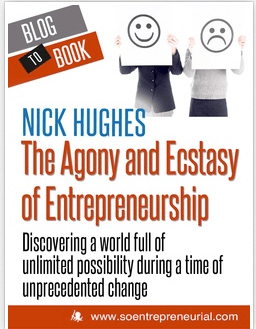
Below is a snippet from my new book The Agony and Ecstasy of Entrepreneurship, available now on Amazon and HyperInk.

Agony and Ecstacy of EntrepreneurshipA few recent experiences have spurred my thinking on the subject of humanity vs technology. Some of this will seem inevitable and some of it will seem common sense to you. Some of it might even go against the grain of what you are currently working on right now. My purpose is to get you thinking about how you go about your life using technology—by yourself and around others.

I am not sure if it’s just me, but I feel we are starting the upswing on what will be viewed as the turning point in our society. We will never have a “slower” life than we do today. Cell phones allowing us to talk to and message anyone in the world was just the beginning of this movement. Now, we have really powerful mobile computers in our pockets that basically bring the entire world to us—instantly—with a touch of a finger. In a not so distant future we will be wearing these computers on our wrists (I hope not) or our faces with such innovations like Google Glass. Will brain implants one day do away with any device or hardware required to access all the worlds information?

Fashion faux pas aside, I think these technical advancements are inevitable yet at the same time very scary.

What seems to bother me is what will happen to our humanity as all these technical advancements come into our lives. We already deal with the quick “phone, text and email check” at the dinner table or during a conversation with someone else.

Is it lost on our society that this action is actually quite rude to the other person you are sitting with? I know I am guilty of frequently swiping my iPhone and seeing what I missed over the last five or ten minutes. In reality, it simply says to the other person, “you are not very important to me and I am wondering what other bits of information I can quickly scan to keep my attention.”

What will happen when we wear a pair of glasses with a screen ever-present right in front of us?

I am afraid we, as a society, are not prepared for this use of technology. Sociologically, we are trained to observe people and gauge them via non-verbal cues as to how we are connecting with them. Are they threatened, scared, turned on, tuned out, distracted, interested, etc. The human eyes/mind/body instantly calculates these millions of inputs and tells us what is going on within this specific human interaction. We live our lives on non-verbal human cues.

Want to read more?  Buy the ebook today >

Although Tempting, Raising Too Much Money Is Not A Good Idea

A 21 year old Stanford grad recently raised $25 million before even launching his payments company.  It was said to be the largest seed round of funding in Silicon Valley history.

This, for him and his other founders, was a terrible mistake. Before I go into the reasons why let’s talk in broader strokes about what the first early years of growth of a company should be.

Initially, you have an idea (a hypothesis) and you sketch it out on a napkin.  You then determine who else you need on your team – go recruit them – and establish the founding group of 3 or 4 people.  After that, you build a prototype as quick as possible and you get it into customers or users hands.  Once released, you observe the usage, gauge what’s working and what’s not, keep what’s working and toss what’s not and iterate as quick as possible.

All the while, you keep your team small, lean and working efficiently running like hell and trying to keep the wheels on the car.

All this could take anywhere between 6 months and 2 years – maybe longer – but it’s the most important time in the company’s history because this is where you are testing things to find the “secret sauce” and how repeatable it can be.  Before leaving this phase you should experience a massive uptick in growth, proving you actually have something worth investing in.  That, or the reality is you just have an idea but you don’t have anything people will use/buy yet.

I explain this because it is not how Clinkle’s, the startup I mention above, story unfolds.  From my understanding – and I don’t have all the facts for sure – is they have been working on this concept for some capacity for almost 2 years, already have roughly 50 employees and just raised $25 million all the while with no product launched.

The crazy thing is the list of investors is star-studded; they are A list investors who have backed many other successful technology companies.  I don’t blame Clinkle for being naive and short sighted when you have these types of people begging you to take their money.

But the reality is they just signed their companies life over to the devil.

The devil?  Yes, they have entered startup hell.

At this point, some simple math and logic can explain. By taking $25 million this early, they just lost all leverage with investors.  They also just put the horse before the cart. When raising money at an early stage, a startup generally gives away anywhere between 20 – 40% of their company.  So, if they raised $25 million and gave away 25% of the company, it’s fair to say this unlaunched company is valued at $100 million post money.

You read that right – $100 million valuation for a startup that hasn’t even put out a product.  This is absurd and it’s a terrible situation for any founder to put themselves in.

You might say that’s too high.  Okay, so maybe it is but given this much invested this early, I have a hard time seeing investors with less than that amount so it’s fair to see the investors share 20% on the low end.

Also, it now raises the exit question.  Given such high investment it now means Clinkle will have to exit for north of $100 million to simply not lose any investor money.  More likely, a $200 or $300m exit would be needed for VC economics to work.  This is not an easy task at all.  A nice $50 million acquisition will now be seen as utter failure.  You don’t think investors wouldn’t block an acquisition offer to sell at a decent price, because it would be bad for their return?

Another thing to consider, down rounds.  Raising this much money and allowing for at least some sort of valuation on the company (even if it was completed using convertible notes there still is an implied valuation) now sets the bar for future fundraising.  Basically, Clinkle just did the equivalent of making their first skydive the Felix Baumgardner Skydive from space.  It’s a bit difficult to repeat this feat.

More to the point, if Clinkle stumbles at all with during their first $25 million and they don’t have out of this world user adoption, they will be facing a down round of funding – meaning they will need to raise another round of funding at a lower company valuation than the previous raise.  The result strips out founders ownership and gravely demotivates the entire team.

Look, I have no idea if Clinkle will be successful or not, they might end up the new Paypal or Square for all we know.  But make no mistake, these are very important founder lessons for a few reasons.

Founders’ best asset is time, in the sense that if they can buy themselves more time to figure stuff out they generally do figure it out.  They key is to figure it out while still retaining the highest percentage of your company possible.  But when you raise $25 million right out of the gate you are not afforded that luxury.  Investors will rake you over the coals if you slip up and not perform.  The problem is Clinkle has no idea how the market will adapt and adopt their product.  That’s what raising a smaller seed round over the first few years and growing naturally affords.

Secondly, the press will kill you if you come out of the gate doing something like this.  Do you want to be known as the next Color (who basically did the same thing) for the entire history of the company?  People love to find the next thing or person to pick on, and as a founder it’s not smart to bring this unwanted attention to your already stressful life.

The lesson here is – mo money, mo problems.  If you raise money at all you should raise enough for money for what you need for the next 12-18 months and be strong enough to say no to investors who don’t have your best interests in mind.

That, or sign your company over to the devil.

Going Deep Inside The Mind Of An Entrepreneur Can Be Scary

The more I live this entrepreneurial life the more I realize how much of a psychological game it is.

I was reminded of it the other day as I watched this interview between Jason Calacanis and Jerry Colonna, a very well known CEO coach in the technology industry.  The 90 minute interview is incredible, they  cover many aspects of how he works with CEO’s and the issues they (we) deal with during the entrepreneurial journey.

There are so many things in this interview I want write about but one of the biggest things that stuck out to me was the idea of “chasing demons” with entrepreneurship.  Jerry and Jason both reveal how their Dad’s lost their jobs when they were young, and how greatly it impacted them, and still does to this day.   For both of them, they committed to never be dependent on a large company, since it could all be gone one day if you are fired.  Deeper, it was the feelings of inadequacy (or the fear of) which drove both to become successful in their pursuits.  It’s amazing and touching to hear them talk about their fears and doubts, and how they are rooted simply from watching their father’s struggles as they were young men.

I think this is something very important to understand.

Why are you so driven?

What demons are you chasing?

Jerry bravely mentions chasing demons is not necessarily bad – not knowing you are chasing demons is.  Not fully understanding who you are and why you are doing things is a scary place to be.

Another thing he points to is how ALL of us feel inadequate, regardless of financial stature and prominence.  He works with over 60 clients (many billionaires) and without fail he see’s highly successful individuals tearing themselves apart, comparing themselves to other founders who – quite frankly – got incredibly lucky with their outcomes.

He emphasizes how much random luck has to do with success in business.

His point: figure yourself out.  Determine who you are outside of your company, your family, and your city.  Once you get to the core of who you are you can fully embrace the life of entrepreneurship without the feeling of insecurity and doubt.

The lesson to take here is although it might be scary to face these demons, once you do you will open yourself up to a much happier entrepreneurial journey.

Sometimes You Just Gotta Try New Things

So I am now a published author and a producing/hosting a new weekly show talking with other founders.

Even just a year ago I wouldn’t have even thought this was possible, yet here I am working on some cool new projects.

Many out there might think “I could never produce a show, let alone get in front of a camera and talk with people!”  Or, “write a book? Where do I even start?”

The thing is you just do.  Just start with an idea. Start talking about it with people. Brainstorm.  Whiteboard.  Draw something.  Write something.  Passionately talk about it and dream about what it could become.

Grab your phone, turn on the video camera and start interviewing people.  It’s that simple.

Sometimes you just need to try new things.  It’s amazing what happens when you simply start talking about a new idea.  Nate and I literally sat in lobby of the W hotel a few months ago and discovered we both were thinking of an idea on how to help entrepreneurs.  We realized we wanted to create multimedia around founders and their stories.  We wanted to bring forth the truth about entrepreneurship and hopefully help others start their journey.

We knew it would require some help on the video side, and we found it.  Now we are having a great time each week filming awesome conversations with founders and other people within the Seattle startup community.

It all started with a conversation.

And the willingness to try something new.

Don’t Just Break The Rules, Make The Rules

I think about this a lot – If you aren’t breaking rules everyday you aren’t an entrepreneur.

People have many different definitions for the word Entrepreneur, but one of mine circles around rule breaking.  Entrepreneurs believe there are numerous ways to live and get things done.  And typically their creative way is much better than the standard practice.  Entrepreneurs often break the rules so they can see or do something from a different perspective.  Only by breaking the rules can you grab a different view of the world, possibly opening up a new market, product or business model.

To take it a little farther, not only should you break the rules but you need to re-write the rules.  If you are a true leader, the rules you write then become the rules others start to play by.  That’s how you end up owning the market.  Look at Gates, Jobs, Zuckerberg, Musk and many other highly influential and successful entrepreneurs.

All were rule breakers.

And more importantly, all were rule makers.

I read a recent GeekWire recent post on Tim cook, where he essentially said the same thing on breaking the rules:

“I think you should rarely follow the rules. I think you should write the rules. I think if you do follow things in a formulaic manner, you will wind up at best being the same as everybody else, maybe you miss something and you’re a little worse. If you want to excel, you can’t do that.”

Call ’em crazy.  I call ’em entrepreneurs.

Published My First Book: The Agony and Ecstasy of Entrepreneurship

Agony and Ecstacy of Entrepreneurship

I am pleased to announce today we are releasing my first book, published through Hyperink.

It comes in ebook format, with content adapted from posts originating on this blog.  I cover topics ranging from leadership, founding experiences, to dealing with uncertainty and doubt.  Go ahead, don’t be shy… give it a purchase and see what happens next!

It’s called The Agony and Ecstasy of Entrepreneurship. Here’s where you can buy it for only $5.95:

  • Amazon

  • Nook

  • Hyperink

    (includes the book in three popular drm-free formats: pdf, mobi, and epub)

Once upon a time there was a world where you went to school, earned a degree, graduated with honors and went straight into a 35-year career with one company. Simple was your life. They treated you right; you worked your way up the company ladder toward senior management; and when you retired they took care of you through your golden years. That was then.

This is now.

Nothing is guaranteed and we’re all fighting for our own scraps today. The world has changed, and your life now depends on you navigating the professional world with a new set of skills and talents. Whether you are starting your own company or joining a large corporation, today’s world demands you to be entrepreneurial in everything you do—fighting tooth and nail for new customers, innovating around creative ideas and new business models, networking with others, and understanding we now live in a fluid and ever-changing world economy where thousands are all elbowing for one job opening.

So what makes you unique in this new world?

What follows has been adapted from my blog, So Entrepreneurial, and placed into book format. They are my thoughts and musings on all things entrepreneurial, meant to help you understand what it takes and how to think like an entrepreneur in today’s world. Far from perfect and by no means the only way to go about the journey, they represent my lessons taken straight from the trenches. Since my thoughts originated as blog posts it’s best to take them piecemeal, maybe even digesting just a few topics each day. You will find my main perspectives are around mobile, digital and internet technologies, but the principles can be applied to any other entrepreneurial focus.

I am not bashful in saying entrepreneurship is not easy—in fact it is extremely difficult. Yet for many reasons it’s probably one of the most rewarding pursuits in the world. You will find straightforward talk, deep thinking and at times uncomfortable topics discussed with authenticity and honesty in hopes to educate the less familiar on the ups and downs of life as a founder. If anything, I’m sure it will lend itself to some entertaining reading.

Your own agony and ecstasy of entrepreneurship will rock your world more than you ever imagined, my hope is that by sharing my thoughts and experiences it might help you prepare for—and even celebrate—entrepreneurship in some small way. If you feel so inclined, shoot me an email and share your own entrepreneurial story.

Purchase The Book Now >

Why We Play This Crazy Game Of Poker

poker chips2

Startups are all about risk.

Taking risk is healthy, if not required, for any successful outcome – be it business or in life. Yet not understanding the risks you are taking (or choosing not to take) is the easiest way to find yourself out of money, out of business and out of a life.
PandoDaily ran a few great pieces recently regarding risk. A few things jumped out at me as I read them (and if you have time please read them yourself, super valuable stuff here).


The first one talked about the Three Main Risks you encounter as you start a company. Those included:

1) Category risk: Is your market large, valuable, and growing?

2) Competitive risk: Are you about to be disrupted?

3) Execution risk: Can you produce legendary results every quarter?

Although all are valuable, I believe the 3rd one is the most important since ideas are a dime a dozen and quality execution means everything. Of course you must start by picking a large, valuable and growing market. You can even take the most competitive angle on the market, and choose to be the innovator/disruptor rather than the traditional business that gets disrupted.

But if you cannot deliver legendary results each and every quarter, you risk losing the war. My thoughts on execution will be left to another post but suffice it to say executing on your idea makes all the difference.

These three thoughts are very important perspectives to take as you set out on your next adventure, and should’t be taken lightly. I would encourage any founder who finds themselves at the starting line of their entrepreneurial journey to take those three points and write at least one page on each point, detailing how you are exceeding what is required to become a great company in today’s markets.

But I want to bring to light another risk you might not even be aware of – The risk not taken. Or better said, how you view your decision to be an entrepreneur in the first place is worth a deeper look.

Andy Dunn, co-founder of mens online clothing retailer Bonobos, penned an incredible post on taking risk, and the possibility of the risk not taken. I cannot do justice here so just go ahead and click the link and take it all in. Good read…

But it gave me pause. It made me thank God I have chosen this life, for better or for worse. I feel at the end of my life I will be incredibly thankful of the lessons, people, relationships, experiences, money and memories this journey will have provided me.

Each and everyday we are presented with decisions, some small and some large. The crazy thing is at the time we probably don’t realize how imminent these decisions will be on our lives, we are usually so distracted and stressed we pretty much look at the immediate consequences of the choice at hand – make it – and go forward with our life.

Yet, as we all know, consequences can have long lasting effects on our life. Simply by punting – not taking the riskier decision – we are holding ourselves back from fully experiencing the world.

Andy talks openly about his struggles during his entrepreneurial journey. I love it because I’ve been there too! He mentions a time where he realized in the middle of a first date the restaurant where they were dining only took cash. Being a founder living pretty much on credit he basically didn’t have ANY cash – he even went to the cash machine during the dinner only to have the machine deny him any money – so he couldn’t pay for the meal. Talk about the worst feeling in the world, especially for a man.

Outside of those crazy broke stories, Andy dives into why we choose to put ourselves through such difficult circumstances, choosing to take risks, ones that probably seem somewhat unnecessary at the time.

The risk is not in doing something that feels risky. The risk is in not doing something that feels risky.

Very little is obvious in the research on human decision-making and happiness. Very few things are proven. One thing that is proven is this: the only regrets octogenarians have are for the risks not taken.

Here’s why: If the risk taken does pan out, it is good. But if it doesn’t — and here’s the key thing — we find a way to justify the failed risk taken as learning.

So true.

So here we have probably the best breakdown of why entrepreneurs CANNOT NOT take risks. I always found it funny people loosely refer to entrepreneurship as a disease. I think this gets to the bone of why people have been saying such a thing. We are addicted to 1) winning and 2) learning. And either way, being an entrepreneur we will succeed in our journey. We will either win big – financial, social, societal – or we’ll learn a hell of a lot in the process.

That is why we play this game. That is why we bet our stack of chips on our future, because we simply cannot NOT see what happens and learn from the experience.

You can learn more about business, people and life in general in 4 years of a startup than from any university in the world.

That is why it’s so addicting. That’s why we pull up our chair and are willing to place our next bet, because you never know what card will be flipped next.

I would rather ante up to see, wouldn’t you?

Bringing Health And Wellness Back Into Daily Focus For The Startup Founder

It ain’t no secret, startups will consume ALL of you.

As any founder can attest, you have no time to spare when you are starting a company.  You have no time for hobbies.  No time for friends.  Little to no time for family.

And definitely no time for your health.

Things start spinning so fast it’s very easy to add the “Founder 40” as former Groupon CEO Andrew Mason put it, simply by not paying attention to what you are or aren’t doing and what you are or aren’t eating.

That’s why I recently stepped back to evaluate my life and get my health and fitness back on track.  I realized I was starting to get soft in areas I have never been soft and lazy in ways I never have been lazy.

Given, I have paid at least small attention to my wellness since founding Seconds and in fact didn’t put on the Founder 40, so I am glad to say I am not overweight or out of shape.  I have been lucky to have kept up with a minimal exercise routine and stayed fairly consistent.

But what I did do was probably what most of you have let happen – I started to pay less attention to what I ate, how I ate it, what I drank and how often I drank it.  I started to notice how often we would include beers in our company meetings (all 4 of us) and how waiting 8 hours before I ate again would make me so hungry I would then stuff my face with a huge meal only to feel really full immediately afterwards.

(pro tip, feeling really full is not a good sign of healthy eating.)

I write this because I know most of you deep down are thinking the same thing, maybe even more desperately than I am.  All of us want to improve our health and wellbeing, and knowingly we would make the right choices if we knew how simple they really are.

Here’s a short list of things that I realized I needed to get back into my life.  The key to all of them is how I committed to them just as I would commit to showing up for a new job at 9am everyday if that is what they expected.

It really is that simple.

fruitCleansing

I just finished a 10 day herbal cleansing, the first one I have ever done.  To my surprise, it feels great and wasn’t bad at all.  The cleanse consisted of a fIber drink and multitudes of vitamins and minerals through the day and herbal cleanse pills at night.

In the end, it was a reset of my entire digestive and limbic system, and it’s amazing how I feel my body is a lot more efficient in how it’s processing the foods I eat.

I highly recommend doing a cleanse once every few months.

Eat more, smaller nutritious meals each day

I have re-committed to eating more nutritious and that means eating more meals throughout the day, with each meal being smaller in portions.  Eating better is simply a decision and then an act of commitment to keep that decision.  Once you have established the habit, it’s reinforcing each time you make the right decision to eat well, instead of grabbing a quick bite of crappy and unhealthy food.

I have learned to love fruits and veggies, I make sure I at least have a banana, orange, and apple each day, more if possible.  I drink meal replacement shakes and make sure I have a protein rich snack between meals.  During meals, I am aware of the nutritional value of the food I am eating, making sure I have a protein base (chicken, fish, beans, eggs, etc…) and then add a fruit and vegetable with it.  I also make sure I finish my meal feeling satisfied but not full.  This is key to not overeating and saving on caloric intake, which in the end will result in a trimmed body from weight loss.

Also, drink water.  A lot of it.  More than you think you need.  It’s the wonder drug of life, as hydration makes all other processes work more efficiently.

Simply put, I actually think about the food I put in my body and that makes all the difference.

Don’t drink as much

Drinking seems to be just part of the startup experience.  Every week there are a number of events going on in the startup community where free beer and wine are offered to meetup attendees.  Who can say no to that!

I realized I was drinking quite a bit of beer each week, and heavy beer at that.  I am not a “light” beer drinker either, I enjoy a strong well made Amber or darker beer with more hoppy taste.  And along with the hops come calories, which if you are not careful will start to add up week upon week.

Think about the affect this can have on weight gain – one beer roughly equals 100 calories.  A pound of body fat equals 3,500 calories.  Without even thinking about it, drinking 5 beers is another 500 calories in your system.  Conservatively,  if all you did was drink 5 extra beers each week you will put on almost 10 pounds each year.  Work on a startup for 4 years and you now see how easy it is to put on the Founder 40.

Keeping an eye on your alcohol consumption – amongst many other positive benefits – will help keep the LB’s off.

nike-shoesExercise every other day

Founders are notorious for having little time for anything else in their life besides working on their startup.  Yet counterintuitively, committing to an exercise routine of every other day actually makes you a A LOT more energetic and productive, giving you the feeling of creating more time in your day.

The cool thing is it doesn’t have to be a 2-hour workout every day.  As little as 20-30 minutes, every other day, will do tremendous improvements to your fitness.  I go on a 3 or 4 mile run and do about 15 minutes of strength training every other day and I feel great.

Honestly, I feel like 23 as I approach my 33rd birthday this summer.  Trust me, do whatever you can to get activity 3 or 4 days a week and you will be shocked at what happens to your life.

Walk whenever possible

In addition to working out every other day, I now pay very close attention to getting out and walking to meetings around downtown Seattle.  Yes, I need to leave a little bit earlier for the meeting but it pays off in the end.  It reinforces my active lifestyle, it gives me fresh air, it keeps the metabolism up and burns energy throughout the day.

Get up from my work station at least once per hour

Similar to walking to meetings, it has been proven sitting for long periods of time is very unhealthy.  It’s bad for our posture, bad for joints, bad for our circulatory system, bad for our digestive system and just downright not good for the body.

Making a habit to get up and do a lap, going to the bathroom, talking to another co-worker or whatever you want to do will keep you limber, awake and give you an edge health wise.

To me, it also allows to break up the monotony of the sitting workday.

To all those who say “I need to concentrate on coding or designs” I urge you to simply stand up at your desk, stretch and do some work on your feet for a while.  Also, you will find taking frequent breaks will keep you sharp, alert and might even help you with your work!

Pay attention to how I look and feel

Finally, all this has helped me pay a little more attention to how look and how I feel.  That’s not a bad thing!  We are told to not care about ourselves and not be so self centered about looks and things like that, which in some ways has its logic.

I agree, to an extent.  No need to overindulge in yourself.

But to barrow a dev term, we only build what we measure.  So if you are paying attention to your health and wellbeing, you will start to notice things about it you want to change.  Once you identify what needs to be changed, only then can you start down the process of changing it.  If you don’t pay attention, obviously nothing will happen.  So paying more attention to how you look, dress, how you feel climbing stairs and walking long distances will go a long way to help you become a healthier and more fit individual.

These simple things have really influenced me and my health recently, and I guarantee they will make positive changes in your life too.  All you need to do is make a few small but significant commitments in your daily life.

Starting A New Chapter Today, Shooting The First Interviews For Founders RAW

FR iconToday marks a new chapter in my life and I am excited to start sharing more about what we are embarking on here in Seattle.

Today, we are shooting what should be the  first of many conversational interviews with local startup founders for our new concept called Founders RAW.

What is Founders RAW?

Founders RAW is actually an experiment. As founders of an early stage startup we quickly realized how difficult starting a company can be. And being part of the larger startup community in Seattle we discovered we weren’t alone in our crazy, mind-blowing experiences – apparently others have them too. The idea started to form once we noticed the frequency of finding ourselves 30 minutes deep in truth sharing and wisdom dropping conversations with founder friends. We wondered if others would be interested in what we have learned, so we figured why not to bring a camera. I guess we’ll see what happens.

Founders RAW a video blog with conversation style interviews focused on bringing out raw stories early stage founders experience in their rough and tumble entrepreneurial journeys. We invite founders to talk openly over a beer or a coffee about the “truth” of how they survive and grow their companies. We post the full conversations on the blog but really, who has time to watch 45 minutes of video? So we slice up the conversations and post nuggets each day as well as send out daily videos no more than 3 or 4 minutes long to blog subscribers. Now we all can receive daily nuggets of the entrepreneurial truth.

More work still needs to be done on the site and the current video posts are just test/fillers, but I am sure you get the idea.  We’ll be updating it soon and you should start to see high quality conversations showing up as the weeks go on.

My first guest – the one and only Nate Martinez, who is my cofounder on the project with me.  We’ll be chatting about our entrepreneurial experiences as well as why we decided to start Founders RAW in the first place.

Since this is new territory for us I have no idea the turn around time for us to get the content uploaded onto the site, but stay tuned.

If you know of anyone who has an interesting and entertaining entrepreneurial story to share, please let me know and I’ll reach out to them.

Seconds Highlighted on Started In Seattle, And Discuss How To Get Noticed

We were highlighted on Started in Seattle yesterday.  Started in Seattle is a a new site where Stephen Medawar and Chet Kittleson profile startup that were actually started in Seattle.  (Stephen made the distinction that it not just companies that reside in Seattle, but you actually have to have started in Seattle.)

Here’s our profile.

It’s a cool new idea and I was honored to do a short interview with Stephen, where he asked a few questions about how to get noticed in a very busy and competitive market.

How Do You Meet Other Cool and Smart People In The Startup Community?

coffeeI was at an event last night and started talking to a person who was younger and newer to the startup community.  During our conversation he asked something that slightly caught me off guard, given his current job at a fairly well known tech resource here in Seattle.

“How do I meet more cool and smart founders and engineers around Seattle?  I mean, what do you do?”

Although he is young – about a year out of college and just getting his feet wet in the professional world – I was still taken aback.  It struck me as odd that someone wouldn’t know where to go and where to look to meet other entrepreneurs.

But then I realized it might not be as obvious to others as it is to me.  I’m a bit more social than most and have had the opportunity to get tied into the Seattle startup community over the course of the last few years.

So if you find yourself asking the same question this person did, here’s a few ideas on how to meet more people doing cool stuff in your community.

Go to a lot of events

It may seem obvious but going to local startup events is one of the best ways to meet new people.  The only drawback is you have to get over the awkwardness of being around a lot of people you really don’t know and looking around to find someone to talk to.  There’s no point in taking the time and energy to go to an event and just sitting on the side by yourself waiting for someone to come talk to you.

Just bite the bullet, find someone in the crowd who is not mid sentence in another conversation, put out your hand, introduce yourself and start the conversation.  BUT remember – only stay in conversation with one person for 5 or 10 minutes before gracefully wrapping it up, grabbing a card if you want and moving on.  No one likes to be cornered by a stranger for an hour.

Go to Hackathons and specific meetups

Hackathons, by their very nature, attract smart and talented people.  If you want to find the people who are hacking away on the newest ideas, you need to start going to local hackathons.  By the end of the first night you will have found a new team to help  build something new and in the process make a handful of new friends.  

Also, seek out a few meetups that fit your interests and just show up.  There are groups meeting in your city on almost anything imaginable.   If you can’t find something that interests you – start one!

Ask your close friends for introductions

Asking the people you already know to introduce you to someone they think is smart and would be a great connection is another way to expand your network.  It’s best if you identify the person you want to meet and specify the reason for meeting them, it makes their intro a lot easier.  One thing to remember on intro’s:  The person doing the introduction is putting their reputation on the line when they introduce you – so make sure you follow through and act professional.   If not, it looks bad on you as well as the  person who connected you.

5o coffee dates

Mark Suster wrote a while back about committing to 50 coffee meetings in a year.  While extreme, the point is clear – committing to having coffee with others in your community will lead to introductions and opportunities you never would have thought were available to you.  So next time you are out at an event or meetup, simply ask the person you are talking to if they can meet for 30 minute coffee next week.  At the end of the coffee meeting, ask the person who they would recommend you meet next.  It works…

Start writing

When I started blogging and guest posting on other media outlets, it opened up another channel for people to reach out and connect with me.  In fact, that is how I founded Seconds (actually, my cofounder read an article I wrote on GeekWire and he cold emailed me to ask if we can meet for coffee – see how it works!)  Putting your thoughts and words on screen and publishing them out into the world allows others to “virtually” get to know you and how you see the world.  On your blog, make it easy for others to connect with you, via Twitter, Facebook or email.  Trust me, it does wonders for your future.

So there you have it.  Don’t be afraid to put yourself out there and get noticed.  Go to events.  Put out your hand.  Say something.  Write something.  And for god sakes book some meetings!

3 Things Founders Need To Remember When They Don’t Want To Get Out of Bed

Founding a company has it’s benefits.  Among them are such things as setting your own schedule, unlimited financial upside and choosing who will be working along side you.

But starting your own company can also be tough, at times it can be excruciating and quite exhausting to even the strongest of souls. Sometimes we need to step back and look at the big picture to fully understand the position in which we are currently sitting.

Darwin was right

The name of the entrepreneurial game is survival.  If this is your first startup, hold on because you are in for a wild ride.  Most don’t work out the first time around and with startup success rates at only about 5% or 10% your chance of hitting it big the first time is quite small.

That’s ok. Consider it like spring training.  Go through the motions and learn the proper techniques.  Take the grounders and throw them to first.   Trust me, some will go right under your mit and through your legs.  You will curse and throw your mit to the ground in frustration.

No worries.  After a while you will get the hang of it and it will start to feel normal.

Your first startup experience is solid training ground for your next startup experience.  Armed with the lessons of the first go around (trust me, you will have a ton) you will then be able to start your next company, wiser and with a better grip of how it all works.

Survival is all about doing whatever it takes to simply live to see another day.  You never know what can happen tomorrow or who will approach you with awesome opportunities.  If you keep with it long enough someone – probably someone you least expect – will discover your skills and talents and want you to join them in some way.

As you might know, we have slowed down the operation of Seconds and placed it on cruise control so now our minds and our talents are freed up to work on other projects.  I cannot tell you how many people have recently approached me with startup ideas, opportunities to join them as another founder, or to work with their team on a part time basis.

Gratefully, I was able to take (a few) up on their offers and I’m now in a less stressful position, helping them with their businesses, giving me some much needed income and providing me a clearer view of my future than 6 months ago.  It’s all due to the fact that I got up each day – even when I really didn’t want to – pushed through the “crap” and proved I am worth every penny someone would choose to pay me.

The Law of Compounding Goodness

If this is your first venture into the world of business then you probably lack a solid reputation.  Unfortunately this is one of the reasons things are so tough right out of the gate.  There’s just not enough data to back up YOU and your story to others.

But don’t worry, the more you do the easier things get.

After you accomplish one or two things notable and positive in the industry the law of compounding kicks in.  What is the Law of Compounding Goodness?  It’s simply your quick referenced resume people will remember you by.  You will be known as “the creator of X” or “the person who did Y”, which then gives you credibility in the greater startup community.  They now have positive data to help them make a decision about you and your potential.

The great thing is you don’t have to have a billion exit to Facebook for the Law of Compounding Goodness to work for you.  Anything notable or worth remembering will set the foundation for you to build your reputation and your career, helping you stair-step your way higher on the food chain in the startup community.

Why not be a leader and organize a meetup and market it to the greater community?  You will be noticed.

Start writing a blog and submitting guest posts to a regional or national media source that have clout in the industry.  You will be noticed.

Heck, write a book on a relevant subject.  Trust me, you will be noticed.  You will then have a lot easier time attracting talent and capital for whatever endeavor is next on your agenda.

Consider the alternative

Andrew Chen recently posted to the graduating college seniors about the nature of a job vs building your own future. He quickly cuts to the chase by simply saying – Jobs suck.

And I agree.  A job is really just slaving away, trading hours for dollars and a small attempt to stay afloat.  Yeah, you might land a solid 6 figure salary as an engineer in your twenties.  But what happens when you are 35 or 40?   Better have an idea of what your life will look like when you aren’t a rock star programmer in their fly-by-the-seat 20’s.

And even if you try to work on a side project during nights and weekends, it still sucks. Why?  Well, if you have a family or a significant other in your life you are definitely cutting into the precious time you have to spend with them.  There’s only 24 hours in a day you know.

If you are going to have a job and work in a side project make sure you invest that time wisely and know that it is temporary, meaning at some point in the near future you have created enough money or secured enough capital to go full time in your own company so you can quit the day job.

Full time entrepreneurship is so much more fulfilling – regardless of salary and benefits.  You are pursuing your dream of creating your own company and in the process creating your own future.  Yes, entrepreneurship is tough and it’s not for everyone.  I should know, I’ve been through more than I would wish on most people.  But fighting tooth and nail for every inch is the trade off for your personal and professional freedom.

I’ll take that any day of the week.

So, remember these thoughts when you are lying there in bed on a day where you don’t feel like even getting up.  Just survive and live to see another day, you never know who or what will walk (or email) into your life.

The One Thing The Robots Will Never Take From Us Is Leadership

Are robots set to take over our society?

Probably.

robotIt is a scary thought to say the least, especially when you consider the Singularity, or what Ray Kurzweil believes is the date when computing power eclipses the intelligence of the human brain.  Basically, at that time the capacity of a machine will be greater than a human mind and they will be able to think for themselves.

So I guess we will need to learn how to live with them or we’re pretty much screwed.

Jon Evans wrote a very intriguing post on TechCrunch titled After Your Job is Gone.  In it he explains how technical advancements are continuing at such a rapid pace that very soon you just might find yourself out of a job since a robot can do what you do more efficiently and at a a very reduced cost.  Actually, he dives deeper into what we are seeing today to illustrate this is already happening in many different industries.

Think you’re safe because you don’t work in a factory? Guess again. “In a move that could put millions of teenagers around the world out of their first job, Momentum Machines is creating a hamburger-making machine that churns out made-to-order burgers,” reports Gizmag. A Cornell robot can learn how and when to pour you a beer. Well, never mind food service, how about social services? …Oh. Other robots have been shown “wiping the mouth of a disabled man and adjusting a blanket.”

You should read the piece, he also taps into the inevitable widening division between the elite wealthy, high tech class and the poor majority.  The picture he paints is not pretty.

I want to stress again that this is only the beginning — that as software eats the world, as Marc Andreessen put it, this two-track economy will grow ever more divergent around the planet. The relatively few people fortunate enough to work in technology (or have the capital to invest in it) will grow steadily wealthier, even as more and more jobs around the world are replaced by software and drones and robots.

I generally agree with his stance – basically you are fighting for your job job every day and eventually you will lose the battle.  Not to a human, but to a machine.

What I don’t agree with is his torch-the-earth view of how WE ALL are pretty much screwed.

I don’t think ALL jobs are not lost, but I do believe you are screwed if you have a job where a task or skillset is the premise of your position.  Do you do something that can be automated in a certain way?  Do you complete a task in a day that could possibly be completed in a few minutes by a programmed machine?

If you do a job which is judged by time, speed, accuracy or many other attributes that an algorithm can optimize, yes you are screwed.

So what are you do to?

Well, don’t just sit there and cry, or just try to deal with it. I suggest you pull back your perspective and look for your answer within the fundamental differences between machines and humans.

Human – human interaction will never be replicated.

What robots will never do is employ Leadership over humans.  It’s simply impossible.  Leadership requires such a complex ingredient of human intelligence (IQ), Social Intelligence (SI), Emotional Intelligence (EQ), situational awareness, cognitive functionality, amongst other nuances of human life.

Even if Ray Kurzweil is right and we’ll see a time where the two are simply equal in computational power, humans will simply refuse to follow machines.  We yearn for people; beings who have feelings and care about our well being and who will lead us towards prosperity.

The human race will always be in short supply for quality leaders.  We needed them in tribal times as hunter gatherers and we’ll need them as the digital future takes hold right in front of our very eyes.

So if you want to save yourself and your employable future, you need to think long and hard about what you do.  What makes you unique?  Are you indispensable?   Can you think critically and influence others in your way of thinking?

What do you do that no robot could ever replace?  What intagible qualitites do you posses which a company large or small – today or next millennia – will pay you top dollar to do for them?

Answer that and you’re set for life.

Image cortesy of Flickr user epSos.de.

Here’s My New ‘Current Projects’ Page, So Y’all Can Keep Tabs On Me

I am noticing a trend forming in my life.

I’ve been more open to starting a few new projects lately and so I decided to update this blog and create a spot where you can go to at any point in time and check out what I am working on.  You can find the link at the top right of the header menu bar on this blog.

Current Project page.

Below you can see a snippet of things I am up to right now.  More will probably come soon but this is what is happening at this point in time in my life.  Given the fact I am currently also doing some outside contract work for other companies, I am only listing the projects/companies I have founder or equity stake in.

Enjoy.

And reach out to me if you are interested in partnering or getting involved with any of them.

Current Projects

Seconds logo

Seconds is a payment system allowing you to swiftly complete transactions via the desktop web, mobile web or text message. It shouldn’t matter what method you use, the payment experience should be as quick, simple and intuitive as sending a text message.  Realizing how important ongoing relationships are between customers and merchants, and also realizing the main point of entry into our world is now through our mobile device, we see an incredible opportunity.


Callin'it logo 2

Callin’it is a mobile web based real-time sports prediction and data analysis platform.  Using Callin’it, people are able to test and share their sports knowledge by publically predicting – or calling – stats, plays or outcomes of an upcoming sporting event.  For instance, right now I am calling the Miami heat will have more rebounds than the Chicago Bulls in tonight’s game.  Using real time sports data, we then compare the specific call with the actual result to build out a score for each user based on the accuracy and difficulty of their calls.  If Twitter and the ‘SAT’s for sports’ had a baby, Callin’it would be their lovechild…


Founders Raw logo2

Founders Raw is my newest project, a video blog with conversation style interviews focused on bringing out  raw stories early stage founders experience in their rough and tumble entrepreneurial journeys.  I invite founders to talk openly over a beer or a coffee about the “truth” of how they survive and grow their companies.  We intend on slicing up the conversations and sending out daily videos no more than 3 or 4 minutes long so we all can receive daily nuggets of the entrepreneurial truth.


Published Books

The Agony and Ecstasy of Entrepreneurship

The Agony and Ecstasy of Entrepreneurship has been adapted from this blog, So Entrepreneurial, and placed into book format.  They are my thoughts and musings on all things entrepreneurial, meant to help you understand what it takes and how to think like an entrepreneur in today’s world.  Far from perfect and by no means the only way to go about the journey, they represent my lessons taken straight from the trenches.  Since my thoughts originated as blog posts it’s best to take them piecemeal, maybe even digesting just a few topics each day. You will find my main perspectives are around mobile, digital and internet technologies but the principles can be applied to any other entrepreneurial focus.