Here is What You Can Learn in 30 Days

One month ago today, May 17th, 2011 I started this blog.  I had just quit my full time job to pursue my entrepreneurial dreams and truth be told – I had no idea what I was actually going to do.  All I knew was I did not want to have a job anymore, I wanted to build a company and change the world.  I wasn’t really sure HOW that would happen.

Previously, one of my biggest challenges was I an outsider  and found it difficult to connect with people in the technology industry.  (Or at least the opportunities to connect.)  That changed once I started my blog and writing for major publications.  This has been the craziest month of my life at the same time the most relaxing month of my life.  I joke and say “my life is pretty cool right now, I call the shots and pretty much do what I want to do each day.”

In the last 30 days I have spoken and interacted with entrepreneurs from NYC, San Francisco, Helsinki, Finland, Bangalore, India, Austria, Australia, and many other parts of the world.  After years of tying to build out my company with a small team here in Seattle, I cannot tell you how many offers and business opportunities have come my way.  I do not say this to boast, I say this so your eyes are opened to the opportunities right on the other side of the door you are staring at right now.  It is all due to me taking the leap without knowing if the parachute was actually on my back.

After a failed first attempt I am back to the drawing board with my company Loyaltize.  I am still going to build a company?  Will it be Loyaltize?  How will I do it?  What will it look like?  With whom?  All these questions I could not answer (most I still can’t).  But regardless, this has been the single best decision I have made in my life.   More doors have been opened in the last 30 days than were opened in many years living a double life.

Here is what I have learned in 30 days:

    • Fear of the unknown paralyzes most people.
    • Letting go of the past and embracing the open road will lighten your load.
    • Most people only dream of quitting their job and pursuing their dreams.
    • Pursuing your dream is only one decision away, make it and don’t look back.
    • Once I came to terms with letting go of a comfortable income, other opportunities emerged.
    • Extending your self through written words greatly enhances your influence.
    • Influence is one of the most powerful things in the world.
    • People the world round crave inspiration and want to be uplifted.
    • Great writing is in low supply and high demand.
    • Confidence will get you through the early stages and any foggy future.
    • The blog posts you think will be huge are not, and the ones you write in 20 minutes can be your most impactful.
    • The titles of blog posts directly determines the number of viewers.
    • Learning how to write a blog post and titling it correctly is great marketing education.
    • The dogma of habitual thinking can hold you back.
    • Stripping everything off and starting from scratch feels good and can free your mind for clearer thoughts.
    • When starting something new, doing it every day for 30 days really does make you better.
    • The road is wide open, very long and waiting to be taken for a ride.  If you are thinking about it, just do it.

Everything In Business is a Test

Test.  Test.  Test.

Everything in business is a test.  The good ol’ days – writing a business plan, pitching for investment, building out a product for the exact market stated in the business plan, launching the product through a large budget Launch strategy – those days are over.

As an entrepreneur, you should now consider yourself a scientist.  Your job now is to run as many tests as possible, with the least amount of expenses to find mass adoption of your product.   The tests should start in the ideation phase and shouldn’t ever end.  The single worst thing you can do now as an entrepreneurial is have one idea and do everything you can think of to bring that specific idea to market.  Start with a problem area and test ideas around it.

Test for consumer problems

What problems are present in which you can bring a solution to market?  The best businesses solve a problem consumers have (or didn’t know they had but now realize life is better with your product).  I heard the other day: You cannot just ask consumers what they want – they do not know.  But if you observe and test them, their actions will lead you to holes that need to be filled.   Inefficiencies will present themselves.  Great entrepreneurs see these inefficiencies early.

Test for Product/Market fit

tubesOnce a problem is found and a solution has been built, the real work starts.  Take it from me, your first attempt will not be the golden fit and you will have to re-align somethings.  Call it pivot, call it whatever you want… it will happen.  I don’t know why we are making such a big deal about pivoting, great entrepreneurs constantly pivot their ideas until they get the right market fit.  Ask Edison, he pivoted like 5,000 times…

Test for Business model

How to make money is the question every company must face.  I believe this is an area a startup must test early and often.  This question should never have just one answer.  Small tests on business model, payment options, advertising (I know… I know….) and other methods of creating revenue.  It’s just a test.  Do some A/B testing on a select group on users.  Release a payment option to 1% of users and see what happens.  You might just discover your next big innovation and create a new billion dollar industry.

Test for Perseverance

Ask any founder of a startup (still running) and they will have hours of talking on the subject of perseverance.  The startup experience will test you and your perseverance.  Just don’t give up.  Do anything you can think of to put off the quitting of your vision.  Read Delivering Happiness by Zappos Tony Hsieh to get an idea on Perseverance.  I had no idea they went through the hell they did with their startup.  You need to read this book if you are a founder of an early stage company not knowing if the future is bright or bleak.

Test for leadership

I laid out the importance of brand and company leadership expansively in my last post The One Thing That Separates Apple From Microsoft.  Suffice it to say I think this is the most underrated, under-talked about, overlooked but most important aspect of building out your long term brand.  You must answer he question: Why are consumers going to want to use my product?  Believe it or not, it will be due to the leadership of the company CEO.  Test your leadership skills early and often to find the right connection with general consumers.

Test for Funding

Investors don’t tell you this, but they are testing you at every stage of the game.  First time you meet them at a “social event” they are testing your IQ and your EQ (your social intelligence) to see if you are someone they would even want to take an interest in.  Next time when you meet for a pitch, they will test your concept and your perspective on the market.  When they don’t call you back, they are testing your perseverance.  When they give you money, they are testing your ability to turn X into 10X.  If you pass that test, you will most likely be able to get money from them anytime thereafter.

I could go on… but I think you get the point.  If you thought your tests were over after graduation, think again.  They only have just begun.  Embrace the test.

Image courtesy of Flickr user Canyon289

The Story of How Pandora Radio Almost Died

I love the Pandora Radio app on my iphone.  I listen to music most of the day – in my room or around the house, in my car, outside walking around – and this is possible only because of internet connected mobile devices.  Pandora Radio just recently went public on the NYSE and looks to have a strong future.  It wasn’t always so bright, this is a story of persistence and hanging on by a thread.   MG Siegler of Techcrunch had a great write-up on Pandora the day of their IPO, I think it’s so I will re-post it below.  I like it because you get a sense these founders would not give up on their vision and persevered through much trial and tribulation.

————

Pandora was founded in 2000, but it wasn’t known as “Pandora” at the time. Instead, the company was focused on their Music Genome Project, which aimed to extract the DNA from music, as it were, and find commonalities to perfect recommendations. When Conrad joined in 2004, the company was known as Savage Beast — yes, a truly awful name that invokes Savage Garden. In fact, here’s an early blog post from Conrad about Savage Beast that he probably won’t be pleased with me sharing.

When Conrad came on board, the company had just taken its first real venture capital investment (from Walden Ventures) and Joe Kennedy had just been hired as CEO. The idea was to transform the Music Genome Project from a cool piece of technology that was licensed out to the likes of Best Buy, and (our parent) AOL, among others, to a consumer-facing product. That effort began in December 2004, with design work leading up to that. By the late summer of 2005, the product was ready to go.

And here’s where things get really interesting.

“TechCrunch is a part of this,” Conrad says. “We launched, and the first Barcamp was the following Saturday. I got out of bed that morning and almost didn’t go. But at the last minute, I threw my laptop in the car and drove to Palo Alto,” he says. “By luck, Mike was in the room.”

He means, of course, Mike Arrington.

“He got up when it was over, went to a Starbucks, I think, and wrote a post about Pandora. That was the starter pistol for our early growth,” Conrad says. And thanks to the magic of the Internet, you too can see that post from August 20, 2005 right here (note the part where Arrington tries to give out invites from his personal email address, then gives up due to massive interest).

Conrad notes that TechCrunch itself was “about 45 days old” at that point. And he fondly remembers Arrington being annoyed with him that the Pandora launch wasn’t given to him as an exclusive. “At that point, he was just some blogger to me,” Conrad says with a laugh.

But that didn’t stop Conrad from showing up at Arrington’s house over the next several months for the BBQs Arrington used to host in his backyard. Conrad recalls that Pandora music streaming from his laptop would often be the musical entertainment for the evening “while we stood around his little campfire”.

From that point on, Pandora “grew at a pace that exceeded my expectations,” Conrad says noting that millions of users were coming on in just the opening years.

But then the CRB decided the royalties for this new form of radio, Internet radio, needed to be set. Conrad notes that after Pandora was live for about a year and a half, those rates were revealed — and they weren’t good. “It was economically unsound,” he says. “And it wasn’t just us that was affected; Yahoo, AOL, Microsoft, and a lot of smaller guys too.” At that point, Pandora entered into a two-year-long process of negotiating with the record labels over royalties that led to the situation described at the beginning of this post. “This was a complicated period for us,” Conrad says.

But there was also a ray of hope that emerged during this time. The App Store.

Conrad notes that when the iPhone OS 3 (remember, it wasn’t “iOS” at the time) launched in the summer of 2008 and brought the third-party-friendly App Store for the first time, everything changed. “Broadly, the smartphone category accelerated everything for us,” he says, noting that the App Store was the catalyst.

“What we’re really trying to do is re-invent radio. It was consumed everywhere, but least of all at work, and the web browser changed that,” Conrad says. “But the mobile devices took it out of the browser and out into the world,” he continues. Now over half of Pandora’s usage comes on smartphone devices, he says. And that’s incredible since Pandora had been on feature phones for about a year prior to the App Store, but it wasn’t going anywhere. With the iPhone, “the consumer expectation of what they could do with their phone changed drastically,” he says.

Conrad also points out that Nielsen had a recent study which put Pandora in the top five apps in terms of usage on major devices — iPhone, iPad, Android, Blackberry. He believes they’re the only company in the top five on each of those devices.

So the App Store helped Pandora’s mood in an otherwise bleak time. “The timelines do overlap in an interesting way,” Conrad says. But at the same time, he says that he was never too concerned for Pandora having to completely shut down. “The [royalty] rates were so irrational that we were very confident through the period that we would come to a compromise with the rights’ holders,” he says. At the same time, he credits the “incredible outpouring of support from our listeners” as the thing that really motivated Congress to start looking into the situation.

“It was frustrating that it went on for so long, but we thought rationality would prevail,” Conrad says. And even after “RIP, Good Times”, hit in late 2008, he wasn’t too worried because “we focused on the monetization of the product from the beginning.” “Other companies were behind the eight ball, but we were starting to see the rewards from that attention to revenue,” he says.

And then in the middle of 2009, the clouds broke. Pandora (and other Internet radio services) reached an agreement that would lower royalties to the point where the business could work. “Pandora is finally on safe ground with a long-term agreement for survivable royalty rates,” Conrad told us at the time.

“A real period of growth started then.” And today, Pandora has over 94 million registered users.

Story courtesy of Techcrunch

If You have a Website, You Need SkyGlue

SkyGlue is a service that helps you understand what your users are doing on your site.  It works with Google analytics and enables individual user tracking and simplifies Google Analytics event tracking. It automatically tracks links, downloads, form interaction activities, buttons and many more within your Google Analytics reports.  SkyGlue’s patents pending technology is the simplest web event tracking tool currently available on market and one that any website owner needs if they want to increase their traffic.

Eric Huang, founder of Skyglue, says the idea behind SkyGlue came with several iterations to a previous idea.  “Before our current product, our idea was to build a standalone web analytics service for user retention analysis. We developed a prototype and had some beta users. What we found out is that it is very hard to have the users spend time updating their websites to collect data.

SkyGlue is a recent graduate of the startup accelerator Founder Institute.  The FI program is a 4 month long incubator meant to help first time founders get a business established and an initial product into the market.   The process is grueling and only about half of the accepted entrants usually end up fulfilling the requirements and graduating from the Founder Institute.

After completing some market research Huang found most of the high-end web analytics solutions, like Omniture, require consultants to add tags to websites to collect detailed user activity data.  According to Huang,” Using these services is an expensive and time-consuming process.  For small to medium websites, they use Google Analytics, but they usually just use the default pageview tracking setting without tracking those high business value click events, such as form interaction, white paper downloads. If they don’t measure them, they cannot improve them.”

Our goal is to make advanced web analytics extremely simple to use and easy to maintain.  We want to help our customers gain better insights into the behavior of their online users . – Eric Huang, Founder SkyGlue

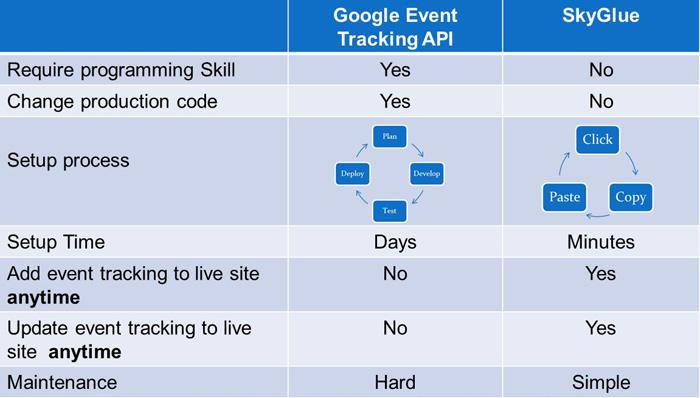
Huang notes website owners can just use Google Analytics, which is by default only measuring papgeview tracking and basic user segmentation.  But without SkyGlue, their Google Analytics data is not actionable, and thus incomplete.  Google Analytics has event tracking but needs programming APIs and code change (tagging) on all related links and buttons and other items usually needing to be completed by developers.  SkyGlue lets users easily measure high business activities and find ways for improvement all with just embeding a line of code.  The major difference between Google Analytics event tracking API and SkyGlue are shown on this chart below.

It took a while for Huang to find this specific need.  “When I was in the Founder Institute Seattle program I spoke with various mentors and my beta users and it became apparent the idea for making advanced features in Google Analytics easier to use will address a bigger market.”  Eric adds that with SlyGlue, it will also be easier for you to attract more users with spending less money.  In a sense, SkyGlue addresses the pain-point of streamlining advanced web analytics – knowing what users are actually doing on your site.

When you sit with Eric, you get a sense he knows what he is talking about.  Not surprisingly, he has a Ph.D. in computer science from Indiana University – Bloomington with a focus on distributed computing and cloud computing.  After graduating IU, Eric joined Microsoft and became the 1st developer in Azure AppFabric ServiceBus team.  He was one of the key early-stage contributors of Microsoft cloud service from incubation to V1 release.  Prior to that, Eric worked for IBM Research and SONY.

With the current version, SkyGlue can automatically detect and track most website events that are of interest to you.  Individual user activity tracking is automated as well.  They have a good list of beta users that have provided tremendously valuable feedback. SkyGlue is currently in private beta and is looking to expand their user base and will soon implement an initial business model.

It’s free for a limited time, so go here to get SkyGlue for your site.

Steve Ballmer’s Lack of Real Leadership

 This post was originally published on BusinessInsider.com.

Around 1975, Microsoft Corporation and Apple Inc. were created, kicking off what would become one of the most fascinating times in modern history.   During this period both have been significant players in the PC revolution, although recently as businesses they appear heading in opposite directions.

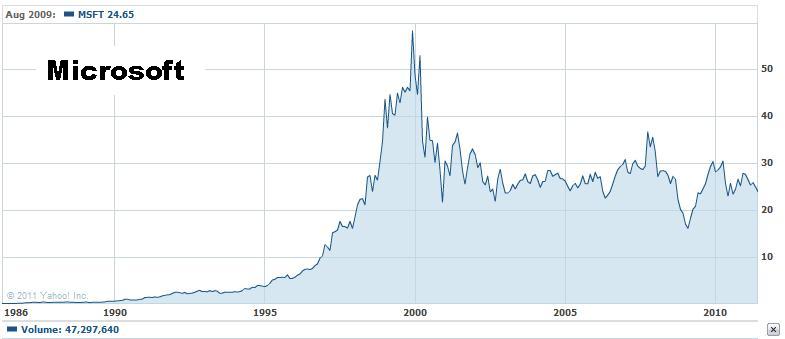
One is accelerating to new heights and one is stalling out like it forgot to refuel at the last gas station.  I think something abnormal is going on here and believe it’s more than the general “great products” vs “not so great products” argument.   Below is a view of the stock price of each company dating back to 1986.  Here is Microsoft:

(images courtesy of Yahoo Finance).

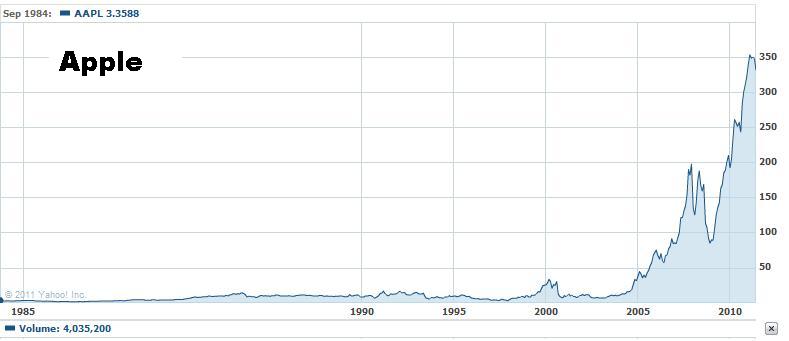
And below is a view of Apple, again viewed with a long lens dating back to 1986.  On thing to note is the scale on the right.

The last decade has seen Apple explode in value, culminating in them becoming the largest technology company in the world.  During the same time frame, Microsoft was dethroned by Apple and has pretty much remained stagnant.  Indeed, there is something peculiar going on here and anyone looking to build a consumer brand should listen closely.  The difference between Apple’s success and Microsoft’s lackluster performance can be summed up in one word – Leadership.  It takes more than smart employees, good technology and market dominance to deliver great financial results.   It also takes a Great Leader.

JobsSteve Jobs understands Leadership, Vision, Inspiration and Branding are vital to business success.  He gets it.  He understands how to position his Brand in the soul of a human being, amazingly interweaving his devices into peoples identity.  This is accomplished by casting a vision and allowing a tribe of followers to form around it.  He also understands: it is first about the vision and only then the resulting products can come in to reinforce the vision with the consumer.  Users of Apple products gladly follow when they realize the vision and resulting products make them feel better.

Jobs’ vision is one where the terms “Think Different”, “Beautiful Creation” and “It just Works” are used in description.  And although difficult to put into words as a consumer, you just feel it – viscerally.  It’s almost magical.   Jobs inspires with every word – not in a flakey, shallow and inauthentic manner – but a genuine manner.  I understand no one is perfect, but he definitely gets how to move people.

Steve Ballmer is flat out not an inspirational leader nor a visionary.

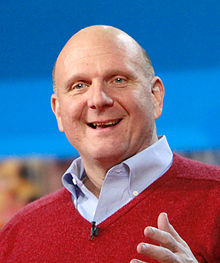
BallmerWith more than ten years at the helm of one of the largest companies in the world, Steve Ballmer has obviously done many things right.  One thing he cannot do is accurately describe the deeper purpose of Microsoft or any of their products.  When he tries, it doesn’t get anywhere close to touching the human soul.  He lacks the innate leadership quality of Inspiration.  He can run and jump, scream and yell, and do Monkey dances on stage all day long but this is not leadership.  Nor is it inspiration.  (Can you even imagine Steve Jobs doing this?)

Unfortunately for Ballmer, Microsoft is stuck between so many business markets it’s almost impossible to tie them together coherently to form a strong brand identity.  Without a unique purpose and vision, there is no brand identity.  The latest Microsoft slogan urges me to “Be What’s Next.”  I am not sure what that means… consumers need to be able to viscerally understand the brand and why they should be using it.  Like it or not, this responsibility rests on the leaders shoulders.  Ballmer has failed to communicate these fundamental aspects of Microsoft on a level that connects with everyday consumers.  He just doesn’t get it.

Is it any coincidence the maxim of Microsoft’s value as a company (January 2000) is pretty much the exact date Ballmer stepped into the CEO role?  And incidentally enough, the first real growth in Apple’s market cap appears not long after Steve Jobs arrives for his second coming as CEO in 1996.  The Leadership difference between these two men has made all the difference in respect to their company’s results.

Looking back at Microsoft’s stock price you can notice a time of incredible growth, back in the 90’s.  Who was the leader at this time in their history?  Iconic founder Bill Gates, an inspiring visionary in his own right was in charge at that time.  He inspired the world with the vision of “a computer on every desktop” during the emergence of the PC and Enterprise Revolutions (and thus the software running on them became a hot market).  Indeed Gates vision expanded the perspectives of all employees and rallied them to become the largest technology company in the world for many years.  But things have changed and today consumer devices are the rage.  What’s the overarching, game changing, ever growing Microsoft vision now?  I don’t see this type of world changing leadership and inspiration radiating out of Redmond any more (and I live 15 miles away).  Suffice it to say Apple saw this New World Order coming and Microsoft didn’t.

People follow leaders who embody a sense of purpose that inspires those around them.  Notice how consumers wait in lines for hours just to have a chance to own an “i-whatever”, the newest product that will touch their soul.  People give standing ovations and watch streaming online video during Steve Jobs inspiring  keynotes speeches.  All these happen for Apple because of Steve Jobs and his Leadership.  They create a mystic aurora which parlays towards the next round of  product announcements.

All this became very apparent to me recently as I observed the response to both companies announcements – Apple’s at their WWDC conference and Microsoft’s at the E3 conference.  The world huddled around their screens in anticipation of an announcement regarding Apple’s next mobile operating system, the iOS5.  In fact, there were no less than 37 individual posts covering Apple on SAI alone, Monday June 6th, the day of the announcement and.  Also 17 posts covering anything that is Apple appeared on Techcrunch.  Alternately, Microsoft’s announcements were an afterthought, an oh-by-the-way-this-happened byline with 3 posts that same day.  Succinctly put, no one really cared.

This unfortunate reality for Microsoft is directly tied back to Ballmer’s lack of Leadership, Vision and Inspiration.  People would have cared about Microsoft’s announcements had the products touched their souls with a deeper purpose.  Right now, go to Apple.com and Microsoft.com and see what I am talking about.  I am like most, finding it impossible to put a finger on exactly what it is that makes Apple… Apple.  All I can say is Steve Jobs knows something Steve Ballmer doesn’t.

Don’t get me wrong, we are talking about a great company in Microsoft, one that still does more than $60 billion in yearly revenue and employs some of the smartest and most talented people in the world.  They hold dominant positions in numerous markets.  But it pains me to write these words and acknowledge the reality of Microsoft’s future.  I am a Seattle resident and appreciate the value Microsoft has added not only to the world but specifically to Seattle.  We owe much of our regional economy to Microsoft.  They have done great things and the enterprise software ecosystem they created is quite amazing.

Yet, I see a company waning at a time when they really need to figure out their guiding purpose.  When I look at Apple, I feel secure they know where they are going.  When I glance across Lake Washington to figure out what Microsoft is doing, I am at a loss for words.  And this is scary for me.  I can only imagine what it’s like for the employees and the executives.

Lessons for us younger founders and entrepreneurs:

  • Find a deeper purpose to associate with your products and business
  • Cast your vision with simple, strong and relatable words
  • Become (or find) a leader who can connect with people and continually inspire them toward action

I don’t know who it will be but Microsoft is in desperate need of a Leader, an inspirational visionary who can turn this boat around – NOW.

Disclaimer: I have no personal connection with either Steve Jobs or Steve Ballmer and this is in no way personal towards either one of them.   My opinions are purely anecdotal and from observations as both an entrepreneur and consumer.

5 Ways to Step Up Your Game

I always enjoy sitting back and observing people, thinking about what they choose to do and what they choose not to do.  Here’s an amazing reality – there are waaaay to many distractions today.  And I think most people are actually too distracted to even notice they are being distracted.  Let me put it this way:  If you don’t put in effort to get better every day, you are going to get passed by others who are putting in this effort.  You will lose the race.

Turn off the TV

Watching TV is one of my peeves.  I just think it’s plain dumb.  There really is nothing on that is worth your time, unless you think your time is best spent voyeuring on idiots who complain about their reality/celebrity lives or just argue and swear all the time. Does watching this make you a better person?

I will just say it:  If you find yourself laying in front of the TV each night, you are getting dumber.

Television watching is a passive activity.  It has been proven watching TV does not use enough mental capacity to gain intelligence.   Honestly, I am actually scared we are getting less intelligent as a society, and a lot of it has to do with how we are spending the majority of our time each day.   If you feel you must watch (cause you are addicted) limit yourself to 30 minutes a day and then get on with doing something productive with your life.   Just turn the dang thing off.

Read

I am a voracious reader and it has flat out changed my life.  It will help you learn new things, help with word comprehension, help with writing (more on that below) make you sound smarter than you are, impress the ladies (or men) and get you hired.  Seriously, when you can answer the “what book are you currently reading” interview question with a unique and intelligent response, you will win them over.  Interestingly, the web has made this easier with all the blogs and articles you can read now, even when using your mobile device.  This has been one of my favorite innovations that have come along with the spread of the internet – information proliferation.  It is just everywhere.  And I take advantage of that to get smarter anywhere I can.

Exercise

I get my best ideas when I am exercising.  When I run, I allow my mind to run free as well, spinning ideas and thoughts out at a frantic pace.  This helps me evaluate an idea and determine if it is valid enough to take further.  I can only do this when I have 45 to an hour of “free” time to just allow the thoughts to flow in and out of consciousness.

Exercise is good for your health, but you probably know that so I am not going down that road.  Get out, get some exercise and let your mind run free as well.  It is one of the best ways to have a natural brainstorm session each day.

Be Social

Interacting with others and meeting new people is a great way to raise your stock.  How easy is it to stick to the same comfortable group of friends?  I actually think  most of us are wired that way – staying in comfort zone and only communicate with ones we are familiar with.  Well, if you are looking to progress socially as well as professionally, you need to get uncomfortable and get in front of new people.  Before you know it, they will be your new friends and you will grow your circle of influence.  And you know what, they usually know people who you need to know.

Write/Blog

I couldn’t have told you this a month ago but writing is one of the best ways to step up your game and expand your influence.  Since I have started SoEntrepreneurial and started blogging, I have connected with many different people around the world in the technology industry.   In fact, I just got off the phone with someone in Helsinki, Finland.  We had a great conversation about startups and his new venture I wrote about previously – Founder2be.

Writing and reading go hand in hand.  The more you read, the better you will become as a writer.  This is natural and will take time to come together, but here’s my advice:  get started.  And keep going.  It will open doors you never even knew existed.

It’s time to step up your game.

Image courtesy of Flickr user Roger Smith.

The Daily Deal Cuts Like a Knife

Update: this post was originally posted on BusinessInsider.com

For years now I have been waiting to read a post like the one I just read on the Daily Deals concept.  Rocky Agrawal has done extensive research on the daily deals phenomenon and succinctly puts it:  The entire daily deals industry must die.

I vehemently agree with his perspective; it finally calls out aspects of the model people have been turning a blind eye towards for way too long.  Please do yourself a favor and read it.   Although much has been written lately regarding Groupon and it’s historical rise (one in which I have no question been fascinated with), we should not forget: a good business might not be good for business.  Here are some thoughts I had back in 2008 when we first heard of Groupon and still hold today.

Discounts are for crappy businesses

BMW is a luxury car.  The Metropolitan in Seattle is a nice restaurant.  Gucci and Prada command extremely high prices for their merchandise.  Although these companies are more well known brands, I think you get the point.  They don’t have to discount their products because they don’t need to.  By building a business through offering a quality product or service (and running it soundly) they don’t need to resort to scrapping the bottom of the ocean just to sell something.

But when a business is having trouble getting people through the door they will look for any way to reverse the trend.  Some hire people to wear the sandwich board, hold the arrow and dance around on the corner for minimum wage.  Others will offer 2-fers.   And now many are realizing the power Groupon has in getting get their name in front of thousands in one day.  All this marketing does not change the fact that something is wrong with their business.  If there wasn’t anything wrong, they wouldn’t need more customers and wouldn’t be running a Groupon.  Rocky describes the core fundamentals of coupons and group discounts have been around for many years.  Only difference now is the medium used for distribution.

Discounting is like crack for business

Once a business chooses to offer their products or services for a discount – say 50% off – they have effectively started abusing a drug.  The daily deal is impulsive for consumers, as in, some experience a high when they open their daily deal email each day.  “OMG, what will it be?”   And local businesses get a excited when they see a large influx of customers (the high).  Once this initial influx dies down two things happen.  First (and most likely), their business volume will go directly back to the customer visit level previously experienced prior to offering a Groupon (the comedown).  And second, they now have told the world the “real” value of their products or services.  It would be foolish for a customer to pay full price for something once they know it will be offered for half the price.  So businesses are forced to continually slash their prices and offer more mass discount deals to maintain customer interest.  It becomes an ugly downward spiral (addiction).  This brings me to my next point…

How is 50% -75% off a sustainable economic model?

knivesGroupon (and the like) are effectively (re)training the local consumer to expect ALL products and services to be offered at a steep discount.  We are creating a consumer addicted to the mass discount.  This is not sustainable and downright scary for the local economy.

I should know, my previous business offered Health and Fitness services on a local level.  My income could be thought of on an hourly rate for the service I provided.  Given I charged $100 per hour, take away 30% for facility rent, and 20% for taxes I am left with at most $50 per hour of compensation.  If I chose to offer a daily deal discount and reduced my professional rate to $50… well I think you get the picture.  And what do you think I would have told my existing clients “oh, them…?  they bought the Groupon so they paid half as much as you for the same service.”  I would have lost all my full paying clients.

My point is profit margins are generally very low in the local economy- restaurants, health services, retail stores, coffee shops, etc… it’s not uncommon to be dealing with single digit percent profit margins.  It’s like each daily deal is a knife stab to the gut of a business.  There is no way this economic picture is sustainable and Rocky does an excellent job of describing what is going on: millions of people and thousands of business owners are being taken advantage of.  It will have to stop.

A real business is built upon Loyalty

Pareto’s law, or something known as the 80/20 rule is at the foundation of any business, any size.  To paraphrase, it says “80 percent of a businesses revenue will come from 20 percent of its customers.”  Simply put, it is loyal customers who keep a business running.  The hard fact is this phenomenon will never change and is the basis of why I started Loyaltize.  Notice how much the words Loyal and Loyalty are popping up nowadays.  I believe tremendous value will be created in the local space built around customer loyalty.

Groupon is essentially trying to swim against the natural economic current by allowing businesses to offer discounts to thousands of new customers.  Surprisingly, they sell local businesses on using their service by saying “we will help you gain more loyal customers” at the same time they promote to consumers “Groupon is a way to discover new businesses in your local community.”   Unfortunately these are contradictory statements and the truth is Groupon attracts deal seekers, not loyal customers who are willing to pay full price for a quality service.

If we are not careful, we are going to ruin our own local communities

I believe this mass group discounting cannot go on much longer.  But if I am wrong and it does we will effectively kill off what we currently consider our local communities.  Maybe it is a good time to reflect on what exactly is the “local community”.  My definition is all the local proprietors who run most of the operations you frequent throughout your normal life.  Actually, they are these things:

•    Represent 99.7 percent of all employer firms.
•    Employ half of all private sector employees.
•    Pay 44 percent of total U.S. private payroll.
•    Generated 65 percent of net new jobs over the past 17 years.
•    Create more than half of the nonfarm private GDP.
•    Hire 43 percent of high tech workers ( scientists, engineers, programmers, and others).
•    Are 52 percent home-based and 2 percent franchises.
•    Made up 97.5 percent of all identified exporters in FY 2008.
•    Produce 13 times more patents per employee than large patenting firms.

Once we all (as consumers) only seek deals on the cheap and expect to buy dinner online for $10 instead of the regular price of $25, the local community will cease to exist.  Most local businesses will not be able to operate at such levels.

Years ago, many feared Walmart and fast food was the end of local culture as we knew it. I argue Groupon, LivingSocial and all Daily Deal operators will do much more harm to all our own unique local communities than Walmart did.  Go ahead, ask any local restauranteur, barista, Health professional, or masseuse what they think about giving away their products for more than half the price.  I hope we can move on from 75% off deals and find a sustainable local advertising model before it’s too late.

Image courtesy of flickr user Parl

Graduates: Stay Hungry, Stay Foolish

Here’s to all the graduates out there who are now taking the leap into the real world.  I cannot say it better than Steve Jobs in his 2005 commencement speech to Standford University students.  This is one of the most incredible speeches I have ever heard and for you, a 15 minutes well spent.  Enjoy.

Sometimes You Just Gotta Jump

Sometimes you just gotta jump ship.

I was sitting with an old college friend the other night catching up with life and I found myself ending the conversation with the saying “sometimes you just gotta jump“.

We were talking about how tough it is to branch off and do your own thing as you become more established with your life.   He is in a different situation as I and finds it more difficult to up and leave his job. Although I agree with his perspective – he is quite established and probably pulling good paycheck – I can’t help but keep coming back to my main point.  “But what happens when you are 45 or 50, are you going to be happy doing what you are doing now, at that age?

It is this question that gets me every time I start thinking maybe I am doing the wrong thing.  I just have to go back and ask myself “which would you regret more when you are older – the decision to jump off now and make it on your own or staying with the same company your entire career, never taking a risk?”

Sometimes you just gotta jump ship.  Start over.  Hit control/Alt/delete and move on.  Most people regret NOT doing something.

On Failure

“On the road to invention, failures are just problems that have yet to be solved.”

My reading this morning brought me to this little gem:

Fearing failure stifles creativity and progress. If you’re not failing, you’re not going to innovate. Do your product or service a favor: embrace failure and blueprint a plan that affords you the opportunity to do it early and often. 

I can’t tell you how strongly I agree with this statement.  Whether it is product design and prototyping or more generally concerning your entrepreneurship path, the worlds biggest failures end up becoming the worlds most successful people and products.  I will write a more in-depth post on this soon.

Find Your Match With Founder2be

Here is a common problem plaguing many entrepreneurs today:  I have a business idea, but I need to find someone with complimentary skills to help me start the company.  In fact, yours truly has this problem currently.  Since we know a big chunk of the success of a start-up is directly correlated to the number of founders, this is a big deal.  Local tech functions like meet-ups, conferences and founder dating are all good ways to meet a co-founder but sometimes if just feels forced, ya know.  Kinda like you’re looking for a one-night stand or something.

Enter Founder2be, a site which could be referred to the match.com for entrepreneurs.

From their website:

Do you think you need a lot of money first for your startup? You don’t. What you need is the right co-founder with the skills to get started. Everyone knows something, and nobody knows everything. Founder2be helps you find the co-founder you need to start up your business. Take the first step today!

I love the idea and have signed up for the service.  When you sign up, you have the option to register or just connect via Facebook.  Once connected,  it walks you through a few basic questions:

1) I am looking for… (someone to help me with my idea or to join someone who has a good idea)

2) The type of co-founder I am looking for…

3) Expectations of co-founder availability

4) choice of where they live

And then you fill out some details about yourself and you are ready to go.  The entire process took less than 5 minutes.  Since I just signed up and starting using the service I cannot relay any results back to you yet, but I love the idea and would recommend any founder who needs to find the other piece of the puzzle to give it a shot.

I had a chance to recently connect with Oliver Bremer, co-founder of Founder2be.  Interestingly, he was in the exact same situation when he realized there was a hole he could fill.  “This got me thinking that I cannot possibly be the only person in the world to have this challenge.  Although initially I had a different idea, I eventually decided to set out and solve the co-founder finding problem instead. And that’s how Founder2be came about. After some chicken and egg of finding a co-founder for that. Which was pure luck.

I love it!  Innovation is the mother of all necessity.  Here is a brief interview with Oliver:

1. Describe and explain Founder2be in a few sentences.
Founder2be is a co-founder matching service. Everyone knows something, and nobody knows everything. Founder2be helps people find co-founders with complementary skill sets. After all, most successful start-ups get started by teams of two or three, not solo entrepreneurs.

With the Founder2be Global Alliance Program, we connect prospective entrepreneurs with incubators and other alliance partners to help them succeed by getting the help they need locally, whether it is mentoring, work space, pitch training, or access to funding.

2. How did you come up with the idea behind Founder2be?
After 10 years in corporate life, last year I finally had a great idea where I thought: ‘Now it’s my opportunity’ to start a start-up. Truth is: Now I can’t even remember what the idea was, and that is because I never got started. Why? Because I don’t know everything and I failed at the step of finding a co-founder. Thinking I can’t be the only person wanting to do a start-up with that problem, I decided to focus on the co-founder finding problem instead, and here is Founder2be.

3. The Founder2be team and background.
Founder2be was co-founded by myself and Frank Haubenschild. My background is M.Sc. in CS, worked for Nokia until 2007, then for Strands until end of last year. Then quit my job specifically to focus on Founder2be. Frank studied CS as well, and has been working as a SW Developer ever since, mostly in the automotive space.

We took on two interns for this summer as well who are helping us with outreach and community management and get credits for their course work.

4. Can’t Entrepreneurs just go to local events to meet people? How do you differentiate?
Absolutely, and we do want people to go to local events as well. We are not so naive to believe that you meet someone online, click on a button, and that’s all you need to start a great start-up. There is many more things. Exploring your options and finding a great co-founder is the first step, and that can be done online very well.

Think of it similar to online dating. Match.com does not replace bars. People don’t get married clicking ‘Yes, I do’. They go on a date and meet the other person in real life first – or at least I hope they do 😉 And that’s very similar for finding a co-founder.

And that’s why we launched the Global Alliance Program, where we connect the co-founders meeting each other, forming start-ups, to organizations supporting start-ups in the real world. The Global Alliance Program has partners on four continents now and we are looking to extend the network to more countries and expand within the countries where there is already partners.

5. What is Founder2be’s current status, and what are your immediate next steps?
We are now at the stage where over a thousand people have signed up, two companies have emerged from co-founders who met on Founder2be. One of them is Ziliot.com, the other one is still in stealth mode. The Global Alliance Program comprises around 20 partners from four continents.

Our ultimate goal for this year is to see 10 start-ups get started by co-founders who met on Founder2be. In order to do so we are focused on growing the user base, connect co-founders with each other, and build out the Global Alliance Program further.

In 3 months, over 1500 people have joined and one company has come out of it with a second one is in stealth mode.  I would say, even if nothing else happens… history has been made.  I am really excited to see how Founder2be expands to help many more partnerships come together.

Dear Advertiser: Please Do Better

This post was originally published on BusinessInsider.com.


Dear Advertiser,

We haven’t formally met but we have had an ongoing relationship for quite some time.  I am a consumer; you are an advertiser trying to sell me something.  Our Love/Hate relationship goes something like this: I love to use my internet but hate to be interrupted by you.  I know you are the one I should actually thank for my ‘free’ usage of all the websites and applications on the web, but deep down in my heart I am finding it hard to thank you.  You see, I just want to go about my day and easily use the mobile apps I enjoy, listen to my favorite music on Pandora, search on the topics I need to know about and read interesting articles.

But here is what I don’t think you fully understand.  You make my life worse.  You interrupt me in every possible way you can think of and believe just because you “got  in front of my eyeballs”, I will make a purchase.  The thing is, I cannot easily use my mobile apps, since you jump right in as I load it up and steal another 5 or 10 seconds of my time.  I hate this!  When I listen to Pandora, between every 2 or 3 songs you shout something I don’t ever pay attention to, so you are wasting your money.  I bet you didn’t know that as I listen to Pandora when drive I turn the radio off or the volume down for about 10 to 15 seconds so I don’t have to hear you freaking annoying voice for the 10th time this hour.  You are just an annoyance and I despise you more and more as this goes on.  When I search on Google, there you are… trying your hardest to sell me something I don’t want.  Even though when I search I type in a keyword, most of the time I am looking to be informed on a topic not buy it.  And what makes me the most frustrated is when you cover the screen the instant I hit a website like Forbes, basically witholding me from my very intent.

Do you realize how rude this is?  I don’t walk up to your desk as you are working and put my hand right in front of your screen, and hold it there for 15 seconds – smiling like I am doing something nice for you.  If I did, you would probably hit me.

I understand it is you who underwrites our “free” access to information so I am not blindly telling you to go away.  All I ask is please make my life better, not worse.

Know my preferences.  Better yet, let me tell you what I like and what I don’t like. 

All the spying, cookies and social data mining in the world will not come nearly as close to knowing me as good as I know myself.  Please allow me to tell you what I like and what I don’t like so when you do step in to talk to me I am actually interested in what you are saying.  (Would someone out there build a platform where I can input my 15 category interest and allow only those advertisers to reach me on every interactive media in the world?  Come to think of it, I just might.  If you are interested in helping, give me a shout.)

Know when I want to interact.  Never interrupt me.

Interrupting is one of the rudest forms of communication in the human race.  Maybe this is your problem: since you are not human you don’t realize you are committing one of the biggest faux pas out there.  If you were to start your strategic alignment with more of a human perspective you would better position yourself for me to receive your message.

Make my life better.  Add value to me and my life

Hindering my internet viewing, making me wait to watch a video or jumping in the middle of a conversation does no make my life better.  It only creates frustration.  Correct me if I am wrong, but I assume you want to create value for the brand or company you are representing?  Okay, if that is the case… I will value any company who makes my life better.  And since we naturally associate the Brand of the company with the mode of advertising … any Brand who rudely interrupts me is instantly placed in the LAME bucket.  Sorry, that is the truth.  On the contrary, any Brand who slides naturally into a position to add value to me and make my life better –  pure GOLD.  Loyal.  They got me for life.

Look, I know this is going to be a life long marriage so can you please start to see things from my side of the bed for once?  If you do, I guarantee you will get more than you ever imagined.

This Get’s the Creative Juices Flowing

Trendwatching.com sends out a monthly briefing on emerging trends.  It’s awesome.  Here’s the latest mini-consumer trends they highlight in their latest edition, “Innovation Extravaganza” .  Read the briefing to get the details.

The both scary and celebratory part? Wherever you live, whatever it is you do, you have absolutely no excuse to be unaware of innovations originating in Australia, in the Netherlands, in the US, in Argentina, in Turkey, in Singapore, in South Africa … It’s all out there, reported 24/7 by numerous sources dedicated to trends and new business ideas.

Be Iconclastic

Ever look at prominent figures in the world and wonder how they stand out from all the rest?  I believe it comes down to how they think.   I believe you can think like them too.  Or.  Not.  Like.  Them..?    At this point, you may not know what the word Iconclast means, but by the end of this post I hope you will be inclined to think a bit differently.

Gregory Burns talks about people who do things others say can’t be done in his book Iconclast – A Neuroscientist Reveals How to Think Differently .  He calls them Iconclasts.

He succinctly describes being an iconclast hinges on 3 things: perception, courage and social skills.

The successful iconclast learns to see things clearly for what they are and are not influenced by other peoples options.  He keeps his amydala in check and does not let fear rule his decisions.  And he expertly navigates the complicated waters of social networking so that other people eventually come to see things the way he does.

If you are like me you’ll want a shorter and easier way to remember the word:

Thinking different is so easy, yet it baffles me how many people do the exact opposite.  They think the same as everyone else.  For some reason they don’t want to be different.  They don’t want to separate themselves from the crowd for they just might have to form an opinion.   They think the same as their neighbor, their classmates, the same as their teammates and they even the same as their competitors.  To me this is just crazy and a recipe for averagism.

Seriously, when did it become generally accepted to think the same as your competitor?  I am pretty sure this type of thinking did not go on in the days of early civilization.  If someone did I guarantee they we’re quickly eliminated…  Thinking the same as the competition is what gets us all these copy-cat products that flood the market.  How many different Groupon competitors do we need?  How many different brands of ‘Bran Flakes’ Cereal is enough.  I could go on and on, but I won’t because I’m not here to inspire you to copy others.  My goal is to inspire you to think differently.  And since we all are capable of thinking… being an Iconclast is now up to you and your thoughts.

Perception

Berns describes in detail how our brains actually perceive thoughts.  Being too scientific for this post, I will only encourage you to buy and read the book for yourself.  But to paraphrase: because we learn from past experiences and past experiences shapes both our perception and our imagination, we tend to constrain our views on things as we grow older.  This is not good for much of anything, but most importantly you will begin lose your creativity.  As time goes on you start to see the same things as everyone else.  And if you see everything others are seeing, you are not to unique.  How are you supposed to be innovative when you see just the same as the others?  Berns suggests we continue to bombard to brain with new experiences.

I suggest running the exact opposite direction as everyone else.  I have always been attracted to uniqueness.  It doesn’t have to be anything eccentric, just being different.   Everyone staying in their safe job because of the recession…  quit yours and pursue your dream of building a company.  You will have a leg up since most others are going in the opposite direction.  Seeing a lot of other companies are offering “daily deals for X” and “social networking for Y”?  Why not have an original vision and do something different?   Most importantly, get out of the daily routine you have slipped into over the last 8 years.  Take Berns advice and change your life.  Create new experiences.  Iconclasts do this and succeed.

Fear

Plain and simple, humans hate fear and live everyday to avoid the feeling.  Fear prevents people from taking action, and even worse it changes the way they see the world.  The ultimate underpinnings of fear is failure, which is the strongest force inconclasts overcome.  Berns notes fear permeates any business and should only be taken as a warning sign.  Once the fear is recognized, it can be deconstructed and reappraised.  So there you go – everyone experiences fear.  Inconclasts dissect it and figure out what it is actually pointing to.  Then they act accordingly.

Here’s my take:  Most people in the world are scared, weak overgrown children.  Sorry to be so blunt, but this is what I have picked up over the years.  Just as we tried to fit in with the “cool” kids on the playground during recess, we go about our lives in constant fear of what people think.  Most people never live as an independent thinker because they are so worried of what other people will think about them.

I say “who gives a @#$% “and “Screw what they think“.  Why do you care what some random guy thinks about you or your idea?  Here’s the truth: One minute after you leave the conversation he will forget what his opinion of your idea was.  He has enough to care about in his life, why would he waste time thinking about you?

Here is Amazon’s Jeff Bezos, an Iconclast I have always looked up to referring to his willingness to be misunderstood.  He has no fear of failure:

If you invent frequently and are willing to fail, then you never get to that point where you really need to bet the whole company. AWS also started about six or seven years ago. We are planting more seeds right now, and it is too early to talk about them, but we are going to continue to plant seeds. And I can guarantee you that everything we do will not work. And, I am never concerned about that…. We are stubbon on vision. We are flexible on details…. We don’t give up on things easily. Our third party seller business is an example of that. It took us three tries to get the third party seller business to work. We didn’t give up.

My mind never lets me get in a place where I think we can’t afford to take these bets, because the bad case never seems that bad to me. And, I think to have that point of view, requires a corporate culture that does a few things. I don’t think every company can do that, can take that point of view. A big piece of the story we tell ourselves about who we are, is that we are willing to invent. We are willing to think long-term. We start with the customer and work backwards. And, very importantly, we are willing to be misunderstood for long periods of time.

I believe if you don’t have that set of things in your corporate culture, then you can’t do large-scale invention. You can do incremental invention, which is critically important for any company. But it is very difficult — if you are not willing to be misunderstood. People will misunderstand you.

Any time you do something big, that’s disruptive — Kindle, AWS — there will be critics. And there will be at least two kinds of critics. There will be well-meaning critics who genuinely misunderstand what you are doing or genuinely have a different opinion. And there will be the self-interested critics that have a vested interest in not liking what you are doing and they will have reason to misunderstand. And you have to be willing to ignore both types of critics. You listen to them, because you want to see, always testing, is it possible they are right?

But if you hold back and you say, ‘No, we believe in this vision,’ then you just stay heads down, stay focused and you build out your vision.

Social Networking

To be successful, it comes down to one’s ability to connect with other people.  Two aspects of social intelligence figure prominently in success or failure: familiarity and reputation.  Incidentally the two are interconnected, since in order to sell your ideas you must create a positive reputation that will draw people toward what is initially unfamiliar and potentially scary.  Familiarity helps build your reputation.  Simply put: to get their ideas into the mass market iconclasts must be able to connect with people.

Think about someone right now who you admire and feel they are a “success” in your eyes.  And now ask yourself this: “Are they good with people?  Do they know how to navigate the social waters?”  I guarantee they (or someone they are close to) understands this principal.  Being an iconclast, thinking different, changing your perception, and dealing with your fear will only get you so far.  I would argue being great in the people department completes the package and helps you rise to prominence.

If you have been reading the words Think Different and imagining a certain company, I am sure you are not alone.  It’s not a coincidence the largest Technology company and one of the most recognizable brands in the world adopted that phrase in most of their marketing.  Apple thinks differently.  I believe the Different Thinking of their founder Steve Jobs is the sole reason they are where they are today. I will leave you with a video that sends chills down my spine.  It is one of the early Apple commercials and the first one in which they used the term Think Different.  Enjoy.


3 Quick Thoughts For The Entrepreneur

Here are just a few quick thoughts to help you think clearer today.

1.  Most successful founders or entrepreneurs have failed many times before.  Just keep getting up.

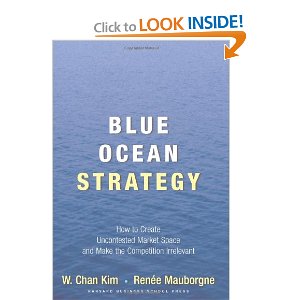
2. Most successful businesses come from Blue Ocean Waters, not Red Ocean Waters.  Look for the open waters around you.

3. You are just one decision away from changing your life.  Make it.

Prediction: There Will Be No Bubble

Update: This was republished on BusinessInsider.com.

You do realize it’s us, with our words, who actually create the Bubbles we will then loathe.   Yes – you, me, all of us… we create the hysteria and the irrational exuberance necessary for a “bubble” to actually form.  If we can just refrain from the word this time, maybe better things will happen.  Plain and simple.  I know the conspiracy theorists out there will indeed flame up the comments with a variety of criticism – and that’s fine, commentary is a good thing.  But I argue we are not going to see a bubble since we just entered the Golden Ages of the Internet.  Don’t want to take my word for it?  Let’s go ahead and use some logic backed by historical analysis to peel this onion a bit.  We’ll see what can come of it since I think it’s better than just running around yelling BUBBLE every time a round of funding is raised or a new company rings the opening bell.

In my recent article, The Evolution of the Tech Bubble, I referred to the book Technological Revolutions and Financial Capital by Carlota Perez.  I have to say again, quite an amazing book.  On a surface level I described the general phases of each cycle (Irruption, Frenzy, Synergy, Maturity) and laid out a nice framework to grasp the magnitudes and movements of the cycle.  I will now go deeper in an effort to bust this silly Bubble talk.

As you can see, our economy has gone through 5 major cycles since the late 1700’s.

1) 1770s through the 1820s – water power and introduced factories and canals, primarily in Britain.

2) 1820s to the 1870s – the age of steam, coal, iron, and railways.

3) 1870’s through about 1910 – steel and heavy engineering.

4) 1910 through 1980 –  the rise of the automobile, petroleum-based materials, the assembly line, and the motion picture and television.

5) Our current cycle began around 1970 – based on silicon: the integrated circuit, the digital computer, globaltelecommunications and the Internet.
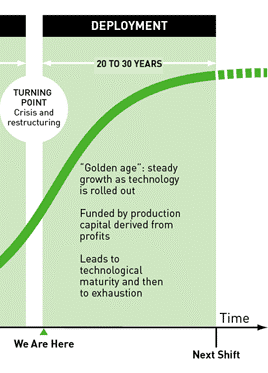
These are not my opinions, Perez illustrates through factual analysis each cycle lasted roughly 60 or 70 years.  I argued we have just entered the Synergy phase of the fifth cycle, probably sometime in the mid 2000’s.  Like it or not, this means the core paradigm (the internet) is about to spread into every corner of your life.  This period is pleasantly referred to as a Golden Age.  The image to the right provides a view of the Synergy and maturity phases, which together last 20 or 30 years.  There’s the internet, going into everything around you.  One thing to note here, the financial recession we just experienced is not directly correlated to these cycles.  I am not passing off the idea that sometimes things rise and fall unexpectedly.  It happened, and will happen again.  The image used in my previous post illustrates the  rate of diffusion of a technology into a society, not the rise in markets or a bubble, per se.

Here is what I think will happen next and why it will be mind blowing.

Fred Wilson recently stated at TechCrunch Disrupt we will very soon experience an incredible cultural revolution on a level we might not realize yet.  Many things will be created to challenge the establishment (think Egypt) and new applications will change your life in very profound ways.

How do I know?  Take a look at what happened the last time we were sitting in this position.

 The car was at the heart of the last technology surge, based on mass production, which started in 1908 with Henry Ford’s Model T. The installation phase was about increasing car ownership and building road networks. The crash came quite early, and the deployment phase was delayed by depression and war. But the deployment phase was the period in which the suburbs evolved and supermarkets became the dominant mode of food distribution and retail.

Looking back, we realize it was because of the automobile (transportation) we now have suburbs, supermarkets and shopping malls.  Now think of the Interstate network, and how important it was to connecting our country.  Thankfully, this is how you can easily have food on your table…  which you bought from the supermarket… which you drove to in your automobile.

Yes, it is amazing.  And it’s all small potatoes compared to what is going to happen next.

Applying that perspective to today’s environment you can now start to grasp the notion we just entered the Golden Age.  Mass adoption of the internet, real time communications and real time data will create adjacent industries we haven’t even thought of yet.  Just ask Reid Hoffman what he thinks about this subject.  For the first time in human civilization 2 billion, maybe even 3 billion people will all be connected on one platform.  Almost a third of our world population is online or using some sort of connected device.  This is even more moving: in the emerging markets of China, India, Brazil, Russia, and dozens of smaller developing nations, a billion people will soon enter the expanding global middle class.

Do you even realize the magnitude of what this will do to our global society? Place communication technologies on that platform.  Include a way to exchange currency and do commerce.  Find a way to locate a mobile device, right down to a 10 foot radius.  Now imagine three billion people using this each day!  Not everything will be rosy, but I argue it will be golden.  For a little economic context, in the year 2000 the AOL/Time warner merger was at the time valued at $350 billion with AOL having roughly 30 million subscribers.

If you look back at the previous 4 cycles, it’s important to keep in mind how little of role communication technologies played.  This is not something to overlook.  Until the fourth phase (early 20th century) people were isolated on their own continents, lest they endured a few months boat ride to a new world.  They were also confined to their local flea market if they couldn’t snag a horse ride.  And information was short supply, limited to neighborhood gossip and a letter which mostly arrived too little too late.

Today, only 1oo short years later, I am theoretically one finger swipe away from anyone in the world (or 2 billion at least).  I can video chat with someone in remote Africa, literally seeing them as we talk while they are on another continent.  I can learn about an earthquake that hit another part of the world less than one minute after it happened.  If you are reading this on your mobile and wanted to buy Perez’s book right now from a random person on the East Coast, an Amazon transaction will take you less than 30 seconds and you will be back reading this next sentence before you know it.

Take a step back and juxtapose those last 2 paragraphs.  This is why I recently quit my job and finally got serious about building something.  I am pretty excited to see what this synergy phase will bring out from within us.  Don’t get me wrong, I don’t pretend to know the future. But I am using solid facts from the past to help me gauge where things might be going.  If you are not serious about doing something amazing, now might be the time to reconsider.

Referencing my last article on the Bubble subject, the Frenzy period was characterized by individualism, excessive investment and miraculous manipulation of wealth.  These ridiculous actions create Bubbles.   Since the foundation of the web is already in place, this Synergy period is a time of Production.  It is because economies of scale, maturation of the core technology and a new understanding of our global network we will not see a bubble burst.

I will leave you with a thought from Perez:

Whatever time it takes to set up the framework to overcome the recession, the beginning of Deployment is usually characterized by synergistic growth, extension of markets and increasing employment.

Bubble schmuble…  can we just stop saying that word?  I suggest we start using the words Internet Golden Age.

Image courtesy of Flickr user timtom.ch

Look at Them Apples

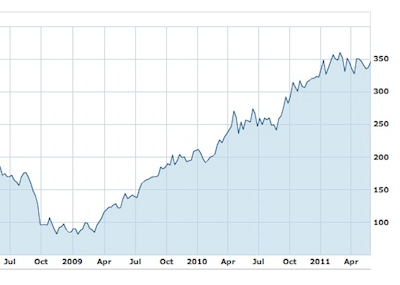
Apple is just HUGE.  Just think about it for a second… iphones, ipods, ipads, macbooks, itunes, they are everywhere.  Apple is now said to be lager than Microsoft and Intel, combined.   Below is a view of Apple’s stock for the last few years, up and to the right.  This has just been amazing to watch.  When will it end?

Here’s Where You are Great, So Shut Up.

The world has an interesting way of revealing your strengths.  This has become apparent to me in the last few weeks as I have started writing.  Allow me to provide some context before I go any further.

Recently I quit my full time job to pursue entrepreneurship and my dream of building my own company.  Prior to this I was living a double life, straddling the fence as they say.  This sucked.  I hated the fact that I did not (or could not) just let go and dive into pursing my dreams.  It sounds silly actually…. you would think living in America we should do whatever we want?   I wasn’t.  Until now.

During this double life I was part of a small team building a startup, a website which would help local businesses further connect with their loyal customers.  Although we didn’t really have titles or positions, I lead the charge and you could say I held the general position of what would be considered the CEO.  We worked on this for quite some time, all the while holding full time jobs.  We met EVERY Tuesday or Wednesday for like 2 years or more.  Eventually we released a Version 1.0 and I felt we were making some progress.  Ultimately, after about 6 months in the test market we decided to revert (what they now call pivot ) back to closed doors and figure out a better vision.  This is where I sit today.

Shut Up and Listen!

My point here is this: I wasn’t in my strength zone.  I wasn’t actually doing things that I was Great at.  I keep my head to the grindstone for years trying to make things happen – to no avail.  Without resources, connections, money or exposure… and most important the wisdom from previous experience, we fell flat.  And I thought I was a loser and a failure.

Shut Up and Listen!

Until I started listening.  When I quit my job I decided I would start writing.  Being an avid reader of books, blogs and any articles I can get my hands on, this seemed like a natural evolution for me.  Little did I know people actually like what I write.  They think I am good.  They even think I am Great, so Great they think I could support myself doing this.  I had no idea.  I just type what I feel inside… that is all I do.  And things just flow together.

Shut Up and Listen!

Amazingly, the world has started reaching out to me.  People from all over have followed, commented, subscribed, and emailed.  I really appreciate this.  Finally, something is taking off.  This type of reaction never happened with Loyaltize.  On a small level in our test market people would say things like “ya know, this is a really good idea.  Very Cool.”  That was nice of them to say, but nothing ever came together and we finally realized we were doing something wrong.

Shut Up and Listen!

If you listen close enough, the world will tell you where you are Great.  You may be like me – hard headed, focused and dead set on making things happen.  Although these are traits successful people employ to move forward, they can also be an incredibly powerful force holding you back.  Are you a programmer who can’t seem to build anything people actually use?  Are you a teacher who comes home from school each day so tired you just want to go to bed?  As a CEO, are things just not lining up for you?  Are there areas in your life where things just happen to come way easier for you?  You might want to take a closer look at those areas.

SHUT UP AND LISTEN!

My advice would be to shut up and listen to the world.  What is it telling you?  Where is it saying “anything you do here will not work.”  Then look the other way to where it tells you “Keep doing this, you are great.”

I know it’s pretty simple stuff.  But trust me, your Greatness might not be where you thought it would be.  Maybe it’s where it always was you just haven’t looked yet.

I am not sure where this writing stuff will take me, I know I will eventually lead a great business.  But all I can say is it already has taken me further in 2 weeks than 5 years working with my ears and eyes closed ever did.

Why Distribution Will Make or Break Your Company

Yesterday, as I was sitting with a friend talking about his early stage company, it hit me.  We were reviewing what he has built, where he is currently and what he is looking to do next.  It was becoming more obvious to me as the meeting went on he was experiencing a common startup dilemma: Great product, No distribution.

Here’s a little background:

This founder has an incredible technical history.  He has worked for very a large tech company here locally and knows his stuff. You can tell he is quite intelligent.  His product is a bit over the average person’s head, more enterprise and B2B focused.  His target customers are business owners and website owners.  He has vast domain knowledge and understands where his product will benefit his users.  He even has a beta version with a small initial user base.   I told him he is in a good situation but has a few big hurdles to figure out.

The problem is he is technically bent, not marketing bent.  Technical people think all you have to do is build a great product.  Although that is true, marketing people understand the positioning of the great product is what determines how big you will grow as a company.   Being foreign, he lacks the clarity in speaking English required to deeply explain his product.  This is fine, but since it is just him right now he cannot depend on a sales oriented approach.  His product is not inherently social, so he cannot rely on word of mouth.

This person is not alone.  I was a part of the recent Founder Institute Seattle winter 2011 class and encountered many companies with similar challenges.  Highly technical team.  Very interesting product.  Solves a unique problem.  But no clear distribution model.

So if you are not building the next social sharing tool, how the heck do you find the vehicle to expand your user base?

Find distribution channels.

1.  Where can you get a free listing or publicity?  There is a magnitude of places on the web where galleries or showcases of applications bring  additional tools to product users (think Google apps).  Is your product is an add on, a second generation tool of an existing product, or interactive with a larger ecosystem?  All these allow you to be highlighted in galleries supporting the main ecosystem.  Find ’em or you will wither on the vine.

2.  What major company needs your product?  One of the best methods to major distribution is to land a very large and visible company as an initial customer.  Maybe you allow them to use it for free with the agreement they will promote it.  Maybe book them with a very large price tag to help you float for the next 6 months.  Whatever the agreement is, make sure you can find a market leader who will provide the credibility necessary for others to follow.

3.  Social Proof.  Although your product is not inherently social, you can still figure out ways to bake in social proof to the everyday use of your product.  It’s the old hotmail bit… every time an email message was sent, hotmail automatically added to the end of each message “Get your private, free email at http://www.hotmail.com”.  This idea is still one of the best marketing concepts every created.  Figure out how to implement it your own unique way.

4.  Find the Influencers.  The main thing I tried to nail home with my friend was he needed to find the one percent, the main target users who will become the influencers for his product.  Together with the above mentioned ideas, this is how you integrate yourself into the proper distribution channels.

And to bring it home, here is the only way I could describe it to him.

Dude, I just started blogging 2 weeks ago.  When you start a blog, you begin writing with the knowledge that only 20 or 50 people will be reading your stuff.  I quickly realized this and decided I needed to ink a few distribution deals if I was going to grow my readers.  I reached out to John Cook at Geekwire.com.  He like it and got me on there.  I reached out to an editor at BusinessInsider.com.  She liked it and hooked me up.  Now, thousands of people are reading my stuff and it is starting to grow.  People are adding me on Twitter like crazy (that was your que) and now they are connected to me independent of those resources.  Without those distribution deals, I was dead in the water.  You need to do the equivalent of that with your product or you will never grow.