A New Article Covering Seconds Points To Our Larger Vision Of Payment Identity

Seconds was recently covered on BetaKit, here’s a snippet:

Smartphone growth is trending upward worldwide, but there’s still a huge percentage of the population using feature phones, and another group of users for whom a stable and consistent data connection is little more than a dream. A couple recent startups are poised to address those markets directly, both in emerging markets and in North America… Read more.

I want to highlight something that came out in the interview that points to the real game changer in mobile payments, although we don’t talk about it too much at this point.

Seconds isn’t just about SMS, however; Hughes said the bigger picture is in establishing user profiles that can be attached to any tech. “We’re more about the software and the identity,” he told us. “Attaching that user identity to other platforms is relatively simple.” That strategy should allow Seconds to work with other mobile communication tech, including NFC and Bluetooth 4.0, as they accrue more popularity.

I believe the winner (or winners) in the mobile payment space will be oriented around a consumer’s identity, meaning everything is aggregated  and organized for both my benefit and the greater merchant ecosystem no matter what method of payment I use.  This is important to the future of commerce and we intend to be a major player.

@jnickhughes

How Seconds Will Give 2,433 Hours Back To Your Life

2,433 hours

The amount of time wasted in an 80 year lifespan just waiting to interact with businesses doing things like:

  • pressing 1 for the employee directory, pressing 2 for account information…
  • waiting on hold on the phone
  • Waiting in line to purchase something
  • calling to ask a question
  • writing a check (who does that anymore?)

How did I get to 2,433 hours wasted in a lifetime?  On average, we can estimate approximately 1 minute is wasted each time we interact with a businesses.

Multiply that by roughly 5 each day.

Multiply that by 365 days each year.

Multiply that by 80 years in a lifetime.

Total all that up and you get 2,433 hours.  This could be an underestimation if one minute turns out to be more like 5 or 10 minutes but I think you get the picture.

How can Seconds save you those hours so you can get back to living your life?

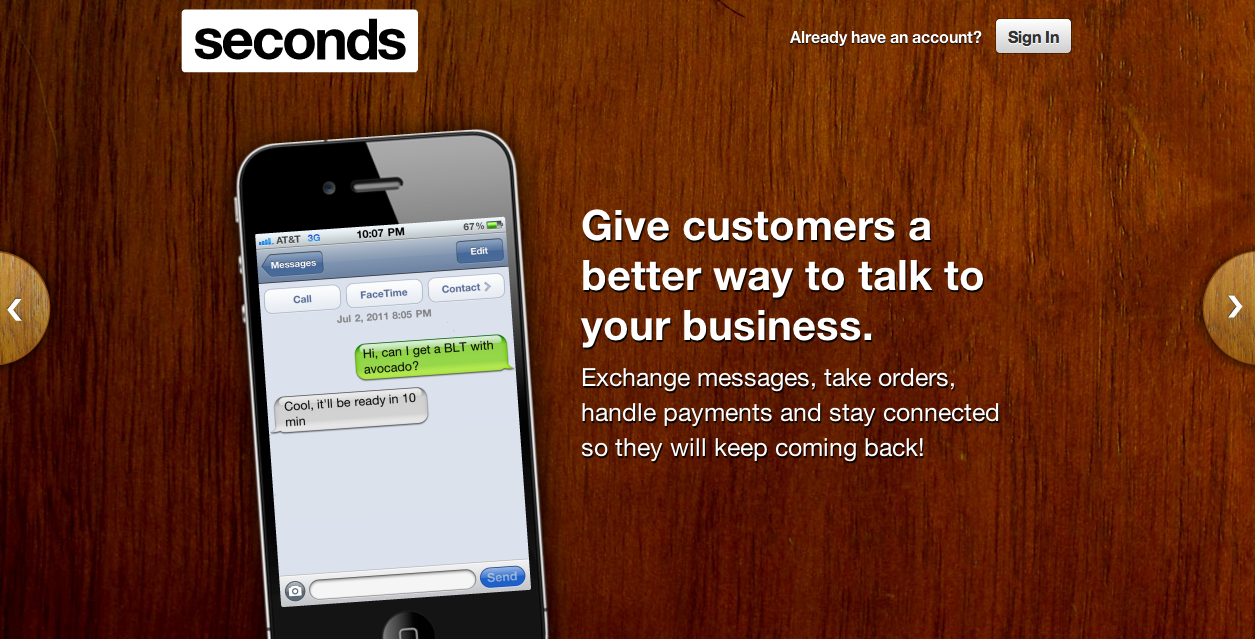
Seconds enables customers quick interaction and transaction with merchants through the mobile web. Our mission is to make the consumer experience more efficient and enjoyable.   When a consumer attaches their payment credentials to their Seconds account, they have effectively transformed their phone into a transactional device.  With Seconds, people can send quick messages and easily make transactions with merchants – which takes seconds, not minutes.  No more waiting on hold.  No more of the “press 1 for operator” crap that no one likes.  No more waiting in a line of ten people to simply swipe your card to pay for something.

If you have a question for a merchant, you simply send a message and then get back to your life.  Within a matter of seconds you should receive a response.  It’s just like how you interact now with your friends and family, shooting them a quick text during a commercial break or in between glances on the road (kidding…. kinda).  Interesting enough merchants actually want you to do this as well since they just want the phone to stop ringing.

Mobile payments work the same way.  Seconds allows merchants to program their account and customize keywords with specific dollar amounts which act as triggers to charge a Seconds user’s mobile payment account.  If you want to purchase something you can text the keyword and immediately pay for whatever you were buying.  Or if you don’t know the keyword the merchant can send you a conformation text and charge your Seconds account for you.  Simple as that!

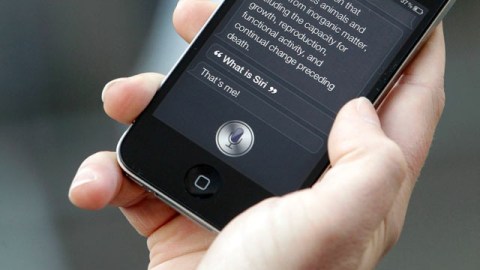
Even more cool, because Seconds is driven through text messaging, if a person is holding an iPhone 4S they can use Siri to complete the mobile transactions by simply saying the keyword.

Maybe you have noticed our world speeding up and getting faster and faster each day, I know I have.  It just seems like there is so much to do and so little time to accomplish all my daily tasks.  I have no time to waste, and yet I find myself along with others standing in line at the grocery store checking my email or twitter stream.  I do this because I don’t like to be idle and feel like I am missing something.  Whether we agree with using mobile devices at places such as the grocery store, I think we all agree there are many things in our life that need to be made more efficient with technology.  Seconds allows us to minimize the time we spend in the minutia of life so we can get back to what is important.

Who’s already using Seconds and helping save hours in their customers lives?

  • Quick Service Restaurants
  • Food Distributors
  • Auto Dealerships
  • Customer Service Consultants
  • Fast Food Restaurants
  • IT Consultants
  • Cafes and Coffee Shops
  • Wine Distributors
  • Beauty and Health Salons
  • Clothing Retail Outlets
  • School Districts

Check out Seconds now and start getting back those precious hours.

@jnickhughes 

Mobile Payments: Siri Hears Your Words And Pays Your Rent In Seconds

Siri is an amazing step forward in computing technology.

So is Seconds.

Seconds enables customers direct interact and transaction with merchants through the mobile web.  When a consumer attaches their payment credentials to their Seconds account, they have effectively transformed their phone into a transactional device.  With Seconds, people can send quick messages and easily make transactions with merchants using the service.  Even more cool, because Seconds is driven through text messaging, if a person is holding an iPhone 4S they can use Siri to complete the mobile transactions with Seconds by simply saying the keyword.

Here’s how it works when you imagine a scenario such as paying rent, which is something we are set to pilot test in Seconds this month.  When rent is due, all you have to do is:

You say: Send a message to landlord  “Pay Rent”

Siri says: OK, here’s your message to your landlord: “Pay rent.”  Are you ready to send it?

You say: Yes

Siri says: message sent

Two seconds later you receive a text “Your account has been charged  $1,200 for your rent.  That’s it! Your rent is paid & you can get on with your life.

How did Siri know who to send the message to and how much you should pay your landlord for rent?

Seconds allows merchants to program their account and customize keywords with specific dollar amounts which act as triggers to charge a Seconds user’s mobile payment account.  So in this scenario, the landlord was able to simply plug in the amount of money “Pay Rent” would translate with and then told their tenants to just text their number and pay in Seconds next month.  This specific tenant was able to tell Siri to pay his rent for him.  And because had labeled his Landlord in his phone contacts, Siri was able to do the job quickly and easily.

Seconds and Siri are a perfect match, and we see a future where payments are so seamless we won’t even have to take out our phones (let alone our wallets).  In the future, your phone numbers + a pin will be all the payment credentials you will need.

The interesting thing about Seconds is not just the transactional component – which is definitely cool – but the communications aspect as well.  Seconds sits directly at the convergence of communications and transactions, and enables each at certain times and both when appropriate.  It’s truly a 21st century communications and commerce platform fit for almost any merchant – large or small, corporate or independent.

It’s my belief there will be many different players in the payments space, but merchants and consumers will not tolerate a plethora of options and varying requirements based upon specific merchants.  It will be far too confusing and there will need to be some market convergence as time goes on.  Consumers will most likely choose the option which is 1) quickest to use, 2) most widely accepted, 3) is not affected by a specific device they are holding, and 4) the easiest to understand.

We like where we sit within the ecosystem and look forward to a great future ahead.  It’s only the beginning.  If you are not familiar with Seconds, here is a quick video of someone paying for a “wrap” by simply texting the words.  Note:  this is not a demo, it’s the real Seconds experience happening every day and will soon be in your hands as well!

Hey Google Wallet, Square and PayPal – Mobile Payments Should Be This Easy

NFC is not required.

There’s no app to download.

No special device needed to make a purchase.

Apple’s iOS and Android may be popular operating systems, but they aren’t needed to use Seconds. Seconds merges transactions into one of the most popular technologies in the world, SMS messaging.  More than 234 million consumers holding mobile devices in the U.S. can use our payment system today because they can text.  Step back a second and think about that.  Why are barriers in the way of an everyday activity like payments?  There should be no barrier to usage, no device requirements or specific apps to download.  Isn’t that how mobile payments should be –  simple, quick, easy and available to anyone?

Why is that so important you might ask?  The diffusion and resulting adoption of a new technology is at the mercy of its availability to consumers.  Why did email spread so quickly?  Simply because people only needed a computer and an internet connection.  The same goes with credit cards, people don’t need a special wallet to carry a credit card, they just need it in hand to correctly communicate with the terminal and make a payment.  If mobile payments are to be available to all we must start at the lowest common denominator.  Today’s common denominator is the device – not a specific model or operating system – but the general mobile device itself, which at last count was almost 6 billion worldwide.  That’s a big market.  And the first to grab consumer mindshare will be one of the big winners.

Once an account is set up, which connects Seconds to your mobile device, all you need to do in order to pay for something is type the keyword and you are automatically charged. Or if you have communicated purchase intent with a merchant, they simply hit one button and a confirmation text is sent to your phone.  Interestingly, this makes a consumer’s mobile number their new payment credential and opens up many new avenues for quick mobile transactions.

The video below shows how one of our pilot customers is using Seconds to distribute their food products around Seattle and beyond.  The hungry person approaches the fridge, texts the word ‘wrap’, a payment confirmation is automatically sent back a few seconds later and they grab the wrap and go on their way.  That’s the future folks…  it’s so much a part of the future Walmart, Target and other large retailers are fussin‘ to build a custom mobile payment experience of their own.

Even better, Seconds allows merchants to program their mobile payments system to create any number of keywords with prices attached so their customers can text and pay with certain words sent to the merchants’ Seconds number.  We have already sat around and wondered what happens when Siri gets involved?

Seconds sits at the convergence of communications and transactions, two activities going through tremendous innovation and both which are germane to commerce.  It’s a perfect marriage and a perfect time to merge the two.  Quite frankly, you really don’t want one without the other since more communications leads to more transactions and vice versa. It’s an absolute virtuous cycle for any merchant.

Also realize Seconds dissociates proximity from transaction, meaning I don’t have to be standing in front of a barista or wave my phone on something to make a purchase, the obvious limitation to NFC payments. This frees up the mobile device to become the new payment terminal, a terminal that resides in the consumer’s hand rather than sitting on the merchants counter.

Mobile transactions will explode once the experience is so quick and simple it only takes Seconds to complete.

Welcome to Seconds.

Wow! Seconds Growing At More Than 150% Month Over Month

One thing you learn when starting a company is how difficult it actually is getting things off the ground.  Inertia is your worst enemy.  An object (or technology) at rest will stay at rest.  Your goal is to muster enough energy and usage to launch the rocket into orbit so you can get to the other side of inertia, where an object in motion stays in motion – that is until something gets in it’s way.

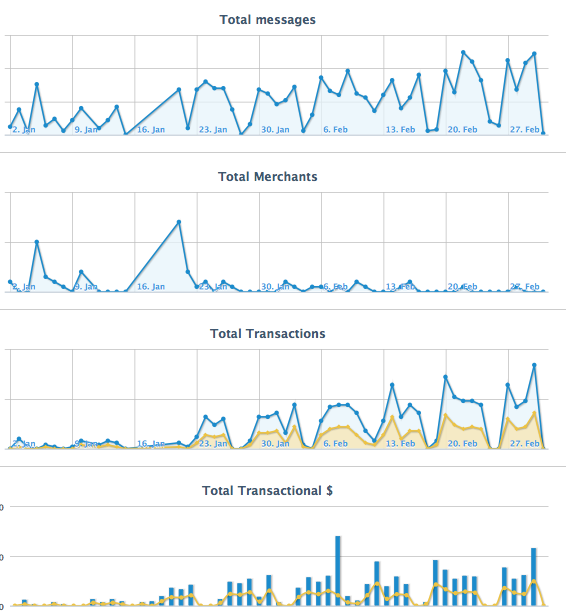
The rocket ship has launched and Seconds is on a tear.  Here are some graphs and statistics for the first two months of 2012 and as you can see, things are starting to take off.   The first image is a screenshot of our internal stats page, measuring Jan – Feb.  As you can see, usage , messaging and transactions are all on an upward trajectory.  Something to note here is the fact that all of this usage and growth is 100% organic, meaning we have spent nothing for customer acquisition.  Imagine if we put fuel on the fire?

Hey investors, you want traction?  Here you go…

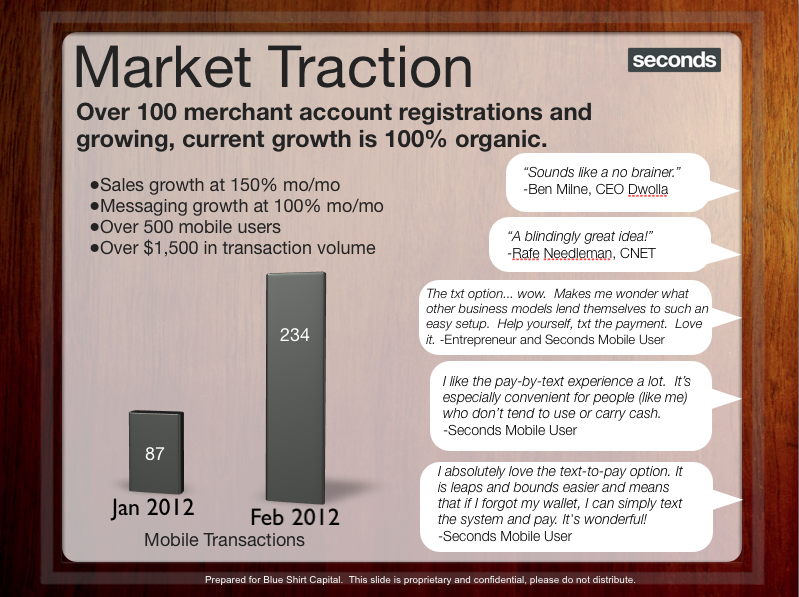
Next, here is one of my favorite slides from a recent pitch deck.  It sums up our traction, month to month growth as well as response from early customers and partners.  Our Pay-By-Text mobile transactions grew more than 150% from January to February and as of March 2nd, are showing no signs of slowing down!  You can read more about the mobile transactions here, but suffice it to say we are onto something.  Don’t just take it from me – based on our innovative concept we are currently in talks with a very major credit card company to roll out something quite exciting later this year.

How Seconds Makes Your Phone Number Your New Payment Identity

The device you hold in your hand has more potential to change your life than you think.  We find that no more fascinating than with the future of payments.  With Seconds, consumers create an account which is tied to their device and identified by their phone number.  After quickly connecting a payment credential to the Seconds account and with necessary PIN codes or security layer in place, making transactions can be as simple as giving your phone number.

Now you can leave your wallet at home!

It can also be a quick as sending a short text.  We have already proved that one with our Pay-By-Text system and plan to roll out more pilot tests.  (Please reach out to me if you are interested!)

Imagine how much better life will be when we are not held back by plastic cards and old school paper bills and coins.  Innovative mobile payment platforms such as Seconds break the chain requiring physical presence and disassociate proximity from transaction.  A whole new world of payments is opening up.

Go on a run and pay for a gatorade at the local market by giving your number

Send a quick text to pay for gas without having to have your credit card.

Pay for groceries by typing in your phone number

Pay your rent by texting ‘RENT – 1,000’ to your landlord’s Seconds number

Square up the food bill with your friend by texting ‘PAY – 20’ to their phone

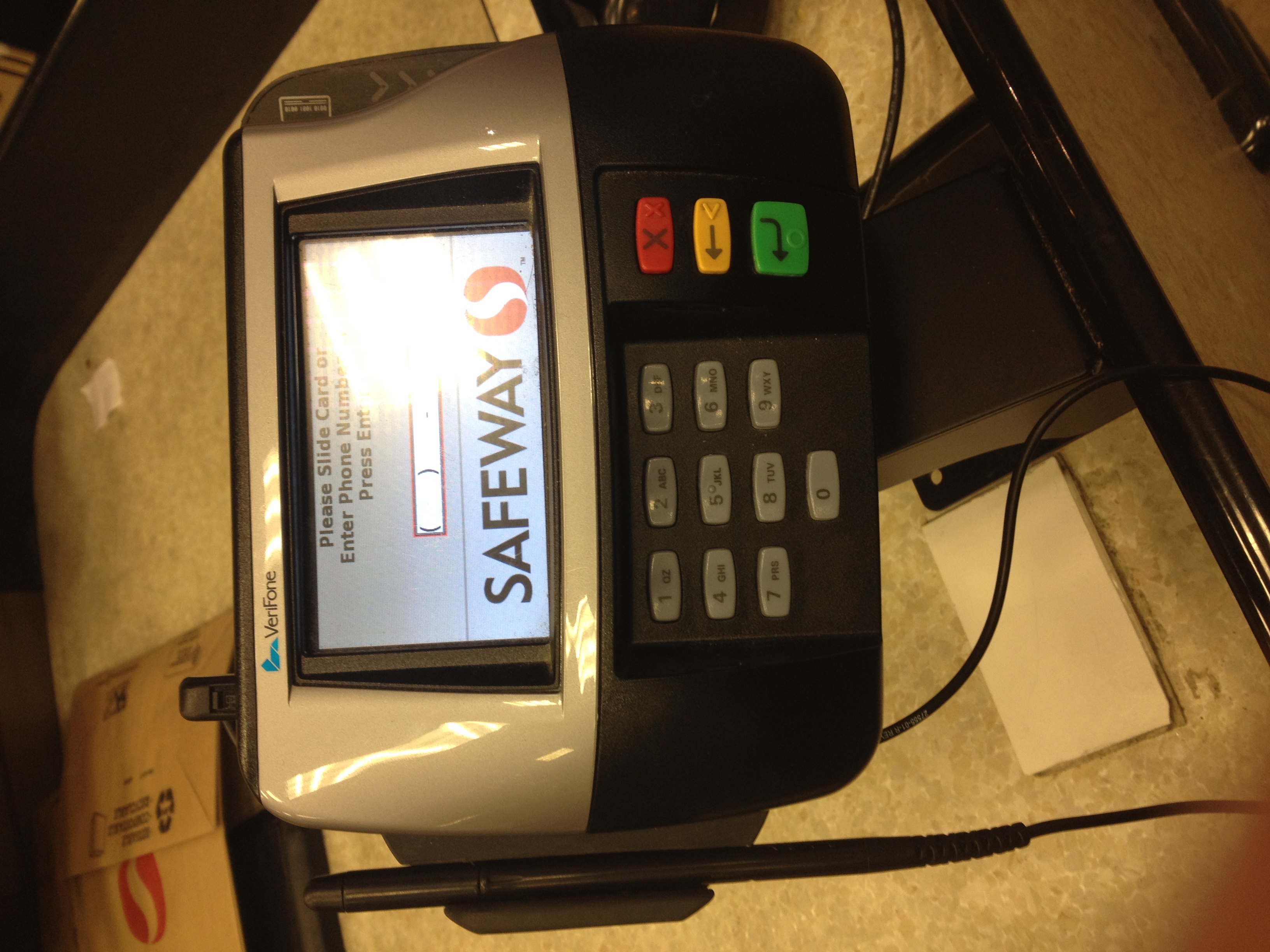
We are not too far off from this scenario and even right now we are programed to type in our phone number to identify our “buying club cards” such as this one at Safeway.  I think you are starting to see where things are going… maybe Safeway was onto something??  I think we are too!

@jnickhughes

Anyone Promoting NFC Is Fighting The Right Battle With The Wrong Weapon

Using NFC (Near Field Communication) to pay for something is not much different than swiping your credit card on a terminal.

Anyone fighting the battle to improve payments will agree it’s an all-out war against the decades old practice of using plastic cards and a centuries old tradition of paper and coins.  These payment methods are so ingrained in our everyday life we hold on to our wallets like our lives depend on it.  So how are we going to transition into the cashless society everyone keeps talking about?

Enter NFC, or Near Field Communication, which can be loosely described  as chips built into our mobile devices that transfer information to another device when  placed at a specific distance from a reader.  Some think this is the future of mobile payments, and some don’t.  I think ReadWriteWeb’s Dan Rowinski says it best:

 From a technological perspective, near field communications (NFC) is one of the most powerful and prominent innovations to come about in the last several years. But from a functional, real world standpoint, NFC is a technology without a clear-cut purpose. What problems does it actually solve? When it comes payments, how much different is a tap with your smartphone than a swipe of your debit card? What about the ability to open doors or share content with your friends? There are solutions already available on mobile devices for many of these “problems.” So, what is the real future for NFC?

Even before I put my gear on, saddled up my horse and rode it directly in the middle of the mobile payments battlefield I questioned NFC as the next big thing in payments.  Why?  Because using NFC to pay for something is not much different than swiping your credit card on a terminal.  Although there is more to the technology, like the ability to include services and software in the payment experience, I believe it is not fundamentally going to change the payment industry for a number of reasons.

Problem 1: Hardware Requirement In Phones

Your ability to swipe your phone and pay for something (via NFC) is dependent first and foremost on you having an NFC enabled device.  This is determined by an NFC chip placed inside your mobile phone when it was assembled.   The majority of phones on the planet carried by most people are not NFC enabled.  Although millions of phones will be shipped this year with an NFC chip inside, it will pale in comparison to the number of phones currently being used that lack the technology.  The mobile device you hold in your hand should not qualify you to purchase a product.

Just as SMS texting technology has nothing to do with your specific device, your ability to pay via your mobile device should not rest on the fact that you are “NFC” enabled.  In fact, what if SMS technology was not just for messaging between friends and family but actually carried a transaction between two parties – be it friends or customers/merchants?  More than 8 trillion text messages were sent around the world last year and those were pretty much all words between people.  It will be interesting to see how a communications technology that is already prevalent and widely used around the world can be leveraged for quick payments.  It’s would be adopted a lot quicker than a technology that will take at least three to five years to get traction and requires a big investment in hardware by merchants.

Problem 2: Hardware Requirement For Merchants

The second biggest requirement for an NFC transaction to work is the merchant must have an NFC enabled terminal so you can swipe your phone.  Expecting consumers to purchase new mobile phone hardware every 2 or 3 years is not too much to ask, but thinking merchants are going to upgrade their point of sale terminals to enable NFC mobile payments is outrageous.  Being on the front lines of servicing local merchants, I personally know these proprietors will do almost anything to not have to spend money upgrading their payment terminals.

And since technology is moving so fast these days the hardware that comes out this year will be ancient in a few short years.  So what are businesses supposed to do then?  Not accept mobile transactions anymore?  Requiring local business owners to upgrade their terminals every couple of years is a losing proposition.

Like anything, the answer is not more hardware but better software.  That is why even though PayPal is experimenting with NFC in some capacity moving forward, the company ultimately believes that the technology is a step backward when it comes to point-of-sale transactions.  Web enabled software connecting customers to merchants for communication and transaction is what will win the battle for mobile payments.  The solution that eventually goes deep into “main street America” will not depend on any new hardware that needs to be replaced every few years, but will leverage existing technologies and networks already in place and which are cost effective to both merchants and consumers.

Problem 3: Your Physical Presence is  STILL Required

Something I am not sure most have thought about when considering the payment experience is the concept of presence.  Many NFC supporters will talk about the security of NFC, meaning it’s safer because you have to be there and swipe to make transaction, similar to how most credit cards work today.  Although that is true, unfortunately this does not make the payments industry any more efficient than it already is.  Even when using a “new” technology like NFC, physical presence is still a requirement.  The point of a new transaction experience is to replace a wallet full of cards, not create new cards or re-create the card present experience.

What happens if I want to pay for something like tickets to an event, a dinner I want delivered to my house, or my rent due every month for my apartment?  Based on the requirements of Google Wallet and NFC, I have to do what I have done for the last 20 years and actually be present to use the payment technology, or call and read them my credit card numbers.

Even Erick Schonfeld agrees: “Waving a card (or phone, for that matter) over a reader is not a huge improvement in ease or convenience to simply swiping a credit card. Credit cards work. More importantly, people know how they work. They are not going to stop swiping and start waving without some incentive to do so.”

At Seconds, we believe the future of payments will be found in your ability to make payments regardless of your physical presence.  That is why we are very excited about our Pay by Text technology, we see a whole new world of payments when you disassociate proximity from transaction.

Whatever happens in war for mobile payments one thing is for sure, the battlefield will see many warriors and the ultimate winner will own a very large territory.

@jnickhughes

The Future Of Mobile Payments: Text A Word And Pay For Something

Imagine a world where by simply texting a word like “Sandwich” will result in a quick and seamless transaction so you could  go about your day.  Think about how much easier our lives would be if we didn’t have to wait in line, handle cash or be turned away from food or beverage if we don’t have our wallets in hand.

What if texting wasn’t just meant for communication, but also designed for transaction?

Today, most people take more precautions about carrying their mobile devices than carrying their wallets or purses.

The new question is: if your house is on fire what do you grab, your wallet or your phone?

I bet the answer is an overwhelming “phone”, since we do almost everything with our mobile devices and very soon we won’t be needing a wallet.

Our vision at Seconds is to make it easier for merchants and customers to interact and transact.  This is no more apparent than when looking at our latest innovations on the mobile payment front: Pay by Text.

Here’s how it works.

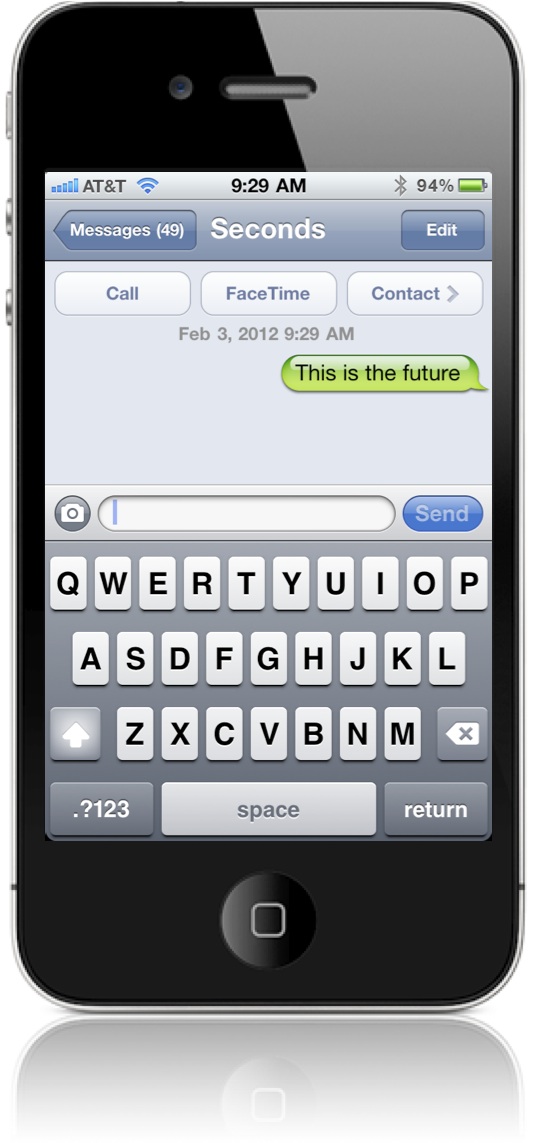
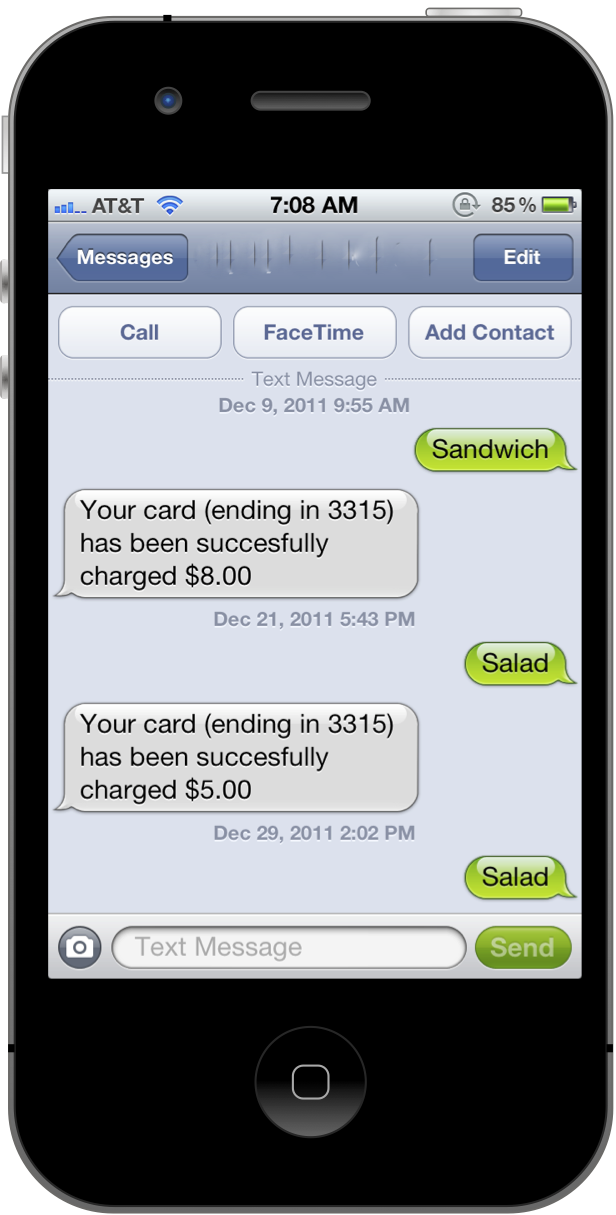
Once a mobile user sets up a Seconds account and attaches a payment card, they now can simply pay for the desired product with a one word text to the merchant’s Seconds number, in this case it would be the word “Sandwich”.  The resulting text a few seconds later will inform the user they indeed have been successfully charged X amount.  Done.

Important Note: This is not carrier billing, where you place the transaction onto your cell phone bill.  Seconds is completely separate from the carrier and a stand alone mobile payment system.

We are currently one month into a pilot program with a customer testing the functionality and perfecting the process.   Each week we are seeing more and more mobile transactions through Pay by Text, and if things keep going the way they are now this could become the default payment method outside simple food offerings.

Roll with me for a moment.  Imagine going to a movie and rather than waiting in line for the teller to give you a ticket you just simply text “Mission Impossible 4” to the box office and the next thing you know you have paid for the movie and are sent the secret code to enter via text.

Or how about the next time to your favorite band is in town…. do we really have to deal with the whole Ticketmaster ordeal?  Why can’t I send a text to the concert organizer with a simple “Said Band Name” and pay for the price of admission.

Okay, here’s a great one…. how about anything to do with hospitality?  Already, when you check in to a hotel they ask for your contact information, namely a cell phone number.  By running on the Seconds platform the can now open a quick and easy channel for you to text and pay for room service, any and all products… not to mention your room.  Or what about on a Vegas Casino floor….

So, what about NFC?

The problem with NFC technology is you actually have to be in physical proximity for the transaction to work.  The whole point of “Near Field Communication” is touching or swiping your device on a reader which will result in a transaction.  But what happens if I want to pay for something when I am not actually at the specific location or can’t get within a few inches of the reader?  What if it’s ecommerce, which will become more prevalent as time goes on?  Although it might have its place, it looks as if NFC  underwhelms and under-delivers.

That is why we are very excited about our Pay by Text technology, we see a whole new world of payments when you disassociate proximity from transaction.  It’s going well right now and the future is looking very bright for Seconds.

@jnickhughes

10 Simple Steps To Making A Kick Ass Explanation Video For Free!

Since Seconds is currently self funded, we have a pretty tight budget when it comes to PR and media exposure. But thankfully we have a “make your own for free… and pretty soon others will come around to make it for you later” mentality.

So when it came time to get a basic explanation video up on our site, we decided to do it ourselves rather spending money on a contracted specialist or video generating sites like broadcast2world.com.

Problem was, we really didn’t know where to start. That is where the creativity of Seconds team member Brent Crocker came in. He used Keynote to animate  and produce it, and while not the greatest App to animate a video with it got the job done. Basic image overlaying works great!

Judge for yourself, the video is at the end of the post. Here’s how he did it!

First get a solid script:

1: Determine what points do you want to make and write them down.

2: Think of a way to explain those points to your audience in a concise way.

3: have someone else on your team read through it, ask people if they understand it! This should be at least the start of your script…

Then Make the recording

5. I find that almost every major change to the script happened while I was making recordings… its something about hearing yourself in the recording.

note : I actually use the mic in the Apple headphones to do all my recording, so don’t make the excuse that you don’t have the right equipment! Record short sections of the script and pieced them together, its better to have short recordings to play with!

Determine what animation or imagery will go with the script:

6: Now is when you should be making the visual aspect of you film, after you know what you’re trying to say and how long it takes to say it!

7. With little time you should be able to make some kind of scene with an image editor, I used PixelMator, but anything that can create a clear background will work. Basically, if you can draw it, you can make it this way…

note: Try and figure out what best tells your audience what you’re saying with an image or animation.

Create some simple animations

8. For most scenes you will need a background and something to orient you (like a desk, building, or I even used a couch), but don’t make the scene too busy. Overlay your orienting image over some kind of basic background, black, white, textured, clouds… it up to you.

9. To create an image, grab a texture image like paper, cloth, or rock in the color you want (you can also adjust the color in the image editor). Then cut it to the shape you want. Make sure the image has a transparent background so you can overlay it on other images.

note: you can choose to make it look slightly 3D, but if you want to get through it quickly keeping to 2D animations works the best.

10. Most animations can be done in a program like Keynote/PowerPoint, along with scene changes. Moving images onto the screen and resizing as they come in to give the idea its getting closer. This gives your video some great movement so you can bring to focus the points you are trying to make. You don’t need to make fancy animations to get your point across, just use the animations to move through your points.

note:  focus on creating images that look good, but aren’t too hard to make.  This whole process should take you a week at the most.

Set the recording over your video and get the timing tuned in and you’re ready to post!

The Best VC Pickup Line Ever, According to CNET

This is awesome!

Seconds was covered by CNET journalist  and he opens the article with:

“Nick Hughes, the CEO of , has the best VC pickup line I’ve ever heard: “Last year, 2 trillion SMS messages were sent in the U.S., and not one reached a local business.”

Read the article here.

Want Hyper Hockey Stick Growth? You Must First Endure The Blade

We all love to talk about the companies experiencing massive user growth in a short period of time, generally referred to as hockey stick growth.  Twitter experienced it.  Facebook saw it happen.  Of course Google did as well.  All great companies at one time went from a small unknown startup with no users to a well known company with a massive user base.

A few startups currently experiencing meteoric hockey stick growth are Instagram and Tumblr, incidentally interviewed at a recent Techcrunch Disrupt about managing hockey stick growth.

As fascinating as the hockey stick growth can be, something intriguing happens immediately before the growth period.   Not talked about because it’s not as sexy, Something must be happening before the massive uptick in usage or the uptick wouldn’t happen at all.

So what is it?

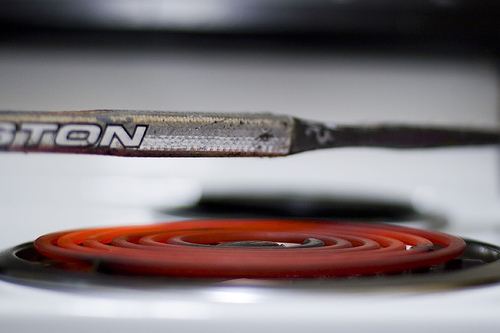
I call it the blade.  As you can see, the hockey stick on the right has a flat section (the blade), an angle (the inflection point), and the  rising handle (growth phase).  The blade is the most critical point for any startup because if they get over it alive they move on to the crazy hockey stick growth phase.

Although the Techcrunch Disrupt interview is great and both founders offer a number of insights as to what its like to go through the insane hockey stick growth periods, they don’t really talk about the blade.  My guess is because it’s not as exciting as hockey stick growth.  In fact, it’s tough.  So tough it will make or break a startup.

Blades Require Heat

When referring about a hockey stick, deciding on a blade may be one of the most important decisions a hockey player can make.  The makeup of a hockey stick blade will determine how durable it is and how much stress it can withstand.  A blade — the bottom portion of a hockey stick that may be curved or straight — can help determine the way a player is able to control a hockey puck.  Wood blades today are frequently covered with a composite material, such as Kevlar. Kevlar is a strong, fiber substance that is designed to be used in high stress situations.

Being made of composite, hockey stick blades are malleable and can be shaped to a players advantage.  All it takes is heat.  When a player heats a blade, they can curve it and shape it to their liking.

As if you didn’t know… startups are situations of ridiculously high stress and immense pressure.  It’s almost like you sign up saying ”let’s see how hot it can actually get.”  As part of a startup, you are trying to create the most with the least amount of money, which leads to tremendous financial heat.  You feel heat trying to force the product down people’s throats, working towards product market fit. The pressure is on to prove a specific customer for your product before time runs out.  Lots of late nights, pivots, redesigns and tough conversations will create friction and heat amongst the team.

The blade period – the period of time after launch but before massive usage growth – is one of the most challenging times a team can go through.  Yet, therein lies the test.  The blade test for a startup team involves a number of points: to observe reality that the product is not an overnight hit, listen to feedback, watch available usage metrics, identify what is working and what isn’t, agree on changes to be made, make the changes, reposition the product, polish the messaging and many many others.

The key is to do all this without losing your mind and going crazy.

This situation is extremely difficult for a young team to get through, and that is why most startups don’t make it.  Failed startups don’t ever get to the position of hockey stick growth because they could manage the heat on the blade.   It’s like a right of passage. Show me a (successful) company that did not get over the blade.  The only way to get from launch to hockey stick growth is to get through the heat and over the blade.

Blades Are Short

If done correctly, the blade is just a phase in the life of the company; the shorter, the better.  Flat growth actually shouldn’t last very long if the founders are quick to make needed adjustments to the product, positioning, messaging, and user acquisition strategies.  When great products hit the market, people take notice and users are attracted.

It may be all relative, but some startups only last a few months on the blade, some last years.  Most are somewhere in between.  What does it take to get off the blade?  As I was researching about hockey stick growth, I found this article about the internet and how it finally hit hockey stick growth.  Interesting to note:

The Internet served an important role for a limited number of users, but it had serious barriers to entry. It displayed its messages in monochrome text; no color, no pictures. The Internet had to become pretty and easy. Lessons to be learned include that ease of use, attractive displays, entertainment value, cost-effectiveness, and genuinely new utility are the keys to type-one hockey stick growth.

The goal is to shorten the blade and reach inflection as soon as possible.  Notice how the above statement clearly illustrates the internet grew quickly once it became easy to use, was cost effective, entertaining and useful (of course this is referring to the world wide web.)  These characteristics are  what every startup is searching for in their product.

A lot of the blade comes from not knowing what to change, but a few major points come to mind.  Correct positioning in the market will allow for your product to actually be found by the right audience.  Finding the correct messaging will help the right people/customers to understand your value proposition and start using your product.  As your user base grows, features that help current users share your product will lead to new users.  And the correct distribution model will aide all other aspects and amplify growth.  As these are fairly general, it is for the fact that each action will be unique to your specific offering.

Not to be overlooked, part of putting yourself in the right position for hyper growth is building the right team.  It’s not about hiring, it’s about finding the right talent.  The correct people in the right positions at the right time will only help to shorten the blade and get a startup to hyper growth.

Blades are Remembered

Although any founder or early employee will tell you growth is what they are looking for, the times on the blade is are always the ones the remember the most.   Tony Hsieh, Zappos CEO recalls the early days when they almost didn’t make it…. many times over in his book Delivering Happiness.  It’s a great read for any startup founder or early employee, as he re-lives all the challenging (and fun) times Zappos endured.  You can almost feel the sharpness and heat of the blade they got over.

Microsoft co-founder and fellow Seattle resident Paul Allen spends the majority of his book recalling the Early days of Microsoft, the struggles and challenges they faced on the blade.  I was not aware of all the times he and Bill were scared, feeling little hope for the future of their company.  Can you imagine Paul Allen or Bill Gates fretting over $100?  But… we all know the rest of the story.  I’m just glad they went through it at one time in their life as well!

So the blade is a fact of startup life.  The only questions are: how much heat can you take?  What will you do to shorten it so you can get on with growing your company?  And what crazy stories will you be telling when you do make it over the blade?

@jnickhughes

The Year I Learned To Fly

As 2011 comes to a close it seems as good of time as any to step back and reflect on what has been, for better or worse, a most incredible year.  The lesson of this post is a lot can change in a year.

A year ago to this day I was sitting at a different desk, with a different job, different title, in a different life, and in a totally different industry.  Technically speaking my professional title was Exercise Physiologist.  I managed a corporate fitness facility and helped executives and employees make better choices in their health and fitness.  This area of expertise was in fact my college degree and ultimately my profession for the greater part of a decade.

I don’t necessarily like to talk about this because I know others look at me and think “how is this guy a CEO and what the hell does he know about tech if his background is fitness?”  Although I can understand where they are coming from anyone who thinks this way is mistaken.

For those who aren’t familiar with my background, I had been associated with the tech industry for more than 5 years and had been working on a “startup” for the last few.  Things had not been going well and to say it bluntly we were heading straight for the deadpool, mainly for the fact that the entire team was still fully employed at their current job.  Not all was lost as those years allowed me to study the industry, achieve a basic understanding of the web and learn what startup life was all about even if it was from outside of the window looking in.  The most difficult part of it all was feeling like I was sitting on both sides of the fence, not being able to make the leap.  And it was one of the most frustrating experiences of my life.

Until something happened.  I finally gave in to my pain, got tired of all the frustration and I decided to finally pick the right side of the fence and ended up making the leap.  I quit my full time job to pursue entrepreneurship and become a real founder.  This felt great, I finally made the decision…  except I had no idea where I was going and where I would end up.  All I knew was I didn’t want to be where I was currently on that spring day.

The craziest thing about jumping is what happens mid-air.

For those of you who might have been following my path, you’ll know I took to writing this summer and ended up finding a few channels where people could find and read my words.  In an amazing turn of events, suddenly people from around the world were reaching out to me asking for my prospective on technology, social media, the web and inquiring my interest in possible professional partnerships.   I was suddenly the expert!  After considering numerous offers, I ended up connecting with some local guys here in Seattle and accepting an opportunity to form a company.

Today I am CEO of Seconds, an emerging mobile messaging and commerce startup with a pretty damn cool product and promising vision.

Your Future is more important than your past

I love this question…. “So what’s your background?” … especially as I sit across from a veteran investor during a meeting as we are about to review our company and our product.  “Shit… how do I answer this one without totally ruining my credibility?” is what I am actually thinking.

I understand their logic as they inquire about my past.  If someone has a Ivy league past, a Stanford degree, an MBA or previous startup experience with a successful exit it is a qualifier in the mind of an investor.  It is proof positive this person has relevant industry experience and basically they pass the sniff test.  The investor is just mitigated the risk (check).  Yet, a strong argument can be made for some of the best entrepreneurs coming out of nowhere to change the world.

I am here to tell you entrepreneurship is not about where you came from, it’s about where you are going.

It is the most important thing I learned by jumping this year.  You must determine where you are going.  No matter your background you must figure out where you are going, refine it and become crystal clear on what you are building and why.  Who cares about your past…  Most of us are not very proud of what we have done in the past and look forward to where we are going.  If that is the case with you, just focus on where you are going because it’s way more powerful than your resume will ever be.

Never, ever, ever…..ever think you are not capable of doing something.  You just need to set your mind to it and get up everyday determined to chip away at whatever/whomever is holding you back.

As Tom Petty would say I am learning to fly .  Or was it Pink Floyd?  Either one… I am damn glad I jumped!

Wow, a massive jump in Seconds Accounts in the last 2 weeks!

Looks at this!  On Nov 28th we released a new feature which allowed merchants to quickly self register a Seconds account in just a few steps.  The result – 20 new accounts created in less than 2 weeks.  Before the 28th, we had created less than a handful of accounts since it was not a streamlined process.  Now, any merchant anywhere in the county can quickly grab a new number to accept text messages and have a nicely designed mobile site to communicate with customers.

Wonder what the next year will look like?

Also, I wonder what the recent redesigns will bring?  I think our numbers will be out of the roof, but you be the judge:

Here’s the old one.

Here’s the new one.

Siri And The Last Mile To Utopia

The amazing Siri, Apple’s new voice recognition technology, has been the topic of much conversation over the last month.  I too am left speechless when asking questions that at first blush seem ridiculous.  Responses to questions such as “Siri, what do you look like?”  or “Siri, will you marry me?” will elicit laughter and jaw dropping looks only magicians are used to seeing.

All fun and games aside, what Apple (not Microsoft) just released represents a fundamental shift in how we will interact with computers – and to an extent the rest of the world.  Even Eric Schmidt knows we will no longer type things into a long search box and wade through a sea of links to find what we “think” we are looking for.   We will also not be required to re-identify ourselves and re-enter our credentials each time we want to make a digital purchase.  I previously believed the future of search will be found within your loose contacts and network of friends – and  still do.  But in addition to leveraging others to find information, it has become very apparent we will now leverage new blends of artificial intelligence and intelligent data systems integrated within our mobile devices to create very personal consumer experiences.  And we’ll accomplish this all this through simple text, voice and gestures thanks to natural language processing within your mobile.  Like it or not, in a very short period of time you will not be able to properly function in society without your trusty device.
Simple and inane tasks can already be accomplished through Siri.  Speaking basic directives into your phone will help to find any personal contact you have in your phone.  Such things as setting reminders, alarms, meetings, checking email, checking the weather, searching the web to look up random information and interestingly enough just having a plain conversation with your phone can now be done by voice dictation.

And the big one – sending text messages to others by speaking to Siri – has the potential to change society in ways you never thought possible.  A quick spoken message gets translated into text and sent off to the exact recipient you have determined, all without clicking or finger swiping anything is simply amazing.  And it’s now here.

Siri (or nicknamed Hubotsiriis the latest in a long line of iOS features to be stretched to the limits, enhancing functionality, capability, and allowing users to realize the full potential of technologies within their devices. Much like buying a Ferrari – you pay a lot, it looks nice, runs well and oozes luxury. Yet until you get it off-road, you can’t really see what it’s capable of due to the restrictions beset upon road users.

As impressive as Siri can be, we still hear naysayers balking at the current ineffectiveness of the technology.  They say it’s not perfect, it can’t yet complete complex tasks such as interacting with the Apps on your device, and when in doubt it defaults to a web search for your request.  Although I am fascinated with Siri I must agree we have only scratched the surface and more work is ahead.

It seems Apple has figured out how to voice activate basic tasks, but what about more practical applications that can make your everyday life easier and more fluid?  How will voice translation and Artificial Intelligence radically transform how you go about your everyday life?  Below is an attempt to peel the layers on what it will take for society to get away from the absurd  and onto the applicable.
Siri, Can You Please Make My Life Easier?

Imagine being able to say things like “send a message to the coffee shop and tell them I will be there in 10 minutes and I will have the usual” and by the time you get there your correct drink it sitting on the counter already paid for.  This is not too far off… it just requires a few more pieces to be put in place.

The answer lies in understanding what exactly Siri is, what exactly are those other pieces, and how they need come together for the above scenario to become reality.  Siri is basically a search engine, one many think has the potential to eat Googles Lunch.  Or better said, it’s a “do” engine in the sense that you can dictate what you want done and Siri will mostly carry out the task.  I say mostly because even though Siri represents the first mile, the possibilities can only become reality when something else comes in as the last mile to fulfill  your request.  Siri can accomplish any task as long as the information is readily available and in the correct form to be delivered to the user.  Would Google have worked so well if there were no links to bring back?

So for Siri , or any AI from a mobile device for that matter, to connect and help you easily communicate with your local community the last mile must be completed in a way that makes sense for Siri.  One can communicate with Siri in audio/voice, yet Siri communicates with databases and other systems via bits.   The last mile must be accessible via the web, enabled to send and receive text based communications, and ultimately be built from the ground up using data as the foundation.

We can see from the article How Siri Works we have a long way ahead to complete the last mile. Siri can’t understand everything. It can do a certain set of key tasks.  From the article:

  • Interact with the calendar.
  • Search contacts.
  • Read and write messages (text and email).
  • Interact with the Maps app and location services.
  • Forward search phrases to certain pre-defined data providers (Yahoo! Weather, Yahoo! Finance, Yelp, Wolfram|Alpha, or Wikipedia).

This is still an impressive and—most importantly—wildly useful set of functions. But it is a limited, focused set. And that’s what makes me think Siri’s “AI” may actually work.

It seems to me that Siri consists of three layers: a speech-to-text analyzer, a grammar analyzer, and a set of service providers. If all three of these work well, then Siri will be fun and helpful. If one of them is as troubled as traditional intelligent agents have tended to be, then Siri will go the same way those other agents went—tumbling into the trash heap of misguided innovations.

Unfortunately, most of the rest of the world does not make sense to Siri. Yet.  Although searching Google will bring back (s0me sort of) local merchant website for most entities in the U.S. and around the world, they are still stuck in the analog world when it comes to communication, interaction or commerce.  Most merchants still require a voice call to reach them and when wanting to transact, one must be present with cash or credit card.   “Forward thinking” merchants offer online and mobile app transaction options, yet the experience is so cumbersome most people give up and take the extra time to physically make the purchase.

Siri will truly transform your life once the last mile is complete.

Ironically the traditional telephone served as the last mile for quite some time, when the most popular connection between two recipients was voice line.   Voice ruled the land  until data – better known as text messaging – became the most popular mode of communication for our new society.  Although the web is based in ‘telephone’ connection, we now communicate in a vasty different language.  It is interesting to note more than 2.2 trillion text messages were sent in the last year, yet little to none were received by local merchants.

Yeah, you read that right.  Imagine that, the most popular mode of communication is not accepted at any place of business in your community.  This would be like you walking into a merchant and asking a question in english (the obvious main language here in the United States) and they don’t even look at you or say a word.  Yet that is exactly what is happening today with mobile messaging.  The fact that more messages will be sent next year than last year, and even more will be sent the next year should be freaking out any manager or business owner right now.  If consumer activities are to be automated through voice diction, short messaging and artificial intelligence then somethings need to change.

The last mile is comprised of a few major technological enhancements that, when adopted, will complete the transformation and bring this new vision into reality.

Merchants need a short messaging service

It is fair to say text messaging has taken over as the most common form of digital communication on the planet.  For a bit of perspective, just look at your own life.  What do you use more often with your mobile phone, text messaging or voice calls?  Local merchants must get up to speed and find a simple way to send/receive text messages to optimize their business for mobile commerce.  Arguably, this is a bigger deal than in the mid-90’s when everyone was touting “you need a website.”  We are talking about basic communications and commerce.   In the next few years we’ll see a fundamental shift in the economy as merchants and business adopt this popular method of communication and use it as new form of commerce.  An interesting note: once a merchant is set up to receive text messages, mobile users are able to simply voice dictate messages to quickly place an order with the merchant using Siri.  It’s awesome!

Customers and merchants need a personalized connection

Personalization and socialization are the new black on the web, yet even today when I call a local merchant they still ask me to identify myself and request I read my payment information (aloud) if I want to make a purchase.  Interestingly, this does not change when I am present.  As I walk in the door they have no idea who I am, how many times I have visited their location, and what my purchase history with them might look like.  In a word, they are ignorant.  They lack the necessary and vital information to not only improve their operations but also make my customer experience much much better.

A whole new world of possibilities opens up when personalized connections between customers and merchants is available.  Customers are able to quickly find and message a merchant, requesting more information and making purchases when and where they feel most compelled.  Merchants are not only afforded a more efficient method of communications, but a unique perspective on each customer and a clearer picture of their entire customer base – in real time.  The possibilities are endless when local merchants fully embrace the mobile world.

Mobile Payments need to be invisible

Connections between customers and merchants are great but what both are actually looking for is the almighty transaction.  The more simple and frictionless the transaction the more we, as customers, will spend.  This should be music to a merchants ears yet there seems to be some resistance to employing new digital payment technologies.   This challenge/opportunity falls back on the tech community, nudging us to continue on forward with our innovative genius at the helm.

Technically speaking, when a transaction occurs neither I, as the customer, or them as the merchant should have to do anything.  If I have already connected digitally with the merchant and my payment credentials have already been cleared, payment should be invisible from then on.  Yes other requirements such as security and merchandising are involved, but those should also be taken care of behind the scenes.  But, I am so bothered right now!  Why do I still need to stand in a line for them to swipe my card and require my signature before I leave?  This is archaic, and if enhanced to the above scenario the merchant will not only provide a better customer experience for me but increase throughput leading to an increased bottom line.

Mobile coverage needs to improve

This one needs no justification, only a fair request to the major  mobile carriers of the world.  What good is Siri if I can’t get a response?  Flat out, we need better coverage and we needed it like, yesterday.  If mobile devices are going to be the center of our lives we cannot be at the mercy of “the number of bars” we have at a certain location or the chance opportunity we still have 3G at the top of our device.  Again, we are encroaching on a time in history where if my mobile device fails me, I am hopeless.  It kind of like if at certain times my Visa card worked when swiped, and sometimes it just didn’t… for no reason at all… except for maybe the restaurant was positioned on the wrong side of the street.  Yeah, I know… This is absurd and it needs to change.

The above may seem crazy to some but to others like us it’s the reality we are working towards each day.  We live in a truly amazing time in history and when the four things I just laid out come together… only Utopia waits.

Groupon, Google, Ebay or Amazon: Who Will Win The Local Market?

No doubt he local space is heating up.  We are starting to see an all out war and currently there are 4 major players lining up their guns and taking aim on the local marketplace.

Groupon recently went public on the Nasdaq and is the undisputed king of daily deals, creating a new movement in local commerce known as the group coupon.  Yet things are not all rosy as they also created quite a bit of controversy as they approached the finish line.  Their numbers are greatly scrutinized  and they can’t seem to shake questions regarding the validity and sustainability of their current model.  Groupon no doubt made a significant splash in the local space, but do they have what it takes to transform our daily consumer lifestyle?

Google’s eyes have been on the local economy ever since they realized a critical mass of searches are local in origin.  Early on they knew local was a goldmine, the tough part has been designing products which bridge the gap between local consumer and local merchant in a way that adds value for both.  Google Places, HotPot, the purchase of Zagat, the failed acquisition of Groupon, and now Google Offers are all attempts to make a play on the local marketplace.  But to date it is hard to argue they have made any significant progress in solving the local market conundrum.  Will they do it?

EBay, the buyer/seller marketplace who has lingered on the outskirts of the web for more than a decade (and hinged earnings on a payment platform) looks to be emerging as a solid player in the local marketplace.  The combination of a number of acquisitions have placed them in a drivers seat helping power the next generation of location specific platforms.  Milo, Magento, Zong and Where all offer unique value propositions that when grouped together create a strong combination – and a strong competitor to the Googles and Amazons of the world.  This is one to watch…

The king of worldwide online commerce is Amazon, and I guarantee they their sights are set on the last mile of the web – the local market.  Their $175 million investment in LivingSocial seem a lot like a “look and feel” investment as they watch how the landscape is taking shape.  Make no mistake, the leader in worldwide e-commerce would love to be the worldwide leader in local commerce as well.  The question is, do they know how to do it in the way the everyday consumer will appreciate?

Ultimately, it is nearly impossible to predict who will eventually win out in the local market.   Remember, Google was late to the search party…

Another valid question is: will any of these major players hit the home run or will a new, tremendously different but effective startup with a better combination of commerce and communications transform our everyday consumer experience?

Share your thoughts in the comments.


Name Change! Introducing Our New Name – Seconds

As conversations evolved and our company matured over the last few months, an interesting theme started to emerge – we are more than just a platform for ordering.  Ordering is just one action a customer takes when they interact with a local merchant; thy also communicate, purchase, refer to friends, find information.  We realized an order cannot happen unless a connection has been established. Once a connection is established, communication usually follows.  In that vein, we have decided to change our name to Seconds.

Frankly, Seconds is a much more brandable name than Order SM.  Throughout our search for a new name we kept coming back to the themes of repeatability, quickness and efficiency.  Seconds brings to mind “wanting more” and “very quickly”, two very strong foundational characteristics to build a consumer oriented product around.

Our entire concept has revolved around repeatability and loyalty.  If you like a restaurant, coffee shop, taxi driver, or any other product or service, it’s a strong possibility you want to go back and repeat your experience.  With that in mind, we created what was originally named Order SM.  We wanted to make it dead simple to communicate and transact again with a favorite local merchant.  Now, the term Seconds will be branded as a way to connect and quickly repeat your customer experience.  Use Seconds to quickly have that non-fat latte you like so much (and order every single time!)

The Realization of the web only speeding up (in fact, our lives seem to be increasing in speed) was also a cornerstone to the name change.  We envision a not so distant future where a user checks Seconds to see the local community activities – from coffee house purchases, to the latest taxi cab whereabouts, to what’s the hot happy hour tonight – all in real time up to the second.  You now see where this thing could go….

Functionality of the current product is not changing and the only enhancements will be cosmetic in nature.  A new logo where the old ones resided, replacing all Order SM content with Seconds content will be most of our enhancements.  But, with this new branding comes an incredible new opportunity – a consumer facing experience.  Be on the lookout for new developments in what will eventually become a whole new local consumer experience.