Seconds Was Just Chosen For Another Nationwide Mobile Donation Campaign

We will be announcing the partnership with a global non-profit and the roll out of a national campaign for donations towards a recent disaster to our county.  More to come….

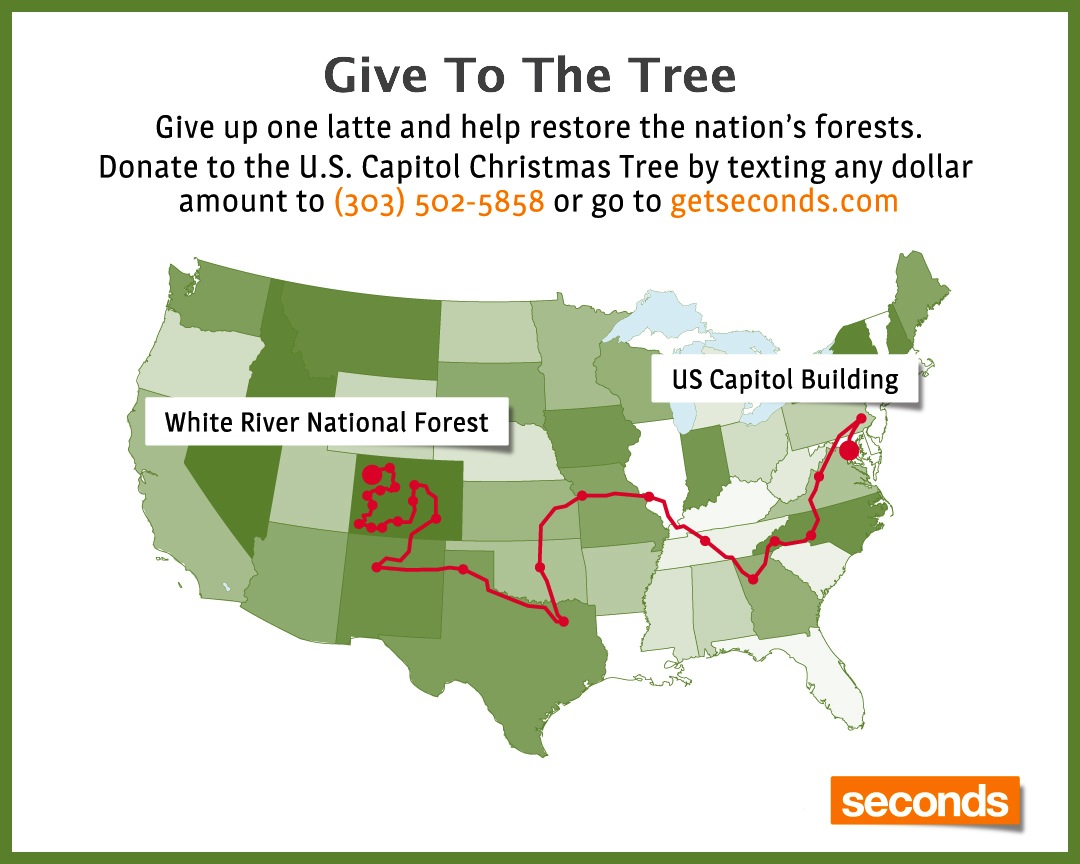
In the meantime, try Seconds out and give to the Capitol Christmas tree to support forest restoration.

The Future of Commerce Will Combine Your Social Network and Mobile Device

Below is from my latest posts published on PayPal’s DevZone, titled The Future of Commerce Will Combine Your Social Network and Mobile Device.

Each day we hear growing speculation about the so-called mobile commerce revolution that’s just starting to take shape. Some think NFC payments will be the next big thing in retail. Others believe text-based payments will open up the mobile payment experience for the billions of mobile device holders around the world. And thousands of new apps are created each year with a new twist on using your mobile device to pay for everyday things.

To some extent, these concepts and more will shape the future of mobile commerce. However, pundits are forgetting what might happen if you combine the most commonly used platforms in the world—mobile devices and social networks—and infuse quick payment technology within them.

If Those Two Powerful Phenomena Merge, Will We Discover a New Payments Utopia?

It seems as if we’ve been in the stone age of social commerce for years now. Facebook has been around for almost a decade, and before that we had Friendster and Myspace. From my perspective, most don’t realize how close we actually are to merging social and commercial actions. How many times have you read a Facebook update from a friend, for instance, saying something like “I just saw ____ and it was the best movie I’ve ever seen.” Or what about the posts that show off a new car or recently purchased clothing? Those posts, in a small way, are the beginnings of social commerce. By sharing things such as a new purchase or a cool new movie, you are influencing your friends’ commercial interests. Today, people are partaking in social commerce without actually knowing it.

The question is, what will happen when they know they are doing it and they help you make a similar purchase? And more interestingly, what happens when it originates from a mobile device?

Read the rest here.

Seconds Chosen To Provide Mobile Donations For U.S. Capitol Christmas Tree

We are pleased to announce Seconds has been chosen to power mobile payments for the 2012 U.S. Capitol Building Christmas Tree.  Yes, the one that travels across the country on a truck and is put on display in front of the capitol building in Washington D.C.  That one.

This past spring, wildfires burned more then 100,000 acres of land and more than 600 homes near Colorado Springs and Fort Collins, Colorado. In addition to destroying homes, these fires severely damaged critical watershed areas that supply water for the cities of Fort Collins and Colorado Springs. They also damaged critical habitat for wildlife and fish in the region.

Seconds was sought out by a Colorado non-profit called ChooseOutdoors and the National Forest Service looking for a dynamic mobile/text payment system to help raise money for restoration of the thousands of acres destroyed in the fires.  They were very clear they wanted it to be as smooth and quick as possible to complete since people will be standing outside during festivities and if wanting to make a donation, they should be able to with a mobile device.

I told them “No problem.  Heres how it works: People simply text a numerical dollar amount to the phone number. For example, texting “5” will instantly send back a link to quickly complete a $5 payment using a credit card or bank account. Payments can also be made on the desktop or mobile web by visiting getseconds.com and searching for the tree.”

That’s it.

You can learn more about the U.S. Capitol Christmas Tree here.  From the press release (full press release below):

People are encouraged to give what they can – even $5 or $10 – to help restore their country, whose deteriorating forest conditions place America at a growing risk of forest fires. “Our team wondered how many dollars can we, as a nation, raise to help restore the forests during the holidays,” said Nick Hughes, CEO of Seconds. So the goal became to raise at least $25,000 for restoration of the very forests many of us make our back yards. “All money raised will go to supporting work crews and acquiring materials needed to replant riparian vegetation, stabilize stream banks and re-plant trees lost in the fires,” said Jeff Olson, president of Choose Outdoors.

Please take a moment out of your busy day and give to the tree.

Seconds Powers Mobile Donations For U.S. Capitol Christmas Tree Campaign

The U.S. Capitol Christmas Tree now represents much more than an old holiday tradition

SEATTLE, WA – November 1st, 2012 – Seconds, the company enabling quick payments using mobile devices, is announcing their have been chosen as the payments provider for a holiday donation campaign associated with the Christmas Tree standing in front of the U.S. Capitol Building.

This past spring, wildfires burned more then 100,000 acres of land and more than 600 homes near Colorado Springs and Fort Collins, Colorado. In addition to destroying homes, these fires severely damaged critical watershed areas that supply water for the cities of Fort Collins and Colorado Springs. They also damaged critical habitat for wildlife and fish in the region.

Seconds is announcing today they have been selected to help ChooseOutdoors.org and the U.S. Forest Service with the Colorado Forest Fire Restoration Challenge Fund, in association with the 2012 Capitol Christmas Tree project. The U.S. Capitol Christmas tree will be cut from Meeker, Colorado and driven across the country starting November 6th, touring more than 30 cities before being decorated and put on display for the holidays in front of the U.S. Capitol Building in Washington DC.

People are encouraged to give what they can – even $5 or $10 – to help restore their country, whose deteriorating forest conditions place America at a growing risk of forest fires. “Our team wondered how many dollars can we, as a nation, raise to help restore the forests during the holidays,” said Nick Hughes, CEO of Seconds. So the goal became to raise at least $25,000 for restoration of the very forests many of us make our back yards. “All money raised will go to supporting work crews and acquiring materials needed to replant riparian vegetation, stabilize stream banks and re-plant trees lost in the fires,” said Jeff Olson, president of Choose Outdoors.

To donate, simply text a numerical dollar amount to the phone number 303-502-5858. For example, texting “5” will instantly send back a link to quickly complete a $5 payment using a credit card or bank account. Payments can also be made on the desktop or mobile web by visiting getseconds.com and searching for the tree.

“It’s an honor to be chosen by the U.S. Forest Service and ChooseOutdoors.org as the payments platform for this special event. Our goal is to encourage people to give any amount they can during the holiday season to help improve the health of our land”, says Hughes. All participants from the winning state will be placed in a drawing for two tickets to next year’s tree lighting ceremony in Washington D.C.

Give up a latte, gain a forest. Our nation’s forests are in critical condition and need our help to restore their health. Imagine what Americans can accomplish by simply giving up one holiday latte and gifting that $5 to the forest. Funding for restoration and public education are just a few of the ways we can decrease the chances of devastating fires – saving homes, neighborhoods and possibly lives. “We are thrilled that a Colorado forest is providing a gift to the nation and hope that it will assist in educating the country about forest health and restoration” said Jerri Marr, supervisor of the Pike and San Isabel National Forests.

For additional information on how to support or help with efforts, contact Jeff Olson at jeff.chooseoutdoors@gmail.com or Nick Hughes, CEO of Seconds at nick@getseconds.com.

About Seconds

Seconds enables any device holder to send or accept payments, whether through the web, mobile web or a quick text message. They believe the payment experience should be as quick, simple and intuitive as sending a text message. Founded during the fall of 2011 in Seattle, the original idea was to enhance mobile ordering and commerce for small local businesses. After pilot tests proved both merchants and customers just want the payment experience to be completed as fast and easy as possible, they decided to only focus on the mobile payment experience. They have a vision of any individual being able to interact and transact with any merchant in the world, holding any device they wish. Currently they hold office space in the recently opened SURF Incubator in downtown Seattle.

Seconds Was Just Given A HUGE Holiday Gift, And It’s Not Even Halloween Yet!

Christmas is still more than 2 months away, but we are already full of holiday cheer.  We have been chosen to be a part of a large holiday tradition, putting Seconds payments on the national stage and changing the trajectory of our company forever.

What it is?  Can’t tell just yet.  But I can tell you it’s not proving mobile payments at Macy’s.  And it’s definitely not a Starbuck’s payments deal, Square already go that one!  Stay tuned for more details in the next few weeks.

But let’s just say Square can’t do what Seconds is about to do.

Valuable Lessons Learned In The First Year As A Startup CEO

About a year ago I was approached by a stranger and was asked to join a Seattle startup.  This stranger, my soon-to-be-cofounder, asked me to take the CEO role in the startup, which unfortunately was named Order SM but eventually became Seconds.

I remember it clear as day.  We met at a coffee shop in the Greenlake neighborhood in Seattle and chatted about our similar ideas on local and mobile commerce.  We both believed all the current options on the market were missing the boat, releasing bloated products and not making the mobile ordering/payment experience any easier than it was online or over voice on the phone.

I was much obliged and we immediately got to work, paving the way to release our first product.  It has now been more than a year since this fateful day and I feel it’s as good of time as any to review some lessons I have gathered through my first year as CEO of a fledging startup.

You will be underestimated

First thing to understand as a rookie – your peers, the media, investors and the rest of the industry will underestimate you.  This is a fact of life and was nothing new to me.  “He’s just a guy who was a personal trainer for god sakes.  What does he know about technology?”  Better get used to these types of reactions if you are trying to do anything out of the ordinary.  I don’t fit the traditional mold of a tech startup’r.  I look different than the rest.  I my degree doesn’t align with what we are doing.  To them, I a lost bet.  Although it’s frustrating at times to hear this, I have no problem being the underdog.  I would rather be doubted and exceed expectations than be heralded and ultimately disappoint.

It’s tougher than they say

Starting a company is definitely one of the most challenging things you will ever do in your life.  It’s especially difficult if you did not study at an IVY league or Stanford university, graduate with a CS degree, come from a family of great wealth, get hired early on by Google, Facebook or Microsoft, have a sizable exit from a previous company or any other notable event investors look for when evaluating startups.  No, my team and I have none of the above.  Yet here we are a year later, still creating great products and building an exciting company.

Be prepared to be challenged more than you ever have in your life.   You will be challenged physically.  You will be challenged mentally.  You will also be challenged psychologically more than you ever thought possible.  You will ask yourself why you are doing this and to what cost is it worth.  Challenges technically, socially, professionally and financially will string you out way past what you ever thought you can deal with.

You will also give up more than you ever thought.  Going without pay for pretty much the entire year has been humbling, to say the least.  You might even come face to face with the very things you take for granted each day – the roof over your head, the car you own, public transportation just to get to the office, enough food in your stomach so you don’t starve.  imagine what I think when I walk past beggars and the homeless nowadays.  Not only do I not have $1 in my pocket to give them but also, why would I give them a dollar when they are just sitting there asking for a handout?  Maybe if they were offering a service or working towards something positive for society I might think differently.  I understand the harshness of my thoughts but it’s the same standard I hold for myself.  Add value to get value back.

This is the road less traveled and indeed it’s much tougher than they say.

VC’s and Investors will lie to you

Unfortunately, investors will lie to you.  They will tell you straight to your face they are interested, want to learn more and actually want to invest.  This, most likely, is a lie.  Why?  Investors want access to the most information possible for the least expense, and will lead you on for months before they let you down with a “you’re just a little early for us but stay in touch.”   This is bullshit and you don’t have to take it.  Just cut to the chase as early as possible, tell them what you are looking for and that you are not going to put up with any BS.  Let them know you call the shots in these conversations, and it’s a privilege they are talking with you.  Ask them to get on the train or risk being left behind.  In fact, not cutting to the chase as early as possible shows investors you are naïve, at which point they will exploit the fact for all its worth.  Trust me, I did this too much and now regret wasting my time and energy on something that was not going to happen at the time.

Remember – if you are the one approaching your odds are slim to none.

Leadership is required from day one

The day I agreed to cofound this company and become CEO of Seconds I told my then cofounder:

“If I am CEO than the buck stops at me.  There will be no power struggles, disagreements and other crap that breaks up promising startups.  The CEO is the ultimate decision maker and will have final say, no matter if I hold the position or anybody else.  Agreed?”

I believe this initial conversation set the tone for the company, a tone that has remained solid to this day.  Clear leadership, from the CEO onto others in different roles within the company (technical, design, product lead) has been established and follows a predictable path.  If an issue or disagreement forms, we talk it out as a team and determine what feels like the right decision.  Ultimately, when all perspectives have been heard heads then turn to the CEO where everyone believes the right decision will be made.

Building a great team takes time

I wrote about building teams previously, focusing on filling complimentary roles within the team.  The way things tend to happen in a startup could be summarized by the words “controlled chaos”.  People come and go.  If your vision is intoxicating enough, you will attract people that want to help out.  Problems arise when people realize it will be harder work than originally thought, so some will split.  At that moment, you will find out who is serious and who isn’t.

It takes time and energy to find the right talent for the right job.  The initial founding team helped prototype the concept and get an initial product into the market.  A full year into existence, Seconds now has a whole new team (besides myself and Brent) working on the next phase of Seconds, which requires slightly different skills and talents.  I have never been more confident about our team – as well as more proud of the work we have done in the last month.  It’s okay to have a fluid team if the product is moving forward.  At some point stability will be found.

Building a great product takes time

Just as building a great team takes time, building a great product takes time.   You must be comfortable with timely, constant iteration and waiting patiently as your tests reveal valuable results.  Recently I commented on our evolution of Seconds:

“We launched the earliest version of Seconds about a year ago, under a different name and clearly aimed at a different customer segment.  The product was buggy as hell and to be honest, a bit embarrassing.  But that’s the point of an early release, isn’t it?  It does you no good to have an idea without a product others can touch, taste and see.  We knew we needed to get something into end-customers hands ASAP if we were going to receive any feedback – feedback that actually led to our next iteration.  I consider it lucky we were able to have a team willing to quickly put out a buggy product and gain much needed feedback.  In fact, we created that luck by committing to releasing immediately and listen to the feedback.

We refused to be boxed too narrow in the beginning, and it has paid off tremendously.  A year ago, we were a text ordering system for local restaurants, struggling to fit our solution to their non-obvious problems.  This winter, possibly millions of people will be using Seconds to make donations to an important cause with a few quick swipes of their finger.

It’s more fun than they say

I am sure you are thinking to yourself about how crazy and interesting of picture the above paints.  All in all, I am having the time of my life and I believe any startup founder needs to be doing the same.  Why on earth would put yourself through such madness if you didn’t enjoy the process?

I though I was just working hard on starting a cool payments company, yet I have learned more about myself in the last year than in the past 30 years of my life.  Deep down in the founding core of any company you will find a root motivation within every founder called personal discovery.  Of course they want to make worldwide impact and maybe even create great wealth for themselves and their shareholders.  But what they don’t talk about is the journey of personal discovery the are currently on, the one that takes them deeper into their psyche and will only make sense decades later.  I find my current journey fascinating simply because most people don’t have the courage to dive this deep.  I consider myself one of the lucky ones.

Are we a little crazy?  Yes.  But as a classic Apple commercial so adamantly starts:

Here’s to the crazy ones. The misfits. The rebels. The troublemakers. The round pegs in the square holes…


Startup Growth Requires Making Your Own Luck

Great things don’t just appear out of thin air.   You have to nurture and cultivate them over time into what you envision as your dream company.

That, my friends, is the secret to startup success.

Yes, you have to build a solid product.  You will need to attract great technical talent.  You also need to have enough user engagement and financial capital so you don’t end up in Startup Death Valley.  But even if you have all that in your favor, luck is still required if you want to succeed.

Luck gives you the breaks you desperately need to go from a no-name into household name.

Seconds has been given an amazing opportunity to drive payments for a nationwide holiday event.  I will provide more detail as the event nears but suffice it to say this lucky opportunity is only possible because of what we have done over the past year.

It definitely didn’t appear out of thin air.  Day by day over the past year we made it happen.

Launch early

We launched the earliest version of Seconds about a year ago, under a different name and clearly aimed at a different customer segment.  The product was buggy as hell and to be honest, a bit embarrassing.  But that’s the point of an early release, isn’t it?  It does you no good to have an idea without a product others can touch, taste and see.  We knew we needed to get something into end-customers hands ASAP if we were going to receive any feedback – feedback that actually led to our next iteration.  I consider it lucky we were able to have a team willing to quickly put out a buggy product and gain much needed feedback.  In fact, we created that luck by committing to releasing immediately and listen to the feedback.

Speak loudly

Not surprising, I like to write.   Also not surprising, I like to write about Seconds and payments in general, on this blog as well as others more well known.   For a number of reasons, I believe this is why we are in the position we are in now given we have only been around 12 months.

If you search Seconds, we come up fourth, above the fold, right below a Wikipedia entry for the time interval and a few links to a movie also titled Seconds.   This is huge, as early feedback on the name was something akin to “great name, but how are you going to be found in Search?  Pretty tough huh?”  Well, that’s where writing comes in…. the more links to a website the more “relevant and valuable” it is in the search index algorithm.   I have no idea how many links are pointing to Seconds but it’s quite a few, based on how many articles I have written as well as how many others have written about Seconds.  This tactic also has helped Seconds gain media attention a lot earlier than other startups in the same situation.  At least we had something written about us and our vision the media could go off of, even if it’s from the founding team.

Founders need to speak loudly about what they are doing.  If you don’t, why should the media?  Getting your word out and better positioning your product are a few ways to create your own luck.

Spray widely

Discovering product market fit is probably the most challenging task for an early stage startup.  It’s one thing to sit at the white board and determine your products are meant for __(whatever)___ market; it’s a whole other ballgame once you get outside the office and try to grow a customer base in that market.  Not so easy…

Seconds is a payments system, a mobile focused one at that.  Amazingly, almost every industry and market vertical handles payments in one way or anther.  This poses both a great opportunity and a large problem.  The fact that our larger market is HUGE is quite the opportunity.  The challenge is trying to serve everyone right out of the gate, which is pretty much impossible.  So we spent the last 8 or 9 months spraying our message quite wide, gaining attention from a number of customer bases.  Some turned out well.  Some did not.  But the incredible thing is we have continued to learn from each and every customer discovery conversation, resulting in refinement of our pitch, company positioning and – at times – the very essence of our product.  Ultimately, this practice led to a few very promising markets ready and willing to run with Seconds.

We refused to be boxed too narrow in the beginning, and it has paid off tremendously.  A year ago, we were a text ordering system for local restaurants, struggling to fit our solution to their non-obvious problems.  This winter, possibly millions of people will be using Seconds to make donations to an important cause with a few quick swipes of their finger.  Everyone wants their payment experience be easier and more enjoyable, especially when making a quick donation.

Are we lucky?  I would say yes.  Did we create this luck?  You bet. You can’t sit on your butt and think the world will come to you.  If you want the world, you need to go out and get it.

Startup Death Valley: What It Is And How To Get Out

I’m sure a large number of teams reading Techcrunch or other tech blogs right now are in the same situation my company found itself recently.  It probably goes something like this: you have a startup, a product, users and a maybe little revenue.  You are growing month over month but really you aren’t where you want to be.

Most likely you are answering questions with reflexive responses such as “well, we are just testing some assumptions right now” or “we’re heading in the right direction, just need a few more engineers on the team.”  Or, how about this one, “oh, we’re still in stealth, you could call it alpha…”

Give me a break.  Quit lying to yourself.

To put it bluntly, you are in Startup Death Valley.  And you need to get out as soon as possible.  If not, your startup will certainly die.  It might make you feel better knowing Death Valley is where most startups end up – not quite done but definitely not making anything happen.  If you do feel better thinking you are not alone, you are most certainly destined to fail.  Finding yourself in Death Valley is scary and should result in only one question: “how long until we’re dead?”


You and I know it wasn’t always this way.  Not too long ago your team was driving forward toward a goal, excited as hell to be at the office until midnight or later hammering away to the launch your latest concept.  And you absolutely knew, once you launched, millions of users were going to flock.  Revenues were supposed to grow.  Investors were most definitely going to call you back.

And then… Crickets.

Now, it’s become a lot more difficult to get out of bed.  You’ve noticed it’s not as exciting to load up the email or go into the office, and definitely not as fun to field questions about your startup.  Reading all the media out there you just wish you could be on the other side, reaching milestones and attracting investment dollars at record levels.  But you’re not.  You get up each day wishing things would be different instead of actually doing anything about it.  In a word, you are complacent.

If this is how you are feeling, you are currently in Death Valley and have little time left.   So, how do those select few companies – the ones gaining all the attention and money – get out (or stay out) of Death Valley?

First and foremost, they make their own luck.  They pick up the dice and roll them again – quickly.  They get out by putting it all on the line and betting the company, just as we did recently.  Oddly, when faced with inadequate growth too many startups just keep heading blindly toward danger only to drive right off the cliff.   This is, quite literally, insane.  They are not self aware enough to sense what needs to change, when, and how fast.  The ability to sense market shifts and adjust accordingly is an incredible skill that can be found in all of the successful founders, especially ones the ones you don’t find in Death Valley.

Without going into detail about my startup, here’s the playbook we just used to redesign and deploy a brand new product within a month’s time, reviving our company and paving the way for a whole new market opportunity.  If you are a founder or early employee of a stagnant startup, maybe this playbook will help you too.

Make a commitment to change
The first step is to determine what you are going to do and how you will go about it.  To get clear on those issues, you need to take an account of what you have or have not accomplished up to this point.  This requires a long and painful look in the mirror by the founding team, revealing truths that will hopefully save the company.

Has your vision changed since the last big development?  What has the larger market and your existing user base told you since your last product release?  What features are engaging users on the existing product?  What is not engaging and not being used.  Point blank, what’s not working?   What assumptions were proven true and what didn’t pan out?

Then it’s pretty simple – keep what is working and throw away what doesn’t.  Really, just scrap it.  In our experience it was smarter to cut the fat and trim features rather than just add new ones we thought might work.  For a number of reasons we actually decided to rebuild rather than make additions to existing codebase.  Contrary to popular belief, this is more challenging than it sounds.  Why? Inherently, humans tend to be scared and freeze when making drastic changes on things they spent long periods of time working on.  It all comes down to our natural fear of change.  This is no truer as an employee of a Big Co. than as it is as a startup team reviewing their V1.0 product.  The reason is we fear change.  Yet, this is exactly where we found ourselves with our product – growing but not growing very fast. Ultimately, we decided we weren’t scared of the consequences since we knew if we did nothing, nothing would change.  Actually, that’s not true.  It would have been the end of the line since “good enough” is actually not good enough in the big leagues.

State it VERY publicly
Almost nothing gets done until there’s a deadline.  Although dates set internally are the start of it, they are only as good as your team’s integrity.  Unfortunately, it’s way too easy to fudge on commitments when they are loosely agreed upon between a few team members in a private meeting. Fully committing to a new product release required establishing a public event and trying it to our new product.  To make it even more drastic of a commitment, we also stated this publicly and promised a large group of people they would be using our system, the very product that wasn’t yet built. This was really the only way to move the needle.  Similar to launch parties, larger public commitments set solid deadlines teams must respect.  In fact, DEADline is a great word since that is what you will be if, in fact, you don’t meet it.

Do whatever it takes to deliver
Staying at the office until wee hours of the morning, having intense discussions of where buttons and other little details should be placed, and not spending time with friends or family because a deadline is fast approaching, these are all signs you are doing whatever it takes to make things happen.

The biggest sign: you are more afraid of not delivering and failing in public than anything else in the moment.

We found ourselves performing at levels we hadn’t reached in quite some time, if ever.  The last few weeks were a blur, and we didn’t sleep at all the night before our release, not because we were excited like Christmas Eve, but because we HAD to deliver.  Although not amusing at the time, the moment media was suppose to go live (6am EST) announcing our latest release, our site was actually down.  How fun!  Even more challenging, throughout the entire launch day our system was incredibly buggy due to a DNS change and other small issues.  Yet I was as proud as any startup CEO could be watching our entire team set aside all other distractions, doing whatever it takes to push out a successful new release.

The lesson here is simple – without a predetermined public commitment connected to a larger event we would never have pushed ourselves as hard as we did.  We would have stayed in Death Valley, remaining complacent like the other 90% of startups out there.   We smartly made a commitment others outside our organization could hold us accountable and expect us to deliver on.   It was very risky.

Yet, through the very late nights and stressful moments an awesome feeling started to emerge:  Damn right, we will most definitely make this happen.

image via Flickr user Michael Ransburg.

What I Learned At DEMO 2012

The DEMO conference, held each year in Silicon Valley, has been home to many successful product launches over the last decade.  I was honored to be in attendance this last week in Santa Clara and it did not disappoint.  For those who aren’t familiar with DEMO, it’s an event where scores of startups have 6 minutes to present their product on stage.  At the end, a few awards are given to winners voted by a panel of investors and journalists.  The trip was actually the winning prize from the SURF Incubator pitch competition we won in June.  Before I go any further I want to publicly thank SURF Incubator for the opportunity and I hope we represented you well.

Although we didn’t present or pitch on stage I definitely had a great time.  Here’s Ray Kurzweil speaking on what he see’s as the future of technology.  Things are about the get crazy cool and I’m very glad I was sitting there that day!

The event – one I won’t forget for a number of reasons – was notable, tiresome, and educational.  We spoke with a number of other startups and were shocked at how strong our pitch has become, even to other entrepreneurs.  It’s pretty cool to see others grasping your concept and actually wanting to use it themselves and integrate within their offering.  The trip in itself was very travel intensive, which takes its toll on you mentally and physically.   We spent way too many hours on public transportation, that’s for sure.  But the biggest thing that stuck with me was how much you can learn by just observing people.  As I closely watched the presenters, I noticed a few things that I feel are not covered enough in the media, lessons us “early stage” founders desperately need.   I realized by following a few simple principles any founder can successfully demo their product and impress an audience.

Passion

The truth is, as an attendee watching all the DEMO’s you get quite restless and bored.  This is natural when you are indoors seeing 75 companies parading across the stage throughout the two-day event.  As a presenter, you must understand people are drawn into passionate communicators and distaste anything boring or monotone.  I watched most of the presentations during the event, and I was struck with how many presenters lacked expressive passion for their concept and cause.  They might have had some really cool tech but I wouldn’t have know it by how little they expressed their excitement.  Maybe they were nervous or something, but for whatever reason they did not positively influence me on what they were trying to DEMO.

To me, as an attendee, if the presenter did not elicit belief and passion as they spoke about their product, I tuned out.  It became background noise and monotone distraction to me and my iphone.  You think I am alone?  Occasionally I would glance around to the crowd only to see most attendees face lit up with some sort of device in front of them.  This is something all presenters should not overlook.  Today, you need to give people a reason NOT to grab their phone and play with it.  The best presenters were passionate in the right way, and helped me become passionate about their concept, albeit even for just a few minutes.  It’s notable to mention EVERY award winner passed my passion test.

Poise

In addition to passion, presenters must employ a great deal of poise when on stage in front of hundreds of people.  This is challenging yet probably the most important aspect of public speaking.  Face it, people are very superficial and if a presenter doesn’t come across comfortable, collected and confident the audience will immediately judge negatively.

The presenters that most impressed me were the ones that came across the most comfortable, confident and collected.  In a word, they were very poised onstage.  They told me, through their non-verbal cues, “I am the expert on this subject at the moment one the one you should be listening to.  Our market leading product is one you definitely need to check out.

Unfortunately, a few of the presenters actually froze on stage and forgot what they were going to say.  This is not a good outcome, especially when being onstage in front of investors and media could result in great fortunes for you and your company.  The result, for me as an attendee, was I didn’t really understand what they were doing (in addition to feeling really uncomfortable).  The result for them, probably very little investment leads.  Whatever it takes, speakers must get prepared!

Relevance

Great product demo’s lead the audience on a journey of discovery into insights and personally useful information.  If not, it’s a waste of six minutes of a person’s time and attention (yes, this is what we all are thinking).   The successful demos all encorporated concepts or illustrations that instantly became relevant to me and others in the room.  One of the startups, StressFriend, has released an app plus wristwatch called Bandu that monitors your current level of stress and displays it in real time on the smartphone app.  Not only that, it maps my stress areas on an interactive map so I can see where I am stressed and where I’m calm.   It’s awesome, and something our society really needs so we can all just chill out!  During their demo, they actually had a drill sergeant come out from behind the stage, yelling and screaming in the face of one of their team members in the audience.  On the big screen, they showed his stress levels changing in real time.  Indeed, they were one of the award winners.  The relevance here is obvious; we all are stressed, we all hate raging people and we all felt it at that moment.  They brought it home!  You gotta believe very few people in the room were messing around on their phone or tablet during their presentation.

Winning pitch competitions can be the difference between gaining media attention and millions of investment dollars… or not.  It doesn’t have to be that difficult, you just need to follow a few major principles.  First be a passionate communicator so the audience feels you and your cause.  Second, be confident and have poise on stage in front of the crowd.  Lastly, no matter your product you need to present a story in which everyone can relate.  These three simple things will go a long way to help with your next demo and hopefully launch your startup successfully.

Café SURF: How A Startup Incubator Turned Tech Hangout In Less Than A Year

The Seattle startup scene just gets better by the day.  One of the coolest things to come out of Seattle this year has to be SURF Incubator, which opened in April and is now home to more than 40 startups.

Yes, there are other startup spots in Seattle (ones where I have thoroughly enjoyed spending my time), but the progress SURF has made in less than a year is staggering.  Over the last five months they have grown from just a glitter of an idea into a strong argument for the tech startup epicenter of Seattle.

Not a week goes by where something’s not happening in their massive office space.  They’ve thrown a raging launch party, hosted entrepreneurs from 23 countries, facilitated a number of members to join forces and become cofounders, hosted various meet-ups and weekly tech gatherings, and let’s not forget the frequent and tasty happy hours!

Community-supported space for digital startups

SURF is dedicated to advancing the ideas and passions of technology-focused entrepreneurs.

I believe the vision of SURF founder Seaton Gras and Director Neil Bergquist for a better startup experience is the main reason SURF is seeing such awesome adoption.  That, and the fact that paying an arm and a leg for office space is pretty much a non-starter for most early stage startups.

Entrepreneurs around the world can be more productive when they collaborate and have access to a broad network of business and technical resources. Working at home or in a coffee shop makes it difficult to gain exposure to fellow subject matter experts. It’s also hard to maintain momentum or gain any serious traction.  SURF can reduce the barriers of entry by providing flexible and affordable space with a robust community of resources. This reduces entrepreneurial risk and enables startups to operate incredibly lean.

Realizing people love hanging out at SURF, today they are announcing their latest concept, Cafe SURF.

Entrepreneurs who may not be ready to lease office space and typically work in low-cost locations such as coffee shops or local cafes now have another option.  SURF Incubator just created its own cafe inside the incubator’s 15,400 square foot facility in downtown Seattle and has opened it up to the public.

SURF is building the cafe to help integrate the startup ecosystem thereby helping entrepreneurs collaborate with one another and engage with the various support resources available at SURF Incubator.

Highlighting the technology and companies built within their walls.

The thing is, Café SURF isn’t your ordinary coffee shop. With the contributions of resident startups, Café SURF is Seattle’s first tech-focused, fully self-serviced coffee bar. Patrons pay just $50 per month and receive unlimited coffee, 100Mbps internet access, and designated work space.

Additionally, food and tea are available for purchase via Seconds, my company and a SURF resident startup, which deploys a text-based mobile payment system. Café SURF members can also provide feedback to the management through a text messaging comment service provided by another SURF resident; Talk to the Manager. Thanks to the various technologies from SURF residents such as Seconds and Talk to the Manager, Café SURF will be sustained as a fully self-serviced operation.  SURF has also partnered with local coffee roaster, Caffe Vita to help establish the cafe.

Café SURF members may attend open office hours with investors, mentors, and SURF Incubator’s corporate partners who provide counsel and startup services. This startup centric cafe is anticipated to become a central link for innovation and networking within Seattle’s technology community.

The technologies and services being integrated into Café SURF are outlined below:

Seconds – Deploying a text-based mobile payment system.

Talk to the Manager – Text message comments to the SURF Café management

Knotis – Online marketing, advertising, daily-deal promotion

Imaginative Design – Creative work

Equilitree – Logo and SURF Café page design

Best Practice – Space design and architecture planning

Caffe Vita – Coffee

General Zuckerberg’s Last Stand

Is it me or is there a growing concern about Facebook’s murky future?  Oh wait it’s not just me.   To make matters worse, current employees now seeing their net worth drop each day, are blatantly being encouraged to stay the course by both their boss and the media.  Facebook’s mounting challenge seems to be worrying a lot of people lately, and the more I read the more I see everybody has their own opinion.

Well FWIW, here is mine.

As Facebook’s General, Mark Zuckerberg famously said:  “we don’t build services to make money; we make money to build better services.”

Mark would do Facebook Nation a solid by finally acknowledging ads annoy people and are not a “service” to users.  Ads might have worked as Band-Aid revenue generation during infancy and adolescence, but now they are proving insufficient as the company matures and struggles in it’s transition to mobile.

First, I have a bone to pick with advertising and why it should not be the future of Facebook.  The main problem with advertising is not rooted in inadequate technology; it’s rooted in the fact that it doesn’t actually add value to you or me.  Ads are meant to interrupt our natural pattern of thought in an effort to imprint a commercial message on the neurons of our brain.  An imprint that, in fact, I wasn’t wanting or I would have sought it out first.

Simply put, ads are an annoyance of life.  Ads are peddling at its purest form and humans have an inherent distaste for peddlers because the act reeks of desperation.  Innovating around ads won’t help either.   Trying to squeeze as many ads as you can in front of people, even deceivingly placing a friends picture on the ad to trick the user for a measly click won’t change the fact that ads suck.  And it doesn’t matter if we can develop a quasi-cool concept like “Pre-Ads” similar to the “Pre-Crime” concept in Minority Report, it will still be a net negative on our society.

(On a side note, propositioning people to buy things they may not be able to afford could be why our country finds itself in the precarious situation we are in today.  But I digress…)

Yet I am no Pollyanna, suggesting Facebook immediately turn off advertising entirely since this is the main revenue source, but they need to find a new self, and quickly.  Mobile is becoming the primary means of access for a growing number of users and Facebook is in desperate need of a long-term solution if it’s going to be a viable business.

So with that behind us, I sure hope Facebook can turn their attention towards more fruitful business models.

My answer: Add value to the consumer, not the advertiser.  Because Mark, I’m afraid under your leadership the servant is quickly becoming the master.

Adding Value To Users
So what does “add value to the consumer” actually mean?  Adding value means making what I do each day, as a consumer, easier and more pleasant to complete.  The success of any product or service lies is the richness of value it creates for me, as a consumer.  Early on (and arguably still true today) Facebook added much value to life by connecting us with our friends.  And that was all nice and neat back in the day before social networking became commoditized.  It’s become clear Facebook needs to stand up, rediscover, redefine, and re-institute a business model around the value it creates in its users lives.

So rather than ads – which I will continue to dodge and evade like the plague – why not focus on commerce, payments, purchases and creating value with the resulting data?  Why not, since Facebook already has my identity and interests all figured out, make my life as a consumer easier and more efficient rather than further interrupted?  I would appreciate things like saving me time, saving me money, helping me understand more about myself and my purchasing habits and then aid me in putting that information to work?  Help me identify where I buy things and why?  And maybe identify what brands I am attracted to and which ones I stay away from?

Further, Facebook could then quickly assist me in accessing specific brands I respect and usher in repeated interactions/purchases for me.  These are the things that matter to us as consumers.  These things help us better manage our lives.  And believe me, I would use Facebook more if it added more value to my life.

Again, we hate ads… but we like buying stuff!   A subtle but HUGE difference lies between those two concepts and if Facebook can dig deep enough into why there’s a difference they will discover the answer is found within the delta.

General Zuckerberg needs to plot a game plan for Facebook that is not only a sustainable but growing future as a business.  A number of business models – outside of the traditional “lead generation” advertising we’ve come to despise – are possible.  Here’s just a few focused on adding value to the everyday consumer.

Payments
The world is rapidly going mobile and an incredible opportunity is looking Facebook right in the face.  They have almost one billion identities of people around the world.  Amazingly, these Facebook users are also consumers who pay for things. And I bet if you polled a large enough subset of them about their online/mobile purchasing experience they would tell you much is to be desired.  I often wonder why we need to plug in the same damn information (name, phone number, card number, email address, physical address, phone number, billing address, first born, mothers maiden name, etc.) again, again, and again, again and again… and again, just to buy something on a website with Facebook connect sitting right there!?  I bet Facebook already knows that information about me…

This “revelation” is not lost on Facebook and they have already been dabbling in the digital payment experience over the last few years.  But something seems amiss.  Recently stated quarterly numbers show payments flattening due to people rapidly shifting to using the site from mobile alone, or at least spending a lot more of their time on mobile than desktop where it shows more ads.  Ah, there’s that damn mobile device again!

So with the Zyngapocalypse upon us, most are wondering what comes next.  My view focuses on tying a mobile experience into our consumer experiences, namely real world payments and transactions.  It all comes back to consumer ID and expediting the payment experience.  Yes, I am talking about the same trillion-dollar market Square, PayPal, LevelUp and many others including my company Seconds are aiming to re-create.  Using the device we carry with us all hours of the day – the very same device we are always logged in as a Facebook user – these emerging business are actually adding value by solving a problem and making life more efficient.  More importantly, they figured out a way to make money while not annoying us!

Donations and Giving
A mobile payment doesn’t just mean buying a latte with my phone.  Donations, giving and social gifting are another potential home run for Facebook payments, since these are transactions people want to talk about and share with friends.  Donations are unique in the fact that the desired outcome is to influence others to join us and make a similar purchase.

So how big is this opportunity? Charitable giving is a $300 billion market, and Facebook would be wise to understand greater than 2/3 of that total – more than $200 billion per year – was given by individuals or household donors.  In fact, gifts from individuals represented 73 percent of all contributed dollars.  Wouldn’t it be great if we had a quick and easy account from which to give to our favorite charity without having to plug in those damn credit card numbers or be required to mail a check that we don’t have, (kinda like a pay button?)

It will be interesting to see what they do with Karma, the social gifting business they purchased the day of their IPO.  Social gifting and quick mobile based donations present a very promising opportunity and the Karma acquisition could be a beachhead to the milestones Peter Volgel predicted, where Facebook’s revenue from payments will double every year for the next five years.

Social Commerce
Finally, a low hanging fruit example for Facebook is the often propagated but yet to be commercialized social commerce concept.  If you think about it, it seems as if we are still in the stone age of social commerce, and have been for years now.  Facebook has been around for almost a decade and before that we had Friendster and Myspace.  What most don’t realize is how close we actually are to merging social and commercial actions, by simply talking about products and purchases with our friends.

How many times have you read a Facebook update from a friend, for instance, saying something like “I just saw ____ and it was the best movie I’ve ever seen.  Or what about the posts that show off a new car or recently purchased clothing?  Those posts, in a small way, are the beginnings of social commerce.

I discovered one startup in particular, Note Social, seeming to be gravitating towards all the ideas of value I bring forth above and from the looks of it they are just about to launch their solution.

Social commerce will usher in a totally new shopping experience, by sharing things such as a new purchase or a cool new movie you are influencing your friends’ commercial interests, which can quickly turn into another purchase.

Commerce taking place on and off Facebook, utilizing the social graph they built over the last 8 years, could be another huge business for them.  Imagine if they charged a 20 or 30% fee on any purchases within the platform?  With a half a billion daily people interacting on the site each day, that’s quite a bit of potential revenue just from social commerce relationships.

So Facebook and General Zuckerberg now stand at a crossroads.  Looking left, they hang onto advertising and hope people can deal with more unwanted interruptions on a smaller screen, leading to Facebook’s demise.  Looking right, they peer down a road full of potentially new and innovative social commerce businesses, ones which actually add value to users and possibly a brighter future.

It’s your move General.

When Good People Do Nothing Innocent People In Africa Don’t Get Clean Water

“All that is necessary for the triumph of evil is that good men do nothing.”

This is a favorite quote of mine from Edmond Burke.  Read it again, it speaks volumes and absolutely drives me as I go about my life.  It also comes to mind as I think about Charity:Water and their mission to bring clean water to millions of people around the world.

If you are not aware of Scott Harrison and his new mission, you need to do your research.  Watch him tell his story, it’s quite inspiring and touching.  This September they are focusing specifically on Rwanda, and with that founder Scott Harrison is calling people to donate their September to bring clean water to Rwanda.

“Kids are carrying dirty water back to their homes each day knowing it will make them sick.”

I urge you to get creative and figure out how you can bring together hundreds of people to help make clean water a reality for people who don’t deserve anything less.  In fact, you could have been born in Rwanda.  Think about that for a second.  I’m starting to think about what we here in the Seattle Startup scene can do to add to the cause….

Hey Seattle Tech Startups, Should We Host Another Startup Crawl?

Last year we threw a party called the Startup Crawl, and it was awesome.  On a Friday in August we had 4 various startups around downtown Seattle host for one hour and we crawled to successive parties.  If any of you made it you remember it was great times indeed.  Here’s a bit from last years event.

It will be in the form of a progressive party, with each host providing their choice of snack/beverages.  We will start at approximately 5pm with Cheezburger Inc./Decide.com as the first co-hosts.  After a drink or two, the group moves on to the offices of Estately/Nine-by-Blue to continue the festivities.  Next, around 7pm the group (probably growing at this time) will arrive at Habit Labs on 9th and finish up with a stop at Big Door in South Lake Union.  The afterparty will begin immediately afterwards, held downstairs (in the same building) hosted by Founders Co-op/TechStars.

So, should we do another one this year?  Please let me know and if enough people want another excuse to toss a few back and get social maybe we can quickly get it together.

Also reach out to me if your startup would like to host for an hour during the event.

Sharpening The Entrepreneurial Arrow

It’s been tough go lately.  I managed to find a new place to live, move most of my stuff into storage, re-align the business, loose a few team members, all the while keeping the dream alive.

I want to talk about the last one for a little bit: keeping the dream alive.  At Seconds, we recently discovered a few things.

First, we indeed have built a kick ass mobile payment system.   The thing just works, and it works ridiculously fast.  People are very excited and using it repeatedly each month.  We have grown each and every month we’ve been in operation.

Next, after a number of meetings with investors it became clear we were onto something but not yet fully baked.  I kept hearing “but what market are you targeting?  Seconds is helping which market become more efficient again?”  This is the main reason we struggled to raised a seed round, we weren’t ready no matter how much I told my self otherwise.

Lastly, it’s tough to quit.  Once you have a working product and have daily usage, it’s extremely difficult to walk away.  Maybe I am programmed differently but I simply cannot quit something I have started just because it’s taking a bit longer than I originally thought.

Put all these together and what do you get?   A kick ass product, not yet fully baked but its too early in the game to quit.

It then became clear if I was to keep the dream alive it was time to sharpen the arrow and get back in the game.

1. Redefine the vision

Seconds had to look in the mirror and ask itself “what type of payments system did it wanted to be?”  We couldn’t be all things to all people so we are now choosing what specific market to zero in on and focus our energy, marketing and branding.  Invert the arrow above and that is what your market focus should be.  Extremely narrow at first, and only when you have nailed it with the first market do you extend your product to other markets and new customers to grow your business.  It took me a while to figure out how sharp our arrowhead needed to be.

2. Re-engage the team

Anytime a team goes through challenges there will be falloffs.  When sharpening the arrow a leader must revisit the commitment with each team member and determine if it’s still “go time”, or “time to go”.   There’s no right answer here.  All you are looking for is the maintained commitment of each member of the team.  If it’s still there then re-engagement on the new direction is a refreshing feeling of excitement.  If it’s time to go, all parties involved will feel better for parting ways respectfully.  With Seconds, I have actually tightened the team and sharpened the edges to form a team that better fits our current development requirements.

3. Redesign the product 

A new direction and tighter focus will result in needed product changes.  We have been hard at work redesigning the features and functions of Seconds, focusing on the speedy payment functionality and clean user interface.  Fred Wilson has a great post on determining “the atomic unit” of your product and doubling down on the specific functionality that makes up your unique product.  In fact, focusing on that one function and stripping out all other frivolous features will lighten your product and create a better overall user experience.

As an entrepreneur you should always be sharpening your arrows.

A Deep Dive Into The Latest Eye-Popping Mobile Trends

Heres a recent article I wrote on the Paypal network x.com titled A Deep Dive into Mary Meeker’s Latest Talk Yields Eye-Popping Mobile Trend.  Below are the mobile trends shaping the next phase of our world I cover in the article.

Smartphone Growth

The first major takeaway from Meeker’s latest talk is the astounding growth yet to be seen in smartphones worldwide. She illustrates the point on the following slide: approximately 953 million out of a total 6.1 billion devices are smartphones. Doing the math, one can see there is only a small portion, about 15% of the worldwide mobile devices, being considered smartphones. To put it bluntly: you are a minority in our world if you have anything more than a feature phone in your hand.

3G Wireless Penetration and Tablets

Another incredible observation involves 3G mobile wireless penetration. At last count, there were a little more than a billion people using 3G mobile wireless connections, again representing just a small fraction of all mobile users around the world.

Augmenting the rise in mobile usage is the adoption of mobile readers and tablets. A chart shows the rise in tablets dating back just a few short years. In Q2 of 2009, roughly 2% of adults owned tablets or eReaders. Comparing that to January 2012, where 29% of adults owned tablets, you start to see the tide rising—and fast.

Mobile Monitization Troubles

In addition to mobile growth, another data point Meeker brings forth is how the sea change of mobile drastically impacts monetization, both online and offline. Take, for instance, the difference between the time people spend using mobile devices versus ad spend on mobile. Time spent on mobile devices each week is estimated at 10% (and growing), yet only about 1% of ad spend is currently focused on mobile. Accordingly, Meeker says it represents a $20 billion+ opportunity in the U.S. alone.

Jon Evans (via TechCrunch) has a great quote:

In 10–20 years’ time, everyone on the planet has a smartphone, and/or some even smaller and more ubiquitous form of wireless access. Indeed, the whole notion of “online” disappears, as the Internet is woven into literally every facet of our waking life. As this happens, what company defines our identity, and becomes the gateway to every activity and every service?

The bigger business opportunity for leveraging the mobile device is to understand all the unique ways it fits into consumers’ daily life, and orient business models around and within those unique use cases. One of the most interesting monetization opportunities mobile presents is to augment the payment experience. From a previous article on mobile payments:

Virtual transactions—making payments without having to swipe, show, or display anything—will transform the payments landscape like never before. Since people carry their mobile devices with them everywhere, it makes the most sense to streamline transactions through the computer in their hands. True authentic mobile payments do not require any hardware outside of the mobile device. With cloud computing and offsite secure services holding payment credentials for every consumer, people can now make simple, quick, and easy mobile payments anywhere. As the consumer, the terminal is now in your hands.

Taking that a step further, the mobile platform is playing an ever-larger part in consumer shopping and buying processes. Even when consumers do not complete transactions via mobile, large numbers of shoppers use their phones to take pictures of potential purchases, access online reviews, compare prices, consult friends and family, locate nearby stores, add items to an online shopping list, or place an order. All of those actions can and will be augmented with business models outside of traditional display advertising.

Those were just a few snippets, go ahead and read the whole thing.

The Lonely Man On The Corner Vs. The Lonely Man On The Hot Seat

This is a re-post from something I wrote more than a year ago… 

See the lonely man there on the corner,
What he’s waiting for, I don’t know,
But he waits everyday now.
He’s just waiting for something to show.

Genesis – Man on the Corner

Disclaimer: What I am about to write is controversial.  As you read please remember this does not insinuate I lack caring in my heart for human beings of all levels of society.  It is merely my opinion of how a person chooses to live their life and what opportunities a person chooses to act upon.  There are no right or wrongs here, just observations and thoughts.  Also, it is important to note the thoughts below regard what people are choosing to do in the moment of poverty, not how they got into poverty in the first place.  I anticipate differing perspectives and opinions to be shared in comments.

——————-

You’ve seen him.  He’s the lonely man over there on the corner.  What he is waiting for nobody knows.  But he waits everyday, and he’s just waiting for something to show.  The quotes throughout this article are lyrics from a song Man on the Corner by Genesis. The video is below and it’s a must listen.   I recently listened to it and was shook by the emotions I felt during the song.  And so I started to think deeper on the concept of poverty.  I started to think about why some are rich; why some are poor; why I drive a nice car and some are stuck wearing the same clothes every day.  I asked myself, “what could possibly be the difference?”  And why some people find themselves on a street corner just waiting for ‘something to show’.  You may differ in your perspective on poverty in this country, but I believe poverty and entrepreneurship are distant cousins.

This man chooses to sit on a corner and hold a sign.  He has nothing (at least from what we know) and feels his best option is to do nothing, look desperate, and ask for money.  His value proposition rests on the morality of another person feeling remorse when they pass him, forcing themselves to face their inner soul and ask “am I a bad person if I turn my head and don’t give him money?”  He wants to be given something for nothing.  He takes from the world, but does not give in return.  He offers no product in which a dollar value can be placed on it and he has no service to offer another.  He just sits and asks for help.  He has chosen to do nothing.

And nobody knows him,
And nobody cares,
‘Cos there’s no hiding place,
There’s no hiding place – for you.

Genesis – Man on the Corner

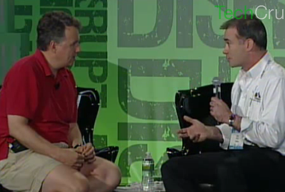
I will juxtapose the man on the corner with the man in the hot seat.  What is the difference between the man in the image above and the man in the image to the left?  The man in the hot seat has, in theory, the same intentions as the man on the corner.  He is asking for money and he is looking for help.  He believes he cannot make his dreams come true unless he receives a gift from someone else.  His future, indeed, depends on another persons good faith.  But that is about where the similarities end.

For those have not picked up on it, the man in the image at left is a person pitching Paul Graham (an investor in the red shirt) on a business idea in hopes he will invest money towards his vision.  But in contrast to the man on the corner, the man on the hot seat does not believe in handouts or in receiving something for nothing.  He believes in creating value through enterprise.  He knows that if you have something, anything – a product, a service, a distribution channel, knowledge, land, a water source, natural elements, really anything – you can offer it to another for a profit.  He chooses to live his life working hard to add value to society, not take away from it.  He has taken ownership and responsibility for his life, understanding he can choose to do anything he wants with it.  But with that decision he knows it is up to him, and only him to make it happen .  The man in the hot seat is an entrepreneur.

Looking everywhere at no one,
He sees everything and nothing at all – oh.
When he shouts, nobody listens,
Where he leads no one will go – oh.

Genesis – Man on the Corner

At times entrepreneurs find themselves looking poverty straight in the face.  It might be in a situation where their income (or lack thereof) cannot fulfill the demands of their debts, whether it is a roof for shelter, food for sustenance or gas for their travel.  They choose to risk their current stability for the return of a better life.  There is an eerie aspect of entrepreneurship and I think it’s due to its distant cousin of poverty.  The mere thought of poverty can be the biggest moving force an entrepreneur receives.   It is incredibly scary and immensely motivating at the same time.  Only in risk one really experiences reward.  So we endure the possibility of poverty for the reward of wealth.

For the record, I am quite privileged to have a roof over my head, food to sustain my health and a nice car to drive each day.  I am doing fine but at this point in my life I hover right above to line, choosing to forgo a stable job for a chance to determine my own destiny.  Also for the record I have stared poverty in the eye and experienced what it could be like.  I have had my electricity turned off and creditors calling my phone for not paying bills on time.  I have had to dig change out of my car to buy a $.99 hamburger.   As a late-twenties ambitious entrepreneur who hadn’t “made it” yet – old enough to be established on my own but young enough to have not built sustainable wealth for myself – it’s was a tough slog.   I’m a tweener as they call them.

When you leave a stable financial situation and leap towards your dream, you risk falling into poverty.  Or should I say you learn how to operate with poverty as a strong possibility in your life.  You learn how to acknowledge where your responsibilities lay in the equation of life.  You start to realize your decisions will make or break you.  It is through this experience I start to think about poverty in a new way.   Whenever I drive by the man on the corner, I cannot help but think: “I could be out there right now.  That could be me.  As I am sitting here in my car it is unbeknownst to me how I will pay rent next month since I just took the leap and started my life as a full time entrepreneur.  But I will find a way.  I will find a way to not only pay rent but to grow my business as well.  I will choose to do something, not sit and do nothing. ”  I argue it is at this point of realization you really become an entrepreneur.

So Here’s the difference between poverty and success:

Man on Corner waits; man in hot seat acts

The man on the corner waits for something to fall into his lap, hands or box.  He takes no responsibility for his actions and believes by just waiting, help will find it’s way to him.  The man in the hot seat acts, on everything.  He believes it is through doing something, anything really, value can be created.  And when he creates value, wealth will find it’s way to him.  It is by doing and acting we entrepreneurs find success.

Man on corner values nothing; man in hot seat values everything

The man on the corner values nothing, not even himself.  If he did value himself, he would be doing something other than sitting desperately on a corner asking for a handout.  He has lost the ability to place value on anything in his life, thus has nothing.  The man in the hot seat values everything, especially himself.  He has such a belief himself he is asking others to invest large sums of money into his enterprise.  And he believes so strongly in himself he knows he can bring the investment amount times X back to the investor.  It is through immense value in self an entrepreneur will be successful.

Man on corner plays victim; man in hot seat plays hero

The man on the corner has ultimately bought into the victim mentality, meaning their outer circumstances determine their inner self worth.  A victim does not take responsibility for actions and outcomes, therefore they do nothing to change their circumstances.  The man on the hot seat understands it is he who determines his destiny and thus plays the hero.  A hero understands they are unique and hold power to orchestrate a positive outcome for all involved.  By believing you as an entrepreneur are the hero, your self worth has nothing to do with outer circumstances.  This frees you up to act according to your vision and experience success.

I am not sure Phil Collins would agree with my interpretation of Man on the Corner but I am curious if you do.

Hey Coach, What Is A Startup CEO Supposed To Be Anyway?

As I was chatting with another CEO friend of mine tonight he said something that caught me off guard.

He said:

“I was talking with another person and we determined as a CEO you push your people in just the right way to get things done… you’re like a coach.  We realized that is a good thing and need to do more of that type of leading in our startups”

Some of you may be familiar with my history so being referred to as a coach might not be much of a surprise.  But in light of the context in which this conversation took place it was a surprise to me.  My CEO friend is farther down the startup path than I am and I tend look to him as a mento-friend.  I appreciated the kind words and thanked him accordingly.

Yet this begged the question: what is a startup CEO anyway?

My take is my friend was exactly right: a coach.

Okay Nick, then what is a coach?  A coach is a Leader.  A coach is someone who is responsible for the outcome of the team – win or lose.  The coach determines who plays on the team and who gets cut. Coaches push players to the brink and guide them in achieving levels of success previously thought impossible.  Coaches know the most about each opponent and dictate the playbook accordingly.  And most important, the coach evaluates each and every player, helping them identify where they are weak and exploiting where they are strong.

Ladies and gentleman – that’s a leader.

Given I am still at the beginnings of the exciting growth of Seconds and my personal journey as a CEO I will not take any credit of success – history will be the judge on that one.  But I couldn’t help but notice myself in the exact moment of this conversation grasping a few lessons regarding leadership I think are important for CEO’s at the startup level.

Face it, you ARE a coach

Like it or not, as the CEO you are the coach.  This should not be taken lightly and in the wrong hands it could lead to disaster.  One of my favorite quotes from author John C. Maxwell is “everything rises and falls on Leadership.”  The statement could be viewed as general toss-grass-in-the-wind pontification.  I tend to just take it at face value – life happens because leaders make things happen.  Or they don’t.

Leaders (CEO’s) determine the pace, structure and culture of a young startup company.  Understanding this should weigh heavily on a CEO’s heart and mind as they relentlessly plow forward.  What you say and what you do will hang like London fog within your small company.  You should think twice about each and every word, positively and negatively directed toward cofounders or customers.

And whether you know it or not, your team is looking  right at you to make decisions.  These decisions can be as mundane as the color of text on your site and as crucial as choosing to relocate the company or adding a co-founder.  Great leaders consistently make the right decision, and even better, teach and empower others to make the “right” decisions for them.

You are also a player

One of the toughest things about being CEO is the fact that you are a player – equal with other team members – at the same time being the coach with added intangible responsibilities.   Highly self-aware CEO’s intuitively understand this dynamic and can navigate the waters accordingly.  Some days you need to get your hands dirty with specs, feature fixes and other product oriented tasks – things you are probably drawn to more naturally as you flex your engineer or designer muscles.  Other days you need to put your coach hat on to lead your team by dictating the vision, talking to investors, evaluating opponents, interviewing new hires, connecting with media or visiting customers.

These things may not come natural to you but believe me they are essential.  I am convinced the drastically high level of failure experienced at startups is due to a failure of leadership.  Delineation too far in any direction from a leader for too long spells doom for a fragile company being built on a hope and a prayer.  If “everything rises and falls on leadership“, startup success must surely follow the same principles.

Leadership is in short supply

My friend mentioned something interesting as we were talking.  He said “I just don’t feel I can push them very hard… I guess I have that Seattle passive thing going.

I said, “look, people actually want to be led.”  And it’s true, (most) people naturally want to be told what to do.  Quite frankly, they are scared to make any important decisions so they naturally default to having someone else tell them what to do, in case it doesn’t work out and they have someone else to blame.  That’s the harsh reality view.  The more positive view is people want to be led and inspired, hoping that the time they are taking away from other important areas and people in their life is actually going to turn out to be something positive.

Unfortunately we have too many people more concerned with not pissing people off then accomplishing the current mission.  Appropriate and authentic leadership is definitely in short supply.  I am not advocating being a jerk or other unmentionable words.  I am calling for people to get more in-tune with the dynamics of human nature and motivation.  This is not rocket science, it’s all right there at the intersection of psychology, sociology and biology.  Notice how I didn’t mention technology…

I also noted to my friend the most common reaction from anyone who worked for Steve Jobs.  I said “dude, most people have said Steve Jobs was a jerk, an asshole, and generally not enjoyable to be around.  They also follow that statement up with the fact that he actually inspired the best out of them and they were somehow able to perform and deliver well above levels they ever thought possible.”  

That’s leadership.  Steve Jobs might not have been best friends with most people he worked with but boy did he get the best out of them.  Indeed, he was their coach.

Why Craigslist Is Still King And Teaching Us Lessons On User Experience

Recently I have been using Craigslist more often and the other day I just sat back and took a moment to appreciate what the old gray haired “startup” has done.  It has a achieved a virtual monopoly in the classified space all the while still looking like it did the first time it hit my radar back more than a decade ago.

After further thought, it occurred to me I could take away a few lessons as I continue to build Seconds.

1.  Always make your product SUPER SIMPLE to use.  

Today, it’s all about user experience – or how easy and simple a product is to use.  Notice how using Craigslist borderlines on dummy-proof.  That is how your product should work if you want millions of people to use it.

2.  Don’t make your users do more work than necessary.

All the flashy designs and information buried in layers of profiles, accounts, tabs, windows just wastes my time as a user.  With Craigslist, you go to the page and search through listings, clicking on ones you like.  The amount of clicks to get something done has always stayed as minimal as possible.

3.  If it ain’t broke… don’t fix it.

Although I am a proponent of innovation and forward product movement, Craigslist is an instance where they clearly nailed it and haven’t had to ‘expand’ into other markets.  I am convinced staying the course is why they have a natural monopoly in online classifieds.

4.  Create a BRAND.

If you are going to move, what online site do you always check?  Need another job or searching for a side gig?  Looking for someone to build you a website?  Even though there are numerous sites that are arguably ‘better’ than Craigslist, millions of people still trust they will ultimately find what they need with Craigslist.  I don’t see this changing for a while….

So, even as Craigslist is starting to gray a bit, you better believe there are some lessons to be learned on how they have stayed on top.

Playing The Field Vs. Sitting On The Sidelines

I had a few great conversations this morning and although they both happened independently there was a similar theme to the conversation.

I found myself thinking “I would rather be a player on the field than sitting on the sidelines.”

We were talking about how its such an awesome time in our society and such a great time to build a technology company, and the thought just hit me.   I don’t want to be 50 yrs old siting there reminiscing about how back when I was 20 people started walking around with these things called cell phones.

“Son, back in my day them people used to dial a number and actually talk to someone through that there handset” I imagine I would be saying to my kids.  “now look at all the things you kids do on those damn things.  If I would’ve just been a little smarter and started something of my own I would been a millionaire… “

NO.  I would rather tell my kids “…. and you know what, I chose to jump into the game and ride the wave of innovation rather than watch it go by.  And It’s the been the best decision I ever made!”


  The Player


The Fan


Being a player means actually getting your butt off the sidelines and into the game.  It takes a lot more energy for an athlete to play in the game than for a fan to sit a watch.  And you wonder why athletes are paid so much money?  Ever try to get out in front of millions of people and catch that touchdown pass before it flies by your head in a split second… its tougher than you think.

It also takes courage to put yourself out there and compete in the game of business.  Yes, you might fail.  Yes, you will probably screw up the play.

Yet, it’s 100 times better than being a monday morning quarterback like all media outlets tend to do.   And at least you are out there making something of yourself and hopefully adding value to the world.

It seems funny to me how crazy excited and into professional sports some fans get.  What do they actually gain when their team actually wins?  Besides beating the Vegas odds, not much.

Being a player is tough but it’s also way more exciting.  Have you ever thought about what happens if you actually succeed?  Who knows… but indeed it will be more than the satisfaction of your team beating the other team on any given Sunday.

Look at those two images and ask yourself which one you want to be.

The Future of Mobile Payments Will Be ‘Artificial Intelligence’

This is a section taken from a recent article I wrote on PayPal’s x.com network.  

How we interact with computers—and to an extent the rest of the world—is changing. As you know, we no longer log on or are required to go to a computer to get online. We now carry computers with us all day, every day; we are always connected.

We do not have to reidentify ourselves and re-enter our credentials each time we go online. And with the inception of Siri, along with other crude artificial intelligence (AI) interfaces, it is now apparent that we will leverage new blends of AI and intelligent data systems integrated within our mobile devices to create very personal consumer experiences.

These technologies and more will drastically change our purchasing experiences. I see a future where the specific mobile device you carry doesn’t have any bearing on how you make a mobile payment. Take simple text, for example. It is fair to say that text messaging has taken over as the most common form of digital communication on the planet, with 6 billion capable devices and more than 8 trillion messages sent in 2011.

But what if SMS and messaging technologies were not only created for basic communications, but for commerce as well? Imagine being able to say things like “send a message to the coffee shop telling them I will be there in 10 minutes and I will have the usual,” and by the time you get there, your correct drink is sitting on the counter, already paid for.

This is not too far off. Actually, the technical requirements are manageable, and the right pieces just need to be put in the right places. The next few years will bring a fundamental shift in the economy as merchants and business adopt this popular method of communication and use it as a new form of commerce. It is already being accomplished through simple text, voice, and gestures, thanks to natural language processing within your mobile device.

http://youtu.be/4czAm7h6i10

Personalization will also become prevalent and is another key component in the future of payments. Today, most merchants still require voice calls to communicate with them; when it comes time to transact, the customer must actually be present with cash or credit card in hand. Think about how far brick-and-mortar retailers need to go to catch up with the e-commerce world. Even today, when I call a local merchant I’m asked to identify myself and to read my payment information (aloud) if I want to make a purchase.

How secure is that?

Interestingly, this lack of personalization does not change when I am present. As I walk in the door, the merchant has no idea who I am, how many times I have visited that location and what my purchase history there might look like. In a word, these retailers are ignorant. They lack the necessary and vital information to not only improve their operations but also make my customer experience much, much better. And why do I still need to stand in a line for them to swipe my card and write my signature before I leave?

A whole new world of possibilities opens up when personalized connections between customer and merchant are made available through mobile technologies and artificial intelligence.  Customers will be able to quickly find and interact with a merchant, requesting more information or making purchases when and where they feel most compelled. Since identification and payment credentials will have already been verified and stored securely in the cloud, transactions then become frictionless.  Merchants are not only afforded a more efficient method of communications and transactions, but also a unique perspective on each customer and a clearer picture of their entire customer base—in real time.

Visit x.com/devzone to read the whole article.