3 Reasons Why Non-Technical CEO’s Need To Go To Hackathons

SHDI am not the typical person you would find at a hackathon.  I don’t code and would be described in the industry as a “non-technical” cofounder.

As a non-technical CEO I tend to focus on things like marketing, branding, positioning, investors, and customers.  I do it because it’s my job and during the early stages of a startup no one else on the team is responsible for those things.

This is all nice and good but it doesn’t build a product.  And if you don’t have a product you can’t actually have marketing, branding, positioning, investors, and customers.

So if you are a non-technical CEO what you need is a techie bootcamp of sorts, short but intense periods of learning and doing so you can start to understand what its like to be a developer.  And trust me, if your devs don’t feel like you understand the hows and why’s of their work you will soon find yourself standing alone at the alter.

So what is a Hackathon?  It’s a room full of developers focused on building the coolest product they can in a 54 hour period.  It’s a self-inflicted bootcamp, challenging you and your team to execute on a new idea with little time, resources or sleep.

Crazy huh?

My team and I participated in the recent Sports Hack Day at the Hub over SuperBowl weekend in Seattle.  It was a great experience.  Obviously, the focus was building something oriented around technology and sports – two of my favorite topics.  While we didn’t take home any of the prizes, we did take home a kernel of an idea we think might actually be something substantial.  More on that later.

I want to review some lessons learned over the weekend and possibly help other non-techical CEO’s who are serious about building a startup realize how important the time spent at a Hackathon can be.

Lessons 1. Become part of the community

There is a strange brotherhood between technical people – developers, hackers, coders, designers – anyone who considers themselves one with the terminal.   It’s like they just have look at each other, head nod without saying anything and instantly know each is in the club.  I have to admit this was quite foreign to me as I began my entrepreneurial journey (uh, what’s that say on your screen?)   I credit the few CTO’s I have worked with for their patience and understanding with me being a non-technical person.  Yet weekends like the last one spent at a hackathon do A LOT to not only further educate me on technical aspects of software/web development but also include me into the community.

The quote “showing up is half of the battle” comes to mind here.  By simply showing up and intuitively saying to others “What’s up?  I’m right here on the front lines with you!” goes a long way to gain respect and inclusion from the community.  Also, asking questions – lots of questions – about various languages, platforms and API’s tells your fellow technical team-members you are interested in learning about their world.  THIS IS HUGE.  You will learn a lot and gain respect from them just based on the fact you are taking the time to know what’s going on.

And the coolest thing is I am actually starting to retain this stuff!

Lesson 2. Execute under pressure

A weekend is barely enough time to take an idea and deploy a working product around.  In fact, it’s not really much time at all since our code deadline was at noon Sunday and Demos started about 12:30pm.  This means you learn to make quick decisions.  There is no time to battle back and forth about a specific feature or naming structure.  You must decide and JFDI.  With less than 54 hours available, Hackathons are all about execution and swift decision making.

You know what?  Swift decision making is incredibly valuable in the real startup world as well.  Hackathons help you to become agile, testing what works and what doesn’t and quickly make corrections if needed.  This is arguably the top advantage of being a startup so being able to polish the diamond during the weekend has tremendous benefits in the long run.  Also, it can be crazy stressful as you get down to the deadline.  The team learns to work in a “crucible” where intense pressure hangs over you as people work tirelessly to get something “respectable” completed and deployed.

Hackathons are not for the faint of heart.

Lesson 3. Find the value proposition

I’ve written previously about the value of pitch competitions, so I will talk more about the process of how you get there than the actual pitch.  During the weekend as you are building out your product you still have to keep in mind what value your product brings to the world.  Remember, after the deadline you will be standing in front of the group and a field of judges describing your product and why it should be used.  There really is not much use for a product that doesn’t solve a problem or pique someones interest in one way or another.  Don’t be the guy/gal who doesn’t even understand how or why their product would be used.

So in addition to building really cool tech you are challenged to figure out the value proposition – both are required to winning a Demo competition.   The condensed timeframe places increased pressure on you to figure out what problem you are actually solving.   Quickly evaluating the market, determining if there are existing players and what problem they are solving.  Finding holes in the market and quickly determining how to meet them.  Evaluating potential business models, although not fully required during a hackath0n, will stretch the creative mind farther than anticipated and lead to interesting business developments.

The benefits can be compared to exercise:  the more ‘reps’ you accomplish at a higher stress level the better (stronger) you become at that particular activity.   Especially for non-technical founders, hackathons provide a great training ground to hone value proposition skills.

Whew, what a weekend!

For all the non-technical founder/CEO’s out there: Don’t shy away from hackathons.  Trust me, you need them more than they need you.

ZappBug Dissected: The Crazy Story About Turning Bed Bugs Into A ‘Killer’ Business

bugDid you know there are 110,000 unique searches a month on Google for “how to get rid of bed bugs”?

I didn’t either.  No one wants to talk about the fact that there’s a Bed Bug problem in our world.

No one but Cameron Wheeler, founder of ZappBug. He has no problem talking about how he can rid people of one of the worst and most traumatic infestations – Bed Bugs.

I met Cameron more than a year ago at a startup event here in Seattle and, to be honest, my first reaction when he told me what he was working on was “uh what was that again, I thought you said bed bugs!”

Turns out that’s exactly what he said.  I quickly found Cameron to be a smart dude and Bed Bugs to be a killer business.  But this story isn’t all about how to get rid of Bed Bugs (although you can find the link below).   Intrigued as an entrepreneur I wanted to learn more about how he was approaching this massive problem and how he built a physical product company in a web dominated startup world.  This is a story of how three normal guys started a product company that actually generates revenue without seeing a single bug.

Do You Have Bed Bugs?

First off, if you have the misfortune of Bed Bugs, you have to check out their solution.  ZappBug is meant to be a one-stop resource for how to get rid of bed bugs and their main products are multi-sized oven heaters to place clothing, luggage and other stuff meant to kill 100% of the bugs.  Basically, you can throw all your stuff in there and “heat em” just like a washing machine washes clothes.

Brilliant!

They’ve also designed a set of free tutorials that gives you all of the information you need to completely get rid of bed bugs in 8 steps. You don’t need to purchase the ZappBug Oven to use these steps, although it looks like oven is an extremely clever and helpful tool in getting rid of an infestation.

Check out ZappBug.

Starting A Company

“Looking back, I never saw myself as the leader of a startup with the sole purpose of killing bed bugs” says Cameron.   In 2009 he graduated with a degree in mechanical engineering and entered the big world. “But my definition of failure at that time included “working for a large, impersonal behemoth so….”

So naturally, starting a company was his only logical choice.

Cameron knew startups are quite different than large behemoth companies – they are smaller, more agile and generally more fun to work at.   I chimed in and said “But they are also cash strapped!”   Being low on capital they have a harder time building businesses around physical products, which was a problem in Cameron’s case.

So the question he had to figure out was: Is there a way to apply Lean Startup principles to physical products?  Could you actually produce and sell a physical product without a huge amount of capital and actually make a profit?

Turns out…there is. And this is exactly what they are doing at ZappBug.

Solving A Big Problem – Bed Bugs

Bed bugs are a real problem and many of us know someone who has encountered them (even though your friends might not tell you).  It all started when a neighbor of one of the company’s co-founders had bed bugs and they spread through the electrical outlets into units across the building into his apartment.  [Gross.]  Having to deal with this “fun” experience searched and searched and finally found out how to get rid of the bugs.

During the initial research process they learned that there was a real need for better solutions and more information. They found out the market is huge but fragmented. Pest control companies want to come to your home and sell. Bloggers spew tons of words with little actionable advice and sellers want to throw products at you.  They realized there weren’t really any great resources or solutions in market and thus, ZappBug was born.

To Cameron the bed bug market is unique for several reasons.  First, it’s new and a surprisingly large niche.  With approximately 110k unique searches for “How To Get Rid of Bed Bugs” a month, its obvious people are continually looking for a better solution.  According to goggle, that number rose by more than 400% in 2010 – so apparently  it’s becoming an even bigger problem – and bigger opportunity!

Also, the subject is Taboo… so there’s less competition that you would see in niches of a similar size.  There are virtually no comprehensive resources online for how to deal with bed bugs from start to finish.  By helping people get rid of bed bugs in their belongings, you are also helping them save thousands of dollars.  A lot of people panic and unwillingly throw away everything they own.

This further intrigued Wheeler and his team.

zappbug-oven-furniture

After some research, they found the elusive hole in the market – no one was providing high quality products at affordable prices so they decided they would develop a physical product and sell it directly to customers.  The idea was to develop a bed bug oven that could use heat to kill bed bugs in luggage and other personal belongings, saving peoples belongings in the end. “We chose to begin with this product because we had the technical competency to do it. Heat treatment is a proven way to kill bed bugs. The product could be used for both prevention and extermination and would be a great revenue generator.”

The Challenge With Physical Products

Apparently, ZappBug is not Wheeler’s first rodeo.  “Ecowell was my first major startup, coincidentally around physical products as well” says Cameron. “We made environmentally friendly, extremely expensive, vending machines. Yes, that’s right, we made a physical sheet metal box with an electromechanical mess of PLCs, solenoids, pumps, valves, filters, and syrups.  But, of course, we ran out of cash in 2010. I learned a lot from this including the fact that cash really is king.”

Through previously failed startups, he learned the importance of applying lean principles to product development and market testing.  Also, as a product manager responsible for overseas manufacturing at Direct Global Sales, he learned how easy it was to get things made in China.  “When my cofounders and I talked about the opportunity, things began to move quickly. I soon developed a strategy for low volume overseas manufacturing and developing an MVP to bring us into the market.”  

Although the “Lean Startup” phenomenon wasn’t out yet, Cameron had intuitively learned the basic concepts of product validation and cash flow and determined to build ZappBug with those in mind.

This is why I have been so interested in Cameron’s approach to ZappBug, and why I wanted to dive deeper into the mechanics of his business.  It can be very expensive to start a company that makes physical products. Testing and manufacturing alone can require more time/money than software products. And there is the fact that each unit costs money. You need working capital up front to buy inventory. Also, you need to make enough units in each production run to meet the minimum order quantities required by factories producing your product. There is no Amazon Web Services for physical products, just Chinese factories…which are a far cry from the affordable but flexible services we are used to in web services.

But there are also advantages!

“The biggest being that people actually pay money for physical products.  I don’t know about you but I spend about $20 a week on coffee and maybe only about $20 a year on apps,” says Wheeler.

So it was obvious they had some good ideas.  But first, they needed something to manufacture.

We Need A Prototype!

The team had the idea, but they needed a prototype.  “I went to home depot and got a heater, some insulation and a storage container. Then I brought all of my nerd tools home and pulled out my Arduino. By the end of the day, I had a working prototype.”

He basically built an oven from scratch.  The goal of the simple bed bug oven was to heat items and hold them lethal temperatures for a period of time.  After a few days of testing they had a really good idea of the max size and how the product was going to operate.  “We then found a guy on craigslist who used to design clothes for Nordstrom and was willing to sew up some samples for us. After a couple of revisions and a lot of testing, we already had a design that was ready to manufacture.”

About that little issue of manufacturing…?

Producing textiles like their “insulated folding box” (aka bed bug oven) is not feasible in the U.S. because of labor costs and minimum order sizes.  Most People don’t really understand how you can go from a prototype in your garage to a factory sample and then a production run.  Cameron, remembering what he learned at his previous job, started looking for a small factory in China to make their stuff.

So how did they find one?

“We took some pictures of the prototype and sent an email to the factories! We sent out hundreds of emails to manufacturers across China and got replies from most and then just started negotiating from there.”

And before he knew it, Cameron was off to China!

Screen Shot 2013-01-31 at 4.59.19 PM

Once things in China were in the works they spent some time developing the website and by June of 2012, everything was done. The product was loaded into a shipping container bound for Seattle. Before the container arrived, they rented out two storage units near the port to store the products.

Everything was ready!

The Cosco Seattle arrived with the goods on June 28, 2012. They started selling the product on Amazon immediately and sales went well.  So well they quickly sold out of the first shipment.  Needing more, they made another manufacturing run and landed their first full shipping container of product in December of 2012.  Cameron passed on the opportunity to talk specific revenue numbers but he did mention they are driving margins “double the wholesale average” and their sales are solid and growing with the latest (and larger) run of heaters.

Lessons Learned

Major lesson # 1: “Chinese manufacturers have a much different concept of what “next week” means.  We had a lot of difficulty getting samples and product out of factories in a timely manner.  Next time I will press harder and be less friendly.  Those guys are tough and everything is a negotiation.  You cannot let your guard down.”

Major Lesson #2: “Get it right the first time.  We had to go though several prototype iterations with the factory. Each one took about a month and it was a painful process.  But we could not afford to do a manufacturing run on a product that we couldn’t sell.  Looking back, this process would have been a lot smoother if we had spent more time perfecting the design ‘state side’ where the iterations would have taken less time.”  

Author’s Lesson:  Cameron is solving a big problem and thus has a nice growing revenue curve to support his business.  With ZappBug, people simply search and find a solution to a nasty problem.  And not too mention, when people have a pressing issue they will not hesitate to spend money on an easy to find solution.  Huge lesson for entrepreneurs out there – solve an urgent problem for people and money will follow.

What’s Next?

ZappBug now has a validated product and the cash to design much more sophisticated products. It’s open road ahead.  “Our goal is to be a one-stop resource to help people get rid of bed bugs.  Anyone coming to our site will find free informational videos and tutorials as well as products that will help them get rid of bed bugs.”  Already, they are looking ahead to larger and more value generating products.  The next will be called The ZappBug Room and will be large enough for a couch or a mattress meant for professionals and consumers.

“I really don’t think this could have been possible just a few years ago” notes Cameron.  Using (mostly free) tools from the modern world allowed a small team in Seattle to quickly build an international operation with very little capital.  “We used google translate, craigslist, wordpress, amazon.com, Alibaba and several other amazing resources.  At the end of the day, our lean approach to ZappBug allowed three normal guys to start a company that now generates enough revenue to pay each of us and grow the company.”

Who knew Bed Bugs could be such a killer business?

Failed New Years Resolution? Try This Instead.

It’s that time of year again, isn’t it?  Time to determine something about your life or business you want to change, figure out how to make it better, and then shout to the world “gosh darn it, I’m really going to do it this year.”

Oh really?

Most people tend to associate health, weight-loss or financial goals with their New Years Resolutions.  A common theme is resolutions tend to be personal in nature. You may have similar goals, or you might have tied them to your new startup or personal achievement milestones in your current job.

Whatever the case, here we are 4 weeks into the New Year and if you are like the other 9 out of 10 people out there you will not succeed.  Statistics show you are destined to fail at to your resolution.  You might have even already broken it, just one month into the New Year.

So I guess it’s better luck next year.

Or is it?

The Problem With Resolutions

The problem is people really suck at keeping New Years resolutions.  According to the University of Scranton, Journal of Clinical Psychology, only 8% of any population making a resolution actually succeeds in achieving what they set out to improve.

Those numbers don’t sound promising to me.  And apparently 38% never even make a New Year’s Resolution; maybe that group is smart enough to know it’s not worth the effort… Or maybe we just need to rework how we approach resolutions and commitments all together?

I have a different perspective on setting goals and commitments that might shed some light on a better way.  A previous career in the health and fitness industry gave me a glimpse into the human psyche and revealed some quite interesting phenomena.

One of the first problems I saw with New Year’s and people making resolutions was the fact that it was temporal.  It was an artificially set start date and they were placing a time emphasis on it.  The prevailing logic says since it is a New Year it just seems like the right time to change something about ourselves.  The problem is it’s a forced decision.  People think, “Well, it’s a New Year so I need to choose something I hate about myself and make sure I change it starting today.”  Unfortunately this leads to short term thinking which is easily observed by 1) stepping into any gym in America during January and noticing how busy it is and then 2) doing the same thing the first or second week of February.  You will see quite a different picture just a month later.

Support Systems Are Required

Counter to common practice, just determining “OK, it’s a new year and today is day 1… Here I go!” will do no good unless you have thought through the decision and put a solid support system in place to provide a method to the madness.  Any significant life change requires well a thought through decision in addition to support mechanisms strategically in place, which is why trainers, psychologists and nutritionists greatly improve achievement of health and fitness goals.

Support systems for executives and startup founders can actually be anything or anyone you want them to be – they just have to be there and be accountable.  As a CEO, I tend to lean on my core group of advisors over team members since I can talk more freely with them regarding sensitive information.  If it’s a new project or milestone associated with our business, teammates work really well.  And even though I haven’t used one (yet) meeting regularly with a therapist or personal confidant would probably help keep you on track.  The point is to employ others in your quest, thinking through how, why and when you will need their help.

Think Pivots

I also noticed people would make very large goals requiring major changes to their lives without taking full consideration of what they are actually embarking on.  Poorly thought-out resolutions tend to involve totally new activities or disciplines rather than tweaks on existing practices.  New activities require much more energy and attention when performed, placing increased stress on the individual to maintain the routine when everything in them is screaming just the opposite.  This is probably the number one reason resolutions are broken and why a full 25% of people don’t even make it past 2 weeks.

To use an overused analogy in the startup world, positive results are easier to achieve if the activity is similar to what is already being done. Depending on the focus of change a better idea would be to pivot around what you are already doing, only making small changes in key areas so significant results can be seen.

Twists, tweaks and “pivots” on existing practices are easier to complete since the individual is already used to going through the motions and thinking about the problem.   Back to the fitness example, rather than saying “I need to lose 50 lbs this year so I am going to go to the gym and workout everyday” a better strategy would be to “I am going to take the stairs whenever possible when I enter a building” and “I will stop eating when I am still hungry during meals so I don’t overeat anymore.”  In terms of weight-loss goals, those practices are much easier to adhere to than working out everyday of the week.

Make A Commitment Instead of A Resolution

Finally, most people fail on resolutions because their goal is kept private and no one is holding them accountable.  Rather than a personal, private resolution, make a public commitment.  Making a commitment towards something bigger than yourself – be it a company, a family, or a cause – is the single most effective way to secure your success.

Why is this?

If done correctly, the adherence to your commitment has an inherent and direct affect on others around you.  Most likely these people count on you daily; maybe even gauge their success on your success.  When you involve others in your commitment you actually create a natural support system to help you stay committed along the way.

So if you are a founder or a leader in your company, it might be best to wrap your team into your New Year commitment and decide on something that will move both you and your team forward.  Then go tell your entire team!  Get them into a room, shut the door, tell them your commitment for the year and ask them to agree to a no-holds-barred agreement to keep you in-line and accountable.  Even better, ask them if they want to make their own commitment and add to the team effort.

That is just one of many ways to make (and keep) a commitment.  At minimum, you will have a great conversation with your team and probably see your company move forward as a result.  At best, you will remain committed through December 31st 2013 and beyond.

Commitment.  It’s the first step towards success.

Why Do We Hurry Up And Wait?

Life always seems to be like this, doesn’t it?  There’s something you want to go accomplish, do, buy, write, build, etc…. yet turns out it’s “not yet time.”

The question I struggle with is why are we presented with an opportunity for something we want and then ultimately have to wait much longer than we expected to finally get it.

Is it so we appreciate it that much more when it finally does happen?  So we don’t just take it for granted and toss it aside like a child does with a new toy?

Is it a matter of maturity?  Are we initially presented with the thought or opportunity to test our maturity and patience?  Or if we don’t ultimately get it, is it that we actually didn’t take advantage of the opportunity when it was presented to us?  Is it that we didn’t do the right thing at the right time?  Did it just slip through our hands without us even knowing it?

Was it that we were never really “qualified” for the opportunity and we were just wishful thinking we could live and operate on such a high level.

Is someone playing an awful trick on us, kind of like what has happened to Manti Te’o recently?  (To which I must add – doing something like that to someone else is really messed up, and how the rest of the world reacted to it is even more messed up.  I want to write about it but would end up using a lot of 4-letter words.   Not sure I want to go there…)

I believe there is proper “timing” for everything and sometimes it just “not the right time.”   I also believe hard work, dedication, patience and diligence is the path towards success so timing is inherent to success.

But dammit, it really gets old telling yourself, “Just keep waiting… it must not be the right time yet.”

Some days, it’s just hard.

Some days, you want someone to walk over to you, point a direction and say, “go that way, you’ll find it over there.”

Some days you want God to grab you by the head, look you in the eyes and tell you the truth, telling you how it will end and if it everything will be ok.

Some days the goal feels as far away as the mountain I see looking out the window from the ferry I ride into Seattle.  The crazy thing is the goal feels to never get much closer or any more clear than the view below.  I struggle with the juxtaposition of being a go-getter and making things happen vs being a farmer, planting seeds that will grow into future opportunities down the road.  Being a farmer is fine when last year’s crop is nicely feeding you and your family, allowing you to plan for your future patiently and wisely.  When it doesn’t, patience will be tested and wisdom can be challenged.

I hope today brings more than the normal “not yet” I seem to keep running into.

photo 4

It Just Got Even Easier To Find Talent At SURF Incubator

logo_104x60One of the most common challenges for early stage startups is finding talented and willing people to join your startup.   In the early stages, finding the right developer can be the difference between success and failure for a young startup.

Today, SURF Incubator announced how they are addressing the recruiting challenges of its tenant companies by partnering with local recruiting agency Capability IT.  With an intellectual partner like Capability IT, startup entrepreneurs are empowered with intellectual resources and a robust network to find culturally and technically capable employees, enabling them to more quickly secure talent and get back to work.

Although the Puget Sound region has proved itself to be home to a world-class high-tech workforce over the last few years, with several companies either opening Seattle engineering offices or expanding their engineering departments, it still remains a tough hiring environment for early stage startups.  Especially since the competition can promise an immediately rewarding salary with large signing bonuses, full benefits and various amenities like a famous executive chef at Google.  But through a partnership with Capability IT, SURF startups will receive greater access to a network of developers and potential growth opportunities, making their lives a bit more pleasant in the process.

Over the past year, Capability IT has made solid traction in the tech community, by adding superior talent to a number of Seattle based startups.  Not only does Capability IT provide more access to developers, they can also help startup entrepreneurs identify and secure contract assignments. It is quite common for entrepreneurs to take on technical consulting projects while their startup gains traction, enabling entrepreneurs better cash flow and sometimes even finance their startup. Because Capability IT works with companies ranging from early-stage startups to publicly traded companies, they are able to efficiently source opportunities for fledging entrepreneurs.

Being a SURF tenant startup founder myself, I can validate how important this move is for all the startups within the SURF Incubator community.  During the early prefunding stage of a startup, founders have little more than their dream to pitch to prospective early talent.   We also have limited time and energy to somehow go and find this talent., which requires scouring online profile databases, attending local meetups and events, searching through our own networks or simply asking around.

At times those can work, but where I see Capability IT really helping is farther up the funnel, providing founders with a larger pool of applicants/names to sort through.  Even though we might still be looking for a needle in a haystack, Capability IT will give early stage startups more haystacks to look through and in the end helping us find better talent to join our teams.  In this way, Capability IT’s partnership with SURF Incubator is just one part of SURF’s mission to be a community-supported space for digital startups.

SURF will be celebrating this announcement with a happy hour event, including beer and wine as well as a few startup pitches from resident companies.  Everyone is welcome to attend, if you are interested – RSVP here.

Launch Event – When & Where

Thursday, January 24th, 2013 from 5:00 – 8:00pm PST

Exchange Building – 821 2nd Ave, Suite 800

5:00 – 6:00pm          Hosted wine and beer

6:00 – 6:15pm          Partnership announcement

6:15 – 7:00pm          Startup demos

7:00 – 8:00pm          Entrepreneur conversations


Wondering How Hard It Is To Start A Company? This Interview Will Help You Understand

This is an interview with Brian Chesky, founder and CEO of Airbnb. They survived years of challenges, brokeness and despair before they hit a growth phase on their way to a now $2 billion+ valued company. If you are not familar, Airbnb allows anyone to rent out a room or their entire home to a stranger. No one would do that, right?

Wrong. They are growing like crazy right now. Simply amazing. It’s a long interview but VERY worth it. A few things I took from the interview:

  • Create something a hundred people will love, not something 1 million people will kind of like.
  • Do whatever you can to survive. Just when you think it’s over your answer will present itself.
  • Love what you do and do it world class. They chose to maximize their unique culture and be great at design. Doing that will attract the right people.

Like NFL Coaches, CEO’s Must Make Tough Decisions. Period.

I recently had a conversation with a fellow CEO dealing with a personnel issue on his team.  The issue at hand is not as important as the fact that the CEO had been putting off the decision for some time.  He seemed to be second-guessing himself and not trusting his gut.  He felt the specific individual in question, who had been with the young company for about a year, was “just not a good fit” and the CEO was having some challenges with the individual, saying things like  “there’s always some issue with him every time we meet…”

My feedback oriented around the fact that being CEO meant being a leader.  And in being leaders we have to be strong enough to make tough decisions, to do what is in the best interest for the long-term health of the company first, and only secondly what is best for any one individual on the team.

This is not an easy thing to do.

A CEO must protect their organization, especially from itself.  It is up to the CEO – and all executive management as the organization grows larger – to place and remove individuals as they see fit.  Most importantly a leader must be able to determine if an individual is adding more value to the organization than it is taking away.  If not, that person must be removed or placed in a more appropriate role immediately.  This includes the CEO himself when he is skirting from his responsibilities.

In this specific instance, the CEO felt the individual in question was a net negative on the team and was a growing concern, even starting to split the team during meetings, discussions, etc…  He was obviously very concerned.

Most decisions a CEO will face won’t feel good or be easy to make.  It gets even more difficult when we involve highly talented individuals.  Sometimes it might seem counterintuitive to actually remove a highly talented individual from a team, yet if the value they bring to the table is being overshadowed by the value they are taking away (or could potentially take away) with their detrimental behavior, something must be done.  That or the entire team will fall as a result.

It’s the leader’s responsibility to make these decisions before its too late.  This is why I argue it is never too early for a startup to have a CEO/Leader in place.

I dovetailed the conversation a bit to illustrate my point.  Just last week the Seattle Seahawks (I live in Seattle and I’m finally proud to be a fan again) played the Washington Redskins in the NFC wild card playoff game.

RG3If you were watching the game you know exactly what happened. And a crystal clear lesson in leadership played out in front of the entire country on national television.   I sure hope others took note.

Robert Griffin III (or RG3 as many know him) won the Heisman trophy last year with Baylor and was drafted 2nd overall by the Washington Redskins and is believed to be their franchise quarterback for many years to come.  They signed him to a 4-year, $21 million salary with the entire deal guaranteed, meaning he gets ALL $21 million no matter if he plays or not.  Obviously, this is a huge investment for the Redskins.  You would think they would have treated him as such during his first season with the club.

RG3 strained a ligament in his knee on Dec 9th and sat out a few games but came back early to play the last game of the season and the playoff game against the Seahawks.   During the playoff game, it was quite obvious RG3 was not 100% and his leg was definitely in pain.  He was “playing hurt, not injured” as they say.

What happened next was all things fascinating (from a leadership perspective), lucky (for us Seahawks fans) and excruciating (as I feel bad for Griffin) to watch.

Early in the game Sunday RG3 tweaked his right hurt knee again, to the point of limping, wincing and running with an impaired gait.  It was obvious he was injured and should not have continued playing.  Even the announcers were wondering when the Redskins will pull him out for the betterment of his health.  Numerous times, the television cameras showed RG with assistance from trainers and medical personnel, walking into a “small room” for who knows what, but my guess is examination and possibly a cortisone shot (pain reliever) so he could drag himself back onto the playing field to continue playing.

And that he did.  According to sources, it was his decision and he absolutely wanted to play the rest of the game even though he was a shell of his previous self.

OF COURSE THE YOUNG STAR WANTED TO PLAY. Anyone high performance individual is going to want to continue, especially when we are down or struggling.  We all want to prove we can overcome obstacles and be champions in the face of adversity.

So what happened next?

As the game continued, the Seahawks eventually took the lead. It was then, as the Redskins were doing all they could to win, RG3 awkwardly bent down to grab a bad snap only to fatally injure his knee; looking as to have seriously torn some ligaments in the process.  Injuring a previously weakened knee on a play where no one touches you, referred to as non-contact, is an obvious sign you shouldn’t have been playing.

RG3 went down, and the future of the franchise lay on the ground to the disappointment of the silent stadium full of Redskins fans.  Although the injury is not career threatening at this point, it’s arguable if RG3 will actually be able to play at the level he was before the injury.

So whose fault is it?

Not RG3’s.  The problem is the person involved is not thinking clearly or wisely at the moment.  They are focused on themselves, considering only the moment and the short term, not the long term.  They do not understand the long-term ramifications of their actions.  Even though RG3 said he could still play the responsibility to make the right decision ultimately falls on the coach, the leader of the team.  He should be realistic enough to make the right decision.

In the case of RG3, his head coach and somewhat the CEO of the organization, Mike Shanahan, is the person who should have been thinking about the long-term consequences of what was transpiring in front of him.  But for some reason he wasn’t thinking clearly either, perhaps wanting to roll the dice and gamble to win the game. His prize procession, the guy they gave up so much to draft and the one they touted as the future of the organization – their $21 million investment – placed himself directly in front of a Mack truck and no one did anything to stop him.

What’s the point of having leaders if they are not looking out for their team?

It’s easy to understand why Shanahan chose to leave RG3 in the game, he’s a good player when healthy.  It was reported he repeatedly told his coach he could play.  He said “I’m hurt, not injured”.  RG3, being a rookie, could be passed for naïve and maybe didn’t fully understand his actions had such drastic consequences.

But Shanahan, a veteran coach and the leader of the organization, should have known this and put his fist down.  It is his responsibility to make the tough decisions and do what is right for the entire team.  The truth is his lack of judgment in the heat of competition has not only cost the Washington Redskins a playoff win, it jeopardized the future of the organization since the resulting knee injury will lead to months of recovery time and RG3’s promising future now looks a bit more unclear.

Like it or not, the fault always goes to the leader.

To win one playoff game (short term) Shanahan could possibly have just given up the entire next season (long term) with his gamble.  But more importantly, Shanahan’s lack of leadership has now altered the life of one of the most promising young athletes to enter the NFL in a long time.  There is a strong possibility RG3 will never be able to perform at the level he was previously, in the end maybe even costing him millions of dollars and lost opportunities.

All because he did not have the courage to grab Robert Griffin III by the shoulder pads and say, “Robert, you are finished for the season.  I want to protect you for the long term so rest the knee and start preparing for next year and going back to the playoffs.”

Leaders must have the courage to do what is right not only for the organization but each individual within it, even if it’s the most difficult thing they have ever done.

I asked my fellow CEO if he thought Coach Shanahan would like to have that game back and possibly make a different decision?  We both agreed and believe he would.

As for his situation, I told him he needs to let the individual go, as soon as possible if he wants the rest of his team to stay intact.  I told him the responsibility of his organization rests on his shoulders and he should strongly consider what happens if he doesn’t make this tough decision.  “Everyone else on the team is watching how you handle this situation”, I told him.  I also suggested he owes it to the individual to be upfront and honest so they know what is happening as well as to free them up to go pursue their goals as soon as possible.

CEO’s must protect their organizations, the people within them as well as themselves by making tough decisions.   Problems are solved by tackling them head on, not by running away from them.

The Stubborn, In Search Of An Open Mind

Why do we do the same things each day?

Why do we think about things in a certain way, taking certain stances and dismissing others?

I became aware of my open/closed mind recently as I ponder my own situation and life direction.  For a stubborn founder type it can be difficult to not look at things with a very narrow mind, only focusing on the business at hand.  And even then, with all the talk about laser focus and “being great at one thing”, one can quickly fall into a dangerously narrow view of the world.

Please pardon my philosophical and existential tonality.   The day, given its early in the new year, is met with a renewed sense of observation and analysis of my current thoughts and actions – both personally and professionally.  I think it’s healthy to frequently step back and evaluate your thoughts, feelings, words, actions and directions in life.  I, too often and probably like you, stay narrowly focused on what is two feet in front of me.  And I am starting to realize its to my loss.

salvador-dali-three-sphinxes-of-bikini

The danger of a narrowly focused individual can be staleness of perspective and a stagnation of progress.  If we are not careful, what we call “the daily grind” will actually do just that – grind away and remove the excess layers.  The problem lies in what layers are ultimately removed.   Remove layers that provide a fresh view of the world and we become intrenched in sameness, staleness, and stagnant environment, with no regard to anything different.  Not to get too off subject but I would be remiss if I didn’t mention this type of viewpoint has a large affect in racism, religious dogma and other societal problems.

To get around the trap is to first realize you might be narrow minded.  You can do this by consciously observing how you go about each day, each month and each year.

Do you mostly frequent the same places?  Same coffee shops, restaurants, theaters, stores, parks, roads, cities, etc..?

When was your last big vacation?  Where did you go?

What are you currently reading?  Fiction or non-fiction?  What about movies and art?

When was the last time you simply pulled up YouTube and found a talk given on a subject you knew nothing about, so you could be introduced to it and possible start a new study?

Who have you spent the majority of your time with lately?  How many different people have you spent time with talking and experiencing life?

Do you venture out on weekdays and weeknights?  Or do you normally stay in?  Why?

How many different cities and communities have you lived in over the course of your adult life?

If the number is quite low… over an extended period of time… for one or more of those questions you may be embracing a narrow minded perspective in life.

Is that such a bad thing?  No, I don’t think so.  But I do think a narrow minded stance hinders ones ability to fully experience the world, as well as discover unique insights one would otherwise discover.

It is both these – to experience life and discover insights – I am yearning for right now.  For some time now I have sensed my life narrowing into a frustratingly tight viewpoint and I am now looking to do something about it.  I want new perspectives on my current business.   I want new insights for future business opportunities.  I want a refreshing new take on the world and how technology can improve it. I want new perspectives on where to live.

I want, for lack of a better term, a more exotic life.

I am not sure where these thoughts are coming from.  I don’t exactly know why but for the first time in my life I am sensing we just recently crossed over the technological threshold and maybe this is how I am responding to it.  Technology, mobile devices and their apps, constant connectivity and the like… is now mainstream and something we all must have.  It’s no lie when most people in our society believe being without their mobile device feels like they are naked.  That’s quite startling.  Before, it was early adopters with these gadgets and ideas for new uses.  But now, it’s everywhere you look and go.

This is both exciting and frightening.

Maybe I am overly aware of societal changes and the feeling things are continually speeding out of my control.  This is worrisome to me.  Part of the worry is in the irony that even though we have access to more information than ever it seems we tend to stay within our comfort zones of products, people, places, reading material and thoughts.

So I am making a conscious intent to open my mind.  I want to look at things with a different lens, seek out new people and new places in the world, accept different stances on things I wouldn’t normally accept.  I also want to do more things WITHOUT the entire focus on my handheld mobile device.

I am going to do this because I believe it will make me a better person.  I also think it will put me and the company I lead in better place, and to hopefully bring something materially better to the world.

3 Healthy Ways To Get Yourself Out Of That Damn Rut

It’s been more than a month since I wrote last.

For someone who typically writes each day and posts numerous times a week, this is not good.

Why so much time between posts you ask?  Well, it’s been quite a ride (or fall, shall I say) down and it’s taken me a while to find which way is up.  Things have gotten pretty difficult and I admit I have taken them to heart.

If you are like me you wear your heart on your sleeve.  (what the hell does that saying even mean… heart on sleeve, it’s just weird?)  Your emotions are at the center of your being, and you live and die by how “your world” is going at that current moment.  It’s a blessing and a curse – when things are going great you are a whip to be around, but when times get tough you just shut down.

I learned a lot about myself recently and hope I can work on how I operate during tough times going forward because for such a positive guy it sucks to find yourself so down, so stuck in a rut.

A tweet the other day struck me.  It said something to the extend of “only you can inflict and create your prison.  We are prisoners to our thoughts and emotions.  You have all the power in the world to change them and your circumstances.”  

It seemed more powerful when I read it but I think you get the point.  We are responsible for what we are thinking, feeling and how we react to the world around us.  We can get mad or just get up and get moving again.  It’s amazing how this realization gets lost in the craziness of the world, one which seems to be getting crazier by the month.  As we become overwhelmed with grief and frustration we often forget that it is us, ourselves, who actually create the response of stress and feelings of frustration.  Yes, something against your will or want might have happened in the world but it is actually your response to what just happen that results in negative feelings and emotions.  Extended for a period of time, this negative energy and emotion can build up and start to tear you apart inside.   It’s a crappy feeling for sure.

If you see where I am going you might notice I am starting to describe the first signs of depression.  Why am I talking about this on a blog meant for entrepreneurs and techies?  I touch on this because no matter who you are, if you are not careful you will find yourself tumbling down a path directly towards depression.

I recently identified these patterns in myself and here’s what I have done to keep me going and start my climb back to better places.

Identify something Centering to hold on to.

For some time my profession actually revolved around it but for my entire life  health and fitness has always been a cornerstone.  No matter my circumstances, I am committed to remain in top shape.  It centers me.  It allows me to go into a mode of top performance – against myself – toward overcoming challenges and achieving success.  Everyday.  Or a few times a week at least.  Doesn’t matter if it’s just a simple workout, it feels great to accomplish something as simple as physical exertion and intense movement.  I am not OCD about my physique, a bodybuilder or a crazy powerlifter.  I am just a healthy individual that uses health and fitness to gauge how I am doing internally.

Interestingly, internal health is directly reflected externally by our weight and body size.  I could have allowed stress to get the best of me, decided I was too busy or too lazy to continue staying active, and lost my edge.  I would have started to get pudgy and gain weight, requiring me to buy new clothes, spend more money and adding more frustration to my already over-stress-filled world.  The unfortunate reality of this would be I continue to lose confidence and the downward spiral would only accelerate… toward.. I don’t know what.

Knowing myself all too well, this reality would be devastating.  Health is not only a very important aspect of life, it is how I personally feel “energetic”, “confident”, “young” and “normal”.   It’s all I have known for my 30+ years of life.  I don’t want to lose those and maintaining a consistent commitment to exercise just 30 minutes, 3 times per week has kept me in solid shape and helped maintain what confidence I have left.

When you find yourself flailing around and losing control in your life, find what you can to hold on to and help keep you feeling “normal”.

Identify just one thing that needs to change

As a founder you give up a lot, but most likely you will give up financial stability to pursue your goals.  Not only is it frustrating, it can become very stressful and result in increasingly insurmountable challenges.  This is definitely what has happened to me and for a time there I did not know what was actually happening or what to do about it.  It feels something like the moment when one fire starts over here, another one starts over there and before you know it you are caught in a forest fire with no way out.  The one main fire started a rage of other fires that started to engulf my life.

The best thing to do is identify just one thing – presumably the biggest and most drastic fire in your life – and only worry about improving that one thing.  Figure out what needs to be done and how to go about making positive changes, then do it.  For me, it’s simply finding a way to support myself until my own company can.   Make a commitment to change the circumstance, no matter how difficult it might be.  Don’t worry about all the other distractions or issues, they will only get in the way of changing the ONE thing that needs to be changed.  It may seem like elementary advice but you will be surprised at how effective it is.  Once you have accomplished the task, now look toward the other challenging issues in your life and choose the next thing to improve.

Trust me, this approach is the only way out of impossible circumstances.

Remember what it was like to be a kid

I have spent more time than normal around my young nephews recently and I noticed something about children I admit I am extremely jealous over.   As you watch young children you will notice they will be laughing, smiling, playing, running, screaming, crying and back to laughing again – all in about five minutes time.  Although young kids cry too much for my liking, within five minutes they seem to forget what they were crying about and they go back to having a great time playing and laughing.  Young children are the most resilient human beings on the planet, intuitively understanding things always work out for the best.

I have no idea why but as adults we somehow lost this ability to look at the big picture and forget we were “devastated” just 5 minutes ago.

And this is a tragedy.  Realize there would not be such a thing as depression if we retained the same “short attention span” characteristic young children posses.

I urge you to go back to being a child inside, find things you can be truly excited about and enjoy the moment for what it is.  When something goes wrong, give it the respect it deserves for a short moment, and then forget about it.  Move on to the next shiny toy and smiling face.  Because with all the tragedies and crap happening in this world our own happiness is all we have, and it’s directly under your control.  Worrying about what happened 5 or 10 minutes ago only hurts yourself.

So that’s my Happy New Year go kick ass in 2013 speech.  It’s good to be back.

Channeling Rand: Why Authenticity And Perseverance Wins The Race

The latest StartupGrind Seattle played host to Rand Fishkin, CEO of SEOmoz.  It was a great night and in fact I was pleasantly surprised at how much I took away.  Rand being Rand, I knew beforehand it would be enjoyable and a must-see interview but I can’t stop thinking about how much authentic truth was spilled during the evening.

First, I would like to briefly touch on StartupGrind and point out to anyone who has not yet attended a session how cool these events actually are.  Unlike most startup “networking” events there’s an agenda and a purpose to the main event, which is the guest interview.  In just a few short months, they have hosted the likes of Bing Fund’s Rahul Sood, Jonathan Sposato and Rand Fishkin.   These interviews are basically fireside chats with successful entrepreneurs in front of 40 or 50 people leading to very intimate entrepreneurial discussions, such as the latest one with Rand.  For most people this is as up close and personal they get to relatively successful tech founders and a great opportunity to ask random questions to gain confirmation on their thoughts.

I attended most of the events since the first one in August, but I must say Rand was an exceptional interview.   His presence, personality and responsiveness during the interview instantly told the audience he was more than happy to be there and his answers came from the heart and soul of an entrepreneur.   Although many different golden nuggets were shared, I wanted to highlight a few we all can take home.

Authenticity

Listening to Rand, one quickly realizes he is flat-out authentic and genuine in all his dealings.  He was unapologetic with his points of view and responses to questions – at the same time emoting the passion and determination of someone still in the trenches.  He more-or-less supported this point off hand as he answered a question about the difference between Seattle and Silicon Valley.  Paraphrasing, he mentioned how it’s not as common down in the valley to have CEO’s and founders as open and willing to help others around them than it is here in Seattle.   If I’m not mistaken he suggested we eat a bit more humble pie up here.  Rand noted this is one of the big positives of the startup environment we find here in Seattle.  What he didn’t say – and I quickly clued into – was it’s more due to people like Rand, fairly successful people actually wanting to help others and give them time of day without hesitation (and willing to participate in events like StartupGrind on a night he could be with family and friends.)

This is what I deem as authenticity – being genuinely gracious and interested in others even when it’s pretty obvious you have nothing material to gain from the interaction.  Authenticity is very important for founders of early stage startups because it’s going to be how you attract others to join you early on in the pursuit of your vision.  People need to feel like you value them and are being authentic in your dealings with them, not dubious and double-facing.

I will end the concept of authenticity with this description taken from a recent article you should read by Scott Weiss published on TechCrunch titled  CEOs Don’t Come Pre-Made, Authentic Leadership Has To Be Learned:

A person cannot make hard decisions, hold unpopular positions, or stand tall for what he believes unless he knows who he is and feels comfortable in his own skin. I am talking about self-confidence and conviction. These traits make a leader bold and decisive, which is absolutely critical in times where you must act quickly, often without complete information. Just as important, authenticity makes a leader likeable, for lack of a better word. Their realness comes across in the way they communicate and reach people on an emotional level. Their words move them; their message touches something inside….

…A leader in times of crisis can’t have an iota of fakeness in him. He has to know himself­­ ­— and like himself ­­­— so that he can be straight with the world, energize followers, and lead with the authority born of authenticity.

Perseverance

The stories Rand shared about the early days of SEOmoz were honest, raw and at times gut-wrenching.  Yet as any of us who are early stage founders know perseverance through challenge and hardship is what it takes to succeed.  He told stories about dealing with personal debt, working late nights, challenges with closing company financing, losing sleep at times wondering what the hell he was doing with his life,  in addition to other funny and (probably at the time challenging) issues he faced when he was starting SEOmoz.  Again, being authentic, Rand choose to share these challenges with the group and detailed how he persevered through the hardships.

The early history of the company is a great study for any founder who finds their startup not experiencing Instagram type growth right out of the gate, which quite frankly, is all of us!  Rand and SEOmoz are another example of why the number one factor for success during a startup is simply perseverance.  Crap happens to everyone.  The difference between the successful companies and the ones that failed (or gave up) is purely because they got up each day and decided to not quit.

Rand deciding to share these challenges with the group is the single best thing he did that night.  It told the people in attendance – most being founders or early startup employees – starting a company is not at all like the flash, glam and awesomeness you read about in the media.  More to the point, it often sucks.

I think most founders are afraid to believe the truth, that it is this hard.  From the beginning they lie to themselves and believe they will be the next Facebook or Instagram, the startup that shoots straight to the moon and straight into conversations beginning with billions of dollars.  This is faulty, will hurt anyone’s mental health and most likely end a startup’s livelihood.  It would be better if founders treated starting a company like bootcamp or SEAL training, at least then you are prepared and understand perseverance is the name of the game.

Culture

It was quite apparent Rand has formed a great business, but more clear was how he has built an incredible company.  This happens not because the focus is on hitting revenue numbers each month (although that is important) but because the culture SEOmoz has created for itself.  Rand brought the point home by saying “your first 5 to 10 hires will determine your culture since they are the ones who go on and hire/work with the next group of employees.”  Great point and one most founders miss as they continue to run in circles chasing their tail and balancing all the plates they have in the air during the early days.

So important is culture to SEOmoz they created an acronym to live by – TAGFEE.  It stands for Transparent, Authentic, Generous, Fun, Empathetic, Exceptional.  These are great attributes to build a company around.  Founders should take note on the acronym part, whatever your core attributes turn out to be it seems like a good idea to create an acronym that starts as a noun and turns into a verb.  Rand mentioned how they use it in meetings such as “well, is that TAGFEE?” or “do you think they are TAGFEE?”

I was quite impacted by this approach to creating a visceral standard of culture within a company.  Not only does it attract specific talent but it can even help attract quality investors.  As you may know, Rand blogs quite a bit.   Some think he crossed a line when he wrote very publicly about a recent failed round of financing, even including quoted emails and meeting descriptions.  Yet, when writing about these financing failures and voicing his frustration it detracted the investors who disagreed with their culture and attracted the exact investors who believed in it.  SEOmoz announced in April 2012 they closed $18 million from Brad Feld and Foundry Group, one of the most well respected VC firms in the country.  That may not have ever happened if TAGFEE wasn’t the heart and soul of SEOmoz.

Authenticity. Perseverance. Culture.

Three simple attributes to a strong and successful entrepreneurial journey.

Thanks Rand.

Seconds Partners With Dwolla For Awesome New Guest Checkout Announcement

Seconds is happy to announce our partnership with Dwolla for their latest product release, referred to as guest checkout, allowing anyone to use Dwolla to make a one-time payment from their financial institution to an online merchant or marketplace.

Why is this so awesome?  Now people can make Dwolla payments, in Seconds.

Simply put, Dwolla is great.  For months we have been evaluating how to include Dwolla payments in our mobile payment experience.  Their online and mobile payment network enables friends, families, and businesses to move money in a way that is safer, faster, and significantly more affordable than traditional payment options.  We always believed in Dwolla’s mission to rid the world of credit card fees and today we are excited to finally turn on the Dwolla payment option.

With Dwolla, you simply connect a bank account so you can make payments through the system.  The challenge up to this point was the fact that unless someone already had a Dwolla account created, it was nearly impossible for them to create a Dwolla account and make a quick payment during their first Seconds experience.   Unfortunately, there were a number of steps – some even taking a few business days – to authorize the financial institution and finalization of the Dwolla account.  It was basically a non-starter for our emerging payment platform.

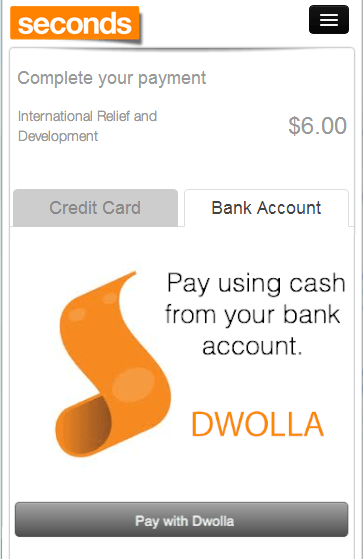
As you can see, this new release leaves all that behind and puts Dwolla center stage in the Seconds payment experience, allowing someone the choice of quickly paying with their bank account using Dwolla in addition to a credit card.

Why is this so great?  Merchants accepting Dwolla are charged at most $.25 per transactions over $10, and transactions under $10 carry no Dwolla transaction fee at all!  Comparing this to the traditional 3% processing fee when dealing with credit cards and your looking at significant savings for merchants with each transaction.

We believe Dwolla has an incredible future and are excited to see where this will lead.  More information about the Dwolla announcement is below.

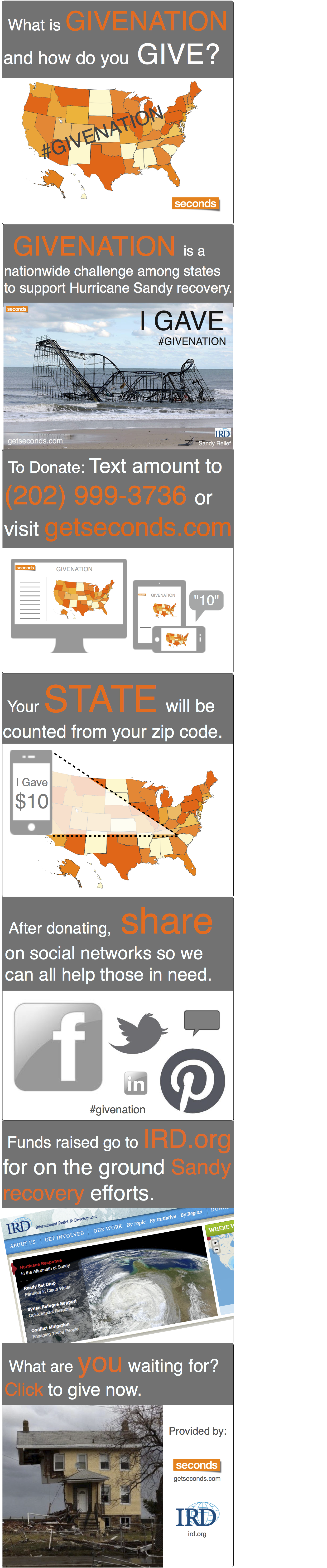
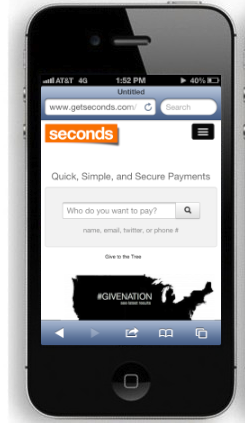
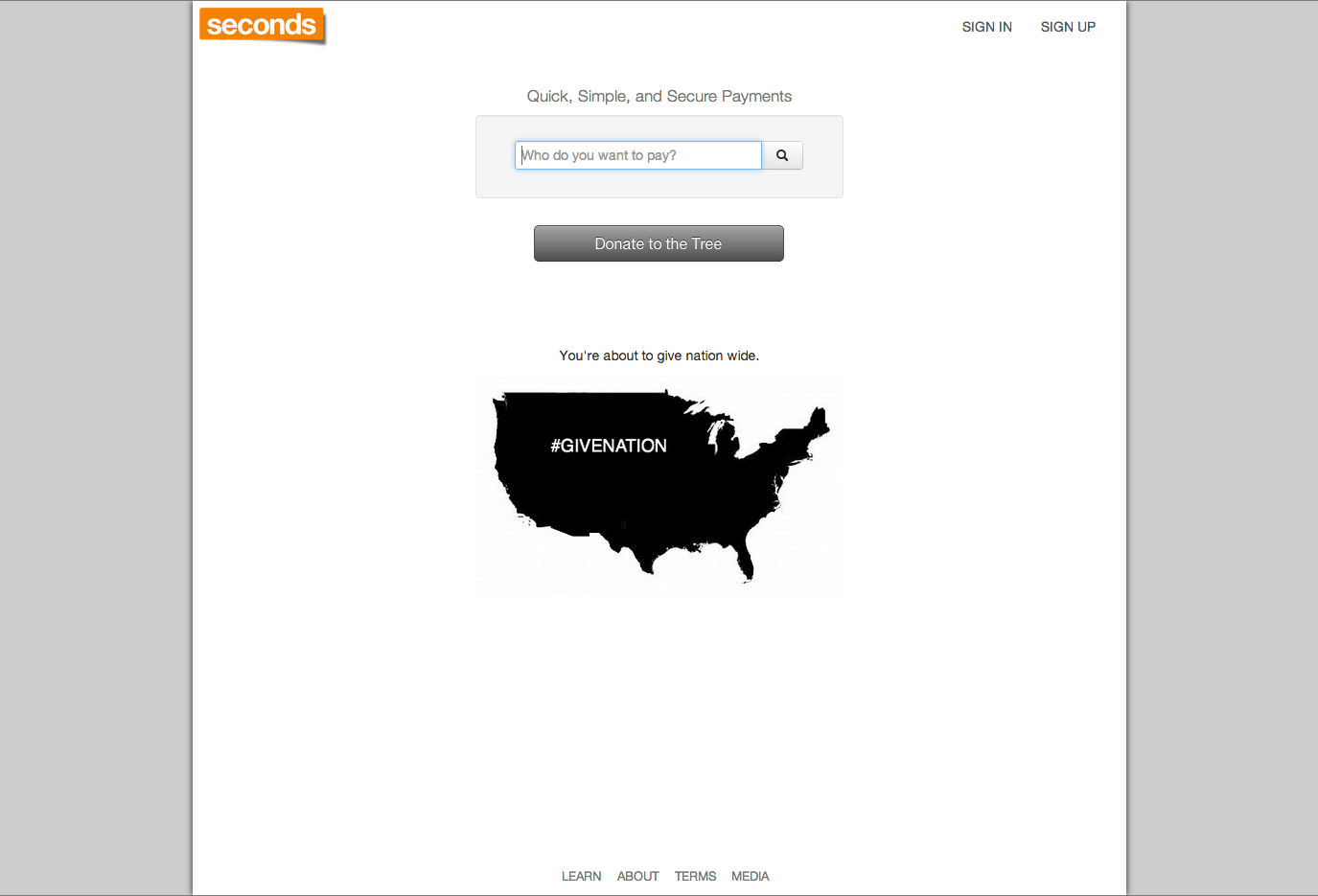
Try it out now with GIVENATION, and give to IRD.org to help with Hurricane Sandy recovery.

What is Dwolla?

Dwolla is an online and mobile payment network that enables friends, families, and businesses to move money in a way that is safer, faster, and significantly more affordable than traditional payment options.

Using the Internet, Dwolla has designed a smarter way to structure payments and identify fraud. This allows the system to bypass credit cards, PayPal, and other payment types and, at the same time, offer the nation’s lowest cost payment network.

Since 2010, the Des Moines-based company has processed millions of transactions, becoming the nation’s newest and fastest growing payment network.

Pay as a guest:

Now, with Dwolla’s new guest checkout option, anyone can use Dwolla to make a one-time payment from their financial institution to an online merchant or marketplace.

Guest checkout adds Dwolla’s payment engine to traditional bank-issued transactions, allowing the same level of security, safety, and innovation regular Dwolla users enjoy.

Benefits of guest checkout

For consumers:
  • No need for a pre-existing Dwolla account
  • Free to pay: no hidden fees or costs
  • Cardless and checkless
  • Safer than writing checks
  • Safe and secure Dwolla network technologies
  • Save money with Dwolla price (with participating merchants)
  • Privacy conscious (we do not sell your data!
For merchants:
  • Increased profit margins and savings over credit cards (flat 25 cent fee for transactions over $10, under $10 is free)
  • Easily add Dwolla as another payment method
  • Fluid offsite checkout experience
  • Automatic PCI compliance


Using Guest Checkout vs. paying as a traditional Dwolla user

Paying as a guest (for those without Dwolla a account):
  • Free to pay: no hidden fees or costs to use
  • Safer than writing checks
  • Cardless and checkless
  • Safe and secure Dwolla network technologies
  • Save money with Dwolla price (see below)
  • Privacy conscious (we do not sell your data!)

Users with Dwolla account (“Paying as a guest” plus the following): 

  • Pay your friends and family through your social networks
  • Lowest-cost (25 cents for payments over $10, free for transactions under $10)
  • Faster payments and clearing dates
  • Suite of features and tools
  • Connect a bank account for simple depositing and withdrawing
  • Use your phone to pay merchants and friends
  • Minimum balance keeps your account full
  • “Plug-and-pay” with numerous web third-party applications

Frequently Asked Questions:

1. Does the merchant ever see my banking information

No. Aside from the fact that you’ve paid, Dwolla does not disclose or include sensitive financial information inside of transactions.

2. Is Dwolla safe?

All information is securely passed, encrypted, and stored in ways that meet or exceed industry standards. Dwolla does not sell your data or transactions with corporations or private parties. For more information, visit security and partnership.

3. Can I cancel my payment?

Yes, but the canceled payment must a.) be initiated by the merchant and b.) occur before the payment is processed.

4. How do Refunds and Disputes occur?

Dwolla defers to the refund policy of its merchants, but will assist in the dispute process whenever necessary. Learn more about Dwolla’s dispute process.

5. Why isn’t my total cheaper when I use Dwolla?

Not all merchants have opted to offer the Dwolla price discount. Dwolla believes it’s up to the merchants to decide what’s best for their business.


Watch How Easy It Is To Give In Support Of Hurricane Sandy Recovery Efforts

Here’s a video showing how easy it is to participate in GIVENATION and use Seconds to give to IRD in support of Hurricane Sandy recovery efforts.  Although he’s paying rent and booking a hotel room, your payment experience will be just the same.

It actually takes longer and it’s more difficult to stand in line and order a latte at Starbucks.  Today, hold the latte and give to those who need it.

Text dollar amount to 202-999-3736

or

go to getseconds.com/givenation

Why I Write So Unbashingly Straightforward and Authentic

On a recent post titled  Founder = Learning To Juggle While Riding A Unicycle On A TightRope   I recieved the following comment.

Nick, I find your blog interesting. Spectating the process of someone having the guts to go it alone and start their own thing is enlightening plus a curious thing to follow to boot. Regardless of the underlying intention of this blog, I thank you for taking the time and being brave enough to share your feelings as you go through your journey.

However…

What did you do before your became this ‘founder’? In the post above you’re describing a vast majority of jobs, whether it be owning a company, directing a company, managing a team or heading up a department. The general sentiment of this post makes me wonder why you considered starting your own business in the first place. That’s really all you’re doing – starting a business. The same as the plumber down the road who is determined to do it on his own. Attaching the terms ‘founder’ and ‘start up’ to it doesn’t really change it in my mind.

Just because the ‘paper pushers’ get a salary, a monthly wage, a mobile device, a fuel card and any amount of other incentives, it doesn’t mean they’re under any less stress to put out their own fires, to keep their job, to keep their team’s jobs, to impress their boss, to impress their spouse, to continue paying the mortgage, schooling the kids, paying for groceries etc, etc.

We all have to juggle buddy. The difference is, while some of us sit in the corner waiting to be hugged, some of us simply add ‘hugging the sad-looking guy in the corner’ to our ever increasing todo list.

Step up mate. If you’re struggling to juggle, perhaps you need to leave the circus? If this response is out of line with the purpose of your post, I apologise. But take a second to consider the sentiment of what you’re putting out there and the effect it might have on your growing number of readers.

Keep up the awesome work and just keep swimming!

Below is my response:

Thanks for the reply and I appreciate your response. And I am glad you are enjoying the journey with me.  However, maybe something was lost in translation and I possibly missed a few things as I wrote this morning. Please read this as a neutral response. The point of the post is twofold.

First, there is a hell of a difference between an owner/founder and an employee – namely the fact that all most all parts of the business rest solely on the founders/owners shoulders. This is typically not the case when you are an employee, especially as the organization grows. (and yes I have been an employee in large and small organizations before, that’s actually what influenced me to start my own company). This perspective can be referred to as Owner vs Employee mentality and it’s not for the faint of heart. And I am not even including all the stuff you mention everyone must now juggle “to keep their job, to keep their team’s jobs, to impress their boss, to impress their spouse, to continue paying the mortgage, schooling the kids, paying for groceries etc, etc.”

Second, using the analogy of learning to juggle while riding a unicycle on a tightrope is to say you have to pretty much learn everything on your own, typically numerous things at once, trial and error as a founder. There’s no owners manual to founding a company, kinda like there’s no magic “lose 50 pounds” diet pill. Startup is no easy task and one of the reasons why most of us never venture out on our own. Employees are trained to do a specific job and have someone (boss, manager, owner) to rely on when things get too difficult or become “over their head” if you will. They have safety nets who can take on the problem if need be and for lack of a better term “wipe their hands clean” at the end of the day since it’s not their company.

I guess a third point is simply the fact that founding a company is damn hard and something I look to grind through towards growth and success. I started on this path because it’s a healthy challenge and allows me to appreciate what life presents when you take it into your own hands. And nope, this circus ain’t leaving anytime soon.

I write bluntly and truthfully for readers – for better or worse. My goal is to open up the black box of entrepreneurship and give people a better perspective, those who may be fascinated with it but have never made the leap themselves. Is it sometimes hard to digest? For sure. But that’s entrepreneurship. Part of the motivation in my writing style is to help readers gain a better appreciation for entrepreneurs and the struggles we go through, and maybe to educate people on the decision they may or may not be contemplating at the moment. Just like life, it’s quite messy.

As you can see, I write with unbashing honesty, authenticity and realness because I believe current and future entrepreneurs deserve it.  I also write with such perspective because quite a few readers of this blog are not actually entrepreneurs and this seems to be the only way I can accurately communicate to them what we go through on a daily basis.  Some are my family and friends that at times I am sure they ask themselves what the hell we are doing.

The point of SoEntrepreneurial is (and has always been) to illustrate and communicate the entrepreneurial journey is words maybe not heard anywhere else.  No, starting a company is not like being an employee no matter how much the above commenter believes it is.  It’s everything they describe – and a hell of a lot more.  And starting a tech company is defineltiy more difficult than becoming a plumber or other service provider who create their own company, namely because when starting a technology company you first have to determine what you are going to do and then build your product out of thin air.  Only after you have done those things can you then go find customers who want to use it!  Come to think of it, if your life and job is equally stressful as being an entrepreneur, I would encourage you to at least put yourself in a position where you are creating equity and ownership in what you do on a day to day basis.   Then you can at least justify to yourself why you are working so damn hard.

If you read popular tech blogs, you’ll read way too much about the lavishing riches and wealth founders’ of companies encounter, as well as all the posts about how another early startup creating a Groupon copycat (ok, maybe a year or two ago) raised millions of investment without any proven market traction.

Like it or not, that is not real life as a startup just as the tabloids or TMZ is not real life.  That’t the 1%.  The rest of us 99% tough it out and have to prove it over the long haul.  It would be a disservice to potential founders if they did not hear the truth from the source.

It sounds as if things I say or the descriptive words I use to write may be offending some people or might cut too close to the bone.  I am sorry if that is the case, but I also feel it’s not really my problem if I offend people.  I know I am doing a service with the words I write, and I am not purposefully out to harm any one person or group of people when I do it.  My intent is to educate and inform through words just as a producer of a documentary would with moving pictures on a screen.  If those words agitate or disturb in any way, well maybe it’s time to look in the mirror.

In any case, I will continue to write with open honesty and authentic voice.  You, as the reader deserve it.  You deserve to actually feel what its like to start a company out of thin air and grow it from the ground up.  You deserve to go through the good times and the bad.  You deserve to hear a fair and balanced perspective on technology and starting a company from someone who didn’t go to Stanford, work at Google or come from the lucky sperm club.  Absolutely, you deserve to hear how a normal guy, with no real starting advantage over the competition can grind it out and become successful with his startup.

Why?

Because if he can do it, so can you.  That’s what SoEntrepreneurial is all about.

Founder = Learning To Juggle While Riding A Unicycle On A TightRope

Being a founder is often hard to describe.  When you are asked, “what do you do” at parties or other social events, it’s easier to brush it off and not bring up the fact that you are a founder of your own company, just so you don’t have to go into how crazy it is.  When they realize you are a “founder” and you have a “startup”, it’s quite impressive to them.  They think it’s all glitz and glamor.  “Oh” they say, “that must be really fun!”  They think you make a ton of money and instantly give you more credit than you deserve.   They almost give you rock star status.

Or, ironically, they don’t give you enough credit.

The problem is they have no clue what you are going through and what it took just to get to where you are right now.  They have no idea how much you gave up to get here.  They don’t understand you don’t go back to a desk in an building owned by the company you work for, push some pieces of paper around, report to a boss, provided daily meals by your employer, given a shiny mobile device and a cushy salary with benefits.

They don’t actually realize NONE of that is included.   They have no idea you have given up everything in your life for this moment.

They also have no idea being a founder is like learning to juggle while riding a unicycle on a tightrope.

Why would I use such an analogy?

Most people’s idea of a founder is Steve Jobs – Miraculous.  Incredible.   Innovator.   Charismatic.  Leader.  Someone who’s all put together and very wealthy.  Use whatever descriptive words you want but they will be wrong.

Sorry to ruin the fun, but as founders we are generally running around like a chicken with our heads cut off trying to put out the latest fire threatening to burn down our dream.  Most things presented to you will be foreign and scary as hell to fix.  Customers will leave you.  Investors will say no.  Tech will fail.  Team members will leave.   Bank accounts will go dry.  And that’s just par for the course each day.

Most of the time you have no idea what you are doing or what the right move is, you are just putting one foot in front of the other and feeling your way around the dark room.

It’s feels like this: you attend to one thing, and just when you think you have it figured out another thing pops up.  So now you have two things to look over and figure out.  Yet before you know it, instantly another issue arises.  But this one is specifically attached to how you actually make money so you must drop everything else and go figure it out.  Hopefully, once you get that figured out you remember what the last issue was so you can return and fix it.

Learning. To. Juggle. While. Riding. A. Unicycle. On. A. TightRope.

Yes, it feels that tiring each and every day.  Next time you find out someone is a founder, please just give them a hug and ask them what you can do to help.

And you know what?  Juggling and riding unicycles also have their benefits and the analogy works the other way.  More on that topic at a later date.

Seconds Announces GIVENATION, A Nationwide Challenge For Sandy Relief

Today, Seconds is excited to announce GIVENATION, a nationwide competition during the holiday season challenging you and your state to give whatever you can to help with the Hurricane Sandy recovery effort.

We thought it would be encouraging to establish a friendly competition between states to determine “the most giving state” based on amount of dollars contributed using Seconds during this year’s holiday season.

Seconds is also excited to announce a partnership with International Relief and Development (IRD) on the nationwide campaign to raise funds for Hurricane Sandy relief.

As families shop for gifts during this holiday season, it is important to remember that our neighbors in New Jersey and New York are still in need. GIVENATION encourages people to give what they can. Even $5 or $10 can help rebuild a home or provide a winter coat or blanket for someone in need. Imagine what millions of Americans can accomplish by giving up one holiday latte and gifting that amount to help others.

The funds collected through this challenge go directly to IRD, a global non-profit that has distributed $3.5 billion toward disaster relief, humanitarian assistance, and development programs since 1998. Funds raised for Sandy relief will support IRD’s immediate disaster recovery efforts. IRD is working in association with FEMA, the National Voluntary Organizations Active in Disaster (NVOAD), and several local organizations to supply water, blankets, winter coats and clothes, cleaning supplies, hygiene kits, and other items to individuals in New Jersey and New York. This is just the first step toward a long-term recovery and rebuilding plan for the region.

To donate—and represent your state’s support for Sandy relief—go to getseconds.com/givenation, where you can make a donation in any amount you wish. You can also text your donation dollar amount to the phone number (202) 999-3736. For example, texting “5” will instantly send back a link where you can quickly complete a $5 payment using a credit card or bank account.

Seconds will be mapping the competition results in real-time starting November 3 and continuing through December 31. Visit IRD’s Facebook page at facebook.com/irdvoices to download and share the “I Gave” and “Did You Give?” images. And learn more about the GIVENATION campaign at getseconds.com/givenation.

For more information on IRD, visit www.ird.org, and visit the IRD Voices blog to read first-hand accounts from IRD staff in the field.

Full press release below image:

Seconds and IRD Launch GIVENATION, A Holiday Challenge For Sandy Relief

Which state will give the most to help the recovery efforts of Hurricane Sandy?

SEATTLE, WA – November 16th, 2012 – Seconds, the company enabling quick payments using mobile devices, is announcing GIVENATION, a holiday campaign encouraging the nation to get further involved with the Sandy recovery effort.

Hurricane Sandy recently caused billions of dollars in damage, destroying cities and displacing millions of people. People may have already given via The American Red Cross or other relief campaigns but there are still a lot of people who are in need and Seconds believes much more can be done.

Today, Seconds is announcing GIVENATION, a nationwide competition during the holiday season challenging you and your state to give whatever you can to help with the Hurricane Sandy recovery effort. “We thought it would be encouraging to establish a friendly competition between states to determine “the most giving state” based on amount of dollars contributed using Seconds during this year’s holiday season,” says Seconds CEO Nick Hughes.

So as people are buying toys, clothes, electronics and other items for family and friends this holiday season, they are urged to not forget about a nation in need. People are encouraged to give what they can – even $5 or $10 – and help rebuild their country. Imagine what millions of Americans can accomplish by simply giving up one holiday latte and gifting that amount to help others in need.

The funds collected go directly to International Relief and Development (IRD.org) a global non- profit which has distributed $3.5 billion towards disaster relief, and will be put towards immediate disaster recovery efforts. IRD is working in association with FEMA to supply water, blankets, winter coats and clothes, cleaning supplies, hygiene kits, and diapers in addition to other important recovery efforts.

To donate, go to at http://getseconds.com/givenation where you will see the map and a donation box to enter any amount you wish. Mobile users can also simply text a numeric dollar amount to the phone number (202) 999-3736. For example, texting “5” will instantly send back a link to quickly complete a $5 payment using a credit card or bank account via payment partner Dwolla.

“While we hope and pray for the full recovery of those affected by Hurricane Sandy, we are excited to partner with IRD in encouraging the entire nation to give any amount they can during the holiday season to help with the disaster recovery,” says Hughes.

Seconds will be mapping the competition results in real-time starting Nov. 16th and proceeding through Dec 31st, 2012.

About Seconds

Seconds enables any device holder to send or accept payments, whether through the web, mobile web or a quick text message. They believe the payment experience should be as quick, simple and intuitive as sending a text message. Founded during the fall of 2011 in Seattle, the original idea was to enhance mobile ordering and commerce for small local businesses. After pilot tests proved both merchants and customers just want the payment experience to be completed as fast and easy as possible, they decided to only focus on the mobile payment experience. They have a vision of any individual being able to interact and transact with any merchant in the world, holding any device they wish. Currently they hold office space in the recently opened SURF Incubator in downtown Seattle. 

A Mobile First Mentality

Fred Wilson has written extensively on designing for mobile first, desktop second.  I couldn’t agree more and that is exactly what we are doing at Seconds.

When looking at our initial user interface design of both the mobile view and the web view, one will see quite a few similarities.  This is not by accident, this is because we start with the mobile view first.  We first ask ourselves which mode most people will use our service, mobile or desktop? Given the fact Seconds is a payments platform oriented around mobile devices, mobile takes highest priority.

Also, the fact that more smartphones are shipping than feature phones and the estimation by 2017 is the majority of web traffic will come from mobile, we feel designing for mobile first is a safe bet.

Finally, it’s such a pain to view a website on a mobile device only to have to pinch and zoom to even read the content and click the desired button.  We feel it’s better to design for the smallest screen and allow the larger screens to pull the content/visuals out.  It’s the reverse perspective of the pinch and zoom experience you mostly see today.

So, if take a look at our desktop web presence you will see pretty much the same information and visuals, just aligned slightly differently since there’s quite a bit more real estate.

How did we do this?  Did we use a different service to create a “mobile optimized website” to augment our desktop website?  One with drop down menus and a very different look and feel to it?  Nope.  I don’t believe this is the right approach.   Unfortunately, farming out your mobile experience to a third party white-labeled service removes your branding and familiarity of your product.   (For example, view this blog article on a mobile device vs the web and you will see what I mean.)  You can refer to this mentality as desktop first, mobile second because you are not allowing the mobile device constraints drive overall user interface design.

Without sounding too redundant, why would you focus on desktop first when as a society we are clearly spending more and more time on mobile devices?

So how do we go about it?  As stated above, we have a mobile first mentality.  We design all Seconds experiences mobile first and then scale up to desktop.  You can see this in play when you access Seconds on a desktop browser.  (Try resizing your browser and shrink the width of the page.  It’s responsive.)  If anything, one might initially feel there is something lacking in the desktop view.  You might think maybe there’s not enough imagery or things to look at… yet is that really the reason to go to Seconds?

You know what, we don’t care.  We know people aren’t coming to Seconds to view pictures, to browse friends’ profiles or to see anything else.  What we care about is that the primary functions of the system, which is to complete a transaction as quickly as possible.  This is paramount.  We measure user experience in mere clicks and finger swipes and most times the more visually stimulating the design, the more clicks/swipes to complete the desired experience.  Those extra steps, in the end, often result in a lost transaction.  Just ask PayPal.

Our mobile first mentality allows the design and UI constraints of the smaller mobile screen to aide us in development of Seconds.  Why?  They help us sift out all the unnecessary and focus on the essentials.

Brevity is always refreshing.  Clean and clear is more compelling than busy and confusing.  Adding things when it seems right is always easier than trying to determine what to remove from the 100 options that could be the problem.

What Is GIVENATION? Would You Give A #@$%?

What is GIVENATION?

Hurricane Sandy recently caused billions of dollars in damage, destroying cities and displacing millions of people. What if GIVENATION was a holiday challenge to give whatever you can, helping with the Hurricane Sandy recovery effort?


What if we established a friendly competition between states to determine “the most giving state” based on amount of dollars contributed during this year’s holiday season?

What if Seconds just partnered with one of the largest global non-profits focusing on disaster relief around the world?

What if, as you are buying toys, clothes, electronics and other items as presents for family and friends this holiday,  you didn’t forget to give a gift to a nation in need?

What if we announce something big this Friday, November 16th 2012?

What if GIVENATION was real?  Would you give?


Ask The Right Question At The Right Time

There are certain moments, typically in business development conversations, when you sense the entire future of your company is resting on that exact moment in time.  You realize what you say next will either result in an affirmative commitment to your company or a “thanks but no thanks” response.

I just had one of those and boy and I glad I knew it was happening.

The conversation was with a self-identified skeptic for which they were asking why they should consider working with Seconds.  This individual was very cordial and nice, yet opened the conversation with an obvious “you’re behind the 8-ball” tone.  It was up to me to unravel where they were coming from, identify where we fill the gaps and bring them to a point where they wanted to work with us.

I learned (or maybe realized) a few lessons as we were working our way through the conversation towards an agreement.

1.  No is easier than yes

People are naturally programmed to say no.  You must work towards the yes, which requires taking that person on a journey through why they are better off with your solution than not.  Saying yes requires one to actually commit to something.  Saying no requires no commitment, thus it is the easier option.  Remember, most people are commitment phobes and would rather say no than have to stick to a commitment.

2.  Conversations turn with one question

As we worked through our conversation and they received answers to all their questions, it became apparent to me I needed to take control of the conversation if I was going to get a satisfactory outcome.  At one point they mentioned they were already working with a “somewhat similar” company, and asked why they should consider working with Seconds?  My response… “how’s that working out?” and then waited for the answer.  I followed up with “are they rolling out nationwide with your organization being the only organization involved, meaning your organization will be highlighted and singled out?”

At that moment, the conversation changed.  It became clear there was no logical reason for this person to say no and we started down a very positive brainstorm on how to make our partnership even better.

3.  People need to be led

What this really comes down to is the fact that most people just need to be led to a decision.  Since people are programmed to say no – even when yes is the better answer – they need to be led to understand why yes is the better answer.  This takes courage for sure, because going out on a limb and calling someone out can be risky, they might get upset and you might even lose the opportunity.  Yet, it may be the only way you earn a new customer or distribution partnership.

You can learn a lot from one conversation, next time pay attention to how you are handling the questions you are being asked.  You might just help them help you.

Seconds Was Just Chosen For Another Nationwide Mobile Donation Campaign

We will be announcing the partnership with a global non-profit and the roll out of a national campaign for donations towards a recent disaster to our county.  More to come….

In the meantime, try Seconds out and give to the Capitol Christmas tree to support forest restoration.

The Future of Commerce Will Combine Your Social Network and Mobile Device

Below is from my latest posts published on PayPal’s DevZone, titled The Future of Commerce Will Combine Your Social Network and Mobile Device.

Each day we hear growing speculation about the so-called mobile commerce revolution that’s just starting to take shape. Some think NFC payments will be the next big thing in retail. Others believe text-based payments will open up the mobile payment experience for the billions of mobile device holders around the world. And thousands of new apps are created each year with a new twist on using your mobile device to pay for everyday things.

To some extent, these concepts and more will shape the future of mobile commerce. However, pundits are forgetting what might happen if you combine the most commonly used platforms in the world—mobile devices and social networks—and infuse quick payment technology within them.

If Those Two Powerful Phenomena Merge, Will We Discover a New Payments Utopia?

It seems as if we’ve been in the stone age of social commerce for years now. Facebook has been around for almost a decade, and before that we had Friendster and Myspace. From my perspective, most don’t realize how close we actually are to merging social and commercial actions. How many times have you read a Facebook update from a friend, for instance, saying something like “I just saw ____ and it was the best movie I’ve ever seen.” Or what about the posts that show off a new car or recently purchased clothing? Those posts, in a small way, are the beginnings of social commerce. By sharing things such as a new purchase or a cool new movie, you are influencing your friends’ commercial interests. Today, people are partaking in social commerce without actually knowing it.

The question is, what will happen when they know they are doing it and they help you make a similar purchase? And more interestingly, what happens when it originates from a mobile device?

Read the rest here.