Seconds Partners With Dwolla For Awesome New Guest Checkout Announcement

Seconds is happy to announce our partnership with Dwolla for their latest product release, referred to as guest checkout, allowing anyone to use Dwolla to make a one-time payment from their financial institution to an online merchant or marketplace.

Why is this so awesome?  Now people can make Dwolla payments, in Seconds.
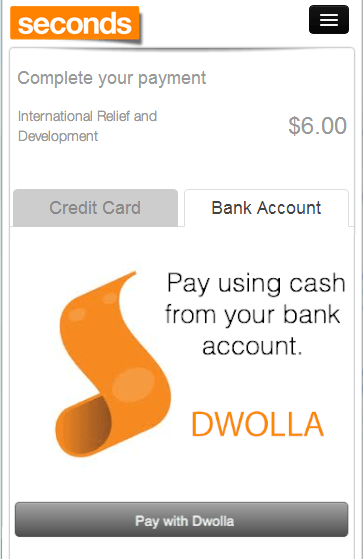
Simply put, Dwolla is great.  For months we have been evaluating how to include Dwolla payments in our mobile payment experience.  Their online and mobile payment network enables friends, families, and businesses to move money in a way that is safer, faster, and significantly more affordable than traditional payment options.  We always believed in Dwolla’s mission to rid the world of credit card fees and today we are excited to finally turn on the Dwolla payment option.

With Dwolla, you simply connect a bank account so you can make payments through the system.  The challenge up to this point was the fact that unless someone already had a Dwolla account created, it was nearly impossible for them to create a Dwolla account and make a quick payment during their first Seconds experience.   Unfortunately, there were a number of steps – some even taking a few business days – to authorize the financial institution and finalization of the Dwolla account.  It was basically a non-starter for our emerging payment platform.

As you can see, this new release leaves all that behind and puts Dwolla center stage in the Seconds payment experience, allowing someone the choice of quickly paying with their bank account using Dwolla in addition to a credit card.

Why is this so great?  Merchants accepting Dwolla are charged at most $.25 per transactions over $10, and transactions under $10 carry no Dwolla transaction fee at all!  Comparing this to the traditional 3% processing fee when dealing with credit cards and your looking at significant savings for merchants with each transaction.

We believe Dwolla has an incredible future and are excited to see where this will lead.  More information about the Dwolla announcement is below.

Try it out now with GIVENATION, and give to IRD.org to help with Hurricane Sandy recovery.

What is Dwolla?

Dwolla is an online and mobile payment network that enables friends, families, and businesses to move money in a way that is safer, faster, and significantly more affordable than traditional payment options.

Using the Internet, Dwolla has designed a smarter way to structure payments and identify fraud. This allows the system to bypass credit cards, PayPal, and other payment types and, at the same time, offer the nation’s lowest cost payment network.

Since 2010, the Des Moines-based company has processed millions of transactions, becoming the nation’s newest and fastest growing payment network.

Pay as a guest:

Now, with Dwolla’s new guest checkout option, anyone can use Dwolla to make a one-time payment from their financial institution to an online merchant or marketplace.

Guest checkout adds Dwolla’s payment engine to traditional bank-issued transactions, allowing the same level of security, safety, and innovation regular Dwolla users enjoy.

Benefits of guest checkout

For consumers:
  • No need for a pre-existing Dwolla account
  • Free to pay: no hidden fees or costs
  • Cardless and checkless
  • Safer than writing checks
  • Safe and secure Dwolla network technologies
  • Save money with Dwolla price (with participating merchants)
  • Privacy conscious (we do not sell your data!
For merchants:
  • Increased profit margins and savings over credit cards (flat 25 cent fee for transactions over $10, under $10 is free)
  • Easily add Dwolla as another payment method
  • Fluid offsite checkout experience
  • Automatic PCI compliance


Using Guest Checkout vs. paying as a traditional Dwolla user

Paying as a guest (for those without Dwolla a account):
  • Free to pay: no hidden fees or costs to use
  • Safer than writing checks
  • Cardless and checkless
  • Safe and secure Dwolla network technologies
  • Save money with Dwolla price (see below)
  • Privacy conscious (we do not sell your data!)

Users with Dwolla account (“Paying as a guest” plus the following): 

  • Pay your friends and family through your social networks
  • Lowest-cost (25 cents for payments over $10, free for transactions under $10)
  • Faster payments and clearing dates
  • Suite of features and tools
  • Connect a bank account for simple depositing and withdrawing
  • Use your phone to pay merchants and friends
  • Minimum balance keeps your account full
  • “Plug-and-pay” with numerous web third-party applications

Frequently Asked Questions:

1. Does the merchant ever see my banking information

No. Aside from the fact that you’ve paid, Dwolla does not disclose or include sensitive financial information inside of transactions.

2. Is Dwolla safe?

All information is securely passed, encrypted, and stored in ways that meet or exceed industry standards. Dwolla does not sell your data or transactions with corporations or private parties. For more information, visit security and partnership.

3. Can I cancel my payment?

Yes, but the canceled payment must a.) be initiated by the merchant and b.) occur before the payment is processed.

4. How do Refunds and Disputes occur?

Dwolla defers to the refund policy of its merchants, but will assist in the dispute process whenever necessary. Learn more about Dwolla’s dispute process.

5. Why isn’t my total cheaper when I use Dwolla?

Not all merchants have opted to offer the Dwolla price discount. Dwolla believes it’s up to the merchants to decide what’s best for their business.

 

Watch How Easy It Is To Give In Support Of Hurricane Sandy Recovery Efforts

Here’s a video showing how easy it is to participate in GIVENATION and use Seconds to give to IRD in support of Hurricane Sandy recovery efforts.  Although he’s paying rent and booking a hotel room, your payment experience will be just the same.

It actually takes longer and it’s more difficult to stand in line and order a latte at Starbucks.  Today, hold the latte and give to those who need it.

Text dollar amount to 202-999-3736

or

go to getseconds.com/givenation

Why I Write So Unbashingly Straightforward and Authentic

On a recent post titled  Founder = Learning To Juggle While Riding A Unicycle On A TightRope   I recieved the following comment.

Nick, I find your blog interesting. Spectating the process of someone having the guts to go it alone and start their own thing is enlightening plus a curious thing to follow to boot. Regardless of the underlying intention of this blog, I thank you for taking the time and being brave enough to share your feelings as you go through your journey.

However…

What did you do before your became this ‘founder’? In the post above you’re describing a vast majority of jobs, whether it be owning a company, directing a company, managing a team or heading up a department. The general sentiment of this post makes me wonder why you considered starting your own business in the first place. That’s really all you’re doing – starting a business. The same as the plumber down the road who is determined to do it on his own. Attaching the terms ‘founder’ and ‘start up’ to it doesn’t really change it in my mind.

Just because the ‘paper pushers’ get a salary, a monthly wage, a mobile device, a fuel card and any amount of other incentives, it doesn’t mean they’re under any less stress to put out their own fires, to keep their job, to keep their team’s jobs, to impress their boss, to impress their spouse, to continue paying the mortgage, schooling the kids, paying for groceries etc, etc.

We all have to juggle buddy. The difference is, while some of us sit in the corner waiting to be hugged, some of us simply add ‘hugging the sad-looking guy in the corner’ to our ever increasing todo list.

Step up mate. If you’re struggling to juggle, perhaps you need to leave the circus? If this response is out of line with the purpose of your post, I apologise. But take a second to consider the sentiment of what you’re putting out there and the effect it might have on your growing number of readers.

Keep up the awesome work and just keep swimming!

Below is my response:

Thanks for the reply and I appreciate your response. And I am glad you are enjoying the journey with me.  However, maybe something was lost in translation and I possibly missed a few things as I wrote this morning. Please read this as a neutral response. The point of the post is twofold.

First, there is a hell of a difference between an owner/founder and an employee – namely the fact that all most all parts of the business rest solely on the founders/owners shoulders. This is typically not the case when you are an employee, especially as the organization grows. (and yes I have been an employee in large and small organizations before, that’s actually what influenced me to start my own company). This perspective can be referred to as Owner vs Employee mentality and it’s not for the faint of heart. And I am not even including all the stuff you mention everyone must now juggle “to keep their job, to keep their team’s jobs, to impress their boss, to impress their spouse, to continue paying the mortgage, schooling the kids, paying for groceries etc, etc.”

Second, using the analogy of learning to juggle while riding a unicycle on a tightrope is to say you have to pretty much learn everything on your own, typically numerous things at once, trial and error as a founder. There’s no owners manual to founding a company, kinda like there’s no magic “lose 50 pounds” diet pill. Startup is no easy task and one of the reasons why most of us never venture out on our own. Employees are trained to do a specific job and have someone (boss, manager, owner) to rely on when things get too difficult or become “over their head” if you will. They have safety nets who can take on the problem if need be and for lack of a better term “wipe their hands clean” at the end of the day since it’s not their company.

I guess a third point is simply the fact that founding a company is damn hard and something I look to grind through towards growth and success. I started on this path because it’s a healthy challenge and allows me to appreciate what life presents when you take it into your own hands. And nope, this circus ain’t leaving anytime soon.

I write bluntly and truthfully for readers – for better or worse. My goal is to open up the black box of entrepreneurship and give people a better perspective, those who may be fascinated with it but have never made the leap themselves. Is it sometimes hard to digest? For sure. But that’s entrepreneurship. Part of the motivation in my writing style is to help readers gain a better appreciation for entrepreneurs and the struggles we go through, and maybe to educate people on the decision they may or may not be contemplating at the moment. Just like life, it’s quite messy.

As you can see, I write with unbashing honesty, authenticity and realness because I believe current and future entrepreneurs deserve it.  I also write with such perspective because quite a few readers of this blog are not actually entrepreneurs and this seems to be the only way I can accurately communicate to them what we go through on a daily basis.  Some are my family and friends that at times I am sure they ask themselves what the hell we are doing.

The point of SoEntrepreneurial is (and has always been) to illustrate and communicate the entrepreneurial journey is words maybe not heard anywhere else.  No, starting a company is not like being an employee no matter how much the above commenter believes it is.  It’s everything they describe – and a hell of a lot more.  And starting a tech company is defineltiy more difficult than becoming a plumber or other service provider who create their own company, namely because when starting a technology company you first have to determine what you are going to do and then build your product out of thin air.  Only after you have done those things can you then go find customers who want to use it!  Come to think of it, if your life and job is equally stressful as being an entrepreneur, I would encourage you to at least put yourself in a position where you are creating equity and ownership in what you do on a day to day basis.   Then you can at least justify to yourself why you are working so damn hard.

If you read popular tech blogs, you’ll read way too much about the lavishing riches and wealth founders’ of companies encounter, as well as all the posts about how another early startup creating a Groupon copycat (ok, maybe a year or two ago) raised millions of investment without any proven market traction.

Like it or not, that is not real life as a startup just as the tabloids or TMZ is not real life.  That’t the 1%.  The rest of us 99% tough it out and have to prove it over the long haul.  It would be a disservice to potential founders if they did not hear the truth from the source.

It sounds as if things I say or the descriptive words I use to write may be offending some people or might cut too close to the bone.  I am sorry if that is the case, but I also feel it’s not really my problem if I offend people.  I know I am doing a service with the words I write, and I am not purposefully out to harm any one person or group of people when I do it.  My intent is to educate and inform through words just as a producer of a documentary would with moving pictures on a screen.  If those words agitate or disturb in any way, well maybe it’s time to look in the mirror.

In any case, I will continue to write with open honesty and authentic voice.  You, as the reader deserve it.  You deserve to actually feel what its like to start a company out of thin air and grow it from the ground up.  You deserve to go through the good times and the bad.  You deserve to hear a fair and balanced perspective on technology and starting a company from someone who didn’t go to Stanford, work at Google or come from the lucky sperm club.  Absolutely, you deserve to hear how a normal guy, with no real starting advantage over the competition can grind it out and become successful with his startup.

Why?

Because if he can do it, so can you.  That’s what SoEntrepreneurial is all about.

Founder = Learning To Juggle While Riding A Unicycle On A TightRope

Being a founder is often hard to describe.  When you are asked, “what do you do” at parties or other social events, it’s easier to brush it off and not bring up the fact that you are a founder of your own company, just so you don’t have to go into how crazy it is.  When they realize you are a “founder” and you have a “startup”, it’s quite impressive to them.  They think it’s all glitz and glamor.  “Oh” they say, “that must be really fun!”  They think you make a ton of money and instantly give you more credit than you deserve.   They almost give you rock star status.

Or, ironically, they don’t give you enough credit.

The problem is they have no clue what you are going through and what it took just to get to where you are right now.  They have no idea how much you gave up to get here.  They don’t understand you don’t go back to a desk in an building owned by the company you work for, push some pieces of paper around, report to a boss, provided daily meals by your employer, given a shiny mobile device and a cushy salary with benefits.

They don’t actually realize NONE of that is included.   They have no idea you have given up everything in your life for this moment.

They also have no idea being a founder is like learning to juggle while riding a unicycle on a tightrope.

Why would I use such an analogy?

Most people’s idea of a founder is Steve Jobs – Miraculous.  Incredible.   Innovator.   Charismatic.  Leader.  Someone who’s all put together and very wealthy.  Use whatever descriptive words you want but they will be wrong.

Sorry to ruin the fun, but as founders we are generally running around like a chicken with our heads cut off trying to put out the latest fire threatening to burn down our dream.  Most things presented to you will be foreign and scary as hell to fix.  Customers will leave you.  Investors will say no.  Tech will fail.  Team members will leave.   Bank accounts will go dry.  And that’s just par for the course each day.

Most of the time you have no idea what you are doing or what the right move is, you are just putting one foot in front of the other and feeling your way around the dark room.

It’s feels like this: you attend to one thing, and just when you think you have it figured out another thing pops up.  So now you have two things to look over and figure out.  Yet before you know it, instantly another issue arises.  But this one is specifically attached to how you actually make money so you must drop everything else and go figure it out.  Hopefully, once you get that figured out you remember what the last issue was so you can return and fix it.

Learning. To. Juggle. While. Riding. A. Unicycle. On. A. TightRope.

Yes, it feels that tiring each and every day.  Next time you find out someone is a founder, please just give them a hug and ask them what you can do to help.

And you know what?  Juggling and riding unicycles also have their benefits and the analogy works the other way.  More on that topic at a later date.

Seconds Announces GIVENATION, A Nationwide Challenge For Sandy Relief

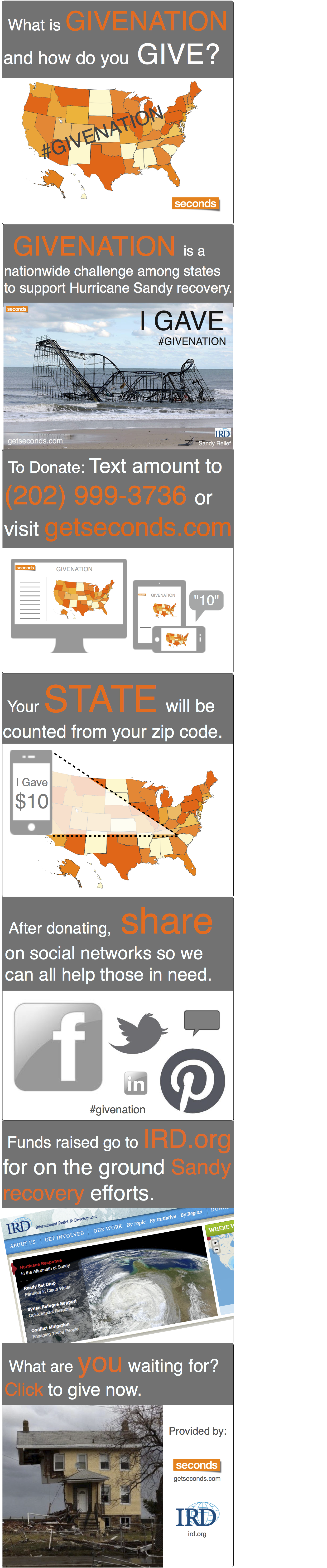
Today, Seconds is excited to announce GIVENATION, a nationwide competition during the holiday season challenging you and your state to give whatever you can to help with the Hurricane Sandy recovery effort.

We thought it would be encouraging to establish a friendly competition between states to determine “the most giving state” based on amount of dollars contributed using Seconds during this year’s holiday season.

Seconds is also excited to announce a partnership with International Relief and Development (IRD) on the nationwide campaign to raise funds for Hurricane Sandy relief.

As families shop for gifts during this holiday season, it is important to remember that our neighbors in New Jersey and New York are still in need. GIVENATION encourages people to give what they can. Even $5 or $10 can help rebuild a home or provide a winter coat or blanket for someone in need. Imagine what millions of Americans can accomplish by giving up one holiday latte and gifting that amount to help others.

The funds collected through this challenge go directly to IRD, a global non-profit that has distributed $3.5 billion toward disaster relief, humanitarian assistance, and development programs since 1998. Funds raised for Sandy relief will support IRD’s immediate disaster recovery efforts. IRD is working in association with FEMA, the National Voluntary Organizations Active in Disaster (NVOAD), and several local organizations to supply water, blankets, winter coats and clothes, cleaning supplies, hygiene kits, and other items to individuals in New Jersey and New York. This is just the first step toward a long-term recovery and rebuilding plan for the region.

To donate—and represent your state’s support for Sandy relief—go to getseconds.com/givenation, where you can make a donation in any amount you wish. You can also text your donation dollar amount to the phone number (202) 999-3736. For example, texting “5” will instantly send back a link where you can quickly complete a $5 payment using a credit card or bank account.

Seconds will be mapping the competition results in real-time starting November 3 and continuing through December 31. Visit IRD’s Facebook page at facebook.com/irdvoices to download and share the “I Gave” and “Did You Give?” images. And learn more about the GIVENATION campaign at getseconds.com/givenation.

For more information on IRD, visit www.ird.org, and visit the IRD Voices blog to read first-hand accounts from IRD staff in the field.

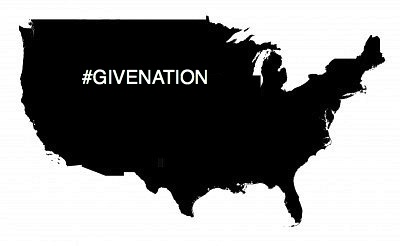
Full press release below image:

Seconds and IRD Launch GIVENATION, A Holiday Challenge For Sandy Relief

Which state will give the most to help the recovery efforts of Hurricane Sandy?

SEATTLE, WA – November 16th, 2012 – Seconds, the company enabling quick payments using mobile devices, is announcing GIVENATION, a holiday campaign encouraging the nation to get further involved with the Sandy recovery effort.

Hurricane Sandy recently caused billions of dollars in damage, destroying cities and displacing millions of people. People may have already given via The American Red Cross or other relief campaigns but there are still a lot of people who are in need and Seconds believes much more can be done.

Today, Seconds is announcing GIVENATION, a nationwide competition during the holiday season challenging you and your state to give whatever you can to help with the Hurricane Sandy recovery effort. “We thought it would be encouraging to establish a friendly competition between states to determine “the most giving state” based on amount of dollars contributed using Seconds during this year’s holiday season,” says Seconds CEO Nick Hughes.

So as people are buying toys, clothes, electronics and other items for family and friends this holiday season, they are urged to not forget about a nation in need. People are encouraged to give what they can – even $5 or $10 – and help rebuild their country. Imagine what millions of Americans can accomplish by simply giving up one holiday latte and gifting that amount to help others in need.

The funds collected go directly to International Relief and Development (IRD.org) a global non- profit which has distributed $3.5 billion towards disaster relief, and will be put towards immediate disaster recovery efforts. IRD is working in association with FEMA to supply water, blankets, winter coats and clothes, cleaning supplies, hygiene kits, and diapers in addition to other important recovery efforts.

To donate, go to at http://getseconds.com/givenation where you will see the map and a donation box to enter any amount you wish. Mobile users can also simply text a numeric dollar amount to the phone number (202) 999-3736. For example, texting “5” will instantly send back a link to quickly complete a $5 payment using a credit card or bank account via payment partner Dwolla.

“While we hope and pray for the full recovery of those affected by Hurricane Sandy, we are excited to partner with IRD in encouraging the entire nation to give any amount they can during the holiday season to help with the disaster recovery,” says Hughes.

Seconds will be mapping the competition results in real-time starting Nov. 16th and proceeding through Dec 31st, 2012.

About Seconds

Seconds enables any device holder to send or accept payments, whether through the web, mobile web or a quick text message. They believe the payment experience should be as quick, simple and intuitive as sending a text message. Founded during the fall of 2011 in Seattle, the original idea was to enhance mobile ordering and commerce for small local businesses. After pilot tests proved both merchants and customers just want the payment experience to be completed as fast and easy as possible, they decided to only focus on the mobile payment experience. They have a vision of any individual being able to interact and transact with any merchant in the world, holding any device they wish. Currently they hold office space in the recently opened SURF Incubator in downtown Seattle. 

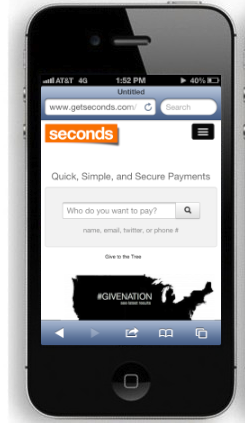
A Mobile First Mentality

Fred Wilson has written extensively on designing for mobile first, desktop second.  I couldn’t agree more and that is exactly what we are doing at Seconds.

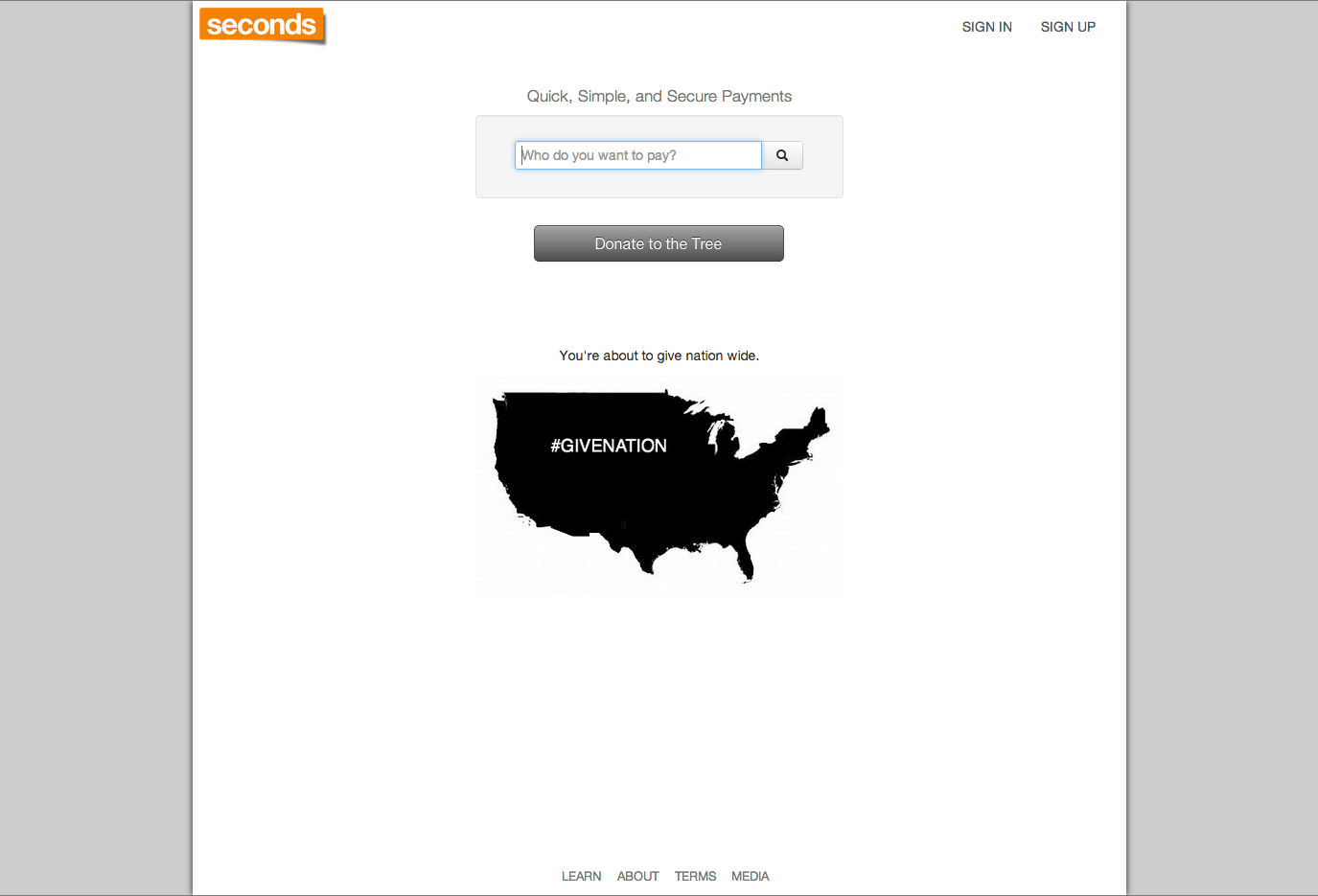
When looking at our initial user interface design of both the mobile view and the web view, one will see quite a few similarities.  This is not by accident, this is because we start with the mobile view first.  We first ask ourselves which mode most people will use our service, mobile or desktop? Given the fact Seconds is a payments platform oriented around mobile devices, mobile takes highest priority.

Also, the fact that more smartphones are shipping than feature phones and the estimation by 2017 is the majority of web traffic will come from mobile, we feel designing for mobile first is a safe bet.

Finally, it’s such a pain to view a website on a mobile device only to have to pinch and zoom to even read the content and click the desired button.  We feel it’s better to design for the smallest screen and allow the larger screens to pull the content/visuals out.  It’s the reverse perspective of the pinch and zoom experience you mostly see today.

So, if take a look at our desktop web presence you will see pretty much the same information and visuals, just aligned slightly differently since there’s quite a bit more real estate.

How did we do this?  Did we use a different service to create a “mobile optimized website” to augment our desktop website?  One with drop down menus and a very different look and feel to it?  Nope.  I don’t believe this is the right approach.   Unfortunately, farming out your mobile experience to a third party white-labeled service removes your branding and familiarity of your product.   (For example, view this blog article on a mobile device vs the web and you will see what I mean.)  You can refer to this mentality as desktop first, mobile second because you are not allowing the mobile device constraints drive overall user interface design.

Without sounding too redundant, why would you focus on desktop first when as a society we are clearly spending more and more time on mobile devices?

So how do we go about it?  As stated above, we have a mobile first mentality.  We design all Seconds experiences mobile first and then scale up to desktop.  You can see this in play when you access Seconds on a desktop browser.  (Try resizing your browser and shrink the width of the page.  It’s responsive.)  If anything, one might initially feel there is something lacking in the desktop view.  You might think maybe there’s not enough imagery or things to look at… yet is that really the reason to go to Seconds?

You know what, we don’t care.  We know people aren’t coming to Seconds to view pictures, to browse friends’ profiles or to see anything else.  What we care about is that the primary functions of the system, which is to complete a transaction as quickly as possible.  This is paramount.  We measure user experience in mere clicks and finger swipes and most times the more visually stimulating the design, the more clicks/swipes to complete the desired experience.  Those extra steps, in the end, often result in a lost transaction.  Just ask PayPal.

Our mobile first mentality allows the design and UI constraints of the smaller mobile screen to aide us in development of Seconds.  Why?  They help us sift out all the unnecessary and focus on the essentials.

Brevity is always refreshing.  Clean and clear is more compelling than busy and confusing.  Adding things when it seems right is always easier than trying to determine what to remove from the 100 options that could be the problem.

What Is GIVENATION? Would You Give A #@$%?

What is GIVENATION?

Hurricane Sandy recently caused billions of dollars in damage, destroying cities and displacing millions of people. What if GIVENATION was a holiday challenge to give whatever you can, helping with the Hurricane Sandy recovery effort?


What if we established a friendly competition between states to determine “the most giving state” based on amount of dollars contributed during this year’s holiday season?

What if Seconds just partnered with one of the largest global non-profits focusing on disaster relief around the world?

What if, as you are buying toys, clothes, electronics and other items as presents for family and friends this holiday,  you didn’t forget to give a gift to a nation in need?

What if we announce something big this Friday, November 16th 2012?

What if GIVENATION was real?  Would you give?


Ask The Right Question At The Right Time

There are certain moments, typically in business development conversations, when you sense the entire future of your company is resting on that exact moment in time.  You realize what you say next will either result in an affirmative commitment to your company or a “thanks but no thanks” response.

I just had one of those and boy and I glad I knew it was happening.

The conversation was with a self-identified skeptic for which they were asking why they should consider working with Seconds.  This individual was very cordial and nice, yet opened the conversation with an obvious “you’re behind the 8-ball” tone.  It was up to me to unravel where they were coming from, identify where we fill the gaps and bring them to a point where they wanted to work with us.

I learned (or maybe realized) a few lessons as we were working our way through the conversation towards an agreement.

1.  No is easier than yes

People are naturally programmed to say no.  You must work towards the yes, which requires taking that person on a journey through why they are better off with your solution than not.  Saying yes requires one to actually commit to something.  Saying no requires no commitment, thus it is the easier option.  Remember, most people are commitment phobes and would rather say no than have to stick to a commitment.

2.  Conversations turn with one question

As we worked through our conversation and they received answers to all their questions, it became apparent to me I needed to take control of the conversation if I was going to get a satisfactory outcome.  At one point they mentioned they were already working with a “somewhat similar” company, and asked why they should consider working with Seconds?  My response… “how’s that working out?” and then waited for the answer.  I followed up with “are they rolling out nationwide with your organization being the only organization involved, meaning your organization will be highlighted and singled out?”

At that moment, the conversation changed.  It became clear there was no logical reason for this person to say no and we started down a very positive brainstorm on how to make our partnership even better.

3.  People need to be led

What this really comes down to is the fact that most people just need to be led to a decision.  Since people are programmed to say no – even when yes is the better answer – they need to be led to understand why yes is the better answer.  This takes courage for sure, because going out on a limb and calling someone out can be risky, they might get upset and you might even lose the opportunity.  Yet, it may be the only way you earn a new customer or distribution partnership.

You can learn a lot from one conversation, next time pay attention to how you are handling the questions you are being asked.  You might just help them help you.

Seconds Was Just Chosen For Another Nationwide Mobile Donation Campaign

We will be announcing the partnership with a global non-profit and the roll out of a national campaign for donations towards a recent disaster to our county.  More to come….

In the meantime, try Seconds out and give to the Capitol Christmas tree to support forest restoration.

The Future of Commerce Will Combine Your Social Network and Mobile Device

Below is from my latest posts published on PayPal’s DevZone, titled The Future of Commerce Will Combine Your Social Network and Mobile Device.

Each day we hear growing speculation about the so-called mobile commerce revolution that’s just starting to take shape. Some think NFC payments will be the next big thing in retail. Others believe text-based payments will open up the mobile payment experience for the billions of mobile device holders around the world. And thousands of new apps are created each year with a new twist on using your mobile device to pay for everyday things.

To some extent, these concepts and more will shape the future of mobile commerce. However, pundits are forgetting what might happen if you combine the most commonly used platforms in the world—mobile devices and social networks—and infuse quick payment technology within them.

If Those Two Powerful Phenomena Merge, Will We Discover a New Payments Utopia?

It seems as if we’ve been in the stone age of social commerce for years now. Facebook has been around for almost a decade, and before that we had Friendster and Myspace. From my perspective, most don’t realize how close we actually are to merging social and commercial actions. How many times have you read a Facebook update from a friend, for instance, saying something like “I just saw ____ and it was the best movie I’ve ever seen.” Or what about the posts that show off a new car or recently purchased clothing? Those posts, in a small way, are the beginnings of social commerce. By sharing things such as a new purchase or a cool new movie, you are influencing your friends’ commercial interests. Today, people are partaking in social commerce without actually knowing it.

The question is, what will happen when they know they are doing it and they help you make a similar purchase? And more interestingly, what happens when it originates from a mobile device?

Read the rest here.

Seconds Chosen To Provide Mobile Donations For U.S. Capitol Christmas Tree

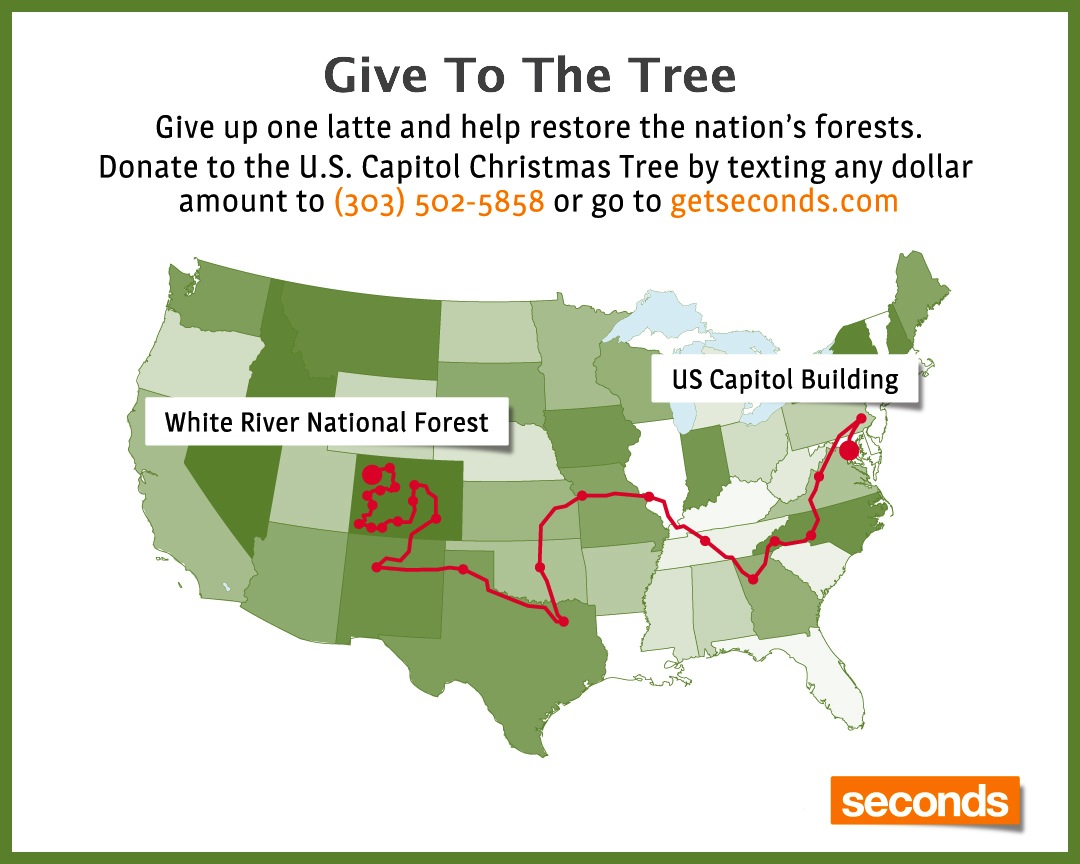
We are pleased to announce Seconds has been chosen to power mobile payments for the 2012 U.S. Capitol Building Christmas Tree.  Yes, the one that travels across the country on a truck and is put on display in front of the capitol building in Washington D.C.  That one.

This past spring, wildfires burned more then 100,000 acres of land and more than 600 homes near Colorado Springs and Fort Collins, Colorado. In addition to destroying homes, these fires severely damaged critical watershed areas that supply water for the cities of Fort Collins and Colorado Springs. They also damaged critical habitat for wildlife and fish in the region.

Seconds was sought out by a Colorado non-profit called ChooseOutdoors and the National Forest Service looking for a dynamic mobile/text payment system to help raise money for restoration of the thousands of acres destroyed in the fires.  They were very clear they wanted it to be as smooth and quick as possible to complete since people will be standing outside during festivities and if wanting to make a donation, they should be able to with a mobile device.

I told them “No problem.  Heres how it works: People simply text a numerical dollar amount to the phone number. For example, texting “5” will instantly send back a link to quickly complete a $5 payment using a credit card or bank account. Payments can also be made on the desktop or mobile web by visiting getseconds.com and searching for the tree.”

That’s it.

You can learn more about the U.S. Capitol Christmas Tree here.  From the press release (full press release below):

People are encouraged to give what they can – even $5 or $10 – to help restore their country, whose deteriorating forest conditions place America at a growing risk of forest fires. “Our team wondered how many dollars can we, as a nation, raise to help restore the forests during the holidays,” said Nick Hughes, CEO of Seconds. So the goal became to raise at least $25,000 for restoration of the very forests many of us make our back yards. “All money raised will go to supporting work crews and acquiring materials needed to replant riparian vegetation, stabilize stream banks and re-plant trees lost in the fires,” said Jeff Olson, president of Choose Outdoors.

Please take a moment out of your busy day and give to the tree.

Seconds Powers Mobile Donations For U.S. Capitol Christmas Tree Campaign

The U.S. Capitol Christmas Tree now represents much more than an old holiday tradition

SEATTLE, WA – November 1st, 2012 – Seconds, the company enabling quick payments using mobile devices, is announcing their have been chosen as the payments provider for a holiday donation campaign associated with the Christmas Tree standing in front of the U.S. Capitol Building.

This past spring, wildfires burned more then 100,000 acres of land and more than 600 homes near Colorado Springs and Fort Collins, Colorado. In addition to destroying homes, these fires severely damaged critical watershed areas that supply water for the cities of Fort Collins and Colorado Springs. They also damaged critical habitat for wildlife and fish in the region.

Seconds is announcing today they have been selected to help ChooseOutdoors.org and the U.S. Forest Service with the Colorado Forest Fire Restoration Challenge Fund, in association with the 2012 Capitol Christmas Tree project. The U.S. Capitol Christmas tree will be cut from Meeker, Colorado and driven across the country starting November 6th, touring more than 30 cities before being decorated and put on display for the holidays in front of the U.S. Capitol Building in Washington DC.

People are encouraged to give what they can – even $5 or $10 – to help restore their country, whose deteriorating forest conditions place America at a growing risk of forest fires. “Our team wondered how many dollars can we, as a nation, raise to help restore the forests during the holidays,” said Nick Hughes, CEO of Seconds. So the goal became to raise at least $25,000 for restoration of the very forests many of us make our back yards. “All money raised will go to supporting work crews and acquiring materials needed to replant riparian vegetation, stabilize stream banks and re-plant trees lost in the fires,” said Jeff Olson, president of Choose Outdoors.

To donate, simply text a numerical dollar amount to the phone number 303-502-5858. For example, texting “5” will instantly send back a link to quickly complete a $5 payment using a credit card or bank account. Payments can also be made on the desktop or mobile web by visiting getseconds.com and searching for the tree.

“It’s an honor to be chosen by the U.S. Forest Service and ChooseOutdoors.org as the payments platform for this special event. Our goal is to encourage people to give any amount they can during the holiday season to help improve the health of our land”, says Hughes. All participants from the winning state will be placed in a drawing for two tickets to next year’s tree lighting ceremony in Washington D.C.

Give up a latte, gain a forest. Our nation’s forests are in critical condition and need our help to restore their health. Imagine what Americans can accomplish by simply giving up one holiday latte and gifting that $5 to the forest. Funding for restoration and public education are just a few of the ways we can decrease the chances of devastating fires – saving homes, neighborhoods and possibly lives. “We are thrilled that a Colorado forest is providing a gift to the nation and hope that it will assist in educating the country about forest health and restoration” said Jerri Marr, supervisor of the Pike and San Isabel National Forests.

For additional information on how to support or help with efforts, contact Jeff Olson at jeff.chooseoutdoors@gmail.com or Nick Hughes, CEO of Seconds at nick@getseconds.com.

About Seconds

Seconds enables any device holder to send or accept payments, whether through the web, mobile web or a quick text message. They believe the payment experience should be as quick, simple and intuitive as sending a text message. Founded during the fall of 2011 in Seattle, the original idea was to enhance mobile ordering and commerce for small local businesses. After pilot tests proved both merchants and customers just want the payment experience to be completed as fast and easy as possible, they decided to only focus on the mobile payment experience. They have a vision of any individual being able to interact and transact with any merchant in the world, holding any device they wish. Currently they hold office space in the recently opened SURF Incubator in downtown Seattle.