More Impressive Is The Successful Founder Who Took The Road Less Traveled

An amazing story is going around right now about a high school senior who has been accepted to Harvard.  What’s more notable is that she was basically from little means in high school and even homeless for her entire senior year.  Even more admirable is how she tried to live a normal life despite her situation, playing sports and partaking in extracurricular activities right along with her peers.

Dawn grew up in a ramshackle home with no electricity and no running water. She often went days, even weeks without showering. She and her brother Shane — who was equally studious in his schoolwork — would walk 20 minutes to a public park to fetch water.

“We would get water jugs and fill them up at the park, using the spigots in the bathroom. And we would use that to flush the toilet or cook with. Stuff like that,” she says.

She confided in a staff member at school. She had trouble doing homework at nighttime because her home had no electricity and she couldn’t afford candles. It was difficult to read in the dark.

Obviously Dawn is not a startup founder, but I think about stuff like this a lot since I am going through something similar.  Do I have it as bad as Dawn?  No, for sure not.  But am I sacrificing a lot and going through hardships to see my dream come true?  Yes, for damn sure.

It’s funny, the naiveté one has when starting a company can be their best friend because if they knew how hard it would be or what it actually takes to succeed, they probably wouldn’t even start.  Especially for the one’s who aren’t cut from the same mold as others they are competing against.

The Well Worn Path Of Tech Founders

A kid grows up playing with computers and rather than playing sports, and he focused on writing the most code he possibly could rather than getting the most girls he possible could.  Other students view him as an outcast or a nerd.  He goes to college, usually Stanford or MIT or some other prestigious school and studies engineering or Computer Science.  Once he graduates he usually receives employment offers from Google, Microsoft, Facebook or other large and successful technology companies.  And now he wants to start a company.  On paper he’s a prime candidate to be successful.

Unknown to most first time founders is how much this well worn path is valued.  It’s cred.  It’s validation.  “He worked at Google so he knows how to build a company” investors, bloggers and others assume.  Money is easier to come by when you take the well worn path.  Attracting engineering talent is not as big of deal if you have the ‘generally accepted credentials’.  People just assume you and your company will be a success.

But is that really true?

Google can help an engineer polish their skills and become one of the best in the wold at their trade.  But what does Google teach an engineer about building a company?  Or Microsoft?  I’m no expert but BIG corporations are about the farthest thing from scrappy, early stage startups.

I am more impressed with successful founders who took the road less traveled.  The ones who didn’t go to Stanford.  The ones who might not have a solid network of investors and engineers right out of the gate but work like hell and take 50 coffee meetings each year just to get to know other entrepreneurs.  The ones who work 2x as hard and 2x as smart as others to get to where they are now.

I love the person who looks impossible in the eye and basically says “f-you, i’m doing it anyway!”  The person who changes paths mid-journey because he knows the one he’s on is too worn down from all the others who preceded him.

Impressive is the one who cuts his own path.

And isn’t that what an entrepreneur actually does?  They shrewdly navigate the business ecosystem to give themselves the greatest advantage possible with the least amount of resources and against all odds.  Most impressive to me are the ones who started the lowest and finished the highest.

The Road Not Taken

Robert Frost

Two roads diverged in a yellow wood,
And sorry I could not travel both
And be one traveler, long I stood
And looked down one as far as I could
To where it bent in the undergrowth;

Then took the other, as just as fair,
And having perhaps the better claim
Because it was grassy and wanted wear,
Though as for that the passing there
Had worn them really about the same,

And both that morning equally lay
In leaves no step had trodden black.
Oh, I marked the first for another day!
Yet knowing how way leads on to way
I doubted if I should ever come back.

I shall be telling this with a sigh
Somewhere ages and ages hence:
Two roads diverged in a wood, and I,
I took the one less traveled by,
And that has made all the difference.

SURF Incubator Already Barrelling With Numerous Startups and Entrepreneurs

As you might have heard, Seconds is one of the first tenants to stake claim on high value territory in Seattle’s newest tech hub SURF Incubator.  They officially opened their doors April 30th but already we are seeing some solid action emerging from within.   We’ve only been in there a few weeks, but here’s some highlights from a few early  SURF tenants I was able to get some time with in between  the craziness of startup life.

Knotis, which helps you discover great deals from businesses you’ll love, is one of the initial launch tenants.  CEO McLean Reiter says he chose SURF because “their mission is to help startups launch as quickly as possible so they can get out on their own, which is pretty much every statups’ goal.”

For background, knotis is reviving the concept of the digital coupon by taking the marketing strategy originated by Asa Candler with Coca-Cola and infusing it with 21st century tools. They are calling this new take on coupons an Online Social Incentive and merchants can now easily create as many as they wish at the low monthly cost (as opposed to the Groupon style of massive revenue share which can be detrimental to businesses). Merchants can share these self-generated OSI’s in online banner ads or through their social media channels like Facebook and twitter.

Knotis is doing business differently and intelligently by charging its merchants a low, flat-rate of $14 per month, and if the merchant doesn’t make a sale during the month, they are not even charged! “That’s just company culture,” says 28 year old founder, McLean Reiter. “We want to help local businesses thrive!”

Asked about why he favors SURF, McLean adds “My favorite thing so far is that everyone is there for the same reason – to succeed – and other entrepreneurs and developers, although busy, are still willing to help other teams achieve success.”

Another early startup is Shopobot, a better search engine for shopping. For example, stores are constantly changing their prices (even day to day), and they make it clear when it’s the right time to buy – which can save people a lot of money. At their heart they’re an analytics company, and  using their data and UI to give people an edge when shopping online.

According to one of the founders Dave Matthews, they went through more of an accelerator in San Francisco before coming back up to Seattle.  “When we started Shopobot we went through an incubator in San Francisco called AngelPad, which was super helpful for doing the demoday / launch / fundraising push. It was really hands-on with all the companies in the program moving on the same schedule towards launch. Now that we’re past that phase, SURF is a great spot for us to focus on our product and growth – while getting the benefits that come from a shared space.”

He notes they wanted to work in a shared space for the unexpected conversations, and meeting other people working on startups. “SURF has the right balance for us of lots of meetups and events and other teams working here, but we still get our private area to focus as a team.”

Lastly is Pandamonium Games, who just announced a Kickstarter project called The End Saga: Revival.   In short, it’s a 90’s style mobile role-playing game, bottling the best of that era and sticking it into a beautiful mobile gaming experience. Using the art of nexxing to build new items, while you amass a team of fighters, magicians or rogues to take out the evil Ismata.    (You should go check it out on Kickstarter!)

Jimmy Gambier from Pandamonium Games says “We chose SURF because we’re not big enough to have a dedicated office space and yet meeting in coffee shops was getting old. I’d also visited places in the Valley like Dogpatch Labs were you can feel the sense of community in the air. We wanted a place where we could bond with like minded people and companies.”

Digging a little deeper on why they chose the Kickstarter/crowd-funding route , Gambier said they went with Kickstarter because they wanted to go directly to the community versus spending their precious time pitching to investors. “We would rather spend the next 6 months heads down on our product instead of raising money.”  I can attest to that!

Gambier believes Kickstarter is the next evolution in investment, as you can receive instant market validation which helps you determine if you are heading in the right direction.  Interestingly, he sees a side benefit from crowd funding platforms.  “Building a fanbase is also crucial for the kind of game we’re working on. We’re catering to a hardcore gamer audience and we thought building that user base early would be wise.”

Through his words it’s obvious Jimmy couldn’t resist the entrepreneurial pull and is the exact person SURF and other incubators need to help cultivate a great community of founders.  “I had been involved in startups in the past and had an unshakeable desire to start a gaming company. It almost seems like there wasn’t anything else worth doing. The art of building a fun game has fascinated me for years and continues to as I learn more about the craft.”

If you are like me, you’re probably not familiar with Pandamonium Games, a scrappy Seattle based games startup who loves RPGs. They’ve made a couple of social games before, but this is their most ambitious game to date. The team has worked at places such as Nintendo, Wizards of the Coast, Amazon and a large MMO company.

Here’s Jimmy’s take on their quick history:

“For the past two years, we’ve been a small but committed team working in the social games space. When Glen Matsushita and I met at Tully’s in Bellevue, Washington, in 2009 to brainstorm our first title, we had never built a game before or worked together as a team. By the end of the first month, we had settled on using the Facebook platform to create Champions of Justice, a superheroes game. We brought on a couple of guys who had worked at Wizards of the Coast—a publisher of fantasy and science-fiction based role-playing games, board games, and collectible card games—to help with the art and writing, and went to work.

“The company was founded on the principle that there is a place for hardcore games in the next evolution of gaming.We made a couple of games along the way—neither a major hit—and are now working on our third title. Whether or not this will be our breakthrough in what has become a highly competitive market, we have the same passion and dedication that got us into the business in the first place. In fact, as we’ve gotten more experience, we’re getting better with each iteration and this title has been the most fun to work on since we’ve carved out more definitive roles and skill sets among the three founders.”

It’s early days for SURF Incubator and I look forward to meeting (and possibly writing about) many more startup founders.  If you are interested in SURF office space, feel free to visit their website and send them a note.

Introducing Seattle’s New General Assembly: SURF Incubator

As a startup founder, not too many things are more important than where you and your team will spend most of their time building you world changing, billion dollar company.  Before you receive an influx of cash and are able to have your own office space, the choices are basically 1) toughing it out in your home, 2) hopping between coffee shops or 3) spend an arm and a leg for office space in a place you really can’t afford.

Although starting a company today is quite a bit cheaper than it was 10 years ago, square foot for office space is not so much. It’s actually getting more expensive.  And it sucks, especially for a young startup that is likely pre-funding and cannot afford much more than cloud hosting.

So what to do?

Well, I’m going SURFing.  Since the beginning of the year, SURF Incubator has been quietly building a network of technology focused entrepreneurs, mentors, investors, and corporate partners. On April 30th, the SURF community will come to life when it officially launches with fifteen incubating startups.  I am proud to say Seconds is one of them, and very excited to be a part of this burgeoning startup community.  Located directly downtown Seattle, this is perfect location for startups, as it’s 5 minute walk from Pioneer square, Westlake mall and a short bus ride to South Lake Union.

SURF has also been collaborating with various corporate partners to develop a robust benefits program to aid in the growth of our young companies.  By leveraging the support of service providers and larger technology companies, SURF is able to provide opportunities that reduce the costs to start a technology company in Seattle. Bringing down the economic barriers associated with building a technology company has the potential to significantly advance the growth of Seattle’s startup community. SURF has already received applications from entrepreneurs located from Vancouver, BC to South America.

This is exactly what Seattle needed.  There are a number of places for co-working and startup office space, but none that were this neutral and spoke with the most potent vision.  Most other spaces are in connection to an accelerator, investment or other ties to companies and investors.  Not SURF.  Their vision is to provide cost effective space (over 15,000 square feet) for innovation and collaboration between tech startups and greatly impact the general startup scene.

It’s crazy because I had this idea last fall and wanted to organize a handful of startups to make it happen, which as I got further into the planning I realized it was a quite a bit larger undertaking than I had time for.

Thanks to the support of some of Seattle’s most respected technology companies and service providers, SURF Residents will not only benefit from subsidized office space, but they will also have access to a suite of free or significantly discounted services. One of the many benefits associated with building a startup at SURF are the free educational workshops provided by corporate partners – covering topics on company formation, intellectual property, fundraising, various programming languages and more.

The monthly SURF membership fee of $300/month per entrepreneur, which nicely suits early startups comprised of 2-4 founders.  They even offer evening hours (which would be 5pm on) at $200 per month.

SURF and its network partners are making it dramatically less expensive to start a technology company in Seattle.  I now know where I am spending most of my time!

Some of the other startups include:

Shopobot – tracks price changes at major online retailers. Using this data, Shopobot helps consumers get the best price on books, cameras, computers, and video games. Name your price, and we’ll alert you when it’s reached. Shop Shopping in the dark!

BBC Easy – dedicated to optimizing the commercial lending process between banks and their borrowers.

Translational Software  – simplifies the logistics of genetic testing and transforms test results into actionable guidance for doctors.  The cost of molecular diagnostics is falling precipitously but genetic tests are not useful without interpretive information.

Knotis – helps consumers discover great deals from local merchants. Customers can find personalized, location-based offers – happening in real time.


Like It Or Not, Here’s How Your Startup Proves Evolution (Controversial)

It’s crazy to think a simple idea of starting a company can prove the controversial concept of evolution.  Yet, like it or not here’s how it does.

Before I go in depth on the idea of evolution in the business world, my disclaimer:

This may be controversial so let’s put aside our beliefs and perspectives on faith or religion and speak only on the concept of evolution, as in the Darwin perspective as we know it.  Ya know, natural selection and all associated phenomena.  I am not an expert on the subject and will not pretend to be here.  I only want to bring  upthe concept of evolution into the context of entrepreneurship and building successful companies.  

An interesting observation is how most world changing technologies or ideas actually start as thoughts and go through a transformation into ideas, onto sketches on napkins, to prototypes, to working models, and onto businesses.  Although almost too obvious to note, all things must start with a thought.  A spark of genius.  An idea.

*ding*

That idea, brilliant or stupid, is just the beginning of a (un)predictable path towards life and eventual death.  If in the right place at the right time, and the right decisions are made to take advantage of opportunities, the idea will transform into something more visceral and experience an extended life.  If not, most likely the idea will die a quick death into obscurity.

This is why you hear “ideas are everywhere” and “execution is everything”.  I can just hear Darwin whisper similar words in the same vein.  In his context, execution would have referred to “the strong” or “genetically enhanced”.  Not to get sexual, but if a highly attractive and sexually active member of a species “executed” properly, they would have passed on their genes to influence the gene pool and the evolution of their species.

Your startup must mirror the same as the highly attractive and sexually active member to survive.  What do I mean?  You need to be attractive to customers, users, investors, media and potential employees to succeed.  If not, you will never be discovered and will eventually die.  Attractiveness can come in many forms but the most obvious one is your unique idea.  Does it make sense?  Is it something most people would be attracted to and want to use?  Does it elicit emotions of excitement or intrigue?  Is it unique enough to not be lost in the clutter of all the other same “species”.

Also required to be attractive is the core members of the founding team.  Is there expertise on the market subject?  Are there proven individuals who get results, or more referred to as JFDI?  Are they fun to be around?  Do they attract people to them or do they drive others away?  This is huge, since any successful startup finds ways to attract employees, investors, users and media attention.

That is why you hear investors say “we invest in people, not ideas.”

Your start up must aggressively mate as well.  Wha??  Yes, I said your company must be promiscuous and interact with other companies if it wants to be successful.  This is how you integrate within the larger framework of the ecosystem and spread your gene pool for future generations.  Facebook is the best example of this with their open graph and the like buttons found all over millions of websites.  Their tentacles are everywhere and indeed they have solidified their gene pool in our world for decades to come.  Do other companies find your startup attractive enough to mate?

How do I know all this and why the heck am I thinking about evolution and your startup having sex with another startup?

We once were the ugly duckling but quickly evolved into a better suited mammal geared to mate with the royalty of the land.  My company Seconds, was originally named Order SM and intended to be a mobile ordering startup for the food industry.  (All S & M jokes aside, the name was supposed to be meant for SMS ordering).   It became clear the name and the basic concept needed to evolve if we were going to continue.  Yet this was not our intention initially, it naturally happened as others started to interact on the platform and suggest use cases outside of our original plan.

Last fall we released out beta product and our initial customers provided enough feedback to realize we were onto something A LOT BIGGER than we originally planned.  We realized ordering was a form of communication – just one aspect of the iteration between merchant and customer.  Questions were another part of the relationship.  Requests and thank you follow ups from merchants were also a part of natural communications.  And the biggie – transactions – are at the very core of the relationship between customers and merchants.

It was at this point we decided to change the name and the fundamental value proposition.  Seconds – quick communications and mobile commerce.  Helping merchants and customers more easily interact and transact.  We are providing consumers a unique mobile commerce identity that will span the entire globe.  And we are giving merchants the ability to identify those most important to their business.

We realized the world was mutating right before our eyes, but one “species” was going to be left behind unless we did something about it.  More than 8 trillion text messages were sent around the world last year, yet none to local businesses or merchants.  It’s crazy to think we can text our friends and family with the widely popular communication medium, yet you or I cannot communicate via text with our favorite local coffee shop or the 5 star resort we intend to visit next week.  We are changing that, and  have quickly found ourselves in talks with everything from emerging startups to multinational, multibillion companies.

Just as Darwin found “one species does change into another” as he looked at Galápagos mockingbirds from different islands, startups must go through phases of transformation if they are to succeed.

The idea that your initial idea – in it’s most basic genetic form – will be required to mutate into a different species for survival has to be understood by founders and investors.  This is more generally called the Pivot, and Lean Startup proponents such as Eric Ries have graciously helped our community unearth one of the most powerful phenomenons to hit the business culture to date.

I think that is enough talk on companies having sex for today.

@jnickhughes

The Numerous Mental Disorders You Probably Have As A Founder

“God, did I just actually think that?” 

Many have wondered what goes on in the minds of the people who go on to start successful companies.  Some may think pure ambition, hopes of everlasting riches or even recognition for doing something great are the driving forces behind a founder.  Others might believe people have a vision or some sort of predestined aura working beyond their comprehension to align the lucky ones with the future.

Whatever is going on behind the scenes of a founding entrepreneur , you can be sure it’s straight out of a psycho-thriller.  The thoughts, feelings, emotions and urges pushing a founder toward success are so dramatic there are no words to accurately describe the experience.  The question is are these normal?

I have no idea what the hell I am doing and where this company will actually end up?

Entrepreneurship is basically a physiological disease, with various mental disorders running rampant.  Being an entrepreneur is something far different than what most people think. It is not about behavior; it is not about business type; and it is not about title. Instead, it seems as if it’s a personality trait with it’s own quirks and characteristics.  There are plenty of small business owners and start-up founders who do exceptionally well — but are not what would be considered an entrepreneur. Just like in big business, you can be a successful general manager without being an entrepreneur or entrepreneurial.

Dammit!  That guy is worth hundreds of millions more than me!!  All he did was start a photosharing app…  What’s he got that I don’t?

So how do you determine if someone is an entrepreneur ?  And are entrepreneurs actually crazy by normal society standards?   That seems to be up for debate.  A thin line separates the temperament of a promising entrepreneur from a person who could use, as they say in psychiatry, a little help.  Academics and hiring consultants say that many successful entrepreneurs have qualities and quirks that, if poured into their psyches in greater ratios, would qualify as full-on mental illness.

If it’s a disease, entrepreneurship then is a combination of many mental disorders that when found in correct combinations, come together to form a very unique individual.  Entrepreneurs are all in all the time. Entrepreneurs love what they do and obsess over it. It is a predisposition; a path that has already been laid for you. It is a character trait, a labor of love, a zeal that cannot be trained, a condition that cannot be treated, an illness that cannot be caught. You’ve either got it or you don’t. Even the Quora community has determined mental disorders are associated with founders.

Wait… did or didn’t I know this was going to happen.  Was it a dream?  I could have swore we already figured this #@%^ out!   Geez, I have no idea when the last time I got a full night’s sleep.

What mental disorders are to be found more common among entrepreneurs than the general population?  After realizing my personal thoughts were “uniquely abnormal” and after numerous interactions with founders of other companies (and discovered the same weirdness), I determined to do some further research.  What follows is an attempt to describe the most common mental disorders associated with the general entrepreneur with descriptions found on Wikipedia.  I came to choosing these specific ones from familiarity and similarity, meaning I noticed a strong association with a founders psyche when reading the definitions.

Anything sound familiar?  As you read these you will start to realize we all are a bit “off our rockers.”  Yet also apparent from reading this list is the notion that maybe the entrepreneur is the lucky one who can actually channel their craziness in a way that actually moves society forward, not backward.

(*please note I am only suggesting it is just the combination of some or all of these in small doses that make up the general entrepreneurial psyche)

Asperger syndrome

Aspergers syndrome an autism spectrum disorder (ASD) that is characterized by significant difficulties in social interaction, alongside restricted and repetitive patterns of behavior and interests…. The lack of demonstrated empathy is possibly the most dysfunctional aspect of Asperger syndrome.  Individuals with AS experience difficulties in basic elements of social interaction, which may include a failure to develop friendships or to seek shared enjoyments or achievements with others (for example, showing others objects of interest), a lack of social or emotional reciprocity, and impaired nonverbal behaviors in areas such as eye contact, facial expression, posture, and gesture.

People with AS may not be as withdrawn around others as those with other, more debilitating, forms of autism; they approach others, even if awkwardly. For example, a person with AS may engage in a one-sided, long-winded speech about a favorite topic, while misunderstanding or not recognizing the listener’s feelings or reactions, such as a need for privacy or haste to leave. This social awkwardness has been called “active but odd”.

Get the hell out of my face right now!  Geez, can’t you figure anything out!   And why do you complain about everything all the time.  You should be grateful you work for a kick ass startup.  

Cognitive disorders

Most common mental disorders affect cognitive functions, mainly memory processing, perception and problem solving. The most direct cognitive disorders are amnesia, dementia and delirium. Others include anxiety disorders such as phobias, panic disorders, obsessive–compulsive disorder, generalized anxiety disorder and post-traumatic stress disorder. Mood disorders such as depression and bipolar disorder are also cognitive mental disorders. Psychotic disorders such as schizophrenia and delusional disorder are also classified as cognitive mental disorders.

This company is worth half what is what worth last year.  I’m a loser.  

As an entrepreneur, depression can set in as well.  It happens to the best of us, especially entrepreneurs who hold strong feelings about their performance and the inevitable outcome of their company.  Ben huh, CEO of Cheezbeuger Network recently opened up about his challenges with depression.

Mania

A manic episode is defined in the American Psychiatric Association’s diagnostic manual as a period of seven or more days of unusually and continuously effusive and open elated or irritable mood, where the mood is not caused by drugs or a medical illness and (a) is causing obvious difficulties at work or in social relationships and activities, or (b) requires admission to hospital to protect the person or others, or (c) the person is suffering psychosis.

To be classed as a manic episode following must have been consistently prominent: grand or extravagant style, or expanded self-esteem; reduced need of sleep (e.g. three hours may be sufficient); talks more often and feels the urge to talk longer; ideas flit through the mind in quick succession, or thoughts race and preoccupy the person; over indulgence in enjoyable behaviors with high risk of a negative outcome (e.g., extravagant shopping, sexual adventures or improbable commercial schemes).

Schizophrenia

Schizophrenia is a complex mental disorder that makes it difficult to tell the difference between real and unreal experiences, think logically, have normal emotional responses, and behave normally in social situations.  Schizophrenia symptoms usually develop slowly over months or years. Sometimes you may have many symptoms, and at other times you may only have a few.  People with any type of schizophrenia may have difficulty keeping friends and working and they may also have problems with anxiety, depression, and suicidal thoughts or behaviors.

At first, you may have the following symptoms:

  • Irritable or tense feeling
  • Difficulty sleeping
  • Difficulty concentrating

As the illness continues, problems with thinking, emotions and behavior develop, including:

  • Lack of emotion (flat affect)
  • Strongly held beliefs that are not based in reality (delusions)
  • Hearing or seeing things that are not there (hallucinations)
  • Problems paying attention
  • Thoughts “jump” between unrelated topics ( “loose associations”)
  • Bizarre behaviors
  • Social isolation

Oneirophrenia

Oneirophrenia is a hallucinatory, dream-like state caused by several conditions such as prolonged sleep deprivation, sensory deprivation, or drugs (such as ibogaine). From the Greekwords “ὄνειρο” (oneiro, “dream”) and “φρενός” (phrenos, “mind”). It has some of the characteristics of simple schizophrenia, such as a confusional state and clouding ofconsciousness, but without presenting the dissociative symptoms which are typical of this disorder.

Persons affected by oneirophrenia have a feeling of dream-like unreality which, in its extreme form, may progress to delusions and hallucinations. Therefore, it is considered a schizophrenia-like acute form of psychosis which remits in about 60% of cases within a period of two years. It is estimated that 50% or more of schizophrenic patients present oneirophrenia at least once.

Narcissistic personality disorder

Narcissistic personality disorder (NPD) is a personality disorder  in which the individual is described as being excessively preoccupied with issues of personal adequacy, power, prestige and vanity.  Narcissistic personality disorder is closely linked to egocentrism.  Narcissists also tend to be physically attractive on first impression, giving them advantages when first meeting people.  Some individuals believe that Narcissistic personality disorder seems like the the person suffering has high confidence and a strong self-esteem, however this is not always the case.

Megalomania

Megalomania is a psycho-pathological condition characterized by delusional fantasies of power, relevance, or omnipotence. ‘Megalomania is characterized by an inflated sense of self-esteem and overestimation by persons of their powers and beliefs’. Historically it was used as an old name for narcissistic personality disorder prior to the latter’s first use by Heinz Kohut in 1968, and is used these days as a non-clinical equivalent.

Arguably, however, ‘in addition to its pathological forms, megalomania is a mental behavior that can be used by any individual as a way of coping with distress linked to frustration, abandonment, loss, or disappearance of the object’ in everyday life. In this sense, we may see ‘megalomania as an extreme form of manic defense…against the anxiety resulting from separation from the object’.

In the social world, ‘megalomania…can be a characteristic of power-drunk or control-freak dictators, some executives, some politicians and some army generals’. All such figures may be said to have ‘a “Big Ego”. A baby’s ego, in fact, insufficiently shrunk….So they’re much more likely to miscalculate To offend people’.

Psychotic disorder

Psychosis (from the Greek ψυχή “psyche”, for mind/soul, and -ωσις “-osis”, for abnormal condition) means abnormal condition of the mind, and is a generic psychiatric term for a mental state often described as involving a “loss of contact with reality”. People suffering from psychosis are described as psychotic. Psychosis is given to the more severe forms of psychiatric disorder, during which hallucinations and delusions and impaired insight may occur.

People experiencing psychosis may report hallucinations or delusional beliefs, and may exhibit personality changes and thought disorder. Depending on its severity, this may be accompanied by unusual or bizarre behavior, as well as difficulty with social interaction and impairment in carrying out daily life activities.

Brief hallucinations are not uncommon in those without any psychiatric disease. Causes or triggers include

  • falling asleep and waking: hypnagogic and hypnopompic hallucinations, which are entirely normal
  • bereavement, in which hallucinations of a deceased loved one are common
  • severe sleep deprivation
  • sensory deprivation and sensory impairment
  • Caffeine Intoxication

Studies with sensory deprivation have shown that the brain is dependent on signals from the outer world to function properly. If the spontaneous activity in the brain is not counterbalanced with information from the senses, loss from reality and psychosis may occur after some hours.

Perfectionism

Perfectionism, in psychology, is a belief that a state of completeness and flawlessness can and should be attained. In its pathological form, perfectionism is a belief that work or output that is anything less than perfect is unacceptable. At such levels, this is considered an unhealthy belief, and psychologists typically refer to such individuals as maladaptive perfectionists.

Hamachek describes two types of perfectionism. Normal perfectionists “derive a very real sense of pleasure from the labours of a painstaking effort” while neurotic perfectionists are “unable to feel satisfaction because in their own eyes they never seem to do things [well] enough to warrant that feeling of satisfaction”.  Burns defines perfectionists as “people who strain compulsively and unremittingly toward impossible goals and who measure their own worth entirely in terms of productivity and accomplishment”. Perfectionism itself is thus never seen as healthy or adaptive.

This button looks like shit!  And it should be over there, not here.   This shade of red sucks and makes my eyes hurt.  And why the hell do I have to tap this to do that?  This just has to be perfect before we release it!

In its pathological form, perfectionism can be very damaging. It can take the form of procrastination when it is used to postpone tasks (“I can’t start my project until I know the ‘right’ way to do it.”), and self-deprecation when it is used to excuse poor performance or to seek sympathy and affirmation from other people (“I can’t believe I don’t know how to reach my own goals. I must be stupid; how else could I not be able to do this?”).

In the workplace, perfectionism is often marked by low productivity as individuals lose time and energy on attention to detail and small irrelevant details of larger projects or mundane daily activities. This can lead to depression, alienated colleagues, and a greater risk of workplace “accidents. Adderholt-Elliot  describes five characteristics of perfectionist students and teachers which contribute to underachievement: procrastination, fear of failure, the all-or-nothing mindset, paralysed perfectionism, and workaholism. In intimate relationships, unrealistic expectations can cause significant dissatisfaction for both partners.

As you can see, being an entrepreneur is a unique combination of actual mental disorders. Pretty interesting, huh.   It is in how the individual decides to channel their “unique characteristics” where we find true greatness.  I hope this doesn’t scare you.  I hope it gives you a better understanding of who you are (or who you are dealing with) on a daily basis.


How To Stop The Insanity, CEO Style

Being a first time CEO can be confusing, intimidating and downright scary.

You have a hundred things to do and no idea which way to look.  Email this person…. talk to that person.  Introduce yourself to another potential investor or partner.    There are so many different people to connect with but it’s difficult to determine the ones you really should to spend your precious and limited time with.

You also need to deal with legal, financial, organizational, strategic and other parts of the company on a daily basis yet might not be fully comfortable with each area of the business.

You look in the mirror , shake your head and whisper “ha, I’m the CEO?”  Yes, you are and everything now rides on your shoulders.

The crazy thing with being a first time CEO is you really don’t know what you don’t know.  This is a blessing and a curse.  Blessing because if you were able to get a glimpse all the things you don’t understand you would probably turn and run for the door.  It’s a curse since there are quite a few important aspects of building a business which require keen awareness and solid judgment, which by definition rookies just don’t have.   It is at this stage where we lean on others who have gone before us to help give perspective and a nudge in the right direction.   I don’t pretend to know these things since I too am “technically” a first time CEO and on the constant lookout for helpful mentors.  [I say technically because my first startup was a failed attempted at a bootstrapped startup.  We didn’t even get to seed stage so although I grew through it, it really wasn’t much more than a warm-up.  It’s safe to say I am now entering the open seas with only my compass in my hand.]

So how do you keep your sanity amongst all this madness?  I reached out polled a few fellow young founders and asked them to give some thoughts on the matter.

Phillip Estrada Reichen, CEO of LocalUncle.

Maintaining focus is all about saying “NO”. Sounds easy in theory, but in practice it’s harder than most people think. Saying NO means leaving out product features that you’ve been dreaming about because you have to hit a certain deadline. It means saying NO to reading everything that is being written/said about your industry and accepting the fact that you’ll have to maneuver the best you can with the limited information that you have. Saying NO also means not working on your other five great ideas and keep executing just this one thing that you chose to do at this point in time. Even when you hit your lowest lows (oh, and you will hit them) and you’ll want to throw everything away, saying NO means not giving up and stick to your initial idea.

In order to stay sane and not be overwhelmed and burn out you need to get off the grid regularly. Exit the Matrix. Don’t do anything work related. This is especially hard if you work in mobile/web because you can work from anywhere at anytime. Go running in the park without iPod or iPhone (no music allowed! just listen to the “real”, offline world for a couple of minutes). Get home after work and do not go online till the next day. Read a book, cook a meal or draw a painting. No matter how much work there needs to be done, you have to have non-electronic, non-work related hobbies or activities like that to stay healthy and balanced. 

Chris Lynch, CEO of Thoughtful.co

A friend of mine said it best: a startup is a marathon, not a sprint. Know where you’re going, and then tell yourself it’s going to be hard. But even then, know it will be more difficult than you imagined. That being said, I’ve noticed that people deal with stress in a number of ways, but there is a common trait among CEOs in startups that always is true: they can take a lot of stress and keep pushing forward. In some ways it doesn’t surprise me, because a startup is a Herculean task.

Great advice from emerging leaders in their respective industries.  I will provide four strong points to consider and add my perspective for trying to stop the insanity.

Movement

Philip alluded to this one and I strongly concur – getting off the grid and back into the physical world is probably the best way to stay sane.  Get outside [or on the treadmill] and get some movement.  Expending energy is the best way to decompress and release all the pent up tightness within your body.  Basically, when we sit at a desk in front of our screens all day long our bodies are placed under continual stress.  This stress, if not released in a healthy manner, constantly builds up and will cause us to crack under pressure.

If you are feel like you have “had it up to here” and just need a break, you are burned out and need to start moving more often.  I mean every day.  Go on walks, hikes, run, play a recreation sport, unplug… whatever you do, get away from the office and just do it.  Your body and mind will be so much clearer when you return.

Prioritize

As I stated before, most CEO’s just feel overwhelmed.  It helps if you can list out the top 3 things you need to get done each day, and only focus on those things.  I mean don’t think about any other task.  Only when you accomplish those top 3 things should you move on to doing anything else.  How do you determine the top 3?  Look at the overall direction of your company, determine what is mission critical and what YOU, THE LEADER, can only do and go do it.  Then delegate the rest.  Try this for a week and see what happens.  I guarantee you will feel like you are doing less yet more seems to be getting done.  Amazing.

Socialize

Getting out and connecting with people [should be] a CEO’s main objective.  Why?  Since they generally are the face of the company and it is up to the leader to fill out the team, socializing connect you with more people quite frankly, it just comes with the CEO territory.  The side effect of socializing is you will start to learn more about how people work, how they think, and whom you would like to eventually join your team.

Being social also releases chemicals called endorphins, which are required to carry out natural processes within your metabolic system.  Interestingly, if you lack adequate amount of social interaction your body will start shutting down.  That might sound a bit drastic, but the premise is still true – we all need social interactions to maintain our sanity.  Get out and have some fun every once in a while.

Mentorship

First time CEO’s have it tough: we lack the foresight to understand what is in front of us at the same time lacking the hindsight of lessons learned from a previous experience to help us make better decisions.  Amazingly, there are individuals who have gone and done it before and look to pay it forward by mentoring young leaders in their field.  If you are a first time CEO and serious about moving forward in your life, you must go find someone willing to give you some of their time.  Ask them questions, detailed and specific questions related to your unique situation and then shut up.  Just sit and listen.  Record the conversation if possible.  Then check in with them every few weeks or month and provide them some context of how you are using their lessons to positively influence your life.

Oh, and one last thing: if you respect someone’s time, they will give you more… if you disrespect their time, they will never give you another minute.

Now, stop the insanity.

@jnickhughes

Image courtesy of Flickr user My Melting Bryan.

Is TechCrunch Too Big? Or Is Quipster Too Small?

It’s tough to be a startup today.  It’s even more difficult to be a youngster looking to run with the giants.  I admire young startups like Quipster, who is dodging the giants right now.

Looking at Twitter, Facebook, Foursquare and Google we think they are indestructible.  It’s understandable.  It’s easy to be armchair critics, Monday morning quarterbacks or Negative Nancy’s when it comes to seeing a new startup attempting to play on their turf.  But the reality is a King’s reign does not last forever, and it’s usually replaced by the one we never expected.

Quipster recently launched to mild criticism, especially from one of the media Giants in the startup industry, TechCrunch.  I respect TC and their reporting, but not exactly their take on Chiding the Child.

“Do we really need another mobile check-in app? Newly launched startup Quipster seems to think so.”  They go on the provide a brief overview of how Quipster is really no different than all other checkin apps.

Is TechCrunch too big for Quipster?  My guess is yes, so big they didn’t even care to give the startup a fair shake.

The three paragraph post – which probably took 1o minutes to complete – does little justice in finding the pearl within the oyster that is Quipster.   If they would have looked a little closer they would have discovered Quipster came from three Thai engineers in Palo Alto led by CEO Krating Poonpol, who has always dreamed of being an entrepreneur and fought for seven months to gain an H1B visa just for the opportunity to build a company here in the US.   Krating – a former engineer at Google who became a bestselling author in Thailand for penning a book on his experiences at Google –  also won two medals in international mathematics competitions, taking home the gold for Thailand in physics.

Needless to say, these aren’t 3 frat dudes sitting around looking to get rich by riding the bubble of copycats. Even ReadWriteWeb does a better job reporting both the positives and the negatives of Quipster as well as questioning the tactics of TechCrunch.

By taking more time, TechCrunch would have also been able to share how Krating started Quipster to simplify and unify social check-ins, an category fragmented and ripe for simplification and a problem worth solving.  His goal: to be the driving force behind the next wave of geolocation.

According to Krating “Geolocation is not really about the check-in, it’s about sharing a context of what you’re doing as well as where you are with a single click and no typing.  He continues …we are creating a fun and fast way to share what your doing and what you like about certain places.”

The ” too many checkin apps ” reaction misses the point about Quipster.  Although check-ins apps are abundant, most lack any context.  Receiving a Foursquare update that reads “John Smith just checked in at Joe’s Bar” really doesn’t tell me anything, and leaves a lot to be desired.  Others are taking notice of the problem.

Krating, like any good innovator, is seeing an area where improvement is needed.  “we are seeing at least 5 or 6 responses resulting from each quip, giving a basis of interaction between users which goes farther than just a “here I am”.  This lowers the barrier of interaction among friends and strangers within a city and also gives users a chance to see what is hot in the city.”

I see apps like Quipster emerging with visions going way past the basic checkin feature and on towards making our everyday life easier and more enjoyable.  And for a possible business model, Krating did not to go into details, but he did say “Like Google – building out the interest graph, adding location and targeting meaningful marketing” seems like a good place to be.”

Am I saying Foursquare or Twitter won’t continue to reign in this space?  Not exactly, they are powerful horses for sure.  Do I think Quipster is the new Foursqare at this point?  No, I think they have a few obstacles to overcome.  But I am impressed with early startups looking to move the needle forward.

An Unfriendly Startup Trend

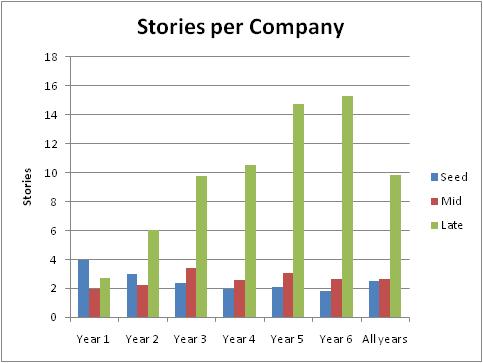
While I was doing my research to cover Quipster, I started to take notice of a new trend in tech media.  Coverage of young and emerging startups is falling behind at a frightening pace.  I am not the only one to notice.  Recent research found Ten companies now account for 30% of TechCrunch coverage.  The image below illustrates the heavily weighted coverage of late seed or large companies, increasing each year.  It is understandable why major outlets cover Apple, Facebok and Google more often, indeed they drive many more pageviews. But it begs the question: Is this raw startup journalism or have Techcrunch (and the like) really become the “New” Old Media?  Has it become all about more page views?

I am a long time Business Insider and TechCrunch reader, but these trends are cause for worry if you are an early stage founder.  Below are a few observations, straight from Guest contributor Mark Goldenson:

1.  Companies funded by a prominent investors get covered twice as much

2. TechCrunch writers do play favorites

3. TechCrunch’s long tail is now 14 times longer but the fat head is 24 times bigger

Guide The Child

My view of the purpose of media is to be a guiding light in helping emerging technologies and companies acheive top of mind with the general public.   Covering young startups with facetious mocking does not do those numbers any justice or help pull startups forward.  Media outlets such as TechCrunch (as well as this one, Business Insider) influence the general public more than they know, and covering a new company with a 3 paragraph Chide probably does more harm than good for an early stage startup.

TechCrunch, Business Insider and the entire startup community – pay attention to small startups like Quipster and remember Twttr was once is the same position.

Everything In Business is a Test

Test.  Test.  Test.

Everything in business is a test.  The good ol’ days – writing a business plan, pitching for investment, building out a product for the exact market stated in the business plan, launching the product through a large budget Launch strategy – those days are over.

As an entrepreneur, you should now consider yourself a scientist.  Your job now is to run as many tests as possible, with the least amount of expenses to find mass adoption of your product.   The tests should start in the ideation phase and shouldn’t ever end.  The single worst thing you can do now as an entrepreneurial is have one idea and do everything you can think of to bring that specific idea to market.  Start with a problem area and test ideas around it.

Test for consumer problems

What problems are present in which you can bring a solution to market?  The best businesses solve a problem consumers have (or didn’t know they had but now realize life is better with your product).  I heard the other day: You cannot just ask consumers what they want – they do not know.  But if you observe and test them, their actions will lead you to holes that need to be filled.   Inefficiencies will present themselves.  Great entrepreneurs see these inefficiencies early.

Test for Product/Market fit

tubesOnce a problem is found and a solution has been built, the real work starts.  Take it from me, your first attempt will not be the golden fit and you will have to re-align somethings.  Call it pivot, call it whatever you want… it will happen.  I don’t know why we are making such a big deal about pivoting, great entrepreneurs constantly pivot their ideas until they get the right market fit.  Ask Edison, he pivoted like 5,000 times…

Test for Business model

How to make money is the question every company must face.  I believe this is an area a startup must test early and often.  This question should never have just one answer.  Small tests on business model, payment options, advertising (I know… I know….) and other methods of creating revenue.  It’s just a test.  Do some A/B testing on a select group on users.  Release a payment option to 1% of users and see what happens.  You might just discover your next big innovation and create a new billion dollar industry.

Test for Perseverance

Ask any founder of a startup (still running) and they will have hours of talking on the subject of perseverance.  The startup experience will test you and your perseverance.  Just don’t give up.  Do anything you can think of to put off the quitting of your vision.  Read Delivering Happiness by Zappos Tony Hsieh to get an idea on Perseverance.  I had no idea they went through the hell they did with their startup.  You need to read this book if you are a founder of an early stage company not knowing if the future is bright or bleak.

Test for leadership

I laid out the importance of brand and company leadership expansively in my last post The One Thing That Separates Apple From Microsoft.  Suffice it to say I think this is the most underrated, under-talked about, overlooked but most important aspect of building out your long term brand.  You must answer he question: Why are consumers going to want to use my product?  Believe it or not, it will be due to the leadership of the company CEO.  Test your leadership skills early and often to find the right connection with general consumers.

Test for Funding

Investors don’t tell you this, but they are testing you at every stage of the game.  First time you meet them at a “social event” they are testing your IQ and your EQ (your social intelligence) to see if you are someone they would even want to take an interest in.  Next time when you meet for a pitch, they will test your concept and your perspective on the market.  When they don’t call you back, they are testing your perseverance.  When they give you money, they are testing your ability to turn X into 10X.  If you pass that test, you will most likely be able to get money from them anytime thereafter.

I could go on… but I think you get the point.  If you thought your tests were over after graduation, think again.  They only have just begun.  Embrace the test.

Image courtesy of Flickr user Canyon289

If You have a Website, You Need SkyGlue

SkyGlue is a service that helps you understand what your users are doing on your site.  It works with Google analytics and enables individual user tracking and simplifies Google Analytics event tracking. It automatically tracks links, downloads, form interaction activities, buttons and many more within your Google Analytics reports.  SkyGlue’s patents pending technology is the simplest web event tracking tool currently available on market and one that any website owner needs if they want to increase their traffic.

Eric Huang, founder of Skyglue, says the idea behind SkyGlue came with several iterations to a previous idea.  “Before our current product, our idea was to build a standalone web analytics service for user retention analysis. We developed a prototype and had some beta users. What we found out is that it is very hard to have the users spend time updating their websites to collect data.

SkyGlue is a recent graduate of the startup accelerator Founder Institute.  The FI program is a 4 month long incubator meant to help first time founders get a business established and an initial product into the market.   The process is grueling and only about half of the accepted entrants usually end up fulfilling the requirements and graduating from the Founder Institute.

After completing some market research Huang found most of the high-end web analytics solutions, like Omniture, require consultants to add tags to websites to collect detailed user activity data.  According to Huang,” Using these services is an expensive and time-consuming process.  For small to medium websites, they use Google Analytics, but they usually just use the default pageview tracking setting without tracking those high business value click events, such as form interaction, white paper downloads. If they don’t measure them, they cannot improve them.”

Our goal is to make advanced web analytics extremely simple to use and easy to maintain.  We want to help our customers gain better insights into the behavior of their online users . – Eric Huang, Founder SkyGlue

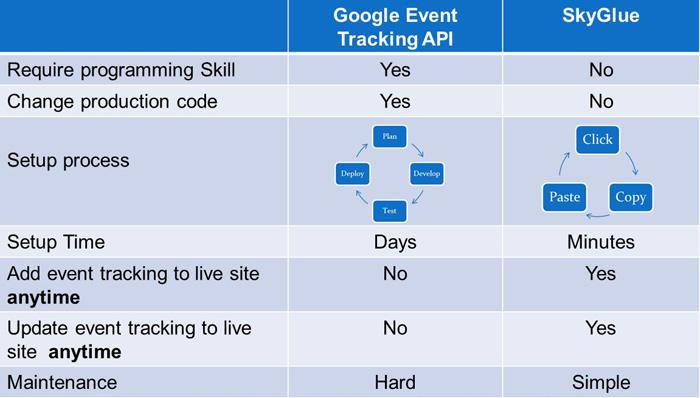
Huang notes website owners can just use Google Analytics, which is by default only measuring papgeview tracking and basic user segmentation.  But without SkyGlue, their Google Analytics data is not actionable, and thus incomplete.  Google Analytics has event tracking but needs programming APIs and code change (tagging) on all related links and buttons and other items usually needing to be completed by developers.  SkyGlue lets users easily measure high business activities and find ways for improvement all with just embeding a line of code.  The major difference between Google Analytics event tracking API and SkyGlue are shown on this chart below.

It took a while for Huang to find this specific need.  “When I was in the Founder Institute Seattle program I spoke with various mentors and my beta users and it became apparent the idea for making advanced features in Google Analytics easier to use will address a bigger market.”  Eric adds that with SlyGlue, it will also be easier for you to attract more users with spending less money.  In a sense, SkyGlue addresses the pain-point of streamlining advanced web analytics – knowing what users are actually doing on your site.

When you sit with Eric, you get a sense he knows what he is talking about.  Not surprisingly, he has a Ph.D. in computer science from Indiana University – Bloomington with a focus on distributed computing and cloud computing.  After graduating IU, Eric joined Microsoft and became the 1st developer in Azure AppFabric ServiceBus team.  He was one of the key early-stage contributors of Microsoft cloud service from incubation to V1 release.  Prior to that, Eric worked for IBM Research and SONY.

With the current version, SkyGlue can automatically detect and track most website events that are of interest to you.  Individual user activity tracking is automated as well.  They have a good list of beta users that have provided tremendously valuable feedback. SkyGlue is currently in private beta and is looking to expand their user base and will soon implement an initial business model.

It’s free for a limited time, so go here to get SkyGlue for your site.

Find Your Match With Founder2be

Here is a common problem plaguing many entrepreneurs today:  I have a business idea, but I need to find someone with complimentary skills to help me start the company.  In fact, yours truly has this problem currently.  Since we know a big chunk of the success of a start-up is directly correlated to the number of founders, this is a big deal.  Local tech functions like meet-ups, conferences and founder dating are all good ways to meet a co-founder but sometimes if just feels forced, ya know.  Kinda like you’re looking for a one-night stand or something.

Enter Founder2be, a site which could be referred to the match.com for entrepreneurs.

From their website:

Do you think you need a lot of money first for your startup? You don’t. What you need is the right co-founder with the skills to get started. Everyone knows something, and nobody knows everything. Founder2be helps you find the co-founder you need to start up your business. Take the first step today!

I love the idea and have signed up for the service.  When you sign up, you have the option to register or just connect via Facebook.  Once connected,  it walks you through a few basic questions:

1) I am looking for… (someone to help me with my idea or to join someone who has a good idea)

2) The type of co-founder I am looking for…

3) Expectations of co-founder availability

4) choice of where they live

And then you fill out some details about yourself and you are ready to go.  The entire process took less than 5 minutes.  Since I just signed up and starting using the service I cannot relay any results back to you yet, but I love the idea and would recommend any founder who needs to find the other piece of the puzzle to give it a shot.

I had a chance to recently connect with Oliver Bremer, co-founder of Founder2be.  Interestingly, he was in the exact same situation when he realized there was a hole he could fill.  “This got me thinking that I cannot possibly be the only person in the world to have this challenge.  Although initially I had a different idea, I eventually decided to set out and solve the co-founder finding problem instead. And that’s how Founder2be came about. After some chicken and egg of finding a co-founder for that. Which was pure luck.

I love it!  Innovation is the mother of all necessity.  Here is a brief interview with Oliver:

1. Describe and explain Founder2be in a few sentences.
Founder2be is a co-founder matching service. Everyone knows something, and nobody knows everything. Founder2be helps people find co-founders with complementary skill sets. After all, most successful start-ups get started by teams of two or three, not solo entrepreneurs.

With the Founder2be Global Alliance Program, we connect prospective entrepreneurs with incubators and other alliance partners to help them succeed by getting the help they need locally, whether it is mentoring, work space, pitch training, or access to funding.

2. How did you come up with the idea behind Founder2be?
After 10 years in corporate life, last year I finally had a great idea where I thought: ‘Now it’s my opportunity’ to start a start-up. Truth is: Now I can’t even remember what the idea was, and that is because I never got started. Why? Because I don’t know everything and I failed at the step of finding a co-founder. Thinking I can’t be the only person wanting to do a start-up with that problem, I decided to focus on the co-founder finding problem instead, and here is Founder2be.

3. The Founder2be team and background.
Founder2be was co-founded by myself and Frank Haubenschild. My background is M.Sc. in CS, worked for Nokia until 2007, then for Strands until end of last year. Then quit my job specifically to focus on Founder2be. Frank studied CS as well, and has been working as a SW Developer ever since, mostly in the automotive space.

We took on two interns for this summer as well who are helping us with outreach and community management and get credits for their course work.

4. Can’t Entrepreneurs just go to local events to meet people? How do you differentiate?
Absolutely, and we do want people to go to local events as well. We are not so naive to believe that you meet someone online, click on a button, and that’s all you need to start a great start-up. There is many more things. Exploring your options and finding a great co-founder is the first step, and that can be done online very well.

Think of it similar to online dating. Match.com does not replace bars. People don’t get married clicking ‘Yes, I do’. They go on a date and meet the other person in real life first – or at least I hope they do 😉 And that’s very similar for finding a co-founder.

And that’s why we launched the Global Alliance Program, where we connect the co-founders meeting each other, forming start-ups, to organizations supporting start-ups in the real world. The Global Alliance Program has partners on four continents now and we are looking to extend the network to more countries and expand within the countries where there is already partners.

5. What is Founder2be’s current status, and what are your immediate next steps?
We are now at the stage where over a thousand people have signed up, two companies have emerged from co-founders who met on Founder2be. One of them is Ziliot.com, the other one is still in stealth mode. The Global Alliance Program comprises around 20 partners from four continents.

Our ultimate goal for this year is to see 10 start-ups get started by co-founders who met on Founder2be. In order to do so we are focused on growing the user base, connect co-founders with each other, and build out the Global Alliance Program further.

In 3 months, over 1500 people have joined and one company has come out of it with a second one is in stealth mode.  I would say, even if nothing else happens… history has been made.  I am really excited to see how Founder2be expands to help many more partnerships come together.

Why Distribution Will Make or Break Your Company

Yesterday, as I was sitting with a friend talking about his early stage company, it hit me.  We were reviewing what he has built, where he is currently and what he is looking to do next.  It was becoming more obvious to me as the meeting went on he was experiencing a common startup dilemma: Great product, No distribution.

Here’s a little background:

This founder has an incredible technical history.  He has worked for very a large tech company here locally and knows his stuff. You can tell he is quite intelligent.  His product is a bit over the average person’s head, more enterprise and B2B focused.  His target customers are business owners and website owners.  He has vast domain knowledge and understands where his product will benefit his users.  He even has a beta version with a small initial user base.   I told him he is in a good situation but has a few big hurdles to figure out.

The problem is he is technically bent, not marketing bent.  Technical people think all you have to do is build a great product.  Although that is true, marketing people understand the positioning of the great product is what determines how big you will grow as a company.   Being foreign, he lacks the clarity in speaking English required to deeply explain his product.  This is fine, but since it is just him right now he cannot depend on a sales oriented approach.  His product is not inherently social, so he cannot rely on word of mouth.

This person is not alone.  I was a part of the recent Founder Institute Seattle winter 2011 class and encountered many companies with similar challenges.  Highly technical team.  Very interesting product.  Solves a unique problem.  But no clear distribution model.

So if you are not building the next social sharing tool, how the heck do you find the vehicle to expand your user base?

Find distribution channels.

1.  Where can you get a free listing or publicity?  There is a magnitude of places on the web where galleries or showcases of applications bring  additional tools to product users (think Google apps).  Is your product is an add on, a second generation tool of an existing product, or interactive with a larger ecosystem?  All these allow you to be highlighted in galleries supporting the main ecosystem.  Find ’em or you will wither on the vine.

2.  What major company needs your product?  One of the best methods to major distribution is to land a very large and visible company as an initial customer.  Maybe you allow them to use it for free with the agreement they will promote it.  Maybe book them with a very large price tag to help you float for the next 6 months.  Whatever the agreement is, make sure you can find a market leader who will provide the credibility necessary for others to follow.

3.  Social Proof.  Although your product is not inherently social, you can still figure out ways to bake in social proof to the everyday use of your product.  It’s the old hotmail bit… every time an email message was sent, hotmail automatically added to the end of each message “Get your private, free email at http://www.hotmail.com”.  This idea is still one of the best marketing concepts every created.  Figure out how to implement it your own unique way.

4.  Find the Influencers.  The main thing I tried to nail home with my friend was he needed to find the one percent, the main target users who will become the influencers for his product.  Together with the above mentioned ideas, this is how you integrate yourself into the proper distribution channels.

And to bring it home, here is the only way I could describe it to him.

Dude, I just started blogging 2 weeks ago.  When you start a blog, you begin writing with the knowledge that only 20 or 50 people will be reading your stuff.  I quickly realized this and decided I needed to ink a few distribution deals if I was going to grow my readers.  I reached out to John Cook at Geekwire.com.  He like it and got me on there.  I reached out to an editor at BusinessInsider.com.  She liked it and hooked me up.  Now, thousands of people are reading my stuff and it is starting to grow.  People are adding me on Twitter like crazy (that was your que) and now they are connected to me independent of those resources.  Without those distribution deals, I was dead in the water.  You need to do the equivalent of that with your product or you will never grow.

It’s A Tight Balance Between Psychosis and Brilliance

You know you are an entrepreneur when you say…

I have no idea when the next paycheck will come in.

This can be the scariest thing in the world… just hold on.

I have no idea when the next round of funding will come together.

Your dream could end at any moment… just hold on.

I have no idea if my business will even be successful.

How are you supposed to know what will happen a year from now… just hold on.

I have no idea who will be the next engineer to help build my product.

Don’t worry, you can barely embed youtube code into your wordpress blog… just hold on.

I have no idea what I am actually doing, am i crazy?

Cat chase tail, cat chase tail, cat chase tail… just hold on.

You also know you are an entrepreneur when you say…

I know so deep in my heart this is the only direction I want to go.

You must trust your gut… now quit that job and start living how you’ve always wanted to.

I can’t stop reading posts and articles about other startups, I need more!

You have a disease; it’s called entrepreneurship… learn to live with it and just effing do it.

Holy crap, I do know more about Google, Facebook and Twitter than any of my friends!

That is what happens when you can’t stop reading… now go find another engineer

Every time I start writing about technology or startups, great things come together

This is one of the biggest signs you are operating in your strength zone…. follow it.

Entrepreneurship is a tight balance between psychosis and brilliance.  Balance it.

What Any Startup Can Learn From Starbucks

Update:  This post was republished on GeekWire.com

As I drove past the Starbucks headquarters today I glanced up at their big green logo.  Instantly I thought “man, what a iconic brand.”  I mean, when most people see a white coffee cup with green letters, they know it’s Starbucks Coffee.  Then I thought “how did they get there?”  Here’s what most forget: Starbucks was a startup at one time.   They had to start somewhere and work hard to establish this incredible brand.  Although I do not know Howard Schultz personally (someday I hope to), it’s obvious he understood a thing or two about creating an iconic brand.  Even if you do not wish to build a business to the size or likes of Starbucks, here are a few things to keep in mind as you grow your company.

Headstrong Founder

Howard Schultz is one of those entrepreneurs you read about in history (or Amazon) books.  He grew up in Brooklyn.  He was the first person in his family to go to college.  He started as a salesman selling Xerox equipment.  Interestingly, before he founded “his Starbucks’ he joined the a small coffee company named Starbucks.  Then after differences in vision he left to start his own coffee company, and as fate would have it he ended up buying the original company’s assets and ultimately named his company Starbucks.  The vision in question?  Changing the way coffee was enjoyed here in The States.  That is no small task and probably why the original Starbucks owners wanted no part in it.  You better believe he encountered and fought through more than a few obstacles along the way.  I will not list them here, but I would recommend reading his book Pour your Heart into it – it’s good.

Founders of startups need to, like Schultz, be headstrong.  It isn’t always going to be fun and roses.  In fact, based on your odds it’s down right impossible for you to take your nascent idea and build a fledgling company around it.   My opinion is most founders quit before they even get started.  Maybe you need to seek out more initial customer feedback?  Maybe you need keep trimming the fat to find your MVP (minimum viable product).  I don’t know.  But if Howard Schultz was sitting across the table from you right now, here’s what I think he would say:

You must be headstrong in your passion, desire, focus, product, marketing, communications, leadership, and recruiting.  In all those things, be headstrong and dead set on doing what-ever-it-takes to make your vision come true.  Anything less will be your company’s demise.

larger Purpose

Early on Starbucks set out on a journey with a larger purpose in mind.  Schultz realized very quickly the coffee industry, although a relatively large market in the US at that time, had become stale.  People were mostly consuming coffee in their home from a tin can.  Schultz knew they could take something familiar and transform it into something altogether new.  They wanted to create a third place.  Not the home.  Not the office.  But a third place.  Somewhere you could go to hang out, drink coffee, talk with a friend, have a business meeting or read a good book.

It was there, at this third place, they figured people would come to be a part of the community.  And drink coffee.  They made this purpose (the place) bigger than their product (coffee).  And it worked to the tune of a $27b market cap.  Go ahead, think about our world without coffee shops.  I am writing from one right now, and it’s all do to Starbucks.  Thank you Howard.

A startup – no matter their industry – needs to find their greater purpose.  “Why on earth are people going to use your application over the millions of other things to play with at this moment?” You must be able to make it clear and concise why their life will be better when they use your product.  I believe this comes together when the overall purpose of your product or service is greater than just making money (for you).   I can’t tell you what your purpose should be; it’s your job to find it.  I feel so strongly about this that if you can’t state your purpose in one sentence, I would recommend finding something else to do.  Because, if you can’t clearly state the purpose of your business how do you expect others to figure it out?

Always Get better

We all know the story, there’s a Starbucks on every corner.  With more than 15,000 stores in approximately 55 countries, it’s fair to say Starbucks won the game.  For a while there I think the executives were also saying the same words behind closed doors.  As the economy collapsed and things got tight, Howard has some decisions to make.  He closed some stores as well as doubled down on their core competencies.  He understood the notion that regardless of what you have done up to this point you need to always get better.  Yes, Starbucks was a successful corporation.  But if not careful, successful corporations are susceptible to failure due to their own hubris.  Howard nipped this in the bud and brought back the idea of continual improvement.

This doesn’t just happen to large corporations.  It’s all relative you know.  To be successful, startups need to continually learn new things and aim to get better as time goes on.  Launching a product and seeing a few million downloads is only the starting line.  What happens after people use your product once?  Ten times?  Two years? You need to get better.  Better analytics to study usage patterns.  Better customer service.  Better executives.  Better management processes.  I am sure there a lot more things to get better at, but whatever it is… just get better.

This is what I thought as I drove by the Starbucks headquarters today.  Hope it helps.

The LOCQL Landscape

Man, what an exciting time we are living in right now. We are starting to see another aspect if the web explode with innovation – the local landscape. Local web applications are infiltrating almost every aspect of our daily lives – searching, shopping, taking pictures, and now Questions and Answers. Question and Answer sites (Q&A as they are referred to) have been around for quite some time, but only recently have entrepreneurs started innovating on the core concept: You ask a question, someone answers it. Startups such as Quora, Hipster, Travellr, localuncle, and many others are recreating the Q&A space for the era of social connectivity.

Quora

Quora, for example, founded by former Facebook employees, aims to build THE go to application for wisdom and knowledge. The cool thing about Quora is you can follow well known people as they continue to add their knowledge to the site. Quora seems to be the emerging leader of these newly minted social Q&A sites. Thus far they have maintained their focus on the relatively smaller web tech community of Silicon Valley. Questions remain (pun intended) if Quora can uphold their quality of answers as they grow in quantity of questions.

Hipster

Then there’s Hipster. Quite frankly, no one really knows what this little Q&A startup is doing. If you go to their homepage you are greeted with a prompt to search questions and answers about SXSW, a conference held in Austin, TX every March. Isn’t it almost June? One thing is for sure, they know how to generate PR and attention. I guess we’ll just have to keep an eye on this one.

But what if you added your specific location to asking a question and receiving an answer? Location based Q&A opens doors we only dreamed of just a few short years ago. “What if I could send into the ether a specific question about the city I just landed in and BAM, one minute later I receive an answer from someone I don’t even know who lives here?”

LOCQL

Enter LOCQL, a Seattle startup some refer to as “Foursquare Meets Quora”. These guys smartly put together two basic premises; 1) everybody knows a little bit about something and 2) location information always make something more valuable. Marry those together and (at scale) you have a living, breathing repository of location relevant information based upon where you currently find yourself. Isn’t that the basis of mobile search? When I use my iphone for search, I am generally looking for a restaraunt, coffee shops, a retail store, an address, directions, and many other location based information. Additionally, what if someone infused a solid Q&A application with mobile commerce capabilities? Mark my words, I believe this space will yield a big hit.

I caught up with LOCQL co-founder Robert Mao recently and asked him a few questions about his company and where it’s going.

Describe and explain LOCQL in a few sentences.

“LOCQL is a location based question and answer site that helps people find answers to places.
LOCQL uses game mechanics to enable social power to find the missing links between the user’s queries and the places in the local landscape they are searching for. Hopefully will be able to bring the local search and location based search to a higher level”

How did you come up with the idea behind LOCQL?

“The idea for LOCQL came from our life experiences, as International travelers, we traveled to many different places, relocated our home’s several times in different countries. There are so many ‘best kept secrets’ only local people know about, those who’ve been there just know it. Unfortunately, without a service like LOCQL, you won’t be able to find it from the web, nor you can find it through search engines. We realized people are increasingly looking for answers about places, according to Bing, over 50% mobile device originated search queries are about a specific place. Google’s Marissa Mayer recently mentioned 20% of all Internet search is about places! In those queries, only around 30% can be solved with today’s information retrieval based search technology. A big pie is missing! We are aiming on make this better.”

Yahoo Q&A has been around for a while. Why attempt a new Q&A site?

“Q&A has been around for a long time, even before search engine become popular. Q&A is one of the most natural modes of communication for human beings and we believe there are still plenty of space to make it even better. As you can see, Yahoo Answer has been there for such a long time, Stackoverflow.com become the most trusted source for the developer community, and the recent rising of Quora.com illustrates how a better designed Q&A can be incredibly attractive and useful. When we began work on LOCQL, none of the Q&A site were specifically for location related questions, or most of them just treat location a name or a category. In our point of view, location answered questions are very important and since they are increasing in frequency they deserve special attention.”

With a lot of competition, besides the location aspect how do you differentiate yourself?

“We do it quite differently, we deeply believe in “Less is more” principle. We do less, so we will be able to provide a better user experiences, especially when designed for the location/place related Q&A. We try to only solve a smaller set of problems than most of the existing players, so we can be much more focused. Another very interesting angel we try to solve the problem is gamification. “Be fun” is another principle when we design our product. If you try LOCQL you will find we have many social game elements build in, in fact some part of the service are purely enjoyable games for you and your friends. No matter if you want to travel, you want to move your home, or find more interesting things around your local community, it’s FUN! We try to make the service fun, playful, and at mean time, so it can capture some value and be useful at the same time.”

What is LOCQL’s current status, and what are your immediate next steps?

“We just opened up to a wider beta. In the first phase, we only let in around 150 test users in order to verify a few of our assumptions and help us understand this space better. We are now more confident and are accepting a wider group of users to try our product, also we released our gaming mechanic in this new phase, so LOCQL will be the most enjoyable Q&A site out there. It’s not just boring questions and answers.”
Image courtesy of of Flickr user Alexanderdrachmann.

Why I Cry During Horse Racing

I have always been a sports fan.  I like soccer, basketball, baseball, football, hockey, tennis, UFC.. you name it.  Although I was not raised around horses and the track, horse racing for some reason draws me in.  There is something about it that is so intriguing and attractive I cannot help but watch.  Today is the Preakness Stakes and I recently realized how similar horse racing and the startup ecosystem are.   Maybe now I am starting to understand why I am so attracted to this sport.

The winner is almost always a surprise

Once a year the Triple Crown tugs at the heart of the sporting community.  As sports fans, deep down we want to root for the underdog.  We want to see an upset.  When those 20 horses line up at the starting gate we have no idea which horse will actually step across the finish line before any of the other horses.  Yes, you can take the odds.  But how often do those odds actually play out accordingly?  I use this racing analogy because success as a startup is pretty much exactly the same as success on the race track.  Starting out, we have no idea who will emerge as the “winner”.  Talent, funding, product, iteration, attitude, economic climate all influence the outcome of the race.  It is always a surprise, isn’t it?   MySpace looked like the breadwinner only to have Facebook clean its shorts around the second turn of the race.   That’s incredible.  Who knew?  I guess that’s why we play the game.

The winner almost always has to adjust their tactics mid-race

If you watch any horse race, you will notice the race is actually won by the jockey, not the horse.  The jockey (the CEO) observes the dynamically changing environment, quickly calculates their options and immediately decides to direct the horse (the company and product) towards the best route for victory.   This is no small task and requires tremendous skill to perform under pressure.  They learn to Pivot at the best possible time.   The word pivot is probably used way to often to describe the transition from one strategy to another in an effort to move a business forward.  Yet I think it is such a great word and such an important tactic.  Great Leaders understand when conditions have become suboptimal, and possess the wherewithal to quickly make necessary changes in order to be successful.

The winner almost always has a storied past

One thing is for sure when I watch these events.  I will tear up.  I tear up more during “extraordinary feats of competition” than any Rom-Com (romantic comedy) that I must watch with a girlfriend.  Why would I tear up during a horse race?  I tear up because the obvious time and effort, blood, sweat and tears put in by the jockey, the breeder and the horse.  There is always a story of triumph over insurmountable circumstances.  And they didn’t quit.  I am so moved by extraordinary accomplishment, maybe because I hope I will one day experience the feeling.  And just as they put in this effort, so does the startup founder.   It is truly an amazing accomplishment to take a seemingly impossible idea and turn it into a network of over 600 million people.  Or leaving Russia as a child for the USA to eventually pursue your dream and become a successful entrepreneur.  Or, after almost 10 years of grinding away not being the darling of the internet, going public and watching your stock double the first day on the market.  For that matter, launching any product and achieving a profitability in-s0-much-as just enough to sustain your business operations.  Those are great stories worth a tear or two.

And I guess that is why I like Horse Racing.