It is 2011, can’t we be done with this hideous banner ad crap. Here’s Thanksgiving Day Seattle Times Homepage with banner ads for Video Only taking over the screen. Are they stuck in 1997?
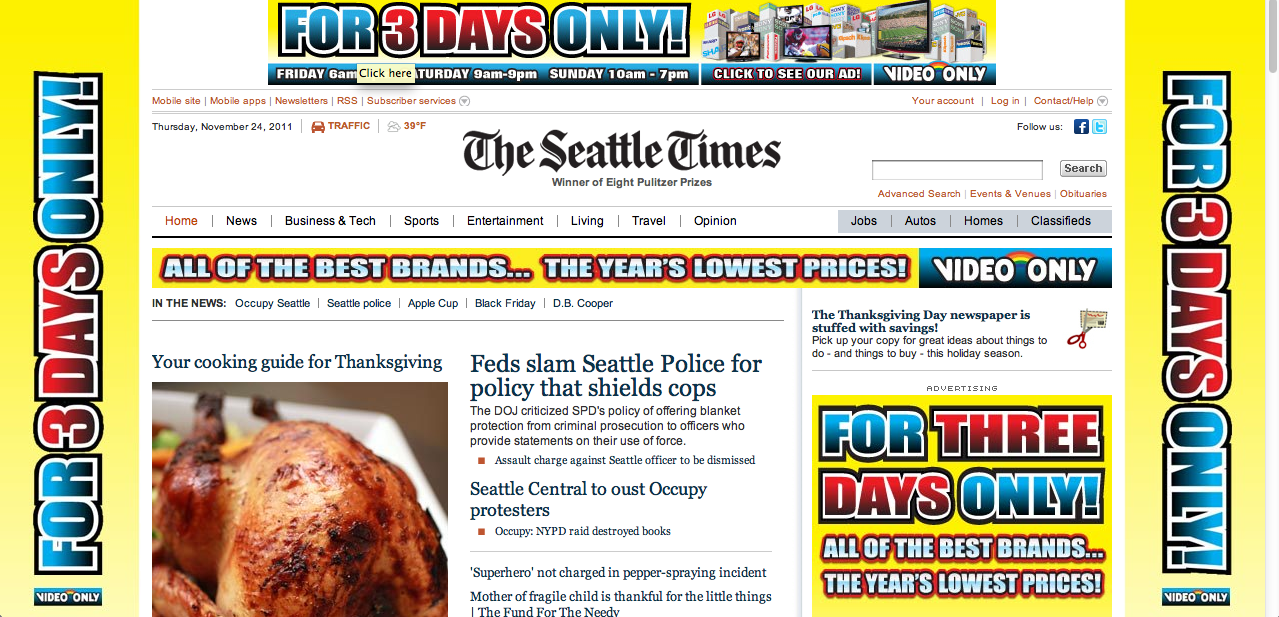
It is 2011, can’t we be done with this hideous banner ad crap. Here’s Thanksgiving Day Seattle Times Homepage with banner ads for Video Only taking over the screen. Are they stuck in 1997?
Here’s a great talk from Investor Roger McNamee at a recent TEDx. It’s very much worth your 20 minutes.
No doubt he local space is heating up. We are starting to see an all out war and currently there are 4 major players lining up their guns and taking aim on the local marketplace.
Groupon recently went public on the Nasdaq and is the undisputed king of daily deals, creating a new movement in local commerce known as the group coupon. Yet things are not all rosy as they also created quite a bit of controversy as they approached the finish line. Their numbers are greatly scrutinized and they can’t seem to shake questions regarding the validity and sustainability of their current model. Groupon no doubt made a significant splash in the local space, but do they have what it takes to transform our daily consumer lifestyle?
Google’s eyes have been on the local economy ever since they realized a critical mass of searches are local in origin. Early on they knew local was a goldmine, the tough part has been designing products which bridge the gap between local consumer and local merchant in a way that adds value for both. Google Places, HotPot, the purchase of Zagat, the failed acquisition of Groupon, and now Google Offers are all attempts to make a play on the local marketplace. But to date it is hard to argue they have made any significant progress in solving the local market conundrum. Will they do it?
EBay, the buyer/seller marketplace who has lingered on the outskirts of the web for more than a decade (and hinged earnings on a payment platform) looks to be emerging as a solid player in the local marketplace. The combination of a number of acquisitions have placed them in a drivers seat helping power the next generation of location specific platforms. Milo, Magento, Zong and Where all offer unique value propositions that when grouped together create a strong combination – and a strong competitor to the Googles and Amazons of the world. This is one to watch…
The king of worldwide online commerce is Amazon, and I guarantee they their sights are set on the last mile of the web – the local market. Their $175 million investment in LivingSocial seem a lot like a “look and feel” investment as they watch how the landscape is taking shape. Make no mistake, the leader in worldwide e-commerce would love to be the worldwide leader in local commerce as well. The question is, do they know how to do it in the way the everyday consumer will appreciate?
Ultimately, it is nearly impossible to predict who will eventually win out in the local market. Remember, Google was late to the search party…
Another valid question is: will any of these major players hit the home run or will a new, tremendously different but effective startup with a better combination of commerce and communications transform our everyday consumer experience?
Share your thoughts in the comments.
As conversations evolved and our company matured over the last few months, an interesting theme started to emerge – we are more than just a platform for ordering. Ordering is just one action a customer takes when they interact with a local merchant; thy also communicate, purchase, refer to friends, find information. We realized an order cannot happen unless a connection has been established. Once a connection is established, communication usually follows. In that vein, we have decided to change our name to Seconds.

Frankly, Seconds is a much more brandable name than Order SM. Throughout our search for a new name we kept coming back to the themes of repeatability, quickness and efficiency. Seconds brings to mind “wanting more” and “very quickly”, two very strong foundational characteristics to build a consumer oriented product around.
Our entire concept has revolved around repeatability and loyalty. If you like a restaurant, coffee shop, taxi driver, or any other product or service, it’s a strong possibility you want to go back and repeat your experience. With that in mind, we created what was originally named Order SM. We wanted to make it dead simple to communicate and transact again with a favorite local merchant. Now, the term Seconds will be branded as a way to connect and quickly repeat your customer experience. Use Seconds to quickly have that non-fat latte you like so much (and order every single time!)
The Realization of the web only speeding up (in fact, our lives seem to be increasing in speed) was also a cornerstone to the name change. We envision a not so distant future where a user checks Seconds to see the local community activities – from coffee house purchases, to the latest taxi cab whereabouts, to what’s the hot happy hour tonight – all in real time up to the second. You now see where this thing could go….
Functionality of the current product is not changing and the only enhancements will be cosmetic in nature. A new logo where the old ones resided, replacing all Order SM content with Seconds content will be most of our enhancements. But, with this new branding comes an incredible new opportunity – a consumer facing experience. Be on the lookout for new developments in what will eventually become a whole new local consumer experience.
Let’s face it, life as a consumer today can be somewhat frustrating. Given the advancements in mobile phones, the social web and auto-payments, by 2011 one would think interacting with local merchants would be a bit more, shall I say… enjoyable.
Yet here we are, still required to actually think about where we are going to eat, look up the merchant online, make the call, hope they answer, talk to the person (with possible language barriers), repeat the same thing I told them last time, read each number of my credit card and expiration date out loud, and then wait for my order with no idea when it will be ready.
Ever sit back and watch people as they are waiting for food in a restaurant or service at a local merchant? You’ll notice heir heads are down, palms out and thumbs moving. Most people I speak with seem tired of wasting precious moments of their life standing in line or being idle waiting for something; inevitably they resort to grabbing the closest thing they can find for distraction. Indeed, they are using some device to surf the web, text a friend or read an email.
In light of the recent $50 million Series E funding for GrubHub and all the hoopla over the daily deals space, I thought I would evaluate the state of the local commercial market and the current web options. Semil Shah does a fantastic job of starting a conversation about what is emerging on the merchant side of the equation, but since the local market is quite deep with numerous verticals this post will focus on the local restaurant and ordering experience from an end consumer point of view.
My goal is three-fold: First to describe where the market is currently; second to illustrate the inherent problems, and lastly to give an idea on the direction of where the local space is heading based on consumer and general societal trends.
The Current Local Consumer Experience
The current local consumer experience can be summed up by the word “discovery”. Observing the options established thus far, most are built for a consumer to use when they are looking for a “new ” food experience. Apparently we have become obsessed with creating a plethora of ways to find the new, whatever it may be. Also interesting is the realization that most are already antiquated because they were designed with the online consumer in mind with little consideration of the mobile experience. This is why, as you will see below, web based ordering and communications with local establishments has yet to experience mainstream adoption.
Online Ordering
Daily Deal Sites
Table Reservations
Local Recommendations
Social Discovery apps
It is obvious with a little research in the online ordering space for instance, a great chasm still exists. There are about 500,000 restaurants in the U.S. and 90,000 in canada. About half are chain (franchise) stores. About half the chains supposedly have some kind of online and/or mobile online ordering system (custom apps) but as we go into these stores to inquire about online ordering, nobody at the store knows what we are talking about. SnapFinger has over 500,000 restaurants in it’s directory but you can only use it’s online ordering for about 30,000 of them. Grubhub (including it’s aquisitions –> CampusFood and AllMenus) has about 300,000 in it’s directory but only about 25,000 you can use online ordering. Eat24Hours estimates it has about 12,000 signed up for online ordering but when you check their directory there are lots and lots of restaurants listed as “closed”.
Going further, the user experience with current mobile ordering apps is atrocious. Here is an experience I had recently during a trip to San Francisco in which I reported back to our team . (specific names have been removed)
Mobile Ordering App A. To put it bluntly, they sucked. And their execution, amongst many others, is why “mobile commerce” has not taken off. The experience is just terrible and based on their current model there are just too many wires left unconnected. When I got to (local restaurant) I asked the guy at the counter if they accepted mobile ordering and payments and he said NO with a questioning look on his face. Interesting, I thought… because there they were right on the app.
Using a nicely designed mobile app I was able to browse many different cities, restaurants, categories, menus, etc.. I found (local restaurant) and after minutes of clicking and scrolling I ended up trying to buy a “beer” (didn’t allow me to actually determine what kind I wanted) from the mobile app as I sat right outside the restaurant on the patio. Yet, after going through the entire process and once I clicked purchase…. nothing happened. Pay $4 and nothing else? No one communicated back to me and no one brought out my beer. Seriously, nothing happened! Weirdly, I received a message from ______ through the app the next day saying “Hi Nick”. I responded with ” Hello” and then nothing else came back. This experience was just ridiculous….
Amazingly, this not-to-be-mentioned mobile app is being touted as a hot new app with great potential. Unfortunately I must disagree. The current online ordering websites are not any better, here is an perspective from a recent correspondence I had with a user of an online ordering site.
“…Should mention one more thing about online ordering at a restaurant with lots of chain stores. Most of the time you have to go to the brand (i.e. Subway, Five Guys, Pizza Hut, PF Changs, etc.) home website and then enter a zip code or some kind of locator information after which you find a store to order from. It’s not a local experience. It’s a top down kind of thing. I don’t think patrons like that. If I want to order something at the PF Changs in Bellevue, why do I have to navigate through all the PF Changs around the world? I’m in bellevue. Just show me the bellevue PFChangs.
So, bottom line is the only tried and true option for a consumer is to just look up a phone number and call ahead or show up in person – ya know, what we did back in 1970. This is a growing hassle and something needs to be done.
The Everyday Consumer
There is a certain disconnect right now in respect to 1) how we live as consumers and 2) available mediums for local merchants to connect with customers. It might help to review a few obvious aspects of the local consumer experience that, when brought to light, will allow us to discuss what is now possible. When I closely evaluate someone going about their everyday life I see peculiar phenomena not currently leveraged by technology. First, people frequent the same places on an ongoing basis. They go to the same coffee shops, restaurants, retail outlets, etc… you get the picture. We are creatures of habit and if you stop for a moment in your own life you will start to see how you do this as well. Second, at these places we mostly order the same things – lattes, pepperoni pizzas, t-shirts… you get the picture. Again, we are very habitual creatures. Think about what types of things you are ordering repeatedly… Third, people love to be identified, called by name and have “uniquely personalized” experiences. We love to feel special, to feel “in” and to feel like we have been upgraded. When you walk into a bar or restaurant, how much better do you feel when the address you by first name? And lastly, we are naturally mobile. We are increasingly on the fly, in a hurry and the ever growing demand is that all aspects of our life keep up with our dizzying pace – using technology. When was the last time you left the house without your mobile phone?
With all that being said, a quick glance back to the current state of the local consumer will show a void in the space becoming clearer. Why is it that even though we are habitual consumers, all the consumer oriented options are built for discovery? Why is it the industry is obsessed with bombarding our email boxes with half off deals at places we will never go? Why is it that most local businesses live and die by their “loyal” customers, yet they keep getting trapped in the push oriented advertising? Ask them, they will tell you they mostly see they same people week in and week out. This was very interesting to us at Order SM. On the consumer side, we found they want control of who connected with them and marketed to them. We also found they demand immediacy when they want their food. The current options for customers are anything but immediate.
The everyday consumer expects a frictionless interaction, one without miscommunications and mistaken orders. The everyday consumer sends A LOT more texts than phone calls, and would greatly appreciate text based communications with local merchants, rather than having to speak to someone on the phone. (funny we have become this type of society). And consumers seek personalized interactions with local merchants, having them remembering previous orders creates an incredible consumer experience. Ironically, with advancements in technology there seems to be is a growing desire for the way it was “back in the day”.
Where the Local Experience Is Going – “I’ll Have The Usual”
The era of Repeatability is now upon us. All the pieces are in place – mobile devices, the mobile web, personalized networks and now direct web integration with local merchants. Since almost all people carry some type of mobile device, customers now have a medium to communicate with their favorite local merchants, just like they communicate with their friends. Now that we understand the everyday consumer, the idea of consumer repeatability driven through the mobile web starts to really make sense. Being able to text “I’ll have the usual” to a local restaurant and everything else is taken care of behind the scenes is now possible. Very Possible.
Think about it: just pull up the last correspondence in your phone and quickly send off a message to your favorite restaurants or cafes and say “Hey, I’ll have what I had last time, it was great!” Since order history is provide in detail they will be able to respond with “got it Nick, your sandwich will be ready in 5 min…. Pay now or pay when you get here”. Then you swing by, grab the order and go about your day.
Repeatability. I have written previously on how utilities make the world go around. This seems to be another area where utility comes into play – quick and easy communications with local merchants. “Just make it easier for me to repeat the things I do each day of the week” is a statement I am starting to hear more often. Just as the landline has been a century old utility for local merchants, something else is starting to displace wired communication – wireless communications.
That’s just kindergarden stuff. Now imagine if that information was (anonymously) shot out to a public feed, where ALL orders and commercial information was aggregated and displayed (possibly twitter style) so people could quickly see what types of things were being ordered, purchased and shared in a local area – in real time! One could drill down into a specific cafe and see what is “hot” that day. And if I found something interesting in that feed… with one simple touch I could purchase the same thing. It’s now possible.
What if a merchant could know all their customers by name? What if they could visually see Joe is a very loyal customer, this is his 55th visit, has an aggregated total spend of $1,445, his usual order is the #1 and tips well. To this merchant Joe is a very valuable customer. Again, building around repeatability is now starting to make a lot of sense.
To make this a reality we need to get over this group deal stuff. Loyalty is not found by offering bottom barrel prices; it is earned by providing quality products with great service. Part of “great service” is meeting consumers at their level, and opening communication channels so they can connect with you. Loyalty is going to be one of the most important actions in the next decade and every company – from small mom and pop shops to large tech behemoths – are looking for better ways to keep their customers.
Imagine if interacting with local merchants was just like texting a friend?
Or, rather than having to walk over and wait for my lunch at SkyUltra Lounge in Bellevue, WA, I was able to text “I’ll have the usual” and 15 minutes later it arrives already paid for? It’s a local commerce experience built around your mobile life. You’re now just one simple message away from your favorite places!
I heard those words the other day and shivers went down my spine! No need to carry a wallet. No need to actually call a restaurant for reservations or placing an order. Simply text your favorite local merchant, make a request, one-click purchase and be on your way.
Adility CEO Thomas Cornelius has a similar vision, detailing out what the next generation of commerce will look like.
“But the concept of reducing online-to-offline commerce data to a single, unique, universally recognizable and usable identifier is still exciting. Once we create this type of “commerce network,” we will start to have an online equivalent to magnetic credit card rails, and the connections between different kinds of commerce will become clearer. Meanwhile, as the social graph is put on top of this data, marketers will be able to move purchases closer to purchase intent — and we will have real time accountability of transactions.”
Thomas is looking towards a transition from a purely segregated offline commerce experience towards a merged online/offline experience involving mobile devices. He has a great vision and I believe it will come true. Yet, the following must align for this transition to take place.
Unique Consumer ID
Today, we see apps for everything. Am I the only one getting a little tired of the phrase “there’s an app for that”? We don’t need individual apps to order a latte at Startbucks,to order at lunch Chipole, to text an appointment at the local dentist and to set up reservations and order beer at the bar later that night. That’s a lot of apps just in one afternoon! This will not scale…
What is required for the transition to a purely mobile commerce society is a unique consumer ID that can be taken and used at ANY local merchant. This ID will be fully controlled by a consumer, fully secure with the ability to block any commercial entity that does not add value to the individual. With the use of that ID, every purchase, message and interaction will be used to further personalize our consumer experiences.
OS/Device Agnostic
The App store wars are wrecking havoc on local merchants and consumer’s everywhere. Needing to develop specifically for Andriod, Apple, WP7 and others is too damn expensive and takes too damn long. Also, as a costumer and realizing you don’t have the exact device required to receive a discount from your favorite local merchant – when taken to an extreme – could be thought of as discrimination. This will also not scale…
A mobile communications and commerce platform must be device agnostic, meaning it must include technologies accessed by any and all web connected devices. It should not matter what device or operating system a person has in their hand, they should be able to place an order, receive a message and earn a discount. A better way to think about it is when aiming for the highest adoption rates and ubiquity, the lowest barrier of usage always wins out. What is one of the most used communication technologies in the world? SMS, or text messages. Pretty simple, but very transformational.
Built on Historical and Social Data
Each morning I visit the neighborhood cafe and order the same thing: a non-fat latte. I find it funny I have to repeat those words each time I step up to the counter. Remember how I opened the article? I just want to say “I’ll have the usual”… and go on with my life. Is that too much to ask? Today, it might be. But not tomorrow!
Also, it would be great if I could see what others have ordered today at this exact cafe, so I can determine whether or not I am missing out on the best drink. It would be really cool to see what everyone in Seattle is ordering, right now in real time. Or across Washington state, and even the world. Think about that one for a second….
If those 3 things can come together in one platform, inevitably we will transition to a fully mobile society.
Everyone has their own opinions, and here is mine – Groupon rushed an IPO as fast as they could knowing their current model was unsustainable, and is in need of an influx of cash before the bricks started falling off the building. It seems the beginning of the end is already upon them.
We can speculate how the story will end but in reality I don’t know any more than you do. This might be a good time to back up a bit and get a grasp of how an early stage company can sidestep this mess all together.
Repeatable. Sustainable. Business. Model. Scalable. Period.
It is easy to get jealous of stratospheric growth companies such as Groupon. I mean who wouldn’t want to be a major shareholder of such a hot web startup. Yet let’s get something straight: Groupon’s daily deals model is not sustainable. It’s repeatable, yes. But sustainable? No. When you are paying off past customer debt with today’s customer revenue and never seeing black ink, the model is broken. When the majority of your “customers” (read businesses) aren’t coming back in troves to frequently repeat their experience, the model is broken.
I doubted the validity of the mass discount daily deals concept from the beginning. Over the last few years I have kept a keen eye on the emergence of this entire “deals” market, and have been pleasantly proven correct. Like a miser with my palms together and a snarky smile, I have watched as everyone jumped in the fray only to realize they are chasing after the pot of gold at the end of a seemingly never-ending rainbow.
Incidentally, I am not alone in thinking about daily deals un-sustainability. Here’s one. And another one. And here’s another one. (search “daily deals not sustainable” and see what pops up.)
I wonder if any of these deal companies ever sat down to draw out their model, expand their business model canvas, if you will, and determine who is involved, where value is created and how it can be sustained?
My guess is no.
Groupon stumbled upon an anomaly when it was still called ThePoint. All the other’s observed Groupon’s rapidly growth and rather than doing the hard work of critical thinking, they just determined it was a solid business. They figured copying was they best idea. Until it wasn’t…
So how do you figure out a sustainable model to orient your business around?
As the CEO of Order SM, it is my job to figure out how to strategically grow and sustain our business. Here’s how we approaching it.
When building out a startup one of the most important pieces to the puzzle is revenue generation, or the business model. Using the Business Model Canvas, Order SM has been able to lay out all the components of the business and visually illustrate where value is created. We have adopted much from the book Business Model Generation: A Handbook For Visionaries, Game Changers and Challengers, including using the canvas to extrapolate various business models within Order SM. (This book is a MUST for any early stage startup. Don’t be so cocky as to think you know exactly what your business models are when you design and launch your product. Do yourself a favor and use this book)
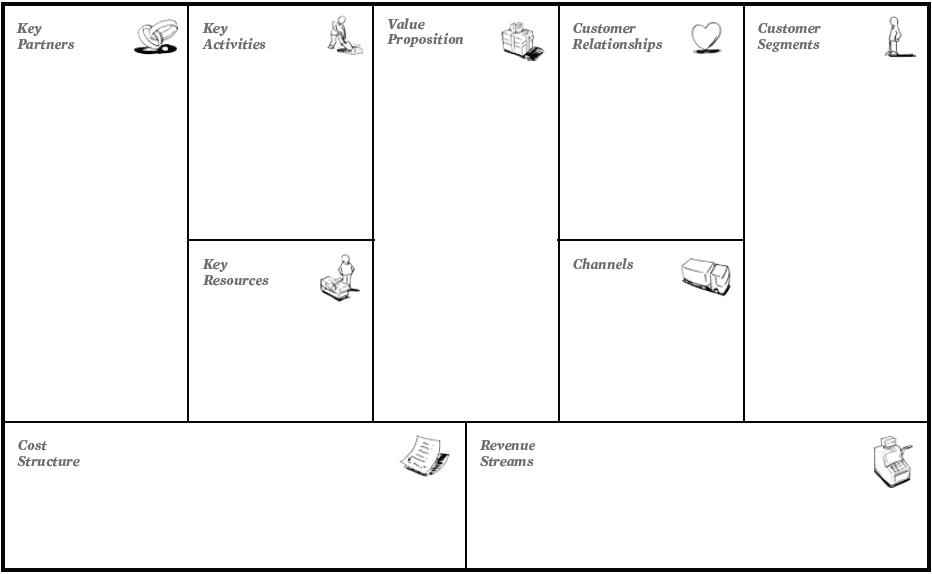
Below are the various sections of the canvas, with associated questions we are evaluating as we move forward developing our business model(s). I have laid it out to help you get a better mental perspective as you start to approach your business model canvas. Adapted from the book, I hope this is enough to nudge you in purchasing it – it’s awesome!
Customer Segments
The customer segments building block defines the different groups of people or organizations an enterprise aims to reach and serve. Without paying (and profitable) customers, a business cannot survive for long.
For whom are we creating value? What are our most important customers?
Value Propositions
The value propositions building block describes the bundle of products and services that create value for a specific customer segment. The value proposition is the reason why customers will turn to one company over the other. It solves a customer problem or satisfies a customer need.
What value do we deliver to the customer? Which one of our customers problems are we helping to solve? Which customer needs are we satisfying?
Channels
The channels building block describes how a company communicates with and reaches its customer segments to deliver a value proposition. Communication, distribution and sales channels comprise a companies interface with customers.
Through which channels do our customer segments want to be reached? How are we reaching them now? How are our channels integrated? Which ones work best? Which ones are most cost efficient?
Customer Relationships
The customer relationships building block describes the types of relationships a company establishes with specific customer segments. A company should clarify the type of relationship it wants to establish with each customer segment.
What type of relationships does each of our customer segments expect us to establish and maintain with them? Which ones have we established? How costly are they? How are they integrated with the rest of our business model?
Revenue Streams
The revenue streams building block represents the cash a company generates from each customer segment. If customers comprise the heart of the business, revenue streams are it’s arteries.
For what value are our customers really willing to pay? For what do they currently pay? How are they currently paying? How would they prefer to pay? How much does each revenue stream contribute to overall revenues?
Key Resources
The key resources building block describes the most important assets required to make a business model work. These key resources allow an enterprise to create and offer a value proposition, reach markets, maintain relationships with customer segments and earn revenues.
What key resources do our value propositions require? Our distribution channels? Customer relationships? Revenue streams?
Key Activities
The key activities building block describes the most important things a company must do to make its business model work. These activities are the most important actions a company must take to operate successfully.
What key activities do our value propositions require? Our distribution channels? Customer relationships? Revenue streams?
Key Partnerships
The key partnerships building block describes the network of suppliers and partners that make the business model work. Companies forge partnerships for many reasons, and partnerships are becoming the cornerstone of many business models.
Who are our key partners? Who are our key suppliers? Which key resources are we acquiring from partners? Which key activities do partners perform?
Cost Structure
The cost structure describes all the costs incurred to operate a business model. These are the most important costs incurred while operating under a particular business model.
What are the most important costs inherent in our business model? Which key resources are most expensive? Which key activities are most expensive?
The building blocks above are essential to mapping out your areas of value creation and value extraction. Paramount to any startup is the ability to identify the main components of their business. Once visualized, it becomes much easier to identify where value is created, whom is involved, what direction the equation is flowing, which parties are involved, what partners your business depends on, which partners your business must depend on, etc… You get the point.
I am not sure Groupon actually took these critical steps from the onset to determine proper business model generation, and now they are feeling the affects. Here’s to you not making the same mistake.
Real time communications are increasingly seeping into our world and the era of ubiquitous web is upon us. Twitter allows us to disseminate comments and links at the speed of bits, creating a whole new way of discovering information. Facebook keeps friends and family updated with the latest thoughts and images from our life. Yes, even the use of email is changing. We still send emails and that will not change for a while, but how many times do you engage in an “instant email” conversation with a friend or co-worker.
This begs the question: What will we be using tomorrow? What new types of technologies will disrupt new industries to create unthought ways in which we will use the our devices? Here is my quick thinking on four emerging ideas as I gaze into the web tonight.
Real Time Local Information Platform
Imagine a twitter like experience, including relevant informational updates from around your local city/town/village, from people and places you chose to stay connected to, delivered to your mobile device in real time. This will happen sooner than you think… Some might say “well Nick, that sounds a lot like Twitter, I don’t believe another platform will replace Twitter.” Great, me neither.
I think Twitter will continue to grow and mature into a different set of protocols and essentially replace certain information hubs we still use today. But Twitter cannot be ubiquitous worldwide and at the same time incredibly strong on a local level. What I think will be different is exactly how the “local” community uses technology to disseminate information. I am hedging my bet on it not being Twitter proper as we use it today. I believe a new player will emerge with specific value propositions set for the local merchant/community/consumer.
Social Search and Discovery
I have written extensively on the concept of Social Search, you can find them here on Business Insider. My main theory is around the fact that in the not-so-distant future we will discover and find relevant information not from a traditional Google search but from leveraging our network of contacts. Think about how much information your network of twitter followers, Facebook friends, and linkedIn contacts interact with on a daily basis. I believe new platforms will be built to collect, organize and disseminate this information to you exactly when you need it. No more 10 links per page with 1,000,000 results crap. If you think about it, why do search engines even tell you about a million results anyway? That doesn’t mean anything to us as users. Whatever…. My point is the forefront of social search and discovery will come from some surpassing players, no doubt.
Mobile Commerce
In less than 5 years, there is no doubt your commercial experience – especially around your local community – will be tremendously different than it is today. Paying with cash… gone. Calling in an order on the phone… forget it, so last century. Waiting in lines to be seated… a thing of the past. Being called Sir or Madam from the restaurant owner…. probably not any more when they now can identify you. With the use of new mobile commerce technologies, all this will be unified within a local commercial network, encompassing orders, payments, communications, social sharing opportunities, offers, marketing messages, etc… and all this will be personalized to the individual so no two people have the same experience. It will be amazing and all driven through your mobile device of choice. Someone should be work on this…
Auto-web
What if cars could talk? No, not to us… to each other. Web enabled cars will fundamentally transform our world. I am not referring to cars having internet screens in them, which some do today and will in the future as a standard feature. More specifically, Google is not too crazy to be working on a self driving car. If an automobile is connected to the web and in constant communications with all the other “devices” on the grid, theoretically there shouldn’t be any more accidents or fatalities due to automobiles. Each car would travel at a certain speed, maintain a certain distance from another, roll along on a set route and never veer from the predetermined destination. It will be transportation 2.0. I believe that day is not too far off the radar and would be a great time to invent or invest in this area.
These are just a few of the things I thought of tonight when I asked myself… man, if Facebook and Twitter are today, what is tomorrow?
Social Search Series: This summer I am embarking on a journey through on the emerging web of Social Search. Traditionally known as the Questions & Answers industry, this category is currently being transformed by social and mobile technologies. No more asking a site questions and finding old answers. I believe the future of the web is ingrained in the dynamic interdependence of social and informational networks. This is part III of the series. For background, check out Part I and part II.
Social, although hot right now, is not the only technology transforming the web today. Location-based social search applications are bridging the gap between our online and offline worlds – and in doing so creating a whole new way for people to find and use information.
This post dives into the new territory of Location Relevant Social Search.
We first determined the traditional question and answer model is now insufficient, since the system doesn’t know your exact location, who your friends are or have any contextual understanding of your query. The resulting answers are typically of low quality and relevance proving a broken model.
Additionally, search technology needs renovating and although Google is currently King of the Search Land they still have a lot to do if they want to hold onto their throne. Basically, the amount of information on the web is growing so quickly that even the major search engines are bringing back mostly meaningless results.
I am postulating the next generation of search will reside within your network of contacts, and I call it Social Search. In my first article a graph was used to illustrate four quadrants separating the field of emerging social search startups. The first quadrant revolves around Location Relevance and it looks as if a few associated startups are positioned well to change the very way we interact and search online.
First, a few tenets we can stand on when talking about Location based social search applications:
In a related post, Evan Britton noted “the goal of real time search engines is to inform the public of what is going on right now. By adding location data, internet users can be specifically informed as to the happenings in a city.” Indeed, real time search results are incomplete without geographical data included in the context. Location relevance completes the equation to help provide users with the best possible results when searching for specific information.
Location based technologies are changing our lives in every way imaginable. Take the emerging location tracking application Glympse for example. Watching someone drive along a map on their way to meet you, being found when lost on a mountain side or viewing thousands of people moving throughout your city in real-time are just a few ways Glympse will change our lives.
Or think about a similar application Geoloqi, a service using persistent location tracking to trigger notifications tied to real-world places. Maybe it’s a note you or a family member left for you at the grocery store or maybe it’s part of a set of geolocated data that you opt-into subscribing to as a layer because it was of interest to you. Some use the app to let their co-workers know how quickly they are getting through traffic to arrive at work. Make no mistake, location aware applications are already changing the way we interact on the web.
So what happens when you combine social, searching and location? Annotating results with specific geolocation data when a query is submitted is fundamental to providing users with the BEST answer possible. According to Bing, over 50% of mobile device originated search queries are about a specific place. Think how often you quickly grab your mobile device to search for something. Exactly. The search world needs to catch up to the intricacies of how we are using the web today.
You can find the entire list of emerging social search startups here, but I am highlighting two emerging startups innovating location-based search and are poised to be big players in the search space.
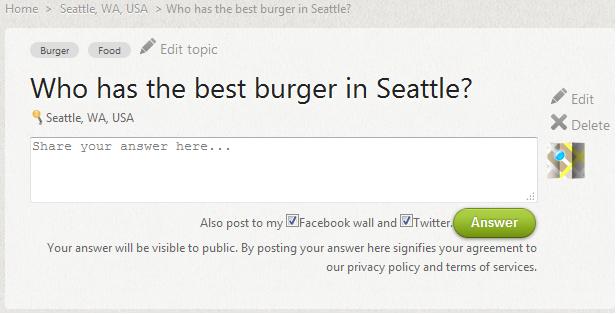 LOCQL, Seattle startup some would refer to as “Foursquare Meets Quora”, has smartly put together two basic premises; 1) everybody knows a little bit about something and 2) location specific information always make things more valuable. Marry those together, involve some game mechanics and you have a living, breathing repository of location relevant information based on where you currently find yourself. Using social power, LOCQL finds the missing links between the user’s queries and the places in the local landscape for which they are searching. They are still in beta but anyone can use the application.
LOCQL Co-founder Robert Mao can see the future of search lies within humans; “The idea for LOCQL came from our life experiences, as International travelers we traveled to many different places, relocated our home’s several times in different countries. There are so many ‘best kept secrets’ only local people know about, those who’ve been there just know it. Unfortunately, without a service like LOCQL, you won’t be able to find it from the web, nor can you find it through search engines.”
A major problem with current search engines is the “objective vs subjective” issue, and the qualitative differences found between their results. Through quantitative analysis, Mao found up to 60 percent of location intended searches are subjective, meaning relevance can vary a lot between two different users searching on the same subject. “Social search is basically harnessing collective intelligence by crowdsourcing the answer from real people, so by nature it better solves the queries which are subjective.”
With LOCQL, users search or submit on topics and questions – typically in relation to a specific location – and receive highly relevant, useful answers. “Who has the best burger joint in Seattle?” searched on LOCQL would give you one or two specific answers left by other LOCQL users who actually know the answer. The same searching on Google will send back hundreds of useless links, most gamed by SEO keywords. Plus one for LOCQL.
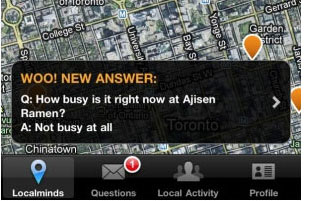 Where LOCQL is building a repository of location based information, Localmind, co-founded by Lenny Rachitsky and Beau Haugh, is centered around a real-time social search platform. It can be thought of as the power of omniscience at your fingertips — the ability to know what’s happening anywhere in the world, right now.
According to CEO Lenny Rachitsky, they are working on a somewhat obvious concept. “We’re living in the 21st century for god sakes; we have data on people’s locations, we have always-on devices in our pockets, we have all kinds of sensors in our devices and in our world. We know more about what’s happening across the country than we do at the restaurant we’re thinking about going to. We are putting all those pieces together and solving that problem.”
Localmind allows you to send questions to users checked-in anywhere around the world to help solve your basic needs and inquires – like how crowded is the bar, how many girls at the club, how good is the food at the restaurant, how long is the line at the airport. More interesting uses include people sending questions to Japan after the tsunami asking if there’s anything they can do to help, or people getting free concert tickets when asking about a concert venue, or saving a family a few hours of travel by finding out a certain hotel was closed.
It has been found that subjective queries can be monetized at 5x – 10x higher than objective queries. It doesn’t take a rocket scientist to see where all this is going. Google and Microsoft, I hope you are listening. The problem incumbents face is these types of platforms are so different they are usually built from the ground up using a whole new infrastructure, not tacked onto an existing search tool.
Lenny noted there are 4 core things they focus on: 1) Your preferences, 2) your friends preferences, 3) your current location, and 4) your exact date and time. Combining those gives users much more relevant and useful information. Interestingly, Google would have no clue how to answer those above searches and probably just shrugs its big shoulders if you try. Alas, plus one for Localmind.
The much accomplished team of three launched Localmind at SXSW in March and have already shipped four major updates to the iPhone app. Their Android app is in it’s final beta release and will be entering the marketplace in a few weeks, and they also have an open API (www.localmind.com/api) that allows anyone to built on top of their platform. Amazingly, Rachitsky says 70% of searches are answered in 5 minutes and they just reached 20,000 users, both numbers are satisfactory to Rachitsky at this point.
With a newly raised angel round of funding and relocation plans to San Fransisco, Localmind looks like they are warming up to play some hardball. And LOCQL, a relatively quiet startup still in their beta release, is very strong technically and has a promising future a head of them. Indeed, it seems both are ready to play David to Google’s Goliath. Now, where is that rock again?
Next time, I will determine if Location Agnostic applications are changing the way we are searching on the web. Yes, I’m looking at you Quora.
Announcement:
As of today Pinger, the #1 free texting provider in the U.S. is going international.
The company who has quietly become the 7th largest mobile carrier in the U.S. will begin their European rollout in Germany with its new Pinger SMS Free app for iOS and Android. Pinger SMS Free operates within the current mobile eco-system—users receive a local German Pinger number and can text for free with any German mobile phone.
The ambitious six year old startup has set its sites on one of the worlds largest markets and will attempt to lead the way toward enabling free worldwide mobile communications. “The worldwide mobile business is a $1 trillion dollar industry with 5.5 billion subscribers, and all those billions of subscribers have one thing in common: they think they pay too much for their phone service.”
Pinger exploded onto the mobile scene by providing users in the U.S. with a real phone numbers and free mobile communications. Their revolutionary Textfree products have been downloaded by tens of millions of iPhone, iPod Touch, iPad, Android, and Web users.
In an interview, Pinger CEO and Co-founder Greg Woock explained to me how Pinger sits on top of and disintermediates the carrier to enable a whole different class of devices to freely communicate, essentially becoming phones. By doing so they open up an entirely new approach to mobile communications.
The obvious question is how can they provide free text and voice in the EU? Their solution: Gamification.
Pinger developed a patent-pending technology to allow anyone to exchange text messages for free in Europe. This new technology ensures that no end user sends more texts than he or she receives. “We created a governor, a meter which matches the inbound and the outbound flow of data between carriers. And then we and gamified the experience.”
By keeping texting volume symmetric, overhead costs are eliminated for Pinger, allowing the company to provide this free service to anyone. “The meter is dead center on the UI and it keeps track of points – when someone sends something, it goes down and when someone receives something it goes up. It’s a dead simple solution.”
This symmetry model also works for voice calls, which Pinger plans to bring to Europe later this year.
 Pinger’s growth, profitability and economics are staggering. They have over 15 million Textfree users and 11 million phone numbers have been given out in the U.S alone. The traffic between those devices is incremental, meaning they add additional revenue to mobile operators. Woock estimates more than $25 million dollars are being generated for the carriers by Pinger because extra devices like iPods and iPads are now becoming ‘phones’.
The number of texts Pinger serves per month will reach 1.7 billion soon and they have become the largest mobile advertiser in the world showing well over 2 billion ad impressions per month. Most amazingly, they are now considered the number 7 carrier in the US and this international play only shows their goal is to be a major player in global communications.
“The expansion will start in Germany with every possible operator, and we’ll focus on text first in order to make sure the symmetrical trading actually works” says Greg. “We will be neutralizing costs through symmetry and then roll out across Europe later this year”
GigaOm recently noted mobile is now 2% of GDP. They also touched on how overall revenue is on the rise for mobile data, but in general the price for voice minutes and everything else is on the decline. Meanwhile demand for data is rising by four to six times per year as more people get smart phones and add more mobile devices such as tablets. More and more data is being created every day, but at lower and lower prices per unit.
So what happens when a new company slides in and offers text and voice communications for free? Most likely, data margins approach zero as illustrated in the image below.

“Carriers will still be important but they are going to have to evolve” says Woock. AT&T, Verizon and others are going to need to shift and set their sites on making the most of what they have. Incidentally, it looks as if they won’t have much data revenue in the future. They should think about being a smart pipe (versus a dumb pipe) and understand they always have something of value flowing through their pipes. Monetizing those channels involves having vision and foresight into becoming more network centric to take advantage of peripheral markets, such as payments.
Pinger is positioning themselves perfectly to ride the coming mobile wave. Mobile devices recently exceed traditional computers in unit sales and revenue. Mobile data traffic is increasing at an exponential rate and will be 95% of global mobile traffic by 2015. Pinger understands all these devices will be wifi and web connected and is positioned to enable mobile communications at unprecedented levels. Indeed, we will see more changes in the next 10 years than in the previous 100.
When asked about the future of mobile communications, Woock simply said, “Big changes are coming… it will be a massive musical chairs and I don’t expect the same people to be sitting when the music stops.”
AT&T and Verizon, can you hear me now?
———
Press Release:
PINGER TRANSFORMS MOBILE COMMUNICATION WITH NEW GAMIFICATION MODEL
Brings Free Talking and Texting to Europe; Cracks the Code on European Economics
San Jose, CA – July 13, 2011 – Pinger, the company disrupting the mobile space by making texting and talking to real phone numbers free, today introduced its patent-pending symmetry technology to bring the free mobile economy to Europe, where high mobile costs have prevented others from offering free talking and texting.
Pinger is uniquely poised to restructure the end-user cost for mobile communication due to the company’s massive scale, unique local phone number model and new gamification technology that works within the context of the highly-regulated European mobile market.
The company’s European expansion will begin next month in Germany with its new Pinger SMS Free app for iOS and Android. Pinger SMS Free operates within the current mobile eco-system—users receive a local German Pinger number and can text for free with any German mobile phone.
“The consumer price of mobile communications in Europe is too high, and for years various companies have been trying to figure out how to make phone number-based mobile communication free,” said Greg Woock, CEO and Co-Founder of Pinger. “Pinger has changed the game by bringing completely free mobile calling and texting to Europe in a totally unique way. We simply neutralize the high costs for consumers while the carriers still make money.”
The Symmetry Model – Pinger’s New European Gamification Technology
Pinger has developed a patent-pending technology to allow anyone to exchange text messages for free in Europe. This new technology ensures that no end user sends more texts than he or she receives. By keeping texting volume symmetric, overhead costs are eliminated for Pinger, allowing the company to provide this free service to anyone. This symmetry model also works for voice calls, which Pinger plans to bring to Europe later this year.
“The worldwide mobile business is a $1 trillion dollar industry with 5.5 billion subscribers, and all those billions of subscribers have one thing in common: they think they pay too much for their phone service,” said Joe Sipher, Chief Product and Marketing Officer and Co-Founder for Pinger. “We can now spread free mobile communication to a wide audience with this simple, yet brilliant twist that combines a symmetry-driven gamification system with an existing mobile infrastructure using real local phone numbers.”
How Pinger’s symmetry model works:
About Pinger’s U.S. Growth
By providing its users in the U.S. with a real phone number and free texting and talk time, Pinger has quickly become 7th largest U.S. mobile carrier and recently surpassed 50 million downloads across its platforms:
“We’ve received tremendous industry support, because our Pinger communications apps generate approximately $25 million in revenue per month for other carriers,” said Woock. “We give people who weren’t formerly using text messaging real phone numbers and the ability to text with anyone, including friends and family on other carriers, who are paying for messages.”
Pinger Textfree also enables free unlimited text and picture messaging from the U.S. to over 18 countries, and Pinger Textfree with Voice supports free calling within the U.S. on iPhone and iPod touch.
Pinger SMS Free will be available in Germany via the iTunes App Store and the Android Market later this summer.
Learn more about Pinger’s Textfree products at: www.pinger.com
About Pinger
Pinger makes texting and talking free. Our market-leading communications products have been downloaded by millions of iPhone, iPod touch, iPad and Android users around the world. Pinger is loaded with inventive people who enjoy creating consumer products and services that make a difference in people’s lives. www.pinger.com
A big announcement is coming tomorrow and I have the opportunity to help break the news with an exclusive announcement 6am Wednesday. Stay tuned.
Until then, think about the ramifications of all text and voice communications free, worldwide….

It’s all about the ‘magic‘ in your app.
In talking with a founder recently about their product a thought quickly came out – “there has to be a certain magic to your app, a function that flat out wow’s the person if you want them to use it all the time and tell their friends about it.”
If your app or product does not generate that instant WOW of amazement, a shot of excitement and glitter of astonishment, you’ve pretty much lost the user at hello. There are literally millions of apps and websites out there and most of them are pretty much forgettable. Nothing about them makes you jump up and say “WOW, how did they do that?”. And that is why most of them suck. Here’s three ways to WOW:
Image courtesy of Flickr user Bohman.
I sit nervously at the corner table waiting for her to arrive. It is 6:15pm on a rainy Tuesday evening in Seattle, WA.
“Oh man, what if she bails on me?” What would I tell the guys?”
I am nervous because this is an extremely exciting night – it’s my first date with Sarah, a beautiful young woman I met a few weeks ago.
This is my big chance.
“If she is late, what does that mean?” My mind is racing. “Should I text her to find out where she is? Or would that just be annoying”
So many thoughts are running through my head it’s about ready to burst. Then I remember hearing traffic is horrible so I figure it might be a while before she gets here.
“… but wait, I don’t think she’s driving on any major freeways… Nick, pull it together. You have more nervous energy than Secretariat did at the gate before winning the Belmont Stakes and the Triple Crown in 1973.”
 Buzz. Up pops a message on my phone. “Sarah says: On my way. I may be late, traffic… Click for a Glympse of my location”. Relieved, I now see she is indeed on the 520 bridge crossing Lake Washington, currently traveling at 10 mph and her estimated time of arrival is 6:35pm. I am then able to watch her as she approaches the restaurant. She actually arrives around 6:30pm and as a matter of fact we have a great dinner.
“The ‘hey, where are you?’ question happens quite often each day. And that’s where we saw the real opportunity. If we can make it easier to share location, more rich, more dynamic, make it simple without privacy concerns… almost a reflex in peoples lives, that’s where we want to be.” – Bryan Trussel, Glympse CEO. (Full interview here)
Earlier that afternoon I decided to go hiking up at Snow Lake, a cherished Seattle day hike in the North Cascades. This is a nice 3 mile jaunt up and over a large crest and then down into the most extraordinary scenery you could find within one hour of a metropolitan city. Turquoise blue water, evergreen trees, snowy patches on the high cresting rocks and blue skies all around make this one of my favorite getaways.
I have been up there many times before but today an eerie feeling fell over me as I was hiking around. Luckily I turned Glympse on before I left my car and sent it out to a few hikers around the area as a safety precaution so I didn’t get lost, or worse. As fate would have it, the former got the best of me and I found myself lost in the wilderness. Frantically, I looked around – all 360 degrees seemed unfamiliar – and I started to wonder if this was really the end.
“Great, now what am I going to do?”
I quickly sent out an SOS from my Glympse application, which goes out to all who are currently tracking my whereabouts. Like a smoke signal of an earlier era the SOS message is a high level alert that I am currently in trouble. With a view of my Glympse, a pair of hikers located me, gave me some water and together we walked down the mountain to our cars. Saved by Glympse.
“The ‘i’m late for the meeting, here’s my location’ case might be the entry point, but then people will start using Glympse more and more deeply in their life.” – Bryan Trussel, Glympse CEO. (Full interview here)
You think that’s crazy? Here is an even wilder situation that happened earlier in the morning. I was walking to a meeting downtown when I decided to take a Glympse of the city of Seattle at 8:05 am. I pulled out my iPhone 10 and with one finger swipe I was able to see thousands of little dots moving about the city. Those dots were actual people, moving in real-time all around me. Double tapping the map zoomed me in on one city block, illumining people choosing to reveal their exact location and identity to me and other Glympse users.
I juxtaposed all the people on the highlighted block with my networks and found out three close colleagues and one old high school friend were within 300 yards from me.
“Dude, this is cool.”
Viewing this block using Glympse helped me more effectively navigate my next 10 minutes. I shook hands with one colleague, booked a much needed follow-up meeting with another and surprised an old friend with a friendly “long time, no see”. Ah yes, technology. What a day.
“In terms of privacy, we do several things, A) you never share your location until you say go, B) you set the timeline so it stops when you want it to, automatically, C) we put ‘stop broadcasting’ very prominently in the UI, and you can delete any Glympse at any time, it disappears from your phone as well as off our servers.” – Bryan Trussel, Glympse CEO. (Full interview here)
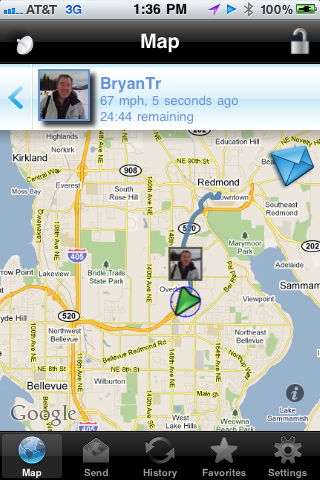
For the record, the above scenario will indeed be normal behavior by the year 2016. Just you watch.
Much has been documented about the location tracking mobile application Glympse. It allows you to purposely share your location and lets people see and track your whereabouts at any moment. And it’s as simple as sending a text (Robert Scoble does a great overview here).
“Uh, why would I do that?” is the normal response from anyone I talk to about Glympse. They also said that about putting their credit cards on the internet 15 years ago and I think we all know how that turned out.
I think people will ease into it, just like e-commerce. Remember back in 1996, no one wanted to place their credit card online. over time eBay, Amazon and others developed a positive reputation for security. And people warmed up to putting their card online. We want to be this brand, “this is a Glympse enabled app” so people will trust it. – Bryan Trussel, Glympse CEO. (Full interview here)
To be honest, I too was initially skeptical but after a rather interesting conversation recently with Glympse CEO Bryan Trussel I am now convinced otherwise. Once you get past the “I would never share my location” gut reaction, you start to grasp the idea and realize this is the future showing itself to you. The image to the right is a Glympse Bryan sent as he traveled to our meeting. I have to say it was pretty amazing watching him get closer and closer to me and then see him walk in the door right on time.
By no exception Bryan is a visionary:
 Take from the beginning of time, from the caveman going out and slaughtering the mammoth (family members wondering where they are), from the ship going out on the horizon and people on the shore wondering “where’s the ship” to the pony express riding the horse, to the telegraph, to now a telephone, now everything is real-time… so if you fast forward accounting for advances in technology… you see a pattern of something people have done since the beginning of time – wondering about someone’s location and whereabouts. And we will have this need 50 years in the future, If you can take that and make it easier, more rich and simple… we think it’s a good place to be. – Bryan Trussel, Glympse CEO. (Full interview here)
Available on many different mobile devices, eclipsing one million users and recently closing a $7.5 million Series B round of financing, The Redmond based Glympse seems to have positioned itself at the forefront of the next major trend in mobile space – location sharing applications.
What makes Glympse so intriguing is the practical/utility application as opposed to a game mechanic approach. It’s tough to argue which is better, but the power of Glympse is quite obvious. Those three uses I described in the year 2016 help illustrate why the need to locate is a human desire and why sharing our location with people will be a second nature behavior. It’s not scary, it’s useful. I believe we could be doing those things now, we just need more people using Glympse. So go and get it. It might just save your life.
Do we really have to wait 5 years for such a great day?
Follow @jnickhughes
 Much has been documented on the features of Glympse, so I wanted to chat a bit deeper with Bryan Trussel, Co-founder and CEO, and talk some about where we are going in terms of location technologies. It was an very interesting conversation and below is a full transcript of the interview.
 You speak in terms of forward thinking, it is interesting… the elements in our initial meetings and slide decks were hilarious, it was stuff like ‘we think smart phones were going to become more prevalent, we think social networks up and coming’… if you look at the time when we were doing that, there weren’t many smartphones out in the market… people questioned our assumptions.
The thing is people have been sharing location – 90’s and today – just not digitally.. analog. People share text or phone call. That happens 10’s of millions of times a day. Now with location today, you use location in games and searches, etc… but the “hey, where are you?” question happens quite often each day. And that’s where we saw the real opportunity. Hey If we can make it easier to share location, more rich, more dynamic, make it simple without privacy concerns… almost a reflex in peoples lives, that’s where we want to be. we are 10% there but happy with where we are today.
We make the claim, like meeting with you today, I could text or call a few times to let you know where I am currently… or I could just share a Glympse at the beginning and then not worry about and you can see for yourself. We will be really happy when people everywhere are sending Glympses everyday like a normal action, like a text.
Take from the beginning of time, from the caveman going out and slaughtering the mammoth (family members wondering where they are), from the ship going out on the horizon and people on the shore wondering “where’s the ship” to the pony express riding the horse, to the telegraph, to now a telephone, now everything is real-time… so if you fast forward accounting for advances in technology… you see a pattern of something people have done since the beginning of time – wondering about someone’s location and whereabouts. And we will have this need 50 years in the future, If you can take that and make it easier, more rich and simple… we think it’s a good place to be.
Now that’s not to say there aren’t going to be a lot of other ways to use location in lives, but there was this thought around that there was only one or two player in location space, no… hundreds and thousands of ways with many different things associated with it.
Yes, just like the Internet. What’s the power of the Internet, There’s thousands of categories… ecommerce, social, information. When the Internet came along, borders were broken down the big thing was connecting someone here with someone in Belarus. Location was irrelevant. But I think when we were doing that we forgot, it’s more relevant right here. Your daily life is in the real world. The people you shake hands with, the kids you come home to… now we can take all the things where location matters.

Yeah, it’s like the opposite as before. take search as an example…. when the Internet was in it’s infancy. I can search movies in Tokyo, but is that really relevant to me? But now, geez, there is so much information.. now things like twitter, flash mobs, social networks, coupons, things I can touch right now. That’s just starting to take off.
So it’s kind of foggy. But here’s where i think it’s going… I make the analogy to the .com era… it was new and nascent, but now the Internet is part of every company, everyone has a .com… it’s just part of the company. So will location, it will be infused in everything. Now where you look up a movie theater app, restaurant reviews, coupon, interact with people.. they all have it, it will transcend most things. You will have this class of things location will just sit on top of.
Stuff will move up the stack.. two years ago you could have had a company could have had cool GPS chips, then you had companies build up location databases, then you had an API for developers to find location information, now you have companies providing automatic geofencing, you now have I think we’ll just have innovation higher and higher… it’s so easy to do now. If I can get that, what service can I lay on top of that. The innovation will just be higher and higher up the stack.
That might be peoples entry point, then they start to use it more and more deeply in their life. Probably one of the most common scenarios has gone from “I’m late” to I’m on my way”. We just put out a new releases where you can put a little icon on your home screen, you can make one like “going home” and you just touch it and then go. That replaces the annoying questions such as “have you left yet? Have you left yet? Yes I almost have, no I am stuck in traffic” People use it when they caravan the kids to soccer. Where we see it going, where we will be happy, is where people use it in all the scenarios where they could use it.
Take a look at text messaging. Go back to your text messages, probably 10% involve your location… We see it going from “i’m late to “I’m on my way” so people just do it for fun, I’m going on a run, going out shopping. Some guy sent one out last week where he was moving out over a field, then he goes over a river, then he starts running in circles… turns out he was hang gliding! He sent a Glympse out for people to watch his hang gliding.
If we can succeed in our vision, where people use it all the time, making if you fast forward a few years this premise of people being confused with where people are goes out the window.
It kind of goes in waves. 80% of the people just want to know that they are in control. We do several things, A) you never share your location until you say go, B) you set the timeline so it stops when you want it to, automatically, C) we put ‘stop broadcasting’ very prominently in the UI, and you can delete any Glympse at any time, it disappears from your phone as well as off our servers.
In fact, we have a policy to delete any from our servers after 48 hours anyway. So, I think people will ease into it, just like e-commerce. Remember back in 1996, no one wanted to place their credit cards online.. over time eBay, Amazon and others developed a positive reputation for security. And people warmed up to putting their card online. We want to be this brand, “this is a Glympse enabled app” so people will trust it.
You can share as broadly or as narrow as you want.. to Facebook, twitter, or just one person.
In terms of privacy, we believe in baking it into the product, very obvious and user controlled. Rather than making people read 50 page privacy statements. It’s all right there.
We built an much more complex location platform initially, it was too complicated, so we actually threw the majority of that away and focused on the utility of it. The simple action of sharing your location with someone.
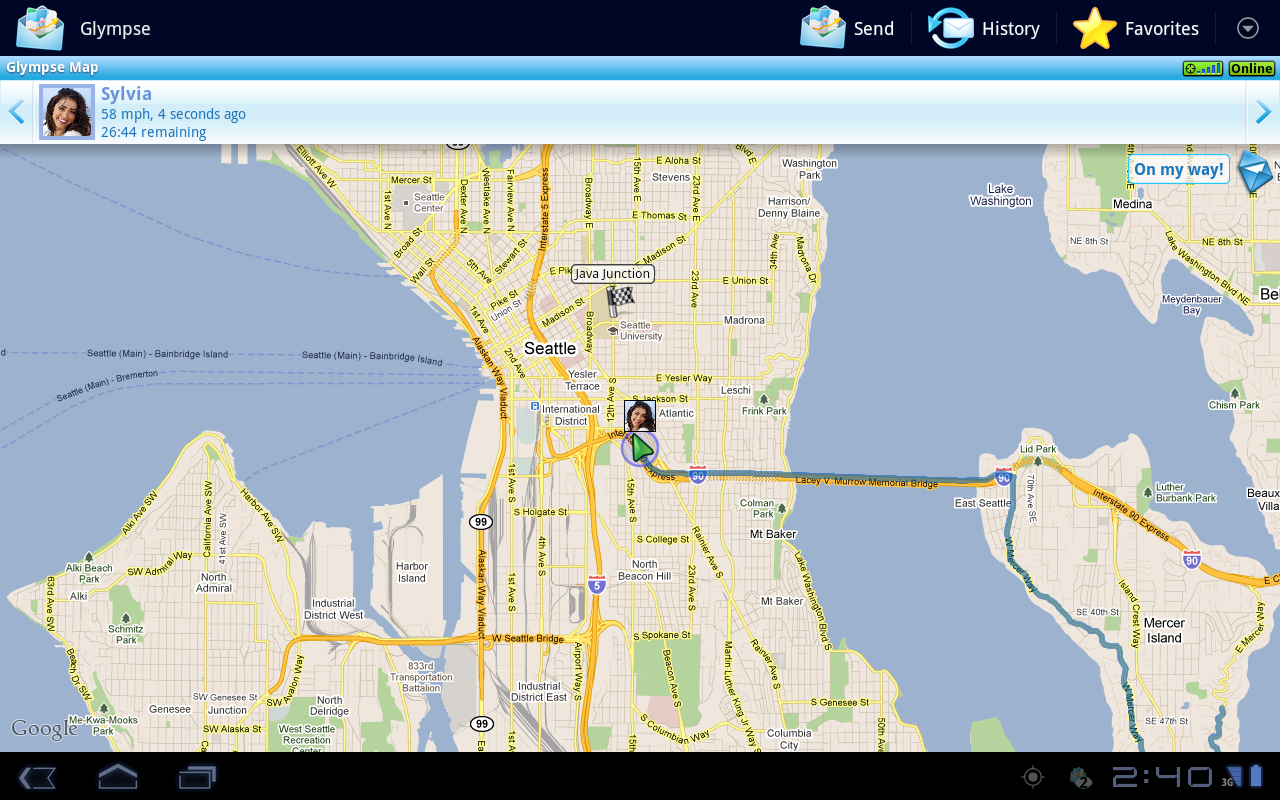
Nope, people can view any Glympse through a mobile web interface. What we really want is someone sending a Glympse to anyone in the world, that someone receiving it, “oh, that’s cool” and then they look further.. and put it on their phone and then start using it. We don’t have a marketing budget… it’s how we have accrued million users through that viral technique. It’s worked pretty well for us.
I was at Microsoft in the mid 90’s, it was very fun, challenging, great time to grow up in the software business. I started in the windows department, then went into games and X-box for a while. But I always wanted to go and try my own thing and I was really interested in the consumer side. Even then, I always had the “itch”… it’s one thing to succeed at Microsoft, it’s another to be successful on your own, without millions of dollars and the big name behind you. I called up some friends in the same situation, we were excited about mobile, about location, and we determined to go do something in the consumer space.
It’s a shame, everybody can’t jump into the entrepreneurial world even for a year or two.. Even if you fail, you will learn so much more.. I am more effective, more driven. You can’t study from the sidelines..
Yes, i do…. everybody likes and wants a challenge, the adrenaline rush… even in a big company… with that said, you have to put everything into it to succeed and some might not want to do that in their life. If you are not driven to go make it happen, you are probably not an entrepreneur…
THE? Probably the ability to rally people around a vision. Which means, A) you have a vision, B) you believe in it, C) it has to be a vision a bit off kilter, because if 5,000 others have the same vision you will get beat. So it has to be enough off mainstream that you have an advantage, one that makes sense… high risk, high reward.
If you can jump in to the entrepreneurial space early in life, do it. If you can surround yourself with the people who have done it, do it. I can’t image a scenario where even if you don’t succeed, whatever it is you do, that experience will be beneficial. I wish I would have done it earlier.
Internally, the Microsoft experience was an advantage since we knew how to build and roll out a software. But externally, when talking to investors, it was a liability would look and say “oh, how long were you at Microsoft?” They would question if we really were entrepreneurs.
Initially, we had to bootstrap our company, prototype our product and show we could get traction. Then we were able to show that we could built what we say we can build. Then we took that to some angels, got some money, then took the product to VC’s. It was a lot easier once we got something in the market.
Yes, that is the main reason for the latest funding round, we will be expanding the development team. We got a lot of opportunities in front of us.. That is the cool thing about this area, Seattle, there is a lot of smart, entrepreneurial minded technical people here. It’s a great place for us to draw upon for talent.
Follow @jnickhughesIf MySpace would have just copied Facebook, it would have been Facebook – Sean Parker
That was Sean Parker’s answer to the question “what happened to MySpace?” in a recent interview with Jimmy Fallon. This got me thinking and was the needle prick I needed to start on a topic I have wanted to write about for some time.
If you can remember at one time MySpace was the social networking behemoth, holding the crown as the largest site on the web. “Do you have a MySpace?” was the proverbial question between twenty-somethings. They had over a hundred million users worldwide, were driving revenue in the hundreds of millions of dollars and it looked as though we had an MTV 2.0 on our hands. They made headlines with the acceptance of a $580 million acquisition from News Corp, validating Social Networking as a ligament startup business venture. Little did we know they would turn out to be a joke, an afterthought on the web and a huge lesson to any young founder looking to build the next big company.
 At right is a snapshot of the MySpace.com monthly unique users from earlier this year (courtesy of Techcrunch). As you can see (and probably already knew) usage has continued to plummet. MySpace is literally a ghost town at the same time Facebook has grown to the largest site in the world, officially eclipsing 700 million users on their way to an inevitable 1 billion users and will soon IPO with a valuation of more than $100 billion! This begs the question: What happened?
My take from Parker’s statement is MySpace had such a massive lead in users, media coverage as well as total mindshare in the social networking space it was their race to loose. Quickly incorporating the features they saw Facebook releasing could have helped them stay atop the game. Imagine what MySpace would be worth now if all they did was manage to keep it all together and ride out this new wave of social/mobile web. Definitely more than the rumored $30 million News Corp is looking for to get them off their books. What a sad ending to once dominant company. To take Parker’s statement a bit further, I argue the biggest mistake MySpace made was sell out to the suits for a mere $580 million. Here are three key differences that add up to a $99,970,000,000 difference between Facebook and MySpace.
The biggest difference between Facebook and MySpace is an intangible I have written about it extensively before. Just as the difference between Apple and Microsoft was found in Leadership, so too was the difference between the social networking companies Facebook and MySpace. (Get used to me writing about vision and leadership because I believe it is the number one reason companies succeed or fail.) MySpace was early out of the gate and sprinted the first mile but did not foresee what could possible be on the horizon. All they knew was people wanted a page to customize as their own and maybe a place find and connect with others. But who was leading MySpace? To put it bluntly, MySpace had no clue what they were doing and no clue who to look towards for leadership. MySpace was not created by a visionary such as Mark Zuckerberg, who saw something in the web most did not. They were driving solely on dollars and revenue, and the lack of vision and focus devastated MySpace’s growth in the end.
If Facebook was only a profile page where you can connect to your friends, MySpace would have won the race. Facebook bet (and won) on a vision of the personalized web, integrating our friends in almost everything we do in the digital world. Zuckerberg saw not only a web of information, but a web of people and set out to connect all those people into the web. Execution on this vision required laser focus from a passionate founder. MySpace ran the first mile faster but lost its way. Facebook knew the course and won the marathon.
Message to entrepreneurs: Have the intelligence to place a visionary leader at the heart of your company and let them guide the way.
 Myspace proved they were technically inept, lacking any engineering vision of how the web should work. According to a recent Bloomberg Businessweek tell-all article, the company was constantly at odds with leadership on how/what/where to innovate. “They were having to do all technical innovations to address the various panics that are happening. Basically their development cycle turned into one of crisis management, not one of innovation.” Bottom line, MySpace lacked the vision as well as the technical edge necessary for a web company to maintain their dominant position.
More importantly, MySpace was not created as an innovative new platform built by forward thinking engineers. They were a company who decided to copy Friendster using sub-par technology but grew because they understood how to market their brand to the general public. Choice quote from the article: “Using .NET is like Fred Flintstone building a database,” says David Siminoff, whose company owns the dating website JDate, which struggled with a similar platform issue. “The flexibility is minimal. It is hated by the developer community.” Why did they choose to do this? Driven by revenue pressures they chose to skimp on technical details and focus on more ads.
On the contrary, Facebook was intended from the beginning to be a socially transformational technology built by smart engineers. Zuck made it a point that their engineers would determine the road ahead. They aimed to redefine the web and understood this would require major investment. As a non-technical executive, it was still obvious to me who was stronger in engineering talent between the two companies. Remember how refreshingly clean a Facebook profile felt vs the craziness that was a MySpace profile. MySpace chose to skimp on the engine and polish the chrome. Bad mistake.
In an interesting note, most close to Zuckerberg would admit the best decision he has ever made was to bring in a much senior and more businesslike Sheryl Sandberg as the Chief Operating Officer of Facebook. It is said she is in more direct managerial oversight than Zuck, and who would want that? Sandberg has been credited with building out Google’s ad business, helping create a multi-billion dollar search ad business. I credit Mark for submitting his ego and filling holes with the right people, Facebook is better off for it. Looking at MySpace and their recent history I cannot say the same. Holes were not filled and egos were not subdued.
Message to entrepreneurs: Know where you are good, understand where you need to be great, and find the right people to fill the gaps.
“I think any time a startup is acquired, there’s always a certain amount of culture clash.” – Chris Dewolfe, MySpace Co-founder and one time CEO.
The worst decision for the future of MySpace was to sell the company to News Corp. (Okay, the founders and initial investors made out fine, but the future of the company pretty much was set in stone.) Time and time again I observe or read about another startup being acquired by a larger company and I think to myself “well, there it goes…”
The blazing, crazy, edgy, partying, sometimes innovative culture of MySpace was suffocated by the bureaucracy of corporate New Corp. Do yourself a favor and think about your startup culture currently, and then think about the culture in a Microsoft, Google, Aol, or any other large corporation. Ask Dennis Crowley. Ask Evan Williams. Ask Caterina Fake. It usually doesn’t end well when you sell your booming startup to a large corporation. Facebook fought off takeover bid after take over bid until everyone knew they just weren’t ever going to be for sale. That’s ballsy, but its also what has to happen if you want to see your vision come together.
Message for entrepreneurs: If you have a long term vision for your company, don’t sell – ever! If you want to make some quick money, sell at the top of your hype – and walk away as early as you can. The post-acquisition company will be nothing like the pre-acquisition company.
I am tired of seeing innovative startups being gobbled up by larger corporations only to disappear off the face of the earth – this is not how innovation changes the world. It is actually how innovation is hindered. I understand, as a founder you are double minded building your company. You want to make a chunk of cheddar, and there’s nothing wrong with that. Isn’t that what going into business is all about? I understand… and I would want to do the same thing in your position.
But before you sign those papers I would step back and determine what you really want and if it’s the best option. If you really need to sell, truth is you did not build the company correctly. If you want to cash in, great. But understand, odds are the world will no longer be changed by your innovation. If you really feel selling is the best option, think deep and hard about the culture inside your company as well as inside the potential acquirer because the marriage is going to be tough. And if you feel deep down in your heart your company has a great future, don’t sell out. Just think about how News Corp and the original MySpace founders feel about this outcome right now.
Image courtesy of Flickr user UltraRob.
This post was originally published on BusinessInsider.com.
Follow @jnickhughes
John Battelle is currently embarking on a new book, titled What We Have Wrought. In it he is attempting to write a narrative of the perspective in 2040, a generation ahead who is looking back on the last 30 years of progress back to today. As he describes our situation, I stumbled upon this and fully agree with him:
I believe we are in a critical moment in our civilization’s development, one where we will face a number of fateful decisions about how we interact with each other, with business, and with government. The decisions we make during this period will frame the kind of world we’ll leave to future generations. Who will control the data we create? What access will we allow citizens to the machinations of government? What kind of people will we become when every single one of us is deeply connected to a socially aware platform like Facebook? Are we building systems – in healthcare, energy, finance – that are too complicated for any of us to understand, much less control?
In short, can we handle what we are creating? Thirty or so years from now, will we be questioning ourselves – “Lord, what hath we wrought?” Or will we look upon what we hath wrought, and be pleased? I think the answer lies in exploring where we are, right now, and laying out the implications of our actions today.
A longer post from me on these thoughts will follow, but go ahead and ponder those words for a moment.
Social Search Series: This summer I am embarking on a journey through on the emerging web of Social Search. Traditionally known as the Questions & Answers industry, this category is currently being transformed by social and mobile technologies. No more asking a site questions and finding old answers. I believe the future of the web is ingrained in the dynamic interdependence of social and informational networks. This is part I of the series.
Traditional Question & Answer sites are old and antiquated. You know the drill – go to a specific website, type a question into a search bar and a variety of indexed answers come back to you. The answers vary in context, quality and relevancy. This was fine in 2002 when the web was less mature, but the reality is with advancements in web technologies it simply does not work today. The problem is these sites typically:
Answers tend to be more relevant and helpful when they include this information. When the system lacks these inputs, the quality of answers remains very low and you are left with an inadequate solution . In fact, so low in quality you might as well just pick up your phone and call a friend.
Enter a new category of applications emerging on the web. Social search applications implicitly take into consideration your social network, your location, your demographics, previous search history and other key data sets to help provide you with the best answer possible at that time. I will not refer to the Questions and Answers space anymore, since I think asking a question and waiting for an answer is quite limiting and the entire concept is antiquated. I believe we are on the cusp of a new internet category where users leverage their social/local sphere to quickly find relevant information. I am calling this space the “Social Search” category. Note that currently I am not including Facebook – the largest social networking site – in this category. This is a study of startups who are strictly focused on social searching technologies.
This space is heating up and I am starting to read more about emerging companies working to build out the next social/local search platform. Traditional Q&A sites are starting to see the writing on the wall, with Answers.com just recently massively laying off employees and replacing their CEO and CTO. In fact, I wrote about a few local Q&A startups a while back noting this space is a game changer on the web.
When evaluating this new space, Four categories/quadrants emerge to separate the players in social search. I have diagrammed them based on their relation to the four categories. (If you don’t see an application that might fit on here, please reach out to me)
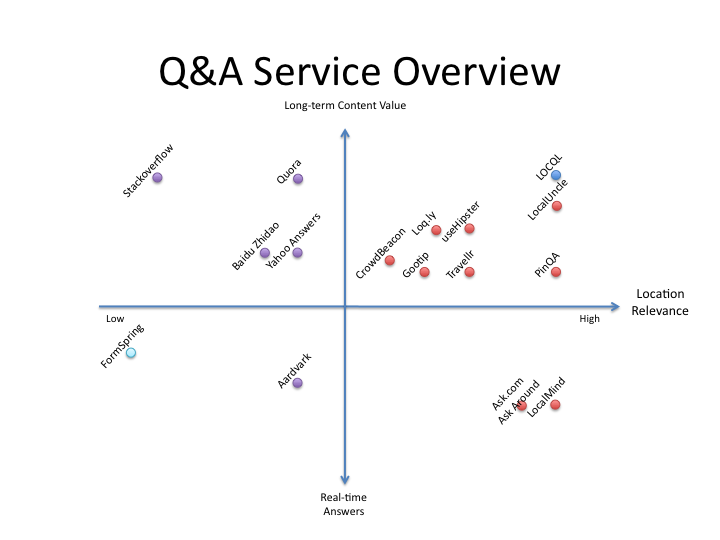
Locating a user when a query is submitted is fundamental to providing the BEST answer possible. According to Bing, over 50% mobile device originated search queries are about a specific place. Think about how often you need an answer and how often you quickly use your mobile device to find it. Exactly. Mobile search will define the next wave of the web.
 LOCQL is a Seattle startup some refer to as “Foursquare Meets Quora”. These guys smartly put together two basic premises; 1) everybody knows a little bit about something and 2) location specific information always make something more valuable. Marry those together, involve some game mechanics and you have a living, breathing repository of location relevant information based upon where you currently find yourself. They are still in beta but anyone can use the LOCQL application.
Others include:
Some social search applications do not integrate location technologies into their functionality. These applications more or less originate around specific topics and knowledge bases, not so much around a specific location. Although these applications are location agnostic, they still can be relevant to certain users and possibly large search companies.
Aardvark is a way to get quick, quality answers to questions from your extended social network. You can ask questions via an instant message buddy or email. The questions are then farmed out to your contacts (and their contacts) based on what they say they have knowledge of. If you ask taste related questions about music, books, movies, restaurants, etc., they’ll ask people who tend to show similar tastes as you in their profile.
Others include:
It is important to create a repository of information so users have something to search, and if done correctly this can be a great competitive advantage – the largest collection of information generally provides the best and most accurate information to a user. Most questions have a narrow answer and this information generally does not change much over time.
 Quora, founded by former Facebook employees, is a continually improving collection of questions and answers created, edited, and organized by everyone who uses it. They aim to build THE go to application for wisdom and knowledge. The cool thing about Quora is you can follow well known people as they continue to add their knowledge to the site. Quora seems to be the emerging leader of these newly minted social Q&A sites. Thus far they have maintained their focus on the relatively smaller web tech community of Silicon Valley.
Others include:
Instant interaction technology (real time) has transformed the web from a static information repository to a live, interactive medium. This single change gave birth to what we know today as the social web, including Facebook, Twitter and many other social interactive platforms. Search technology is catching up as well, and when infused with social interaction things could get very interesting. Understandably, this category is nascent.
Localmind allows you to send a question to any place in the world, and get an answer from someone at that location in real-time. They connect you, temporarily and anonymously, to someone at the location you are interested in, allowing you to ask any question you want, and get an answer in real-time. You can find out how crowded it is at a bar, how long the line is at a club, or how many tables are open at the restaurant.
Others include:
Look for my next post as I investigate: what’s the point of Q&A anyway? Why am I now calling it Social Search?
This post was originally published on BusinessInsider.com
Recently quitting my job and diving full time into entrepreneurship has allowed me time to step back and think about what is actually going on in the current tech space. It’s interesting times to say the least, but what I am about to say may not be what you expected.
A concerning trend is starting to bubble from within and I feel it is necessary to bring it to light. Reviewing the web’s latest news we see more companies going public, constant talk of Groupon’s massive growth and community destruction, Facebook tempting us (and current employees) with an inevitable IPO, Twitter’s ubiquity becoming every politicians nightmare and Google’s latest and always awkward attempt at the social web. Seems like just another month in the frothy web market.
But take a close look at this infographic detailing Q1 investment dollars broken down into categories. It is from an article a few weeks ago on GigaOm. Click for a larger view.
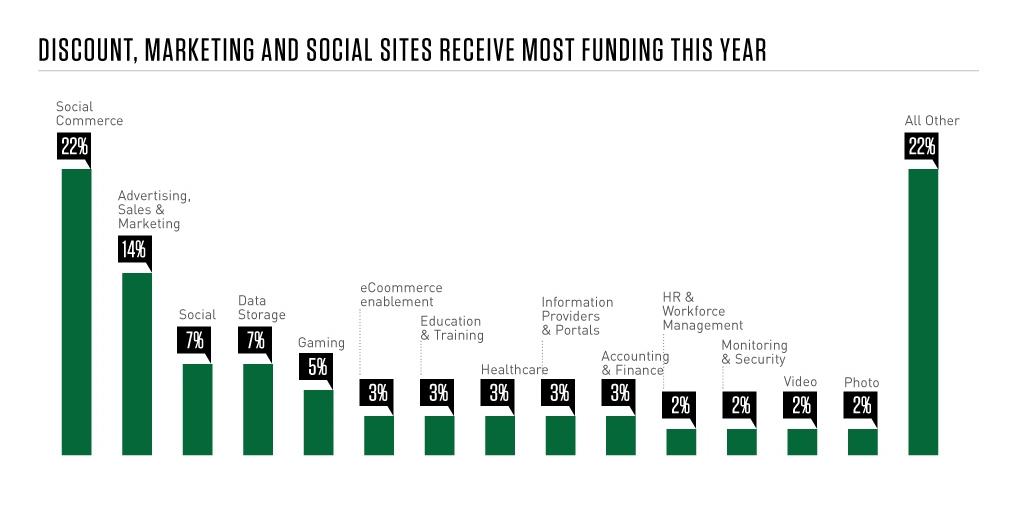
Disclosure: my startup – Loyaltize Inc.- was initially focused on local commerce with our first version and it remains to be seen what we build out next but my mind is buzzing with new perspectives as of late. So I am also talking to myself here.
While trying to figure out what this infographic actually means let me just state the obvious – taken on the surface it tells a lot about what we value as a society. Or what we don’t value. Namely Health Care, Education, Security, and “all the others.” This has massive future implications and should be a cause for worry – that is if you are American.
Social Commerce attracted 22% of all investment dollars so far in 2011. Advertising, sales and marketing took home another 14%. and social apps saw 7% of VC money. That is almost 1/2 of startup investment dollars focused on improving how we socialize and spend money! (note: take away the amount invested in the Groupon bubble and the picture changes a bit, but hyperbole is needed here to provoke some deeper thought.) The amount of money invested in “all other areas” of technology equaled the amount invested in Groupon and the like-clones. You have got to be kidding me.
No wonder the United States of Idiocracy America is at record levels of consumer and national debt. An old maxim comes to mind: show me where your money goes and I’ll show you what you value. I will also offer another maxim: Show me today what you are investing in and your future I will show you.
The sad truth is we value selling products over our children’s future well being and education. We value buying stuff right now over investing in a better future. We value gluttony over governance. With this current trend in investments, these “American” values won’t be changing anytime soon. There is no fighting or arguing this statement. It’s all right there.
This whole Groupon thing has gotten out of control. We are falling farther behind the world in education, yet we seem to excel in creating new ways to spend money quicker and eat cupcakes faster. The biggest and most anticipated IPO this year is going to be a site where mass consumers can purchase things at mass discounts? Sometimes I think I am hallucinating that Groupon is the major story of innovation on the web in 2011.
Is this the best we can do Silicon Valley? Chicago? New York or Seattle? Or is this just what investors think will make them the fastest dollar? That is one part ridiculous and another part sad.
This baffles me: Why are the largest issues of the past 4 years and the focus of the current political landscape – things that are paramount to the future of our country – receiving almost no private investment attention?
What about using some brain power and engineering talent to rework the healthcare system, a system which is in more dire straights than our shopping experiences? How about transforming education so children understand the world is full of information and it’s all right at their finger tips? They just need the access, be taught how to use and deploy it to their advantage all the while learning how to critically think. And if I was sitting across from the table from you and asked what is more important: 1) buying something from your mobile phone or 2) your personal security, I think most of you would admittedly choose the latter.
Hundreds, maybe thousands of companies have determined the best use of their time and intelligence is to copy Groupon and put out another daily deals site. Numerous talented engineers are inventing new ways for us to share pictures from our iPhone and scores of startups have been working on new methods of messaging groups of people.
 Although all those ideas are interesting in their own way, it is the equivalent of Barry Bonds stepping up to the plate and bunting. Wha? Yeah, I ask myself the same question every day as I read another $5 million was just invested in a Series A round for another picture sharing/messaging iPhone application.
You guys are the best of the best… remember?
The reason I wrote in-depth about technology cycles was because it became clear to me the web will very quickly infiltrate every part of our life. I cannot wait till the internet of things starts to power everything we use, from our toothbrushes (transmit data to help us maintain our oral health) to our shoes (real time data about how many steps we have taken, informing us when we need new shoes or the current state of our metabolic systems, etc) to the lamp I am using right now (instantly search and learn the history of this exact product to know if it was created Carbon neutral). I can’t wait for stuff like that.
I am not here to rant, I am here to inspire better.
Founders: odds are you went to Stanford, have an MBA, or you came from a benefited family – and your company slings mass discount group coupons online? Why are you wasting your talent and intelligence? I believe you are better than this.
And VC’s: that $5 million could have helped an entrepreneur who has a vision to transform your children’s’ future education? Or maybe help lower your monthly health care costs? Doesn’t that sound like a better future?
I honestly think these are valid questions to ask in today’s investment and entrepreneurial communities.
I am not saying I disagree with venture capital and the inherent goal of “invest X and receive a 10X return“, I understand the system has to return something and feed itself. I just hope we don’t grind ourselves into the dumbest, fattest, most uneducated, quickest to buy a 50% off dinner using our mobile device from our couch society. Because the path we are currently heading down is indeed pointing us in that direction. I hope we (investors, entrepreneurs, consumers) can see there are a hell of a lot more important areas of our society that need fixing.
I believe true entrepreneurship is about changing the world, not taking advantage of the world. We need more entrepreneurs like Dr. Samir Qamar. Please someone… anyone… answer my call and help turn things around. You will be forever referred to as a hero by me down the road.
Image courtesy of Flickr user Roger Smith.
This post was originally published on BusinessInsider.com.
Dear Advertiser,
 We haven’t formally met but we have had an ongoing relationship for quite some time. I am a consumer; you are an advertiser trying to sell me something. Our Love/Hate relationship goes something like this: I love to use my internet but hate to be interrupted by you. I know you are the one I should actually thank for my ‘free’ usage of all the websites and applications on the web, but deep down in my heart I am finding it hard to thank you. You see, I just want to go about my day and easily use the mobile apps I enjoy, listen to my favorite music on Pandora, search on the topics I need to know about and read interesting articles.
But here is what I don’t think you fully understand. You make my life worse. You interrupt me in every possible way you can think of and believe just because you “got in front of my eyeballs”, I will make a purchase. The thing is, I cannot easily use my mobile apps, since you jump right in as I load it up and steal another 5 or 10 seconds of my time. I hate this! When I listen to Pandora, between every 2 or 3 songs you shout something I don’t ever pay attention to, so you are wasting your money. I bet you didn’t know that as I listen to Pandora when drive I turn the radio off or the volume down for about 10 to 15 seconds so I don’t have to hear you freaking annoying voice for the 10th time this hour. You are just an annoyance and I despise you more and more as this goes on. When I search on Google, there you are… trying your hardest to sell me something I don’t want. Even though when I search I type in a keyword, most of the time I am looking to be informed on a topic not buy it. And what makes me the most frustrated is when you cover the screen the instant I hit a website like Forbes, basically witholding me from my very intent.
Do you realize how rude this is? I don’t walk up to your desk as you are working and put my hand right in front of your screen, and hold it there for 15 seconds – smiling like I am doing something nice for you. If I did, you would probably hit me.
I understand it is you who underwrites our “free” access to information so I am not blindly telling you to go away. All I ask is please make my life better, not worse.
Know my preferences. Better yet, let me tell you what I like and what I don’t like.
All the spying, cookies and social data mining in the world will not come nearly as close to knowing me as good as I know myself. Please allow me to tell you what I like and what I don’t like so when you do step in to talk to me I am actually interested in what you are saying. (Would someone out there build a platform where I can input my 15 category interest and allow only those advertisers to reach me on every interactive media in the world? Come to think of it, I just might. If you are interested in helping, give me a shout.)
Know when I want to interact. Never interrupt me.
Interrupting is one of the rudest forms of communication in the human race. Maybe this is your problem: since you are not human you don’t realize you are committing one of the biggest faux pas out there. If you were to start your strategic alignment with more of a human perspective you would better position yourself for me to receive your message.
Make my life better. Add value to me and my life
Hindering my internet viewing, making me wait to watch a video or jumping in the middle of a conversation does no make my life better. It only creates frustration. Correct me if I am wrong, but I assume you want to create value for the brand or company you are representing? Okay, if that is the case… I will value any company who makes my life better. And since we naturally associate the Brand of the company with the mode of advertising … any Brand who rudely interrupts me is instantly placed in the LAME bucket. Sorry, that is the truth. On the contrary, any Brand who slides naturally into a position to add value to me and make my life better – pure GOLD. Loyal. They got me for life.
Look, I know this is going to be a life long marriage so can you please start to see things from my side of the bed for once? If you do, I guarantee you will get more than you ever imagined.
Follow @jnickhughes



 So Entrepreneurial