What Do Houdini, Copperfield and Angel Know About Tech?

It’s all about the ‘magic‘ in your app.

In talking with a founder recently about their product a thought quickly came out – “there has to be a certain magic to your app, a function that flat out wow’s the person if you want them to use it all the time and tell their friends about it.”

If your app or product does not generate that instant WOW of amazement, a shot of excitement and glitter of astonishment, you’ve pretty much lost  the user at hello.   There are literally millions of apps and websites out there and most of them are pretty much forgettable.  Nothing about them makes you jump up and say “WOW, how did they do that?”.  And that is why most of them suck.  Here’s three ways to WOW:

Be a Magician (Apple)

  • Appear to do something people have not seen before.
  • Focus on presentation and make it look simple and easy.
  • Hide as much as you can from the user, they don’t need to know how you do it.

Create an Addict (Twitter)

  • Like a drug, instant use of your app should illicit the undeniable urge to use again
  • Understand behavioral addiction and how to interweave your app into the consumer psyche.
  • Think how many times a day you slide your phone open to look for new texts or check Twitter to find the latest information?  That’s an Addict.

Pull on Emotions (Facebook)

  • Humans deepest motivations as are driven by emotions.
  • Tie your purpose to an emotional state (Why check Facebook?  Because we don’t want be left out!)
  • Joy, Sadness, Trust, Distrust, Fear, Anger, Surprise, Anticipation… all illicit responses.

Image courtesy of Flickr user Bohman.

Is TechCrunch Too Big? Or Is Quipster Too Small?

It’s tough to be a startup today.  It’s even more difficult to be a youngster looking to run with the giants.  I admire young startups like Quipster, who is dodging the giants right now.

Looking at Twitter, Facebook, Foursquare and Google we think they are indestructible.  It’s understandable.  It’s easy to be armchair critics, Monday morning quarterbacks or Negative Nancy’s when it comes to seeing a new startup attempting to play on their turf.  But the reality is a King’s reign does not last forever, and it’s usually replaced by the one we never expected.

Quipster recently launched to mild criticism, especially from one of the media Giants in the startup industry, TechCrunch.  I respect TC and their reporting, but not exactly their take on Chiding the Child.

“Do we really need another mobile check-in app? Newly launched startup Quipster seems to think so.”  They go on the provide a brief overview of how Quipster is really no different than all other checkin apps.

Is TechCrunch too big for Quipster?  My guess is yes, so big they didn’t even care to give the startup a fair shake.

The three paragraph post – which probably took 1o minutes to complete – does little justice in finding the pearl within the oyster that is Quipster.   If they would have looked a little closer they would have discovered Quipster came from three Thai engineers in Palo Alto led by CEO Krating Poonpol, who has always dreamed of being an entrepreneur and fought for seven months to gain an H1B visa just for the opportunity to build a company here in the US.   Krating – a former engineer at Google who became a bestselling author in Thailand for penning a book on his experiences at Google –  also won two medals in international mathematics competitions, taking home the gold for Thailand in physics.

Needless to say, these aren’t 3 frat dudes sitting around looking to get rich by riding the bubble of copycats. Even ReadWriteWeb does a better job reporting both the positives and the negatives of Quipster as well as questioning the tactics of TechCrunch.

By taking more time, TechCrunch would have also been able to share how Krating started Quipster to simplify and unify social check-ins, an category fragmented and ripe for simplification and a problem worth solving.  His goal: to be the driving force behind the next wave of geolocation.

According to Krating “Geolocation is not really about the check-in, it’s about sharing a context of what you’re doing as well as where you are with a single click and no typing.  He continues …we are creating a fun and fast way to share what your doing and what you like about certain places.”

The ” too many checkin apps ” reaction misses the point about Quipster.  Although check-ins apps are abundant, most lack any context.  Receiving a Foursquare update that reads “John Smith just checked in at Joe’s Bar” really doesn’t tell me anything, and leaves a lot to be desired.  Others are taking notice of the problem.

Krating, like any good innovator, is seeing an area where improvement is needed.  “we are seeing at least 5 or 6 responses resulting from each quip, giving a basis of interaction between users which goes farther than just a “here I am”.  This lowers the barrier of interaction among friends and strangers within a city and also gives users a chance to see what is hot in the city.”

I see apps like Quipster emerging with visions going way past the basic checkin feature and on towards making our everyday life easier and more enjoyable.  And for a possible business model, Krating did not to go into details, but he did say “Like Google – building out the interest graph, adding location and targeting meaningful marketing” seems like a good place to be.”

Am I saying Foursquare or Twitter won’t continue to reign in this space?  Not exactly, they are powerful horses for sure.  Do I think Quipster is the new Foursqare at this point?  No, I think they have a few obstacles to overcome.  But I am impressed with early startups looking to move the needle forward.

An Unfriendly Startup Trend

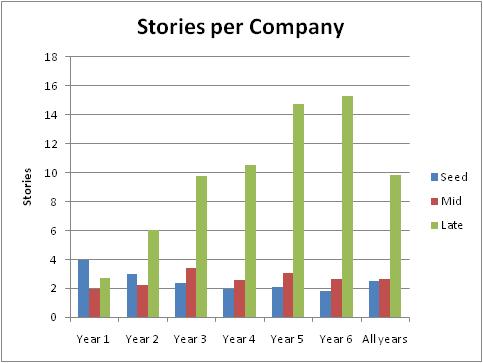
While I was doing my research to cover Quipster, I started to take notice of a new trend in tech media.  Coverage of young and emerging startups is falling behind at a frightening pace.  I am not the only one to notice.  Recent research found Ten companies now account for 30% of TechCrunch coverage.  The image below illustrates the heavily weighted coverage of late seed or large companies, increasing each year.  It is understandable why major outlets cover Apple, Facebok and Google more often, indeed they drive many more pageviews. But it begs the question: Is this raw startup journalism or have Techcrunch (and the like) really become the “New” Old Media?  Has it become all about more page views?

I am a long time Business Insider and TechCrunch reader, but these trends are cause for worry if you are an early stage founder.  Below are a few observations, straight from Guest contributor Mark Goldenson:

1.  Companies funded by a prominent investors get covered twice as much

2. TechCrunch writers do play favorites

3. TechCrunch’s long tail is now 14 times longer but the fat head is 24 times bigger

Guide The Child

My view of the purpose of media is to be a guiding light in helping emerging technologies and companies acheive top of mind with the general public.   Covering young startups with facetious mocking does not do those numbers any justice or help pull startups forward.  Media outlets such as TechCrunch (as well as this one, Business Insider) influence the general public more than they know, and covering a new company with a 3 paragraph Chide probably does more harm than good for an early stage startup.

TechCrunch, Business Insider and the entire startup community – pay attention to small startups like Quipster and remember Twttr was once is the same position.

Here’s A Glympse Into The Future, Circa 2016

July 6th, 2016

I sit nervously at the corner table waiting for her to arrive.  It is 6:15pm on a rainy Tuesday evening in Seattle, WA

“Oh man, what if she bails on me?”  What would I tell the guys?”

I am nervous because this is an extremely exciting night –  it’s my first date with Sarah, a beautiful young woman I met a few weeks ago.

This is my big chance.

If she is late, what does that mean?”  My mind is racing.  “Should I text her to find out where she is?  Or would that just be annoying”

So many thoughts are running through my head it’s about ready to burst.  Then I remember hearing traffic is horrible so I figure it might be a while before she gets here.

“… but wait, I don’t think she’s driving on any major freeways… Nick, pull it together.  You have more nervous energy than Secretariat did at the gate before winning the Belmont Stakes and the Triple Crown in 1973.”

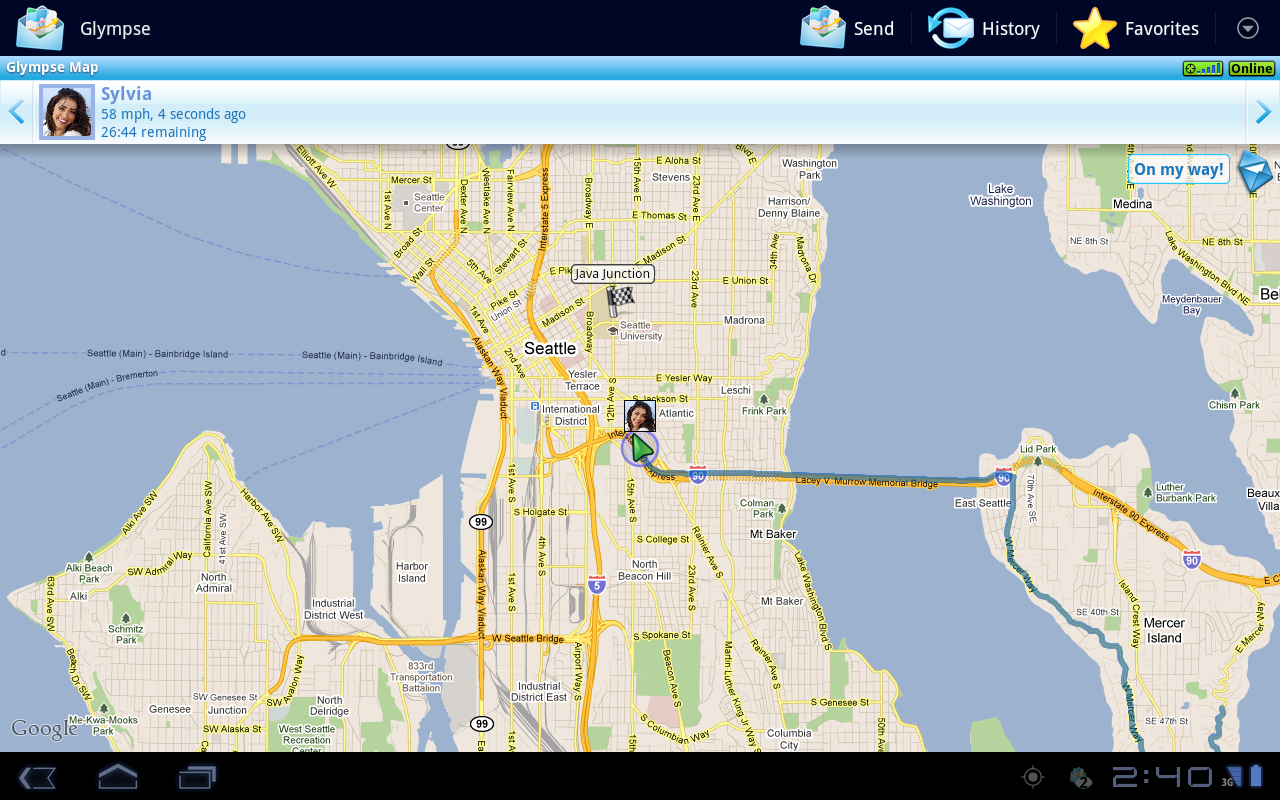
Buzz.  Up pops a message on my phone.  “Sarah says: On my way. I may be late, traffic…  Click for a Glympse of my location”.   Relieved, I now see she is indeed on the 520 bridge crossing Lake Washington, currently traveling at 10 mph and her estimated time of arrival is 6:35pm.  I am then able to watch her as she approaches the restaurant.  She actually arrives around 6:30pm and as a matter of fact we have a great dinner.

 “The ‘hey, where are you?’ question happens quite often each day.  And that’s where we saw the real opportunity.  If we can make it easier to share location, more rich, more dynamic, make it simple without privacy concerns… almost a reflex in peoples lives, that’s where we want to be.” –  Bryan Trussel, Glympse CEO. (Full interview here)

Earlier that afternoon I decided to go hiking up at Snow Lake, a cherished Seattle day hike in the North Cascades.  This is a nice 3 mile jaunt up and over a large crest and then down into the most extraordinary scenery you could find within one hour of a metropolitan city.  Turquoise blue water, evergreen trees, snowy patches on the high cresting rocks and blue skies all around make this one of my favorite getaways.

I have been up there many times before but today an eerie feeling fell over me as I was hiking around.  Luckily I turned Glympse on before I left my car and sent it out to a few hikers around the area as a safety precaution so I didn’t get lost, or worse.  As fate would have it, the former got the best of me and I found myself lost in the wilderness.  Frantically, I looked around – all 360 degrees seemed unfamiliar – and I started to wonder if this was really the end.

“Great, now what am I going to do?” 

I quickly sent out an SOS from my Glympse application, which goes out to all who are currently tracking my whereabouts.  Like a smoke signal of an earlier era the SOS message is a high level alert that I am currently in trouble.  With a view of my Glympse, a pair of hikers located me, gave me some water and together we walked down the mountain to our cars.  Saved by Glympse.

“The ‘i’m late for the meeting, here’s my location’ case might be the entry point, but then people will start using Glympse more and more deeply in their life.”  –  Bryan Trussel, Glympse CEO. (Full interview here)

You think that’s crazy?  Here is an even wilder situation that happened earlier in the morning.  I was walking to a meeting downtown when I decided to take a Glympse of the city of Seattle at 8:05 am.  I pulled out my iPhone 10 and with one finger swipe I was able to see thousands of little dots moving about the city.  Those dots were actual people, moving in real-time all around me.  Double tapping the map zoomed me in on one city block, illumining people choosing to reveal their exact location and identity to me and other Glympse users.

I juxtaposed all the people on the highlighted block with my networks and found out three close colleagues and one old high school friend were within 300 yards from me.

Dude, this is cool.

Viewing this block using Glympse helped me more effectively navigate my next 10 minutes.  I shook hands with one colleague, booked a much needed follow-up meeting with another and surprised an old friend with a friendly “long time, no see”.  Ah yes, technology.  What a day.

“In terms of privacy, we do several things, A) you never share your location until you say go, B) you set the timeline so it stops when you want it to, automatically, C) we put ‘stop broadcasting’ very prominently in the UI, and you can delete any Glympse at any time, it disappears from your phone as well as off our servers.” –  Bryan Trussel, Glympse CEO.  (Full interview here)

Present Day

For the record, the above scenario will indeed be normal behavior by the year 2016.  Just you watch.

Much has been documented about the location tracking mobile application Glympse.  It allows you to purposely share your location and lets people see and track your whereabouts at any moment.  And it’s as simple as sending a text (Robert Scoble does a great overview here).

“Uh, why would I do that?” is the normal response from anyone I talk to about Glympse.  They also said that about putting their credit cards on the internet 15 years ago and I think we all know how that turned out.

I think people will ease into it, just like e-commerce.  Remember back in 1996, no one wanted to place their credit card online. over time eBay, Amazon and others developed a positive reputation for security.  And people warmed up to putting their card online.  We want to be this brand, “this is a Glympse enabled app” so people will trust it. –  Bryan Trussel, Glympse CEO. (Full interview here)

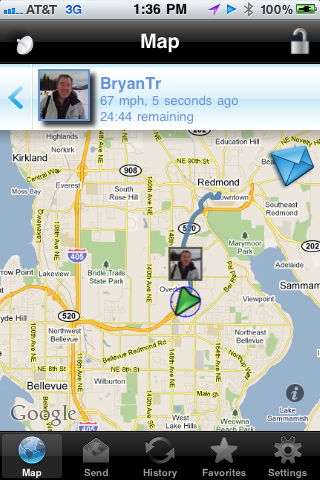
To be honest, I too was initially skeptical but after a rather interesting conversation recently with Glympse CEO Bryan Trussel I am now convinced otherwise.  Once you get past the “I would never share my location” gut reaction, you start to grasp the idea and realize this is the future showing itself to you.  The image to the right is a Glympse Bryan sent as he traveled to our meeting.  I have to say it was pretty amazing watching him get closer and closer to me and then see him walk in the door right on time.

By no exception Bryan is a visionary:

Take from the beginning of time, from the caveman going out and slaughtering the mammoth (family members wondering where they are), from the ship going out on the horizon and people on the shore wondering “where’s the ship”  to the pony express riding the horse, to the telegraph, to now a telephone, now everything is real-time… so if you fast forward accounting for advances in technology… you see a pattern of something people have done since the beginning of time – wondering about someone’s location and whereabouts.  And we will have this need 50 years in the future, If you can take that and make it easier, more rich and simple… we think it’s a good place to be. –  Bryan Trussel, Glympse CEO. (Full interview here)

Available on many different mobile devices, eclipsing one million users and recently closing a $7.5 million Series B round of financing, The Redmond based Glympse seems to have positioned itself at the forefront of the next major trend in mobile space – location sharing applications.

What makes Glympse so intriguing is the practical/utility application as opposed to a game mechanic approach.  It’s tough to argue which is better, but the power of Glympse is quite obvious.  Those three uses I described in the year 2016 help illustrate why the need to locate is a human desire and why sharing our location with people will be a second nature behavior.  It’s not scary, it’s useful.  I believe we could be doing those things now, we just need more people using Glympse.   So go and get it.  It might just save your life.

Do we really have to wait 5 years for such a great day?

Interview With Glympse Visionary CEO Bryan Trussel

Much has been documented on the features of Glympse, so I wanted to chat a bit deeper with Bryan Trussel, Co-founder and CEO, and talk some about where we are going in terms of location technologies.  It was an very interesting conversation and below is a full transcript of the interview.

Location is not a game, it’s a utility.  Elaborate on that statement…

You speak in terms of forward thinking, it is interesting… the elements in our initial meetings and slide decks were hilarious, it was stuff like ‘we think smart phones were going to become more prevalent, we think social networks up and coming’… if you look at the time when we were doing that, there weren’t many smartphones out in the market… people questioned our assumptions.

The thing is people have been sharing location – 90’s and today – just not digitally..  analog.  People share text or phone call.  That happens 10’s of millions of times a day.  Now with location today, you use location in games and searches, etc… but the “hey, where are you?” question happens quite often each day.  And that’s where we saw the real opportunity.  Hey If we can make it easier to share location, more rich, more dynamic, make it simple without privacy concerns… almost a reflex in peoples lives, that’s where we want to be. we are 10% there but happy with where we are today.

We make the claim, like meeting with you today,  I could text or call a few times to let you know where I am currently… or I could just share a Glympse at the beginning and then not worry about and you can see for yourself.  We will be really happy when people everywhere are sending Glympses everyday like a normal action, like a text.

Why is location important?

Take from the beginning of time, from the caveman going out and slaughtering the mammoth (family members wondering where they are), from the ship going out on the horizon and people on the shore wondering “where’s the ship”  to the pony express riding the horse, to the telegraph, to now a telephone, now everything is real-time… so if you fast forward accounting for advances in technology… you see a pattern of something people have done since the beginning of time – wondering about someone’s location and whereabouts.  And we will have this need 50 years in the future, If you can take that and make it easier, more rich and simple… we think it’s a good place to be.

Now that’s not to say there aren’t going to be a lot of other ways to use location in lives, but there was this thought around that there was only one or two player in location space, no… hundreds and thousands of ways with many different things associated with it.

So you would view it as a splintering of the category?

Yes, just like the Internet.  What’s the power of the Internet,  There’s thousands of categories… ecommerce, social, information.  When the Internet came along, borders were broken down the big thing was connecting someone here with someone in Belarus.  Location was irrelevant.  But I think when we were doing that we forgot, it’s more relevant right here.  Your daily life is in the real world.  The people you shake hands with, the kids you come home to… now we can take all the things where location matters.
Now we are seeing the emergence of local, hyper local… The power now seems to be “on this block”

Yeah, it’s like the opposite as before.  take search as an example…. when the Internet was in it’s infancy.  I can search movies in Tokyo, but is that really relevant to me?  But now, geez, there is so much information.. now things like twitter, flash mobs, social networks, coupons, things I can touch right now.   That’s just starting to take off.

Where do you see this space going?  There is an open path for sure.

So it’s kind of foggy.  But here’s where i think it’s going… I make the analogy to the .com era… it was new and nascent, but now the Internet is part of every company, everyone has a .com… it’s just part of the company.  So will location, it will be infused in everything.  Now where you look up a movie theater app, restaurant reviews, coupon, interact with people.. they all have it,  it will transcend most things.  You will have this class of things location will just sit on top of.

Do you think there will be one major player providing location?

Stuff will move up the stack.. two years ago you could have had a company could have had cool GPS chips, then you had companies build up location databases, then you had an API for developers to find location information, now you have companies providing automatic geofencing, you now have I think we’ll just have innovation higher and higher… it’s so easy to do now.  If I can get that, what service can I lay on top of that.  The innovation will just be higher and higher up the stack.

Outside of the “I’m late for the meeting” scenario, walk me through your dream use case.

That might be peoples entry point, then they start to use it more and more deeply in their life.  Probably one of the most common scenarios has gone from “I’m late” to I’m on my way”.  We just put out a new releases where you can put a little icon on your home screen, you can make one like “going home” and you just touch it and then go.  That replaces the annoying questions such as “have you left yet? Have you left yet?  Yes I almost have, no I am stuck in traffic”   People use it when they caravan the kids to soccer.  Where we see it going, where we will be happy, is where people use it in all the scenarios where they could use it.

Take a look at text messaging.  Go back to your text messages, probably 10% involve your location… We see it going from “i’m late to “I’m on my way” so people just do it for fun, I’m going on a run, going out shopping.  Some guy sent one out last week where he was moving out over a field, then he goes over a river, then he starts running in circles… turns out he was hang gliding!  He sent a Glympse out for people to watch his hang gliding.

If we can succeed in our vision, where people use it all the time, making  if you fast forward a few years this premise of people being confused with where people are goes out the window.

Privacy, where do you sit on that issue?

It kind of goes in waves. 80% of the people just want to know that they are in control.  We do several things, A) you never share your location until you say go, B) you set the timeline so it stops when you want it to, automatically, C) we put ‘stop broadcasting’ very prominently in the UI, and you can delete any Glympse at any time, it disappears from your phone as well as off our servers.

In fact, we have a policy to delete any from our servers after 48 hours anyway.  So, I think people will ease into it, just like e-commerce.  Remember back in 1996, no one wanted to place their credit cards online.. over time eBay, Amazon and others developed a positive reputation for security.  And people warmed up to putting their card online.  We want to be this brand, “this is a Glympse enabled app” so people will trust it.

You can share as broadly or as narrow as you want.. to Facebook, twitter, or just one person.

In terms of privacy, we believe in baking it into the product, very obvious and user controlled. Rather than making people read 50 page privacy statements.  It’s all right there.

We built an much more complex location platform initially, it was too complicated, so we actually threw the majority of that away and focused on the utility of it.  The simple action of sharing your location with someone.

So do people have to have the app to receive a Glympse

Nope, people can view any Glympse through a mobile web interface.  What we really want is someone sending a Glympse to anyone in the world, that someone receiving it, “oh, that’s cool” and then they look further.. and put it on their phone and then start using it.  We don’t have a marketing budget… it’s how we have accrued million users through that viral technique.  It’s worked pretty well for us.

16 Years at Microsoft, describe your journey and what pulled you away?

I was at Microsoft in the mid 90’s, it was very fun, challenging, great time to grow up in the software business.  I started in the windows department, then went into games and X-box for a while.  But I always wanted to go and try my own thing and I was really interested in the consumer side.  Even then, I always had the “itch”… it’s one thing to succeed at Microsoft, it’s another to be successful on your own, without millions of dollars and the big name behind you.  I called up some friends in the same situation, we were excited about mobile, about location, and we determined to go do something in the consumer space.

It’s a shame, everybody can’t jump into the entrepreneurial world even for a year or two..  Even if you fail, you will learn so much more.. I am more effective, more driven.  You can’t study from the sidelines..

Do you feel some just don’t have the itch

Yes, i do…. everybody likes and wants a challenge, the adrenaline rush… even in a big company… with that said, you have to put everything into it to succeed and some might not want to do that in their life.  If you are not driven to go make it happen, you are probably not an entrepreneur…

What is the most important characteristic of a successful CEO

THE?  Probably the ability to rally people around a vision.  Which means, A) you have a vision, B) you believe in it, C) it has to be a vision a bit off kilter, because if 5,000 others have the same vision you will get beat.  So it has to be enough off mainstream that you have an advantage, one that makes sense… high risk, high reward.

What advice would you give young entrepreneurs out there who are just starting out.

If you can jump in to the entrepreneurial space early in life, do it.  If you can surround yourself with the people who have done it,  do it.  I can’t image a scenario where even if you don’t succeed, whatever it is you do, that experience will be beneficial.  I wish I would have done it earlier.

Internally, the Microsoft experience was an advantage since we knew how to build and roll out a software.  But externally, when talking to investors, it was a liability would look and say “oh, how long were you at Microsoft?”  They would question if we really were entrepreneurs.

Initially, we had to bootstrap our company, prototype our product and show we could get traction.  Then we were able to show that we could built what we say we can build.  Then we took that to some angels, got some money, then took the product to VC’s.  It was a lot easier once we got something in the market.

So you plan on expanding the team?

Yes, that is the main reason for the latest funding round, we will be expanding the development team.  We got a lot of opportunities in front of us.. That is the cool thing about this area, Seattle, there is a lot of smart, entrepreneurial minded technical people here.  It’s a great place for us to draw upon for talent.

The Future of Search: Why Humanoids Will Rein Over Androids

Social Search Series: This summer I am embarking on a journey through on the emerging web of Social Search.  Traditionally known as the Questions & Answers industry, this category is currently being transformed by social and mobile technologies.  No more asking a site questions and finding old answers.  I believe the future of the web is ingrained in the dynamic interdependence of social and informational networks.  This is part II of the series, you can find part I here.

In my last post I briefly covered how the nature of the web is rapidly shifting toward social.  I also noted the future of search does not look bright for Google, who seems to constantly struggle connecting social dots.  I call this new category (formerly known as Q&A) Social Search and here’s why I think it is emerging as the future of the web.

Semil Shah, in a recent post suggested Google is Asking the Wrong Question With Social.  He seems to agree with my stance:

Before the Internet, most “search” was conducted through offline directories and by the time-honored evolutionary tradition of asking questions. “Where would you recommend I stay on my trip to Hawaii?” “What dish did you order at that new restaurant in the hotel?” “Where can I get the best deal on that hotel?” Google has elegantly stripped down these queries and trained us to, instead, enter the following text in a search box: “Hawaii + hotel deal” or “Hawaii + restaurant + popular dish.”

Now, that might be how some geeks actually ask questions in real life, but this is not how we are wired to search. We are most accustomed to asking questions as an extension of our own curiosities.  And while Google keyword search is incredibly efficient, the content it points us to is unfortunately declining in quality. The bottom line is that although it’s never been easier to search online, it’s getting harder and harder to find exactly what we’re looking for because there are perverse incentives to not only create, but also promote, keyword-optimized content.

Eloquently put: traditional online search goes against our biological inclination of gathering information – asking questions.  Naturally, humans tend to search for information through asking other people questions because we intuitively know everyone is an expert at something.  And as hard as Google tries it cannot create an algorithm as intelligent as a human being, let alone harness the quality of knowledge curated from many different people and perspectives.

So what’s the point of social Q&A and why is it merging into the next form of search?

I would postulate the original point of asking questions – even dating back to prehistoric times – was actually search.  It was how humans searched for information before Google, PageRank and keywords were available.  Cavemen conducted searches when they asked others where they made their last killing for the same reason we, in the 21st century, type “pizza” into a Google search bar; to find out where to have dinner.  Because most humans are now constantly connected, it feels more natural to use social tools to find information.  Notice how often we send out messages on Facebook or twitter asking our friends  this or that, if they have eaten at a certain Pizzeria or seen the latest Transformers movie.  It is not a coincidence social questions are increasing at a rapid rate.

As I was talking to a CEO the other day he made an interesting analogy I think fits well in this discussion.  During the first internet wave (mid 90’s), it was fascinating how you could sit in a coffee shop in Seattle and somehow find information, communicate and do business with another person in a place like Tokyo.  Borders became irrelevant as the web layered on a communication system that spanned the globe.  Never before in human history had we experienced this phenomenon and it certainly was socially and economically transformational.  But today, do we really care about what is available to us in Tokyo?  More than what’s available in Seattle?  Do we want 1,000 different options displayed on 100 pages to requiring time and attention to sift through?  No, the pendulum seems to be swinging back the other way.  We care about what is going on down the street, in our social circle and in our immediate local surroundings.  We want to be shown what is MOST relevant to us at the moment (and not have to see the rest).

It seems the cycle in Search has followed the same trajectory.  Google broke through because it discovered the very best way to 1) index and organize the web and 2) bring us information matching specific keywords when we searched.  But it’s a different web now.  The problem is there’s just too much information on the web today.  Like, waaaaaaaaay too much.  The major player(s) are struggling to instantly sift out 99.999% of the information in the world so they can provide us the most relevant and useful .001% – our answer.  What they lack is intuition.

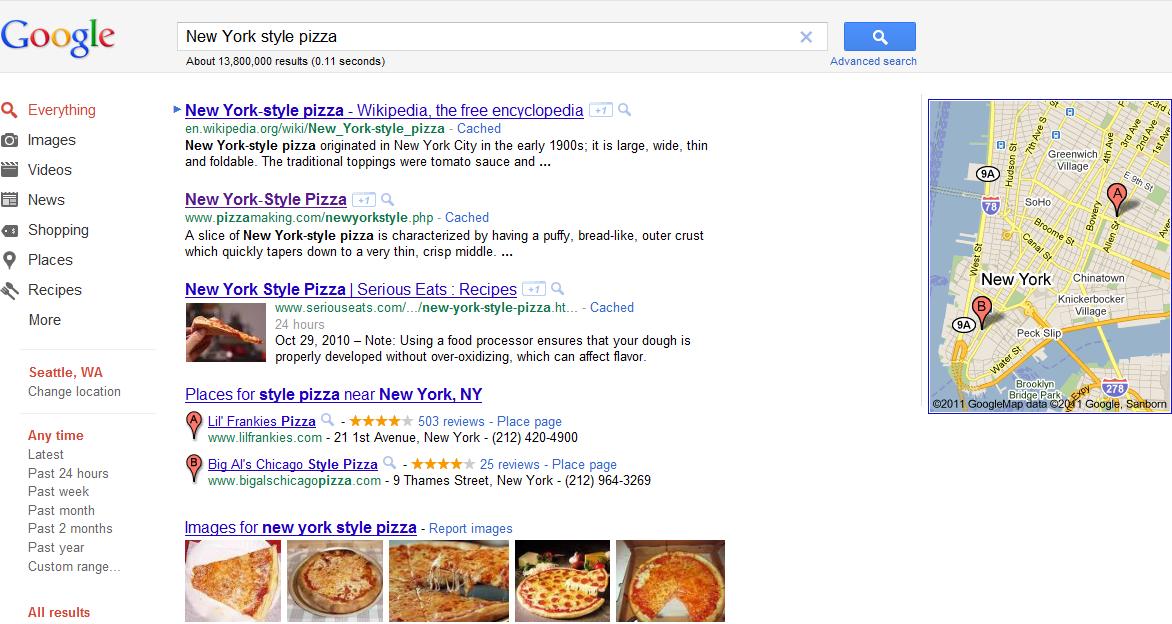
For example I live in Seattle and right now I am hungry for pizza, in fact New York Style Pizza, so I choose to do a quick search on Google “New York Style Pizza” to find an viable option.  Observing the image above, it is clear Google is lacking in the contextual department.  Lil’ Frankies and Big Al’s are both pizza joints in New York City!  Amazingly, nothing on the page has anything to do with pizza here in Seattle.  This is not good.  I’m pretty sure my friends on Facebook or even growing local social search platforms such as CrowdBeacon or LOCQL would provide me a New York style pizza option closer than 2,400 miles.  I am aware Google has made strides in localization, but it is not apparent when I quickly use their main search tool.  This simple query illustrates how broken search is at the moment.

It is becoming clear to me, as more  and more information gets created each day, how important our network of social contacts are in bringing us information. More specifically, those two phenomenons are inversely related – as the amount of information grows, the tighter and more important my social contacts become. Why? Because as the amount of information increases we need context and location to help determine relevance. Context can help determine if I am searching for a pizza place in New York or if I am looking for New York style pizza. Location helps define if I am indeed looking for a New York style pizza joint here in Seattle.

Another noteworthy contextual observation is the innate difference between certain search decisions, for instance searching for a clothing retailer versus searching for a restaurant. I would be fine buying a shirt from a distant retailer in New York City. Ordering pizza…? Not so much. Google’s Android DNA doesn’t seem to understand humanoid nuances at all. I guarantee a social search application (powered by my friends) would intuitively understand the contextual and location nuances within my searches.

Understandably, this is freaking Google out and forcing them to push socially awkward applications onto their users at an increasing pace. Unfortunately this is not how social works, you simply cannot rush things on the first date or you will never have the opportunity for a second one. Google+ looks to be their best social offering as of yet, but only time will tell if they have finally aligned the social dots.

It is now clear why Google purchased Aardvark, one of the social search companies I highlighted in my last post. Just read this brief overview and think of how it could help us search:

Aardvark is a way to get quick, quality answers to questions from your extended social network. You can ask questions via an instant message buddy or email. The questions are then farmed out to your contacts (and their contacts) based on what they say they have knowledge of. If you ask taste related questions about music, books, movies, restaurants, etc., they’ll ask people who tend to show similar tastes as you in their profile.

It will be interesting to see how (and if) Google integrates Aardvark to help navigate this new search territory. Regardless of the outcome, I do not think Google will loose its shirt anytime soon. They have a stranglehold on the overall search market and most realize there are many different channels in search. I agree with Semil,”This type of search, or social discovery, will become important, but it won’t dominate search—it’s just one channel, and different social networks exist for different parts of our lives.” 

This is just the beginning of an incredible change in how we will find and use information and I cannot wait to see what emerges. In five years (2016)  we will not be looking at a white screen with blinking cursor begging us to type a few short words into the search vault so it can pull thousand’s of links for us to plow through.

In my next post I will go in-depth on the first of the four quadrants of social search, an area I believe has yet to fully experience this massive technological revolution.

$99,970,000,000 is The Difference Between These 3 Decisions

If MySpace would have just copied Facebook, it would have been FacebookSean Parker

That was Sean Parker’s answer to the question “what happened to MySpace?”  in a recent interview with Jimmy Fallon.  This got me thinking and was the needle prick I needed to start on a topic I have wanted to write about for some time.

If you can remember at one time MySpace was the social networking behemoth, holding the crown as the largest site on the web.  “Do you have a MySpace?” was the proverbial question between twenty-somethings.   They had over a hundred  million users worldwide, were driving revenue in the hundreds of millions of dollars and it looked as though we had an MTV 2.0 on our hands.  They made headlines with the acceptance of a $580 million acquisition from News Corp, validating Social Networking as a ligament startup business venture.   Little did we know they would turn out to be a joke, an afterthought on the web and a huge lesson to any young founder looking to build the next big company.

At right is a snapshot of the MySpace.com monthly unique users from earlier this year (courtesy of Techcrunch). As you can see (and probably already knew) usage has continued to plummet.  MySpace is literally a ghost town at the same time Facebook has grown to the largest site in the world, officially eclipsing 700 million users on their way to an inevitable 1 billion users and will soon IPO with a valuation of more than $100 billion!  This begs the question: What happened?

My take from Parker’s statement is MySpace had such a massive lead in users, media coverage as well as total mindshare in the social networking space it was their race to loose.  Quickly incorporating the features they saw Facebook releasing could have helped them stay atop the game.  Imagine what MySpace would be worth now if all they did was manage to keep it all together and ride out this new wave of social/mobile web.  Definitely more than the rumored $30 million News Corp is looking for to get them off their books.  What a sad ending to once dominant company.  To take Parker’s statement a bit further, I argue the biggest mistake MySpace made was sell out to the suits for a mere $580 million.  Here are three key differences that add up to a $99,970,000,000 difference between Facebook and MySpace.

Lack of vision and Leadership

The biggest difference between Facebook and MySpace is an intangible I have written about it extensively before.  Just as the difference between Apple and Microsoft was found in Leadership, so too was the difference between the social networking companies Facebook and MySpace.   (Get used to me writing about vision and leadership because I believe it is the number one reason companies succeed or fail.)  MySpace was early out of the gate and sprinted the first mile but did not foresee what could possible be on the horizon.  All they knew was people wanted a page to customize as their own and maybe a place find and connect with others.  But who was leading MySpace?  To put it bluntly, MySpace had no clue what they were doing and no clue who to look towards for leadership.  MySpace was not created by a visionary such as Mark Zuckerberg, who saw something in the web most did not.  They were driving solely on dollars and revenue, and the lack of vision and focus devastated MySpace’s growth in the end.

If Facebook was only a profile page where you can connect to your friends, MySpace would have won the race.  Facebook bet (and won) on a vision of the personalized web, integrating our friends in almost everything we do in the digital world.  Zuckerberg saw not only a web of information, but a web of people and set out to connect all those people into the web.  Execution on this vision required laser focus from a passionate founder.  MySpace ran the first mile faster but lost its way.  Facebook knew the course and won the marathon.

Message to entrepreneurs:  Have the intelligence to place a visionary leader at the heart of your company and let them guide the way.

Technically Inept

Myspace proved they were technically inept, lacking any engineering vision of how the web should work.  According to a recent Bloomberg Businessweek tell-all article, the company was constantly at odds with leadership on how/what/where to innovate.  “They were having to do all technical innovations to address the various panics that are happening. Basically their development cycle turned into one of crisis management, not one of innovation.”  Bottom line, MySpace lacked the vision as well as the technical edge necessary for a web company to maintain their dominant position.

More importantly, MySpace was not created as an innovative new platform built by forward thinking engineers. They were a company who decided to copy Friendster using sub-par technology but grew because they understood how to market their brand to the general public.  Choice quote from the article: “Using .NET is like Fred Flintstone building a database,” says David Siminoff, whose company owns the dating website JDate, which struggled with a similar platform issue. “The flexibility is minimal. It is hated by the developer community.”  Why did they choose to do this?  Driven by revenue pressures they chose to skimp on technical details and focus on more ads.

On the contrary, Facebook was intended from the beginning to be a socially transformational technology built by smart engineers.  Zuck made it a point that their engineers would determine the road ahead.  They aimed to redefine the web and understood this would require major investment.   As a non-technical executive, it was still obvious to me who was stronger in  engineering talent between the two companies.  Remember how refreshingly clean a Facebook profile felt vs the craziness that was a MySpace profile.  MySpace chose to skimp on the engine and polish the chrome.  Bad mistake.

In an interesting note, most close to Zuckerberg would admit the best decision he has ever made was to bring in a much senior and more businesslike Sheryl Sandberg as the Chief Operating Officer of Facebook.  It is said she is in more direct managerial oversight than Zuck, and who would want that?  Sandberg has been credited with building out Google’s ad business, helping create a multi-billion dollar search ad business.  I credit Mark for submitting his ego and filling holes with the right people, Facebook is better off for it.  Looking at MySpace and their recent history I cannot say the same.  Holes were not filled and egos were not subdued.

Message to entrepreneurs:  Know where you are good, understand where you need to be great, and find the right people to fill the gaps.

Poor Culture Fit with News Corp

“I think any time a startup is acquired, there’s always a certain amount of culture clash.” – Chris Dewolfe, MySpace Co-founder and one time CEO.

The worst decision for the future of MySpace was to sell the company to News Corp.  (Okay, the founders and initial investors made out fine, but the future of the company pretty much was set in stone.)  Time and time again I observe or read about another startup being acquired by a larger company and I think to myself  “well, there it goes…

The blazing, crazy, edgy, partying, sometimes innovative culture of MySpace was suffocated by the bureaucracy of corporate New Corp.  Do yourself a favor and think about your startup culture currently, and then think about the culture in a Microsoft, Google, Aol, or any other large corporation.  Ask Dennis Crowley.  Ask Evan Williams.  Ask Caterina Fake.   It usually doesn’t end well when you sell your booming startup to a large corporation.  Facebook fought off takeover bid after take over bid until everyone knew they just weren’t ever going to be for sale.  That’s ballsy, but its also what has to happen if you want to see your vision come together.

Message for entrepreneurs:  If you have a long term vision for your company, don’t sell – ever!  If you want to make some quick money, sell at the top of your hype – and walk away as early as you can.  The post-acquisition company will be nothing like the pre-acquisition company.

I am tired of seeing innovative startups being gobbled up by larger corporations only to disappear off the face of the earth – this is not how innovation changes the world.  It is actually how innovation is hindered.  I understand, as a founder you are double minded building your company.  You want to make a chunk of cheddar, and  there’s nothing wrong with that.  Isn’t that what going into business is all about?  I understand… and I would want to do the same thing in your position.

But before you sign those papers I would step back and determine what you really want and if it’s the best option.  If you really need to sell, truth is you did not build the company correctly.  If you want to cash in, great.  But understand, odds are the world will no longer be changed by your innovation.  If you really feel selling is the best option, think deep and hard about the culture inside your company as well as inside the potential acquirer because the marriage is going to be tough.  And if you feel deep down in your heart your company has a great future, don’t sell out.  Just think about how News Corp and the original MySpace founders feel about this outcome right now.

Image courtesy of Flickr user UltraRob.

This post was originally published on BusinessInsider.com.

I Just Asked My Friend About the Future of The Web, and Here is What They Said

Social Search Series: This summer I am embarking on a journey through on the emerging web of Social Search.  Traditionally known as the Questions & Answers industry, this category is currently being transformed by social and mobile technologies.  No more asking a site questions and finding old answers.  I believe the future of the web is ingrained in the dynamic interdependence of social and informational networks.  This is part I of the series.

Traditional Question & Answer sites are old and antiquated.  You know the drill – go to a specific website, type a question into a search bar and a variety of indexed answers come back to you.  The answers vary in context, quality and relevancy.  This was fine in 2002 when the web was less mature, but the reality is with advancements in web technologies it simply does not work today.  The problem is these sites typically:

  • Don’t know your location

  • Don’t know who are your friends

  • Don’t understand the context of your query

  • Are typically of low quality and relevance

Answers tend to be more relevant and helpful when they include this information.  When the system lacks these inputs, the quality of answers remains very low and you are left with an inadequate solution .  In fact, so low in quality you might as well just pick up your phone and call a friend.

Enter a new category of applications emerging on the web.  Social search applications implicitly take into consideration your social network, your location, your demographics, previous search history and other key data sets to help provide you with the best answer possible at that time.  I will not refer to the Questions and Answers space anymore, since I think asking a question and waiting for an answer is quite limiting and the entire concept is antiquated.  I believe we are on the cusp of a new internet category where users leverage their social/local sphere to quickly find relevant information.  I am calling this space the “Social Search” category.  Note that currently I am not including Facebook – the largest social networking site – in this category.  This is a study of startups who are strictly focused on social searching technologies.

This space is heating up and I am starting to read more about emerging companies working to build out the next social/local search platform.  Traditional Q&A sites are starting to see the writing on the wall, with Answers.com just recently massively laying off employees and replacing their CEO and CTO.  In fact, I wrote about a few local Q&A startups a while back noting this space is a game changer on the web.

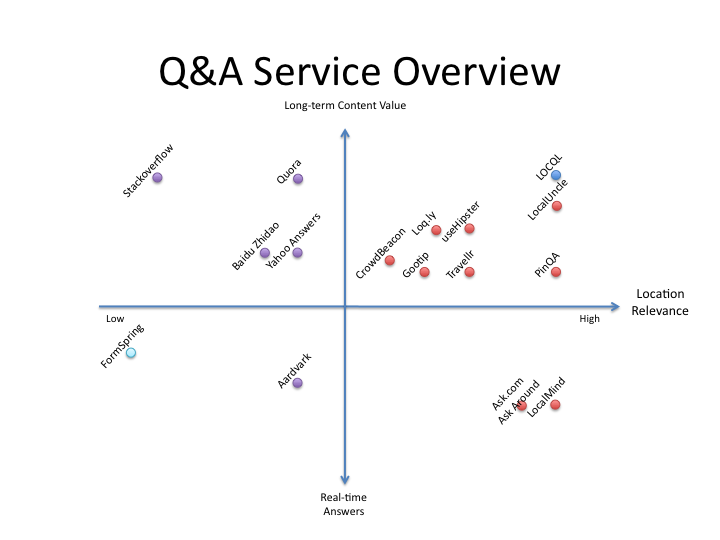
When evaluating this new space, Four categories/quadrants emerge to separate the players in social search.  I have diagrammed them based on their relation to the four categories.  (If you don’t see an application that might fit on here, please reach out to me)

Location Relevance

Locating a user when a query is submitted is fundamental to providing the BEST answer possible.  According to Bing, over 50% mobile device originated search queries are about a specific place.  Think about how often you need an answer and how often you quickly use your mobile device to find it.  Exactly.  Mobile search will define the next wave of the web.

LOCQL

LOCQL is a Seattle startup some refer to as “Foursquare Meets Quora”.  These guys smartly put together two basic premises; 1) everybody knows a little bit about something and 2) location specific information always make something more valuable.  Marry those together, involve some game mechanics and you have a living, breathing repository of location relevant information based upon where you currently find yourself.  They are still in beta but anyone can use the LOCQL application.

Others include:

CrowdBeacon

Loqly

Gootip

Hipster

Travellr

LocalUncle

Local Mind

Location Agnostic

Some social search applications do not integrate location technologies into their functionality.  These applications more or less originate around specific topics and knowledge bases, not so much around a specific location.   Although these applications are location agnostic, they still can be relevant to certain users and possibly large search companies.

Aardvark

Aardvark is a way to get quick, quality answers to questions from your extended social network. You can ask questions via an instant message buddy or email. The questions are then farmed out to your contacts (and their contacts) based on what they say they have knowledge of. If you ask taste related questions about music, books, movies, restaurants, etc., they’ll ask people who tend to show similar tastes as you in their profile.

Others include:

Formspring

StackOverflow

Quora

Yahoo Answers

Long Term Value

It is important to create a  repository of information so users have something to search, and if done correctly this can be a great competitive advantage – the largest collection of information generally provides the best and most accurate information to a user.  Most questions have a narrow answer and this information generally does not change much over time.

Quora

Quora, founded by former Facebook employees, is a continually improving collection of questions and answers created, edited, and organized by everyone who uses it.   They aim to build THE go to application for wisdom and knowledge.  The cool thing about Quora is you can follow well known people as they continue to add their knowledge to the site. Quora seems to be the emerging leader of these newly minted social Q&A sites.  Thus far they have maintained their focus on the relatively smaller web tech community of Silicon Valley.

Others include:

CrowdBeacon

Loqly

Gootip

Hipster

Travellr

LOCQL

LocalUncle

StackOverflow

Yahoo Answers

Real – Time Answers

Instant interaction technology (real time) has transformed the web from a static information repository to a live, interactive medium.  This single change gave birth to what we know today as the social web, including Facebook, Twitter and many other social interactive platforms.  Search technology is catching up as well, and when infused with social interaction things could get very interesting.  Understandably, this category is nascent.

LocalMind

Localmind allows you to send a question to any place in the world, and get an answer from someone at that location in real-time.  They connect you, temporarily and anonymously, to someone at the location you are interested in, allowing you to ask any question you want, and get an answer in real-time. You can find out how crowded it is at a bar, how long the line is at a club, or how many tables are open at the restaurant.

Others include:

Ask Around (Ask.com)

Aardvark

Formspring

Look for my next post as I investigate: what’s the point of Q&A anyway?  Why am I now calling it Social Search?

Another Lesson Learned: See The Opening

I woke up yesterday to a pretty cool email waiting in my inbox with the words:

“We would like you to come in and interview Giant Thinkwell and Sir Mix-A-Lot today”

This doesn’t just happen to anybody, and it certainly doesn’t happen to someone that waits for opportunities to fall in their lap.  Successful entrepreneurs MAKE things happen.  And to be brutally honest, I pretty much made this happen (acknowledgment: with help from others to connect the dots).  How?  It all started 3 months ago.

  1. I connected with a founder of a recently launched startup about 3 months ago
  2. We stayed in contact via email, sometimes not hearing from him for months at a time
  3. I started writing on this blog
  4. I started shooting out my posts to larger publications around the country
  5. BusinessInsider.com like my writing, published a few posts and offered me to become a contributor
  6. I finally met up with the founder a few weeks ago and chatted about my latest happenings (quitting job, blogging, looking for connections)
  7. He connected me into a local startup communications list last week
  8. Giant Thinkwell, a local startup, announced they were releasing the Mix-n-Match app on the list
  9. They also requested help and asked if people could spread via social networks
  10. I reached out and simply commented “I could do a post on BusinessInsider.com if they wanted”
  11. I recieved the email in the morning and that afternoon I was sitting across the table having a conversation with “Mix”

Successful people jump at opportunities and follow through on them.  You cannot wait around for someone to find you and give you exactly what you have been looking for.  You must go make it happen.  Like a running back in football, when you see an opening, you must go for it.  Sometimes that little opening will make all the difference in your life.

Image courtesy of Flickr user Monicas Dad

Did We Just Become The United States of Idiocracy?

This post was originally published on BusinessInsider.com

Recently quitting my job and diving full time into entrepreneurship has allowed me time to step back and think about what is actually going on in the current tech space. It’s interesting times to say the least, but what I am about to say may not be what you expected.

A concerning trend is starting to bubble from within and I feel it is necessary to bring it to light. Reviewing the web’s latest news we see more companies going public, constant talk of Groupon’s massive growth and community destruction, Facebook tempting us (and current employees) with an inevitable IPO, Twitter’s ubiquity becoming every politicians nightmare and Google’s latest and always awkward attempt at the social web.  Seems like just another month in the frothy web market.

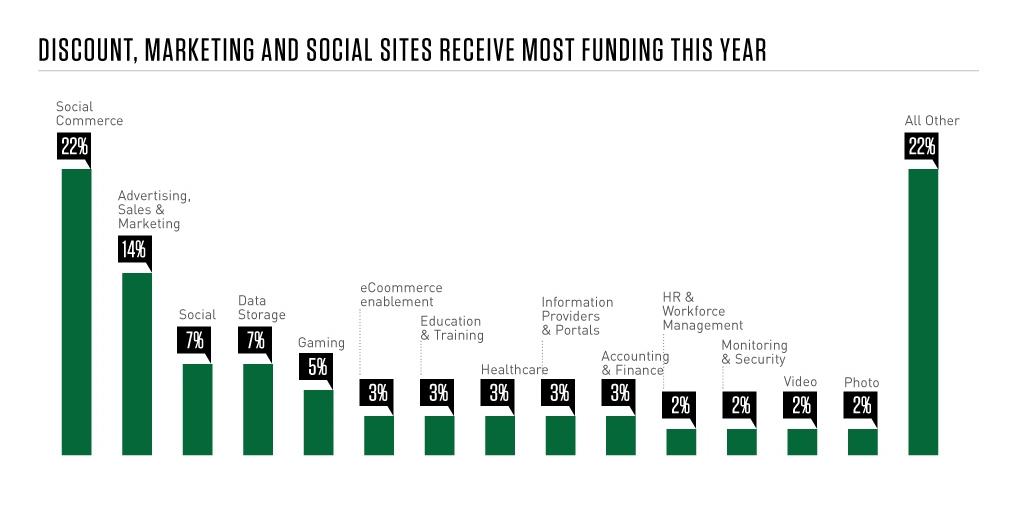
But take a close look at this infographic detailing Q1 investment dollars broken down into categories.  It is from an article a few weeks ago on GigaOm.  Click for a larger view.

So let me get this straight: If this information is correct, most of our capital resources and engineering talent are hard at work figuring out how to help people buy massages for 50% off?

Disclosure: my startup – Loyaltize Inc.- was initially focused on local commerce with our first version and it remains to be seen what we build out next but my mind is buzzing with new perspectives as of late. So I am also talking to myself here.

While trying to figure out what this infographic actually means let me just state the obvious – taken on the surface it tells a lot about what we value as a society.  Or what we don’t value.  Namely Health Care, Education, Security, and “all the others.”  This has massive future implications and should be a cause for worry – that is if you are American.

Social Commerce attracted 22% of all investment dollars so far in 2011. Advertising, sales and marketing took home another 14%. and social apps saw 7% of VC money. That is almost 1/2 of startup investment dollars focused on improving how we socialize and spend money! (note: take away the amount invested in the Groupon bubble and the picture changes a bit, but hyperbole is needed here to provoke some deeper thought.)  The amount of money invested in “all other areas” of technology equaled the amount invested in Groupon and the like-clones.  You have got to be kidding me.

No wonder the United States of Idiocracy America is at record levels of consumer and national debt. An old maxim comes to mind: show me where your money goes and I’ll show you what you value. I will also offer another maxim:  Show me today what you are investing in and your future I will show you.

The sad truth is we value selling products over our children’s future well being and education. We value buying stuff right now over investing in a better future. We value gluttony over governance. With this current trend in investments, these “American” values won’t be changing anytime soon. There is no fighting or arguing this statement. It’s all right there.

This whole Groupon thing has gotten out of control. We are falling farther behind the world in education, yet we seem to excel in creating new ways to spend money quicker and eat cupcakes faster. The biggest and most anticipated IPO this year is going to be a site where mass consumers can purchase things at mass discounts? Sometimes I think I am hallucinating that Groupon is the major story of innovation on the web in 2011.

Is this the best we can do Silicon Valley? Chicago? New York or Seattle? Or is this just what investors think will make them the fastest dollar? That is one part ridiculous and another part sad.

This baffles me: Why are the largest issues of the past 4 years and the focus of the current political landscape – things that are paramount to the future of our country – receiving almost no private investment attention?

What about using some brain power and engineering talent to rework the healthcare system, a system which is in more dire straights than our shopping experiences? How about transforming education so children understand the world is full of information and it’s all right at their finger tips? They just need the access, be taught how to use and deploy it to their advantage all the while learning how to critically think. And if I was sitting across from the table from you and asked what is more important: 1) buying something from your mobile phone or 2) your personal security, I think most of you would admittedly choose the latter.

Hundreds, maybe thousands of companies have determined the best use of their time and intelligence is to copy Groupon and put out another daily deals site. Numerous talented engineers are inventing new ways for us to share pictures from our iPhone and scores of startups have been working on new methods of messaging groups of people.

Although all those ideas are interesting in their own way, it is the equivalent of Barry Bonds stepping up to the plate and bunting. Wha? Yeah, I ask myself the same question every day as I read another $5 million was just invested in a Series A round for another picture sharing/messaging iPhone application.

You guys are the best of the best… remember?

The reason I wrote in-depth about technology cycles was because it became clear to me the web will very quickly infiltrate every part of our life.  I cannot wait till the internet of things starts to power everything we use, from our toothbrushes (transmit data to help us maintain our oral health) to our shoes (real time data about how many steps we have taken, informing us when we need new shoes or the current state of our metabolic systems, etc) to the lamp I am using right now (instantly search and learn the history of this exact product to know if it was created Carbon neutral).  I can’t wait for stuff like that.

I am not here to rant, I am here to inspire better.

Founders: odds are you went to Stanford, have an MBA, or you came from a benefited family – and your company slings mass discount group coupons online? Why are you wasting your talent and intelligence?  I believe you are better than this.

And VC’s: that $5 million could have helped an entrepreneur who has a vision to transform your children’s’ future education?  Or maybe help lower your monthly health care costs?  Doesn’t that sound like a better future?

I honestly think these are valid questions to ask in today’s investment and entrepreneurial communities.

I am not saying I disagree with venture capital and the inherent goal of “invest X and receive a 10X return“, I understand the system has to return something and feed itself. I just hope we don’t grind ourselves into the dumbest, fattest, most uneducated, quickest to buy a 50% off dinner using our mobile device from our couch society. Because the path we are currently heading down is indeed pointing us in that direction. I hope we (investors, entrepreneurs, consumers) can see there are a hell of a lot more important areas of our society that need fixing.

I believe true entrepreneurship is about changing the world, not taking advantage of the world.  We need more entrepreneurs like Dr. Samir Qamar.  Please someone… anyone… answer my call and help turn things around. You will be forever referred to as a hero by me down the road.

Image courtesy of Flickr user Roger Smith.

Are You Being Brutally Honest With Yourself?

Chris Dixon writes in a short piece on Founder/Market fit about not only aligning yourself and your strengths in the proper market but also understanding where you fall short.

Founders need to be brutally honest with themselves. Good entrepreneurs are willing to make long lists of things at which they are have no ability. I have never built a sales team. I don’t manage people well. I have no particular knowledge of what college students today want to do on the internet. I could go on and on about my deficiencies. But hopefully being aware of these things helps me focus on areas where I can make a real contribution and also allows me to recruit people that complement those deficiencies.

Most importantly, founders should realize that a startup is an endeavor that generally lasts many years. You should fit your market not only because you understand it, but because you love it — and will continue to love it as your product and market change over time.

This is so true and applies in my life.  Great entrepreneurs know where they are great and are honest about their weaknesses.  I constantly ask myself:
  • What are my strengths?
  • What is it I do better than anyone else?
  • What are the areas where I am weak?
  • In what areas do I (and my company) need help?
  • Who is strong in those areas?
  • How can I inspire them to join me?

Everything In Business is a Test

Test.  Test.  Test.

Everything in business is a test.  The good ol’ days – writing a business plan, pitching for investment, building out a product for the exact market stated in the business plan, launching the product through a large budget Launch strategy – those days are over.

As an entrepreneur, you should now consider yourself a scientist.  Your job now is to run as many tests as possible, with the least amount of expenses to find mass adoption of your product.   The tests should start in the ideation phase and shouldn’t ever end.  The single worst thing you can do now as an entrepreneurial is have one idea and do everything you can think of to bring that specific idea to market.  Start with a problem area and test ideas around it.

Test for consumer problems

What problems are present in which you can bring a solution to market?  The best businesses solve a problem consumers have (or didn’t know they had but now realize life is better with your product).  I heard the other day: You cannot just ask consumers what they want – they do not know.  But if you observe and test them, their actions will lead you to holes that need to be filled.   Inefficiencies will present themselves.  Great entrepreneurs see these inefficiencies early.

Test for Product/Market fit

tubesOnce a problem is found and a solution has been built, the real work starts.  Take it from me, your first attempt will not be the golden fit and you will have to re-align somethings.  Call it pivot, call it whatever you want… it will happen.  I don’t know why we are making such a big deal about pivoting, great entrepreneurs constantly pivot their ideas until they get the right market fit.  Ask Edison, he pivoted like 5,000 times…

Test for Business model

How to make money is the question every company must face.  I believe this is an area a startup must test early and often.  This question should never have just one answer.  Small tests on business model, payment options, advertising (I know… I know….) and other methods of creating revenue.  It’s just a test.  Do some A/B testing on a select group on users.  Release a payment option to 1% of users and see what happens.  You might just discover your next big innovation and create a new billion dollar industry.

Test for Perseverance

Ask any founder of a startup (still running) and they will have hours of talking on the subject of perseverance.  The startup experience will test you and your perseverance.  Just don’t give up.  Do anything you can think of to put off the quitting of your vision.  Read Delivering Happiness by Zappos Tony Hsieh to get an idea on Perseverance.  I had no idea they went through the hell they did with their startup.  You need to read this book if you are a founder of an early stage company not knowing if the future is bright or bleak.

Test for leadership

I laid out the importance of brand and company leadership expansively in my last post The One Thing That Separates Apple From Microsoft.  Suffice it to say I think this is the most underrated, under-talked about, overlooked but most important aspect of building out your long term brand.  You must answer he question: Why are consumers going to want to use my product?  Believe it or not, it will be due to the leadership of the company CEO.  Test your leadership skills early and often to find the right connection with general consumers.

Test for Funding

Investors don’t tell you this, but they are testing you at every stage of the game.  First time you meet them at a “social event” they are testing your IQ and your EQ (your social intelligence) to see if you are someone they would even want to take an interest in.  Next time when you meet for a pitch, they will test your concept and your perspective on the market.  When they don’t call you back, they are testing your perseverance.  When they give you money, they are testing your ability to turn X into 10X.  If you pass that test, you will most likely be able to get money from them anytime thereafter.

I could go on… but I think you get the point.  If you thought your tests were over after graduation, think again.  They only have just begun.  Embrace the test.

Image courtesy of Flickr user Canyon289

The Story of How Pandora Radio Almost Died

I love the Pandora Radio app on my iphone.  I listen to music most of the day – in my room or around the house, in my car, outside walking around – and this is possible only because of internet connected mobile devices.  Pandora Radio just recently went public on the NYSE and looks to have a strong future.  It wasn’t always so bright, this is a story of persistence and hanging on by a thread.   MG Siegler of Techcrunch had a great write-up on Pandora the day of their IPO, I think it’s so I will re-post it below.  I like it because you get a sense these founders would not give up on their vision and persevered through much trial and tribulation.

————

Pandora was founded in 2000, but it wasn’t known as “Pandora” at the time. Instead, the company was focused on their Music Genome Project, which aimed to extract the DNA from music, as it were, and find commonalities to perfect recommendations. When Conrad joined in 2004, the company was known as Savage Beast — yes, a truly awful name that invokes Savage Garden. In fact, here’s an early blog post from Conrad about Savage Beast that he probably won’t be pleased with me sharing.

When Conrad came on board, the company had just taken its first real venture capital investment (from Walden Ventures) and Joe Kennedy had just been hired as CEO. The idea was to transform the Music Genome Project from a cool piece of technology that was licensed out to the likes of Best Buy, and (our parent) AOL, among others, to a consumer-facing product. That effort began in December 2004, with design work leading up to that. By the late summer of 2005, the product was ready to go.

And here’s where things get really interesting.

“TechCrunch is a part of this,” Conrad says. “We launched, and the first Barcamp was the following Saturday. I got out of bed that morning and almost didn’t go. But at the last minute, I threw my laptop in the car and drove to Palo Alto,” he says. “By luck, Mike was in the room.”

He means, of course, Mike Arrington.

“He got up when it was over, went to a Starbucks, I think, and wrote a post about Pandora. That was the starter pistol for our early growth,” Conrad says. And thanks to the magic of the Internet, you too can see that post from August 20, 2005 right here (note the part where Arrington tries to give out invites from his personal email address, then gives up due to massive interest).

Conrad notes that TechCrunch itself was “about 45 days old” at that point. And he fondly remembers Arrington being annoyed with him that the Pandora launch wasn’t given to him as an exclusive. “At that point, he was just some blogger to me,” Conrad says with a laugh.

But that didn’t stop Conrad from showing up at Arrington’s house over the next several months for the BBQs Arrington used to host in his backyard. Conrad recalls that Pandora music streaming from his laptop would often be the musical entertainment for the evening “while we stood around his little campfire”.

From that point on, Pandora “grew at a pace that exceeded my expectations,” Conrad says noting that millions of users were coming on in just the opening years.

But then the CRB decided the royalties for this new form of radio, Internet radio, needed to be set. Conrad notes that after Pandora was live for about a year and a half, those rates were revealed — and they weren’t good. “It was economically unsound,” he says. “And it wasn’t just us that was affected; Yahoo, AOL, Microsoft, and a lot of smaller guys too.” At that point, Pandora entered into a two-year-long process of negotiating with the record labels over royalties that led to the situation described at the beginning of this post. “This was a complicated period for us,” Conrad says.

But there was also a ray of hope that emerged during this time. The App Store.

Conrad notes that when the iPhone OS 3 (remember, it wasn’t “iOS” at the time) launched in the summer of 2008 and brought the third-party-friendly App Store for the first time, everything changed. “Broadly, the smartphone category accelerated everything for us,” he says, noting that the App Store was the catalyst.

“What we’re really trying to do is re-invent radio. It was consumed everywhere, but least of all at work, and the web browser changed that,” Conrad says. “But the mobile devices took it out of the browser and out into the world,” he continues. Now over half of Pandora’s usage comes on smartphone devices, he says. And that’s incredible since Pandora had been on feature phones for about a year prior to the App Store, but it wasn’t going anywhere. With the iPhone, “the consumer expectation of what they could do with their phone changed drastically,” he says.

Conrad also points out that Nielsen had a recent study which put Pandora in the top five apps in terms of usage on major devices — iPhone, iPad, Android, Blackberry. He believes they’re the only company in the top five on each of those devices.

So the App Store helped Pandora’s mood in an otherwise bleak time. “The timelines do overlap in an interesting way,” Conrad says. But at the same time, he says that he was never too concerned for Pandora having to completely shut down. “The [royalty] rates were so irrational that we were very confident through the period that we would come to a compromise with the rights’ holders,” he says. At the same time, he credits the “incredible outpouring of support from our listeners” as the thing that really motivated Congress to start looking into the situation.

“It was frustrating that it went on for so long, but we thought rationality would prevail,” Conrad says. And even after “RIP, Good Times”, hit in late 2008, he wasn’t too worried because “we focused on the monetization of the product from the beginning.” “Other companies were behind the eight ball, but we were starting to see the rewards from that attention to revenue,” he says.

And then in the middle of 2009, the clouds broke. Pandora (and other Internet radio services) reached an agreement that would lower royalties to the point where the business could work. “Pandora is finally on safe ground with a long-term agreement for survivable royalty rates,” Conrad told us at the time.

“A real period of growth started then.” And today, Pandora has over 94 million registered users.

Story courtesy of Techcrunch

If You have a Website, You Need SkyGlue

SkyGlue is a service that helps you understand what your users are doing on your site.  It works with Google analytics and enables individual user tracking and simplifies Google Analytics event tracking. It automatically tracks links, downloads, form interaction activities, buttons and many more within your Google Analytics reports.  SkyGlue’s patents pending technology is the simplest web event tracking tool currently available on market and one that any website owner needs if they want to increase their traffic.

Eric Huang, founder of Skyglue, says the idea behind SkyGlue came with several iterations to a previous idea.  “Before our current product, our idea was to build a standalone web analytics service for user retention analysis. We developed a prototype and had some beta users. What we found out is that it is very hard to have the users spend time updating their websites to collect data.

SkyGlue is a recent graduate of the startup accelerator Founder Institute.  The FI program is a 4 month long incubator meant to help first time founders get a business established and an initial product into the market.   The process is grueling and only about half of the accepted entrants usually end up fulfilling the requirements and graduating from the Founder Institute.

After completing some market research Huang found most of the high-end web analytics solutions, like Omniture, require consultants to add tags to websites to collect detailed user activity data.  According to Huang,” Using these services is an expensive and time-consuming process.  For small to medium websites, they use Google Analytics, but they usually just use the default pageview tracking setting without tracking those high business value click events, such as form interaction, white paper downloads. If they don’t measure them, they cannot improve them.”

Our goal is to make advanced web analytics extremely simple to use and easy to maintain.  We want to help our customers gain better insights into the behavior of their online users . – Eric Huang, Founder SkyGlue

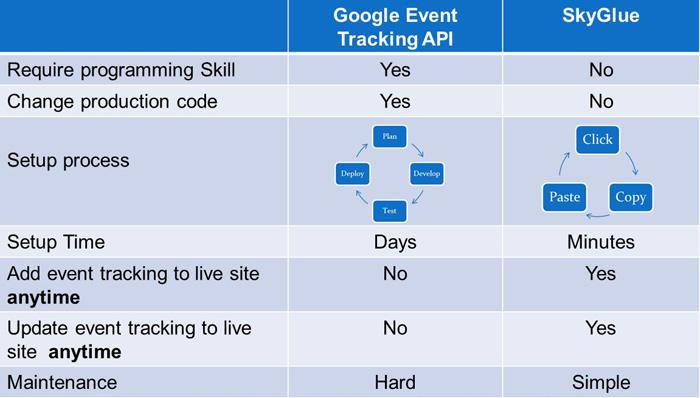
Huang notes website owners can just use Google Analytics, which is by default only measuring papgeview tracking and basic user segmentation.  But without SkyGlue, their Google Analytics data is not actionable, and thus incomplete.  Google Analytics has event tracking but needs programming APIs and code change (tagging) on all related links and buttons and other items usually needing to be completed by developers.  SkyGlue lets users easily measure high business activities and find ways for improvement all with just embeding a line of code.  The major difference between Google Analytics event tracking API and SkyGlue are shown on this chart below.

It took a while for Huang to find this specific need.  “When I was in the Founder Institute Seattle program I spoke with various mentors and my beta users and it became apparent the idea for making advanced features in Google Analytics easier to use will address a bigger market.”  Eric adds that with SlyGlue, it will also be easier for you to attract more users with spending less money.  In a sense, SkyGlue addresses the pain-point of streamlining advanced web analytics – knowing what users are actually doing on your site.

When you sit with Eric, you get a sense he knows what he is talking about.  Not surprisingly, he has a Ph.D. in computer science from Indiana University – Bloomington with a focus on distributed computing and cloud computing.  After graduating IU, Eric joined Microsoft and became the 1st developer in Azure AppFabric ServiceBus team.  He was one of the key early-stage contributors of Microsoft cloud service from incubation to V1 release.  Prior to that, Eric worked for IBM Research and SONY.

With the current version, SkyGlue can automatically detect and track most website events that are of interest to you.  Individual user activity tracking is automated as well.  They have a good list of beta users that have provided tremendously valuable feedback. SkyGlue is currently in private beta and is looking to expand their user base and will soon implement an initial business model.

It’s free for a limited time, so go here to get SkyGlue for your site.

The Daily Deal Cuts Like a Knife

Update: this post was originally posted on BusinessInsider.com

For years now I have been waiting to read a post like the one I just read on the Daily Deals concept.  Rocky Agrawal has done extensive research on the daily deals phenomenon and succinctly puts it:  The entire daily deals industry must die.

I vehemently agree with his perspective; it finally calls out aspects of the model people have been turning a blind eye towards for way too long.  Please do yourself a favor and read it.   Although much has been written lately regarding Groupon and it’s historical rise (one in which I have no question been fascinated with), we should not forget: a good business might not be good for business.  Here are some thoughts I had back in 2008 when we first heard of Groupon and still hold today.

Discounts are for crappy businesses

BMW is a luxury car.  The Metropolitan in Seattle is a nice restaurant.  Gucci and Prada command extremely high prices for their merchandise.  Although these companies are more well known brands, I think you get the point.  They don’t have to discount their products because they don’t need to.  By building a business through offering a quality product or service (and running it soundly) they don’t need to resort to scrapping the bottom of the ocean just to sell something.

But when a business is having trouble getting people through the door they will look for any way to reverse the trend.  Some hire people to wear the sandwich board, hold the arrow and dance around on the corner for minimum wage.  Others will offer 2-fers.   And now many are realizing the power Groupon has in getting get their name in front of thousands in one day.  All this marketing does not change the fact that something is wrong with their business.  If there wasn’t anything wrong, they wouldn’t need more customers and wouldn’t be running a Groupon.  Rocky describes the core fundamentals of coupons and group discounts have been around for many years.  Only difference now is the medium used for distribution.

Discounting is like crack for business

Once a business chooses to offer their products or services for a discount – say 50% off – they have effectively started abusing a drug.  The daily deal is impulsive for consumers, as in, some experience a high when they open their daily deal email each day.  “OMG, what will it be?”   And local businesses get a excited when they see a large influx of customers (the high).  Once this initial influx dies down two things happen.  First (and most likely), their business volume will go directly back to the customer visit level previously experienced prior to offering a Groupon (the comedown).  And second, they now have told the world the “real” value of their products or services.  It would be foolish for a customer to pay full price for something once they know it will be offered for half the price.  So businesses are forced to continually slash their prices and offer more mass discount deals to maintain customer interest.  It becomes an ugly downward spiral (addiction).  This brings me to my next point…

How is 50% -75% off a sustainable economic model?

knivesGroupon (and the like) are effectively (re)training the local consumer to expect ALL products and services to be offered at a steep discount.  We are creating a consumer addicted to the mass discount.  This is not sustainable and downright scary for the local economy.

I should know, my previous business offered Health and Fitness services on a local level.  My income could be thought of on an hourly rate for the service I provided.  Given I charged $100 per hour, take away 30% for facility rent, and 20% for taxes I am left with at most $50 per hour of compensation.  If I chose to offer a daily deal discount and reduced my professional rate to $50… well I think you get the picture.  And what do you think I would have told my existing clients “oh, them…?  they bought the Groupon so they paid half as much as you for the same service.”  I would have lost all my full paying clients.

My point is profit margins are generally very low in the local economy- restaurants, health services, retail stores, coffee shops, etc… it’s not uncommon to be dealing with single digit percent profit margins.  It’s like each daily deal is a knife stab to the gut of a business.  There is no way this economic picture is sustainable and Rocky does an excellent job of describing what is going on: millions of people and thousands of business owners are being taken advantage of.  It will have to stop.

A real business is built upon Loyalty

Pareto’s law, or something known as the 80/20 rule is at the foundation of any business, any size.  To paraphrase, it says “80 percent of a businesses revenue will come from 20 percent of its customers.”  Simply put, it is loyal customers who keep a business running.  The hard fact is this phenomenon will never change and is the basis of why I started Loyaltize.  Notice how much the words Loyal and Loyalty are popping up nowadays.  I believe tremendous value will be created in the local space built around customer loyalty.

Groupon is essentially trying to swim against the natural economic current by allowing businesses to offer discounts to thousands of new customers.  Surprisingly, they sell local businesses on using their service by saying “we will help you gain more loyal customers” at the same time they promote to consumers “Groupon is a way to discover new businesses in your local community.”   Unfortunately these are contradictory statements and the truth is Groupon attracts deal seekers, not loyal customers who are willing to pay full price for a quality service.

If we are not careful, we are going to ruin our own local communities

I believe this mass group discounting cannot go on much longer.  But if I am wrong and it does we will effectively kill off what we currently consider our local communities.  Maybe it is a good time to reflect on what exactly is the “local community”.  My definition is all the local proprietors who run most of the operations you frequent throughout your normal life.  Actually, they are these things:

•    Represent 99.7 percent of all employer firms.
•    Employ half of all private sector employees.
•    Pay 44 percent of total U.S. private payroll.
•    Generated 65 percent of net new jobs over the past 17 years.
•    Create more than half of the nonfarm private GDP.
•    Hire 43 percent of high tech workers ( scientists, engineers, programmers, and others).
•    Are 52 percent home-based and 2 percent franchises.
•    Made up 97.5 percent of all identified exporters in FY 2008.
•    Produce 13 times more patents per employee than large patenting firms.

Once we all (as consumers) only seek deals on the cheap and expect to buy dinner online for $10 instead of the regular price of $25, the local community will cease to exist.  Most local businesses will not be able to operate at such levels.

Years ago, many feared Walmart and fast food was the end of local culture as we knew it. I argue Groupon, LivingSocial and all Daily Deal operators will do much more harm to all our own unique local communities than Walmart did.  Go ahead, ask any local restauranteur, barista, Health professional, or masseuse what they think about giving away their products for more than half the price.  I hope we can move on from 75% off deals and find a sustainable local advertising model before it’s too late.

Image courtesy of flickr user Parl

On Failure

“On the road to invention, failures are just problems that have yet to be solved.”

My reading this morning brought me to this little gem:

Fearing failure stifles creativity and progress. If you’re not failing, you’re not going to innovate. Do your product or service a favor: embrace failure and blueprint a plan that affords you the opportunity to do it early and often. 

I can’t tell you how strongly I agree with this statement.  Whether it is product design and prototyping or more generally concerning your entrepreneurship path, the worlds biggest failures end up becoming the worlds most successful people and products.  I will write a more in-depth post on this soon.

Find Your Match With Founder2be

Here is a common problem plaguing many entrepreneurs today:  I have a business idea, but I need to find someone with complimentary skills to help me start the company.  In fact, yours truly has this problem currently.  Since we know a big chunk of the success of a start-up is directly correlated to the number of founders, this is a big deal.  Local tech functions like meet-ups, conferences and founder dating are all good ways to meet a co-founder but sometimes if just feels forced, ya know.  Kinda like you’re looking for a one-night stand or something.

Enter Founder2be, a site which could be referred to the match.com for entrepreneurs.

From their website:

Do you think you need a lot of money first for your startup? You don’t. What you need is the right co-founder with the skills to get started. Everyone knows something, and nobody knows everything. Founder2be helps you find the co-founder you need to start up your business. Take the first step today!

I love the idea and have signed up for the service.  When you sign up, you have the option to register or just connect via Facebook.  Once connected,  it walks you through a few basic questions:

1) I am looking for… (someone to help me with my idea or to join someone who has a good idea)

2) The type of co-founder I am looking for…

3) Expectations of co-founder availability

4) choice of where they live

And then you fill out some details about yourself and you are ready to go.  The entire process took less than 5 minutes.  Since I just signed up and starting using the service I cannot relay any results back to you yet, but I love the idea and would recommend any founder who needs to find the other piece of the puzzle to give it a shot.

I had a chance to recently connect with Oliver Bremer, co-founder of Founder2be.  Interestingly, he was in the exact same situation when he realized there was a hole he could fill.  “This got me thinking that I cannot possibly be the only person in the world to have this challenge.  Although initially I had a different idea, I eventually decided to set out and solve the co-founder finding problem instead. And that’s how Founder2be came about. After some chicken and egg of finding a co-founder for that. Which was pure luck.

I love it!  Innovation is the mother of all necessity.  Here is a brief interview with Oliver:

1. Describe and explain Founder2be in a few sentences.
Founder2be is a co-founder matching service. Everyone knows something, and nobody knows everything. Founder2be helps people find co-founders with complementary skill sets. After all, most successful start-ups get started by teams of two or three, not solo entrepreneurs.

With the Founder2be Global Alliance Program, we connect prospective entrepreneurs with incubators and other alliance partners to help them succeed by getting the help they need locally, whether it is mentoring, work space, pitch training, or access to funding.

2. How did you come up with the idea behind Founder2be?
After 10 years in corporate life, last year I finally had a great idea where I thought: ‘Now it’s my opportunity’ to start a start-up. Truth is: Now I can’t even remember what the idea was, and that is because I never got started. Why? Because I don’t know everything and I failed at the step of finding a co-founder. Thinking I can’t be the only person wanting to do a start-up with that problem, I decided to focus on the co-founder finding problem instead, and here is Founder2be.

3. The Founder2be team and background.
Founder2be was co-founded by myself and Frank Haubenschild. My background is M.Sc. in CS, worked for Nokia until 2007, then for Strands until end of last year. Then quit my job specifically to focus on Founder2be. Frank studied CS as well, and has been working as a SW Developer ever since, mostly in the automotive space.

We took on two interns for this summer as well who are helping us with outreach and community management and get credits for their course work.

4. Can’t Entrepreneurs just go to local events to meet people? How do you differentiate?
Absolutely, and we do want people to go to local events as well. We are not so naive to believe that you meet someone online, click on a button, and that’s all you need to start a great start-up. There is many more things. Exploring your options and finding a great co-founder is the first step, and that can be done online very well.

Think of it similar to online dating. Match.com does not replace bars. People don’t get married clicking ‘Yes, I do’. They go on a date and meet the other person in real life first – or at least I hope they do 😉 And that’s very similar for finding a co-founder.

And that’s why we launched the Global Alliance Program, where we connect the co-founders meeting each other, forming start-ups, to organizations supporting start-ups in the real world. The Global Alliance Program has partners on four continents now and we are looking to extend the network to more countries and expand within the countries where there is already partners.

5. What is Founder2be’s current status, and what are your immediate next steps?
We are now at the stage where over a thousand people have signed up, two companies have emerged from co-founders who met on Founder2be. One of them is Ziliot.com, the other one is still in stealth mode. The Global Alliance Program comprises around 20 partners from four continents.

Our ultimate goal for this year is to see 10 start-ups get started by co-founders who met on Founder2be. In order to do so we are focused on growing the user base, connect co-founders with each other, and build out the Global Alliance Program further.

In 3 months, over 1500 people have joined and one company has come out of it with a second one is in stealth mode.  I would say, even if nothing else happens… history has been made.  I am really excited to see how Founder2be expands to help many more partnerships come together.

Why Distribution Will Make or Break Your Company

Yesterday, as I was sitting with a friend talking about his early stage company, it hit me.  We were reviewing what he has built, where he is currently and what he is looking to do next.  It was becoming more obvious to me as the meeting went on he was experiencing a common startup dilemma: Great product, No distribution.

Here’s a little background:

This founder has an incredible technical history.  He has worked for very a large tech company here locally and knows his stuff. You can tell he is quite intelligent.  His product is a bit over the average person’s head, more enterprise and B2B focused.  His target customers are business owners and website owners.  He has vast domain knowledge and understands where his product will benefit his users.  He even has a beta version with a small initial user base.   I told him he is in a good situation but has a few big hurdles to figure out.

The problem is he is technically bent, not marketing bent.  Technical people think all you have to do is build a great product.  Although that is true, marketing people understand the positioning of the great product is what determines how big you will grow as a company.   Being foreign, he lacks the clarity in speaking English required to deeply explain his product.  This is fine, but since it is just him right now he cannot depend on a sales oriented approach.  His product is not inherently social, so he cannot rely on word of mouth.

This person is not alone.  I was a part of the recent Founder Institute Seattle winter 2011 class and encountered many companies with similar challenges.  Highly technical team.  Very interesting product.  Solves a unique problem.  But no clear distribution model.

So if you are not building the next social sharing tool, how the heck do you find the vehicle to expand your user base?

Find distribution channels.

1.  Where can you get a free listing or publicity?  There is a magnitude of places on the web where galleries or showcases of applications bring  additional tools to product users (think Google apps).  Is your product is an add on, a second generation tool of an existing product, or interactive with a larger ecosystem?  All these allow you to be highlighted in galleries supporting the main ecosystem.  Find ’em or you will wither on the vine.

2.  What major company needs your product?  One of the best methods to major distribution is to land a very large and visible company as an initial customer.  Maybe you allow them to use it for free with the agreement they will promote it.  Maybe book them with a very large price tag to help you float for the next 6 months.  Whatever the agreement is, make sure you can find a market leader who will provide the credibility necessary for others to follow.

3.  Social Proof.  Although your product is not inherently social, you can still figure out ways to bake in social proof to the everyday use of your product.  It’s the old hotmail bit… every time an email message was sent, hotmail automatically added to the end of each message “Get your private, free email at http://www.hotmail.com”.  This idea is still one of the best marketing concepts every created.  Figure out how to implement it your own unique way.

4.  Find the Influencers.  The main thing I tried to nail home with my friend was he needed to find the one percent, the main target users who will become the influencers for his product.  Together with the above mentioned ideas, this is how you integrate yourself into the proper distribution channels.

And to bring it home, here is the only way I could describe it to him.

Dude, I just started blogging 2 weeks ago.  When you start a blog, you begin writing with the knowledge that only 20 or 50 people will be reading your stuff.  I quickly realized this and decided I needed to ink a few distribution deals if I was going to grow my readers.  I reached out to John Cook at Geekwire.com.  He like it and got me on there.  I reached out to an editor at BusinessInsider.com.  She liked it and hooked me up.  Now, thousands of people are reading my stuff and it is starting to grow.  People are adding me on Twitter like crazy (that was your que) and now they are connected to me independent of those resources.  Without those distribution deals, I was dead in the water.  You need to do the equivalent of that with your product or you will never grow.

Breaking: Who’s in control of Groupon Now?

Groupon files an S-1 for an Initial Public Offering today.   Huge details revealed on Business Insider.  The question now becomes: Who’s in control of Groupon?

Lightbank partner Eric Lefkofsky owns 21% of the company’s voting shares. Founder and CEO Andrew Mason owns 7.7%.

I am not sure if this is good or bad for the “web” but it sure is HUGE.

It’s A Tight Balance Between Psychosis and Brilliance

You know you are an entrepreneur when you say…

I have no idea when the next paycheck will come in.

This can be the scariest thing in the world… just hold on.

I have no idea when the next round of funding will come together.

Your dream could end at any moment… just hold on.

I have no idea if my business will even be successful.

How are you supposed to know what will happen a year from now… just hold on.

I have no idea who will be the next engineer to help build my product.

Don’t worry, you can barely embed youtube code into your wordpress blog… just hold on.

I have no idea what I am actually doing, am i crazy?

Cat chase tail, cat chase tail, cat chase tail… just hold on.

You also know you are an entrepreneur when you say…

I know so deep in my heart this is the only direction I want to go.

You must trust your gut… now quit that job and start living how you’ve always wanted to.

I can’t stop reading posts and articles about other startups, I need more!

You have a disease; it’s called entrepreneurship… learn to live with it and just effing do it.

Holy crap, I do know more about Google, Facebook and Twitter than any of my friends!

That is what happens when you can’t stop reading… now go find another engineer

Every time I start writing about technology or startups, great things come together

This is one of the biggest signs you are operating in your strength zone…. follow it.

Entrepreneurship is a tight balance between psychosis and brilliance.  Balance it.

You Talkin to Me?

Update: The post was republished on BusinessInsider.com

As a youngster growing up I did not know I wanted to be an “entrepreneur”.  In fact I didn’t even know what one was.  It’s kind of a weird, unintuitive word.  But even as small children I think we can tell the difference between a Pirate and a peon.  Early on I just  knew I wanted to do something different, something bigger.  I knew it the first time I saw Tony Montana scorch the earth building an empire in the movie Scarface.  If you are reading this as an entrepreneur, you probably remember your early entrepreneurial feelings as well.

@ev, @jack, Mark Zuckerberg, Steve Jobs, Jeff Bezos, Reid Hoffman, Larry and Sergey, Marc Andreessen and many others – I have incredible respect for you.  Not many will do what you have done and maybe one day we can connect, hopefully some of that can rub off on me.  But I ain’t talkin to you.

I’m talking to the rest of y’all – the other 98%.   You at your desk hoping your boss doesn’t catch you reading Business Insider at work… again.   No need to close the tab, he probably hasn’t seen yet.  And you, reading this on your phone at the restaurant as you wait for your significant other to come back from the bathroom.  Go ahead and finish reading, I assure you they’ll be glad you’re reading a tech blog and not secretly texting someone else.  And yes, you laying in bed reading this on your ipad, you are just trying to squeeze in one last article before you go to bed.

How do I know you are all doing this?  Cause I am one of you.  I’ve done all those things and more.   I have wanted it so bad I couldn’t sleep at night.  Like you I have also put years into my own vision only to come up short on the latest attempt.  Like you I lived a double life, straddling the fence of trying to successfully launch a side project and lacking the cajones to let go of stability in a day job.  Somewhere along the line I found myself living a lie – vicariously living as an entrepreneur but not actually acting and doing like real entrepreneurs should.   That life sucks and I am done with it.

Yes, it’s a great time to be an entrepreneur and things once again seem to be bubbling.  Venture investments are up.  Valuations are rising.  IPO’s are starting to pop again.   With all this talk of Bubbles, IPO’s, Frothiness, and “it’s different this time”, I just have one question for you: What you gonna do now?

Because here is the truth for most of us:

1) We’ve never launched a successful product. We only wished we had.

2) We’ve never succeeded in raising venture capital, because of number 1.

3) Even though things are frothy, this will not change the numbers game.  Our odds of launching a successful product and raising VC are still going to be slim to none.

Well Tony would say eff the odds.  Tony said eff to everything and everybody.  He knew where he was going and nobody was going to stop him.  Regardless how you feel about the word (my apologies), I think it’s a great perspective.  Tony was the quintessential entrepreneur – purposeful, driven, headstrong and at times ruthless.  When he set his mind to something, you pretty much knew he was going to get it.  Great entrepreneurs look odds straight in the face, laugh, and then get back to work.

But what about Captain Jack?

I don’t care if you’re a billionaire. If you haven’t started a company, really gambled your resume and your money and maybe even your marriage to just go crazy and try something on your own, you’re no pirate and you aren’t in the club.

I about jumped out of my skin when I read those words written by Michael Arrington on Techcrunch a few months back.  It chilled me to the bone and was pure poetic justice at a time when I was really needing to hear it.   I wish I would have cut it out, put it in my pocket and showed it to anyone who asked why I was leaving my “stable and dependable” job.  Most people just don’t get how exotic and intoxicating being an entrepreneur really is.  I think Tony Montana would second Michael’s statement as well.

Although I agree with Arrington and his version of Captain Jack Sparrow, I feel Tony is a better depiction of a pure entrepreneur.  Strip away the guns, drugs and violence and you have a great example in Tony Montana.  He has the dedication.  He has the attitude.  He has the street smarts.  He has the charm.  He has the willingness to risk.  In him you have someone so committed to his vision he was willing to die for it.  Love him or hate him, we need more leaders as committed as Tony.

So here’s what we need to do:

Realize you are – YOU.   The best way to beat the numbers game is to be unique.  You cannot be the next Mark Zuckerberg, Ried Hoffman or Steve Jobs.  You were given your own unique vision.  Execute it.  Zuck was given the vision of a world wide social network.  That’s great for him (and for us to use).  But go do something different.  I think of Zaarly or Square.  Andrew Mason figured out how to make daily coupons cool again.  Awesome, think of something farther ahead like what LOCQL, a start up here in Seattle is doing.  Who knows, maybe back when Zuck, Hoffman, and Jobs were getting started they secretly wanted to be the next Bill Gates, Andy Grove or Thomas Edison.   But of course, they couldn’t and didn’t.  So they became the best versions of themselves and subsequently created the world you now live in.  Read that last sentence again…

Channel your inner Tony Montana.  One of the most interesting aspects of the movie Scarface is how it touches on both the light and dark sides of humanity, capitalism and wealth.  Most people who watch the movie see the obvious flaws in Tony.  But more subtle is the notion that we all have the capacity to think and act in this way.  You too have a little bit of Tony fire in your belly.  You also have the choice to use your competitive edge for the better of humanity, not the worse.  Channeling your drive, determination and what-ever-it-takes attitude will lead you to make a positive dent in the universe.  This is more important that you might think.  Although I have yet to raise a round of VC, I am pretty sure investors would rather have someone walk in their office with a Tony-esk chip on their shoulder talking about taking over the world than see (another!?) demo of a new twist on a social application which also shares groupons.   Mark Suster is so right – “There are so many big inefficiencies in this country that need tackling. I feel quite comfortable that our bars & restaurant industry will be just fine.” 

Find something you are willing to die for.  No, I don’t mean head out the door with machine gun in hand ready to do battle with anyone who criticizes your next idea.  But I am suggesting you find something so grand in vision you will spend the rest of your life making it come true.   In my humble opinion, this is the key to being successful – a driving purpose.  Simon Sinek taught me to Start With Why.  Read this book and you will discover true greatness is not about copying the next social sharing feature.  It’s about inspiring society to move forward with truly crazy ideas that have a larger purpose.  Trust me – Bezos, Jobs, Edison, Larry and Sergey… these guys would tell you the same thing.

It’s a great time to be an entrepreneur.  Shall we not let this time in history be remembered only as the “Social Bubble”.  I think there’s more within all of us.

Yeah I am talking to you…. you with me?