How To Stop The Insanity, CEO Style

Being a first time CEO can be confusing, intimidating and downright scary.

You have a hundred things to do and no idea which way to look.  Email this person…. talk to that person.  Introduce yourself to another potential investor or partner.    There are so many different people to connect with but it’s difficult to determine the ones you really should to spend your precious and limited time with.

You also need to deal with legal, financial, organizational, strategic and other parts of the company on a daily basis yet might not be fully comfortable with each area of the business.

You look in the mirror , shake your head and whisper “ha, I’m the CEO?”  Yes, you are and everything now rides on your shoulders.

The crazy thing with being a first time CEO is you really don’t know what you don’t know.  This is a blessing and a curse.  Blessing because if you were able to get a glimpse all the things you don’t understand you would probably turn and run for the door.  It’s a curse since there are quite a few important aspects of building a business which require keen awareness and solid judgment, which by definition rookies just don’t have.   It is at this stage where we lean on others who have gone before us to help give perspective and a nudge in the right direction.   I don’t pretend to know these things since I too am “technically” a first time CEO and on the constant lookout for helpful mentors.  [I say technically because my first startup was a failed attempted at a bootstrapped startup.  We didn’t even get to seed stage so although I grew through it, it really wasn’t much more than a warm-up.  It’s safe to say I am now entering the open seas with only my compass in my hand.]

So how do you keep your sanity amongst all this madness?  I reached out polled a few fellow young founders and asked them to give some thoughts on the matter.

Phillip Estrada Reichen, CEO of LocalUncle.

Maintaining focus is all about saying “NO”. Sounds easy in theory, but in practice it’s harder than most people think. Saying NO means leaving out product features that you’ve been dreaming about because you have to hit a certain deadline. It means saying NO to reading everything that is being written/said about your industry and accepting the fact that you’ll have to maneuver the best you can with the limited information that you have. Saying NO also means not working on your other five great ideas and keep executing just this one thing that you chose to do at this point in time. Even when you hit your lowest lows (oh, and you will hit them) and you’ll want to throw everything away, saying NO means not giving up and stick to your initial idea.

In order to stay sane and not be overwhelmed and burn out you need to get off the grid regularly. Exit the Matrix. Don’t do anything work related. This is especially hard if you work in mobile/web because you can work from anywhere at anytime. Go running in the park without iPod or iPhone (no music allowed! just listen to the “real”, offline world for a couple of minutes). Get home after work and do not go online till the next day. Read a book, cook a meal or draw a painting. No matter how much work there needs to be done, you have to have non-electronic, non-work related hobbies or activities like that to stay healthy and balanced. 

Chris Lynch, CEO of Thoughtful.co

A friend of mine said it best: a startup is a marathon, not a sprint. Know where you’re going, and then tell yourself it’s going to be hard. But even then, know it will be more difficult than you imagined. That being said, I’ve noticed that people deal with stress in a number of ways, but there is a common trait among CEOs in startups that always is true: they can take a lot of stress and keep pushing forward. In some ways it doesn’t surprise me, because a startup is a Herculean task.

Great advice from emerging leaders in their respective industries.  I will provide four strong points to consider and add my perspective for trying to stop the insanity.

Movement

Philip alluded to this one and I strongly concur – getting off the grid and back into the physical world is probably the best way to stay sane.  Get outside [or on the treadmill] and get some movement.  Expending energy is the best way to decompress and release all the pent up tightness within your body.  Basically, when we sit at a desk in front of our screens all day long our bodies are placed under continual stress.  This stress, if not released in a healthy manner, constantly builds up and will cause us to crack under pressure.

If you are feel like you have “had it up to here” and just need a break, you are burned out and need to start moving more often.  I mean every day.  Go on walks, hikes, run, play a recreation sport, unplug… whatever you do, get away from the office and just do it.  Your body and mind will be so much clearer when you return.

Prioritize

As I stated before, most CEO’s just feel overwhelmed.  It helps if you can list out the top 3 things you need to get done each day, and only focus on those things.  I mean don’t think about any other task.  Only when you accomplish those top 3 things should you move on to doing anything else.  How do you determine the top 3?  Look at the overall direction of your company, determine what is mission critical and what YOU, THE LEADER, can only do and go do it.  Then delegate the rest.  Try this for a week and see what happens.  I guarantee you will feel like you are doing less yet more seems to be getting done.  Amazing.

Socialize

Getting out and connecting with people [should be] a CEO’s main objective.  Why?  Since they generally are the face of the company and it is up to the leader to fill out the team, socializing connect you with more people quite frankly, it just comes with the CEO territory.  The side effect of socializing is you will start to learn more about how people work, how they think, and whom you would like to eventually join your team.

Being social also releases chemicals called endorphins, which are required to carry out natural processes within your metabolic system.  Interestingly, if you lack adequate amount of social interaction your body will start shutting down.  That might sound a bit drastic, but the premise is still true – we all need social interactions to maintain our sanity.  Get out and have some fun every once in a while.

Mentorship

First time CEO’s have it tough: we lack the foresight to understand what is in front of us at the same time lacking the hindsight of lessons learned from a previous experience to help us make better decisions.  Amazingly, there are individuals who have gone and done it before and look to pay it forward by mentoring young leaders in their field.  If you are a first time CEO and serious about moving forward in your life, you must go find someone willing to give you some of their time.  Ask them questions, detailed and specific questions related to your unique situation and then shut up.  Just sit and listen.  Record the conversation if possible.  Then check in with them every few weeks or month and provide them some context of how you are using their lessons to positively influence your life.

Oh, and one last thing: if you respect someone’s time, they will give you more… if you disrespect their time, they will never give you another minute.

Now, stop the insanity.

@jnickhughes

Image courtesy of Flickr user My Melting Bryan.
One Leader Steps Down, This Leader Steps Up

Today I learned the hard news Steve Jobs was stepping down as CEO of Apple, the worlds most valuable company and the envy of any honest person in the business of technology.  Like most people, I looked at Jobs as more a Saint, Monk, or Prophet; less of a businessperson.  Is this fair or even right?  Who knows… but he is truly one of a kind and I really don’t know what to say at this point.  What I do know is he set a damn high bar for me and all other leaders.  Thanks Steve.

So much is being written regarding the amazing performance of Steve Jobs I think I will leave it to them to tell you his story.

Instead, I will tell you mine.

You have no idea how many sleepless nights (in Seattle no less) have been spent tossing and turning, just wishing a great engineering team was standing behind my vision.  I have known for some time now a grand and transformational “something” is stuck deep down in my soul and needs others to help pull it out.  For so long I felt I just needed the right pieces to fall into the right place.  For so long it felt like a hope, a dream or a far off story only found true reading through Inc. magazine or TechCrunch or Silicon Alley Insider.

Well that dream has finally come true.

I have chosen to accept an offer to become CEO and co-founder of a promising startup here in Seattle, one just about to hit the public radar.  It really is like a dream come true and the vision we are setting forth is nothing short of transformational.  Keep an eye on this one.

A little Background – Loyaltize

Years ago something hit me like a ton of bricks and I had a vision:  The local economy was one of the one the last holy grail industries of the internet, not fully transformed by the consumer web as we know it today and ripe for change.  I also realized businesses function by and large through customer loyalty.  Most people intuitively understand 80% (or a majority) of a businesses revenue comes from 20% (or a minority) of their customer base.  This is natural and it will never change, you can ask Vilfredo Pareto on that one.

I also noticed local consumers have distinct relationships with specific businesses, and come-hell-or-high-water they will do business with them.  People have favorite restaurants, coffee shops, wine stores, clothing retailers, gyms, etc…  Why not reorganize the local economy around the consumer and their ability to dictate relationships and interactions with their favorite entities.  Allow them to choose who/what to follow and who/what to stay connected to and receive information from.  Ya know, around the loyal customers and their view of the local economy.   Why not Loyaltize?

Understanding that fact, it baffles me why the hell new “advertising” and “group coupons” and other crazy schemes keep popping up every day claiming to increase revenues, profits, customer bases and all other things push media in an effort to bring MORE customers in the door.  It ain’t about “offers” people.  To me, that is just ass backwards to how it actually works.

Businesses don’t want more flaky one-night stands, they want more long term relationships.

When I looked at the current technologies, business practices and the state of the local economy I saw inefficiency, ineffectiveness and little change from 20 or even 30 years ago.   I am sure I was not the only person who saw an opening, but I am positive no one has my exact vision.

Except This Guy

I was recently approached by a talented local engineer here in Seattle who wondered if I would be willing to talk about my ideas on Loyaltize.  He thought we had the same vision.  What he didn’t know was I had as so much given up on my dream of Loyaltize as the summer had progressed.  You see, I did have a startup at one time – a bootstrapped company we threw together called Loyaltize – but after failed attempt on version 1 we backed off and the team dispersed early this year.  Trying to build a startup while being employed full time is not the path for success (at least not for me).   Trust me, after almost 5 years of blood, sweat and tears, it’s a little tempting to throw in the towel and walk on home.

As some of you may know, in May I said “F-it“, kicked my full time job to the curb and doubled down on myself as an entrepreneur.  I figured one thing out – if I don’t fully believe in myself and do whatever it takes to succeed – why would anyone else believe in me?  Why would they believe enough to join or invest?  I also figured I would rather die knowing I tried everything possible to make my vision come true rather than feel regret as the years went by.

Side note: I also started writing on here, Business Insider and other publications, proving to be the smartest decision of my life.  No joke.

Throughout this summer I entertained different business ideas, different roles, different industries and even different approaches to business.  Nothing felt right.

Well, as we spoke that day something woke up in me and it felt as if an old friend had just come back into my life.  I am sure it was obvious to him as well.   The blood started rushing to my head and the vision started to come back to life.  I said to myself “I am home and it is time“.

Since timing is everything I will refrain from naming the company or any others involved.  But keep your eyes open, you will soon start seeing and hearing about it.  Our vision is eerily similar to what you read above and mark my words: your local consumer experience will drastically change in the next five years. 

Today I enter the next phase of my life.  As CEO of a new company, with a new life and a world of potential in front of it. I am set to make the best of it, whatever that means… be it lessons learned, acquisition, IPO or lifelong employment/retirement.

As I step up to be the leader of this company – and a leader in the technology industry as a whole – I cannot let go of the irony this day holds with the greatest leader the business world has ever witnessed stepping down.  But I must since life always has it’s way of moving forward.

It seems fitting that Steve Jobs said it so eloquently: “We believe that people with passion can change the world… for the better.  And it’s those people who are crazy enough to believe they can change the world, actually do.”  

Will do, Steve.

@jnickhughes

If You’re Not Getting Job Offers Right Now, You Just Ain’t Tryin

I know we are in an extended period of economic recovery.  I understand markets are shaky right now and the global economy is teetering on another possible collapse.  I am also aware unemployment rates not only in the U.S. but around the world are as high as they have been in many years.  I know all this.  But If You Ain’t Getting Job Offers Right Now, You Just Ain’t Tryin.

How do I know?  Although I haven’t settled on my next business pursuit just yet (decision coming soon!), I have been offered many unique and exciting job offers and partnerships recently.  This article is not about me and how great I may be – that is not for me to decide – but more about how one can start to gain a more attractive position for future opportunities.

Do Something…. Anything!

The first thing to do is SOMETHING.  Anything will do, just do something.  Make sure it’s unique.  And do it well.  And do it every day and document it.  I have talked to numerous people recently and I keep having the same conversation.

Person: Man, I can’t stand my job

Me: What is it about the job you hate so much?

Person: I just feel I am not challenged, it’s not fun anymore and I need something new.

Me: Well, what are you doing about it?

Person: I don’t know… nothing at this point.  I am looking around and submitting some resumes, I’m looking on Craigslist too…

Me: Well, good luck with that!

Then I go on to help them understand submitting your resume is the #1 worst way to get a job.  You have a better chance getting attention by standing in Times Square holding a sign in your underwear, like the cowboy dude playing the guitar.  You do realize when you go the resume route you are just 1 of 100 or even 500 people, who all now will be juxtaposed and compared solely on what they have done on paper.

Standout…. Somehow

Maybe you shouldn’t stand outside somewhere in your underwear, but you need to do something to stand out and showcase who you are and what value you bring to the world.  If you are not working on something of value outside of your “paid” hours, you are falling farther and farther behind all those people who are.  This is what I mean when I say “you ain’t tryin“.  Employers, startups and investors want to see what you do that is unique and separates you from the rest of the pack.

For me, it has become writing and creating these short pieces you are reading now.  I have only been writing for 3 months now, but opportunities are hitting my email, twitter, Facebook and LinkedIn accounts every day. We’ll see how it turns out…

[I enjoy people reaching out to me, so feel free – @jnickhughes]

Employers, investors, business partners first hire based on character, uniqueness and value, and secondly on competency.  That is a fact.  Knowing this, you need to use digital media to highlight your strengths and spread them across the globe so others can start to see why you are so special.  It is also why I for the last 3 months have adhered to Mark Suster’s rule of take 50 coffee meetings.  Face to face is the best way to determine character and value, not on a piece of resume paper.  I have done so many meetings this summer I can’t keep track, but for sure they have been the best coffees I have bought in recent years.

As a CEO, who do you think I would chose to hire:

Person 1:  Randomly received their resume via email, looks 5 years old.

Person 2: Saw their latest blog post passed around via twitter, LinkedIn and Facebook.  Heard my friends and co-workers commenting on their latest work, and last time I spoke with their current CEO, he had nothing but praise for this person and their work.  When I check their LinkedIn profile, it’s complete and displays a strong and wide array of industry experience and many common connections.  They have started a conversation with me via one of the social platforms…

Introverted?  Get Help

There are many who are not naturally outgoing, extroverted, courageous enough to start writing to thousands of people, or just can’t figure out how you can get discovered.  If this is you, get some help.  Jobfully is a web service that helps people like you; people who are submitting resumes, even getting interviews but are having a hard time getting hired into the job they want.  Their motto: Get Hired Faster and Easier.

Mei Lu, Founder of Jobfully, told me they can shorten the average job search from something like 9 months to about 6 weeks, an 80% difference.  How?  By providing the smart way to job search. They provide tools, coaching, support, strategy and a step-by-step plan for success – all in one place.  They help you prepare for interviews and learn the follow-up process to seal the deal.  It’s a great idea.

Look, I know these are challenging times… but please understand if you aren’t currently being offered new positions and business opportunities, you just ain’t trying very hard.

@jnickhughes

Ice-cream Is Great, But Utilities Make The World Go Around

Lately I have had a recurring theme running through my head – “didn’t I see that startup idea before, only with a different name?  Aren’t there more than a few startups doing this same  little sharing thing? ”  I believe we are witnessing another “bubblish” period of time, with valuations of young startups skyrocketing and investment money flowing like wine from Napa Valley.  When money starts flying from every which pocket so do the various copy cats and so called “Groupon’s for X industry” and “Airbnb for Y category” startups.  Ironically, creative innovation declines as similar business ideas get most of the available investment funding; I am not sure this is the best thing for the future of our economy.

Twitter co-founder Biz Stone recently commented “Everybody said ‘Twitter’s useless.’ To which my co-founder Evan Williams said, ‘Well so’s Ice Cream, you want us to ban Ice Cream and all joy?’ We said, ‘Screw that. We’ll just keep working on it.’”

This ice cream statement is referring to some people thinking Twitter and other social sharing applications are just petty fun but don’t serve much purpose and are not very important to the development of our economy.  Others believe the future lies in developing new technologies around people and infusing social in everything we do.  So who is right?

Well, let me go on record saying I beleive the application of social technology is indeed impacting our world and will continue to transform our society.  Yet, I will add a caveat to Stone’s point of view – ice cream is great, but ultilties make the world go around.  Ironies aside as Twitter becomes a utility to web users around the world, it ended up solving a problem we didn’t know we had at the time, which happened to be discovering people and distributing information.  But how many social companies are actually created with a strong economic value proposition in mind?  I think the point is very clear – when evaluating business and startup ideas, entrepreneurs and investors would be wise to focus their attention on things that solve a very strong need and plug into society’s daily function if they want to increase their odds of success.

Take a look at the following list below and observe what they all have in common:

Natural gas

Electricity

Telephone

Water

Old Steam Companies

hydraulic power

public transit

postal services

Public Infrastructure

All those industries and the associated companies all have one major thing in common – they are a public utility.  Being a public utility implies they serve a very obvious consumer need and  are frequently used products and services (speaking generally from a consumer point of view).  As a business they should have no problem developing a customer base, since their product is a need all consumers inherently have.

I suggest entrepreneurs think in absolute terms when developing their products or services.  Using an understanding of where technology is going, founders can anticipate aspects of everyday life which can be turned into utilities.  Here are a few things to consider:

  • What types of problems and challenges are consumers facing each day?
  • What problems are still served with older technological paradigms and are in need of more efficient solutions?
  • What types of industries have become ‘utilities’ and why?
  • What consumer activities seem to be more common place and will become utilities tomorrow?
Below are just a few examples of entrepreneurs viewing business as a utility.  Not an exhaustive list by any means, but they can serve as examples of clever business strategy and positioning.

 Schwab  and Wharton –  Steel

Steel was foundational utility as our country expanded from a small “startup” into the economic powerhouse of the 20th century.  Due to the expansion of the steel industry, railways, buildings, cars and other major industries advanced.  From wikipedia:

The Bethlehem Steel Corporation ascended to great prominence in American industry, installing the revolutionary grey rolling mill and producing the first wide-flange structural shapes to be made in America. These shapes were largely responsible for ushering in the age of the skyscraper and establishing Bethlehem Steel as the leading supplier of steel to the construction industry.

Edison – Electricity

Electricity, ala Thomas Edison, brought light to our night as well as power to our life.  Imagine a world without electricity… it is almost impossible to live in the 21st centuty (at least in the developed world) without this incredible utility.  Think about all the other multi-billion dollar industries that have been born and brought forth because electricity became widespread technology everyone could use.

Ford – Automobile

Although Henry Ford did not invent the automobile, he brought it (and mass manufacturing) to the general population.  With the introduction of the affordable car, consumers were able to travel more than a couple miles to spend their hard earned money, a transforming affect on the young US economy.  Commercial malls, retail centers, Supermarkets and many other industries were born from the advent of the automobile.  From the book American Entrepreneur:

Autos fundamentally changed transportation from a collective undertaking, whether in boats or railcars, to a principally individual experience.  Cars represented independence, not only freeing people from the confines of the city but from restrictions imposed by a particular geographic region. 

Gates – Software

Bill Gates had a vision – a computer on every desk!  Unofficially, he has achieved his vision and then some.  Shouldn’t it now be referred to as ‘a computer in every hand/pocket’?  But, who is keeping score…  Gates and Microsoft built the software found in almost all computers available, bringing to life the PC  revolution and birthing the connected world we live in today.  Productivity of Private, Public as well as Personal lives has greatly increased because of the software industry Gates created.

Zuckerberg – Social networks

As web connected devices continue to drive our daily activities, no one company has a better position to lead the charge in our new world as does Facebook.  Mark Zuckerberg, at a ripe young age of 19, saw we would interact with devices, the web and people around the world in a whole new way.  In creating and growing Facebook, he established a platform users now consider a daily communications tool.  What can be built off it still mostly remains a mystery, but his vision of a utility is quite clear.

As a brieft list, these visionary individuals are amongst many others who transformed our world through groundbreaking businesses.  Importantly, all of them viewed their concepts through a utilitarian eye, observing where human life currently had a problem and how their company could offer a solution.  Find a need and fill it.  Serve a strong purpose in consumers’ everyday life.  Have a vision of a wide-spread platform, or a unique position where a multitude of new industries can be spawned from your one idea.  I believe that is the best position to start with when evaluating a new business venture.

@jnickhughes

Image courtesy of Flickr user Daniele Sartori.

2 Steps Forward, 1 Step Back Is The Crazy Entrepreneurial Path We All Follow

We as entrepreneurs have a jaded view of the world we live in.  It’s a disease actually.  We look out onto the horizon seeing opportunity, wealth, fame, fortune or whatever gets us up each day and disregard the inevitable barriers which lay in our way.  But it’s not always up and the the right, within our journey failure sits awaiting; steps forward and steps backward.  It’s natural and should be expected.

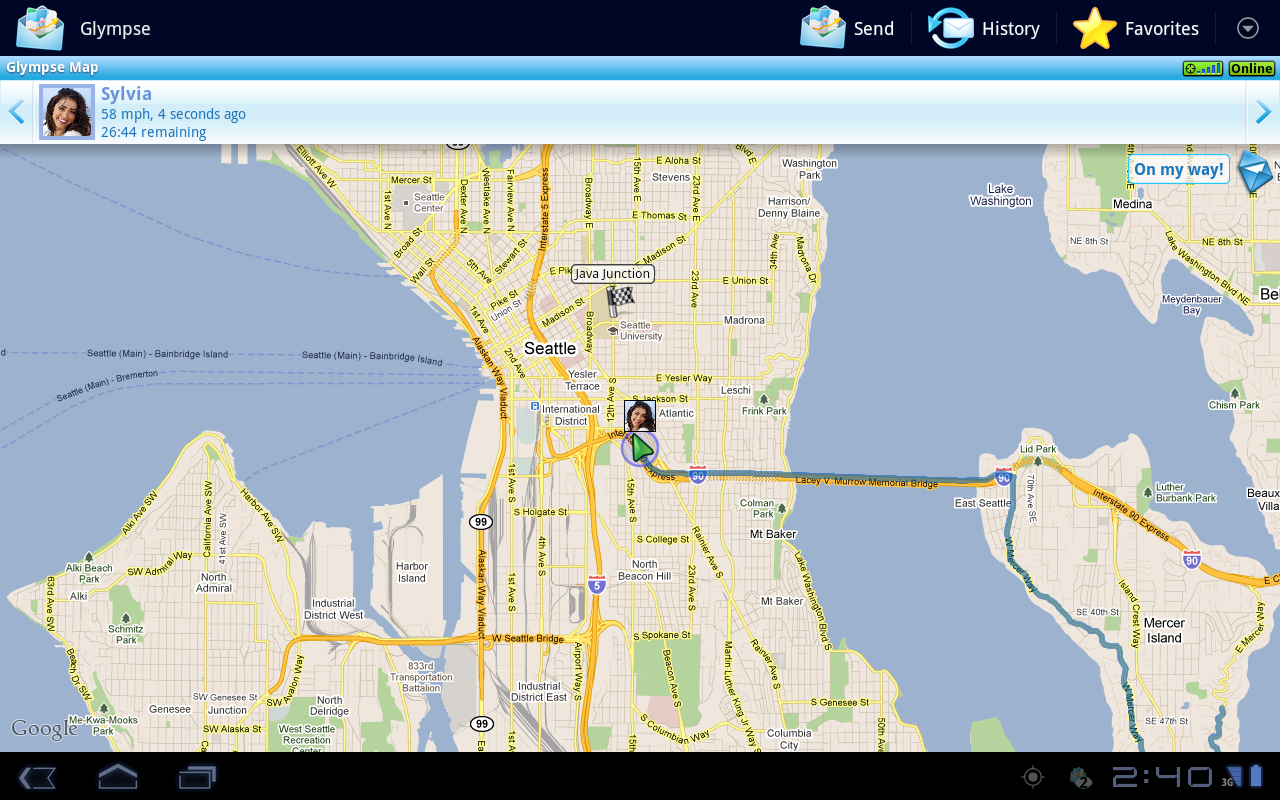
Already for me, this summer has been a microcosm of the entrepreneurial journey.  Courageously leaving a full time job at the beginning of May, quickly learning what I thought was my next gig actually wasn’t, setting out on my own to make ends meet, continually reaching out and connecting with various CEO’s and local entrepreneurs each week, starting to write daily and beginning to reach people like yourself, interviewing everyone from CEO’s like Bryan Trussell of Glympse to entertainers like Sir Mix-A-Lot, being approached to cover topics and startups I never would have imagined a few months ago, being approached by numerous startups with offers to join, and ultimately accepting an offer that is currently forming into my next venture.

Yea, I know… all that in about 90 days.   Words cannot describe this experience, but somewhere in between exhilarating and terrifying would be accurate.

As you can see by my short summer filled with opportunity, the entrepreneurial path is always 2 steps forward, one step back.  The important thing is at the very least you are always moving forward.  If it were one step forward, two steps back – you would be sinking.  Let’s hope you aren’t going that way.

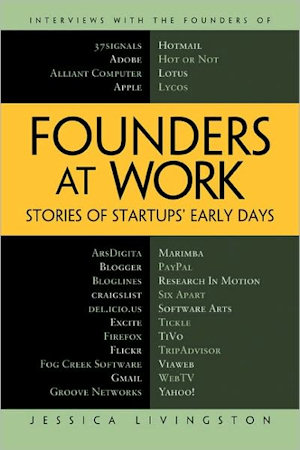
It’s times like these I grab my copy of Founders At Work, a book which has helped me through similar challenging times.  As a collection of startup and early day stories of some of the more well known technology companies from the past 25 years, it is my entrepreneurial medicine.   It gives inside perspectives on the founding of various companies starting with Lotus, Apple all the way to Flickr and Craigslist, almost like you are there with them.  You can feel their pain and experience their triamph all the while secretly wishing/hoping you will one day grace similar pages.  Through reading incredible stories like overcoming insurmountable challenges , founder disagreements, backstabbing, near bankruptcy, exploding revenue, and going public you realize every entrepreneur faces an uphill battle and your situation, although unique, is not impossible.

You will also see that each is a unique story of two steps forward, one step back.  Apple was founded by Steve Jobs and Steve Wozniak in a garage in 1976 and got initial steps forward because of the Homebrew Computer Club.  Paypal, founded by Max Levchin, was a security and cryptography service for transferring money between PDA’s before becoming a web payments company.  Founders like you and me need to understand all these large and successful companies we read about each day all started with a lot of hard work and as just an idea.  Usually that idea wasn’t what you see today and those billoinare founders were a lot like you – scrappy, dissatisfied, hungry and motivated.

Tw0 steps forward, one step back.

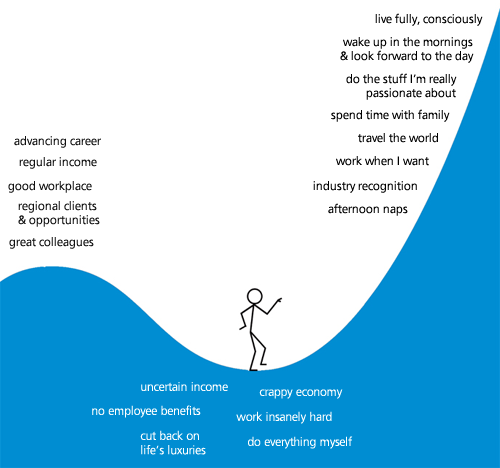
Another way to think about it is what Seth Godin calls The Dip. Put bluntly, he visually describes the path people encounter in life, where to be great one has to go through the challenging trough to emerge on a higher level.  It’s a book about avoiding temptation and gravity and becoming the best in the world.

I’m amazed at how quickly people will stand up and defend not just the status quo but the inevitability of it. We’ve been taught since forever that the world needs joiners and followers, not just leaders. We’ve been taught that fitting in is far better than standing out, and that good enough is good enough.

Which might have been fine in a company town, but doesn’t work so well in a winner-take-all world. Now, the benefits that accrue to someone who is the best in the world are orders of magnitude greater than the crumbs they save for the average. No matter how hard working the average may be.

I’ve never met anyone… anyone… who needed to settle for being average. Best is a slot that’s available to everyone, somewhere.

Two steps forward, one step back.

That’s how we roll as entrepreneurs – somehow, someway moving forward.  I believe how you approach the one step back will make all the difference in your life.  Knowing it is a natural step in your evolutionary process as en entrepreneur will help you use it as a stabilizer, not a fall backwards.

These are exciting times, and although constant talk concerning the economic health of our nation is getting louder, I am not going to let it deafen my voice.  Neither should you.  Take the backward step in stride and then look forward as you readily take your next one.

How Those Of Us Not Named Mark Zuckerberg Can Still Be Successful

A recent post on Business Insider by Rishi Chowdhury titled “Being a Young Entrepreneur” got me thinking about being young, being entrepreneurial and the affect it has on how others view us.

Chowdhury maintains since it is much easier to start companies today, we are seeing many more founders in their late teens and early twenties emerge with significant web products.  This has happened because they 1) come to coding and technology more naturally, 2) have the free time and 3) have less in their life weighing them down.  He notes:

It is also more common place to see teens who have taught themselves code and are able to create innovative web apps due to the freedom they possess. As this generation has grown up along with social networks, they know how to leverage these. What may start out as hobby/after school project can turn into a real business.

That’ s the upside, easily being able to start a company.  He then goes on to illustrate the difficulties in being taken seriously and actually building a company at such a young age.  I fully agree with Rishi and whatever the challenges he sees ahead, based on his writing I believe he has a great future ahead of him.

But what about those of us who aren’t Mark Zuckerberg, who didn’t trip onto a great idea in their late teens and now have more wealth than we ever imagined?  What about the guy in his mid-late twenties, who isn’t seen as the next “wonderkid” but cannot seem to shake the entrepreneurial bug that chases him everywhere he goes?  How about the people out there who don’t know how to code, have never actually created a web app but still dream of building a great business?

I believe sometimes we can be too hard on ourselves.  I think we look at the lucky few and think “geez, that guy is like 5 years younger than I but he is one of the richest people in the world!  How did he get so lucky?”  This is not the right perspective.  Mark Zuckerberg is an exception, and an outlier who has skewed the tech founder perspective

It is still harder than ever to create a breakout business.  Actually, it’s quite a bit harder than it was 10 or 20 years ago.  Why?  Because when it’s extremely easy and cheap to create a new web/mobile app, thousands and thousands of people do.  And when so many more people get involved, the market gets overcrowded.  When the market gets too crowded it becomes incredibly difficult to stand out and be discovered by enough people to achieve a critical mass of users.  Today, you must be very good at what you do to make it big.  Quality now matters more than ever – quality in product as well as quality in person.

So how does one go from a non-technical industry to becoming a tech executive?  Or put another way by Rishi: “A big consideration when starting your company while still very young, is how are you supposed to be taken seriously as a young entrepreneur?”

Well, my advice to Rishi as well as all other entrepreneurs: Be an exceptional person.

1) Build yourself as you build your company

From this day forward and for the rest of your life, you will be interacting with older, more educated and much wealthier individuals.  Sorry to tell you, but they usually will decide if they want to work with you within 5 minutes.  The trick is to quickly impress on them your strengths and abilities, usually within the time it takes to finish your elevator pitch.

This can be the biggest obstacle of all – your personal presentation – especially if you don’t have the luxury of saying “oh, and I’m a Harvard (or Stanford) grad.”  How much time you devote to development of your wisdom, knowledge, wit, personality and social skills will be obvious to businessmen, CEO’s and investors the moment they meet you.   I am a firm believer you can really move forward in life by polishing yourself each day.  No one should ever leave the student mentality.

A few ideas:

  •  Audio learning whenever possible- I listen to Stanford ecorner podcasts each week and it’s like I am in the class.  I also listen to ITconversations when I am driving.
  • Read books like it’s going out of style – business, tech, personal development, fiction, etc…
  • Get uncomfortable and reach out to people whenever possible; learn from each interaction

2) Build your network as you build your company

I cannot tell you how valuable “the network” is, and I am referring to the professional networks like LinkedIn.  Whatever you choose to go with, reaching out and connecting with well established people validates you as a professional.  Once you get connected (via email, phone call, mutual friend into, etc…) immediately book an in-person meeting.  Overlooking a personal meeting is the biggest mistake most young (or less connected) people make today.  Put bluntly: virtual connection does nothing but link you with someone else.  To leverage the connection, you must sit eye-to-eye, open yourself up and let the other person get to know you so they actually understand how to best help you.  This can only happen through in-person meetings.

A few ideas:

  • Reach out to your local tech network and introduce yourself to others in the community
  • Ask to have coffee and meet them in person.  Interview them and write about it!
  • Build out your LinkedIn connections, more people validate you with it than you might think

3) Build your vision as you build your company

There is something magical about hearing someone describe a vision of how they intend to change the world, especially if they are younger in age.  Doing this separates you from the crowd so when you do connect with others they will remember you and your unique vision.  Who wants to listen to someone says “oh, we’re the guys doing daily deals for X industry”?   They most likely won’t remember you or what you are doing with a vision so undifferentiated.  Get passionate, creative, and innovative around something new and start talking about it.

A few ideas:

  • Look at industries which haven’t been fully transformed by the web and search for pain points
  • Take the long view and have courage to paint a unique vision, tell the people you meet about it
  • Use “the network” to find others who share your vision, they might just turn out to be future partners

I understand it’s difficult to be taken seriously as a younger founder because it’s the same as a (relative) newbie to the tech scene, and I’m just barely out of my twenties myself.  We are not Mark Zuckerbergs, who seemed destined to create the next big thing.  But it also doesn’t mean you are any less qualified to lead a great organization.  It just means you have some extra work ahead of you.  And as an entrepreneur, that shouldn’t come as a surprise.

Interview With Glympse Visionary CEO Bryan Trussel

Much has been documented on the features of Glympse, so I wanted to chat a bit deeper with Bryan Trussel, Co-founder and CEO, and talk some about where we are going in terms of location technologies.  It was an very interesting conversation and below is a full transcript of the interview.

Location is not a game, it’s a utility.  Elaborate on that statement…

You speak in terms of forward thinking, it is interesting… the elements in our initial meetings and slide decks were hilarious, it was stuff like ‘we think smart phones were going to become more prevalent, we think social networks up and coming’… if you look at the time when we were doing that, there weren’t many smartphones out in the market… people questioned our assumptions.

The thing is people have been sharing location – 90’s and today – just not digitally..  analog.  People share text or phone call.  That happens 10’s of millions of times a day.  Now with location today, you use location in games and searches, etc… but the “hey, where are you?” question happens quite often each day.  And that’s where we saw the real opportunity.  Hey If we can make it easier to share location, more rich, more dynamic, make it simple without privacy concerns… almost a reflex in peoples lives, that’s where we want to be. we are 10% there but happy with where we are today.

We make the claim, like meeting with you today,  I could text or call a few times to let you know where I am currently… or I could just share a Glympse at the beginning and then not worry about and you can see for yourself.  We will be really happy when people everywhere are sending Glympses everyday like a normal action, like a text.

Why is location important?

Take from the beginning of time, from the caveman going out and slaughtering the mammoth (family members wondering where they are), from the ship going out on the horizon and people on the shore wondering “where’s the ship”  to the pony express riding the horse, to the telegraph, to now a telephone, now everything is real-time… so if you fast forward accounting for advances in technology… you see a pattern of something people have done since the beginning of time – wondering about someone’s location and whereabouts.  And we will have this need 50 years in the future, If you can take that and make it easier, more rich and simple… we think it’s a good place to be.

Now that’s not to say there aren’t going to be a lot of other ways to use location in lives, but there was this thought around that there was only one or two player in location space, no… hundreds and thousands of ways with many different things associated with it.

So you would view it as a splintering of the category?

Yes, just like the Internet.  What’s the power of the Internet,  There’s thousands of categories… ecommerce, social, information.  When the Internet came along, borders were broken down the big thing was connecting someone here with someone in Belarus.  Location was irrelevant.  But I think when we were doing that we forgot, it’s more relevant right here.  Your daily life is in the real world.  The people you shake hands with, the kids you come home to… now we can take all the things where location matters.

Now we are seeing the emergence of local, hyper local… The power now seems to be “on this block”

Yeah, it’s like the opposite as before.  take search as an example…. when the Internet was in it’s infancy.  I can search movies in Tokyo, but is that really relevant to me?  But now, geez, there is so much information.. now things like twitter, flash mobs, social networks, coupons, things I can touch right now.   That’s just starting to take off.

Where do you see this space going?  There is an open path for sure.

So it’s kind of foggy.  But here’s where i think it’s going… I make the analogy to the .com era… it was new and nascent, but now the Internet is part of every company, everyone has a .com… it’s just part of the company.  So will location, it will be infused in everything.  Now where you look up a movie theater app, restaurant reviews, coupon, interact with people.. they all have it,  it will transcend most things.  You will have this class of things location will just sit on top of.

Do you think there will be one major player providing location?

Stuff will move up the stack.. two years ago you could have had a company could have had cool GPS chips, then you had companies build up location databases, then you had an API for developers to find location information, now you have companies providing automatic geofencing, you now have I think we’ll just have innovation higher and higher… it’s so easy to do now.  If I can get that, what service can I lay on top of that.  The innovation will just be higher and higher up the stack.

Outside of the “I’m late for the meeting” scenario, walk me through your dream use case.

That might be peoples entry point, then they start to use it more and more deeply in their life.  Probably one of the most common scenarios has gone from “I’m late” to I’m on my way”.  We just put out a new releases where you can put a little icon on your home screen, you can make one like “going home” and you just touch it and then go.  That replaces the annoying questions such as “have you left yet? Have you left yet?  Yes I almost have, no I am stuck in traffic”   People use it when they caravan the kids to soccer.  Where we see it going, where we will be happy, is where people use it in all the scenarios where they could use it.

Take a look at text messaging.  Go back to your text messages, probably 10% involve your location… We see it going from “i’m late to “I’m on my way” so people just do it for fun, I’m going on a run, going out shopping.  Some guy sent one out last week where he was moving out over a field, then he goes over a river, then he starts running in circles… turns out he was hang gliding!  He sent a Glympse out for people to watch his hang gliding.

If we can succeed in our vision, where people use it all the time, making  if you fast forward a few years this premise of people being confused with where people are goes out the window.

Privacy, where do you sit on that issue?

It kind of goes in waves. 80% of the people just want to know that they are in control.  We do several things, A) you never share your location until you say go, B) you set the timeline so it stops when you want it to, automatically, C) we put ‘stop broadcasting’ very prominently in the UI, and you can delete any Glympse at any time, it disappears from your phone as well as off our servers.

In fact, we have a policy to delete any from our servers after 48 hours anyway.  So, I think people will ease into it, just like e-commerce.  Remember back in 1996, no one wanted to place their credit cards online.. over time eBay, Amazon and others developed a positive reputation for security.  And people warmed up to putting their card online.  We want to be this brand, “this is a Glympse enabled app” so people will trust it.

You can share as broadly or as narrow as you want.. to Facebook, twitter, or just one person.

In terms of privacy, we believe in baking it into the product, very obvious and user controlled. Rather than making people read 50 page privacy statements.  It’s all right there.

We built an much more complex location platform initially, it was too complicated, so we actually threw the majority of that away and focused on the utility of it.  The simple action of sharing your location with someone.

So do people have to have the app to receive a Glympse

Nope, people can view any Glympse through a mobile web interface.  What we really want is someone sending a Glympse to anyone in the world, that someone receiving it, “oh, that’s cool” and then they look further.. and put it on their phone and then start using it.  We don’t have a marketing budget… it’s how we have accrued million users through that viral technique.  It’s worked pretty well for us.

16 Years at Microsoft, describe your journey and what pulled you away?

I was at Microsoft in the mid 90’s, it was very fun, challenging, great time to grow up in the software business.  I started in the windows department, then went into games and X-box for a while.  But I always wanted to go and try my own thing and I was really interested in the consumer side.  Even then, I always had the “itch”… it’s one thing to succeed at Microsoft, it’s another to be successful on your own, without millions of dollars and the big name behind you.  I called up some friends in the same situation, we were excited about mobile, about location, and we determined to go do something in the consumer space.

It’s a shame, everybody can’t jump into the entrepreneurial world even for a year or two..  Even if you fail, you will learn so much more.. I am more effective, more driven.  You can’t study from the sidelines..

Do you feel some just don’t have the itch

Yes, i do…. everybody likes and wants a challenge, the adrenaline rush… even in a big company… with that said, you have to put everything into it to succeed and some might not want to do that in their life.  If you are not driven to go make it happen, you are probably not an entrepreneur…

What is the most important characteristic of a successful CEO

THE?  Probably the ability to rally people around a vision.  Which means, A) you have a vision, B) you believe in it, C) it has to be a vision a bit off kilter, because if 5,000 others have the same vision you will get beat.  So it has to be enough off mainstream that you have an advantage, one that makes sense… high risk, high reward.

What advice would you give young entrepreneurs out there who are just starting out.

If you can jump in to the entrepreneurial space early in life, do it.  If you can surround yourself with the people who have done it,  do it.  I can’t image a scenario where even if you don’t succeed, whatever it is you do, that experience will be beneficial.  I wish I would have done it earlier.

Internally, the Microsoft experience was an advantage since we knew how to build and roll out a software.  But externally, when talking to investors, it was a liability would look and say “oh, how long were you at Microsoft?”  They would question if we really were entrepreneurs.

Initially, we had to bootstrap our company, prototype our product and show we could get traction.  Then we were able to show that we could built what we say we can build.  Then we took that to some angels, got some money, then took the product to VC’s.  It was a lot easier once we got something in the market.

So you plan on expanding the team?

Yes, that is the main reason for the latest funding round, we will be expanding the development team.  We got a lot of opportunities in front of us.. That is the cool thing about this area, Seattle, there is a lot of smart, entrepreneurial minded technical people here.  It’s a great place for us to draw upon for talent.

Here is Why Your Passion is Always A Blessing

This post is built off of Bob Crimmons’ recent post Entrepreneurial Passion: A blessing or a Curse.  In one part I agree with Bob and in another I find disagreement and will offer a slightly varying perspective.  Let’s call it taking a different path to a similar conclusion and in doing so encouraging any entrepreneur that yes, they should pursue their passion to the fullest extent.

I agree with Bob in his general message – you must validate the idea you have become passionate about.  As he eludes, it is natural for an entrepreneur be overcome with the passion for “scratching their own itch”, working long hours to get something out into the market only to launch and then realize their execution is all wrong.  The way around this (and what I believe Bob was encouraging any entrepreneur to do) is to do massive market testing and validation prior to any time invested in production.  How do you do this?

Observe – Go into your target market’s environment and observe them interacting around where your product would fit.

Investigate – Ask them open ended questions regarding their thoughts on X, Y, Z products and features.

Float The Idea – Spend $25 on a google ad promoting your product with the link leading to a landing page, observe the click response.

Test and Research – Do massive business model research prior to launching a product, especially if you are developing a “social app”.

These are just a few actions that fall within due diligence and business validity testing and they should be done prior to any product work.  So yes, I agree with Bob when he cautions entrepreneurs in blindly pursuing their passions.

I should know, I was the guy Bob was talking about the first attempt at my start up, Loyaltize.  I was extremely passionate about building a business which not only was to be a web 2.0 darling but would also rewrite the books for the new social media marketing era.  Our bright idea was to integrate local business marketing and the support of local non-profits, such as youth soccer teams.  Local business created offers and coupons with donations tied into them, so when someone redeemed the offer a donation would go from the local business to the local soccer club.  Everyone wins right!  We were so passionate about this idea we spent more than a year to build our site (remember, I was living a double life so things take double the amount of time you think they should) and finally launched in our test market.

BAM…. fell right on the ground.   We scraped it forward for about six months but basically realized our execution around a few main features was flawed.  Would we have saved the year if we did proper user testing and validation?  I am not sure but we would have learned a few key lessons and we probably would be still growing right now had we validated properly.  I learned you need to do major validation, testing, and “pivoting” around your initial assumptions to get the proper fit.

-I am now going to talk strongly here and although I have never met Bob, I fully respect him-

What struck a cord when I read Bob’s post is I am that guy – incredibly passionate, focused, head down working to build out a new platform to take over the world.  It struck me quite deep because after working so hard on something you start to wonder if you are doing the right thing and really cut out to be an entrepreneur if things aren’t coming together.  It struck me because, as they say, “truth hurts”.

Passion definitely can work against you, and if you are an entrepreneur you are probably nodding your head with me.

But I would caution Bob on cautioning entrepreneurs to be wary of their passions.  It has the potential to send the wrong message to young aspiring entrepreneurs; because it’s not what you say, it’s what they hear.  They will hear messages such as “don’t follow your passion, follow a proven business model” and “Your passions are not valid businesses”.

Following a proven business model does not inspire innovative new ideas, it does not create new markets nor does it spawn new industries.   Encouraging entrepreneurs to follow proven business models creates hundreds of daily deal sites.  We don’t need more competition, we need more innovation.

I would not be writing for you today had I taken Bob’s advice.  There is a high probability that if I went to a mentor such as Bob and they cautioned me on pursuing my passions, I might be on a different path.  Keeping aligned with my passion is what helped me gather enough knowledge and courage to make the leap and put me in the position I am in today.  I am so grateful someone I respected didn’t pull me aside and say “ya know Nick, this Loyaltize thing just does seem like it’s panning out for you.  Are you sure you should pursue this passion?”

I think Bob’s message takes the wrong angle on a good point.  Rather than telling entrepreneurs to be wary of things they are passionate about, I think a better angle on this issue would be to encourage entrepreneurs to harness their passions for everything they have.  Understand you have been tapped by something (someone) and dive deep into the problem area you are looking to bring a solution to.  Indeed entrepreneurs need every ounce of their passion to get where they want to go.

Jack Dorsey was obsessed with how cabs moved and communicated about the city.  He was so passionate about the idea of communication networks he sat on the idea for twitter for something like 6 years.  He couldn’t shake it and decided to build it even though it seemed crazy and didn’t make sense.  We are lucky to have twitter today to help us connect with people around the globe (@jnickhughes if you want to connect with me)

Dennis Crowley was seemingly obsessed with location aware technologies, so he built Dodgeball.  He ended up selling it to Google quite quickly, which some saw as a success, but they subsequently shut it down.  This really bothered him.  Because he was so passionate about this concept he build another application, Foursquare, with the knowledge and validations they learned from Dodgeball.  Foursquare just crossed the 10 million user mark in a little over 2 years and is paving the way in geolocation applications.

I am not being facetious here, I am being totally serious.  I guarantee Jack, Dennis, Steve Jobs, Bill Gates or any other successful entrepreneur followed their passion.  The next “Jack” or “Dennis” is probably reading this right now.  They are gripped by something in the world, so gripped they want to build a product and business around it.  I say follow it.  Build it.  Test it.  Work it.  Rework it.  Test it again.  Stay on it.  Just don’t give up, the right thing will come together.

Call me crazy and laugh to yourself if you want, but I wholeheartedly believe this: The only difference between you and Jack Dorsey is… you just haven’t figured out the combination yet.  That is it.

In fact, I am of the camp we need more entrepreneurs who think bigger.  I agree with Jason Freedman of FlightCaster.

Jason wrote a post recently about a recent trip he took to visit some friends, Henderson and Rebecca who live in Mississippi.  He was shocked at what he felt as he was leaving them:

I’m glad we’ve moved past throwing sheep at each other on Facebook.  I’m glad we’ve moved past acquiring users by downloading someone’s contact list and spamming their friends.  The startup ecosystem is much healthier than it was in 2008.  But still, I’m concerned.  As a fellow geek and early adopter, I’m psyched for one of the photo-sharing concepts to really take off.  I think it’ll be sweet to instantly share pictures with my friends in cool new ways.  But I know it’s not a huge problem for Henderson and Rebecca.  It’s just not an issue that affects them.  I’m concerned about how many of us are working on problems that just don’t matter all that much to the rest of the world.

Look, it requires a lot of passion to change the world.  I mean, to really impact Henderson and Rebecca you are going to need to harness all your passion and give it everything you got.  Just remember to test and validate along the way.

Image courtesy of Flickr user Horia Varlan

Everything In Business is a Test

Test.  Test.  Test.

Everything in business is a test.  The good ol’ days – writing a business plan, pitching for investment, building out a product for the exact market stated in the business plan, launching the product through a large budget Launch strategy – those days are over.

As an entrepreneur, you should now consider yourself a scientist.  Your job now is to run as many tests as possible, with the least amount of expenses to find mass adoption of your product.   The tests should start in the ideation phase and shouldn’t ever end.  The single worst thing you can do now as an entrepreneurial is have one idea and do everything you can think of to bring that specific idea to market.  Start with a problem area and test ideas around it.

Test for consumer problems

What problems are present in which you can bring a solution to market?  The best businesses solve a problem consumers have (or didn’t know they had but now realize life is better with your product).  I heard the other day: You cannot just ask consumers what they want – they do not know.  But if you observe and test them, their actions will lead you to holes that need to be filled.   Inefficiencies will present themselves.  Great entrepreneurs see these inefficiencies early.

Test for Product/Market fit

tubesOnce a problem is found and a solution has been built, the real work starts.  Take it from me, your first attempt will not be the golden fit and you will have to re-align somethings.  Call it pivot, call it whatever you want… it will happen.  I don’t know why we are making such a big deal about pivoting, great entrepreneurs constantly pivot their ideas until they get the right market fit.  Ask Edison, he pivoted like 5,000 times…

Test for Business model

How to make money is the question every company must face.  I believe this is an area a startup must test early and often.  This question should never have just one answer.  Small tests on business model, payment options, advertising (I know… I know….) and other methods of creating revenue.  It’s just a test.  Do some A/B testing on a select group on users.  Release a payment option to 1% of users and see what happens.  You might just discover your next big innovation and create a new billion dollar industry.

Test for Perseverance

Ask any founder of a startup (still running) and they will have hours of talking on the subject of perseverance.  The startup experience will test you and your perseverance.  Just don’t give up.  Do anything you can think of to put off the quitting of your vision.  Read Delivering Happiness by Zappos Tony Hsieh to get an idea on Perseverance.  I had no idea they went through the hell they did with their startup.  You need to read this book if you are a founder of an early stage company not knowing if the future is bright or bleak.

Test for leadership

I laid out the importance of brand and company leadership expansively in my last post The One Thing That Separates Apple From Microsoft.  Suffice it to say I think this is the most underrated, under-talked about, overlooked but most important aspect of building out your long term brand.  You must answer he question: Why are consumers going to want to use my product?  Believe it or not, it will be due to the leadership of the company CEO.  Test your leadership skills early and often to find the right connection with general consumers.

Test for Funding

Investors don’t tell you this, but they are testing you at every stage of the game.  First time you meet them at a “social event” they are testing your IQ and your EQ (your social intelligence) to see if you are someone they would even want to take an interest in.  Next time when you meet for a pitch, they will test your concept and your perspective on the market.  When they don’t call you back, they are testing your perseverance.  When they give you money, they are testing your ability to turn X into 10X.  If you pass that test, you will most likely be able to get money from them anytime thereafter.

I could go on… but I think you get the point.  If you thought your tests were over after graduation, think again.  They only have just begun.  Embrace the test.

Image courtesy of Flickr user Canyon289

Graduates: Stay Hungry, Stay Foolish

Here’s to all the graduates out there who are now taking the leap into the real world.  I cannot say it better than Steve Jobs in his 2005 commencement speech to Standford University students.  This is one of the most incredible speeches I have ever heard and for you, a 15 minutes well spent.  Enjoy.

Find Your Match With Founder2be

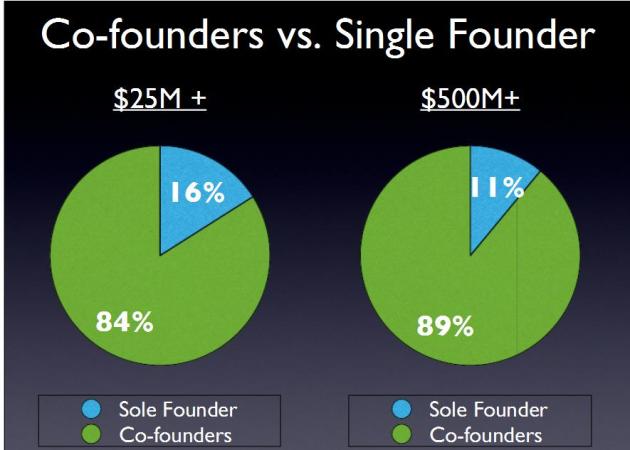
Here is a common problem plaguing many entrepreneurs today:  I have a business idea, but I need to find someone with complimentary skills to help me start the company.  In fact, yours truly has this problem currently.  Since we know a big chunk of the success of a start-up is directly correlated to the number of founders, this is a big deal.  Local tech functions like meet-ups, conferences and founder dating are all good ways to meet a co-founder but sometimes if just feels forced, ya know.  Kinda like you’re looking for a one-night stand or something.

Enter Founder2be, a site which could be referred to the match.com for entrepreneurs.

From their website:

Do you think you need a lot of money first for your startup? You don’t. What you need is the right co-founder with the skills to get started. Everyone knows something, and nobody knows everything. Founder2be helps you find the co-founder you need to start up your business. Take the first step today!

I love the idea and have signed up for the service.  When you sign up, you have the option to register or just connect via Facebook.  Once connected,  it walks you through a few basic questions:

1) I am looking for… (someone to help me with my idea or to join someone who has a good idea)

2) The type of co-founder I am looking for…

3) Expectations of co-founder availability

4) choice of where they live

And then you fill out some details about yourself and you are ready to go.  The entire process took less than 5 minutes.  Since I just signed up and starting using the service I cannot relay any results back to you yet, but I love the idea and would recommend any founder who needs to find the other piece of the puzzle to give it a shot.

I had a chance to recently connect with Oliver Bremer, co-founder of Founder2be.  Interestingly, he was in the exact same situation when he realized there was a hole he could fill.  “This got me thinking that I cannot possibly be the only person in the world to have this challenge.  Although initially I had a different idea, I eventually decided to set out and solve the co-founder finding problem instead. And that’s how Founder2be came about. After some chicken and egg of finding a co-founder for that. Which was pure luck.

I love it!  Innovation is the mother of all necessity.  Here is a brief interview with Oliver:

1. Describe and explain Founder2be in a few sentences.
Founder2be is a co-founder matching service. Everyone knows something, and nobody knows everything. Founder2be helps people find co-founders with complementary skill sets. After all, most successful start-ups get started by teams of two or three, not solo entrepreneurs.

With the Founder2be Global Alliance Program, we connect prospective entrepreneurs with incubators and other alliance partners to help them succeed by getting the help they need locally, whether it is mentoring, work space, pitch training, or access to funding.

2. How did you come up with the idea behind Founder2be?
After 10 years in corporate life, last year I finally had a great idea where I thought: ‘Now it’s my opportunity’ to start a start-up. Truth is: Now I can’t even remember what the idea was, and that is because I never got started. Why? Because I don’t know everything and I failed at the step of finding a co-founder. Thinking I can’t be the only person wanting to do a start-up with that problem, I decided to focus on the co-founder finding problem instead, and here is Founder2be.

3. The Founder2be team and background.
Founder2be was co-founded by myself and Frank Haubenschild. My background is M.Sc. in CS, worked for Nokia until 2007, then for Strands until end of last year. Then quit my job specifically to focus on Founder2be. Frank studied CS as well, and has been working as a SW Developer ever since, mostly in the automotive space.

We took on two interns for this summer as well who are helping us with outreach and community management and get credits for their course work.

4. Can’t Entrepreneurs just go to local events to meet people? How do you differentiate?
Absolutely, and we do want people to go to local events as well. We are not so naive to believe that you meet someone online, click on a button, and that’s all you need to start a great start-up. There is many more things. Exploring your options and finding a great co-founder is the first step, and that can be done online very well.

Think of it similar to online dating. Match.com does not replace bars. People don’t get married clicking ‘Yes, I do’. They go on a date and meet the other person in real life first – or at least I hope they do 😉 And that’s very similar for finding a co-founder.

And that’s why we launched the Global Alliance Program, where we connect the co-founders meeting each other, forming start-ups, to organizations supporting start-ups in the real world. The Global Alliance Program has partners on four continents now and we are looking to extend the network to more countries and expand within the countries where there is already partners.

5. What is Founder2be’s current status, and what are your immediate next steps?
We are now at the stage where over a thousand people have signed up, two companies have emerged from co-founders who met on Founder2be. One of them is Ziliot.com, the other one is still in stealth mode. The Global Alliance Program comprises around 20 partners from four continents.

Our ultimate goal for this year is to see 10 start-ups get started by co-founders who met on Founder2be. In order to do so we are focused on growing the user base, connect co-founders with each other, and build out the Global Alliance Program further.

In 3 months, over 1500 people have joined and one company has come out of it with a second one is in stealth mode.  I would say, even if nothing else happens… history has been made.  I am really excited to see how Founder2be expands to help many more partnerships come together.

3 Quick Thoughts For The Entrepreneur

Here are just a few quick thoughts to help you think clearer today.

1.  Most successful founders or entrepreneurs have failed many times before.  Just keep getting up.

2. Most successful businesses come from Blue Ocean Waters, not Red Ocean Waters.  Look for the open waters around you.

3. You are just one decision away from changing your life.  Make it.

Here’s Where You are Great, So Shut Up.

The world has an interesting way of revealing your strengths.  This has become apparent to me in the last few weeks as I have started writing.  Allow me to provide some context before I go any further.

Recently I quit my full time job to pursue entrepreneurship and my dream of building my own company.  Prior to this I was living a double life, straddling the fence as they say.  This sucked.  I hated the fact that I did not (or could not) just let go and dive into pursing my dreams.  It sounds silly actually…. you would think living in America we should do whatever we want?   I wasn’t.  Until now.

During this double life I was part of a small team building a startup, a website which would help local businesses further connect with their loyal customers.  Although we didn’t really have titles or positions, I lead the charge and you could say I held the general position of what would be considered the CEO.  We worked on this for quite some time, all the while holding full time jobs.  We met EVERY Tuesday or Wednesday for like 2 years or more.  Eventually we released a Version 1.0 and I felt we were making some progress.  Ultimately, after about 6 months in the test market we decided to revert (what they now call pivot ) back to closed doors and figure out a better vision.  This is where I sit today.

Shut Up and Listen!

My point here is this: I wasn’t in my strength zone.  I wasn’t actually doing things that I was Great at.  I keep my head to the grindstone for years trying to make things happen – to no avail.  Without resources, connections, money or exposure… and most important the wisdom from previous experience, we fell flat.  And I thought I was a loser and a failure.

Shut Up and Listen!

Until I started listening.  When I quit my job I decided I would start writing.  Being an avid reader of books, blogs and any articles I can get my hands on, this seemed like a natural evolution for me.  Little did I know people actually like what I write.  They think I am good.  They even think I am Great, so Great they think I could support myself doing this.  I had no idea.  I just type what I feel inside… that is all I do.  And things just flow together.

Shut Up and Listen!

Amazingly, the world has started reaching out to me.  People from all over have followed, commented, subscribed, and emailed.  I really appreciate this.  Finally, something is taking off.  This type of reaction never happened with Loyaltize.  On a small level in our test market people would say things like “ya know, this is a really good idea.  Very Cool.”  That was nice of them to say, but nothing ever came together and we finally realized we were doing something wrong.

Shut Up and Listen!

If you listen close enough, the world will tell you where you are Great.  You may be like me – hard headed, focused and dead set on making things happen.  Although these are traits successful people employ to move forward, they can also be an incredibly powerful force holding you back.  Are you a programmer who can’t seem to build anything people actually use?  Are you a teacher who comes home from school each day so tired you just want to go to bed?  As a CEO, are things just not lining up for you?  Are there areas in your life where things just happen to come way easier for you?  You might want to take a closer look at those areas.

SHUT UP AND LISTEN!

My advice would be to shut up and listen to the world.  What is it telling you?  Where is it saying “anything you do here will not work.”  Then look the other way to where it tells you “Keep doing this, you are great.”

I know it’s pretty simple stuff.  But trust me, your Greatness might not be where you thought it would be.  Maybe it’s where it always was you just haven’t looked yet.

I am not sure where this writing stuff will take me, I know I will eventually lead a great business.  But all I can say is it already has taken me further in 2 weeks than 5 years working with my ears and eyes closed ever did.

Why Distribution Will Make or Break Your Company

Yesterday, as I was sitting with a friend talking about his early stage company, it hit me.  We were reviewing what he has built, where he is currently and what he is looking to do next.  It was becoming more obvious to me as the meeting went on he was experiencing a common startup dilemma: Great product, No distribution.

Here’s a little background:

This founder has an incredible technical history.  He has worked for very a large tech company here locally and knows his stuff. You can tell he is quite intelligent.  His product is a bit over the average person’s head, more enterprise and B2B focused.  His target customers are business owners and website owners.  He has vast domain knowledge and understands where his product will benefit his users.  He even has a beta version with a small initial user base.   I told him he is in a good situation but has a few big hurdles to figure out.

The problem is he is technically bent, not marketing bent.  Technical people think all you have to do is build a great product.  Although that is true, marketing people understand the positioning of the great product is what determines how big you will grow as a company.   Being foreign, he lacks the clarity in speaking English required to deeply explain his product.  This is fine, but since it is just him right now he cannot depend on a sales oriented approach.  His product is not inherently social, so he cannot rely on word of mouth.

This person is not alone.  I was a part of the recent Founder Institute Seattle winter 2011 class and encountered many companies with similar challenges.  Highly technical team.  Very interesting product.  Solves a unique problem.  But no clear distribution model.

So if you are not building the next social sharing tool, how the heck do you find the vehicle to expand your user base?

Find distribution channels.

1.  Where can you get a free listing or publicity?  There is a magnitude of places on the web where galleries or showcases of applications bring  additional tools to product users (think Google apps).  Is your product is an add on, a second generation tool of an existing product, or interactive with a larger ecosystem?  All these allow you to be highlighted in galleries supporting the main ecosystem.  Find ’em or you will wither on the vine.

2.  What major company needs your product?  One of the best methods to major distribution is to land a very large and visible company as an initial customer.  Maybe you allow them to use it for free with the agreement they will promote it.  Maybe book them with a very large price tag to help you float for the next 6 months.  Whatever the agreement is, make sure you can find a market leader who will provide the credibility necessary for others to follow.

3.  Social Proof.  Although your product is not inherently social, you can still figure out ways to bake in social proof to the everyday use of your product.  It’s the old hotmail bit… every time an email message was sent, hotmail automatically added to the end of each message “Get your private, free email at http://www.hotmail.com”.  This idea is still one of the best marketing concepts every created.  Figure out how to implement it your own unique way.

4.  Find the Influencers.  The main thing I tried to nail home with my friend was he needed to find the one percent, the main target users who will become the influencers for his product.  Together with the above mentioned ideas, this is how you integrate yourself into the proper distribution channels.

And to bring it home, here is the only way I could describe it to him.

Dude, I just started blogging 2 weeks ago.  When you start a blog, you begin writing with the knowledge that only 20 or 50 people will be reading your stuff.  I quickly realized this and decided I needed to ink a few distribution deals if I was going to grow my readers.  I reached out to John Cook at Geekwire.com.  He like it and got me on there.  I reached out to an editor at BusinessInsider.com.  She liked it and hooked me up.  Now, thousands of people are reading my stuff and it is starting to grow.  People are adding me on Twitter like crazy (that was your que) and now they are connected to me independent of those resources.  Without those distribution deals, I was dead in the water.  You need to do the equivalent of that with your product or you will never grow.

You Talkin to Me?

Update: The post was republished on BusinessInsider.com

As a youngster growing up I did not know I wanted to be an “entrepreneur”.  In fact I didn’t even know what one was.  It’s kind of a weird, unintuitive word.  But even as small children I think we can tell the difference between a Pirate and a peon.  Early on I just  knew I wanted to do something different, something bigger.  I knew it the first time I saw Tony Montana scorch the earth building an empire in the movie Scarface.  If you are reading this as an entrepreneur, you probably remember your early entrepreneurial feelings as well.

@ev, @jack, Mark Zuckerberg, Steve Jobs, Jeff Bezos, Reid Hoffman, Larry and Sergey, Marc Andreessen and many others – I have incredible respect for you.  Not many will do what you have done and maybe one day we can connect, hopefully some of that can rub off on me.  But I ain’t talkin to you.

I’m talking to the rest of y’all – the other 98%.   You at your desk hoping your boss doesn’t catch you reading Business Insider at work… again.   No need to close the tab, he probably hasn’t seen yet.  And you, reading this on your phone at the restaurant as you wait for your significant other to come back from the bathroom.  Go ahead and finish reading, I assure you they’ll be glad you’re reading a tech blog and not secretly texting someone else.  And yes, you laying in bed reading this on your ipad, you are just trying to squeeze in one last article before you go to bed.

How do I know you are all doing this?  Cause I am one of you.  I’ve done all those things and more.   I have wanted it so bad I couldn’t sleep at night.  Like you I have also put years into my own vision only to come up short on the latest attempt.  Like you I lived a double life, straddling the fence of trying to successfully launch a side project and lacking the cajones to let go of stability in a day job.  Somewhere along the line I found myself living a lie – vicariously living as an entrepreneur but not actually acting and doing like real entrepreneurs should.   That life sucks and I am done with it.

Yes, it’s a great time to be an entrepreneur and things once again seem to be bubbling.  Venture investments are up.  Valuations are rising.  IPO’s are starting to pop again.   With all this talk of Bubbles, IPO’s, Frothiness, and “it’s different this time”, I just have one question for you: What you gonna do now?

Because here is the truth for most of us:

1) We’ve never launched a successful product. We only wished we had.

2) We’ve never succeeded in raising venture capital, because of number 1.

3) Even though things are frothy, this will not change the numbers game.  Our odds of launching a successful product and raising VC are still going to be slim to none.

Well Tony would say eff the odds.  Tony said eff to everything and everybody.  He knew where he was going and nobody was going to stop him.  Regardless how you feel about the word (my apologies), I think it’s a great perspective.  Tony was the quintessential entrepreneur – purposeful, driven, headstrong and at times ruthless.  When he set his mind to something, you pretty much knew he was going to get it.  Great entrepreneurs look odds straight in the face, laugh, and then get back to work.

But what about Captain Jack?

I don’t care if you’re a billionaire. If you haven’t started a company, really gambled your resume and your money and maybe even your marriage to just go crazy and try something on your own, you’re no pirate and you aren’t in the club.

I about jumped out of my skin when I read those words written by Michael Arrington on Techcrunch a few months back.  It chilled me to the bone and was pure poetic justice at a time when I was really needing to hear it.   I wish I would have cut it out, put it in my pocket and showed it to anyone who asked why I was leaving my “stable and dependable” job.  Most people just don’t get how exotic and intoxicating being an entrepreneur really is.  I think Tony Montana would second Michael’s statement as well.

Although I agree with Arrington and his version of Captain Jack Sparrow, I feel Tony is a better depiction of a pure entrepreneur.  Strip away the guns, drugs and violence and you have a great example in Tony Montana.  He has the dedication.  He has the attitude.  He has the street smarts.  He has the charm.  He has the willingness to risk.  In him you have someone so committed to his vision he was willing to die for it.  Love him or hate him, we need more leaders as committed as Tony.

So here’s what we need to do:

Realize you are – YOU.   The best way to beat the numbers game is to be unique.  You cannot be the next Mark Zuckerberg, Ried Hoffman or Steve Jobs.  You were given your own unique vision.  Execute it.  Zuck was given the vision of a world wide social network.  That’s great for him (and for us to use).  But go do something different.  I think of Zaarly or Square.  Andrew Mason figured out how to make daily coupons cool again.  Awesome, think of something farther ahead like what LOCQL, a start up here in Seattle is doing.  Who knows, maybe back when Zuck, Hoffman, and Jobs were getting started they secretly wanted to be the next Bill Gates, Andy Grove or Thomas Edison.   But of course, they couldn’t and didn’t.  So they became the best versions of themselves and subsequently created the world you now live in.  Read that last sentence again…

Channel your inner Tony Montana.  One of the most interesting aspects of the movie Scarface is how it touches on both the light and dark sides of humanity, capitalism and wealth.  Most people who watch the movie see the obvious flaws in Tony.  But more subtle is the notion that we all have the capacity to think and act in this way.  You too have a little bit of Tony fire in your belly.  You also have the choice to use your competitive edge for the better of humanity, not the worse.  Channeling your drive, determination and what-ever-it-takes attitude will lead you to make a positive dent in the universe.  This is more important that you might think.  Although I have yet to raise a round of VC, I am pretty sure investors would rather have someone walk in their office with a Tony-esk chip on their shoulder talking about taking over the world than see (another!?) demo of a new twist on a social application which also shares groupons.   Mark Suster is so right – “There are so many big inefficiencies in this country that need tackling. I feel quite comfortable that our bars & restaurant industry will be just fine.” 

Find something you are willing to die for.  No, I don’t mean head out the door with machine gun in hand ready to do battle with anyone who criticizes your next idea.  But I am suggesting you find something so grand in vision you will spend the rest of your life making it come true.   In my humble opinion, this is the key to being successful – a driving purpose.  Simon Sinek taught me to Start With Why.  Read this book and you will discover true greatness is not about copying the next social sharing feature.  It’s about inspiring society to move forward with truly crazy ideas that have a larger purpose.  Trust me – Bezos, Jobs, Edison, Larry and Sergey… these guys would tell you the same thing.

It’s a great time to be an entrepreneur.  Shall we not let this time in history be remembered only as the “Social Bubble”.  I think there’s more within all of us.

Yeah I am talking to you…. you with me?


Lonely Man on the Corner

See the lonely man there on the corner,
What he’s waiting for, I don’t know,
But he waits everyday now.
He’s just waiting for something to show.

Genesis – Man on the Corner

Disclaimer: What I am about to write is controversial.  As you read please remember this does not insinuate I lack caring in my heart for human beings of all levels of society.  It is merely my opinion of how a person chooses to live their life and what opportunities a person chooses to act upon.  There are no right or wrongs here, just observations and thoughts.  Also, it is important to note the thoughts below regard what people are choosing to do in the moment of poverty, not how they got into poverty in the first place.  I anticipate differing perspectives and opinions to be shared in comments.

——————-

You’ve seen him.  He’s the lonely man over there on the corner.  What he is waiting for nobody knows.  But he waits everyday, and he’s just waiting for something to show.  The quotes throughout this article are lyrics from a song Man on the Corner by Genesis. The video is below and it’s a must listen.   I recently listened to it and was shook by the emotions I felt during the song.  And so I started to think deeper on the concept of poverty.  I started to think about why some are rich; why some are poor; why I drive a nice car and some are stuck wearing the same clothes every day.  I asked myself, “what could possibly be the difference?”  And why some people find themselves on a street corner just waiting for ‘something to show’.  You may differ in your perspective on poverty in this country, but I believe poverty and entrepreneurship are distant cousins.

This man chooses to sit on a corner and hold a sign.  He has nothing (at least from what we know) and feels his best option is to do nothing, look desperate, and ask for money.  His value proposition rests on the morality of another person feeling remorse when they pass him, forcing themselves to face their inner soul and ask “am I a bad person if I turn my head and don’t give him money?”  He wants to be given something for nothing.  He takes from the world, but does not give in return.  He offers no product in which a dollar value can be placed on it and he has no service to offer another.  He just sits and asks for help.  He has chosen to do nothing.

And nobody knows him,
And nobody cares,
‘Cos there’s no hiding place,
There’s no hiding place – for you.

Genesis – Man on the Corner

I will juxtapose the man on the corner with the man in the hot seat.  What is the difference between the man in the image above and the man in the image to the left?  The man in the hot seat has, in theory, the same intentions as the man on the corner.  He is asking for money and he is looking for help.  He believes he cannot make his dreams come true unless he receives a gift from someone else.  His future, indeed, depends on another persons good faith.  But that is about where the similarities end.

For those have not picked up on it, the man in the image at left is a person pitching Paul Graham (an investor in the red shirt) on a business idea in hopes he will invest money towards his vision.  But in contrast to the man on the corner, the man on the hot seat does not believe in handouts or in receiving something for nothing.  He believes in creating value through enterprise.  He knows that if you have something, anything – a product, a service, a distribution channel, knowledge, land, a water source, natural elements, really anything – you can offer it to another for a profit.  He chooses to live his life working hard to add value to society, not take away from it.  He has taken ownership and responsibility for his life, understanding he can choose to do anything he wants with it.  But with that decision he knows it is up to him, and only him to make it happen .  The man in the hot seat is an entrepreneur.

Looking everywhere at no one,
He sees everything and nothing at all – oh.
When he shouts, nobody listens,
Where he leads no one will go – oh.

Genesis – Man on the Corner

At times entrepreneurs find themselves looking poverty straight in the face.  It might be in a situation where their income (or lack thereof) cannot fulfill the demands of their debts, whether it is a roof for shelter, food for sustenance or gas for their travel.  They choose to risk their current stability for the return of a better life.  There is an eerie aspect of entrepreneurship and I think it’s due to its distant cousin of poverty.  The mere thought of poverty can be the biggest moving force an entrepreneur receives.   It is incredibly scary and immensely motivating at the same time.  Only in risk one really experiences reward.  So we endure the possibility of poverty for the reward of wealth.

For the record, I am quite privileged to have a roof over my head, food to sustain my health and a nice car to drive each day.  I am doing fine but at this point in my life I hover right above to line, choosing to forgo a stable job for a chance to determine my own destiny.  Also for the record I have stared poverty in the eye and experienced what it could be like.  I have had my electricity turned off and creditors calling my phone for not paying bills on time.  I have had to dig change out of my car to buy a $.99 hamburger.   As a late-twenties ambitious entrepreneur who hadn’t “made it” yet – old enough to be established on my own but young enough to have not built sustainable wealth for myself – it’s was a tough slog.   I’m a tweener as they call them.

When you leave a stable financial situation and leap towards your dream, you risk falling into poverty.  Or should I say you learn how to operate with poverty as a strong possibility in your life.  You learn how to acknowledge where your responsibilities lay in the equation of life.  You start to realize your decisions will make or break you.  It is through this experience I start to think about poverty in a new way.   Whenever I drive by the man on the corner, I cannot help but think: “I could be out there right now.  That could be me.  As I am sitting here in my car it is unbeknownst to me how I will pay rent next month since I just took the leap and started my life as a full time entrepreneur.  But I will find a way.  I will find a way to not only pay rent but to grow my business as well.  I will choose to do something, not sit and do nothing. ”  I argue it is at this point of realization you really become an entrepreneur.

So Here’s the difference between poverty and success:

Man on Corner waits; man in hot seat acts

The man on the corner waits for something to fall into his lap, hands or box.  He takes no responsibility for his actions and believes by just waiting, help will find it’s way to him.  The man in the hot seat acts, on everything.  He believes it is through doing something, anything really, value can be created.  And when he creates value, wealth will find it’s way to him.  It is by doing and acting we entrepreneurs find success.

Man on corner values nothing; man in hot seat values everything

The man on the corner values nothing, not even himself.  If he did value himself, he would be doing something other than sitting desperately on a corner asking for a handout.  He has lost the ability to place value on anything in his life, thus has nothing.  The man in the hot seat values everything, especially himself.  He has such a belief himself he is asking others to invest large sums of money into his enterprise.  And he believes so strongly in himself he knows he can bring the investment amount times X back to the investor.  It is through immense value in self an entrepreneur will be successful.

Man on corner plays victim; man in hot seat plays hero

The man on the corner has ultimately bought into the victim mentality, meaning their outer circumstances determine their inner self worth.  A victim does not take responsibility for actions and outcomes, therefore they do nothing to change their circumstances.  The man on the hot seat understands it is he who determines his destiny and thus plays the hero.  A hero understands they are unique and hold power to orchestrate a positive outcome for all involved.  By believing you as an entrepreneur are the hero, your self worth has nothing to do with outer circumstances.  This frees you up to act according to your vision and experience success.

I am not sure Phil Collins would agree with my interpretation of Man on the Corner but I am curious if you do.

What Any Startup Can Learn From Starbucks

Update:  This post was republished on GeekWire.com

As I drove past the Starbucks headquarters today I glanced up at their big green logo.  Instantly I thought “man, what a iconic brand.”  I mean, when most people see a white coffee cup with green letters, they know it’s Starbucks Coffee.  Then I thought “how did they get there?”  Here’s what most forget: Starbucks was a startup at one time.   They had to start somewhere and work hard to establish this incredible brand.  Although I do not know Howard Schultz personally (someday I hope to), it’s obvious he understood a thing or two about creating an iconic brand.  Even if you do not wish to build a business to the size or likes of Starbucks, here are a few things to keep in mind as you grow your company.

Headstrong Founder

Howard Schultz is one of those entrepreneurs you read about in history (or Amazon) books.  He grew up in Brooklyn.  He was the first person in his family to go to college.  He started as a salesman selling Xerox equipment.  Interestingly, before he founded “his Starbucks’ he joined the a small coffee company named Starbucks.  Then after differences in vision he left to start his own coffee company, and as fate would have it he ended up buying the original company’s assets and ultimately named his company Starbucks.  The vision in question?  Changing the way coffee was enjoyed here in The States.  That is no small task and probably why the original Starbucks owners wanted no part in it.  You better believe he encountered and fought through more than a few obstacles along the way.  I will not list them here, but I would recommend reading his book Pour your Heart into it – it’s good.

Founders of startups need to, like Schultz, be headstrong.  It isn’t always going to be fun and roses.  In fact, based on your odds it’s down right impossible for you to take your nascent idea and build a fledgling company around it.   My opinion is most founders quit before they even get started.  Maybe you need to seek out more initial customer feedback?  Maybe you need keep trimming the fat to find your MVP (minimum viable product).  I don’t know.  But if Howard Schultz was sitting across the table from you right now, here’s what I think he would say:

You must be headstrong in your passion, desire, focus, product, marketing, communications, leadership, and recruiting.  In all those things, be headstrong and dead set on doing what-ever-it-takes to make your vision come true.  Anything less will be your company’s demise.

larger Purpose

Early on Starbucks set out on a journey with a larger purpose in mind.  Schultz realized very quickly the coffee industry, although a relatively large market in the US at that time, had become stale.  People were mostly consuming coffee in their home from a tin can.  Schultz knew they could take something familiar and transform it into something altogether new.  They wanted to create a third place.  Not the home.  Not the office.  But a third place.  Somewhere you could go to hang out, drink coffee, talk with a friend, have a business meeting or read a good book.

It was there, at this third place, they figured people would come to be a part of the community.  And drink coffee.  They made this purpose (the place) bigger than their product (coffee).  And it worked to the tune of a $27b market cap.  Go ahead, think about our world without coffee shops.  I am writing from one right now, and it’s all do to Starbucks.  Thank you Howard.

A startup – no matter their industry – needs to find their greater purpose.  “Why on earth are people going to use your application over the millions of other things to play with at this moment?” You must be able to make it clear and concise why their life will be better when they use your product.  I believe this comes together when the overall purpose of your product or service is greater than just making money (for you).   I can’t tell you what your purpose should be; it’s your job to find it.  I feel so strongly about this that if you can’t state your purpose in one sentence, I would recommend finding something else to do.  Because, if you can’t clearly state the purpose of your business how do you expect others to figure it out?

Always Get better

We all know the story, there’s a Starbucks on every corner.  With more than 15,000 stores in approximately 55 countries, it’s fair to say Starbucks won the game.  For a while there I think the executives were also saying the same words behind closed doors.  As the economy collapsed and things got tight, Howard has some decisions to make.  He closed some stores as well as doubled down on their core competencies.  He understood the notion that regardless of what you have done up to this point you need to always get better.  Yes, Starbucks was a successful corporation.  But if not careful, successful corporations are susceptible to failure due to their own hubris.  Howard nipped this in the bud and brought back the idea of continual improvement.

This doesn’t just happen to large corporations.  It’s all relative you know.  To be successful, startups need to continually learn new things and aim to get better as time goes on.  Launching a product and seeing a few million downloads is only the starting line.  What happens after people use your product once?  Ten times?  Two years? You need to get better.  Better analytics to study usage patterns.  Better customer service.  Better executives.  Better management processes.  I am sure there a lot more things to get better at, but whatever it is… just get better.

This is what I thought as I drove by the Starbucks headquarters today.  Hope it helps.

Entrepreneurs Can’t be Wishy-Washy

“There are some people who just get what they want in the world. If you want to start a startup you have to be one of those people. You can’t be passive and wishy-washy,” – Paul Graham

During the second day of TechCrunch Disrupt NYC, Paul Graham sat down for a chat with Charlie Rose.  Paul Graham is the founder of Y-Combinator, a popular incubator and launch pad for early stage startups.  One interesting tidbit any entrepreneur considering Y-combinator should take note is the current acceptance rate at YC. It’s around 3%, which may be just slightly better than traditional VC fundraising.  I assume this number to get even smaller as YC gets more popular.  Also noteworthy, here’s who they look for:

… we’re not looking for people who did what they were told in life.

Here’s the Best Way to Increase Your Company’s Value

Have a co-founder.

On stage today at TechCrunch Disrupt NYC, prolific Angel investor Ron Conway spoke on what makes Great entrepreneurs Great.  They interviewed almost 500 CEO’s from their portfolio companies and found some interesting nuggets of wisdom.  Here is a big one: having a co-founder greatly increases your exit.  Companies with exits (or the potential of an exit) in the $25m range, single founders made up only 16%.  Even more interesting, exits of $500m+ (or the potential of an exit) , single founders only made up 11% of the group.  A full 89% of the group were companies with 2 or more founders.  This does not surprise me.   Larry and Sergey (Google).  Steve and Steve (Apple).  Bill and Paul (Microsoft).  Jerry and David (Yahoo).  David and Bill (HP).

Founders – life looks better with a friend along for the ride.

Being a Founder is easy…

it’s actually properly executing and growing the vision (being a Finisher) which is extremely hard.

To every dreamer I have known
May Lady Luck take you home
I pray for every wannabe
Dreamin’ big and livin’ free like me

Kenny Chesney “Like Me”


As an entrepreneur and founder, I can relate to Kenny Chesney’s words in his song Like Me, from the album The Road and the Radio.   Along the road of being a Founder you meet a lot of wannabees, dreamin big and livin free.  Being a Founder, by definition, means all you have done is starting something.   You are a dreamer, thinking of all the ways the world could be better with your new  idea, software, device, app, project or team.  Founders are great and we will always need Founders.  In fact, every company ever started has had founders.  Apple.  Google.  Microsoft.  Facebook.  They all started with an idea from the mind of one or two people.

Founder –noun

a person who founds or establishes.


Finisher – noun
a person who brings (something) to an end or to completion; complete:


But what about being a Finisher?  Take a look at those simple definitions once again.   Founder starts – Finisher completes.  Seems to me Finisher’s are a lot less celebrated in our society, yet they are equally if not more important than a Founder to the success of an enterprise.   A finisher enables the project to be completed.  They lead the team which launches a new product or service and makes sure it gets into the right hands for success.  They are the one who establishes the appropriate processes so the system can function properly.  They line up investors for future growth or acquirers to fulfill the liquidation process for early stakeholders.  In short, Finisher’s complete what a Founder has started.  And in the end isn’t that what matters?  It is interesting that a Founder can hold a majority equity stake in company, but only earn his wealth if a finisher is present to help bring things to fruition.   Let it be known, some Founders are also Finishers, but it is extremely rare and it takes a lot of resiliency.  I would venture to say this is the main reason why the majority of startups fail to make it to “completion” – they in fact had a Founder, but no Finisher.

There are a lot of Founders in this world, for which I are thankful for since innovation starts with a vision.  But I think the world needs a heck of a lot more Finishers.  Which one are you?