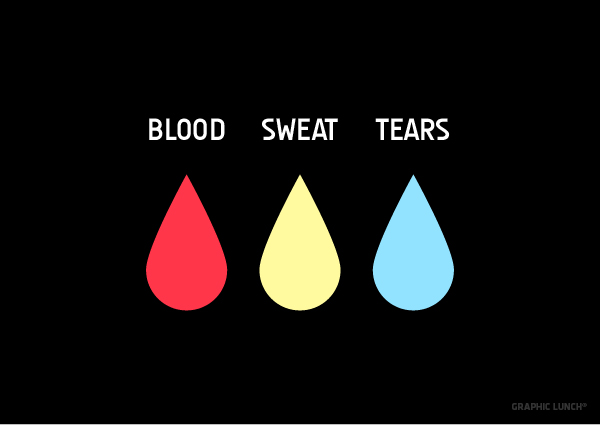
Blood + Sweat + Tears + Code + Polish + Sales + Luck = Startup

Startups are tough…..  Here’s a simple equation to get you headed in the right direction.

Blood + Sweat + Tears + Code + Polish + Sales + Luck = Startup

BloodSweatTears_02

Blood – Like an initiation to a gang, founders basically cut their hand and make their pledge to build a successful company.  No Blood, No Commitment.

Sweat – A massive work ethic and a JFDI attitude  will be required to break down all barriers and knock down all doors along the way.  Better bring your gloves, water bottle and a sweat towel.

Tears – You will feel pain.  You will cry.  It’s ok.  A better way to think about it is if you haven’t cried because of your startup experience you are on the road to nowhere.  Comfort doesn’t equal success.

Code – Something needs to be built and someone needs to code it.  Piecing together other services or just pulling API’s is not defensible long term.  Figure out what you – and only you – can create and then protect the IP.  Once you build the secret sauce you can outsource all other technical needs of the product.

Polish – Design is quickly becoming the great differentiator between the good, the bad and the ugly of technology.  User experience, or how the end user interfaces and understands your product, should be your number one focus.  If a user doesn’t enjoy using your product why should they tell their friend to use it?

Sales -Plain and simple, customers pay the bills.  A startup’s need for sales and marketing talent is still undervalued in today’s technical heavy Silicon Valley.  Minus a large investment, your startup will wither on the vine if no revenue is ever generated.  And if VC’s ever do invest they will want to see revenues, so either way sales and marketing are a core function of startup success.

Luck – Perhaps the most important of all is luck, which unfortunately is out of the hands of the founders.   But the saying goes “you make your own luck” so being in the right place, at the right time, in the right market, talking to the right people and releasing the right product all can be influenced by the founders.  The more chances you take the more lucky you get so get out there and get discovered.

Pretty simple stuff.

Is It Possible To Be An Entrepreneur And Not Be Selfish?

Going through a recent state of self reflection a few things became clearer to me.   One of them is how much being an entrepreneur brings out the selfish side of human beings.  Recent experiences have held a mirror to my face to illustrate this in my own life so I am genuinely asking the question, “is it possible to be an entrepreneur and not be selfish?”

It’s an interesting and possibly shocking question, I know.  Pardon me while I think out loud on the subject.

Breaking it down further one sees where two worlds collide – personal and professional – blurring into 0ne and the same, resulting in the entrepreneurial individual acting very selfish.  They instinctually strive to get what they want both in business and in their personal life. Most early stage founders are scrappy, shrewd and manipulating. Why? Because that is how you end up getting what you want.  The fact is you have to be scrappy and find any opportunity you can to move your interests forward against a world suggesting otherwise.   If not, people will doze you over with their own agenda and force you into a life you don’t want to live.

That angst for being dozed over, for those uninitiated, is the root reason entrepreneurs exist.  The problem lies in when one cannot turn it off once they leave the office.  I think the reason why they can’t is because “leaving the office” just doesn’t happen as an early stage entrepreneur.

An unfortunate reality can be found in the tension created between the good hearted and the driven. Through my self reflection I started to evaluate both those stances and realized it can be very difficult to be good hearted; giving-in and acquiescing to everybody in your life while at the same time driving headstrong to give up everything for your dream as an entrepreneur.  The math just doesn’t work.

After all, selflessness can be defined as putting yourself last, which taken at face value runs counter to what entrepreneurship means to each individual. People start businesses to feed their own needs first. More specifically, Bill Gates didn’t set out  at 19 years old with the vision to donate all his wealth to the less fortunate and cure the world of disease. He set out to become one of the greatest technologist and capitalists the world has ever seen, all the while serving his self interests (and his company) earning massive wealth in the process. Based on stories from co-funders and early employees he was quite selfish in his ways. It was only after he made his billions and conquered the world (figuratively) that he decided to give it back, maybe realizing how selfish he had been during his early years in business.  It’s quite easy to be selfless when you already have everything you want.

The same selfish description has been reported with the late Steve Jobs.

The Characteristics of an Entrepreneur

-Head strong
-narrowly focused
-determined
-hard working
-persuasive
-self absorbed
-obsessed
-delusional

Notice that if all you did was replace the title of list above with “The Characteristics of a Selfish Person” it would still make sense. This is when I realized I am not only an entrepreneur but I am a selfish person. For someone who prides himself on being a “good hearted person” this is a tough pill to swallow.

It may not be good news for everyone involved but I think its important to understand it and possibly unravel how to work/live with someone who suffers the entrepreneurial disease.

Founders
Newly minted entrepreneurs, or people considering starting their own journey as a founder need to take note of the inherent flaws. You may already posses those characteristics and believe you were born to be an entrepreneur but if you don’t take account and ownership of your DNA, it will be a rough go.  Starting a new venture is very difficult and not for the faint of heart.  It also is not for the selfless, since the ability to overcome the massive inertia requires A LOT of inward focus – which means less time spent focusing on others in your life. You will self evaluate. You will self doubt. You will self organize and self determine. A lot goes on inside the mind of an entrepreneur focusing on their “personal” situation and thus replaces thoughts involving others.

You need to know this, anticipate it and determine how you will live with it.  Others suggest work life balance and the like (which to an extent I do agree with) but at some point you will need to pick which direction you will lean.  Thinking you will be able to lean both directions at the same time is futile.  Be prepared to make A LOT of sacrifices for a period of time in your life.

Family
Family members of an entrepreneur need to understand Entrepreneurship is a disease, and the symptoms are all listed above. Given that, practice a healthy balance of both understanding these inherent flaws in the person you love and firmness in your own principles.  This will help you navigate the unknown road ahead. You need to be ready for challenging circumstances, tough conversations and compromises from both sides.

You also should know that yes, most of time you are right and we are wrong.   But we are actually seeing it from a skewed perspective – similar to how a schizophrenic might argue something you have no idea what they are talking about.  So rather than fighting about right or wrong, gray or grey, work with us in how we can move forward with the least amount of collateral damage possible.  You should also read this book by Brad Feld – Startup Life: Surviving and Thriving in a Relationship with an Entrepreneur.

Friends
Close friends of entrepreneurs should know that although we try our best we are going to drop the ball, especially during the early stages.  We will not be able to hang all the time, go on trips with you to cool places or grab drinks on a regular basis.  Trust me when I tell you your founder friends really do want to grab drinks but they feel inferior if they need to depend on you to pick up the tab.  We also work crazier hours than your 8-5 job so don’t be surprised when you text at 8 or 9pm and we’re still hacking away in the office.  Most importantly, we just need your support and secretly we dream of hanging out as if nothing has changed from the “back in the day”.

After all this you may be wondering why entrepreneurs give up so much and risk their livelihood?  We do it because we love the challenge and firmly believe we were supposed to do it, whatever that means…

You may also think I am off base with all this selfish talk, maybe even saying to yourself “not true… I’m an entrepreneur and I’m not selfish”.  As with all things, this topic is not black or white but probably a smearing of grey (or gray).

I am curious of your perspective.

Evolution Of A Founder: Up, Down, Up, Down, Up, Down, Sideways, Up, Down…

Much has been written about the founding experience yet I still feel like more needs to be said about the journey.  Since it is unique to all of us, no one article or blog post will be a sufficient summary of what to do and how to do it.

Life is never that easy.

Hilly RoadThe thing is, you will read one post from someone who is on the upswing, just having raised millions of dollars of funding or sold to Facebook and they’re all giddy about life.  Good for them!

Next article you will hear from someone who has just seen their business tank and is reeling in pain and defeat. Bummer for them.  You will start to notice it’s up and down, up, down, up, down and maybe a little sideways sliding in the middle of all of it.

I think the best approach (and the one I am employing) is to make a daily habit of reading other people’s perspectives and experiences, especially as founders and investors.  This helps me achieve and maintain a pulse of how to best navigate the choppy waters ahead.  I don’t pretend to know everything and don’t expect any one person to know it all either.  So, I make it a habit to cast a wide net on my daily learning.  I grab from other founders and entrepreneurs.  I pull from investors and VC’s whom I have an affinity for in their writings.  I gauge how the startup community is doing based on TechCrunch, Pandodaily, GigaOm, TheNextWeb, VentureBeat, BusinessInsider and other media outlets.  I cast a wide net, gather the information, digest it and make it my own.

The beauty of entrepreneurship is that it is unique in circumstances for each one of us.  Some of us have it easier.  Some of us have it harder.  Some were born into money and instantly have financial backers for their projects.  The rest of us – we must feel and find our way through the room with no lights on.

You, as an entrepreneur, need both perspectives.  You need to learn about how to deal with the good, the bad and the ugly if you are going to survive as an entrepreneur.  Om Malik, founder of GigaOm wrote a great piece recently on his journey as a founder.  Below, I have grabbed a few lessons I saw in it I felt were pretty telling:

Lesson Learned: You have to walk before you run. As a founder, you often don’t understand the gulf between your vision of the future and the reality in which a business exists. It is important to find the right balance between the two.

Lesson Learned: Shun consensus. Don’t be shy about making difficult decisions. If you have conviction, zig when everyone is zagging. After all, the worst that can happen is that you fail. If you don’t try, you don’t fail. You don’t fail, you don’t learn. You don’t learn, you will have failed anyway.

Lesson Learned: People who believe in you also want to succeed. They will work better if you encourage them, not micromanage them. Empower them to win.

Expanding on what Om is eluding to, I believe founders don’t really understand what they are getting themselves into and where they are going right out of the gate.  And that is OK, even expected.  At the time of founding (the)Facebook, how was Mark Zuckerberg supposed to know he was going to create one the largest web service in the world, reaching over 1 billion people (and still growing) making him a billionaire.

No way he could have known that.  If he knew that it would have scared him so much he probably wouldn’t have continued.

Yet he walked before he ran.  He knew he needed to get other smart people around him to help build out his vision.  He started by just focusing on Harvard.  Then Yale.  Then the Ivy League.   Then other universities.  Then high schools.  Then everyone.  Walking.  Before.  Running.

At times, it’s almost easier for founders to have too large of vision and be blinded by what they see.  They end up frozen by the blindness and not even focusing on the right foot being placed in front of the left.  If you didn’t catch it, that’s all that is required for walking.

Right, Left, right, left….

If you don’t try, you don’t fail. You don’t fail, you don’t learn. You don’t learn, you will have failed anyway.  

A truer sentence has never been written.  Failing, or learning, is the essence of entrepreneurship and must be embraced by anyone setting out on the journey.   Success is only a result of entrepreneurship.  I think we get those two facts confused as we blindly pursue our ventures, pushing forward with all our might and not taking into account what we are learning in the process.

I am lightyears ahead of where I was when I started Seconds just 15 months ago.  Yet, if I am not careful I will take a bianary view of my last 15 months and see there has not been a huge round of funding raised, acquisition to Google or IPO on the NASDAQ.

Does that mean I failed?  Hell no.

But that is what the media tries to tell us when they write posts saying “XYZ shuts down!”  StartupX fails to raise money, CEO quits

I urge you to dive deeper into the details when you read that stuff, since they are playing the age old game of news reporting. If you dive further into the story, researching the founders and finding their blogs, you will learn a lot more about the journey and probably the real reason why they chose to go a different direction.  Although lack of resources lead to dying companies, those founders will teach you more about how to start and grow a company than any “XYZ startup raises $10m series A” funding article will ever teach you.

Study the ups and the downs and figure out how others navigated the choppy waters of entrepreneurship.  Cast a wide net and allow all perspectives to sink in to your subconscious so you can make it your own.  No one person or blog post can tell you how it is and what to do.  It takes years to learn all there is to this game.

Actually you will never learn it all.  Just enough to be dangerous.

The White Screen Of Death Can Be A New Beginning of Sorts…

Well, I was greeted with the white screen of death on my MacBook Pro the other day. Similar to the blue screen of death on the Windows machine, the white screen of death means something has gone terribly wrong. It’s Apple’s way of saying “you will not be able to use this machine.”

Regardless of the situation, the reality is you are handcuffed. You are sidelined. You are “S.O.L.” as they say.

iMac-ScreenOfDeath

And it sucked.

It got me thinking how tied we are to our devices and how drastic the ramifications seem to be if something goes wrong. I don’t necessary like this dependence but the more I think about it the more I realize there is not much we can do.

Are we really at that point in society where a broken machine means a broken life? If your laptop goes down, will you still be able to be productive each day? If you are like me, the sad reality is probably not.

What would happen if your current device was stolen, lost or died? And what about the information on it? Would the information on it be lost forever?

Laptops Need TuneUps Too

As I diagnosed my situation it became clear the issue was with the OS and I was needing to re-install a new operating system.

For background, this machine was given to me by my co-founder when we started Seconds about 16 months ago. It is a 4-year old MacBook Pro, which he had used previously for his dev work before he upgraded. As he gave it to me I realized it was stack full of apps and programs used for development work – stuff I wouldn’t really be using. I also noticed it was running Lion, an older version of the operating system for Apple. I basically got lazy and didn’t upgrade when Mountain Lion came out.

During the last year or so I started to notice the ‘stress’ on the system and felt this specific outcome was approaching in the near future. I was also seeing that pesky pinwheel more and more (which I have to say is one of the most frustrating things). It was only a matter of time before the straw broke.

It broke on Sunday and I was sidelined.

Anyways, my current CTO Justin help me re-install the operating system. We went through the process and booted it up only to see a brand new experience with none of my old files there. They were all gone!

The amazing thing is I wasn’t upset.

Being Smart And Use The Cloud

When I was handed the keys to Seconds as the CEO (and handed this machine at the same time) I made a conscious decision to start storing all my important docs in the cloud. The combination of using Dropbox, Google, gmail, and Google Drive has allowed me to have pretty much everything at my fingertips, safe and ready to use on whatever web connected device I am using. I do recall a few random docs and images on my hard drive which are now gone. But nothing which would be devastating to my life or my business.

If you have not made this decision you must make it now. Do not save anything to your hard drive any more, save it to a cloud storage service. If you must save to something physical, go get a extra hard drive and start the habit of backing up once a week. But do not make the fatal mistake of saving something important to a mortal machine. You will regret it sometime in the near future.

So I am back to square one with this machine. There’ s a small amount of apps on here right now but not much more. I will need to download some design/wireframe/task oriented apps that I use during our product development cycles, but that is about it.

But it feels great to have the machine back up and running. I shedded the excess weight. The machine runs faster, and with the new OS Mountain Lion it feels swifter and more up to date. It feels like a new machine.

It also feels like a new beginning.

At times, we just need to press the “restart” button and start fresh like I have done that with my machine.

Maybe it’s something you can do in other areas of your life as well.

3 Reasons Why Non-Technical CEO’s Need To Go To Hackathons

SHDI am not the typical person you would find at a hackathon.  I don’t code and would be described in the industry as a “non-technical” cofounder.

As a non-technical CEO I tend to focus on things like marketing, branding, positioning, investors, and customers.  I do it because it’s my job and during the early stages of a startup no one else on the team is responsible for those things.

This is all nice and good but it doesn’t build a product.  And if you don’t have a product you can’t actually have marketing, branding, positioning, investors, and customers.

So if you are a non-technical CEO what you need is a techie bootcamp of sorts, short but intense periods of learning and doing so you can start to understand what its like to be a developer.  And trust me, if your devs don’t feel like you understand the hows and why’s of their work you will soon find yourself standing alone at the alter.

So what is a Hackathon?  It’s a room full of developers focused on building the coolest product they can in a 54 hour period.  It’s a self-inflicted bootcamp, challenging you and your team to execute on a new idea with little time, resources or sleep.

Crazy huh?

My team and I participated in the recent Sports Hack Day at the Hub over SuperBowl weekend in Seattle.  It was a great experience.  Obviously, the focus was building something oriented around technology and sports – two of my favorite topics.  While we didn’t take home any of the prizes, we did take home a kernel of an idea we think might actually be something substantial.  More on that later.

I want to review some lessons learned over the weekend and possibly help other non-techical CEO’s who are serious about building a startup realize how important the time spent at a Hackathon can be.

Lessons 1. Become part of the community

There is a strange brotherhood between technical people – developers, hackers, coders, designers – anyone who considers themselves one with the terminal.   It’s like they just have look at each other, head nod without saying anything and instantly know each is in the club.  I have to admit this was quite foreign to me as I began my entrepreneurial journey (uh, what’s that say on your screen?)   I credit the few CTO’s I have worked with for their patience and understanding with me being a non-technical person.  Yet weekends like the last one spent at a hackathon do A LOT to not only further educate me on technical aspects of software/web development but also include me into the community.

The quote “showing up is half of the battle” comes to mind here.  By simply showing up and intuitively saying to others “What’s up?  I’m right here on the front lines with you!” goes a long way to gain respect and inclusion from the community.  Also, asking questions – lots of questions – about various languages, platforms and API’s tells your fellow technical team-members you are interested in learning about their world.  THIS IS HUGE.  You will learn a lot and gain respect from them just based on the fact you are taking the time to know what’s going on.

And the coolest thing is I am actually starting to retain this stuff!

Lesson 2. Execute under pressure

A weekend is barely enough time to take an idea and deploy a working product around.  In fact, it’s not really much time at all since our code deadline was at noon Sunday and Demos started about 12:30pm.  This means you learn to make quick decisions.  There is no time to battle back and forth about a specific feature or naming structure.  You must decide and JFDI.  With less than 54 hours available, Hackathons are all about execution and swift decision making.

You know what?  Swift decision making is incredibly valuable in the real startup world as well.  Hackathons help you to become agile, testing what works and what doesn’t and quickly make corrections if needed.  This is arguably the top advantage of being a startup so being able to polish the diamond during the weekend has tremendous benefits in the long run.  Also, it can be crazy stressful as you get down to the deadline.  The team learns to work in a “crucible” where intense pressure hangs over you as people work tirelessly to get something “respectable” completed and deployed.

Hackathons are not for the faint of heart.

Lesson 3. Find the value proposition

I’ve written previously about the value of pitch competitions, so I will talk more about the process of how you get there than the actual pitch.  During the weekend as you are building out your product you still have to keep in mind what value your product brings to the world.  Remember, after the deadline you will be standing in front of the group and a field of judges describing your product and why it should be used.  There really is not much use for a product that doesn’t solve a problem or pique someones interest in one way or another.  Don’t be the guy/gal who doesn’t even understand how or why their product would be used.

So in addition to building really cool tech you are challenged to figure out the value proposition – both are required to winning a Demo competition.   The condensed timeframe places increased pressure on you to figure out what problem you are actually solving.   Quickly evaluating the market, determining if there are existing players and what problem they are solving.  Finding holes in the market and quickly determining how to meet them.  Evaluating potential business models, although not fully required during a hackath0n, will stretch the creative mind farther than anticipated and lead to interesting business developments.

The benefits can be compared to exercise:  the more ‘reps’ you accomplish at a higher stress level the better (stronger) you become at that particular activity.   Especially for non-technical founders, hackathons provide a great training ground to hone value proposition skills.

Whew, what a weekend!

For all the non-technical founder/CEO’s out there: Don’t shy away from hackathons.  Trust me, you need them more than they need you.

Why Do We Hurry Up And Wait?

Life always seems to be like this, doesn’t it?  There’s something you want to go accomplish, do, buy, write, build, etc…. yet turns out it’s “not yet time.”

The question I struggle with is why are we presented with an opportunity for something we want and then ultimately have to wait much longer than we expected to finally get it.

Is it so we appreciate it that much more when it finally does happen?  So we don’t just take it for granted and toss it aside like a child does with a new toy?

Is it a matter of maturity?  Are we initially presented with the thought or opportunity to test our maturity and patience?  Or if we don’t ultimately get it, is it that we actually didn’t take advantage of the opportunity when it was presented to us?  Is it that we didn’t do the right thing at the right time?  Did it just slip through our hands without us even knowing it?

Was it that we were never really “qualified” for the opportunity and we were just wishful thinking we could live and operate on such a high level.

Is someone playing an awful trick on us, kind of like what has happened to Manti Te’o recently?  (To which I must add – doing something like that to someone else is really messed up, and how the rest of the world reacted to it is even more messed up.  I want to write about it but would end up using a lot of 4-letter words.   Not sure I want to go there…)

I believe there is proper “timing” for everything and sometimes it just “not the right time.”   I also believe hard work, dedication, patience and diligence is the path towards success so timing is inherent to success.

But dammit, it really gets old telling yourself, “Just keep waiting… it must not be the right time yet.”

Some days, it’s just hard.

Some days, you want someone to walk over to you, point a direction and say, “go that way, you’ll find it over there.”

Some days you want God to grab you by the head, look you in the eyes and tell you the truth, telling you how it will end and if it everything will be ok.

Some days the goal feels as far away as the mountain I see looking out the window from the ferry I ride into Seattle.  The crazy thing is the goal feels to never get much closer or any more clear than the view below.  I struggle with the juxtaposition of being a go-getter and making things happen vs being a farmer, planting seeds that will grow into future opportunities down the road.  Being a farmer is fine when last year’s crop is nicely feeding you and your family, allowing you to plan for your future patiently and wisely.  When it doesn’t, patience will be tested and wisdom can be challenged.

I hope today brings more than the normal “not yet” I seem to keep running into.

photo 4

Wondering How Hard It Is To Start A Company? This Interview Will Help You Understand

This is an interview with Brian Chesky, founder and CEO of Airbnb. They survived years of challenges, brokeness and despair before they hit a growth phase on their way to a now $2 billion+ valued company. If you are not familar, Airbnb allows anyone to rent out a room or their entire home to a stranger. No one would do that, right?

Wrong. They are growing like crazy right now. Simply amazing. It’s a long interview but VERY worth it. A few things I took from the interview:

  • Create something a hundred people will love, not something 1 million people will kind of like.
  • Do whatever you can to survive. Just when you think it’s over your answer will present itself.
  • Love what you do and do it world class. They chose to maximize their unique culture and be great at design. Doing that will attract the right people.

Why I Write So Unbashingly Straightforward and Authentic

On a recent post titled  Founder = Learning To Juggle While Riding A Unicycle On A TightRope   I recieved the following comment.

Nick, I find your blog interesting. Spectating the process of someone having the guts to go it alone and start their own thing is enlightening plus a curious thing to follow to boot. Regardless of the underlying intention of this blog, I thank you for taking the time and being brave enough to share your feelings as you go through your journey.

However…

What did you do before your became this ‘founder’? In the post above you’re describing a vast majority of jobs, whether it be owning a company, directing a company, managing a team or heading up a department. The general sentiment of this post makes me wonder why you considered starting your own business in the first place. That’s really all you’re doing – starting a business. The same as the plumber down the road who is determined to do it on his own. Attaching the terms ‘founder’ and ‘start up’ to it doesn’t really change it in my mind.

Just because the ‘paper pushers’ get a salary, a monthly wage, a mobile device, a fuel card and any amount of other incentives, it doesn’t mean they’re under any less stress to put out their own fires, to keep their job, to keep their team’s jobs, to impress their boss, to impress their spouse, to continue paying the mortgage, schooling the kids, paying for groceries etc, etc.

We all have to juggle buddy. The difference is, while some of us sit in the corner waiting to be hugged, some of us simply add ‘hugging the sad-looking guy in the corner’ to our ever increasing todo list.

Step up mate. If you’re struggling to juggle, perhaps you need to leave the circus? If this response is out of line with the purpose of your post, I apologise. But take a second to consider the sentiment of what you’re putting out there and the effect it might have on your growing number of readers.

Keep up the awesome work and just keep swimming!

Below is my response:

Thanks for the reply and I appreciate your response. And I am glad you are enjoying the journey with me.  However, maybe something was lost in translation and I possibly missed a few things as I wrote this morning. Please read this as a neutral response. The point of the post is twofold.

First, there is a hell of a difference between an owner/founder and an employee – namely the fact that all most all parts of the business rest solely on the founders/owners shoulders. This is typically not the case when you are an employee, especially as the organization grows. (and yes I have been an employee in large and small organizations before, that’s actually what influenced me to start my own company). This perspective can be referred to as Owner vs Employee mentality and it’s not for the faint of heart. And I am not even including all the stuff you mention everyone must now juggle “to keep their job, to keep their team’s jobs, to impress their boss, to impress their spouse, to continue paying the mortgage, schooling the kids, paying for groceries etc, etc.”

Second, using the analogy of learning to juggle while riding a unicycle on a tightrope is to say you have to pretty much learn everything on your own, typically numerous things at once, trial and error as a founder. There’s no owners manual to founding a company, kinda like there’s no magic “lose 50 pounds” diet pill. Startup is no easy task and one of the reasons why most of us never venture out on our own. Employees are trained to do a specific job and have someone (boss, manager, owner) to rely on when things get too difficult or become “over their head” if you will. They have safety nets who can take on the problem if need be and for lack of a better term “wipe their hands clean” at the end of the day since it’s not their company.

I guess a third point is simply the fact that founding a company is damn hard and something I look to grind through towards growth and success. I started on this path because it’s a healthy challenge and allows me to appreciate what life presents when you take it into your own hands. And nope, this circus ain’t leaving anytime soon.

I write bluntly and truthfully for readers – for better or worse. My goal is to open up the black box of entrepreneurship and give people a better perspective, those who may be fascinated with it but have never made the leap themselves. Is it sometimes hard to digest? For sure. But that’s entrepreneurship. Part of the motivation in my writing style is to help readers gain a better appreciation for entrepreneurs and the struggles we go through, and maybe to educate people on the decision they may or may not be contemplating at the moment. Just like life, it’s quite messy.

As you can see, I write with unbashing honesty, authenticity and realness because I believe current and future entrepreneurs deserve it.  I also write with such perspective because quite a few readers of this blog are not actually entrepreneurs and this seems to be the only way I can accurately communicate to them what we go through on a daily basis.  Some are my family and friends that at times I am sure they ask themselves what the hell we are doing.

The point of SoEntrepreneurial is (and has always been) to illustrate and communicate the entrepreneurial journey is words maybe not heard anywhere else.  No, starting a company is not like being an employee no matter how much the above commenter believes it is.  It’s everything they describe – and a hell of a lot more.  And starting a tech company is defineltiy more difficult than becoming a plumber or other service provider who create their own company, namely because when starting a technology company you first have to determine what you are going to do and then build your product out of thin air.  Only after you have done those things can you then go find customers who want to use it!  Come to think of it, if your life and job is equally stressful as being an entrepreneur, I would encourage you to at least put yourself in a position where you are creating equity and ownership in what you do on a day to day basis.   Then you can at least justify to yourself why you are working so damn hard.

If you read popular tech blogs, you’ll read way too much about the lavishing riches and wealth founders’ of companies encounter, as well as all the posts about how another early startup creating a Groupon copycat (ok, maybe a year or two ago) raised millions of investment without any proven market traction.

Like it or not, that is not real life as a startup just as the tabloids or TMZ is not real life.  That’t the 1%.  The rest of us 99% tough it out and have to prove it over the long haul.  It would be a disservice to potential founders if they did not hear the truth from the source.

It sounds as if things I say or the descriptive words I use to write may be offending some people or might cut too close to the bone.  I am sorry if that is the case, but I also feel it’s not really my problem if I offend people.  I know I am doing a service with the words I write, and I am not purposefully out to harm any one person or group of people when I do it.  My intent is to educate and inform through words just as a producer of a documentary would with moving pictures on a screen.  If those words agitate or disturb in any way, well maybe it’s time to look in the mirror.

In any case, I will continue to write with open honesty and authentic voice.  You, as the reader deserve it.  You deserve to actually feel what its like to start a company out of thin air and grow it from the ground up.  You deserve to go through the good times and the bad.  You deserve to hear a fair and balanced perspective on technology and starting a company from someone who didn’t go to Stanford, work at Google or come from the lucky sperm club.  Absolutely, you deserve to hear how a normal guy, with no real starting advantage over the competition can grind it out and become successful with his startup.

Why?

Because if he can do it, so can you.  That’s what SoEntrepreneurial is all about.

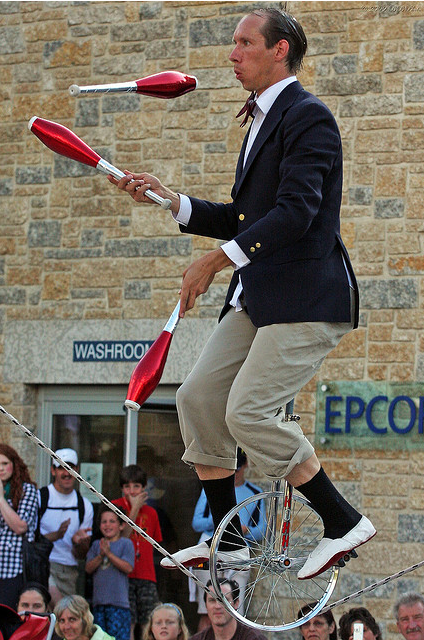
Founder = Learning To Juggle While Riding A Unicycle On A TightRope

Being a founder is often hard to describe.  When you are asked, “what do you do” at parties or other social events, it’s easier to brush it off and not bring up the fact that you are a founder of your own company, just so you don’t have to go into how crazy it is.  When they realize you are a “founder” and you have a “startup”, it’s quite impressive to them.  They think it’s all glitz and glamor.  “Oh” they say, “that must be really fun!”  They think you make a ton of money and instantly give you more credit than you deserve.   They almost give you rock star status.

Or, ironically, they don’t give you enough credit.

The problem is they have no clue what you are going through and what it took just to get to where you are right now.  They have no idea how much you gave up to get here.  They don’t understand you don’t go back to a desk in an building owned by the company you work for, push some pieces of paper around, report to a boss, provided daily meals by your employer, given a shiny mobile device and a cushy salary with benefits.

They don’t actually realize NONE of that is included.   They have no idea you have given up everything in your life for this moment.

They also have no idea being a founder is like learning to juggle while riding a unicycle on a tightrope.

Why would I use such an analogy?

Most people’s idea of a founder is Steve Jobs – Miraculous.  Incredible.   Innovator.   Charismatic.  Leader.  Someone who’s all put together and very wealthy.  Use whatever descriptive words you want but they will be wrong.

Sorry to ruin the fun, but as founders we are generally running around like a chicken with our heads cut off trying to put out the latest fire threatening to burn down our dream.  Most things presented to you will be foreign and scary as hell to fix.  Customers will leave you.  Investors will say no.  Tech will fail.  Team members will leave.   Bank accounts will go dry.  And that’s just par for the course each day.

Most of the time you have no idea what you are doing or what the right move is, you are just putting one foot in front of the other and feeling your way around the dark room.

It’s feels like this: you attend to one thing, and just when you think you have it figured out another thing pops up.  So now you have two things to look over and figure out.  Yet before you know it, instantly another issue arises.  But this one is specifically attached to how you actually make money so you must drop everything else and go figure it out.  Hopefully, once you get that figured out you remember what the last issue was so you can return and fix it.

Learning. To. Juggle. While. Riding. A. Unicycle. On. A. TightRope.

Yes, it feels that tiring each and every day.  Next time you find out someone is a founder, please just give them a hug and ask them what you can do to help.

And you know what?  Juggling and riding unicycles also have their benefits and the analogy works the other way.  More on that topic at a later date.

What Every Entrepreneur Thinks Before They Even Lift Their Head Off The Pillow

“No way, You Can’t Quit Now”

I’ve said it before and I’ll say it again: this founder thing is damn tough.  Not a day goes by do I not think about how much easier life would be if I just quit and went back to a measly job trading hours for dollars.

It sounds so nice, doesn’t it… get a job where I have no real responsibility, just show up, go through the motions and every two weeks have money automatically deposited into my bank account.  Clock-in/clock-out and then go hang with friends and family, gleefully spending the money I didn’t work very hard to earn.

If that was the case, the basis of my employment would be how close to the status quo I could lie, just making sure I don’t screw anything up.

Oppose this to the radical idea of pursing excellence in myself and the things I create.

Yes, it’s tempting to go take the easy road like so many others do… so many whom most likely are way more in touch with reality than am I.

The thing is I am not wired that way.  As crazy as it seems to be, entrepreneurship is so much more than status quo, hours for dollars and not screwing up.  Entrepreneurship is about embracing the unknown and challenging yourself to overcome seemingly insurmountable challenges, all this with little or no support and resources.  Basically, an entrepreneur is a magician creating something from nothing.  And trust me, most challenges we face seem insurmountable.  These aren’t just “where’s that piece of paper again?” or “I wonder if my boss will let me go on that vacation I have been thinking about?

That’s child’s play.

Not a day goes by where I don’t think about the consequences of my decision to forgo income (in my own company or with another job opportunity) for the opportunity to do something most people are afraid to do.    Think about what would happen to you and your life if one day your paycheck just stopped showing up in your bank account.  It takes courage, vision, strategy and a bit of stubbornness to make it as an entrepreneur.  And because of those requirements, most don’t.

Also, quitting is the worst possible option at this time.  Quitting not only validates all who doubted but it also flushes everything I’ve worked for and have equity in.  It flushes it right down the drain.  Not only would I be broke but I would have nothing to show for it.  I can’t let that happen.  I won’t let it happen.

All this goes through my head before I even raise it off the pillow each day.  Although things are tough at times, I count my blessings –  family, friends, business partners, God and all other greatness in my life – allowing me this opportunity.   Not everyone has what I have around me.

The amazing thing is how great of position Seconds is sitting in right now.

  • We just experienced our 8th month of continuous growth, month over month.  We have never seen a down month and don’t intend to.
  • We are just about to release a new version of Seconds, one where it will be much easier for you and I to use and experience the value.   It’s gonna blow your socks off.
  • We are throwing a big charity party at the end of the month involving a number of area startups as well as donations (via Seconds) to local non-profit Vittana in an effort to fight world poverty.
  • We are attending DEMO Conference at the beginning of October, a conference which will be full of founders, executives, investors and media.  This is the event we won a trip to earlier this year at the SURF Incubator pitch competition.
  • We have been asked to go back down to San Francisco mid-Oct to be a part of a select group of startups in attendance the TwilioCon, a conference put on by one of the tech platforms in which we have built our system.  They want us to demo Seconds and showcase what we have built with their communications technology.
  • In conjunction with our release, we will be rolling out across local colleges and universities for Seconds to be used to easily collect payments in students’ college and greek life.  First one starts at the end of September and we’ll be systematically spreading across numerous campuses throughout the year.

Given all that is good about where Seconds is heading, a few bad days/weeks/months personally will not be enough to push me over the cliff.  I suppose someone or something is trying its best to persuade me to give-in and give up.  If that’s the case, they are going to have to do much better than they are now.

No way, you can’t quit now… you gotta get up and go make it happen.

Hey Coach, What Is A Startup CEO Supposed To Be Anyway?

As I was chatting with another CEO friend of mine tonight he said something that caught me off guard.

He said:

“I was talking with another person and we determined as a CEO you push your people in just the right way to get things done… you’re like a coach.  We realized that is a good thing and need to do more of that type of leading in our startups”

Some of you may be familiar with my history so being referred to as a coach might not be much of a surprise.  But in light of the context in which this conversation took place it was a surprise to me.  My CEO friend is farther down the startup path than I am and I tend look to him as a mento-friend.  I appreciated the kind words and thanked him accordingly.

Yet this begged the question: what is a startup CEO anyway?

My take is my friend was exactly right: a coach.

Okay Nick, then what is a coach?  A coach is a Leader.  A coach is someone who is responsible for the outcome of the team – win or lose.  The coach determines who plays on the team and who gets cut. Coaches push players to the brink and guide them in achieving levels of success previously thought impossible.  Coaches know the most about each opponent and dictate the playbook accordingly.  And most important, the coach evaluates each and every player, helping them identify where they are weak and exploiting where they are strong.

Ladies and gentleman – that’s a leader.

Given I am still at the beginnings of the exciting growth of Seconds and my personal journey as a CEO I will not take any credit of success – history will be the judge on that one.  But I couldn’t help but notice myself in the exact moment of this conversation grasping a few lessons regarding leadership I think are important for CEO’s at the startup level.

Face it, you ARE a coach

Like it or not, as the CEO you are the coach.  This should not be taken lightly and in the wrong hands it could lead to disaster.  One of my favorite quotes from author John C. Maxwell is “everything rises and falls on Leadership.”  The statement could be viewed as general toss-grass-in-the-wind pontification.  I tend to just take it at face value – life happens because leaders make things happen.  Or they don’t.

Leaders (CEO’s) determine the pace, structure and culture of a young startup company.  Understanding this should weigh heavily on a CEO’s heart and mind as they relentlessly plow forward.  What you say and what you do will hang like London fog within your small company.  You should think twice about each and every word, positively and negatively directed toward cofounders or customers.

And whether you know it or not, your team is looking  right at you to make decisions.  These decisions can be as mundane as the color of text on your site and as crucial as choosing to relocate the company or adding a co-founder.  Great leaders consistently make the right decision, and even better, teach and empower others to make the “right” decisions for them.

You are also a player

One of the toughest things about being CEO is the fact that you are a player – equal with other team members – at the same time being the coach with added intangible responsibilities.   Highly self-aware CEO’s intuitively understand this dynamic and can navigate the waters accordingly.  Some days you need to get your hands dirty with specs, feature fixes and other product oriented tasks – things you are probably drawn to more naturally as you flex your engineer or designer muscles.  Other days you need to put your coach hat on to lead your team by dictating the vision, talking to investors, evaluating opponents, interviewing new hires, connecting with media or visiting customers.

These things may not come natural to you but believe me they are essential.  I am convinced the drastically high level of failure experienced at startups is due to a failure of leadership.  Delineation too far in any direction from a leader for too long spells doom for a fragile company being built on a hope and a prayer.  If “everything rises and falls on leadership“, startup success must surely follow the same principles.

Leadership is in short supply

My friend mentioned something interesting as we were talking.  He said “I just don’t feel I can push them very hard… I guess I have that Seattle passive thing going.

I said, “look, people actually want to be led.”  And it’s true, (most) people naturally want to be told what to do.  Quite frankly, they are scared to make any important decisions so they naturally default to having someone else tell them what to do, in case it doesn’t work out and they have someone else to blame.  That’s the harsh reality view.  The more positive view is people want to be led and inspired, hoping that the time they are taking away from other important areas and people in their life is actually going to turn out to be something positive.

Unfortunately we have too many people more concerned with not pissing people off then accomplishing the current mission.  Appropriate and authentic leadership is definitely in short supply.  I am not advocating being a jerk or other unmentionable words.  I am calling for people to get more in-tune with the dynamics of human nature and motivation.  This is not rocket science, it’s all right there at the intersection of psychology, sociology and biology.  Notice how I didn’t mention technology…

I also noted to my friend the most common reaction from anyone who worked for Steve Jobs.  I said “dude, most people have said Steve Jobs was a jerk, an asshole, and generally not enjoyable to be around.  They also follow that statement up with the fact that he actually inspired the best out of them and they were somehow able to perform and deliver well above levels they ever thought possible.”  

That’s leadership.  Steve Jobs might not have been best friends with most people he worked with but boy did he get the best out of them.  Indeed, he was their coach.

Culture Is One Of The Most Important Aspects Of An Embryonic Startup

I continually think about what kind of culture I am building within the Seconds team.  We are still a rag-tag founding team, some full time and some very part time, most on the west coast but some outside of Seattle.  Yet setting a strong and distinct culture at this embryonic and incubation stage of the company is one of the most important things a founder can do.

I read this the other day and it made me pause and reflect on how to better create culture within my team.  From Blake Master’s notes on Peter Thiel’s CS 183 class:

Good company culture is more nuanced than simple homogeneity or heterogeneity. On the homogeneity side, everyone being alike isn’t enough. A robust company culture is one in which people have something in common thatdistinguishes them quite sharply from rest of the world. If everybody likes ice cream, that probably doesn’t matter. If the core people share a relevant and unique philosophy about something important, you’re onto something.

Similarly, differences qua differences don’t matter much. In strong company cultures, people are different in a way that goes to the core mission. Suppose one key person is on an ice cream only diet. That’s quirky. But it’s also irrelevant. You want your people to be different in a way that gives the company a strong sense of identity and yet still dovetails with the overall mission. Having different kinds of problem-solvers on a team, for example, can make for a stronger culture.

5 Startup Founder Rules To Live By

Apparently, Twitter co-founder Biz Stone makes all Twitter employees adopt seven rules when they join the company.  I though these were quite interesting, especially Leave space for the unknown. When I read these rules it made me sit back and think about what might be my rules.

1.  Be Original – Originality is rare today, being truly unique sets you apart from all the rest and makes you attractive to others.

2.  Don’t Ever Quit, Just Refocus – Obstacles and frustration are part of the game.  Refocusing after a setback will help you find meaning and your next milestone.

3.  High Risk-High Reward – We only have so much time on earth to make a difference, why not opt to make the most out of it.  Unfortunately high rewards require high risk.  Fortunately, most choose to risk very little leaving you with a lot of opportunity.

4.  Live Authentically –  Things have a way of coming back around so living authentically alleviates lots of future problems.

5.  Turn Complexity Into Simplicity – Successful products and technical innovation is all about simplifying the complex.  Do that and everything else takes care of itself.

@jnickhughes

Would You Rather Be Undervalued Or Underestimated?

Being a first time CEO can be confusing, intimidating and downright scary.  You have a hundred things to do and no idea which way to look.  You feel the need to talk to a lot of people but it’s difficult to determine the ones you really need to spend time with.   You need to deal with legal, financial, organizational, strategic and other parts of the company on a daily basis yet might not be fully comfortable with each area just yet.

Everything rides on your shoulders.

Although this is not my first startup founder experience, it is my first as a CEO in, shall we say, the “big leagues”.  It has been brought to my attention this will be a significant challenge to me since my background lacks “normal tech startup experiences” and don’t fit the typical CEO path.  They say I will be underestimated.

Well, I say perfect.  Bring it!  I love challenges and believe the great ones are created through immense crucibles, where pressure either polishes them into greatness or crushes them into pieces.

As I ponder the reality I face, a question arose in my head:  Would you rather be undervalued or underestimated?

Undervalued means they have already sized you up and determine you don’t add much value to the ecosystem.

Underestimated means they are ignorantly judging you, still don’t know your potential and will be shocked when you reach it.

I have a hunch where I fall in respect to those two.  Do you know where you stand?

@jnickhughes

The Numerous Mental Disorders You Probably Have As A Founder

“God, did I just actually think that?” 

Many have wondered what goes on in the minds of the people who go on to start successful companies.  Some may think pure ambition, hopes of everlasting riches or even recognition for doing something great are the driving forces behind a founder.  Others might believe people have a vision or some sort of predestined aura working beyond their comprehension to align the lucky ones with the future.

Whatever is going on behind the scenes of a founding entrepreneur , you can be sure it’s straight out of a psycho-thriller.  The thoughts, feelings, emotions and urges pushing a founder toward success are so dramatic there are no words to accurately describe the experience.  The question is are these normal?

I have no idea what the hell I am doing and where this company will actually end up?

Entrepreneurship is basically a physiological disease, with various mental disorders running rampant.  Being an entrepreneur is something far different than what most people think. It is not about behavior; it is not about business type; and it is not about title. Instead, it seems as if it’s a personality trait with it’s own quirks and characteristics.  There are plenty of small business owners and start-up founders who do exceptionally well — but are not what would be considered an entrepreneur. Just like in big business, you can be a successful general manager without being an entrepreneur or entrepreneurial.

Dammit!  That guy is worth hundreds of millions more than me!!  All he did was start a photosharing app…  What’s he got that I don’t?

So how do you determine if someone is an entrepreneur ?  And are entrepreneurs actually crazy by normal society standards?   That seems to be up for debate.  A thin line separates the temperament of a promising entrepreneur from a person who could use, as they say in psychiatry, a little help.  Academics and hiring consultants say that many successful entrepreneurs have qualities and quirks that, if poured into their psyches in greater ratios, would qualify as full-on mental illness.

If it’s a disease, entrepreneurship then is a combination of many mental disorders that when found in correct combinations, come together to form a very unique individual.  Entrepreneurs are all in all the time. Entrepreneurs love what they do and obsess over it. It is a predisposition; a path that has already been laid for you. It is a character trait, a labor of love, a zeal that cannot be trained, a condition that cannot be treated, an illness that cannot be caught. You’ve either got it or you don’t. Even the Quora community has determined mental disorders are associated with founders.

Wait… did or didn’t I know this was going to happen.  Was it a dream?  I could have swore we already figured this #@%^ out!   Geez, I have no idea when the last time I got a full night’s sleep.

What mental disorders are to be found more common among entrepreneurs than the general population?  After realizing my personal thoughts were “uniquely abnormal” and after numerous interactions with founders of other companies (and discovered the same weirdness), I determined to do some further research.  What follows is an attempt to describe the most common mental disorders associated with the general entrepreneur with descriptions found on Wikipedia.  I came to choosing these specific ones from familiarity and similarity, meaning I noticed a strong association with a founders psyche when reading the definitions.

Anything sound familiar?  As you read these you will start to realize we all are a bit “off our rockers.”  Yet also apparent from reading this list is the notion that maybe the entrepreneur is the lucky one who can actually channel their craziness in a way that actually moves society forward, not backward.

(*please note I am only suggesting it is just the combination of some or all of these in small doses that make up the general entrepreneurial psyche)

Asperger syndrome

Aspergers syndrome an autism spectrum disorder (ASD) that is characterized by significant difficulties in social interaction, alongside restricted and repetitive patterns of behavior and interests…. The lack of demonstrated empathy is possibly the most dysfunctional aspect of Asperger syndrome.  Individuals with AS experience difficulties in basic elements of social interaction, which may include a failure to develop friendships or to seek shared enjoyments or achievements with others (for example, showing others objects of interest), a lack of social or emotional reciprocity, and impaired nonverbal behaviors in areas such as eye contact, facial expression, posture, and gesture.

People with AS may not be as withdrawn around others as those with other, more debilitating, forms of autism; they approach others, even if awkwardly. For example, a person with AS may engage in a one-sided, long-winded speech about a favorite topic, while misunderstanding or not recognizing the listener’s feelings or reactions, such as a need for privacy or haste to leave. This social awkwardness has been called “active but odd”.

Get the hell out of my face right now!  Geez, can’t you figure anything out!   And why do you complain about everything all the time.  You should be grateful you work for a kick ass startup.  

Cognitive disorders

Most common mental disorders affect cognitive functions, mainly memory processing, perception and problem solving. The most direct cognitive disorders are amnesia, dementia and delirium. Others include anxiety disorders such as phobias, panic disorders, obsessive–compulsive disorder, generalized anxiety disorder and post-traumatic stress disorder. Mood disorders such as depression and bipolar disorder are also cognitive mental disorders. Psychotic disorders such as schizophrenia and delusional disorder are also classified as cognitive mental disorders.

This company is worth half what is what worth last year.  I’m a loser.  

As an entrepreneur, depression can set in as well.  It happens to the best of us, especially entrepreneurs who hold strong feelings about their performance and the inevitable outcome of their company.  Ben huh, CEO of Cheezbeuger Network recently opened up about his challenges with depression.

Mania

A manic episode is defined in the American Psychiatric Association’s diagnostic manual as a period of seven or more days of unusually and continuously effusive and open elated or irritable mood, where the mood is not caused by drugs or a medical illness and (a) is causing obvious difficulties at work or in social relationships and activities, or (b) requires admission to hospital to protect the person or others, or (c) the person is suffering psychosis.

To be classed as a manic episode following must have been consistently prominent: grand or extravagant style, or expanded self-esteem; reduced need of sleep (e.g. three hours may be sufficient); talks more often and feels the urge to talk longer; ideas flit through the mind in quick succession, or thoughts race and preoccupy the person; over indulgence in enjoyable behaviors with high risk of a negative outcome (e.g., extravagant shopping, sexual adventures or improbable commercial schemes).

Schizophrenia

Schizophrenia is a complex mental disorder that makes it difficult to tell the difference between real and unreal experiences, think logically, have normal emotional responses, and behave normally in social situations.  Schizophrenia symptoms usually develop slowly over months or years. Sometimes you may have many symptoms, and at other times you may only have a few.  People with any type of schizophrenia may have difficulty keeping friends and working and they may also have problems with anxiety, depression, and suicidal thoughts or behaviors.

At first, you may have the following symptoms:

  • Irritable or tense feeling
  • Difficulty sleeping
  • Difficulty concentrating

As the illness continues, problems with thinking, emotions and behavior develop, including:

  • Lack of emotion (flat affect)
  • Strongly held beliefs that are not based in reality (delusions)
  • Hearing or seeing things that are not there (hallucinations)
  • Problems paying attention
  • Thoughts “jump” between unrelated topics ( “loose associations”)
  • Bizarre behaviors
  • Social isolation

Oneirophrenia

Oneirophrenia is a hallucinatory, dream-like state caused by several conditions such as prolonged sleep deprivation, sensory deprivation, or drugs (such as ibogaine). From the Greekwords “ὄνειρο” (oneiro, “dream”) and “φρενός” (phrenos, “mind”). It has some of the characteristics of simple schizophrenia, such as a confusional state and clouding ofconsciousness, but without presenting the dissociative symptoms which are typical of this disorder.

Persons affected by oneirophrenia have a feeling of dream-like unreality which, in its extreme form, may progress to delusions and hallucinations. Therefore, it is considered a schizophrenia-like acute form of psychosis which remits in about 60% of cases within a period of two years. It is estimated that 50% or more of schizophrenic patients present oneirophrenia at least once.

Narcissistic personality disorder

Narcissistic personality disorder (NPD) is a personality disorder  in which the individual is described as being excessively preoccupied with issues of personal adequacy, power, prestige and vanity.  Narcissistic personality disorder is closely linked to egocentrism.  Narcissists also tend to be physically attractive on first impression, giving them advantages when first meeting people.  Some individuals believe that Narcissistic personality disorder seems like the the person suffering has high confidence and a strong self-esteem, however this is not always the case.

Megalomania

Megalomania is a psycho-pathological condition characterized by delusional fantasies of power, relevance, or omnipotence. ‘Megalomania is characterized by an inflated sense of self-esteem and overestimation by persons of their powers and beliefs’. Historically it was used as an old name for narcissistic personality disorder prior to the latter’s first use by Heinz Kohut in 1968, and is used these days as a non-clinical equivalent.

Arguably, however, ‘in addition to its pathological forms, megalomania is a mental behavior that can be used by any individual as a way of coping with distress linked to frustration, abandonment, loss, or disappearance of the object’ in everyday life. In this sense, we may see ‘megalomania as an extreme form of manic defense…against the anxiety resulting from separation from the object’.

In the social world, ‘megalomania…can be a characteristic of power-drunk or control-freak dictators, some executives, some politicians and some army generals’. All such figures may be said to have ‘a “Big Ego”. A baby’s ego, in fact, insufficiently shrunk….So they’re much more likely to miscalculate To offend people’.

Psychotic disorder

Psychosis (from the Greek ψυχή “psyche”, for mind/soul, and -ωσις “-osis”, for abnormal condition) means abnormal condition of the mind, and is a generic psychiatric term for a mental state often described as involving a “loss of contact with reality”. People suffering from psychosis are described as psychotic. Psychosis is given to the more severe forms of psychiatric disorder, during which hallucinations and delusions and impaired insight may occur.

People experiencing psychosis may report hallucinations or delusional beliefs, and may exhibit personality changes and thought disorder. Depending on its severity, this may be accompanied by unusual or bizarre behavior, as well as difficulty with social interaction and impairment in carrying out daily life activities.

Brief hallucinations are not uncommon in those without any psychiatric disease. Causes or triggers include

  • falling asleep and waking: hypnagogic and hypnopompic hallucinations, which are entirely normal
  • bereavement, in which hallucinations of a deceased loved one are common
  • severe sleep deprivation
  • sensory deprivation and sensory impairment
  • Caffeine Intoxication

Studies with sensory deprivation have shown that the brain is dependent on signals from the outer world to function properly. If the spontaneous activity in the brain is not counterbalanced with information from the senses, loss from reality and psychosis may occur after some hours.

Perfectionism

Perfectionism, in psychology, is a belief that a state of completeness and flawlessness can and should be attained. In its pathological form, perfectionism is a belief that work or output that is anything less than perfect is unacceptable. At such levels, this is considered an unhealthy belief, and psychologists typically refer to such individuals as maladaptive perfectionists.

Hamachek describes two types of perfectionism. Normal perfectionists “derive a very real sense of pleasure from the labours of a painstaking effort” while neurotic perfectionists are “unable to feel satisfaction because in their own eyes they never seem to do things [well] enough to warrant that feeling of satisfaction”.  Burns defines perfectionists as “people who strain compulsively and unremittingly toward impossible goals and who measure their own worth entirely in terms of productivity and accomplishment”. Perfectionism itself is thus never seen as healthy or adaptive.

This button looks like shit!  And it should be over there, not here.   This shade of red sucks and makes my eyes hurt.  And why the hell do I have to tap this to do that?  This just has to be perfect before we release it!

In its pathological form, perfectionism can be very damaging. It can take the form of procrastination when it is used to postpone tasks (“I can’t start my project until I know the ‘right’ way to do it.”), and self-deprecation when it is used to excuse poor performance or to seek sympathy and affirmation from other people (“I can’t believe I don’t know how to reach my own goals. I must be stupid; how else could I not be able to do this?”).

In the workplace, perfectionism is often marked by low productivity as individuals lose time and energy on attention to detail and small irrelevant details of larger projects or mundane daily activities. This can lead to depression, alienated colleagues, and a greater risk of workplace “accidents. Adderholt-Elliot  describes five characteristics of perfectionist students and teachers which contribute to underachievement: procrastination, fear of failure, the all-or-nothing mindset, paralysed perfectionism, and workaholism. In intimate relationships, unrealistic expectations can cause significant dissatisfaction for both partners.

As you can see, being an entrepreneur is a unique combination of actual mental disorders. Pretty interesting, huh.   It is in how the individual decides to channel their “unique characteristics” where we find true greatness.  I hope this doesn’t scare you.  I hope it gives you a better understanding of who you are (or who you are dealing with) on a daily basis.

The Start It Series: How To Build A #Winning Team

Start It is a documentary series on how Order SM, an early stage mobile commerce startup, is approaching the launch of their company.  It is intended as a helpful guide to anyone looking to build or grow a startup in today’s fast paced technology space. 

What you read may counter “generally accepted” startup practices in Silicon Valley or elsewhere but that’s what happens when you are a bit different. We are not Stanford Grads; we are not ex-Googlers; we are located in Seattle, not San Francisco; and we did not start off with a large network or initial funding sources. We are 21st century entrepreneurs and this is our story.  It’s a good bet most of you are none of those things either so we hope this may help you get off the ground.  Please feel free to reach out with comments or questions.  This is the second of many posts in the Start It Series.

In the previous post How To Establish A Vision Worth Pursuing we covered how important vision is to the  success of startup.  You really need to know where you are going before you start the journey.  But once you figured that out,  the next question to ask is Who will go with me?  Or more importantly, what do I actually need to get done and who are the right people to help make it come true?

The story of the 1980 U.S. Olympic Hockey team can teach us a lot about leadership and team building. The movie Miracle details how the coach Herb Brooks (played by Kurt Russell) led the 1980 U.S. Olympic hockey team to victory over the seemingly invincible Russian squad. For many reasons Miracle is one of my favorite movies and Herb Brooks has been a great example to me of how to approach building a team.  His leadership approach is astounding as he prepares the team to take on what seems to be an insurmountable odds.  One moment in the movie stopped me right in my tracks.  Herb picks his team by bringing together a bunch of random players – young players and no-names –  going against the wisdom of his assistant coaches and team advisors.  The conversation went something like this:

Herb’s assistant: This is the final roster?  You’re kidding me, right?  This is our first day, Herb. We’ve got a week of this. What about the advisory staff? Aren’t they supposed to have a say in this?  You’re missing some of the best players.”

Herb responds: I’m not looking for the best players, Craig. I’m looking for the right players.

The last sentence says it all:  I’m not looking for the best players, I am looking for the right players.  You get a sense Herb knows what he is doing and understands just who should be in each position.  He had spent countless hours studying the opposition and knowing EVERY player he might possibly have on his team before he actually knew he was to coach the team.  Once the opportunity came to him he knew exactly which players were going to be on the team and why.  Ultimately, his strategy proved correct and his story illustrates why building the TEAM is one of the most important tasks a leader must undergo.

Counter-intuition, we see it all the time in sports.  Very rarely do “dream teams” with massive payrolls win championships yet most organizations try to land the biggest names and highest paid players.  Another great lesson can be observed in the recent movie (and book by Michael Lewis) Moneyball.  In the early 2000’s the average payroll of a Major League Baseball franchise was growing like a weed.  Oakland A’s General Manager Billy Beane came to realize if they were going to compete with the Yankees of the world, they needed to play a different game.  So he re-wrote the rules.

With a little “number crunching” help from his assistant he discovered success in baseball was not a result of big bats, MVP’s and inflated contracts, but actually due to higher on-base percentage.  Quite frankly, the more each player got on base the more likely he was to score.  And  baseball games are won by scoring more runs than the other team.  T

His assistant said: “Your goal shouldn’t be to buy players. Your goal should be to buy wins. In order buy wins, you need to buys runs.”

He started looking at the concept TEAM in a whole new way.  Countering the opinions of others and risking his job, he gutted the team of high-cost players and found younger, cheaper and more teachable players who fit into his game plan.  Like Herb, he didn’t want the best players he wanted the right players.  He the found players who not only got more done, but got it done at a tenth of the cost.  The A’s went on to win a record 20 games in a row and were one of the winningest teams of the 2000’s.

So my question, what is required for your team to win?  And who can just get it done?  Is it an all-start team or is it a team who can JFDI?  The founder who takes responsibility for forming a young team needs to have as much conviction as Herb when they are “picking their team”.  It’s easy when starting off to fall into the trap of looking for the best “dev talent” or “hot shot serial entrepreneur” when in reality you need to find the right players and place them in their correct roles.  Success for a start-up means actually launching a product and experiencing growth in usage.  This requires with speed and efficiency, and the optimal team is one where everyone plays a specific part for a specific reason so they can ship a product and grow a business.  JFDI.

Ask yourself: “Why do I want this person on the team and what are they going to own?”

I not saying don’t look for the best people you can possibly get.  Who wouldn’t want to have a team comprised of the best people you can find tackling a big problem?  Of course look for greatness in your people. But there is something counterintuitive about finding the “best”.  Unfortunately some of the best people around the world (in anything) are the most difficult people to work with.  At best these people are great at what they do and can really make a team shine.  But at worst, these people can become a cancer within the group and bring down the entire team.  It is the founder (leader’s) responsibility to make sure their company stays afloat and successfully gets to market .  You must mitigate as many risks as possible and because people can be one of your biggest liabilities, this issue cannot be overlooked.

The Startup Triad

If you are looking to build a technology or web startup you will mostly likely fall into the general founding position of needing a techie, a designer and a business guy.  Important: You may officially have more or less than 3 founders on your legal documents, that is up to you.  Why three individuals?  Why can’t a single founder do it all?  Well, most technical startups require specific skills and numerous areas of expertise.  It’s safe to say no one is great at all three descriptions and anyone trying to start something alone is wasting their time.  Do yourself a favor and find some complimentary teammates.

Here’s an approach to forming a solid founding team for those who are just staring out:

Founder 1: The Technical Engineer – the one who writes code and builds the product.

Founder 2: The UX Designer –the one who makes the product usable and look good from the end users point of view.

Founder 3: The Business Developer – the one who develops the business strategy and finds the money.

These roles are required to build anything that resembles a tech startup.  You need someone to think of the strategy, someone to build the product and someone to make it usable.  The key is finding the sweet spot where all three overlap.

Note: Don’t make the fatal mistake and think you can cut corners here.   As the leader, if you haven’t found someone for each of those 3 roles, drop everything and go find them.

The Order SM Founding Team – We have taken the triad approach to forming the Order SM team.

Jacques Crocker: The Technical Engineer

Jacques is an amazing Rails Jedi who worked hours on end to piece together Order SM earlier this summer.  He owns the code and with his expertise he has single-handedly changed the game by creating this incredible product.  Every startup needs to have a Jedi.

Gary Windels: The UX Designer

A extensive background in design has given Gary an eye for simplicity and elegance and is a strong compliment to Jacques’s engineering skills.  He always centers his designs on the end user’s perspective, and does so with well grounded reasons as to why design will make or break your product.   Every startup needs “end user eyes”.

Nick Hughes: The Business Developer

As the business developer I focus Order SM on value creation.  I answer questions such as “how and where does our technology add value to the current business ecosystem?”  “Who are our customers?”  Where are we going to find them?”  “How much does it cost to operate our product and can we create enough value to charge more than our cost?”  Every startup needs someone laser focused on the how, where and when of value creation.

Look for to the next post in the Start It Series, here is the previous post on vision in case you missed it.

@jnickhughes

Flickr image courtesy of chipgriffin


Video Shoots? Product Launches? All in A Days Work…

Thursday was a great day!  Shooting a video Demo and interview with the Bing team at Microsoft as well as using our own service to order lunch, we are now a real startup.  Can you feel it?  It’s all starting to happen…

First, we were surprised recently to be picked by the Bing team at Microsoft to shoot a video of our basic pitch, product, and some tips to other startups around the country.  It was really fun, and most definitely an educational experience for me as the CEO of Order SM.  They said I did great, but I believe I can do better.   I said to the others I felt 80% comfortable… there is just something uneasy about sitting in front of a camera and trying to remember the profound things you wanted to say.  What ends up coming out is usually less than profound, but in any case should make some sense.

Things like this are a great help in gaining initial buzz and attention in the web startup space, and we intend to use this momentum to attain other unique opportunities like this.   The video will be out in a about a month, so be looking for it!

Second, as Brent and I were driving from Seattle to Bellevue we placed an order with our first test customer, SkyUltra Lounge, using Order SM.

”This is my test run, I’ll have the pulled pork sandwich”

And wouldn’t you know it, a few minutes later my phone goes “buzz”, and a new message awaits from SkyUltra Lounge.

[Side note: Actually, the girl on shift at SkyUltra had never used the interface, and did’t know what to do.  Yet, she was able to intuit the communications aspect right off the bat, which proved someone who had never set eyes on our system was able to use it correctly.  This is a really good sign we have designed a great UX in that department.]

She sent back a message saying she didn’t know what/how to accept the order so we instructed her to go to “menu and add the pulled pork sandwich”.

Few minutes later, “buzz”. I received the “Your order has been accepted, to save time go here to pay” message.

Yes!

The striking thing about Order SM is how real it feels, just like you are texting a friend.  This is going to be our strongest value to mobile users; People have been trained for years on using text messages to communicate with their friends, now we are just folding that over to your other community interactions and ushering in a new era of activity in local commerce.  And realizing our society now wants to just send a text message rather than actually talking to someone (see the graph we put together through some basic research), we have a strong sense Order SM is onto something BIG.  Notice how fast SMS texting has grown in the last 5 years!  Yes, it’s a very good place to be as business.

I went on the pay through the mobile payment process to complete my order as we approached the restaurant.  All in all, a decent execution from Order SM tech standpoint.  There are some loose wires that need to be connected (payment alignment with the merchant, lessons on they take an order from Order SM and plug it into the POS) but I would say Brent and I were struck at how Order SM really does what we promise.

I used my own communications system to text my order to a restaurant and then a few minutes later arrive to pick it up.

”It’s alive!”

Innovate Around “Deadly Sins” And Other Golden Nuggets from StartupDay In Seattle

According to Wikipedia, the lean startup is defined as:

the method advocates the creation of rapid prototypes designed to test market assumptions, and uses customer feedback to evolve them much faster than via more traditional product development practices, such as the Waterfall model. It is not uncommon to see Lean Startups release new code to production multiple times a day[2], often using a practice known as Continuous Deployment[3].

According to Eric Ries, this might be satisfactory.  But he believes the Lean Startup is defined as:

An experiment.

I recently attended StartupDay in Seattle, where speakers touched on a variety of subjects to help early stage founders and would be entrepreneurs along their startup path.  As the keynote speaker, Reis explained how the process of building a startup is evolving from the waterfall ideology to a more agile and lean approach.

“Your goal is to determine if there is a cheaper way to test and validate your assumptions.”

Ries hammered home the idea that a startup really is just an experiment, where you are testing a set of assumptions as cheap as possible.  If proven wrong, you “pivot” towards a new set of assumptions and continue down the path of establishing a scalable and repeatable business model.

“The goal is to Reduce the time between pivots, increase odds and runway so your company can survive until you find a repeatable and scalable model.”

He also noted the new approach to The startup Way, focusing on four areas of the company.

  • people
  • culture
  • process
  • accountability

Among a number of new terms, Validated Learning jumps out at me as something to internalize.  It is a process on determining value and waste… Then optimize accordingly.  Find the value (what is working) and do more of it.  Find the waste (what is not) and put it aside, leave it behind.  Sounds pretty simple, right?  Well yes.  Yet it is funny how so many startups fail because they did not get to the point of repeatable value creation.  What Reis is saying is “get to this point as fast as you can”.  So measure everything.  Study it and validate your learning.

To sum it up, here are 3 things to focus on if you are a founder:

  • Establish the baseline MVP
  • Tune the engine
  • Pivot or persevere

Other notable speakers include:

Brian Wong
Kiip – As a young founder, Wong laid out six thoughts to help first time entrepreneurs on their journey.

1. Set the direction
2. Law of serendipity
3. You = motivator
4. Won’t have a clue
5. No time to spend
6. Crazy things

Rand Fishkin

SEOmoz – Rand spoke on the challenging topic of Failure, noting that it happens to all of us and how we approach it will determine our success.

  • Fail early
  • Have metrics
  • Fail survivably

Ask yourself the hard questions

  • do we have wrong assumptions?
  • do we have the wrong people?
  • odds we screw up again?
Glenn Kelmann
Redfin -Glenn had some great advice on how best to approach the initial stages of your product, everything from focusing on “problems in your life” to “deadly sins”.
  • Build off of others ideas
  • Delight the first user
  • Focus on Seven deadly sins

NYC, Seattle or Silicon Valley? If You’re A Flounder It Don’t Matter

Every so often a proverbial argument reverberates around the tech world.

It will sound something like “How can we be more like Silicon Valley?”  or, “New York is now a more hip Silicon Valley”

We here in Seattle have even gotten some flack lately from predominant VC’s trying their best to state their respect for the city at the same time point out it’s obvious flaws.  That is a difficult position to hold for sure.

Then this was written last weekend on GeekWire.  Choice quote: What we do need is to go and build some fucking companies.

I must say I was a bit taken back with Kirill’s approach.  It just felt like someone blowing his hardest in an effort to make a forest fire burn stronger.

But ya know, I do agree with Kirill  in principal.  Yes, we all need shut up and go build some companies.  And let me also agree with others who are stating “there is just something unique about the valley… and as a founder you should start your company here.”  It does not take a genius to realize there are certain subtle aspects about Silicon Valley which can help founders build great companies.

But let me frame this argument slightly differently: If a founder builds the next billion dollar company outside the valley, is he in fact a better entrepreneur since he did it without the resources and luxury of Silicon Valley?  What if he did it without going to Stanford?  How about without being part of the latest YC batch?

I say Yes.

Or read differently: are we just mind-sweeping ourselves into thinking since we aren’t in Silicon Valley we cannot build great technology companies.  Although not the entire reason, I believe this is playing a somewhat significant role in the perception of the “Silicon Valley Only Success.”

Let me go on record as saying there is more than one city in the country.  There are also millions of people who (currently employer or unemployed) are not in the valley and would almost die for a great opportunity.  There is also something called the web, something that has connected humans and money like nothing ever before in history.  My point: proximity is getting less and less important is time goes on.

But Nick, why the typo in the title?

Being a Founder is one thing.  I think that describes the ones who start companies and instantly compare themselves to Silicon Valley . They use the word Founder like it’s a surname.  They are worried about “who funds them, who’s party they are going to, who will be their next prominent acquisition, who is writing about them, etc.. ”  Founders get sucked into tunnel vision, influenced by group think and worried what the Jones’s are doing.   They have two eyes looking straight ahead and focused on the ground.

Don’t get me wrong, these things are important to the success of a company.  But they are not the only thing  just as makeup, dresses and friends don’t really make the ultimate girl.

Being a Flounder is a whole other level of entrepreneur.  They have one eye on the ground and one on the horizon.  Ever notice flounders (the fish) seem to be looking in two directions at once?  That’s called vision.  And I believe the best entrepreneurs always have one eye on the ground (present) and one eye on the horizon (future).  They are Flounders.

A Flounder isn’t bothered by where he builds his empire.  He just builds it.  He doesn’t care if his company isn’t written about as the next hottest thing.  He builds it large enough and becomes the largest thing.  Flounders have such a strong sense of purpose they attract others to join the mission and turn any naysayer on their head with amazing and consistent results.  Flounders have an eerie way of being calm in the storm, so much so they freak you out.  Why?  Flounders can see what you can’t.

So next time you start to fall into the Founder hole, think Flounder.  Think Vision.  Think about seeing with one eye here and one eye over there on the horizon.  You will start to realize most of the B.S. all other founders are talking/bitching/complaining about really, in the end, doesn’t add up to much.  With better perspective Flounders see the big picture and stay the course.

@jnickhughes