Steve Ballmer’s Lack of Real Leadership

 This post was originally published on BusinessInsider.com.

Around 1975, Microsoft Corporation and Apple Inc. were created, kicking off what would become one of the most fascinating times in modern history.   During this period both have been significant players in the PC revolution, although recently as businesses they appear heading in opposite directions.

One is accelerating to new heights and one is stalling out like it forgot to refuel at the last gas station.  I think something abnormal is going on here and believe it’s more than the general “great products” vs “not so great products” argument.   Below is a view of the stock price of each company dating back to 1986.  Here is Microsoft:
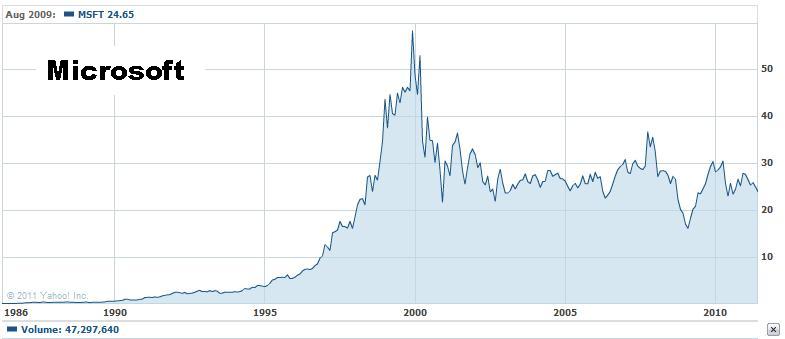
(images courtesy of Yahoo Finance).

And below is a view of Apple, again viewed with a long lens dating back to 1986.  On thing to note is the scale on the right.
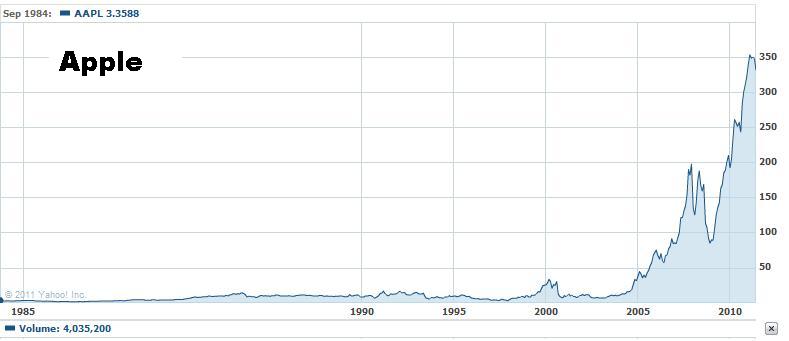
The last decade has seen Apple explode in value, culminating in them becoming the largest technology company in the world.  During the same time frame, Microsoft was dethroned by Apple and has pretty much remained stagnant.  Indeed, there is something peculiar going on here and anyone looking to build a consumer brand should listen closely.  The difference between Apple’s success and Microsoft’s lackluster performance can be summed up in one word – Leadership.  It takes more than smart employees, good technology and market dominance to deliver great financial results.   It also takes a Great Leader.

JobsSteve Jobs understands Leadership, Vision, Inspiration and Branding are vital to business success.  He gets it.  He understands how to position his Brand in the soul of a human being, amazingly interweaving his devices into peoples identity.  This is accomplished by casting a vision and allowing a tribe of followers to form around it.  He also understands: it is first about the vision and only then the resulting products can come in to reinforce the vision with the consumer.  Users of Apple products gladly follow when they realize the vision and resulting products make them feel better.

Jobs’ vision is one where the terms “Think Different”, “Beautiful Creation” and “It just Works” are used in description.  And although difficult to put into words as a consumer, you just feel it – viscerally.  It’s almost magical.   Jobs inspires with every word – not in a flakey, shallow and inauthentic manner – but a genuine manner.  I understand no one is perfect, but he definitely gets how to move people.

Steve Ballmer is flat out not an inspirational leader nor a visionary.
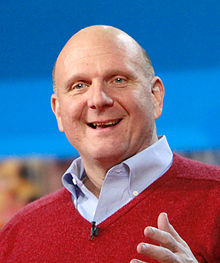
BallmerWith more than ten years at the helm of one of the largest companies in the world, Steve Ballmer has obviously done many things right.  One thing he cannot do is accurately describe the deeper purpose of Microsoft or any of their products.  When he tries, it doesn’t get anywhere close to touching the human soul.  He lacks the innate leadership quality of Inspiration.  He can run and jump, scream and yell, and do Monkey dances on stage all day long but this is not leadership.  Nor is it inspiration.  (Can you even imagine Steve Jobs doing this?)

Unfortunately for Ballmer, Microsoft is stuck between so many business markets it’s almost impossible to tie them together coherently to form a strong brand identity.  Without a unique purpose and vision, there is no brand identity.  The latest Microsoft slogan urges me to “Be What’s Next.”  I am not sure what that means… consumers need to be able to viscerally understand the brand and why they should be using it.  Like it or not, this responsibility rests on the leaders shoulders.  Ballmer has failed to communicate these fundamental aspects of Microsoft on a level that connects with everyday consumers.  He just doesn’t get it.

Is it any coincidence the maxim of Microsoft’s value as a company (January 2000) is pretty much the exact date Ballmer stepped into the CEO role?  And incidentally enough, the first real growth in Apple’s market cap appears not long after Steve Jobs arrives for his second coming as CEO in 1996.  The Leadership difference between these two men has made all the difference in respect to their company’s results.

Looking back at Microsoft’s stock price you can notice a time of incredible growth, back in the 90’s.  Who was the leader at this time in their history?  Iconic founder Bill Gates, an inspiring visionary in his own right was in charge at that time.  He inspired the world with the vision of “a computer on every desktop” during the emergence of the PC and Enterprise Revolutions (and thus the software running on them became a hot market).  Indeed Gates vision expanded the perspectives of all employees and rallied them to become the largest technology company in the world for many years.  But things have changed and today consumer devices are the rage.  What’s the overarching, game changing, ever growing Microsoft vision now?  I don’t see this type of world changing leadership and inspiration radiating out of Redmond any more (and I live 15 miles away).  Suffice it to say Apple saw this New World Order coming and Microsoft didn’t.

People follow leaders who embody a sense of purpose that inspires those around them.  Notice how consumers wait in lines for hours just to have a chance to own an “i-whatever”, the newest product that will touch their soul.  People give standing ovations and watch streaming online video during Steve Jobs inspiring  keynotes speeches.  All these happen for Apple because of Steve Jobs and his Leadership.  They create a mystic aurora which parlays towards the next round of  product announcements.

All this became very apparent to me recently as I observed the response to both companies announcements – Apple’s at their WWDC conference and Microsoft’s at the E3 conference.  The world huddled around their screens in anticipation of an announcement regarding Apple’s next mobile operating system, the iOS5.  In fact, there were no less than 37 individual posts covering Apple on SAI alone, Monday June 6th, the day of the announcement and.  Also 17 posts covering anything that is Apple appeared on Techcrunch.  Alternately, Microsoft’s announcements were an afterthought, an oh-by-the-way-this-happened byline with 3 posts that same day.  Succinctly put, no one really cared.

This unfortunate reality for Microsoft is directly tied back to Ballmer’s lack of Leadership, Vision and Inspiration.  People would have cared about Microsoft’s announcements had the products touched their souls with a deeper purpose.  Right now, go to Apple.com and Microsoft.com and see what I am talking about.  I am like most, finding it impossible to put a finger on exactly what it is that makes Apple… Apple.  All I can say is Steve Jobs knows something Steve Ballmer doesn’t.

Don’t get me wrong, we are talking about a great company in Microsoft, one that still does more than $60 billion in yearly revenue and employs some of the smartest and most talented people in the world.  They hold dominant positions in numerous markets.  But it pains me to write these words and acknowledge the reality of Microsoft’s future.  I am a Seattle resident and appreciate the value Microsoft has added not only to the world but specifically to Seattle.  We owe much of our regional economy to Microsoft.  They have done great things and the enterprise software ecosystem they created is quite amazing.

Yet, I see a company waning at a time when they really need to figure out their guiding purpose.  When I look at Apple, I feel secure they know where they are going.  When I glance across Lake Washington to figure out what Microsoft is doing, I am at a loss for words.  And this is scary for me.  I can only imagine what it’s like for the employees and the executives.

Lessons for us younger founders and entrepreneurs:

  • Find a deeper purpose to associate with your products and business
  • Cast your vision with simple, strong and relatable words
  • Become (or find) a leader who can connect with people and continually inspire them toward action

I don’t know who it will be but Microsoft is in desperate need of a Leader, an inspirational visionary who can turn this boat around – NOW.

Disclaimer: I have no personal connection with either Steve Jobs or Steve Ballmer and this is in no way personal towards either one of them.   My opinions are purely anecdotal and from observations as both an entrepreneur and consumer.

5 Ways to Step Up Your Game

I always enjoy sitting back and observing people, thinking about what they choose to do and what they choose not to do.  Here’s an amazing reality – there are waaaay to many distractions today.  And I think most people are actually too distracted to even notice they are being distracted.  Let me put it this way:  If you don’t put in effort to get better every day, you are going to get passed by others who are putting in this effort.  You will lose the race.

Turn off the TV

Watching TV is one of my peeves.  I just think it’s plain dumb.  There really is nothing on that is worth your time, unless you think your time is best spent voyeuring on idiots who complain about their reality/celebrity lives or just argue and swear all the time. Does watching this make you a better person?

I will just say it:  If you find yourself laying in front of the TV each night, you are getting dumber.

Television watching is a passive activity.  It has been proven watching TV does not use enough mental capacity to gain intelligence.   Honestly, I am actually scared we are getting less intelligent as a society, and a lot of it has to do with how we are spending the majority of our time each day.   If you feel you must watch (cause you are addicted) limit yourself to 30 minutes a day and then get on with doing something productive with your life.   Just turn the dang thing off.

Read

I am a voracious reader and it has flat out changed my life.  It will help you learn new things, help with word comprehension, help with writing (more on that below) make you sound smarter than you are, impress the ladies (or men) and get you hired.  Seriously, when you can answer the “what book are you currently reading” interview question with a unique and intelligent response, you will win them over.  Interestingly, the web has made this easier with all the blogs and articles you can read now, even when using your mobile device.  This has been one of my favorite innovations that have come along with the spread of the internet – information proliferation.  It is just everywhere.  And I take advantage of that to get smarter anywhere I can.

Exercise

I get my best ideas when I am exercising.  When I run, I allow my mind to run free as well, spinning ideas and thoughts out at a frantic pace.  This helps me evaluate an idea and determine if it is valid enough to take further.  I can only do this when I have 45 to an hour of “free” time to just allow the thoughts to flow in and out of consciousness.

Exercise is good for your health, but you probably know that so I am not going down that road.  Get out, get some exercise and let your mind run free as well.  It is one of the best ways to have a natural brainstorm session each day.

Be Social

Interacting with others and meeting new people is a great way to raise your stock.  How easy is it to stick to the same comfortable group of friends?  I actually think  most of us are wired that way – staying in comfort zone and only communicate with ones we are familiar with.  Well, if you are looking to progress socially as well as professionally, you need to get uncomfortable and get in front of new people.  Before you know it, they will be your new friends and you will grow your circle of influence.  And you know what, they usually know people who you need to know.

Write/Blog

I couldn’t have told you this a month ago but writing is one of the best ways to step up your game and expand your influence.  Since I have started SoEntrepreneurial and started blogging, I have connected with many different people around the world in the technology industry.   In fact, I just got off the phone with someone in Helsinki, Finland.  We had a great conversation about startups and his new venture I wrote about previously – Founder2be.

Writing and reading go hand in hand.  The more you read, the better you will become as a writer.  This is natural and will take time to come together, but here’s my advice:  get started.  And keep going.  It will open doors you never even knew existed.

It’s time to step up your game.

Image courtesy of Flickr user Roger Smith.

The Daily Deal Cuts Like a Knife

Update: this post was originally posted on BusinessInsider.com

For years now I have been waiting to read a post like the one I just read on the Daily Deals concept.  Rocky Agrawal has done extensive research on the daily deals phenomenon and succinctly puts it:  The entire daily deals industry must die.

I vehemently agree with his perspective; it finally calls out aspects of the model people have been turning a blind eye towards for way too long.  Please do yourself a favor and read it.   Although much has been written lately regarding Groupon and it’s historical rise (one in which I have no question been fascinated with), we should not forget: a good business might not be good for business.  Here are some thoughts I had back in 2008 when we first heard of Groupon and still hold today.

Discounts are for crappy businesses

BMW is a luxury car.  The Metropolitan in Seattle is a nice restaurant.  Gucci and Prada command extremely high prices for their merchandise.  Although these companies are more well known brands, I think you get the point.  They don’t have to discount their products because they don’t need to.  By building a business through offering a quality product or service (and running it soundly) they don’t need to resort to scrapping the bottom of the ocean just to sell something.

But when a business is having trouble getting people through the door they will look for any way to reverse the trend.  Some hire people to wear the sandwich board, hold the arrow and dance around on the corner for minimum wage.  Others will offer 2-fers.   And now many are realizing the power Groupon has in getting get their name in front of thousands in one day.  All this marketing does not change the fact that something is wrong with their business.  If there wasn’t anything wrong, they wouldn’t need more customers and wouldn’t be running a Groupon.  Rocky describes the core fundamentals of coupons and group discounts have been around for many years.  Only difference now is the medium used for distribution.

Discounting is like crack for business

Once a business chooses to offer their products or services for a discount – say 50% off – they have effectively started abusing a drug.  The daily deal is impulsive for consumers, as in, some experience a high when they open their daily deal email each day.  “OMG, what will it be?”   And local businesses get a excited when they see a large influx of customers (the high).  Once this initial influx dies down two things happen.  First (and most likely), their business volume will go directly back to the customer visit level previously experienced prior to offering a Groupon (the comedown).  And second, they now have told the world the “real” value of their products or services.  It would be foolish for a customer to pay full price for something once they know it will be offered for half the price.  So businesses are forced to continually slash their prices and offer more mass discount deals to maintain customer interest.  It becomes an ugly downward spiral (addiction).  This brings me to my next point…

How is 50% -75% off a sustainable economic model?

knivesGroupon (and the like) are effectively (re)training the local consumer to expect ALL products and services to be offered at a steep discount.  We are creating a consumer addicted to the mass discount.  This is not sustainable and downright scary for the local economy.

I should know, my previous business offered Health and Fitness services on a local level.  My income could be thought of on an hourly rate for the service I provided.  Given I charged $100 per hour, take away 30% for facility rent, and 20% for taxes I am left with at most $50 per hour of compensation.  If I chose to offer a daily deal discount and reduced my professional rate to $50… well I think you get the picture.  And what do you think I would have told my existing clients “oh, them…?  they bought the Groupon so they paid half as much as you for the same service.”  I would have lost all my full paying clients.

My point is profit margins are generally very low in the local economy- restaurants, health services, retail stores, coffee shops, etc… it’s not uncommon to be dealing with single digit percent profit margins.  It’s like each daily deal is a knife stab to the gut of a business.  There is no way this economic picture is sustainable and Rocky does an excellent job of describing what is going on: millions of people and thousands of business owners are being taken advantage of.  It will have to stop.

A real business is built upon Loyalty

Pareto’s law, or something known as the 80/20 rule is at the foundation of any business, any size.  To paraphrase, it says “80 percent of a businesses revenue will come from 20 percent of its customers.”  Simply put, it is loyal customers who keep a business running.  The hard fact is this phenomenon will never change and is the basis of why I started Loyaltize.  Notice how much the words Loyal and Loyalty are popping up nowadays.  I believe tremendous value will be created in the local space built around customer loyalty.

Groupon is essentially trying to swim against the natural economic current by allowing businesses to offer discounts to thousands of new customers.  Surprisingly, they sell local businesses on using their service by saying “we will help you gain more loyal customers” at the same time they promote to consumers “Groupon is a way to discover new businesses in your local community.”   Unfortunately these are contradictory statements and the truth is Groupon attracts deal seekers, not loyal customers who are willing to pay full price for a quality service.

If we are not careful, we are going to ruin our own local communities

I believe this mass group discounting cannot go on much longer.  But if I am wrong and it does we will effectively kill off what we currently consider our local communities.  Maybe it is a good time to reflect on what exactly is the “local community”.  My definition is all the local proprietors who run most of the operations you frequent throughout your normal life.  Actually, they are these things:

•    Represent 99.7 percent of all employer firms.
•    Employ half of all private sector employees.
•    Pay 44 percent of total U.S. private payroll.
•    Generated 65 percent of net new jobs over the past 17 years.
•    Create more than half of the nonfarm private GDP.
•    Hire 43 percent of high tech workers ( scientists, engineers, programmers, and others).
•    Are 52 percent home-based and 2 percent franchises.
•    Made up 97.5 percent of all identified exporters in FY 2008.
•    Produce 13 times more patents per employee than large patenting firms.

Once we all (as consumers) only seek deals on the cheap and expect to buy dinner online for $10 instead of the regular price of $25, the local community will cease to exist.  Most local businesses will not be able to operate at such levels.

Years ago, many feared Walmart and fast food was the end of local culture as we knew it. I argue Groupon, LivingSocial and all Daily Deal operators will do much more harm to all our own unique local communities than Walmart did.  Go ahead, ask any local restauranteur, barista, Health professional, or masseuse what they think about giving away their products for more than half the price.  I hope we can move on from 75% off deals and find a sustainable local advertising model before it’s too late.

Image courtesy of flickr user Parl

Graduates: Stay Hungry, Stay Foolish

Here’s to all the graduates out there who are now taking the leap into the real world.  I cannot say it better than Steve Jobs in his 2005 commencement speech to Standford University students.  This is one of the most incredible speeches I have ever heard and for you, a 15 minutes well spent.  Enjoy.

Sometimes You Just Gotta Jump

Sometimes you just gotta jump ship.

I was sitting with an old college friend the other night catching up with life and I found myself ending the conversation with the saying “sometimes you just gotta jump“.

We were talking about how tough it is to branch off and do your own thing as you become more established with your life.   He is in a different situation as I and finds it more difficult to up and leave his job. Although I agree with his perspective – he is quite established and probably pulling good paycheck – I can’t help but keep coming back to my main point.  “But what happens when you are 45 or 50, are you going to be happy doing what you are doing now, at that age?

It is this question that gets me every time I start thinking maybe I am doing the wrong thing.  I just have to go back and ask myself “which would you regret more when you are older – the decision to jump off now and make it on your own or staying with the same company your entire career, never taking a risk?”

Sometimes you just gotta jump ship.  Start over.  Hit control/Alt/delete and move on.  Most people regret NOT doing something.

On Failure

“On the road to invention, failures are just problems that have yet to be solved.”

My reading this morning brought me to this little gem:

Fearing failure stifles creativity and progress. If you’re not failing, you’re not going to innovate. Do your product or service a favor: embrace failure and blueprint a plan that affords you the opportunity to do it early and often. 

I can’t tell you how strongly I agree with this statement.  Whether it is product design and prototyping or more generally concerning your entrepreneurship path, the worlds biggest failures end up becoming the worlds most successful people and products.  I will write a more in-depth post on this soon.

Be Iconclastic

Ever look at prominent figures in the world and wonder how they stand out from all the rest?  I believe it comes down to how they think.   I believe you can think like them too.  Or.  Not.  Like.  Them..?    At this point, you may not know what the word Iconclast means, but by the end of this post I hope you will be inclined to think a bit differently.

Gregory Burns talks about people who do things others say can’t be done in his book Iconclast – A Neuroscientist Reveals How to Think Differently .  He calls them Iconclasts.

He succinctly describes being an iconclast hinges on 3 things: perception, courage and social skills.

The successful iconclast learns to see things clearly for what they are and are not influenced by other peoples options.  He keeps his amydala in check and does not let fear rule his decisions.  And he expertly navigates the complicated waters of social networking so that other people eventually come to see things the way he does.

If you are like me you’ll want a shorter and easier way to remember the word:

Thinking different is so easy, yet it baffles me how many people do the exact opposite.  They think the same as everyone else.  For some reason they don’t want to be different.  They don’t want to separate themselves from the crowd for they just might have to form an opinion.   They think the same as their neighbor, their classmates, the same as their teammates and they even the same as their competitors.  To me this is just crazy and a recipe for averagism.

Seriously, when did it become generally accepted to think the same as your competitor?  I am pretty sure this type of thinking did not go on in the days of early civilization.  If someone did I guarantee they we’re quickly eliminated…  Thinking the same as the competition is what gets us all these copy-cat products that flood the market.  How many different Groupon competitors do we need?  How many different brands of ‘Bran Flakes’ Cereal is enough.  I could go on and on, but I won’t because I’m not here to inspire you to copy others.  My goal is to inspire you to think differently.  And since we all are capable of thinking… being an Iconclast is now up to you and your thoughts.

Perception

Berns describes in detail how our brains actually perceive thoughts.  Being too scientific for this post, I will only encourage you to buy and read the book for yourself.  But to paraphrase: because we learn from past experiences and past experiences shapes both our perception and our imagination, we tend to constrain our views on things as we grow older.  This is not good for much of anything, but most importantly you will begin lose your creativity.  As time goes on you start to see the same things as everyone else.  And if you see everything others are seeing, you are not to unique.  How are you supposed to be innovative when you see just the same as the others?  Berns suggests we continue to bombard to brain with new experiences.

I suggest running the exact opposite direction as everyone else.  I have always been attracted to uniqueness.  It doesn’t have to be anything eccentric, just being different.   Everyone staying in their safe job because of the recession…  quit yours and pursue your dream of building a company.  You will have a leg up since most others are going in the opposite direction.  Seeing a lot of other companies are offering “daily deals for X” and “social networking for Y”?  Why not have an original vision and do something different?   Most importantly, get out of the daily routine you have slipped into over the last 8 years.  Take Berns advice and change your life.  Create new experiences.  Iconclasts do this and succeed.

Fear

Plain and simple, humans hate fear and live everyday to avoid the feeling.  Fear prevents people from taking action, and even worse it changes the way they see the world.  The ultimate underpinnings of fear is failure, which is the strongest force inconclasts overcome.  Berns notes fear permeates any business and should only be taken as a warning sign.  Once the fear is recognized, it can be deconstructed and reappraised.  So there you go – everyone experiences fear.  Inconclasts dissect it and figure out what it is actually pointing to.  Then they act accordingly.

Here’s my take:  Most people in the world are scared, weak overgrown children.  Sorry to be so blunt, but this is what I have picked up over the years.  Just as we tried to fit in with the “cool” kids on the playground during recess, we go about our lives in constant fear of what people think.  Most people never live as an independent thinker because they are so worried of what other people will think about them.

I say “who gives a @#$% “and “Screw what they think“.  Why do you care what some random guy thinks about you or your idea?  Here’s the truth: One minute after you leave the conversation he will forget what his opinion of your idea was.  He has enough to care about in his life, why would he waste time thinking about you?

Here is Amazon’s Jeff Bezos, an Iconclast I have always looked up to referring to his willingness to be misunderstood.  He has no fear of failure:

If you invent frequently and are willing to fail, then you never get to that point where you really need to bet the whole company. AWS also started about six or seven years ago. We are planting more seeds right now, and it is too early to talk about them, but we are going to continue to plant seeds. And I can guarantee you that everything we do will not work. And, I am never concerned about that…. We are stubbon on vision. We are flexible on details…. We don’t give up on things easily. Our third party seller business is an example of that. It took us three tries to get the third party seller business to work. We didn’t give up.

My mind never lets me get in a place where I think we can’t afford to take these bets, because the bad case never seems that bad to me. And, I think to have that point of view, requires a corporate culture that does a few things. I don’t think every company can do that, can take that point of view. A big piece of the story we tell ourselves about who we are, is that we are willing to invent. We are willing to think long-term. We start with the customer and work backwards. And, very importantly, we are willing to be misunderstood for long periods of time.

I believe if you don’t have that set of things in your corporate culture, then you can’t do large-scale invention. You can do incremental invention, which is critically important for any company. But it is very difficult — if you are not willing to be misunderstood. People will misunderstand you.

Any time you do something big, that’s disruptive — Kindle, AWS — there will be critics. And there will be at least two kinds of critics. There will be well-meaning critics who genuinely misunderstand what you are doing or genuinely have a different opinion. And there will be the self-interested critics that have a vested interest in not liking what you are doing and they will have reason to misunderstand. And you have to be willing to ignore both types of critics. You listen to them, because you want to see, always testing, is it possible they are right?

But if you hold back and you say, ‘No, we believe in this vision,’ then you just stay heads down, stay focused and you build out your vision.

Social Networking

To be successful, it comes down to one’s ability to connect with other people.  Two aspects of social intelligence figure prominently in success or failure: familiarity and reputation.  Incidentally the two are interconnected, since in order to sell your ideas you must create a positive reputation that will draw people toward what is initially unfamiliar and potentially scary.  Familiarity helps build your reputation.  Simply put: to get their ideas into the mass market iconclasts must be able to connect with people.

Think about someone right now who you admire and feel they are a “success” in your eyes.  And now ask yourself this: “Are they good with people?  Do they know how to navigate the social waters?”  I guarantee they (or someone they are close to) understands this principal.  Being an iconclast, thinking different, changing your perception, and dealing with your fear will only get you so far.  I would argue being great in the people department completes the package and helps you rise to prominence.

If you have been reading the words Think Different and imagining a certain company, I am sure you are not alone.  It’s not a coincidence the largest Technology company and one of the most recognizable brands in the world adopted that phrase in most of their marketing.  Apple thinks differently.  I believe the Different Thinking of their founder Steve Jobs is the sole reason they are where they are today. I will leave you with a video that sends chills down my spine.  It is one of the early Apple commercials and the first one in which they used the term Think Different.  Enjoy.


3 Quick Thoughts For The Entrepreneur

Here are just a few quick thoughts to help you think clearer today.

1.  Most successful founders or entrepreneurs have failed many times before.  Just keep getting up.

2. Most successful businesses come from Blue Ocean Waters, not Red Ocean Waters.  Look for the open waters around you.

3. You are just one decision away from changing your life.  Make it.

Here’s Where You are Great, So Shut Up.

The world has an interesting way of revealing your strengths.  This has become apparent to me in the last few weeks as I have started writing.  Allow me to provide some context before I go any further.

Recently I quit my full time job to pursue entrepreneurship and my dream of building my own company.  Prior to this I was living a double life, straddling the fence as they say.  This sucked.  I hated the fact that I did not (or could not) just let go and dive into pursing my dreams.  It sounds silly actually…. you would think living in America we should do whatever we want?   I wasn’t.  Until now.

During this double life I was part of a small team building a startup, a website which would help local businesses further connect with their loyal customers.  Although we didn’t really have titles or positions, I lead the charge and you could say I held the general position of what would be considered the CEO.  We worked on this for quite some time, all the while holding full time jobs.  We met EVERY Tuesday or Wednesday for like 2 years or more.  Eventually we released a Version 1.0 and I felt we were making some progress.  Ultimately, after about 6 months in the test market we decided to revert (what they now call pivot ) back to closed doors and figure out a better vision.  This is where I sit today.

Shut Up and Listen!

My point here is this: I wasn’t in my strength zone.  I wasn’t actually doing things that I was Great at.  I keep my head to the grindstone for years trying to make things happen – to no avail.  Without resources, connections, money or exposure… and most important the wisdom from previous experience, we fell flat.  And I thought I was a loser and a failure.

Shut Up and Listen!

Until I started listening.  When I quit my job I decided I would start writing.  Being an avid reader of books, blogs and any articles I can get my hands on, this seemed like a natural evolution for me.  Little did I know people actually like what I write.  They think I am good.  They even think I am Great, so Great they think I could support myself doing this.  I had no idea.  I just type what I feel inside… that is all I do.  And things just flow together.

Shut Up and Listen!

Amazingly, the world has started reaching out to me.  People from all over have followed, commented, subscribed, and emailed.  I really appreciate this.  Finally, something is taking off.  This type of reaction never happened with Loyaltize.  On a small level in our test market people would say things like “ya know, this is a really good idea.  Very Cool.”  That was nice of them to say, but nothing ever came together and we finally realized we were doing something wrong.

Shut Up and Listen!

If you listen close enough, the world will tell you where you are Great.  You may be like me – hard headed, focused and dead set on making things happen.  Although these are traits successful people employ to move forward, they can also be an incredibly powerful force holding you back.  Are you a programmer who can’t seem to build anything people actually use?  Are you a teacher who comes home from school each day so tired you just want to go to bed?  As a CEO, are things just not lining up for you?  Are there areas in your life where things just happen to come way easier for you?  You might want to take a closer look at those areas.

SHUT UP AND LISTEN!

My advice would be to shut up and listen to the world.  What is it telling you?  Where is it saying “anything you do here will not work.”  Then look the other way to where it tells you “Keep doing this, you are great.”

I know it’s pretty simple stuff.  But trust me, your Greatness might not be where you thought it would be.  Maybe it’s where it always was you just haven’t looked yet.

I am not sure where this writing stuff will take me, I know I will eventually lead a great business.  But all I can say is it already has taken me further in 2 weeks than 5 years working with my ears and eyes closed ever did.

A Public Thank You to John Battelle

Disclosure: no one knows I am writing this, not even John.  It is not a stunt for attention, but a genuine thank you.

This morning, as I was glancing through FM Signal it occurred to me how much value John Battelle brings to this industry (and to my life).  It also occurs to me how hard he works.  Amazingly, he touches numerous industries – marketing, advertising, technology, the web, early stage startups, blogging, journalism, music and many others.  Even better, he is at the cusp of bringing together and connecting those industries, a skill I don’t see in many others.  I look forward to each day as he curates information just for my unique education.  And, boy do I still need it.  You should take note just some of the ways he adds value to our lives:

Federated Media

Started by John in a garage in 2005, FM was intended to create a business model for the best independent publishers.  I have always been impressed with FM and look for great things from them in the near future.  From their site:

FM develops programs and products that help brands engage in those conversations and host their own dialogues with current and potential customers. As we’ve grown to have offices across North America and represent a larger number of partners, that basic principle continues to describe our business.

Web 2.0 Summit

Each year in the late fall, the tech world convenes for one of the great rituals of the industry –  The Web 2.0 Summit.  Years ago, this was one of the first events to have a tremendous impact on me and the direction in my life.  Did I attend?  No.  But I did always download the audio files of the talks, burn them onto a CD and drive around listening to them on my way to work (it beats radio commercials).   Together, John and Tim O’rielly really helped a guy like me further my knowledge and get up to speed on things.  This year’s, called The Data Frame, should be more of the same great stuff.  I hope I can attend.

The CM Summit

The Conversational Marketing Summit is another event put on by Federated Media, focused on the intersection of Marketing and technology.  Arguably, marketing people need John more than we tech people do.  They need someone who can communicate in both languages – marketing speak and tech speak – to help nudge them towards more effective concepts.   The next one is June 6th in NYC.   Go here for all things CM Summit.

FM Signal

Each morning I am greeted with a collection of 8 to 10 links to very informative and educational articles.  I make sure I start my mornings with a review of the latest in the industry, so this is one of the first emails I open each day.  Coffee, check.  Music, check. Signal, Check.  Man, good stuff.  If you want an edge in this industry, you must get the Signal.  Go to the upper right hand corner on this page to sign up.

Influential Blogger and Author

In addition to FM Signal, John blogs at John Battlelle’s Searchblog.  He always has unique insights to a variety of topics, mostly around the web, technology, and conversational marketing.  Also very useful has been the book The Search, an in-depth look at how Google and search in general has transformed our world.

If you are in any of the above mentioned industries, use these resources from John.  They have no doubt changed my life.  Thank you John.

It’s A Tight Balance Between Psychosis and Brilliance

You know you are an entrepreneur when you say…

I have no idea when the next paycheck will come in.

This can be the scariest thing in the world… just hold on.

I have no idea when the next round of funding will come together.

Your dream could end at any moment… just hold on.

I have no idea if my business will even be successful.

How are you supposed to know what will happen a year from now… just hold on.

I have no idea who will be the next engineer to help build my product.

Don’t worry, you can barely embed youtube code into your wordpress blog… just hold on.

I have no idea what I am actually doing, am i crazy?

Cat chase tail, cat chase tail, cat chase tail… just hold on.

You also know you are an entrepreneur when you say…

I know so deep in my heart this is the only direction I want to go.

You must trust your gut… now quit that job and start living how you’ve always wanted to.

I can’t stop reading posts and articles about other startups, I need more!

You have a disease; it’s called entrepreneurship… learn to live with it and just effing do it.

Holy crap, I do know more about Google, Facebook and Twitter than any of my friends!

That is what happens when you can’t stop reading… now go find another engineer

Every time I start writing about technology or startups, great things come together

This is one of the biggest signs you are operating in your strength zone…. follow it.

Entrepreneurship is a tight balance between psychosis and brilliance.  Balance it.

You Talkin to Me?

Update: The post was republished on BusinessInsider.com

As a youngster growing up I did not know I wanted to be an “entrepreneur”.  In fact I didn’t even know what one was.  It’s kind of a weird, unintuitive word.  But even as small children I think we can tell the difference between a Pirate and a peon.  Early on I just  knew I wanted to do something different, something bigger.  I knew it the first time I saw Tony Montana scorch the earth building an empire in the movie Scarface.  If you are reading this as an entrepreneur, you probably remember your early entrepreneurial feelings as well.

@ev, @jack, Mark Zuckerberg, Steve Jobs, Jeff Bezos, Reid Hoffman, Larry and Sergey, Marc Andreessen and many others – I have incredible respect for you.  Not many will do what you have done and maybe one day we can connect, hopefully some of that can rub off on me.  But I ain’t talkin to you.

I’m talking to the rest of y’all – the other 98%.   You at your desk hoping your boss doesn’t catch you reading Business Insider at work… again.   No need to close the tab, he probably hasn’t seen yet.  And you, reading this on your phone at the restaurant as you wait for your significant other to come back from the bathroom.  Go ahead and finish reading, I assure you they’ll be glad you’re reading a tech blog and not secretly texting someone else.  And yes, you laying in bed reading this on your ipad, you are just trying to squeeze in one last article before you go to bed.

How do I know you are all doing this?  Cause I am one of you.  I’ve done all those things and more.   I have wanted it so bad I couldn’t sleep at night.  Like you I have also put years into my own vision only to come up short on the latest attempt.  Like you I lived a double life, straddling the fence of trying to successfully launch a side project and lacking the cajones to let go of stability in a day job.  Somewhere along the line I found myself living a lie – vicariously living as an entrepreneur but not actually acting and doing like real entrepreneurs should.   That life sucks and I am done with it.

Yes, it’s a great time to be an entrepreneur and things once again seem to be bubbling.  Venture investments are up.  Valuations are rising.  IPO’s are starting to pop again.   With all this talk of Bubbles, IPO’s, Frothiness, and “it’s different this time”, I just have one question for you: What you gonna do now?

Because here is the truth for most of us:

1) We’ve never launched a successful product. We only wished we had.

2) We’ve never succeeded in raising venture capital, because of number 1.

3) Even though things are frothy, this will not change the numbers game.  Our odds of launching a successful product and raising VC are still going to be slim to none.

Well Tony would say eff the odds.  Tony said eff to everything and everybody.  He knew where he was going and nobody was going to stop him.  Regardless how you feel about the word (my apologies), I think it’s a great perspective.  Tony was the quintessential entrepreneur – purposeful, driven, headstrong and at times ruthless.  When he set his mind to something, you pretty much knew he was going to get it.  Great entrepreneurs look odds straight in the face, laugh, and then get back to work.

But what about Captain Jack?

I don’t care if you’re a billionaire. If you haven’t started a company, really gambled your resume and your money and maybe even your marriage to just go crazy and try something on your own, you’re no pirate and you aren’t in the club.

I about jumped out of my skin when I read those words written by Michael Arrington on Techcrunch a few months back.  It chilled me to the bone and was pure poetic justice at a time when I was really needing to hear it.   I wish I would have cut it out, put it in my pocket and showed it to anyone who asked why I was leaving my “stable and dependable” job.  Most people just don’t get how exotic and intoxicating being an entrepreneur really is.  I think Tony Montana would second Michael’s statement as well.

Although I agree with Arrington and his version of Captain Jack Sparrow, I feel Tony is a better depiction of a pure entrepreneur.  Strip away the guns, drugs and violence and you have a great example in Tony Montana.  He has the dedication.  He has the attitude.  He has the street smarts.  He has the charm.  He has the willingness to risk.  In him you have someone so committed to his vision he was willing to die for it.  Love him or hate him, we need more leaders as committed as Tony.

So here’s what we need to do:

Realize you are – YOU.   The best way to beat the numbers game is to be unique.  You cannot be the next Mark Zuckerberg, Ried Hoffman or Steve Jobs.  You were given your own unique vision.  Execute it.  Zuck was given the vision of a world wide social network.  That’s great for him (and for us to use).  But go do something different.  I think of Zaarly or Square.  Andrew Mason figured out how to make daily coupons cool again.  Awesome, think of something farther ahead like what LOCQL, a start up here in Seattle is doing.  Who knows, maybe back when Zuck, Hoffman, and Jobs were getting started they secretly wanted to be the next Bill Gates, Andy Grove or Thomas Edison.   But of course, they couldn’t and didn’t.  So they became the best versions of themselves and subsequently created the world you now live in.  Read that last sentence again…

Channel your inner Tony Montana.  One of the most interesting aspects of the movie Scarface is how it touches on both the light and dark sides of humanity, capitalism and wealth.  Most people who watch the movie see the obvious flaws in Tony.  But more subtle is the notion that we all have the capacity to think and act in this way.  You too have a little bit of Tony fire in your belly.  You also have the choice to use your competitive edge for the better of humanity, not the worse.  Channeling your drive, determination and what-ever-it-takes attitude will lead you to make a positive dent in the universe.  This is more important that you might think.  Although I have yet to raise a round of VC, I am pretty sure investors would rather have someone walk in their office with a Tony-esk chip on their shoulder talking about taking over the world than see (another!?) demo of a new twist on a social application which also shares groupons.   Mark Suster is so right – “There are so many big inefficiencies in this country that need tackling. I feel quite comfortable that our bars & restaurant industry will be just fine.” 

Find something you are willing to die for.  No, I don’t mean head out the door with machine gun in hand ready to do battle with anyone who criticizes your next idea.  But I am suggesting you find something so grand in vision you will spend the rest of your life making it come true.   In my humble opinion, this is the key to being successful – a driving purpose.  Simon Sinek taught me to Start With Why.  Read this book and you will discover true greatness is not about copying the next social sharing feature.  It’s about inspiring society to move forward with truly crazy ideas that have a larger purpose.  Trust me – Bezos, Jobs, Edison, Larry and Sergey… these guys would tell you the same thing.

It’s a great time to be an entrepreneur.  Shall we not let this time in history be remembered only as the “Social Bubble”.  I think there’s more within all of us.

Yeah I am talking to you…. you with me?


Lonely Man on the Corner

See the lonely man there on the corner,
What he’s waiting for, I don’t know,
But he waits everyday now.
He’s just waiting for something to show.

Genesis – Man on the Corner

Disclaimer: What I am about to write is controversial.  As you read please remember this does not insinuate I lack caring in my heart for human beings of all levels of society.  It is merely my opinion of how a person chooses to live their life and what opportunities a person chooses to act upon.  There are no right or wrongs here, just observations and thoughts.  Also, it is important to note the thoughts below regard what people are choosing to do in the moment of poverty, not how they got into poverty in the first place.  I anticipate differing perspectives and opinions to be shared in comments.

——————-

You’ve seen him.  He’s the lonely man over there on the corner.  What he is waiting for nobody knows.  But he waits everyday, and he’s just waiting for something to show.  The quotes throughout this article are lyrics from a song Man on the Corner by Genesis. The video is below and it’s a must listen.   I recently listened to it and was shook by the emotions I felt during the song.  And so I started to think deeper on the concept of poverty.  I started to think about why some are rich; why some are poor; why I drive a nice car and some are stuck wearing the same clothes every day.  I asked myself, “what could possibly be the difference?”  And why some people find themselves on a street corner just waiting for ‘something to show’.  You may differ in your perspective on poverty in this country, but I believe poverty and entrepreneurship are distant cousins.

This man chooses to sit on a corner and hold a sign.  He has nothing (at least from what we know) and feels his best option is to do nothing, look desperate, and ask for money.  His value proposition rests on the morality of another person feeling remorse when they pass him, forcing themselves to face their inner soul and ask “am I a bad person if I turn my head and don’t give him money?”  He wants to be given something for nothing.  He takes from the world, but does not give in return.  He offers no product in which a dollar value can be placed on it and he has no service to offer another.  He just sits and asks for help.  He has chosen to do nothing.

And nobody knows him,
And nobody cares,
‘Cos there’s no hiding place,
There’s no hiding place – for you.

Genesis – Man on the Corner

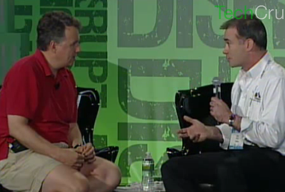
I will juxtapose the man on the corner with the man in the hot seat.  What is the difference between the man in the image above and the man in the image to the left?  The man in the hot seat has, in theory, the same intentions as the man on the corner.  He is asking for money and he is looking for help.  He believes he cannot make his dreams come true unless he receives a gift from someone else.  His future, indeed, depends on another persons good faith.  But that is about where the similarities end.

For those have not picked up on it, the man in the image at left is a person pitching Paul Graham (an investor in the red shirt) on a business idea in hopes he will invest money towards his vision.  But in contrast to the man on the corner, the man on the hot seat does not believe in handouts or in receiving something for nothing.  He believes in creating value through enterprise.  He knows that if you have something, anything – a product, a service, a distribution channel, knowledge, land, a water source, natural elements, really anything – you can offer it to another for a profit.  He chooses to live his life working hard to add value to society, not take away from it.  He has taken ownership and responsibility for his life, understanding he can choose to do anything he wants with it.  But with that decision he knows it is up to him, and only him to make it happen .  The man in the hot seat is an entrepreneur.

Looking everywhere at no one,
He sees everything and nothing at all – oh.
When he shouts, nobody listens,
Where he leads no one will go – oh.

Genesis – Man on the Corner

At times entrepreneurs find themselves looking poverty straight in the face.  It might be in a situation where their income (or lack thereof) cannot fulfill the demands of their debts, whether it is a roof for shelter, food for sustenance or gas for their travel.  They choose to risk their current stability for the return of a better life.  There is an eerie aspect of entrepreneurship and I think it’s due to its distant cousin of poverty.  The mere thought of poverty can be the biggest moving force an entrepreneur receives.   It is incredibly scary and immensely motivating at the same time.  Only in risk one really experiences reward.  So we endure the possibility of poverty for the reward of wealth.

For the record, I am quite privileged to have a roof over my head, food to sustain my health and a nice car to drive each day.  I am doing fine but at this point in my life I hover right above to line, choosing to forgo a stable job for a chance to determine my own destiny.  Also for the record I have stared poverty in the eye and experienced what it could be like.  I have had my electricity turned off and creditors calling my phone for not paying bills on time.  I have had to dig change out of my car to buy a $.99 hamburger.   As a late-twenties ambitious entrepreneur who hadn’t “made it” yet – old enough to be established on my own but young enough to have not built sustainable wealth for myself – it’s was a tough slog.   I’m a tweener as they call them.

When you leave a stable financial situation and leap towards your dream, you risk falling into poverty.  Or should I say you learn how to operate with poverty as a strong possibility in your life.  You learn how to acknowledge where your responsibilities lay in the equation of life.  You start to realize your decisions will make or break you.  It is through this experience I start to think about poverty in a new way.   Whenever I drive by the man on the corner, I cannot help but think: “I could be out there right now.  That could be me.  As I am sitting here in my car it is unbeknownst to me how I will pay rent next month since I just took the leap and started my life as a full time entrepreneur.  But I will find a way.  I will find a way to not only pay rent but to grow my business as well.  I will choose to do something, not sit and do nothing. ”  I argue it is at this point of realization you really become an entrepreneur.

So Here’s the difference between poverty and success:

Man on Corner waits; man in hot seat acts

The man on the corner waits for something to fall into his lap, hands or box.  He takes no responsibility for his actions and believes by just waiting, help will find it’s way to him.  The man in the hot seat acts, on everything.  He believes it is through doing something, anything really, value can be created.  And when he creates value, wealth will find it’s way to him.  It is by doing and acting we entrepreneurs find success.

Man on corner values nothing; man in hot seat values everything

The man on the corner values nothing, not even himself.  If he did value himself, he would be doing something other than sitting desperately on a corner asking for a handout.  He has lost the ability to place value on anything in his life, thus has nothing.  The man in the hot seat values everything, especially himself.  He has such a belief himself he is asking others to invest large sums of money into his enterprise.  And he believes so strongly in himself he knows he can bring the investment amount times X back to the investor.  It is through immense value in self an entrepreneur will be successful.

Man on corner plays victim; man in hot seat plays hero

The man on the corner has ultimately bought into the victim mentality, meaning their outer circumstances determine their inner self worth.  A victim does not take responsibility for actions and outcomes, therefore they do nothing to change their circumstances.  The man on the hot seat understands it is he who determines his destiny and thus plays the hero.  A hero understands they are unique and hold power to orchestrate a positive outcome for all involved.  By believing you as an entrepreneur are the hero, your self worth has nothing to do with outer circumstances.  This frees you up to act according to your vision and experience success.

I am not sure Phil Collins would agree with my interpretation of Man on the Corner but I am curious if you do.

Whoa!

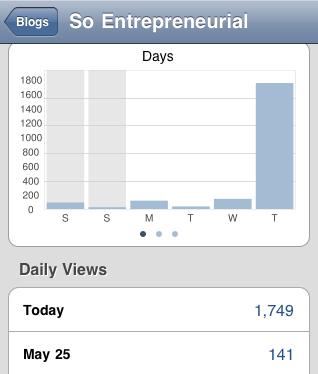
Holy Cow!  This is what happens to a week old blog when you get national coverage on a well known business and technology site – Businessinsider.com.  Below are the So.E. blog viewer numbers from the past week.  The gray areas  denote a weekend day.  Not too shabby for someone who hasn’t even been blogging for two weeks.  Trust me, this is just the beginning.

What Any Startup Can Learn From Starbucks

Update:  This post was republished on GeekWire.com

As I drove past the Starbucks headquarters today I glanced up at their big green logo.  Instantly I thought “man, what a iconic brand.”  I mean, when most people see a white coffee cup with green letters, they know it’s Starbucks Coffee.  Then I thought “how did they get there?”  Here’s what most forget: Starbucks was a startup at one time.   They had to start somewhere and work hard to establish this incredible brand.  Although I do not know Howard Schultz personally (someday I hope to), it’s obvious he understood a thing or two about creating an iconic brand.  Even if you do not wish to build a business to the size or likes of Starbucks, here are a few things to keep in mind as you grow your company.

Headstrong Founder

Howard Schultz is one of those entrepreneurs you read about in history (or Amazon) books.  He grew up in Brooklyn.  He was the first person in his family to go to college.  He started as a salesman selling Xerox equipment.  Interestingly, before he founded “his Starbucks’ he joined the a small coffee company named Starbucks.  Then after differences in vision he left to start his own coffee company, and as fate would have it he ended up buying the original company’s assets and ultimately named his company Starbucks.  The vision in question?  Changing the way coffee was enjoyed here in The States.  That is no small task and probably why the original Starbucks owners wanted no part in it.  You better believe he encountered and fought through more than a few obstacles along the way.  I will not list them here, but I would recommend reading his book Pour your Heart into it – it’s good.

Founders of startups need to, like Schultz, be headstrong.  It isn’t always going to be fun and roses.  In fact, based on your odds it’s down right impossible for you to take your nascent idea and build a fledgling company around it.   My opinion is most founders quit before they even get started.  Maybe you need to seek out more initial customer feedback?  Maybe you need keep trimming the fat to find your MVP (minimum viable product).  I don’t know.  But if Howard Schultz was sitting across the table from you right now, here’s what I think he would say:

You must be headstrong in your passion, desire, focus, product, marketing, communications, leadership, and recruiting.  In all those things, be headstrong and dead set on doing what-ever-it-takes to make your vision come true.  Anything less will be your company’s demise.

larger Purpose

Early on Starbucks set out on a journey with a larger purpose in mind.  Schultz realized very quickly the coffee industry, although a relatively large market in the US at that time, had become stale.  People were mostly consuming coffee in their home from a tin can.  Schultz knew they could take something familiar and transform it into something altogether new.  They wanted to create a third place.  Not the home.  Not the office.  But a third place.  Somewhere you could go to hang out, drink coffee, talk with a friend, have a business meeting or read a good book.

It was there, at this third place, they figured people would come to be a part of the community.  And drink coffee.  They made this purpose (the place) bigger than their product (coffee).  And it worked to the tune of a $27b market cap.  Go ahead, think about our world without coffee shops.  I am writing from one right now, and it’s all do to Starbucks.  Thank you Howard.

A startup – no matter their industry – needs to find their greater purpose.  “Why on earth are people going to use your application over the millions of other things to play with at this moment?” You must be able to make it clear and concise why their life will be better when they use your product.  I believe this comes together when the overall purpose of your product or service is greater than just making money (for you).   I can’t tell you what your purpose should be; it’s your job to find it.  I feel so strongly about this that if you can’t state your purpose in one sentence, I would recommend finding something else to do.  Because, if you can’t clearly state the purpose of your business how do you expect others to figure it out?

Always Get better

We all know the story, there’s a Starbucks on every corner.  With more than 15,000 stores in approximately 55 countries, it’s fair to say Starbucks won the game.  For a while there I think the executives were also saying the same words behind closed doors.  As the economy collapsed and things got tight, Howard has some decisions to make.  He closed some stores as well as doubled down on their core competencies.  He understood the notion that regardless of what you have done up to this point you need to always get better.  Yes, Starbucks was a successful corporation.  But if not careful, successful corporations are susceptible to failure due to their own hubris.  Howard nipped this in the bud and brought back the idea of continual improvement.

This doesn’t just happen to large corporations.  It’s all relative you know.  To be successful, startups need to continually learn new things and aim to get better as time goes on.  Launching a product and seeing a few million downloads is only the starting line.  What happens after people use your product once?  Ten times?  Two years? You need to get better.  Better analytics to study usage patterns.  Better customer service.  Better executives.  Better management processes.  I am sure there a lot more things to get better at, but whatever it is… just get better.

This is what I thought as I drove by the Starbucks headquarters today.  Hope it helps.

Entrepreneurs Can’t be Wishy-Washy

“There are some people who just get what they want in the world. If you want to start a startup you have to be one of those people. You can’t be passive and wishy-washy,” – Paul Graham

During the second day of TechCrunch Disrupt NYC, Paul Graham sat down for a chat with Charlie Rose.  Paul Graham is the founder of Y-Combinator, a popular incubator and launch pad for early stage startups.  One interesting tidbit any entrepreneur considering Y-combinator should take note is the current acceptance rate at YC. It’s around 3%, which may be just slightly better than traditional VC fundraising.  I assume this number to get even smaller as YC gets more popular.  Also noteworthy, here’s who they look for:

… we’re not looking for people who did what they were told in life.

Don’t Live a Double Life

Because it sucks.

As some of you know, I have finally taken the leap and now I am a full time entrepreneur focused on a new direction in my life.  This was not always the case – for like 5 years – I lived a double life; as a Fitness Professional (my reality) and as a founder of a web startup (my fantasy).  I say fantasy because we really didn’t acheive what we set out to achieve, so it remained as my “side project” and thus my fantasy.  I hated that s@#%.  I hated making the excuses like “we just launched, we’ll see what happens.” and “It’s our test market, so we are just keeping it under wraps until we get some good user feedback.”  The fact is that I approached it with the conventional wisdom of starting something on the side while remaining at my full time job to keep a stable income.  Most of the time THIS DOESN”T WORK since anything extraordinary requires the extra – or its just remains ordinary.

For those of you standing on both sides of the fence, with one foot on the side of your passion/dream/vision and the other side remaining on the reality/job/paying bills, here are some thoughts to help you take the leap.

50/50 does not equal 100

When you find yourself split between two major life directions, say starting a company or high level athletic performance and your day job, you are in a tough spot.  Because the two directions require effort, attention, and energy, there is only so much you can give to each one.  Since you only have 100% of yourself to give (there is no such thing as 110%), you will have to compromise the quality of effort you put in each just to keep up.  You will end up failing to achieve the level of performance necessary to be GREAT.   People don’t pay for Average.  They pay for Greatness.   Being great at anything will require EVERYTHING you have, not just half of it.  Founders or athletes take note:  whatever is holding you back from fully working towards your vision, let it go…  and only focus on the ONE thing in which you want to be great.

Psychologically you get lost

Who are you?  What do you do?  What are you working on?  Where are you going?  When these questions were asked of me, I didn’t know how to respond.  I’m Nick…. the trainer, I work in health and fitness.  I’m Nick, an entrepreneur.   I recently founded a startup, Loyaltize.  I didn’t really know what to say, which really started to mess with my head.  The craziest thing about success, failure and the long slog in between is how much it messes with your psyche.  When you are attempting to develop or achieve anything extraordinary on the side and with partial commitment, you are at the risk of losing your sense of self.  The Who and the Why of you are not aligned with the What of you as a person and a professional.  This will have extremely damaging effects on your self esteem.   You will start to not want to talk about your pursuits with others because you really haven’t achieved anything since the last time you spoke with them.  You are afraid they will think less of you.  You will then start to ask yourself if you are supposed to be pursuing it in the first place.   Champions don’t think this way.  Champions fully commit.  I am pretty sure Steve Jobs fully committed to his dream.  I am also pretty sure Phillip Day Lewis didn’t.  If you don’t know who that is… right, neither do I.   Being half good at anything – sucks.  And it will take its toll.

Things will always work out

When making the leap, you will find life starts to become very crazy and quite uncomfortable.  But things tend to work themselves out, as they always do.  When sitting on both sides of the fence, it’s better to ask yourself this question: If I don’t change, will anything ever be different?  The answer is an obvious NO, yet it is fascinating how many people keep complaining while doing what they have always done.  They change nothing, yet expect different results.  Yes, when you quit your job to pursue a dream, some unexpected things might happen.  You might not pay your cell phone bill on time.  Groceries might be a little tight for a few months.  Filling up the car requires keeping an eye on the pump to stop at half full. Going on a date and using  Groupons to pay for dinners.   Visiting the parents more often so you can save on a dinner or two.  Or.. since you have 100% of yourself to devote to your dream, people might start discovering your talent.  Users start downloading your app.  You start winning races.  Your bank account actually starts growing because people are paying you for your Greatness, not your average.  Indeed, when you take the leap, something will happen.  You just need to determine if you want something to happen or not.