Don’t Emulate Steve Jobs, His Lesson Is All About ‘Finding’ Yourself

Michael Arrington interviewed Salesforce founder and CEO Marc Benioff recently at TechCrunch Disrupt.  It’s a great conversation, including a few touching stories about Marc’s relationship with Steve Jobs.  You should watch the entire conversation if you have a chance, there’s some truly wise observations from Benioff.

But what emerges is one of the best things I have ever heard regarding Steve Jobs.  Marc describes how we shouldn’t look at Jobs as an example of leading by being an asshole, visionary or anything like that, but in understanding Steve Jobs showed us the way through self actualization.

Actualize Yourself.  Look at the world from the inside out.”  Benioff says Jobs was successful because he was not afraid to take the journey towards self actualization.  “We all need to all be working on actualizing ourselves.”

The 3 Most Important Skills An Entrepreneur Needs To Sharpen

I was asked a question recently send from a reader which centered around what I thought “was most important skills/qualities  beneficial when going out on your own?”  You can read my answer below.

In terms of skills for being an entrepreneur I think the 3 below are the most needed:

1) Courage/strength
You must have courage to make the decision to jump out on your own. Courage means acknowledging there is risk involved and you do have some trepidation, yet you still take action and make the move. It also means you are in it for the long haul. This takes strength and trust in yourself.  But you JUST DO IT.

2) Market Identification
This is the ability to look at certain markets and market segments to identify holes, or needs that are not met yet. This is where you get strategic and determine what you are going to build and why. It’s pretty hard to be a successful entrepreneur if you can’t find a market for your product or service.

This is a skill that develops over time but I would suggest starting by reading as much about business, technology and the changing dynamics of our world today as possible – and then make that a daily habit.  Also, once you figure out the general market you want to serve, you polish your market identification by talking to your (potential) customers to find out all you can about their problems.

3) Flexibility
Great entrepreneurs are very flexible and change direction similar to how a sail boat tacks back and forth. Nothing stays the same for very long and the ability to shift with the wind is a huge advantage over people who aren’t willing to change. Entrepreneurship is a tough road, but the ability to handle the hard knocks and go with the flow will allow you to remain relatively stress free, also it will help you to quickly pounce on unexpected but awesome new opportunities.

Although you can’t take classes for these, I think if you concentrate on the general ideas long enough you can really polish the skills.

Trust Yourself And Your Ability To Adapt

A few recent conversations with founders have brought a thought to my attention – Trust Yourself And Your Ability To Adapt.

I am noticing one of the most common issues with early stage founders, or people who are making the leap from employee to owner, is their lack of confidence in themselves.

Who am I to be CEO?

What if I fail?

I am not sure what I am really doing?

What if others find out I don’t know what I am doing?

News flash, we already know, because we also have no idea what we are doing.  The little secret no one wants to talk about is that we all are winging it, trying our hardest to fool others into thinking we know what we are doing all the while running around asking ourself “what the hell am I doing?”

Ok, so it’s a fools game.

If so, how do you win?

You need to actually fool yourself into thinking you know what you are doing.   You need to trust yourself, trusting your ability to adapt and make adjustments in real-time.  This requires confidence.  Maybe even a little stubbornness as well since you will often be finding yourself up against some hard places.

Confidence is achieved by quieting the inner voice you hear telling you things like “you can’t do that” and “who am I to think I can….” and replacing it with a calmness that accepts whatever result that inevitably comes your way.  Confidence is not caring what actually happens because you are at least doing something.

But if you lack confidence in yourself and doubt you are the right person to start your company, all is for not,  Nothing and no one will make up the difference if you lack faith in yourself and what is possible.

Get out of your own way by trusting you can make things happen, and by knowing deep down you ARE ABLE to do it, and then take those first few steps.

Trust me, no one has the answer to your problems and challenges.  Only you do.

The Value Of Social Events And The Greater Startup Community

“I was defintely in a dark place.  It was the meetups and startup events that brought me back.” – Michael Grabham, founder of Startup Grind Seattle

Who knew something as a simple as a meetup could help someone get back to feeling normal again?  But that is exactly what happened with Michael Grabham, one of my recent guests on Founders RAW.

He details how he was in a “dark place” after experiencing a big failure in one of his businesses a number of years back.  He didn’t go into much detail during our conversation but he alluded to being very down and out, probably in some sort of depressive state.

Why am I guessing depression was upon him?   Well, I dealt with those feelings as well.  Even the best of us can have our worst times, and those times can seem to drag on for so long you feel like it won’t ever get better.  That is what I think Michael was referring to when he mentions his dark place.

So how do you get out?

Like he mentions, you lean on your community and get around excited people doing cool things.  He decided he had enough and started going to meetups and other startup events here in Seattle, meeting founders and other people working on new projects.  He knew he would be lifted up simply by osmosis.

In fact, that is how I originally met Michael, at an event called Tech Cocktail held in Seattle in fall 2011.  After that, we kept meeting every month or two where he would advise me on what to do next and who I should talk to.

This face to face time was incredibly valuable to me as a rookie founder.  But amazingly, I had no idea how important it was to him and where he had been (psychologically) so recently in his past.

It’s funny, you never know what, to what degree and to what depth someone is dealing with, since we all put on these masks as we go about our day.  It’s quite possible one of the people you will talk to at your next social or networking event is deeply struggling with something, and you may never no it from the outside.

Yet they are silent screaming “please help me!”

Do them a favor and ask “what can I do to help you?”  You will be amazed at how surprised they will look when you say that.  Also, ask to get in contact with them and book a coffee/beer meeting with them so you can talk deeper privately.  I guarantee you will change their life – or they might even change yours.

I think we underestimate how important our greater community is.  It very well can save the person standing right next to you.

Navigating When There Is No Map

map1“There is no map, and charting a path ahead will not be easy. We will need to invent, which means we will need to experiment.”  – Jeff Bezos on the purchase of The Washington Post

Jeff Bezos wrote the above words the day he bought the Washington Post to the amazement of not only the online world but the traditional newspaper world.  Simply put, he said there is no game plan or road map on innovation.

I think Bezos is one of the most underrated and misunderstood founders of our generation.  He very well could be looked at as THE definitive entrepreneur of the 21st century (in strong competition with Steve Jobs and Elon Musk.)  I say this even though Amazon is already 15 years old with a market cap north of $130billion, making Bezos one of the wealthiest people in the world. Yet I don’t think they/he has made anywhere near the impact they/he will make in our world.  Like it or not it’s only going to get more Amazonian as the decades go on.

My perspective above comes from how Bezos thinks – specifically how he has a long term perspective on new business models and innovation.  Regardless of business unit or product, the quote I opened up with stands above and beyond anything else I have recently read surrounding entrepreneurship.  In fact, I believe all entrepreneurs working on anything new or different need to embrace the mantra of navigating when there is no map.

Let’s breaking down the statement into chunks to see what else we can grab from it.

There is no map and charting a path ahead will not be easy

Almost too obvious to mention, there is no road map or directions to follow when you are innovating.  If you are doing something novel or new in a market, you are by definition innovating.   Yet, it seems as if some entrepreneurs (myself included) yearn for THE answer to all their confusion and frustrations when they are starting out, as if someone has the magical answer.  The fact is THERE IS NO ANSWER.  Or better said, NO ONE KNOWS THE ANSWER YOU ARE LOOKING FOR, so stop asking.

Why?

No one knows because most likely you are the first to encounter this specific problem, thus no map or charted path is available for you to lean on.  The first step of innovation is acknowledging you don’t really know the exact path and you will be blazing your own trail. Yep, it’s not easy to be a leader just as it couldn’t have been very comfortable for Lewis and Clark during their epic journey west.

We will need to invent

So if no one has your answer, what do you do?

You invent it.

Since no one has gone before you and you are encroaching upon uncharted territory, you need to muster up  the courage to invent your answer.  Then you also must have courage to trust your answer and trust it is the right step forward at that specific time.  Some entrepreneurs – especially rookie first-timers – have difficulty knowing when to trust their gut and when to seek and act on the guidance and advice from others.  But I will argue you aren’t really an entrepreneur (OK, an innovator to be more specific) if you aren’t willing to have the courage to create your own map and to trust yourself with your own answer.

and we will need to experiment.

One of the best ways to earn your own trust is to acknowledge the answer won’t be the first thing you act upon – it will be a series of things.  Embracing the fact that charting your own map will involve experimentation, failure and course correction goes along way to ease the uncomfortableness of uncharted territory.  Our first ideas are only there to get us going in the right direction, but will never be the only turn we make.  There will be right turns, left turns, wide turns, U-turns and maybe even parallel parking for a short period.

The point of all of this is to identify how one of our generations greatest entrepreneurs thinks and to illustrate how you can think the same way as well.  I think Jeff Bezos is a genius, but not in the way you might think about genius.  His genius – and one you need to see as well – is in simplicity and honesty with himself and others.

Believe me, a simple mind frame like this on complex subjects such as creating a whole new market segment makes all the difference.

Attracting Technical Talent When You Are Not Technical

I seem to be fielding a specific question more often lately.

“How did you find your technical co-founder – your lead developer – when you yourself are not technical?”

Finding technical talent when you are not technical yourself is indeed a challenge.  Developers are notoriously hard to find, difficult to communicate with and almost impossible to convince to join you to build a random and weird idea.

So, how do you find them?

You actually don’t find them.  They should find you.

You see, developers are approached all the time by “biz dev” guys pitching them yet another idea.  An idea in which it’s blatantly obvious the person pitching cannot build, hence the earth- scorching search for a workhorse they can ride.  This almost never works, since just like the pretty girl at the bar, developers have their pick of the litter when it comes to accepting job/founding opportunities.

So rather than finding developers, you must attract technical talent.  Here are just a few ways to put yourself out there so technical talent will 1) discover who you are and 2) actually want to work with you.

Write stuff

First thing you need to do is get in front of people, and the easiest way to do that is to create a blog, pick relevant topics and start writing.   “Ok Nick, what am I supposed to write about?”  ANYTHING.  Simply putting your thoughts and opinions out into the public is the first step to helping people understand who you are and what you are thinking about.

Then, once you have a few solid posts under your belt, quickly reach out to growing media resources and offer to write a guest post for them.  Guest posts give you instant credibility (given it’s the right channel and one developers are reading) to the technical crowd.

Go to technically focused events

I have written about the value of events before, but I will touch on it again.  Attending events focused on the technical crowd is a great way to meet new developers.  What better way to connect with technical person than to go to a meet up centered on an interesting technical/programming topic which will attract technical people.  That’s just common sense 101 right there.   And if you have been following #1 above, you will start to get approached by these people since they are reading your stuff.  See how it all works…

Offer compensation in ownership and equity

There’s nothing worse than pitching a developer on your idea, making it very obvious they are the one’s who will make this thing come to life, and then stiff them with no equity in the product/company.  The best approach is once you feel you have a solid candidate, you need to have a very uncomfortable conversation about the equity and compensation structure going forward.

If you are just starting out, I would say you should consider looking for an equal partner and splitting the ownership around half/half.  If it’s farther down the road of the product/company, you can offer a smaller chunk or negotiate a different agreement.  Bottom line = give them the respect they deserve for bringing your vision into reality.

Scared, So What.

Ok, let’s all agree we get scared sometimes.  So what.

I want to dissect the notion of being afraid and why it shouldn’t get in your way.

I was having a conversation recently where I blurted out “basically, WE are the only ones getting in our own way of doing whatever we want to do.”  It came out in response to the person describing the challenges they had been experiencing over the course of the last year or two.  These challenges were rooted in pain they felt from a previous experience, and they were acting similar to the kid who burns his hand on the hot stove and didn’t wouldn’t go back and try it again.

Scared_of_the_dark_motivational_poster_5(To finish the analogy, it’s not that the stove is always hot, children learn to observe other things around the stove to help them determine if it’s hot dangerous or if it’s indeed safe to touch.  So should we in other areas of our life.)

I have a sneaking suspicion most people go through their life not acknowledging this truism of being scared.  If they did, they wouldn’t be frozen in a state of  hesitation and frustration, being stuck in a rut and not achieving things in life the way they know they can.

I think the first step out of this rut is to acknowledge your fear and then looking deeper into why you are scared and how to navigate around it.  How you say? Simply shouting out loud “Yes, this is scary.  I don’t know if I can actually follow through with what they are expecting me to do” will go a long way to subside those fears.  Also, once vocally identified we can now pull off the layers and find out what exactly is holding us back.  Usually it’s  something petty and small.

But it’s not that we are scared.  It’s how we overcome those fears through courage that will move you forward.

Think about when you were young and you overcame the fear of the dark.  At first, it was really scary and you hesitated to go into a dark room or fall asleep without a night light. You thought monsters, murderers, big animals or other scary things were waiting for you.  So you just couldn’t have it pitch black.  But over time you took small steps to overcome your fear of the dark, until the time came where you shut off the light and realized “Ha, this is fine!  I am not afraid of the dark anymore.”

Well, that’s how it works in the real world as well.

How do I know?

I have been through it.  As confident as some people may seem, we all have worries and can become afraid of certain things in life.    Being a founder of my own startup, I had to overcome many different scary situations which ended up holding me back.  For me it tended to be investors or people who were more successful than I was in the industry.   My initial feeling  was they would look into my past and judge me for not having the proper credentials or successful previous outcomes that other founders they talk to may have.  I imagined them saying “who does he think he is and how does he think he can achieve that!”   I was self-conscious of my degree, which is in the human sciences rather than the computer sciences.

I was also scared of what people would think if and when I failed.  Would they just say “ha, I knew it.  I knew he wouldn’t be able to do it.

But you know what?  Who the hell cares!  Who cares what anyone says – when you succeed as well as when you fail.  Just like when you were young you basically came to the realization it’s pretty much impossible a huge monster is in your room.

So the first thing to do is get out of your own way.  Then get over yourself and others.  And then, actually identify what freaks you out.  Lastly, go attack it head on and see it crumble right in front of you.

Now go.

Stay True To Your Roots Regardless of The Competition

I love the way John Cook describes how he maintains the GeekWire focus and brand among stifling competition.  Basically, he says

If you want to differentiate yourself you need to stay focused on your unique DNA – your roots if you will – and why you started in the first place rather than just copying whatever the other competitors are doing.”

That’s an awesome statement and one I try to live by as a founder as well.

But how?

I think there are a few fundamental methods of staying true to your roots.

1)Deeply Know Thyself

It’s important to know why you started your company or built your product in the first place.  Was it something that occurred to you through a life experience?  Or did you see numerous other startups doing the same thing and raising money from investors so you thought you might as well jump in and do it as well?  Really evaluating and understanding the why of your pursuit will bring you closer to your roots, which will inevitably lead to differentiation from the rest of the pack.

2) Talk To Your Users and Customers

Rather than looking at the competition, you need to look at your users.  Very early on you need to talk to your customers or users to determine why they are using the product and what value they are deriving from it.  The insights from your users will open your eyes to aspects of your product you may have not seen before.  This Customer-centric practice will keep you internally focused on your product/vision/future rather than what all the other competitors are doing in the space.

3) Be A Leader, Not A Follower

One of the best ways to stay true to your roots is to be a market leader, one who blazes the trail vs finding someone else’s trail.   Leaders usually have unique insights on an existing model and are doing something new and different than the competition.  They don’t care what others think or what the competition is doing.   They are independent thinkers and use their own models as testing for what works and what doesn’t.  In this manner, Leaders typically are the unique and original brands the other competitors are trying to copy – to little avail.

Listen to John touch on his perspective of staying true to GeekWire’s roots.   Go to Founders RAW >>

33 And…. Awesome

Today is my 33rd birthday and I’m doing awesome.

A year ago I was in quite a different situation.  I couldn’t afford rent and was basically homeless.  I ended up moving into my sisters place (then an apartment) with her in her family, which includes 3 boys.  That’s not even the worst of it given it was an hour ferry ride plus another 45 minutes ONE WAY to get downtown Seattle.   I would make that trip each and every day into the office to meet with my team and work on building Seconds.  Needless to say I was tired, broke and fighting off depression from not achieving what I had intended with my startup.

It’s in those days you question your sanity.

There were days I couldn’t afford the $7 ferry ride and I was forced to stay in town and work from home (or go to Starbucks and be that guy… if you know what I mean.)   I am so appreciative of my sister and her husband for taking me in and supporting me.  I was not in a good place, for sure.

But life moves on and things change.

Earlier this spring I was able to land a contract gig with a company, doing part time biz dev and strategic consulting while I still work on Seconds and other projects.  This has allowed me to get back on my feet and get my own place once again.  Below is my view of my new place overlooking Lake Union in Seattle.

Not bad, eh?

photo (1)

During my morning run today I pondered my birthday.  I thought, “I’m turning 33 but really I feel 23.”  I can pretty much tackle the same workouts and physical challenges that I was doing back 10 years ago.  Health is really important to me, and to be able to say that I feel 10 years younger makes me proud to have been so diligent in keeping my health and fitness standards as I grow older and become more of a “professional, executive, founder” or whatever description you want to use.  Most people fall off that wagon…

I am also excited as to where my road is heading now and the new projects I am embarking on.  I really feel the gears are finally  clicking into place.  Seconds did not produce the outcome I had initially intended, but in fact that is very reason we started Founders RAW, and why people are attracted to it.  So I guess things really DO happen for a reason!

A strange thing happens as you enter your 30’s – people naturally start taking you more seriously.  Well, maybe it’s just my gray hair but I think you know what I mean.  People intuitively grasp you have been around long enough and (hopefully) mature enough to make wiser decisions, so they listen more intently and return your emails with more interest.  But yet at the same time you are also young enough to still connect and fit in with the 20 somethings, the ones still working out the kinks of their adulthood.  I still love to have a good time so I am in great company there!

Below is a picture of a friend and me out last Friday celebrating our birthdays.

photo (2)

The dichotomy between Aug 2012 and Aug 2013 is so drastic I am probably not doing it any justice in this post.  Given the day I don’t want to go there… That is for another time.

Suffice it to say on my 33rd, I am doing quite well – finally!

How To Best Handle ‘Battles’ Within Your Team

Is it a good sign if team members are frequently challenging and arguing with each other ?

I say yes.

And so does Patrick Henley.

During a recent Founds RAW conversation we touched on the subject of leadership and team dynamics.

“If they aren’t arguing with one another or passionately responding to others ideas, it tells me they don’t really care.” – Patrick Henley, co-founder of Amp Tab

I like that statement.  I believe it to be true as well.

A healthy dose of argument and discussion is essential for a team to balance themselves out.  There should never be the same winner each and every time, that would eventually discourage others from speaking up.  “what’s the point?” they will start up wonder.  Probably the best way to shut someone down is to never value their opinion, or put to use their ideas.

But if the team agrees upon a method of “battling” where each person’s perspective is heard, understood, evaluated and then placed in juxtaposition to the vision of the product/company and then eventually one direction is decided on, that – to me – is a healthy team.

The key is to actually agree upon your “rules of Battle” early on in the companies lifecycle.  How are new ideas submitted?  How will we decide which is the best option?  How do we  pitch these ideas, and hear each person out so everyone is on equal footing?  Who’s the ultimate decision maker?  Where does the buck stop?  Deciding on these upfront will save a lot of frustration later.

Watch and see what Patrick has to say.  It’s great.   Go to Founders RAW >>>

Hang In There

I tend to get a bit emotional when I find myself looking back over my almost 2 years of full time, full contact entrepreneurship.

Why?

Well, it’s been such a crazy ride.  It’s been up.  It’s been down.  I’ve been in.  I’ve been out.  I quit my last full-time job over 2 years ago with basically nothing to jump to but my own gut instinct, which told me – akin to Field of Dreams – “if you jump, they will find you.”

I jumped.  And they found me.

It was incredible to jump into my company full-time, but in reality it hasn’t been all roses.   Mostly I’ve hung in there and “weathered the storm”  as they say, until brighter days came.

It was then I realized what this entrepreneurial journey is all about – hanging in there.  I was reminded of this recently as I was chatting with GeekWire founder John Cook.  He mentioned it as I asked him about some of the lessons he has learned over the last few years building GeekWire.

He said something to the extent of “if you just hang around long enough you will make it.”

What I think John is saying is you need to be patient enough to give yourself the opportunity to encounter success.  It doesn’t happen overnight.  It sometimes doesn’t happen over a year.  Fortunately (or unfortunately) some people must wait many, many years before the seeds they have planted actually grow into something they can reap benefits from.

But you just have to hang in there.

John is a perfect example of this in action.  He spent about 10 years working for an old traditional newspaper, the Seattle PI.  At the time, he was covering tech and could see what was about to happen (or happening) to the newspaper industry due to the growth of the web.

In fact, he and his friend Todd actually came up with an entire plan, shared it with the PI and suggested they go another direction, embracing the web as opposed to fighting it.  John and Todd told the PI they would run it.  Those executives didn’t listen the John and Todd, which at the time I am sure was frustrating to the both of them.

Yet, today…. GeekWire is an up and coming digital media resource, has a great presence in Seattle and beyond, and is growing strong.   The Seattle PI?  They shut their doors on their physical paper a few years ago and are struggling to stay relevant in this new digital world.

Lesson: It will come soon enough if you just hang in there.

Startup 101 – Make Something Worth Investing In And Be Honest About It

honest

One of the most common mistakes founders make when starting a new project is creating the wrong product.  Or said a different way, they spend all their time creating something they think is valuable only to get to the end of the road and find out no one else thinks it’s valuable.

This is your classic Founderitis:  you are the only one who thinks your idea is good or valuable enough to purchase/buy/invest in.

Of course, this is where customer discovery and development come into play.  As a founder, before your team lays down one line of code you need to research the market, observe what they are doing, learn their problems and determine what you can build to solve those problems.  Then you need to test the hell out of the idea and the prototype.  Doing this will save you and your team a lot of frustration and grief down the line.

But what about convincing investors to actually give you money in support of your venture?  Is it as easy as walking in and sharing your world changing vision?  How about explaining in excruciating detail how your unique  technology is the latest, greatest and smartest in the market?

Not exactly.  The single best way to raise money is to tell the truth.

Paul Graham just wrote a great essay on this subject.  In it he states investors really only care about a few things:

Formidable Founders.  “The most important ingredient is formidable founders. Most investors decide in the first few minutes whether you seem like a winner or a loser, and once their opinion is set it’s hard to change.”

Tell the Truth “The way to seem most formidable as an inexperienced founder is to stick to the truth.  Investors will know if you are lying or pulling something over on them.  That’s the quickest way to turn them off.”

A Big Market “To prove you’re worth investing in, you don’t have to prove you’re going to succeed, just that you’re a sufficiently good bet. What makes a startup a sufficiently good bet? In addition to formidable founders, you need a plausible path to owning a big piece of a big market.”

So here’s the recipe for impressing investors when you’re not already good at seeming formidable:

  1. Make something worth investing in.
  2. Understand why it’s worth investing in.
  3. Explain that clearly to investors.

If you’re saying something you know is true, you’ll seem confident when you’re saying it. Conversely, never let pitching draw you into bullshitting. As long as you stay on the territory of truth, you’re strong. Make the truth good, then just tell it.

There you go.  It’s not easy to raise money but you should be simple, straightforward and honest.

Who Makes Seattle? We Make Seattle.

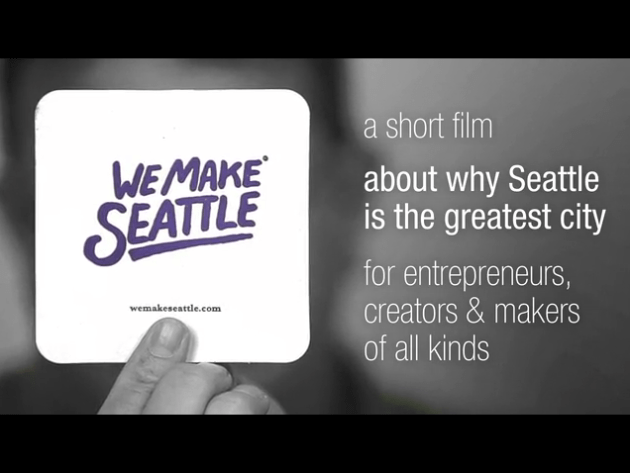
A cool new project about the Seattle creative community hit Kickstarter recently.  It’s called We Make Seattle.

Given the fact I am an entrepreneur, founder of a Seattle startup and now founder of a site that helps other founders tell their  startup stories, I am very excited to see something like this come out of our community.  Seattle needs more exposure to put to rest the “Seattle vs Silicon Valley” arguments.  We are not SV and never will be; we are Seattle.   We are unique, different, but also a land of huge opportunity.  Films like this allow us to tell our stories to the world and show them we know a thing or two about creating great products and companies.

They are more than half way to their goal of raising $28,500 to get this thing in production, so go on and help them achieve their goal!  Below is more about the short film.

Screen Shot 2013-08-07 at 12.12.17 PM

This short film is a celebration of what makes Seattle the best place in the world for entrepreneurs and creatives to live. It tells the story of the vibrant and supportive community we have for starting companies, betting on dreams, and chasing big ideas.

Despite being named the #1 tech city in America by The Atlantic, and consistent top rankings on the list of the world’s most livable city, we’re frequently overlooked as the place to go for people with big talents and ideas. This film will change that.

The film has three goals:

1. Celebrate the creative community.  We have all personally benefited from the Seattle community, and the film will be a reflection back to the community itself on how many amazing companies, events, and projects are based here. In our daily lives we rarely step back to see the entire city, and We Make Seattle will inspire by telling the story of how many great things happen around us.

2. Help recruiters and entrepreneurs attract talent. NYC, LA and even Portland have produced short videos to help local companies tell the story of their city. Seattle has no such film, until now. The film will be the perfect one link to send to convince ambitious creatives, potential business partners, or top candidates from around the world to bring their passions to the northwest.

3. Have the community tell its own story. Everything about this project is built by the Seattle community itself, and led by well known leaders who have benefited from our creative city and want to give something back. We’ll be inviting people to contribute in various ways throughout the production of the film.

All funds beyond our budget will be used to promote the video, as PR and reaching a wide audience is as important as the video itself.

What I Have Learned In the First Few Founders RAW Conversations

I love entrepreneurship because it comes in all shapes, sizes, flavors and personalities.

As I am sure you know, we have started a new project recently, called Founders RAW.   It’s a video site where we showcase recorded conversations I have with other founders over a beer to get a better idea of their story as well as (hopefully) pull out lessons that other viewer will be able to apply to their life.

One of the perks of founding Founders RAW is the unique opportunity to be the one sitting down with these individuals and drive the conversation.  It’s an honor, and it’s quite fun.

It’s also very educational.  Here are just a few things I picked up after the first 6 Founders RAW conversations.

Entrepreneurial from an early age

Everyone I have sat down with has expressed how they were exposed to entrepreneurial ventures from a very early age.  This may have been through observing their parents operating their businesses, working paper routes during middle-school, creating their first “business” in their youth or somewhere in between.  The common thread I am already seeing is entrepreneurship is taught (or experiecned) very early.  So early, in fact, these people thought it was normal and was what they wanted to do when they “grew up”.

This is precisely what I was talking about when I wrote about Making Entrepreneurship An Infectious Cultural Disease.  If we’re taught from a young age to take responsibly for our business life and chart our own course, well that’s exactly what we end up doing.

Clueless at first

Like clockwork, when I talk to founders it’s bound to come out at some point.  “I was clueless at first.  We had no idea what we were doing and we just tried things to see what happened.”  It’s amazing how high of a pedestal we place founders of companies, thinking they know it all and are destined to succeed from day one.  Unfortunately it can’t be farther from the truth.  Founders are forced to quickly learn on the job.

If anything, we are VERY good actors.  We fool others into believing we know what we are doing.  And we continue to do that until we stumble into actually knowing what we are doing.  I believe this skill is a pre-requisite for a founder: the ability to convince yourself and others you know the next few steps to take towards success.  And then exercise that ability to go find and do what ends up being the next step before it’s too late.

It’s Hard Work!

Founding a company is hard work.  I hear it again and again each time I sit down with a new founder during Founders RAW conversations.  “It was tough man!”  “We worked really, really hard sometimes for many, many years.”  Anything extraordinary will require extra effort on the part of the founder, no exceptions, they tell me.

What’s really interesting is to ask them the next question “So given it was hard work, what makes you different than the other founders who are working just as hard?”   I don’t have a specific answer I can write about right now but I think that answer would be very interesting, specially coming from the horses mouth.

My guess: “I figured out a smarter way to work hard.”  Although everyone can work hard, the most successful people find ingenious ways to get things done quicker, faster, more efficient and with higher quality.  A railroad worker most definitely worked harder than a business man, but it was the business man who walked away from the day with more money, providing him more security.

Hear many, listen to few

An interesting nugget of wisdom has already been touched on in these early conversations.  It revolves around the idea that everyone wants to tell you what to do next and how to best build your company.  “Everyone has an opinion, just like everyone has an _________.”

The key is to hear and understand as many viewpoints as you can, but then parse out what applies to your situation and follow a few solid pieces of advice.  Be very picky on who you give your ear to, who listen to and what you read.

Hear a lot, listen to few.

This is huge!  If you don’t follow this advice you end up like a dog running around looking up every time it hears something and sniffing everything it sees.  This is a quick way to go nowhere, fast.

Man, it’s been quite an awesome few months and I look forward to many, many more beers with other great founders who are willing to open up to me and tell us their stories.

If you haven’t yet watched these first conversations, go check them out now > Founders RAW

Determining Which Problems to Solve Requires Wisdom

An important first step when building a product/business is determining what problem you are actually solving.  Pick the wrong problem and you will waste precious time, resources and energy running in the wrong direction.  Pick the right one and you just might have a billion dollar business on your hands.

The key is to be wise in how you pick the problems you will ultimately solve.

thinkingSean Ellis said it best.

Surprisingly, founders’ instincts to solve problems can also cause us to fail. Many startups miss success signals because they are too busy solving problems. Our instincts tell us to be responsive to customer feedback – especially negative feedback. These problems are so actionable that we feel good solving them. But over time a startup that chases problem after problem creates a bloated, fragmented solution that isn’t really needed by anyone.

 Think about that statement for a minute.  Basically, what Sean is saying is you cannot run around and fix everything that people complain about in your product.  It takes wisdom to decipher which feedback from customers – positive or negative – you should listen to and act upon.

He goes further.

Ultimately the goal of any startup should be to create a “must have” product experience. The signal that tells you that you have created a “must have” product is your true north to build a successful business. You should understand everything you can about the “must have” experience so you can cultivate and protect it. Who considers it a must have, how are they using it, why do they love it, why did they need it, where do they come from…?

A “must have” user experience.  Perfect.  That’s exactly what you need to be striving for and what customer discovery is all about.  He lists of a few questions that need to be asked about the target user.  I can think of hundreds more which need to be written down and answered through interviews, user testing and the customer validation process.

The goal = listen to the positive reinforcements from customers, follow where they are leading and create the best product possible.  All the while not listening to all the negative feedback and not building X, Y and Z feature just because one random customer emailed you and suggested you need to include it.

Be wise my friends.

Founders RAW: John Cook of GeekWire Tells His Awesome Startup Story

“If you just hang around long enough… you’ll make it.”

In the latest installment of Founders RAW I recently sat down with John Cook, co-founder of GeekWire, a growing media resource here in Seattle covering technology and startups.  It’s a great conversation, ranging from his memories of his entrepreneurial parents to his lessons from youth sports and onto his crazy startup experience with launching GeekWire.

Founders take note, John is not only a budding entrepreneur himself, but since he covers other successful founders he knows what it takes to make things happen.

Design Around Behaviors Core to the Human Experience

Here’s a quick one today.  When designing your product, app or website, it’s best to think about the user first.  Interestingly, some behaviors that drive us nuts are core to the human experience:

  • We want attention.
  • We collect things.
  • We want status.
  • We are vain.
  • We make judgments accordingly

Next time you are whiteboarding your product just stop and think about what you, as a human, value most.  Your users will thank you later for it.

The Value of Youth Sports In Startup Founder Success

A few recent conversations have turned towards youth sports participation and the valuable life lessons they provide.  One in particular stood out to me – youth sports participation is one of the best training grounds for a startup founder.

How would I know?  I was a competitive athlete pretty much since the time I could run, competed up until college and still remain athletic and competitive today.

soccer1Although I didn’t necessarily know it at the time, as I was playing youth soccer, basketball and baseball I was adequately preparing myself for a life long battle in the business world.  Learning to cope with immense challenge and competition is paramount to a person’s ability to achieve success.

I am so grateful for the experience and for my parents not forcing me into any specific activity, but rather allowing me to participate in a number of sports so that I could further develop my athletic ability, maximize my leadership skills and mature enough to determine which sport I more fully wanted to pursue.

It turned out it was Soccer, and it’s crazy to think back and imagine me as an 8 year old running around in a grassy field on an early Saturday morning thinking I’m just having fun when in actuality I was taking in and absorbing lessons which would help me in my life 20, 30 and 40 years down the line.

Below are just a few ways youth sports help develop a young energetic child into a strong willed startup founder.  I thank John Cook of GeekWire for the conversation that sparked these thoughts.

Teamwork

One of the first things you learn as a young athlete is how to play as a team and how to become the best teammate possible.  No soccer team can win with one person trying to play alone – teams must be able to depend on their offensive players, their defensive players and ultimately their goalie to perform to their best ability.  Players must be willing to step up and take the shot, yet at the same time be able to support and assist their other teammates if the organization is going to function properly.  This requires youth to understand which is which, and the appropriate timing of each decision.

Companies are the same way, they aren’t built by one person. Startup teams must be well rounded, supportive and willing to do whatever it takes to achieve success – for all members of the team.  That, or the team won’t exist.

Leadership

Even at the earliest of ages sports teams will vote on a player to become captain, basically naming the leader of the team.  I believe this is the single best thing we (should continue to) do for our youth.  Captains are usually the more talented of players, have wide ranging experience and are outgoing and not shy in their ways with others.  But most importantly they are willing to take on responsibility.  They must lead the team, delegate when appropriate and stand up for a teammate if something goes wrong.

I believe giving responsibility as early as possible is one of the best ways to develop great leaders.

Imagine the lessons a 10 year old is learning as they lead their team during youth competition.  He/she is learning the basic tenants of team leadership, things they can apply to almost any endeavor.  In short, they are the on-field CEO and the success or failure of the team will rest (at least somewhat) on their young shoulders.

I cover startup leadership quite a bit so if you are a regular reader you will know my basic thoughts on the subject.  Simply put, startup CEO’s need to take full responsibility for their organization from day one.  They must wear the captain’s band on their sleeve in plain view so everyone knows where the buck stops.  This is not for their ego; it’s for efficient and effective organizational structure.  Why should an employee ask 3 people a question when really they should go directly to the decision maker to get the best and quickest response?  If employees in a startup don’t know who the decision maker actually is, whatever startup they are a part of ain’t gonna be around very long.

Failing

I get it, losing is not why we play the game.   Go visit a sports park on a weekend and watch how kids react to losing nowadays.  Yet losing in sports – just as in life – happens.  It actually happens a lot.  Learning to fail gracefully is a huge lesson any person, especially for someone thinking about starting their own company.

Why am I telling you failing is good for children?  Failing, maybe even getting injured  in the process, and then getting back up and trying again shows young athletes that if you do not quit then each new day is a new opportunity to win.  Losing teaches children not everything in life is guaranteed.  In fact, it teaches us more often than not things will not go as originally planned.  Sometimes shit hits the fan and you need to retreat and regroup to determine your next move.  There’s your basic “strategic thinking” lesson in action, a skill founders must employ A LOT.  Losing teaches youth hard work is required to experience success against your competitors.

This is essentially the experience of any early stage founder.  Startups fail most of the time.  Using lessons from our youth we can realize we just need to get back up and try it again, and hopefully we learn something in the process.

Enduring Hard Work

Finally, part of learning from failing is gaining the endurance to last long enough so we can experience success.  I distinctly remember our training sessions during soccer season.  They sucked.  Even if we weren’t going to be the best in the state of Washington (which we were 3 out of 4 years) we were definitely going to be the most in shape.  Coach made it very clear we would be the team with the best endurance around.

So we ran.  A lot.  We ran until we dropped, and then we ran some more.  We learned to embrace hard work and earn our success.  We learned anything worth winning was worth enduring tough challenges and the hardest of practices.  It was our standard and we embraced it wholeheartedly.  We spoke it.  We lived it.  We practiced it and we played it.  No wonder we won the state championship 3 out of 4 years I was on the team.  It was in our our DNA and our blood.

Startup founders need to take ownership of their future.  They simply need to determine where they are going, commit to a standard and uphold it no matter the cost.  They need to bleed confidence to the point where their success is inevitable.  They need to work harder than their competition.  This doesn’t mean work the most hours as humanly possible, that would be as dumb as our soccer coach running us until we all pulled hamstrings, eliminating us from competition completely.  Startups must figure out how to work harder but also work smarter.   Determining and following quality performance standards will do wonders to founders and their startup teams.

Youth sports are fun but they are also incredibly valuable to our society.  If you are a parent I would encourage you to place your children in a positive environment where they can develop leadership and success skills as early as possible.

Just like you.