Would You Rather Be Undervalued Or Underestimated?

Being a first time CEO can be confusing, intimidating and downright scary.  You have a hundred things to do and no idea which way to look.  You feel the need to talk to a lot of people but it’s difficult to determine the ones you really need to spend time with.   You need to deal with legal, financial, organizational, strategic and other parts of the company on a daily basis yet might not be fully comfortable with each area just yet.

Everything rides on your shoulders.

Although this is not my first startup founder experience, it is my first as a CEO in, shall we say, the “big leagues”.  It has been brought to my attention this will be a significant challenge to me since my background lacks “normal tech startup experiences” and don’t fit the typical CEO path.  They say I will be underestimated.

Well, I say perfect.  Bring it!  I love challenges and believe the great ones are created through immense crucibles, where pressure either polishes them into greatness or crushes them into pieces.

As I ponder the reality I face, a question arose in my head:  Would you rather be undervalued or underestimated?

Undervalued means they have already sized you up and determine you don’t add much value to the ecosystem.

Underestimated means they are ignorantly judging you, still don’t know your potential and will be shocked when you reach it.

I have a hunch where I fall in respect to those two.  Do you know where you stand?

@jnickhughes

The Axioms of Entrepreneurship

Recently Ashkan Karbasfrooshan, founder and CEO of WatchMojo, wrote a brief post about the Lies Entrepreneurs Tell.  In the article he makes the point entrepreneurs are “always in sell mode, but that doesn’t mean they need to be BS-artists”.  Their common lies include  “I have no regrets” or “If I had to do it again, I wouldn’t do it any differently”; “It’s not personal, it’s business”; “We’re not raising money”; “We’re not looking to sell”; and “I’m your biggest fan.”

Ashkan has an interesting point – entrepreneurs can be so damn good at “selling” that they begin to say things that aren’t exactly true.  This may be due to a few factors: we actually believe the words we are saying, we feel the means justify the ends or we just want it so bad we are willing to cross over the line into fallacy in order to get what we want.

Regardless, I agree with Ashkan.  We can at times can get carried away with the approach we take when it comes to business interactions.  Yet after reading the post I started thinking… if those are some of the lies of entrepreneurship, there must also be some truths, ones in which are germane to the success of an entrepreneur.

Build For Value

We are seeing a comeback in tech IPO’s and this can have a negative side affect on the business world: young founders dream of (and build) new startups mainly for the ultimate payday.  This is a grave mistake.  M& A or IPO desires directly out of the gate – meaning the only reason they are starting the company is to quickly flip it or go public – is a scary sign of misalignment.    Making certain decisions to maximize revenue and profits to the determent of users can be traced back to this unfortunate thinking.  These are results of building for money, not value.

The best entrepreneurs start (and end) their journey with value in mind.   What exactly is value and how do you find it?  I believe it starts by searching for a big problem in the world, a problem which if solved would open up new markets and even more opportunities for others.  Value means your product or service actually is meaningful in a persons life, and adds something rather than just take something away (time or money).  The irony is if you can focus on value first and you are able to clearly articulate what your company adds to the world, people will come knocking with money to spend.

Have A Standard

Imagine that… setting a standard and living by it!  This must permeate your company, from how you hire to how you interact with the press.  When hiring, who do you look for and why?  Knowing the answer to the question will save you from a lot of headache down the road.  We’ve all heard A players hire A players; B players hire C players, etc…  This is true because A players have standards for not only themselves but the people they look for to join the team.   A players are strong enough to pass on someone who does not stand up to their standards.

Applying a standard when building products and defining and business models most definitely leads to better outcomes.    Are you a trend setter or a trend follower?  Did you start the whole Daily Deal mania or did you just tag along because it seemed easy?   Notice who is the market leader and who isn’t.  Having a standard when developing a business means there are certain things you will not do because of certain beliefs.  It means having a backbone and saying “hell no” at times.  One of the best business building standards I have observed in current market leaders is the resistance to “trends” or “buzz word models” just because they are popular; they stay the course and  lead their market.

In addition to business model, another must have is user experience standards.  Simply put, it your product enjoyable to use?  Does it elicit positive emotions and experiences or is it hard to navigate and tough to understand?  Unfortunately, design and user experience is not something that just happens naturally in technology products.  Having a standard like limited number of swipes for certain actions and least amount of words on each page as possible are just two standards which can drastically enhance your users experience.  Standards in user experience will help your product stand out in a very large sea of…. well, crap.

Think Before You Speak

Entrepreneurs are notorious for blasphemy.  We tend to just say what we think and feel right at that exact moment.  And there’s the problem… no real thinking goes into the words coming out of their mouths most of the time.  Your words will be held against you whether you like it or not.   As Ashkan eluded to, lying or not being truthful during business practices, although common, should not be acceptable.  The truth will always come back around whether you are talking to media, speaking to employees, chatting with acquaintance or in a “discussion” with your significant other.

Simply taking a few seconds before you blurt out the next statement can steer the conversation (and your career) in the right direction.  You’ve heard of damage control – where you have to take precious time from your already busy schedule to smooth over a sensitive situation caused by a misread tweet or a too-much-passion-in-the-moment comment?  You got it, that’s time not spent on value adding tasks your startup desperately needs.  And you cannot afford it.  Just think before you speak.

Be Original

An amazing phenomenon is happening right now: there is a burgeoning of creativity happening on the web right now yet originality is waning.  What do I mean?  I see more copying, emulating and flat out ripping off happening each day as information flows freely.  This is not good for innovation and IMHO it’s just annoying.  Being original is one of the best ways to be discovered.  Original thoughts and personality created a Jack Dorsey.  They also created a Steve Jobs… and other unique personalities in the tech world.  Be yourself and be someone who is unique; it goes a long way.  Just look at one of the newest billionaires Andrew Mason…

Originality in business models and product characteristics create unique offerings that help set your company apart in the market, leading to media coverage as well as investor interest.  We don’t need more Daily Deal sites, we need more innovative ideas for local commerce that actually add value and help merchants succeed, growing local economies.  So look into abyss, seek out problems, ask why, iterate around a new solution will help in becoming a unique and original business.

Although as entrepreneurs we have a tendency to mislead and lie on occasion, we also have tried and true Axioms into which wisdom and success can be found.  These are just a few I came up with quickly as I read Ashkan’s post.  Are there others you cling to as you strive forward?

The Year I Learned To Fly

As 2011 comes to a close it seems as good of time as any to step back and reflect on what has been, for better or worse, a most incredible year.  The lesson of this post is a lot can change in a year.

A year ago to this day I was sitting at a different desk, with a different job, different title, in a different life, and in a totally different industry.  Technically speaking my professional title was Exercise Physiologist.  I managed a corporate fitness facility and helped executives and employees make better choices in their health and fitness.  This area of expertise was in fact my college degree and ultimately my profession for the greater part of a decade.

I don’t necessarily like to talk about this because I know others look at me and think “how is this guy a CEO and what the hell does he know about tech if his background is fitness?”  Although I can understand where they are coming from anyone who thinks this way is mistaken.

For those who aren’t familiar with my background, I had been associated with the tech industry for more than 5 years and had been working on a “startup” for the last few.  Things had not been going well and to say it bluntly we were heading straight for the deadpool, mainly for the fact that the entire team was still fully employed at their current job.  Not all was lost as those years allowed me to study the industry, achieve a basic understanding of the web and learn what startup life was all about even if it was from outside of the window looking in.  The most difficult part of it all was feeling like I was sitting on both sides of the fence, not being able to make the leap.  And it was one of the most frustrating experiences of my life.

Until something happened.  I finally gave in to my pain, got tired of all the frustration and I decided to finally pick the right side of the fence and ended up making the leap.  I quit my full time job to pursue entrepreneurship and become a real founder.  This felt great, I finally made the decision…  except I had no idea where I was going and where I would end up.  All I knew was I didn’t want to be where I was currently on that spring day.

The craziest thing about jumping is what happens mid-air.

For those of you who might have been following my path, you’ll know I took to writing this summer and ended up finding a few channels where people could find and read my words.  In an amazing turn of events, suddenly people from around the world were reaching out to me asking for my prospective on technology, social media, the web and inquiring my interest in possible professional partnerships.   I was suddenly the expert!  After considering numerous offers, I ended up connecting with some local guys here in Seattle and accepting an opportunity to form a company.

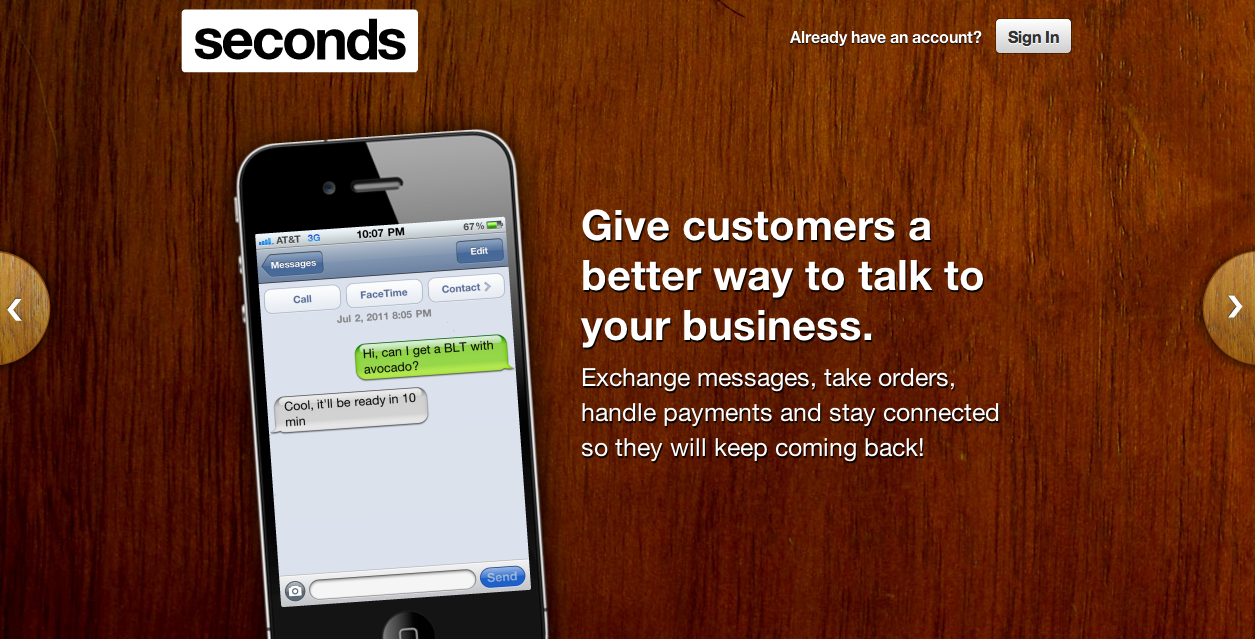
Today I am CEO of Seconds, an emerging mobile messaging and commerce startup with a pretty damn cool product and promising vision.

Your Future is more important than your past

I love this question…. “So what’s your background?” … especially as I sit across from a veteran investor during a meeting as we are about to review our company and our product.  “Shit… how do I answer this one without totally ruining my credibility?” is what I am actually thinking.

I understand their logic as they inquire about my past.  If someone has a Ivy league past, a Stanford degree, an MBA or previous startup experience with a successful exit it is a qualifier in the mind of an investor.  It is proof positive this person has relevant industry experience and basically they pass the sniff test.  The investor is just mitigated the risk (check).  Yet, a strong argument can be made for some of the best entrepreneurs coming out of nowhere to change the world.

I am here to tell you entrepreneurship is not about where you came from, it’s about where you are going.

It is the most important thing I learned by jumping this year.  You must determine where you are going.  No matter your background you must figure out where you are going, refine it and become crystal clear on what you are building and why.  Who cares about your past…  Most of us are not very proud of what we have done in the past and look forward to where we are going.  If that is the case with you, just focus on where you are going because it’s way more powerful than your resume will ever be.

Never, ever, ever…..ever think you are not capable of doing something.  You just need to set your mind to it and get up everyday determined to chip away at whatever/whomever is holding you back.

As Tom Petty would say I am learning to fly .  Or was it Pink Floyd?  Either one… I am damn glad I jumped!

Wow, a massive jump in Seconds Accounts in the last 2 weeks!

Looks at this!  On Nov 28th we released a new feature which allowed merchants to quickly self register a Seconds account in just a few steps.  The result – 20 new accounts created in less than 2 weeks.  Before the 28th, we had created less than a handful of accounts since it was not a streamlined process.  Now, any merchant anywhere in the county can quickly grab a new number to accept text messages and have a nicely designed mobile site to communicate with customers.

Wonder what the next year will look like?

Also, I wonder what the recent redesigns will bring?  I think our numbers will be out of the roof, but you be the judge:

Here’s the old one.

Here’s the new one.

Make No Mistake, Seattle Needs More Events Like The GeekWire Gala

If you had the opportunity to attend the recent GeekWire Gala you will probably agree with me when I say it was awesome.

Was there some crazy entertainer or cool band?  No.

Were there fireworks or a kick ass pyro-technics?  Nope.

Was it for a special occasion like a reunion or anniversary?  Not really.

Yet  more than 500 people showed up in attendance from various pockets of the tech community.  Investors to startup founders to lawyers and aspiring entrepreneurs gathered for a night of talking tech and socializing.  I know it sounds like a normal Seattle Startup event, so you might be wondering why it was so awesome?

As I looked out over the crowded event I started to realize all these people, in just this one room, can help me become successful if they get to know me well enough.  And this is true for all of us in that room.

I give a very big thanks to the entire GeekWire staff and all others who helped put on the event.  Although most people arrived, had a drink or two and then left without realizing how important this gathering was for the health of our tight-knit community; it was not lost on me.

Every so often the “Seattle vs. Silicon Valley” argument boils up to the cognitive surface with various differing opinions shouting about who is better at the top of their lungs.  Regardless of your stance it’s fair to say we – Seattle –  have our own identity with our own startup and investment characteristics, for better or for worse.

Yet I cannot shake an off-the-cuff comment given to me at a startup event this fall from someone close to me at the time.  They said “Nick, go down to the valley and you can find something like this going on pretty much every single night.”  I was immediately taken back by the comment but once I thought about it a little more I started to grasp the deeper meaning of the statement.

It wasn’t about “the valley” at all.  It was about community.

And it is with that statement I come to the conclusion: if Seattle is going to continue to grow as a serious technology, startup, and investment epicenter we need more events like the GeekWire Gala.  We need more opportunities to come together and get to know each other – as individuals and as a larger community.  And it desperately needs to happen more often.

From Wikipedia, The term community has two distinct meanings:

  • a group of interacting people, possibly living in close proximity, and often refers to a group that shares some common values, and is attributed with social cohesion within a shared geographical location, generally in social units larger than a household. The word can also refer to the national community or international community, and
  • in biology, a community is a group of interacting living organisms sharing a populated environment.

Notice the bold word interacting.  It is an important word – as a verb it indicates what we should be doing as a group of people.  We gather.  We interact.  We get to know each other.  We socialize.   We share common values.  Only when we are able to interact are we then able to possibly collaborate and do deals.

Interacting.  Hmmm, that’s an Interesting word  we find there, shall we dive a bit deeper… and find out what that word actually means?

  • communication of any sort, for example two or more people talking to each other, or communication among groups, organizations, nations or states: trade, migration, foreign relations, transportation,

Ah… there it is!  Communication – the one thing that will make or break any relationship.  So it seems to build a robust community we must continue to sharpen the communication lines between the individuals within our larger group.  As a relative newcomer to this scene, this makes a lot of sense to me.

What good is the “tech” or “startup” community here in Seattle if we just remain in our own silo’s, sitting behind our monitors in our own little offices.  An easy habit to form these days is thinking you, as an individual company, are building one something isolated from the outer world.  So we tend to want to stay within our own walls and this is a big mistake.  If you are apart of a large company or even a startup here in Seattle, you are a very important piece to a large organism.  Just as cells of the body must stay in constant communication with each other to remain in healthy stasis; so must we here in Seattle continue to communicate and interact so we can build a strong and healthy tech community.

What about using technology to virtually communicate?  Yes, we may banter back and forth via email and on Twitter but those are only extensions of community.  They don’t actually create a community.

Don’t get me wrong, I am not saying we don’t have events and activities to cultivate the ecosystem.  Currently there are a number of events happening on a monthly basis in which we can participate.  To name a few:

  • StartupWeekend events
  • Poker 2.0
  • WTIA Events
  • Morning Coffee’s
  • Pitch events
  • Meetups

I am suggesting even more events need to be put together to create and foster the tech community here in Seattle.  We all are responsible to do something for the health of the larger community – that is if we are going to voice our opinions on the subject.  And the Gala illustrated larger events bringing together a lot of people can spawn interesting and advantageous opportunities, just as a being a part of a small group playing poker will do.  This is why I organized the Startup Crawl, it was a great time to relax with a beer in your hand and just talk openly with people you might not otherwise interact with.  Sometimes these events are the start of something special.

Do they all have to revolve around drinking alcohol?  No, not at all.  Whatever the event, it should enhance the strengthening of existing relationships at the same time encourage new comers to attend and make some initial and important connections to help them get further ingrained in the community.

We may not be able to have much impact on the investment macroeconomics here in Seattle but we sure as hell can do something about the over community interaction.  And interestingly enough… I believe the later will pull the former along towards a better day.

The Numerous Mental Disorders You Probably Have As A Founder

“God, did I just actually think that?” 

Many have wondered what goes on in the minds of the people who go on to start successful companies.  Some may think pure ambition, hopes of everlasting riches or even recognition for doing something great are the driving forces behind a founder.  Others might believe people have a vision or some sort of predestined aura working beyond their comprehension to align the lucky ones with the future.

Whatever is going on behind the scenes of a founding entrepreneur , you can be sure it’s straight out of a psycho-thriller.  The thoughts, feelings, emotions and urges pushing a founder toward success are so dramatic there are no words to accurately describe the experience.  The question is are these normal?

I have no idea what the hell I am doing and where this company will actually end up?

Entrepreneurship is basically a physiological disease, with various mental disorders running rampant.  Being an entrepreneur is something far different than what most people think. It is not about behavior; it is not about business type; and it is not about title. Instead, it seems as if it’s a personality trait with it’s own quirks and characteristics.  There are plenty of small business owners and start-up founders who do exceptionally well — but are not what would be considered an entrepreneur. Just like in big business, you can be a successful general manager without being an entrepreneur or entrepreneurial.

Dammit!  That guy is worth hundreds of millions more than me!!  All he did was start a photosharing app…  What’s he got that I don’t?

So how do you determine if someone is an entrepreneur ?  And are entrepreneurs actually crazy by normal society standards?   That seems to be up for debate.  A thin line separates the temperament of a promising entrepreneur from a person who could use, as they say in psychiatry, a little help.  Academics and hiring consultants say that many successful entrepreneurs have qualities and quirks that, if poured into their psyches in greater ratios, would qualify as full-on mental illness.

If it’s a disease, entrepreneurship then is a combination of many mental disorders that when found in correct combinations, come together to form a very unique individual.  Entrepreneurs are all in all the time. Entrepreneurs love what they do and obsess over it. It is a predisposition; a path that has already been laid for you. It is a character trait, a labor of love, a zeal that cannot be trained, a condition that cannot be treated, an illness that cannot be caught. You’ve either got it or you don’t. Even the Quora community has determined mental disorders are associated with founders.

Wait… did or didn’t I know this was going to happen.  Was it a dream?  I could have swore we already figured this #@%^ out!   Geez, I have no idea when the last time I got a full night’s sleep.

What mental disorders are to be found more common among entrepreneurs than the general population?  After realizing my personal thoughts were “uniquely abnormal” and after numerous interactions with founders of other companies (and discovered the same weirdness), I determined to do some further research.  What follows is an attempt to describe the most common mental disorders associated with the general entrepreneur with descriptions found on Wikipedia.  I came to choosing these specific ones from familiarity and similarity, meaning I noticed a strong association with a founders psyche when reading the definitions.

Anything sound familiar?  As you read these you will start to realize we all are a bit “off our rockers.”  Yet also apparent from reading this list is the notion that maybe the entrepreneur is the lucky one who can actually channel their craziness in a way that actually moves society forward, not backward.

(*please note I am only suggesting it is just the combination of some or all of these in small doses that make up the general entrepreneurial psyche)

Asperger syndrome

Aspergers syndrome an autism spectrum disorder (ASD) that is characterized by significant difficulties in social interaction, alongside restricted and repetitive patterns of behavior and interests…. The lack of demonstrated empathy is possibly the most dysfunctional aspect of Asperger syndrome.  Individuals with AS experience difficulties in basic elements of social interaction, which may include a failure to develop friendships or to seek shared enjoyments or achievements with others (for example, showing others objects of interest), a lack of social or emotional reciprocity, and impaired nonverbal behaviors in areas such as eye contact, facial expression, posture, and gesture.

People with AS may not be as withdrawn around others as those with other, more debilitating, forms of autism; they approach others, even if awkwardly. For example, a person with AS may engage in a one-sided, long-winded speech about a favorite topic, while misunderstanding or not recognizing the listener’s feelings or reactions, such as a need for privacy or haste to leave. This social awkwardness has been called “active but odd”.

Get the hell out of my face right now!  Geez, can’t you figure anything out!   And why do you complain about everything all the time.  You should be grateful you work for a kick ass startup.  

Cognitive disorders

Most common mental disorders affect cognitive functions, mainly memory processing, perception and problem solving. The most direct cognitive disorders are amnesia, dementia and delirium. Others include anxiety disorders such as phobias, panic disorders, obsessive–compulsive disorder, generalized anxiety disorder and post-traumatic stress disorder. Mood disorders such as depression and bipolar disorder are also cognitive mental disorders. Psychotic disorders such as schizophrenia and delusional disorder are also classified as cognitive mental disorders.

This company is worth half what is what worth last year.  I’m a loser.  

As an entrepreneur, depression can set in as well.  It happens to the best of us, especially entrepreneurs who hold strong feelings about their performance and the inevitable outcome of their company.  Ben huh, CEO of Cheezbeuger Network recently opened up about his challenges with depression.

Mania

A manic episode is defined in the American Psychiatric Association’s diagnostic manual as a period of seven or more days of unusually and continuously effusive and open elated or irritable mood, where the mood is not caused by drugs or a medical illness and (a) is causing obvious difficulties at work or in social relationships and activities, or (b) requires admission to hospital to protect the person or others, or (c) the person is suffering psychosis.

To be classed as a manic episode following must have been consistently prominent: grand or extravagant style, or expanded self-esteem; reduced need of sleep (e.g. three hours may be sufficient); talks more often and feels the urge to talk longer; ideas flit through the mind in quick succession, or thoughts race and preoccupy the person; over indulgence in enjoyable behaviors with high risk of a negative outcome (e.g., extravagant shopping, sexual adventures or improbable commercial schemes).

Schizophrenia

Schizophrenia is a complex mental disorder that makes it difficult to tell the difference between real and unreal experiences, think logically, have normal emotional responses, and behave normally in social situations.  Schizophrenia symptoms usually develop slowly over months or years. Sometimes you may have many symptoms, and at other times you may only have a few.  People with any type of schizophrenia may have difficulty keeping friends and working and they may also have problems with anxiety, depression, and suicidal thoughts or behaviors.

At first, you may have the following symptoms:

  • Irritable or tense feeling
  • Difficulty sleeping
  • Difficulty concentrating

As the illness continues, problems with thinking, emotions and behavior develop, including:

  • Lack of emotion (flat affect)
  • Strongly held beliefs that are not based in reality (delusions)
  • Hearing or seeing things that are not there (hallucinations)
  • Problems paying attention
  • Thoughts “jump” between unrelated topics ( “loose associations”)
  • Bizarre behaviors
  • Social isolation

Oneirophrenia

Oneirophrenia is a hallucinatory, dream-like state caused by several conditions such as prolonged sleep deprivation, sensory deprivation, or drugs (such as ibogaine). From the Greekwords “ὄνειρο” (oneiro, “dream”) and “φρενός” (phrenos, “mind”). It has some of the characteristics of simple schizophrenia, such as a confusional state and clouding ofconsciousness, but without presenting the dissociative symptoms which are typical of this disorder.

Persons affected by oneirophrenia have a feeling of dream-like unreality which, in its extreme form, may progress to delusions and hallucinations. Therefore, it is considered a schizophrenia-like acute form of psychosis which remits in about 60% of cases within a period of two years. It is estimated that 50% or more of schizophrenic patients present oneirophrenia at least once.

Narcissistic personality disorder

Narcissistic personality disorder (NPD) is a personality disorder  in which the individual is described as being excessively preoccupied with issues of personal adequacy, power, prestige and vanity.  Narcissistic personality disorder is closely linked to egocentrism.  Narcissists also tend to be physically attractive on first impression, giving them advantages when first meeting people.  Some individuals believe that Narcissistic personality disorder seems like the the person suffering has high confidence and a strong self-esteem, however this is not always the case.

Megalomania

Megalomania is a psycho-pathological condition characterized by delusional fantasies of power, relevance, or omnipotence. ‘Megalomania is characterized by an inflated sense of self-esteem and overestimation by persons of their powers and beliefs’. Historically it was used as an old name for narcissistic personality disorder prior to the latter’s first use by Heinz Kohut in 1968, and is used these days as a non-clinical equivalent.

Arguably, however, ‘in addition to its pathological forms, megalomania is a mental behavior that can be used by any individual as a way of coping with distress linked to frustration, abandonment, loss, or disappearance of the object’ in everyday life. In this sense, we may see ‘megalomania as an extreme form of manic defense…against the anxiety resulting from separation from the object’.

In the social world, ‘megalomania…can be a characteristic of power-drunk or control-freak dictators, some executives, some politicians and some army generals’. All such figures may be said to have ‘a “Big Ego”. A baby’s ego, in fact, insufficiently shrunk….So they’re much more likely to miscalculate To offend people’.

Psychotic disorder

Psychosis (from the Greek ψυχή “psyche”, for mind/soul, and -ωσις “-osis”, for abnormal condition) means abnormal condition of the mind, and is a generic psychiatric term for a mental state often described as involving a “loss of contact with reality”. People suffering from psychosis are described as psychotic. Psychosis is given to the more severe forms of psychiatric disorder, during which hallucinations and delusions and impaired insight may occur.

People experiencing psychosis may report hallucinations or delusional beliefs, and may exhibit personality changes and thought disorder. Depending on its severity, this may be accompanied by unusual or bizarre behavior, as well as difficulty with social interaction and impairment in carrying out daily life activities.

Brief hallucinations are not uncommon in those without any psychiatric disease. Causes or triggers include

  • falling asleep and waking: hypnagogic and hypnopompic hallucinations, which are entirely normal
  • bereavement, in which hallucinations of a deceased loved one are common
  • severe sleep deprivation
  • sensory deprivation and sensory impairment
  • Caffeine Intoxication

Studies with sensory deprivation have shown that the brain is dependent on signals from the outer world to function properly. If the spontaneous activity in the brain is not counterbalanced with information from the senses, loss from reality and psychosis may occur after some hours.

Perfectionism

Perfectionism, in psychology, is a belief that a state of completeness and flawlessness can and should be attained. In its pathological form, perfectionism is a belief that work or output that is anything less than perfect is unacceptable. At such levels, this is considered an unhealthy belief, and psychologists typically refer to such individuals as maladaptive perfectionists.

Hamachek describes two types of perfectionism. Normal perfectionists “derive a very real sense of pleasure from the labours of a painstaking effort” while neurotic perfectionists are “unable to feel satisfaction because in their own eyes they never seem to do things [well] enough to warrant that feeling of satisfaction”.  Burns defines perfectionists as “people who strain compulsively and unremittingly toward impossible goals and who measure their own worth entirely in terms of productivity and accomplishment”. Perfectionism itself is thus never seen as healthy or adaptive.

This button looks like shit!  And it should be over there, not here.   This shade of red sucks and makes my eyes hurt.  And why the hell do I have to tap this to do that?  This just has to be perfect before we release it!

In its pathological form, perfectionism can be very damaging. It can take the form of procrastination when it is used to postpone tasks (“I can’t start my project until I know the ‘right’ way to do it.”), and self-deprecation when it is used to excuse poor performance or to seek sympathy and affirmation from other people (“I can’t believe I don’t know how to reach my own goals. I must be stupid; how else could I not be able to do this?”).

In the workplace, perfectionism is often marked by low productivity as individuals lose time and energy on attention to detail and small irrelevant details of larger projects or mundane daily activities. This can lead to depression, alienated colleagues, and a greater risk of workplace “accidents. Adderholt-Elliot  describes five characteristics of perfectionist students and teachers which contribute to underachievement: procrastination, fear of failure, the all-or-nothing mindset, paralysed perfectionism, and workaholism. In intimate relationships, unrealistic expectations can cause significant dissatisfaction for both partners.

As you can see, being an entrepreneur is a unique combination of actual mental disorders. Pretty interesting, huh.   It is in how the individual decides to channel their “unique characteristics” where we find true greatness.  I hope this doesn’t scare you.  I hope it gives you a better understanding of who you are (or who you are dealing with) on a daily basis.


Quality Writing Skills Are The Best Way For Startups To Get Discovered

Publishing on social sites and writing blog posts has a direct effect on traffic (and thus eventual usage) to Seconds.  Looking at Google Analytics numbers for November 2011, direct access to the site led the way.  The next question is how did those people know to go directly to Seconds, or Order SM at the time?

1. (direct) / (none
2. google / organic
3. t.co / referral
4. angel.co / referral
5. entrepreneur.com / referral
6. facebook.com / referral
7. quora.com / referral
8. soentrepreneurial.com / referral
9. dev.ordersm.com / referral
10. geekwire.com / referral

Looking past the first 2 (direct and google), you can see the next 8 are all social and publishing oriented.  The thing to realize is most of the direct visits originated one way or another from the other sources.  Not being even 4 months old as a company, the most predominant way people hear about our company and kick ass new concept is through written words – social sharing, articles and blog post.  As the weeks continue more and more people are discovering Seconds from one of our publishing avenues.  They may not click through the link (that is how it’s measured) but opt to just type in our url the next day.

Causation or correlation aside, it is pretty obvious we must continue to publish as we proceed our initial rollout.  We must drive awareness of Seconds and our mobile commerce platform through our publishing skills.  Here are the main ways make noise and get the word out:

Publishing to this blog, So Entrepreneurial

Seconds Dev blog  

Nick guest Contributing on Business Insider

Nick guest publishing on GeekWire

Twitter sharing

Facebook sharing

AngelList updates and links

Writing is a strong suit for our a team and we will never stop being creative in our noise making.  Emerging startups need to do anything they can to make noise and get discovered.  The key is to find your strength, identifty what you are good at and determine to ride that skill for everything it’s worth.