A Public Thank You to John Battelle

Disclosure: no one knows I am writing this, not even John.  It is not a stunt for attention, but a genuine thank you.

This morning, as I was glancing through FM Signal it occurred to me how much value John Battelle brings to this industry (and to my life).  It also occurs to me how hard he works.  Amazingly, he touches numerous industries – marketing, advertising, technology, the web, early stage startups, blogging, journalism, music and many others.  Even better, he is at the cusp of bringing together and connecting those industries, a skill I don’t see in many others.  I look forward to each day as he curates information just for my unique education.  And, boy do I still need it.  You should take note just some of the ways he adds value to our lives:

Federated Media

Started by John in a garage in 2005, FM was intended to create a business model for the best independent publishers.  I have always been impressed with FM and look for great things from them in the near future.  From their site:

FM develops programs and products that help brands engage in those conversations and host their own dialogues with current and potential customers. As we’ve grown to have offices across North America and represent a larger number of partners, that basic principle continues to describe our business.

Web 2.0 Summit

Each year in the late fall, the tech world convenes for one of the great rituals of the industry –  The Web 2.0 Summit.  Years ago, this was one of the first events to have a tremendous impact on me and the direction in my life.  Did I attend?  No.  But I did always download the audio files of the talks, burn them onto a CD and drive around listening to them on my way to work (it beats radio commercials).   Together, John and Tim O’rielly really helped a guy like me further my knowledge and get up to speed on things.  This year’s, called The Data Frame, should be more of the same great stuff.  I hope I can attend.

The CM Summit

The Conversational Marketing Summit is another event put on by Federated Media, focused on the intersection of Marketing and technology.  Arguably, marketing people need John more than we tech people do.  They need someone who can communicate in both languages – marketing speak and tech speak – to help nudge them towards more effective concepts.   The next one is June 6th in NYC.   Go here for all things CM Summit.

FM Signal

Each morning I am greeted with a collection of 8 to 10 links to very informative and educational articles.  I make sure I start my mornings with a review of the latest in the industry, so this is one of the first emails I open each day.  Coffee, check.  Music, check. Signal, Check.  Man, good stuff.  If you want an edge in this industry, you must get the Signal.  Go to the upper right hand corner on this page to sign up.

Influential Blogger and Author

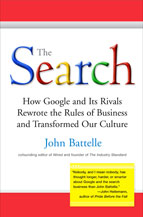
In addition to FM Signal, John blogs at John Battlelle’s Searchblog.  He always has unique insights to a variety of topics, mostly around the web, technology, and conversational marketing.  Also very useful has been the book The Search, an in-depth look at how Google and search in general has transformed our world.

If you are in any of the above mentioned industries, use these resources from John.  They have no doubt changed my life.  Thank you John.

Breaking: Who’s in control of Groupon Now?

Groupon files an S-1 for an Initial Public Offering today.   Huge details revealed on Business Insider.  The question now becomes: Who’s in control of Groupon?

Lightbank partner Eric Lefkofsky owns 21% of the company’s voting shares. Founder and CEO Andrew Mason owns 7.7%.

I am not sure if this is good or bad for the “web” but it sure is HUGE.

It’s A Tight Balance Between Psychosis and Brilliance

You know you are an entrepreneur when you say…

I have no idea when the next paycheck will come in.

This can be the scariest thing in the world… just hold on.

I have no idea when the next round of funding will come together.

Your dream could end at any moment… just hold on.

I have no idea if my business will even be successful.

How are you supposed to know what will happen a year from now… just hold on.

I have no idea who will be the next engineer to help build my product.

Don’t worry, you can barely embed youtube code into your wordpress blog… just hold on.

I have no idea what I am actually doing, am i crazy?

Cat chase tail, cat chase tail, cat chase tail… just hold on.

You also know you are an entrepreneur when you say…

I know so deep in my heart this is the only direction I want to go.

You must trust your gut… now quit that job and start living how you’ve always wanted to.

I can’t stop reading posts and articles about other startups, I need more!

You have a disease; it’s called entrepreneurship… learn to live with it and just effing do it.

Holy crap, I do know more about Google, Facebook and Twitter than any of my friends!

That is what happens when you can’t stop reading… now go find another engineer

Every time I start writing about technology or startups, great things come together

This is one of the biggest signs you are operating in your strength zone…. follow it.

Entrepreneurship is a tight balance between psychosis and brilliance.  Balance it.

You Talkin to Me?

Update: The post was republished on BusinessInsider.com

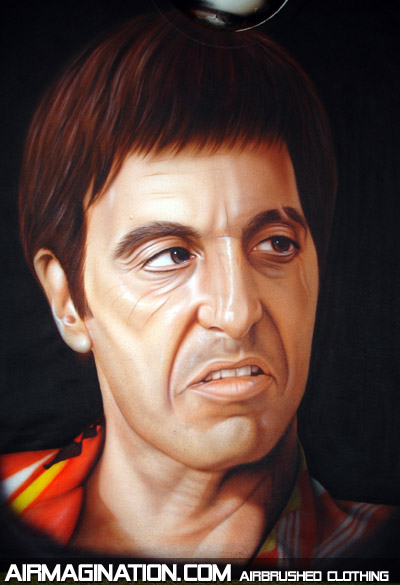
As a youngster growing up I did not know I wanted to be an “entrepreneur”.  In fact I didn’t even know what one was.  It’s kind of a weird, unintuitive word.  But even as small children I think we can tell the difference between a Pirate and a peon.  Early on I just  knew I wanted to do something different, something bigger.  I knew it the first time I saw Tony Montana scorch the earth building an empire in the movie Scarface.  If you are reading this as an entrepreneur, you probably remember your early entrepreneurial feelings as well.

@ev, @jack, Mark Zuckerberg, Steve Jobs, Jeff Bezos, Reid Hoffman, Larry and Sergey, Marc Andreessen and many others – I have incredible respect for you.  Not many will do what you have done and maybe one day we can connect, hopefully some of that can rub off on me.  But I ain’t talkin to you.

I’m talking to the rest of y’all – the other 98%.   You at your desk hoping your boss doesn’t catch you reading Business Insider at work… again.   No need to close the tab, he probably hasn’t seen yet.  And you, reading this on your phone at the restaurant as you wait for your significant other to come back from the bathroom.  Go ahead and finish reading, I assure you they’ll be glad you’re reading a tech blog and not secretly texting someone else.  And yes, you laying in bed reading this on your ipad, you are just trying to squeeze in one last article before you go to bed.

How do I know you are all doing this?  Cause I am one of you.  I’ve done all those things and more.   I have wanted it so bad I couldn’t sleep at night.  Like you I have also put years into my own vision only to come up short on the latest attempt.  Like you I lived a double life, straddling the fence of trying to successfully launch a side project and lacking the cajones to let go of stability in a day job.  Somewhere along the line I found myself living a lie – vicariously living as an entrepreneur but not actually acting and doing like real entrepreneurs should.   That life sucks and I am done with it.

Yes, it’s a great time to be an entrepreneur and things once again seem to be bubbling.  Venture investments are up.  Valuations are rising.  IPO’s are starting to pop again.   With all this talk of Bubbles, IPO’s, Frothiness, and “it’s different this time”, I just have one question for you: What you gonna do now?

Because here is the truth for most of us:

1) We’ve never launched a successful product. We only wished we had.

2) We’ve never succeeded in raising venture capital, because of number 1.

3) Even though things are frothy, this will not change the numbers game.  Our odds of launching a successful product and raising VC are still going to be slim to none.

Well Tony would say eff the odds.  Tony said eff to everything and everybody.  He knew where he was going and nobody was going to stop him.  Regardless how you feel about the word (my apologies), I think it’s a great perspective.  Tony was the quintessential entrepreneur – purposeful, driven, headstrong and at times ruthless.  When he set his mind to something, you pretty much knew he was going to get it.  Great entrepreneurs look odds straight in the face, laugh, and then get back to work.

But what about Captain Jack?

I don’t care if you’re a billionaire. If you haven’t started a company, really gambled your resume and your money and maybe even your marriage to just go crazy and try something on your own, you’re no pirate and you aren’t in the club.

I about jumped out of my skin when I read those words written by Michael Arrington on Techcrunch a few months back.  It chilled me to the bone and was pure poetic justice at a time when I was really needing to hear it.   I wish I would have cut it out, put it in my pocket and showed it to anyone who asked why I was leaving my “stable and dependable” job.  Most people just don’t get how exotic and intoxicating being an entrepreneur really is.  I think Tony Montana would second Michael’s statement as well.

Although I agree with Arrington and his version of Captain Jack Sparrow, I feel Tony is a better depiction of a pure entrepreneur.  Strip away the guns, drugs and violence and you have a great example in Tony Montana.  He has the dedication.  He has the attitude.  He has the street smarts.  He has the charm.  He has the willingness to risk.  In him you have someone so committed to his vision he was willing to die for it.  Love him or hate him, we need more leaders as committed as Tony.

So here’s what we need to do:
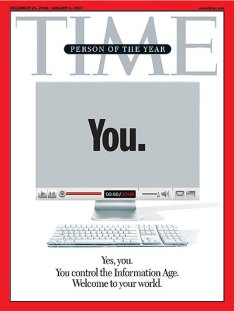
Realize you are – YOU.   The best way to beat the numbers game is to be unique.  You cannot be the next Mark Zuckerberg, Ried Hoffman or Steve Jobs.  You were given your own unique vision.  Execute it.  Zuck was given the vision of a world wide social network.  That’s great for him (and for us to use).  But go do something different.  I think of Zaarly or Square.  Andrew Mason figured out how to make daily coupons cool again.  Awesome, think of something farther ahead like what LOCQL, a start up here in Seattle is doing.  Who knows, maybe back when Zuck, Hoffman, and Jobs were getting started they secretly wanted to be the next Bill Gates, Andy Grove or Thomas Edison.   But of course, they couldn’t and didn’t.  So they became the best versions of themselves and subsequently created the world you now live in.  Read that last sentence again…

Channel your inner Tony Montana.  One of the most interesting aspects of the movie Scarface is how it touches on both the light and dark sides of humanity, capitalism and wealth.  Most people who watch the movie see the obvious flaws in Tony.  But more subtle is the notion that we all have the capacity to think and act in this way.  You too have a little bit of Tony fire in your belly.  You also have the choice to use your competitive edge for the better of humanity, not the worse.  Channeling your drive, determination and what-ever-it-takes attitude will lead you to make a positive dent in the universe.  This is more important that you might think.  Although I have yet to raise a round of VC, I am pretty sure investors would rather have someone walk in their office with a Tony-esk chip on their shoulder talking about taking over the world than see (another!?) demo of a new twist on a social application which also shares groupons.   Mark Suster is so right – “There are so many big inefficiencies in this country that need tackling. I feel quite comfortable that our bars & restaurant industry will be just fine.” 

Find something you are willing to die for.  No, I don’t mean head out the door with machine gun in hand ready to do battle with anyone who criticizes your next idea.  But I am suggesting you find something so grand in vision you will spend the rest of your life making it come true.   In my humble opinion, this is the key to being successful – a driving purpose.  Simon Sinek taught me to Start With Why.  Read this book and you will discover true greatness is not about copying the next social sharing feature.  It’s about inspiring society to move forward with truly crazy ideas that have a larger purpose.  Trust me – Bezos, Jobs, Edison, Larry and Sergey… these guys would tell you the same thing.

It’s a great time to be an entrepreneur.  Shall we not let this time in history be remembered only as the “Social Bubble”.  I think there’s more within all of us.

Yeah I am talking to you…. you with me?


Lonely Man on the Corner

See the lonely man there on the corner,
What he’s waiting for, I don’t know,
But he waits everyday now.
He’s just waiting for something to show.

Genesis – Man on the Corner

Disclaimer: What I am about to write is controversial.  As you read please remember this does not insinuate I lack caring in my heart for human beings of all levels of society.  It is merely my opinion of how a person chooses to live their life and what opportunities a person chooses to act upon.  There are no right or wrongs here, just observations and thoughts.  Also, it is important to note the thoughts below regard what people are choosing to do in the moment of poverty, not how they got into poverty in the first place.  I anticipate differing perspectives and opinions to be shared in comments.

——————-

You’ve seen him.  He’s the lonely man over there on the corner.  What he is waiting for nobody knows.  But he waits everyday, and he’s just waiting for something to show.  The quotes throughout this article are lyrics from a song Man on the Corner by Genesis. The video is below and it’s a must listen.   I recently listened to it and was shook by the emotions I felt during the song.  And so I started to think deeper on the concept of poverty.  I started to think about why some are rich; why some are poor; why I drive a nice car and some are stuck wearing the same clothes every day.  I asked myself, “what could possibly be the difference?”  And why some people find themselves on a street corner just waiting for ‘something to show’.  You may differ in your perspective on poverty in this country, but I believe poverty and entrepreneurship are distant cousins.

This man chooses to sit on a corner and hold a sign.  He has nothing (at least from what we know) and feels his best option is to do nothing, look desperate, and ask for money.  His value proposition rests on the morality of another person feeling remorse when they pass him, forcing themselves to face their inner soul and ask “am I a bad person if I turn my head and don’t give him money?”  He wants to be given something for nothing.  He takes from the world, but does not give in return.  He offers no product in which a dollar value can be placed on it and he has no service to offer another.  He just sits and asks for help.  He has chosen to do nothing.

And nobody knows him,
And nobody cares,
‘Cos there’s no hiding place,
There’s no hiding place – for you.

Genesis – Man on the Corner

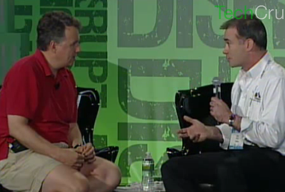
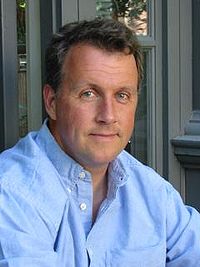
I will juxtapose the man on the corner with the man in the hot seat.  What is the difference between the man in the image above and the man in the image to the left?  The man in the hot seat has, in theory, the same intentions as the man on the corner.  He is asking for money and he is looking for help.  He believes he cannot make his dreams come true unless he receives a gift from someone else.  His future, indeed, depends on another persons good faith.  But that is about where the similarities end.

For those have not picked up on it, the man in the image at left is a person pitching Paul Graham (an investor in the red shirt) on a business idea in hopes he will invest money towards his vision.  But in contrast to the man on the corner, the man on the hot seat does not believe in handouts or in receiving something for nothing.  He believes in creating value through enterprise.  He knows that if you have something, anything – a product, a service, a distribution channel, knowledge, land, a water source, natural elements, really anything – you can offer it to another for a profit.  He chooses to live his life working hard to add value to society, not take away from it.  He has taken ownership and responsibility for his life, understanding he can choose to do anything he wants with it.  But with that decision he knows it is up to him, and only him to make it happen .  The man in the hot seat is an entrepreneur.

Looking everywhere at no one,
He sees everything and nothing at all – oh.
When he shouts, nobody listens,
Where he leads no one will go – oh.

Genesis – Man on the Corner

At times entrepreneurs find themselves looking poverty straight in the face.  It might be in a situation where their income (or lack thereof) cannot fulfill the demands of their debts, whether it is a roof for shelter, food for sustenance or gas for their travel.  They choose to risk their current stability for the return of a better life.  There is an eerie aspect of entrepreneurship and I think it’s due to its distant cousin of poverty.  The mere thought of poverty can be the biggest moving force an entrepreneur receives.   It is incredibly scary and immensely motivating at the same time.  Only in risk one really experiences reward.  So we endure the possibility of poverty for the reward of wealth.

For the record, I am quite privileged to have a roof over my head, food to sustain my health and a nice car to drive each day.  I am doing fine but at this point in my life I hover right above to line, choosing to forgo a stable job for a chance to determine my own destiny.  Also for the record I have stared poverty in the eye and experienced what it could be like.  I have had my electricity turned off and creditors calling my phone for not paying bills on time.  I have had to dig change out of my car to buy a $.99 hamburger.   As a late-twenties ambitious entrepreneur who hadn’t “made it” yet – old enough to be established on my own but young enough to have not built sustainable wealth for myself – it’s was a tough slog.   I’m a tweener as they call them.

When you leave a stable financial situation and leap towards your dream, you risk falling into poverty.  Or should I say you learn how to operate with poverty as a strong possibility in your life.  You learn how to acknowledge where your responsibilities lay in the equation of life.  You start to realize your decisions will make or break you.  It is through this experience I start to think about poverty in a new way.   Whenever I drive by the man on the corner, I cannot help but think: “I could be out there right now.  That could be me.  As I am sitting here in my car it is unbeknownst to me how I will pay rent next month since I just took the leap and started my life as a full time entrepreneur.  But I will find a way.  I will find a way to not only pay rent but to grow my business as well.  I will choose to do something, not sit and do nothing. ”  I argue it is at this point of realization you really become an entrepreneur.

So Here’s the difference between poverty and success:

Man on Corner waits; man in hot seat acts

The man on the corner waits for something to fall into his lap, hands or box.  He takes no responsibility for his actions and believes by just waiting, help will find it’s way to him.  The man in the hot seat acts, on everything.  He believes it is through doing something, anything really, value can be created.  And when he creates value, wealth will find it’s way to him.  It is by doing and acting we entrepreneurs find success.

Man on corner values nothing; man in hot seat values everything

The man on the corner values nothing, not even himself.  If he did value himself, he would be doing something other than sitting desperately on a corner asking for a handout.  He has lost the ability to place value on anything in his life, thus has nothing.  The man in the hot seat values everything, especially himself.  He has such a belief himself he is asking others to invest large sums of money into his enterprise.  And he believes so strongly in himself he knows he can bring the investment amount times X back to the investor.  It is through immense value in self an entrepreneur will be successful.

Man on corner plays victim; man in hot seat plays hero

The man on the corner has ultimately bought into the victim mentality, meaning their outer circumstances determine their inner self worth.  A victim does not take responsibility for actions and outcomes, therefore they do nothing to change their circumstances.  The man on the hot seat understands it is he who determines his destiny and thus plays the hero.  A hero understands they are unique and hold power to orchestrate a positive outcome for all involved.  By believing you as an entrepreneur are the hero, your self worth has nothing to do with outer circumstances.  This frees you up to act according to your vision and experience success.

I am not sure Phil Collins would agree with my interpretation of Man on the Corner but I am curious if you do.

The Crest of Web 3.0 is Upon Us

I recently authored a post on Businessinsider.com titled The Evolution of The Tech Bubble.  In fact, it was a re-post of the article here on So Entrepreneurial titled Bubbles and Golden Ages.  My main goal was to take a larger glance as what we call Bubbles, and to provide some context to the inevitability of a technological paradigm and its lifecycle.  It was indeed a birds eye view, and with each phase the possibility remains where one could dive further into the details.  Thankfully, that was done for me.

Jasephase, a commenter on the Business Insider piece, has provided us longer perspective on current times using the Bubble framework I provided earlier.  Jasephase lays out a more in-depth perspective, postulating we are on the crest of Web 3.0.  My takeaway: “The trick is to look past the crest into the subtler currents to extract the themes of Web3.0 and make the Google or Facebook that will in effect become the next Web3.0 Titan.”  Well said.

jasephase on May 27, 7:17 AM said:

I realize this is incredibly long – it’s what happens when a little free time in otherwise very busy days mixes with the first coffee in months…

I have been working, by that I mean visualizing the future, through goggles strikingly similar to these for the last five years.

I agree with the author in that we are, in large part, in the synergy phase. I lose him when he reaches his ‘Maturity’ argument, in effect dismissing maturity as not occurring in the present time but 60 years in the future. I believe the paradigm he is employing here, ‘the internet’, is far too broad a subject to practically inform our thinking and actions now. But the pattern is useful.

As I see it, ‘the internet’ as a whole is, yes, in the synergy phase right now. But we can very easily break the internet up into its own phases: Web 1.0, which I would say came into focus with Google and had its own ‘bubble’.  Then, Web 2.0, the poster child of which is Facebook and social in general, which is bubbling now and may or may not burst as much as peter out. And then finally the predestined semweb, the first faces of which we are seeing now in products that bridge the gap between old and new media, between 1.0, 2.0, and even the early stages of 3.0, between social and local, between social and knowledge, between social and professional, between social and commerce, e.g., Foursquare, Quora, LinkedIn, Twitter, GroupOn, Yelp!, Square…

Thus, I would say that Web 2.0 is in its synergistic phase now, whereas everything Web 1.0 is already quite snug in its maturation phase. Hence Google’s plateau or incremental improvements (which I would argue point to long-term decline and an inevitable dropping stock price (not due just to a changing of the guard and internal restructuring)). Of course some 1.0 companies are making the shift, like Amazon, but others, like eBay, are not. Bezos can pivot and drive for the hoop at the same time.

Still, Amazon and Google are primarily single-value, long-tail companies with a lot of features and secondary products. But if you remove their core value proposition: eCommerce and search, they are dead in the water, networks without a hub. While they are polymaths, they are limited. Apple on the other hand consistently creates entirely new markets for itself to swim through, but that’s a whole other chapter…

Anyway, back to synergy and maturation. I think that this article’s graph of the internet’s growth resembles the period of a Y=sinX curve from x=0 to x=pi/2, but that a Y=X+sinX wavy step function would be much more indicative of a Web1.0, Web2.0, and semweb reality (it’s been a while so my math might be off…). Or better yet, instead of one line, envision the constructive/destructive interference patterns of three or more curves plotted to represent their respective perspectives. In such a system I think we will find that Web1.0 is in maturation, Web2.0 is in synergy, and Web3.0 is in its earliest stage (perhaps situated within the synergy phase of the internet as a whole – but that is a bigger claim than I would make or justify – history and evolution are slippery).

Furthermore, as each 1.0, 2.0, and 3.0 wave is interconnected and evidence for maturation and growth are present even in the synergistic crest, we tend to focus only on the crests (on the valuations and IPOs of LinkedIn, GroupOn, Facebook, etc…) while the subtler, smaller stories, such as the maturation of 1.0 and the growth of 3.0 waves, are obscured. Still, if we look past the bubble at the larger picture, we can reasonably foresee or feel-out a timeframe in which 3.0 will start to grow. I would argue that the catalyst for that is the 2.0 crest we are experiencing right now.

Let me expand on that. I believe that the boom of Web1.0 was the activation energy required to begin a Web2.0 phase transition, and that the current boom of Web2.0 will supply the energy necessary to get Web3.0 started. Yet we will not see the accelerated growth of Web3.0 until Web2.0’s growth decelerates. Causation is funny, chicken or the egg. Which comes first: the development of Web3.0 currents or the dissolution of Web2.0 energies? Does Web2.0 by its very nature sew the seeds for its own destruction…? Again, I would argue that it is the dissolution of relative power and of the investment of new capital and of manpower in the 1.0 companies that provides the opportunity for such drastic Web2.0 growth now. Furthermore, if we were to integrate the heights of the inflection point (entrance to maturation) of Web1.0 we get the incredibly steeply-sloped pace of growth for Web2.0. Been a long time since math…

Anyway, evidence for this: read through the lists of every Y Combinator and TechCrunch Disrupt startup – not a single one is doing anything revolutionary or interestingly new. They are all competing to build the best nifty/gimmicky features of Web2.0. They are all trying to ride the same wave. Without forcing these trends into some value-system, this is a ‘good’ thing, a necessary step for evolution of Web3.0. The higher Web2.0 goes and the faster it tips, the sooner and faster Web3.0 will be born. It will be the collective weight of all these startups, the investment of VC, and the mass of incremental innovations they bring to the table that will bring Web2.0 to its crest quickly and eventually take the wind out its sails. So I’m redunant.

Just as no VC is going to fund the next big search engine, neither will the next big social site or deals site find funding. The forces that be effectively crowd out the competition. A startup’s fate in this atmosphere is inevitable (read planned) obsolescence or assimilation into one of the borgs (Google or Facebook…). Thus innovation will peter out, which will lead to the maturation phase of Web2.0, the shifting sights (sites) of VC and entrepreneur alike, and the emergence of the 3.0 startup, to whom the current titans will appear as old media to be disrupted. Google is the dinosaur now, playing at arguably the same game as Microsoft – dead in the water, searching for a board to hang onto so as not to sink.

Seeing all this is the easy part. Making a successful startup in today’s environment, then, is even that much easier, just network, just game the system (like trading in Diablo II, or convincing our old landlord to let us rent the house). The trick is to look past the crest into the subtler currents to extract the themes of Web3.0 and make the Google or Facebook that will in effect become the next Web3.0 Titan.

What will that look like? Who is in that space now? How will it articulate with current industry? What old media will be disrupted? One thing I can tell for sure is that Google is a Sisyphus to keep on chasing a social dream. Likewise, while Facebook’s capitalization on the social graph and social search is still in its infancy and there’s no real telling how far its synergy phase will go, it is still just following the dreams of Web2.0. As of yet there is no competition (glances over my shoulder to see if Apple is listening) in the Web3.0 space, everyone is focused completely on Web2.0. Opportunity?!

Whoa!

Holy Cow!  This is what happens to a week old blog when you get national coverage on a well known business and technology site – Businessinsider.com.  Below are the So.E. blog viewer numbers from the past week.  The gray areas  denote a weekend day.  Not too shabby for someone who hasn’t even been blogging for two weeks.  Trust me, this is just the beginning.

What Any Startup Can Learn From Starbucks

Update:  This post was republished on GeekWire.com

As I drove past the Starbucks headquarters today I glanced up at their big green logo.  Instantly I thought “man, what a iconic brand.”  I mean, when most people see a white coffee cup with green letters, they know it’s Starbucks Coffee.  Then I thought “how did they get there?”  Here’s what most forget: Starbucks was a startup at one time.   They had to start somewhere and work hard to establish this incredible brand.  Although I do not know Howard Schultz personally (someday I hope to), it’s obvious he understood a thing or two about creating an iconic brand.  Even if you do not wish to build a business to the size or likes of Starbucks, here are a few things to keep in mind as you grow your company.

Headstrong Founder

Howard Schultz is one of those entrepreneurs you read about in history (or Amazon) books.  He grew up in Brooklyn.  He was the first person in his family to go to college.  He started as a salesman selling Xerox equipment.  Interestingly, before he founded “his Starbucks’ he joined the a small coffee company named Starbucks.  Then after differences in vision he left to start his own coffee company, and as fate would have it he ended up buying the original company’s assets and ultimately named his company Starbucks.  The vision in question?  Changing the way coffee was enjoyed here in The States.  That is no small task and probably why the original Starbucks owners wanted no part in it.  You better believe he encountered and fought through more than a few obstacles along the way.  I will not list them here, but I would recommend reading his book Pour your Heart into it – it’s good.

Founders of startups need to, like Schultz, be headstrong.  It isn’t always going to be fun and roses.  In fact, based on your odds it’s down right impossible for you to take your nascent idea and build a fledgling company around it.   My opinion is most founders quit before they even get started.  Maybe you need to seek out more initial customer feedback?  Maybe you need keep trimming the fat to find your MVP (minimum viable product).  I don’t know.  But if Howard Schultz was sitting across the table from you right now, here’s what I think he would say:

You must be headstrong in your passion, desire, focus, product, marketing, communications, leadership, and recruiting.  In all those things, be headstrong and dead set on doing what-ever-it-takes to make your vision come true.  Anything less will be your company’s demise.

larger Purpose

Early on Starbucks set out on a journey with a larger purpose in mind.  Schultz realized very quickly the coffee industry, although a relatively large market in the US at that time, had become stale.  People were mostly consuming coffee in their home from a tin can.  Schultz knew they could take something familiar and transform it into something altogether new.  They wanted to create a third place.  Not the home.  Not the office.  But a third place.  Somewhere you could go to hang out, drink coffee, talk with a friend, have a business meeting or read a good book.

It was there, at this third place, they figured people would come to be a part of the community.  And drink coffee.  They made this purpose (the place) bigger than their product (coffee).  And it worked to the tune of a $27b market cap.  Go ahead, think about our world without coffee shops.  I am writing from one right now, and it’s all do to Starbucks.  Thank you Howard.

A startup – no matter their industry – needs to find their greater purpose.  “Why on earth are people going to use your application over the millions of other things to play with at this moment?” You must be able to make it clear and concise why their life will be better when they use your product.  I believe this comes together when the overall purpose of your product or service is greater than just making money (for you).   I can’t tell you what your purpose should be; it’s your job to find it.  I feel so strongly about this that if you can’t state your purpose in one sentence, I would recommend finding something else to do.  Because, if you can’t clearly state the purpose of your business how do you expect others to figure it out?

Always Get better

We all know the story, there’s a Starbucks on every corner.  With more than 15,000 stores in approximately 55 countries, it’s fair to say Starbucks won the game.  For a while there I think the executives were also saying the same words behind closed doors.  As the economy collapsed and things got tight, Howard has some decisions to make.  He closed some stores as well as doubled down on their core competencies.  He understood the notion that regardless of what you have done up to this point you need to always get better.  Yes, Starbucks was a successful corporation.  But if not careful, successful corporations are susceptible to failure due to their own hubris.  Howard nipped this in the bud and brought back the idea of continual improvement.

This doesn’t just happen to large corporations.  It’s all relative you know.  To be successful, startups need to continually learn new things and aim to get better as time goes on.  Launching a product and seeing a few million downloads is only the starting line.  What happens after people use your product once?  Ten times?  Two years? You need to get better.  Better analytics to study usage patterns.  Better customer service.  Better executives.  Better management processes.  I am sure there a lot more things to get better at, but whatever it is… just get better.

This is what I thought as I drove by the Starbucks headquarters today.  Hope it helps.

The LOCQL Landscape

Man, what an exciting time we are living in right now. We are starting to see another aspect if the web explode with innovation – the local landscape. Local web applications are infiltrating almost every aspect of our daily lives – searching, shopping, taking pictures, and now Questions and Answers. Question and Answer sites (Q&A as they are referred to) have been around for quite some time, but only recently have entrepreneurs started innovating on the core concept: You ask a question, someone answers it. Startups such as Quora, Hipster, Travellr, localuncle, and many others are recreating the Q&A space for the era of social connectivity.

Quora

Quora, for example, founded by former Facebook employees, aims to build THE go to application for wisdom and knowledge. The cool thing about Quora is you can follow well known people as they continue to add their knowledge to the site. Quora seems to be the emerging leader of these newly minted social Q&A sites. Thus far they have maintained their focus on the relatively smaller web tech community of Silicon Valley. Questions remain (pun intended) if Quora can uphold their quality of answers as they grow in quantity of questions.

Hipster

Then there’s Hipster. Quite frankly, no one really knows what this little Q&A startup is doing. If you go to their homepage you are greeted with a prompt to search questions and answers about SXSW, a conference held in Austin, TX every March. Isn’t it almost June? One thing is for sure, they know how to generate PR and attention. I guess we’ll just have to keep an eye on this one.

But what if you added your specific location to asking a question and receiving an answer? Location based Q&A opens doors we only dreamed of just a few short years ago. “What if I could send into the ether a specific question about the city I just landed in and BAM, one minute later I receive an answer from someone I don’t even know who lives here?”

LOCQL

Enter LOCQL, a Seattle startup some refer to as “Foursquare Meets Quora”. These guys smartly put together two basic premises; 1) everybody knows a little bit about something and 2) location information always make something more valuable. Marry those together and (at scale) you have a living, breathing repository of location relevant information based upon where you currently find yourself. Isn’t that the basis of mobile search? When I use my iphone for search, I am generally looking for a restaraunt, coffee shops, a retail store, an address, directions, and many other location based information. Additionally, what if someone infused a solid Q&A application with mobile commerce capabilities? Mark my words, I believe this space will yield a big hit.

I caught up with LOCQL co-founder Robert Mao recently and asked him a few questions about his company and where it’s going.

Describe and explain LOCQL in a few sentences.

“LOCQL is a location based question and answer site that helps people find answers to places.
LOCQL uses game mechanics to enable social power to find the missing links between the user’s queries and the places in the local landscape they are searching for. Hopefully will be able to bring the local search and location based search to a higher level”

How did you come up with the idea behind LOCQL?

“The idea for LOCQL came from our life experiences, as International travelers, we traveled to many different places, relocated our home’s several times in different countries. There are so many ‘best kept secrets’ only local people know about, those who’ve been there just know it. Unfortunately, without a service like LOCQL, you won’t be able to find it from the web, nor you can find it through search engines. We realized people are increasingly looking for answers about places, according to Bing, over 50% mobile device originated search queries are about a specific place. Google’s Marissa Mayer recently mentioned 20% of all Internet search is about places! In those queries, only around 30% can be solved with today’s information retrieval based search technology. A big pie is missing! We are aiming on make this better.”

Yahoo Q&A has been around for a while. Why attempt a new Q&A site?

“Q&A has been around for a long time, even before search engine become popular. Q&A is one of the most natural modes of communication for human beings and we believe there are still plenty of space to make it even better. As you can see, Yahoo Answer has been there for such a long time, Stackoverflow.com become the most trusted source for the developer community, and the recent rising of Quora.com illustrates how a better designed Q&A can be incredibly attractive and useful. When we began work on LOCQL, none of the Q&A site were specifically for location related questions, or most of them just treat location a name or a category. In our point of view, location answered questions are very important and since they are increasing in frequency they deserve special attention.”

With a lot of competition, besides the location aspect how do you differentiate yourself?

“We do it quite differently, we deeply believe in “Less is more” principle. We do less, so we will be able to provide a better user experiences, especially when designed for the location/place related Q&A. We try to only solve a smaller set of problems than most of the existing players, so we can be much more focused. Another very interesting angel we try to solve the problem is gamification. “Be fun” is another principle when we design our product. If you try LOCQL you will find we have many social game elements build in, in fact some part of the service are purely enjoyable games for you and your friends. No matter if you want to travel, you want to move your home, or find more interesting things around your local community, it’s FUN! We try to make the service fun, playful, and at mean time, so it can capture some value and be useful at the same time.”

What is LOCQL’s current status, and what are your immediate next steps?

“We just opened up to a wider beta. In the first phase, we only let in around 150 test users in order to verify a few of our assumptions and help us understand this space better. We are now more confident and are accepting a wider group of users to try our product, also we released our gaming mechanic in this new phase, so LOCQL will be the most enjoyable Q&A site out there. It’s not just boring questions and answers.”
Image courtesy of of Flickr user Alexanderdrachmann.

Bubbles and Golden Ages

Update: This post has been republished on www.businessinsider.com.

I once watched an interview where angel investor Fred Wilson offhandedly noted reading a book which transformed the way he looked at markets and the web in general.  I instantly went to Amazon and ordered it and spent the next week reading it front to back.  Whew… it changed my life as well.  I up and quit my job the next month.  Thanks Fred.

Technological Revolutions and Financial Capital by Carlota Perez is one of the greatest overviews of the incredible economic phenomenon known as the bubble.   What we are currently going though – recessions and expansions, bubbles and bursts, highs and lows, whatever you want to call them – they are inevitable.  In fact, the history of the entire world economy is one big cycle which repeats itself over a period of about 60 years.  I cannot do this entire book justice, just take my word for it, go buy it and read it yourself.  You will publicly thank me later just as I just thanked Fred now.  But I will introduce the general phases a new technology (paradigm) encounters so the “layman” technologist, marketer, social media guru or business person can start to see a clearer economic picture.

I hope I am not being too being blunt, but without grasping this concept you are swimming with your cap over your eyes.  You need to understand what is actually going on in this crazy economic world.

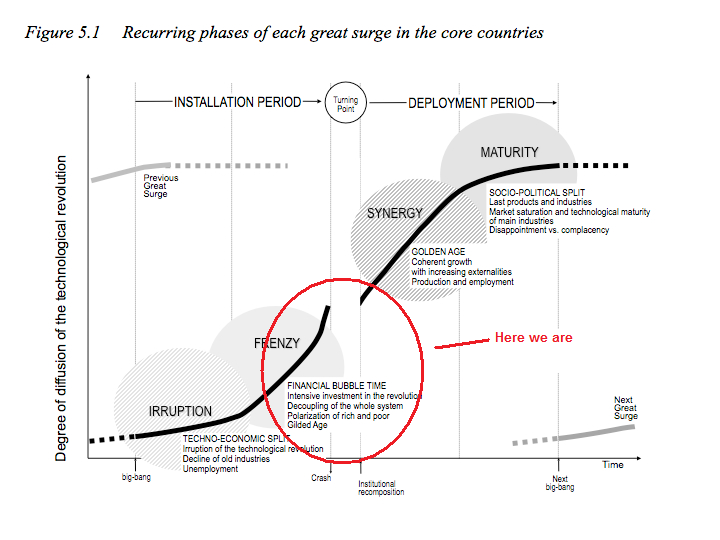
Irruption

As a new technology is developed and deployed into our society, it will enter a cycle of adoption.  Interestingly, Perez notes new technologies are created during the maturity phase of the last great technology expansion.  So although we are starting with the irruption phase, let us take for granted the specific technology has already been created and diffused through very early adopter communities.  During the irruption phase, we see a slowing or declining of the old industries and an early adoption of a new technology.  Carlota notes:

The very intense activity of the new paradigm carriers contrast more and more with the decline of the old industries.  A techno-economic split takes place from then on, threatening the survival of the obsolete and creating conditions that will force modernization.

Old print media anyone?  This irruption phase is started with a big bang (invention and initial diffusion) and will propagate within a small community of early adopters.  Note the image above, depicting very low diffusion, even to a point the general masses dismissing the technology altogether.  Amazingly it is contained within this tight group of people and industries for some period of time.  That is until a tipping point is hit.

Frenzy

Frenzy is a period of massive growth for a new technology.  It is a time of new market creation as well as for rejuvenating old industries.  Once a critical mass of consumers have been hit, the diffusion of the paradigm takes center stage.  Individualism rules the land, as does speculation, wealth creation and ultimately resulting in over-investment flooding the market.   

Frenzy is the later phase of the installation period.  It is a time of new millionaires at one end and growing exclusion at the other, as in the 1880’s to 1890’s, the 1920’s and the 1990’s.   In this phase, financial capital takes over; its immediate interests overule the operation of the whole system.

Notice the part about the growing polarization between the rich and the poor.  Sound familiar?  Capital investments soar during this time, creating a false sense of wealth creation.  This craze attracts more and more individuals wanting to get a piece of the action; so late frenzy is financial bubble time.

Turning point

At some point, the bubble has to burst.   Things that go up must come back down.  Interestingly, the turning point is neither an event or a phase, rather it is a process of contextual change. 

The turning point has to do with the balance between individual and social interests within capitalism.  It is the swing of the pendulum from the extreme individualism of Frenzy to giving greater attention to collective well being, usually through the regulatory intervention of the state and the active participation of other forms of civil society.

The turning point is a space for social rethinking and reconcidering.  It is, in fact, the time when the mode of growth that will shape the next few decades is defined.  I would argue we have been in this phase for a while, maybe starting 5-8 years ago After picking up the pieces of the crash of the early 2000’s we are now starting to see realignment in almost every industry known to man.  Name an industry that is not currently being touched by the internet?  Exactly.


Synergy

This is a time for production.  Since the foundations and infrastructures were laid out during the previous phases, conditions are there for dynamic expansion and economies of scale.   The diffusion of the new paradigm now reaches far and wide, is accepted as standard, and now governs supreme.  It is a time for promise, work and hope.  For many, the future looks bright.   

Synergy is the early half of the deployment period.  This phase can be the true ‘golden age’.  It is likely to be the closest the system ever comes to convergence within the economy of the core countries of the system.

Mary Meeker anyone?  She has identified this expansion phase quite eloquently, particularly in the mobile space.  I would argue we are still at the turning point but on the cusp of this synergy phase.  We should expect to observe massive expansion and economies of scale in almost every industry imaginable for the next few decades.  New industries and markets will emerge.  Old ones will finally die off.  Will it be all golden?  I am not so sure.  But if history is any indication, we shall see an expansion of scale only experienced once every 60 or 70 years. 

It was this exact point in the book which urged me finally jump off the fence and into my entrepreneurial pursuits full time.      

Maturity

Once again, the cycle continues.  Every paradigm has a shelf life and can only survive so long.  As it enters maturity, deep questions are asked about the system and the climate is favorable for politics and ideological confrontation.  Markets are saturating and technologies are maturing.  

Gradually the paradigm is taken to its ultimate consequences until it shows up its limitations... yet all the signs of prosperity are still around.  Those who reaped the full benefits of the ‘golden age’ continue to hold onto their belief in the virtues of the system and to proclaim eternal and unstoppable progress, in a complacent blindness, which could be called the ‘Great Society Syndrome’.

During maturity, the stage is set for the decline of the whole mode of growth and for the next technological revolution.  Since we are entering a synergy phase, I will not spend much time on maturity.  According to Perez, the next maturity phase should not be entered for quite some time and the decline of our current paradigm should not influence ones innovation or investment perspective.  Yet it is always smart to keep an eye on something like this.  Interestingly, it is in this period inventors and innovators are tinkering with what will eventually become the next great paradigm.  This begs the question:  What will supplant the internet?  I would suggest not worrying much about the answer to that question and take advantage of the current conditions.  According to Perez, it should be quite good for years to come.


Entrepreneurs Can’t be Wishy-Washy

“There are some people who just get what they want in the world. If you want to start a startup you have to be one of those people. You can’t be passive and wishy-washy,” – Paul Graham

During the second day of TechCrunch Disrupt NYC, Paul Graham sat down for a chat with Charlie Rose.  Paul Graham is the founder of Y-Combinator, a popular incubator and launch pad for early stage startups.  One interesting tidbit any entrepreneur considering Y-combinator should take note is the current acceptance rate at YC. It’s around 3%, which may be just slightly better than traditional VC fundraising.  I assume this number to get even smaller as YC gets more popular.  Also noteworthy, here’s who they look for:

… we’re not looking for people who did what they were told in life.

Seattle – Learn the Secrets of LinkedIn

If you live in Seattle and are interested in learning how to best use LinkedIn, go to this meetup on the 23rd of June.  The Tea Palace in Renton, WA will play host for the meetup, and it will only cost $5.00.  Well worth it… it might just help you find your next business partner or land that great gig you have been wishing would fall in your lap.  By the way, I received this courtesy of Michael Surkan just by being a part of the Linked:Seattle group on LinkedIn.  Good stuff.

Learn the secrets of LinkedIn at the Linked:Seattle June 23rd meetup.

At the next Linked:Seattle meetup I will be giving my presentation on “LinkedIn Secrets”. Learn how to use LinkedIn to not only find people but to build productive relationships that will help your career or business.

To get an idea of what I will be speaking about, I have published some short videos of my LinkedIn secrets here (you need to register as a member of the site to view them):
http://bit.ly/PPlisecrets

The meetup will be at 5:30pm on June 23rd at the Tea Palace in Renton. My presentation occurs immediately before the meetup starts at 5:00pm. To help cover expenses we are now charging a $5.00 fee for attendance.

You can find details about the meetup and register here:
http://bit.ly/lsmeetup

You can find details on being a meetup sponsor and having a table for promoting your business here:
http://bit.ly/lssponsor

Cheers,
Michael

Here’s the Best Way to Increase Your Company’s Value

Have a co-founder.

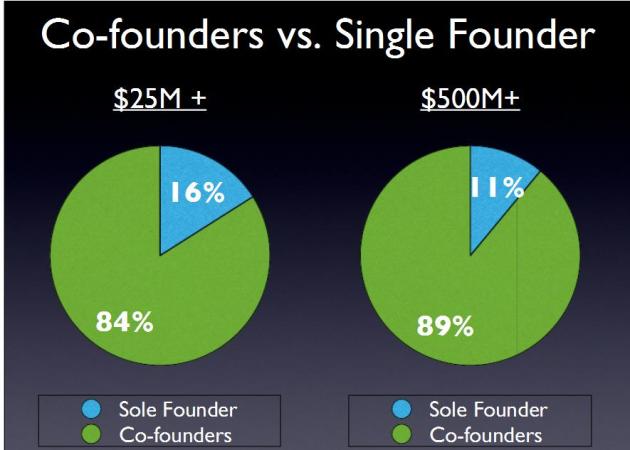
On stage today at TechCrunch Disrupt NYC, prolific Angel investor Ron Conway spoke on what makes Great entrepreneurs Great.  They interviewed almost 500 CEO’s from their portfolio companies and found some interesting nuggets of wisdom.  Here is a big one: having a co-founder greatly increases your exit.  Companies with exits (or the potential of an exit) in the $25m range, single founders made up only 16%.  Even more interesting, exits of $500m+ (or the potential of an exit) , single founders only made up 11% of the group.  A full 89% of the group were companies with 2 or more founders.  This does not surprise me.   Larry and Sergey (Google).  Steve and Steve (Apple).  Bill and Paul (Microsoft).  Jerry and David (Yahoo).  David and Bill (HP).

Founders – life looks better with a friend along for the ride.

I Hear the Future

And it’s a Daily Deal Nearby!

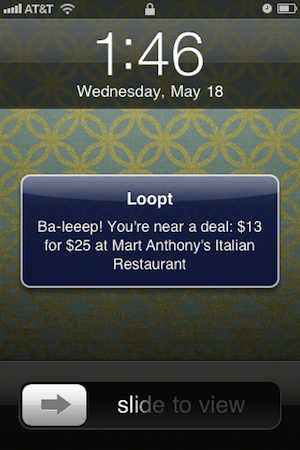
Loopt has partnered with Groupon to push their users notifications about nearby daily deals.  Currently, I am not sure how I feel about my phone buzzing every minute as I walk down the street to notify me about deals, regardless if I am interested or not.  This might change, but that is how I feel right now.  What do you think?

Why I Cry During Horse Racing

I have always been a sports fan.  I like soccer, basketball, baseball, football, hockey, tennis, UFC.. you name it.  Although I was not raised around horses and the track, horse racing for some reason draws me in.  There is something about it that is so intriguing and attractive I cannot help but watch.  Today is the Preakness Stakes and I recently realized how similar horse racing and the startup ecosystem are.   Maybe now I am starting to understand why I am so attracted to this sport.

The winner is almost always a surprise

Once a year the Triple Crown tugs at the heart of the sporting community.  As sports fans, deep down we want to root for the underdog.  We want to see an upset.  When those 20 horses line up at the starting gate we have no idea which horse will actually step across the finish line before any of the other horses.  Yes, you can take the odds.  But how often do those odds actually play out accordingly?  I use this racing analogy because success as a startup is pretty much exactly the same as success on the race track.  Starting out, we have no idea who will emerge as the “winner”.  Talent, funding, product, iteration, attitude, economic climate all influence the outcome of the race.  It is always a surprise, isn’t it?   MySpace looked like the breadwinner only to have Facebook clean its shorts around the second turn of the race.   That’s incredible.  Who knew?  I guess that’s why we play the game.

The winner almost always has to adjust their tactics mid-race

If you watch any horse race, you will notice the race is actually won by the jockey, not the horse.  The jockey (the CEO) observes the dynamically changing environment, quickly calculates their options and immediately decides to direct the horse (the company and product) towards the best route for victory.   This is no small task and requires tremendous skill to perform under pressure.  They learn to Pivot at the best possible time.   The word pivot is probably used way to often to describe the transition from one strategy to another in an effort to move a business forward.  Yet I think it is such a great word and such an important tactic.  Great Leaders understand when conditions have become suboptimal, and possess the wherewithal to quickly make necessary changes in order to be successful.

The winner almost always has a storied past

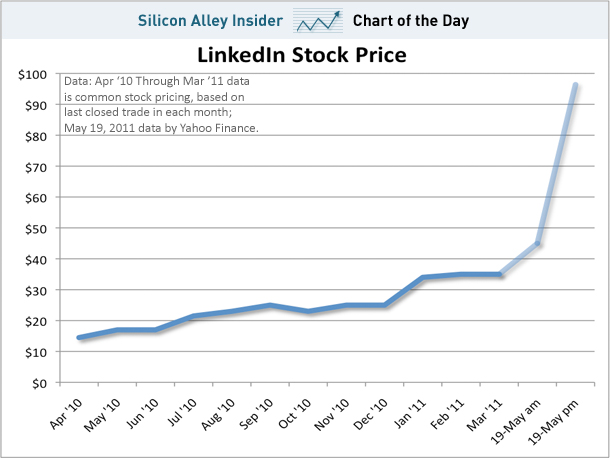
One thing is for sure when I watch these events.  I will tear up.  I tear up more during “extraordinary feats of competition” than any Rom-Com (romantic comedy) that I must watch with a girlfriend.  Why would I tear up during a horse race?  I tear up because the obvious time and effort, blood, sweat and tears put in by the jockey, the breeder and the horse.  There is always a story of triumph over insurmountable circumstances.  And they didn’t quit.  I am so moved by extraordinary accomplishment, maybe because I hope I will one day experience the feeling.  And just as they put in this effort, so does the startup founder.   It is truly an amazing accomplishment to take a seemingly impossible idea and turn it into a network of over 600 million people.  Or leaving Russia as a child for the USA to eventually pursue your dream and become a successful entrepreneur.  Or, after almost 10 years of grinding away not being the darling of the internet, going public and watching your stock double the first day on the market.  For that matter, launching any product and achieving a profitability in-s0-much-as just enough to sustain your business operations.  Those are great stories worth a tear or two.

And I guess that is why I like Horse Racing.

Instapaper is a Lifesaver

“A simple tool to save web pages for reading later.”

In these times of information overload, Instapaper is an incredible service.  Once you create an account, all you have to do is click the Read Later icon located on your bookmarks toolbar to save any article (or webpage) for later use.  Access your account anytime and you have a running list of  saved pages.  Lifesaver.  I will be using Instapaper as a daily resource for now on.  Thanks Instapaper guys.

I will ride a Virgin whenever I can

Airplane.  Airlines.  Virgin America.  If you clicked on this for any other reason than hearing about how cool Virgin America is , you are out of luck.  For the rest of you here is my Virgin America experience.

Back in March I took a long weekend trip to Las Vegas for a good friend’s Bachelor party.  Now I know what you are thinking.  It wasn’t really like that… well not exactly like it, but I will leave that for another post.  After a long Vegas weekend of NCAA march madness games, late night poker, a few too many cold beverages and the like, it was time to go home.  For any Vegas veteran out there, you know a Sunday morning 9 am flight out of Las Vegas is a catastrophe, to say the least.   Most people at the airport or on your flight have not slept, reek of booze and are not in the best of moods.  “This is going to be interesting.”

Having booked my return flight weeks earlier by just picking the cheapest one, I was now blessed with the realization I was going to be flying Virgin America.  For those unaware,  The Virgin brand was founded 40 some years ago by British Entrepreneur Richard Branson.  I have always looked up to him and felt he really understood how to grow a business and build a brand.   As a budding entrepreneur, this was exciting to me.  I had never flown Virgin before, and even though no brand is perfect, after reading various blog posts, articles and a few books praising Branson and the Virgin Brand, now was my opportunity to experience it first had.  Boy was I not disappointed.

I was greeted by this (at left) upon stepping aboard the plane, ahh…  When was the last time you actually looked forward to boarding a plane? I don’t look forward to fighting others in the crowded center isle as I place my bags above my seat and try to get settled in.  This was pure bliss 8:30 am on a Sunday in Vegas.  When you are building a brand, it’s the little things that matter.  But it gets better.

Look closer at all those seats, you can see little personal screens on the back of each seat.  To my amazement, once I sat down I realized not only can we watch whatever we want, Virgin offers satellite TV and wireless internet – FOR FREE.  As coincidence would have it, the University of Washington men’s basketball team had just tipped off against the University of North Carolina and was currently being shown on CBS.  Yes!  I plugged in my headphones, dialed into the game and watched 2 hours of great college hoops while as we flew to our stop off in San Fransisco.  It’s the little things.  I have to say it was the best flight I have ever had.  I remember feeling like I wasn’t even on a plane.

To top it off, the flight crew is young, hip, professional and above all else very happy and positive.  You get the feeling their entire purpose is to make you – the customer – at ease and extremely comfortable.  Little things, as it should be.  After a brief layover in SF, we boarded another Virgin aircraft and flew on to Seattle, where I live.  Again with the ease of technology I was able to plug in and enjoy another college basketball game, without the irritation of crying babies, arguing couples or a blabbing college freshman girl.  Pure bliss.

Why I like Virgin America so much

  • Virgin actually cares about their customers
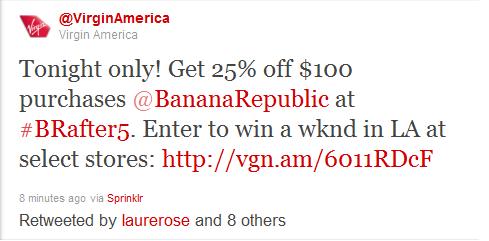
  • Virgin is ahead of the curve (notice their twitter account)
  • Virgin has embraced their founder’s personality
  • The Virgin brand is hip, cool and innovative
  • They provide a service that just so happens to be a business (not the other way around)
  • I just like the name

You heard it here, from now on I will ride a Virgin whenever I can.  You should too.

Disclosure:  Virgin America has no idea I am writing this.  I wrote this purely because of a great customer experience. 

Mobile Commerce Will Be HUGE

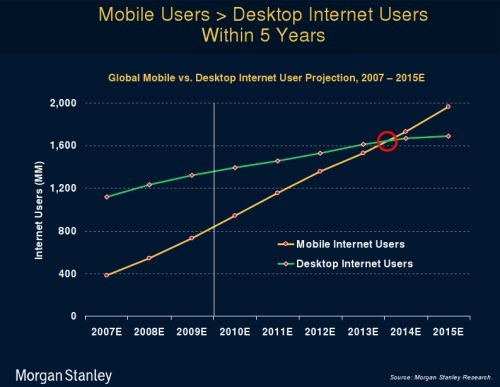
Mobile commerce is starting to show its legs.  Groupon just announced it will be seeing half of revenue coming from mobile devices sometime in the next two years.  This coincides with what Mary Meeker has been saying for so many years – the mobile web will be HUGE.  Look at the chart below, you can see it is predicted global mobile users will overtake desktop users within the next 5 years.  Think about that for a second.

According to Mary Meeker:

“the world is currently in the midst of the fifth major technology cycle of the past half a century. The previous four were the mainframe era of the 1950s and 60s, the mini-computer era of the 1970s and the desktop Internet era of the 80s. The current cycle is the era of the mobile Internet, she says — predicting that within the next five years “more users will connect to the Internet over mobile devices than desktop PCs.”

This shift has major implications for consumers as well a businesses.  Shopkick, a mobile app initially created for in-store shopping experiences, now allows users to create a custom area for their favorite retailers.  Remember how you throw away most of the advertisements and mailers you receive each day.  This is the opposite.  It’s all the best deals right in front of your face.

If you are a local business, your customers are theoretically always connected to you and your products or services.  Think: how can you add value to them on a daily basis.  If you are a consumer, odds are you carry a device in which pretty much anything (or anyone) in the world is just a few taps away.  Think: what new place/thing can I discover in my city today.

As a consumer, in what ways do you use your mobile to interact with your local community?  And what do you wish you could do?  In today’s world, you might just get what you ask for…

Being a Founder is easy…

it’s actually properly executing and growing the vision (being a Finisher) which is extremely hard.

To every dreamer I have known
May Lady Luck take you home
I pray for every wannabe
Dreamin’ big and livin’ free like me

Kenny Chesney “Like Me”


As an entrepreneur and founder, I can relate to Kenny Chesney’s words in his song Like Me, from the album The Road and the Radio.   Along the road of being a Founder you meet a lot of wannabees, dreamin big and livin free.  Being a Founder, by definition, means all you have done is starting something.   You are a dreamer, thinking of all the ways the world could be better with your new  idea, software, device, app, project or team.  Founders are great and we will always need Founders.  In fact, every company ever started has had founders.  Apple.  Google.  Microsoft.  Facebook.  They all started with an idea from the mind of one or two people.

Founder –noun

a person who founds or establishes.


Finisher – noun
a person who brings (something) to an end or to completion; complete:


But what about being a Finisher?  Take a look at those simple definitions once again.   Founder starts – Finisher completes.  Seems to me Finisher’s are a lot less celebrated in our society, yet they are equally if not more important than a Founder to the success of an enterprise.   A finisher enables the project to be completed.  They lead the team which launches a new product or service and makes sure it gets into the right hands for success.  They are the one who establishes the appropriate processes so the system can function properly.  They line up investors for future growth or acquirers to fulfill the liquidation process for early stakeholders.  In short, Finisher’s complete what a Founder has started.  And in the end isn’t that what matters?  It is interesting that a Founder can hold a majority equity stake in company, but only earn his wealth if a finisher is present to help bring things to fruition.   Let it be known, some Founders are also Finishers, but it is extremely rare and it takes a lot of resiliency.  I would venture to say this is the main reason why the majority of startups fail to make it to “completion” – they in fact had a Founder, but no Finisher.

There are a lot of Founders in this world, for which I are thankful for since innovation starts with a vision.  But I think the world needs a heck of a lot more Finishers.  Which one are you?