When Losing is Winning

I recently sat down with serial entrepreneur Jordan Weisman for a Founders RAW conversation and walked away a changed founder.  As we cracked our beers and adjusted our mics – we hadn’t even yet turned on the cameras – I asked him to give me a brief overview of his entrepreneurial journey.  Here’s a rough summary of what followed:

So I started out trying solve problem X…. that didn’t work.  So we tried something else…

Next, we founded a game company.  That was bought by company Y.   Boy was that crazy..

After that, I started a few more, one was sold to Disney.  Another I sold to….and  so on and  so on.

In total, Jordan has founded 14 companies over the course of his entrepreneurial life.  Many failed.  Some very much succeeded and you could sense he was very content with his journey.

I really wish we had captured those few precious minutes on camera!  I wish you could have heard it – and seen my face – during the conversation because my jaw was dropping lower and lower each time he said the words “…and then I started” and followed them up with “and that was sold to...”

It was during that specific moment I was struck by something very powerful, I realized I was grasping a strong lesson right then and there.  Of course you are going to feel like a failure if you start one company and it doesn’t work out.  But the truth of entrepreneurship is it’s a numbers game.  Or said differently, if you take just one crack at it most likely you are going to fall flat on your face.  But by simply getting back up and trying again you greatly increase your odds of succeeding.

At risk of sounding naive, pollyanna and cheerleaderish, I want to bring up a really important point.  The irony is the most successful people in our world have failed more than many of us, sometimes more than many of us – combined.  We all have seen the old Nike commercial where Jordan describes how many times he failed, yet he still is arguably the most successful athlete we’ve ever seen.  He says: “I have failed over and over and over in my life, and that is why I succeed.”  

Look at any billionaire founder (outside of Mark Zuckerberg) and you will see someone who did not make it on their first try at business.  Or second try.  It might have even taken them 3, 4, or 5 starts before the big one hit.

This is not a “let’s all grab hands, sing kumbaya and make each other feel better for failing” type of post.  This is about absolute truths of the world, and ones which are hard to truly understand when you find yourself in challenging moments.

The lesson here is all of us founders must understand the first few times are the most challenging.  If you didn’t achieve what you set out to achieve in your current startup, statistics tell you to try again.

Does a gambler in Vegas take just one shot at the craps table?

Was your your first job the best and highest paying you have ever had?

I am guessing no.  So don’t think your first startup is going to be your best.

During another recent FR conversation, Matt Schobe told me it took starting 2 other companies before starting Feedburner, which in the end sold to Google for $100 million.   Would you grind away at two tough startups before a third one gets acquired for nine figures?

I sure hope so.

And a subtle but important footnote in that story is Dick Costolo.  He was part of all of those attempts – there during the tough times and challenging days – which in the end led him to Google, and then on to Twitter where he is now CEO.

Oh and he recently took Twitter public, minting him many more millions in the process.  I am wondering if he would be there today if he quit after the 2nd failed startup?

Here’s Jordan’s advice to first time founders.

A Great Conversation With Matt Shobe of FeedBurner And Google

I recently sat down with Matt Shobe for a Founders RAW conversation over some tasty beer at Easy Joe’s in Seattle.

Matt is a local entrepreneur and seasoned technology vet, he co-founded Feedburner in 2004 and sold it to Google in 2007 for $100 million.  Not bad.  You should hear what he’s considering starting next.

His story is amazing, entertaining and educational.  You will enjoy!

See more Founders RAW conversations here.

Founders RAW: Here’s What A Good Founder Looks Like To An Investor

In one of my latest Founders RAW conversations I sat down with Seattle VC and managing partner of Seapoint Ventures Tom Huseby to talk about entrepreneurship, investing, patents, and what he looks for in founders he might potentially invest in.

This clip encompasses what he considers a “good” founder – most important is the fact that it’s all about the relationship and the connection/alignment between entrepreneur and investor.

Watch more Founders RAW clips here >


Manipulating The Big Mo’

A recent conversation with my good friend Kyle Kersterson of Freak’n Genius brought forth – amongst many other things – one interesting observation.

Startups are all about momentum” Kyle said during our meeting.

And he’s right, momentum is key to getting over the hump and experiencing startup success. But it ain’t just startups where momentum applies, I think it applies to life in general.

We went back and forth on the subject for a good 10-15 minutes. One of my key takeaways was that momentum is a 2-way street and you have to spend energy to “manipulate” the big mo’ in your life, knowing how to create it and how to direct it appropriately to maximize the upsides.

This requires need a keen observation of what’s happening in your life, the strange but interesting conversations you find yourself in, people you seem to spending more time with and the inevitable opportunities that can result from those conversations.

And then sharpening the ability to identify when momentum is on your side so you can then use it to parlay into circumstances and opportunities otherwise not available to you.

The thing to know is momentum is 100% manufactured, and it starts in your head, your words and your actions. You have the Big Mo’ when you find yourself saying things like:

“Oh, you didn’t know (well known investor X) is participating in our round? We might have room for one more…”

“I’m booked up for the next month or so…. but let me see if I can squeeze you in”

Momentum is an entrepreneurs best friend.

But also know there’s a dark side of momentum, which is the another way of describing the downward spiral. Entrepreneurship, for all it’s glory and celebration, can negatively impact people if they don’t fully understand the dark side of momentum and how to curb it.

This is where emotional and phycological issues take their toll on someone to the point of full on depression.  No one is immune to these thoughts and feelings, but the best medicine I have found is to fully understand how to manipulate momentum in your life – taking the wheel and directing it so to minimizing negative emotions and maximizing positive outcomes.

What also sprung from the conversation is the concept of luck, or “lucky people.” I added that I think “the lucky ones” are simply people who are actually paying close attention, and keen of what is happening around them at any moment in time.  In another word, lucky people are the one’s who know momentum is on their side and are in control of where it’s going.

Think about how many people go through life unaware of what and who is around them. They hang their head and mope around all the while complaining “nothing ever happens to me” and “why can’t I just catch a break?”

What they don’t realize is luck is simply being prepared when opportunity strikes, such as when you find yourself in line next to a predominant investor, entrepreneur, or attractive person with nothing else to do but say hi and “waste a couple minutes” talking with you. Only then, if you have prepared for this chance meeting, will you actually be able to maximize the opportunity.

Ha, and some call that luck!

Founders RAW: The Definition Of A Fundable Founder

I recently sat down for a Founders RAW conversation with Marc Weiser, a VC who started the investment firm RPM Ventures after a successful run as an entrepreneur.  If anyone knows a thing or two about the desired qualities of a founder, it would be Marc.

During the conversation I asked him what he looks for in founders the consider investing in.  His answer is great, and if you are thinking about raising money from outside investors you need to listen to what Marc is saying.  He’s right on the money (no pun intended).

Go here to watch the entire Founders RAW conversation with Marc.


The Keys To (Revelevant) Local Commerce Are Now Within Reach

So since we all now know daily deals aren’t the holy grail of local commerce, it begs the question “WHAT IS the holy grail of local commerce?”

I’ll throw in my hat and suggest a real-time product and service discovery platform within your local community would be a strong contender.  Imagine if the right information hit your mobile device just at the right time, suggesting (or urging) you to make a purchase or buy a product from a favorite merchant of yours, who happens to be right in front of you at the moment.

keysIt’ll happen.  And OfferSavvy is already treading in these waters.

I spoke with Justin Boggs, one of the OfferSavvy founders about the future of commerce, where he sees it going and how they are looking to roll out their product discovery platform.

A few years ago Boggs started to think about how Groupon, LivingSoclal and other daily deal sites were taking huge cuts from each deal sold but not adding much value to local commerce.  He thought “how do we track offline transactions, and do it better and in a more healthy way for the local economy?”

After going through Bizdom, an accelerator in Cleveland where they got advice and connections, they are now headquartered in Long Beach, CA and rolling out their first version of the product as we speak – a personalized product discovery platform with CashBack incentives on any purchases through the system.

Ideally, they aim to build out this commerce platform and offer it to brick and mortar companies to establish a full blown local product recommendation system, akin to what Amazon does on their properties.

The goal is to create something meaningful for business owners and local consumers, with cash back incentives for both if they opt for social sharing.

I sure hope they succeed, I cannot wait to get relevant deals and offers from a system that actually knows who I am, knows my interests, knows my favorite local merchants and understands my purchase history.

You can read the entire back and forth conversation below.

What is OfferSavvy?

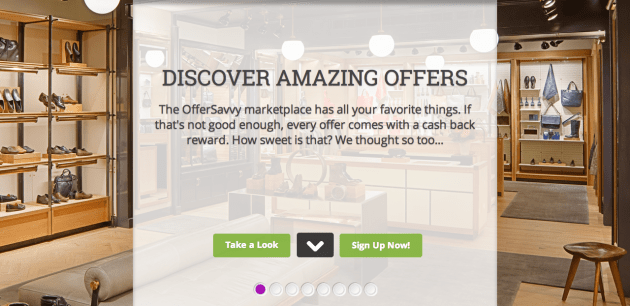
OfferSavvy is a social commerce marketplace where people come to discover, share, collect and buy their favorite products. We incentivize social activity and reward users with CashBack Offers on Products and Social Bonuses when their social activity leads to sales. Users can elect to have their earnings deposited into their bank account or they can donate those funds to charity AND OfferSavvy will match that donation.

We believe we have figured out how to truly create social engagement around the shopping experience in a meaningful way. Most importantly, our goals are to present each user with a personalized experience and a wall of relevant offers. So with our advanced recommender technology, artificial intelligence machine learning software, graph database, and natural language processing capabilities, we can acutely monitor a users interaction with our website and people on the site, and then begin to customize the experience for each user. Thus we help people shop for fun and with purpose.
Screen Shot 2013-11-05 at 6.59.44 AM

What’s the vision?  And what problem is OfferSavvy solving?

OfferSavvy is shopping evolved. People love to window shop, score great deals, and tell their friends all about it. OfferSavvy delivers that experience in one place, and we help people earn some extra cash based on their social connectivity. Moreover, the best form of advertising is word of mouth. Big brands and marketers know this. You probably realize this too, as your friend’s opinions are more important to you than some paid advertisement.

So, we encourage our users to be social and share offers that they discover through OfferSavvy. And each track every link that is shared. Therefore, when any social activity leads to new signups and sales through OfferSavvy, we give a little Social Bonus to the user for being the catalyst to that activity. Every user now has the power to earn dollars just for being social. Plus for the millions of American’s that need their dollars to stretch just a bit further, every product on our platform has a CashBack offer attached to it, so you can find the products that you really want- and earn CashBack in the process.

Our longterm vision for OfferSavvy is to build out the commerce rails to allow any business to actively engage with us and make Offers through our platform. This will give our users a unified experience, and allow them to stay on our website rather than be redirected third party websites to buy products. In addition, we have already written card linked offer software, as a means to close the loop for offline redemption in store. So, when I am able to build out this vision, OfferSavvy will be a grand catalog of CashBack Offers, both online and offline, to your favorite brands and merchants. We will be able to serve up real time, geo-located, personalized, mobile and cardlinked offers for our users. This way we can help people earn rewards off of every transaction they make each month. If you think about all the money you spend each month, how meaningful would it be in your life to get 5-15% of that back… we can truly impact lives here, while building cool technology.

How do users discover and use OfferSavvy?

We just went live last week, so we have started contact all of our friends, family, and connections directly. So people are coming to the site mostly through a direct link to the site. In addition, the website is built on the premise of social shopping, which means that each of us spends time using the product, creating collections, and sharing products with friends through social media. This has lead to promising traffic from Pinterest and Facebook, and a couple of visits from Tumblr and Stumbleupon.  As time goes on, traffic in large part will be through natural search for products, and given are large catalog, we can compete for page rank.

What’s the story behind OfferSavvy?  Any lessons to share?

The initial thoughts and ideas were came to me a few years ago, since that time I have continue to iterate and cultivate what is now OfferSavvy. Officially, the company was started June 2012, when we got some initial seed funding.

Some things I’ve learned from building startups is that nothing happens unless you do it, and you can truly never expect anybody else to be invested in your ideas the way you are. So you really need to be passionate about what you are doing, and love working, because for the first several years, work life balances shouldn’t exist- if you want to build something truly impactful.

Another interesting thought is just how startups are a lot about “hurry up and wait”. You have this grand vision for what this thing could be, and you want it tomorrow, but come to find out that it is going to take quite some time to build such a thing.

Also, as the founder, remember that you don’t have to be the best at everything, instead try to be the maestro, and get the right and best people for each role of the orchestra.. the genius is witnessing the music as your group plays in concert, in harmony.

What is the company’s current status? (funding, beta, users)

We have raised a little over $300k in seed funding thus far. We now have a live product open for consumption, and watching intently as users begin to interact with our platform. Ideally we want to use data and user feedback to shape this into the product that people truly want to use. And we can take the evolution in development and modifications in stride as we have structured release cycles in agile development. This allows us to be nimble, and redirect development efforts quickly as users begin to tell us, and show us the right way to go. We are also looking to raise additional funding that would give us a 9-12 month run rate, so we can focus on user acquisition and engagement on the website.

What’s next?

We have some fun hacks under way as we speak that is truly ground breaking. In the next few weeks you can expect to see the release of some social products that are completely unique to OfferSavvy. One such hack will allow users to not only make comments on products or collections, but respond with hashtags.  You might say, “Hashtags” aren’t new? To which I reply, ‘what if’ every hashtag pulled the top user generated tweets & Instagram Pics in real time into the thread?  People would not only be discovering new and interesting products, but they would find additional rich social content surrounding that product.

So with a hashtag system in place you could not only read what people think or how they feel about the products, you can see the latest tweets about the product from all over the web attached to that hashtag, and you could see the most recent Instagram Pictures that people snapped with that product or brand with that hashtag. Check out our “Featured” section today to see this in action in a slightly different way, but it will give you a good idea of the direction we want to go socially.

Founders RAW: Startups Are A Lot Like Surfing

This post was originally posted on GeekWire.

Seaton Gras started a tech incubator because he wanted to help entrepreneurs more easily create companies.  He named it SURF Incubator — an acronym for Start Up Really Fast.

But If you prod a bit more and ask him about the name, he might just dive into an analogy of how startups and surfing are quite similar. SURF is a great name since founders are constantly working against resistance to get a business up and running, he says.

Bromium founder Simon Crosby brought up that same analogy during one of my recent Founders RAW conversations.

He says:

“So you’re in the waves… and you got a board.  And your board is your ‘idea’.  And one thing you quickly realize is you cannot control when the waves come.. you have no ability.  When the wave comes, you gotta get on the board and you gotta surf… and there’s reefs and other dangerous things under you.  So you cannot control time, you’re in a very precarious situation at all times… and it goes up and down a lot, sometimes several times a day.”

New startups are being created at a fever pitch — and we’re coming off Seattle Startup Week where we crawled, sang, danced, learned, lived and breathed startups. But it’s important to remember: Not everyone surfs.

And they don’t for very good reasons.

It’s dangerous.  It takes time.  It takes patience.  It takes learning the ins and outs of the environment  so you can start predicting what’s going to happen next.  It’s not as glamorous as most make it out to be, sometimes it’s cold, it’s always wet and a mouthful of salt water doesn’t usually sit too well.

See the similarities?

Let’s not forget it takes lots of hard work and dedication to build great and lasting companies.  Here’s to hoping you paid attention this last week, made some great contacts and discovered your next steps to take. I know I did.

Now, it is time to act on those next steps.  Make a promise that your excitement and energy of wanting to be a part of the startup movement doesn’t get washed away just like the “NICK WAS HERE” signature I place in the sand of every beach I visit.

Below is the short clip of the surfing analogy from my conversation with Simon.  You can catch more of Founders RAW here.