Culture Is One Of The Most Important Aspects Of An Embryonic Startup

I continually think about what kind of culture I am building within the Seconds team.  We are still a rag-tag founding team, some full time and some very part time, most on the west coast but some outside of Seattle.  Yet setting a strong and distinct culture at this embryonic and incubation stage of the company is one of the most important things a founder can do.

I read this the other day and it made me pause and reflect on how to better create culture within my team.  From Blake Master’s notes on Peter Thiel’s CS 183 class:

Good company culture is more nuanced than simple homogeneity or heterogeneity. On the homogeneity side, everyone being alike isn’t enough. A robust company culture is one in which people have something in common thatdistinguishes them quite sharply from rest of the world. If everybody likes ice cream, that probably doesn’t matter. If the core people share a relevant and unique philosophy about something important, you’re onto something.

Similarly, differences qua differences don’t matter much. In strong company cultures, people are different in a way that goes to the core mission. Suppose one key person is on an ice cream only diet. That’s quirky. But it’s also irrelevant. You want your people to be different in a way that gives the company a strong sense of identity and yet still dovetails with the overall mission. Having different kinds of problem-solvers on a team, for example, can make for a stronger culture.

The Amazing Story Of How Charity:Water Was Founded And How You Can Do It Too

Charity: Water’s Scott Harrison talks with Kevin Rose about his past life and how he came to found Charity: Water.  It is an amazing story and one that will make you want to do more with your life.  I won’t ruin the story, but I do want to touch on a few things before you go and watch the interview.

As he is talking, Harrison makes a number of great observations around how we can go about our lives only to come to a dead end mid-life and wonder what the hell we are actually doing here.   Drugs, alcohol, partying, looniness, emptiness.  We easily slip into ruts where we become way too selfish, arrogant, entitled and  self-centered to look up and realize there are people on this earth who not only don’t do those things but don’t have access to the very things we take for granted like food, water and shelter.

Did you take a shower today with clean water?  Millions of people in the world did not.  How about a nice glass of ice-cold water?  Or were you able to cook your food long enough to kill all bacteria so you won’t get sick or a disease?  Again, millions cannot appreciate those things.  Did they choose to live this way?  Nope.  They were born into a life without clean running water, electricity or other things you and I take for granted in our daily lives.

We should all start to ask ourselves what a meaningful life looks like to us?  To quote Harrison, “Ya know, Jesus was actually a bad-ass dude walking around helping strangers and making people’s lives better.”  He wondered if he could take his life and do the same thing.

As I push forward in my entrepreneurial journey and build a tech company focused on communications and transactions, these sort of thoughts are not lost on me.   I hope my path is not just about solving first world problems.  We have a unique vision for how the mobile device will make your life easier and I look forward to bringing it to fruition.  But it will not just be available to the privileged few living on many thousands of dollars a month.  I aim to someday live a life like Scott Harrison and work towards bringing happiness to people all over the world – in cities as well as villages.

I challenge you to determine what you can do for people who live on a few dollars per month.   I choose to not think about charity as much as economically sustainable ideas, meaning I would rather see something come in and transform a culture by enabling economic growth over one-time charitable contributions.

What types of ideas can we bring to third world countries that have the power to radially transform their lives and lift them out of their challenging situations?  Harrison’s Charity Water is only a drop in the bucket.

Fear – The Reason Why Most Of You Won’t Start A Company

Fear paralyzes most everyone at some point or another in life but it’s most drastic affect can be found when people are faced with doing something new or different.  It’s fascinating a person would choose not to do someone simply because they are scared of what they don’t know.

I often wonder why that is?  As an entrepreneur I am almost addicted to the new, to the rush of achievement and to the embarkment into the unknown.  It perplexes me why most of us don’t think this way and allow fear to paralyze them in making life changing decisions.  Of course, a simple search brings more to light.

From Wikipedia:

Fear is a distressing negative sensation induced by a perceived threat. It is a basic survival mechanism occurring in response to a specific stimulus, such as pain or the threat of danger. In short, fear is the ability to recognize danger leading to an urge to confront it or flee from it (also known as the fight-or-flight response) but in extreme cases of fear (terror) a freeze or paralysis response is possible. 

Additionally, fear is frequently related to the specific behaviors of escape and avoidance, whereas anxiety is the result of threats which are perceived to be uncontrollable or unavoidable.  It is worth noting that fear almost always relates to future events, such as worsening of a situation, or continuation of a situation that is unacceptable.  Fear can also be an instant reaction to something presently happening.  

Why am I focusing on fear?   Recently I identified fear as the sole deterrent to people taking the leap and starting something new, like a company or new life direction.  I should know, I am currently going through everything a person like this fears and living to tell you about it.

Fear of Failing

Quite possibly the strongest of the fears is the social fear of failing, or the public statement that we are going to do something and then ultimately not succeeding at it.  Humans have a inherent need to be liked, embraced and accepted by the norm of society.  I think this dates back to pre-historic times and the fear of being left out in the cold, alone and vulnerable to prey.  Back then, failing at something meant you would be ostracized from the pack which most likely led to your death.

I can relate to this sort of fear of failing, only to the opposite extreme.  I tend to turn our inherent fear of failing into the fear of failing to meet my potential.  Sometime earlier in my life I heard a statement that struck me so deep I will not ever forget it:

Imagine dying and arriving in the afterlife only to meet your ‘highest potential self’ – the one God intended you to be when he created you – and only then and there you fully realized what you wasted when you were alive.

Whether you believe in a God or not, that statement should send shivers down your spine.  It points to the fact that we all were created with a vast amount of potential, yet it is up to us to choose to pursue it.  My ultimate fear is not failure in one thing or another but  failing to continue to stretch and reach towards my potential.

Fear of success

Interestingly, a lot of people actually fear achievement and success.  Millions of dollars, popularity and attention or the phenomenon of freedom from a job is so foreign to some people they have no idea how to comprehend it in their life.  Imagine waking up early and automatically going to a job each day and then one day waking up with so much money you never have to work again.  This is unfathomable for many people.  So they say things like “oh, I can’t do that?” and  “I am not talented, so how could I achieve that.”  Fear is actually at the root of those statements – they perceive the ability to do such things as something they lack and thus unknown – so one merely passes it off as a fear not be entertained.  That is quite sad.

Fear of hard work

Starting a company is damn hard work.  Most people are lazy and don’t want to work hard; they want to cruise through life along the path of least resistance and have as much handed to them for the least amount of effort.  There, I said it.  And it’s a fact of life.  Humans have been trained to expend the least amount of energy for the most amount of gain and it’s no more prevalent than in the corporate world.  As a culture we have trained ourselves to be lazy and get the most we can for the least amount of effort or investment.

This is why entrepreneurs are so different than the rest of society.  We think opposite.  We understand it demands a hell of a lot from us and WANT to work hard to achieve our goals.  We actually shun the 9-5 “clock in and clock out” life.  This trait can be seen in entrepreneurs, athletes and any person who strikes out on their own to accomplish something extraordinary.  We embrace the 10,000 hours it takes to achieve excellence in anything.

Fear of the unknown

I think all of this comes down to the paralyzing fear of the unknown.  Quite simply, people just want to know everything and hate it when they don’t (obviously the growth of Google has proven that true).  People hate it so much that when they are unsure of something, even when it’s totally normal to not be sure, they just don’t do anything.  They’re frozen.  They stay put.

If there is one point to take away from this is the fact that staying put is they worst thing to do today if you want to move forward in your life.  Doing nothing will only bring more of the same.  This is why most of you will not start a company, because you don’t know what you don’t know and that scares you.  You have no idea how hard it will be.  You don’t know how low the balance in your bank account will go.  You have no idea how hard it will be to recruit people to your vision, compensate them appropriately and treat them right regardless of the circumstances.  You have no clue as to how high the balance in your bank account could go if you happen to succeed.  Lost to you is the incredible opportunities of growth and development that come with placing yourself in a challenging situation.

It’s unfortunate because you have no idea what you are missing.  Although this has been the most challenging thing I have ever done, it is also the most rewarding.  In the depths of the valley I find more about myself than on the tops of the mountains.  The valley’s reveal to us our weaknesses and our strengths; they show us where we need help but they also allow for discovery of the character traits only we posses and how we must use them to get out of the valley and back on the mountain.  For that is what the entrepreneurial journey is all about.

@jnickhughes

5 Startup Founder Rules To Live By

Apparently, Twitter co-founder Biz Stone makes all Twitter employees adopt seven rules when they join the company.  I though these were quite interesting, especially Leave space for the unknown. When I read these rules it made me sit back and think about what might be my rules.

1.  Be Original – Originality is rare today, being truly unique sets you apart from all the rest and makes you attractive to others.

2.  Don’t Ever Quit, Just Refocus – Obstacles and frustration are part of the game.  Refocusing after a setback will help you find meaning and your next milestone.

3.  High Risk-High Reward – We only have so much time on earth to make a difference, why not opt to make the most out of it.  Unfortunately high rewards require high risk.  Fortunately, most choose to risk very little leaving you with a lot of opportunity.

4.  Live Authentically –  Things have a way of coming back around so living authentically alleviates lots of future problems.

5.  Turn Complexity Into Simplicity – Successful products and technical innovation is all about simplifying the complex.  Do that and everything else takes care of itself.

@jnickhughes

The Year I Learned To Fly

As 2011 comes to a close it seems as good of time as any to step back and reflect on what has been, for better or worse, a most incredible year.  The lesson of this post is a lot can change in a year.

A year ago to this day I was sitting at a different desk, with a different job, different title, in a different life, and in a totally different industry.  Technically speaking my professional title was Exercise Physiologist.  I managed a corporate fitness facility and helped executives and employees make better choices in their health and fitness.  This area of expertise was in fact my college degree and ultimately my profession for the greater part of a decade.

I don’t necessarily like to talk about this because I know others look at me and think “how is this guy a CEO and what the hell does he know about tech if his background is fitness?”  Although I can understand where they are coming from anyone who thinks this way is mistaken.

For those who aren’t familiar with my background, I had been associated with the tech industry for more than 5 years and had been working on a “startup” for the last few.  Things had not been going well and to say it bluntly we were heading straight for the deadpool, mainly for the fact that the entire team was still fully employed at their current job.  Not all was lost as those years allowed me to study the industry, achieve a basic understanding of the web and learn what startup life was all about even if it was from outside of the window looking in.  The most difficult part of it all was feeling like I was sitting on both sides of the fence, not being able to make the leap.  And it was one of the most frustrating experiences of my life.

Until something happened.  I finally gave in to my pain, got tired of all the frustration and I decided to finally pick the right side of the fence and ended up making the leap.  I quit my full time job to pursue entrepreneurship and become a real founder.  This felt great, I finally made the decision…  except I had no idea where I was going and where I would end up.  All I knew was I didn’t want to be where I was currently on that spring day.

The craziest thing about jumping is what happens mid-air.

For those of you who might have been following my path, you’ll know I took to writing this summer and ended up finding a few channels where people could find and read my words.  In an amazing turn of events, suddenly people from around the world were reaching out to me asking for my prospective on technology, social media, the web and inquiring my interest in possible professional partnerships.   I was suddenly the expert!  After considering numerous offers, I ended up connecting with some local guys here in Seattle and accepting an opportunity to form a company.

Today I am CEO of Seconds, an emerging mobile messaging and commerce startup with a pretty damn cool product and promising vision.

Your Future is more important than your past

I love this question…. “So what’s your background?” … especially as I sit across from a veteran investor during a meeting as we are about to review our company and our product.  “Shit… how do I answer this one without totally ruining my credibility?” is what I am actually thinking.

I understand their logic as they inquire about my past.  If someone has a Ivy league past, a Stanford degree, an MBA or previous startup experience with a successful exit it is a qualifier in the mind of an investor.  It is proof positive this person has relevant industry experience and basically they pass the sniff test.  The investor is just mitigated the risk (check).  Yet, a strong argument can be made for some of the best entrepreneurs coming out of nowhere to change the world.

I am here to tell you entrepreneurship is not about where you came from, it’s about where you are going.

It is the most important thing I learned by jumping this year.  You must determine where you are going.  No matter your background you must figure out where you are going, refine it and become crystal clear on what you are building and why.  Who cares about your past…  Most of us are not very proud of what we have done in the past and look forward to where we are going.  If that is the case with you, just focus on where you are going because it’s way more powerful than your resume will ever be.

Never, ever, ever…..ever think you are not capable of doing something.  You just need to set your mind to it and get up everyday determined to chip away at whatever/whomever is holding you back.

As Tom Petty would say I am learning to fly .  Or was it Pink Floyd?  Either one… I am damn glad I jumped!

The Numerous Mental Disorders You Probably Have As A Founder

“God, did I just actually think that?” 

Many have wondered what goes on in the minds of the people who go on to start successful companies.  Some may think pure ambition, hopes of everlasting riches or even recognition for doing something great are the driving forces behind a founder.  Others might believe people have a vision or some sort of predestined aura working beyond their comprehension to align the lucky ones with the future.

Whatever is going on behind the scenes of a founding entrepreneur , you can be sure it’s straight out of a psycho-thriller.  The thoughts, feelings, emotions and urges pushing a founder toward success are so dramatic there are no words to accurately describe the experience.  The question is are these normal?

I have no idea what the hell I am doing and where this company will actually end up?

Entrepreneurship is basically a physiological disease, with various mental disorders running rampant.  Being an entrepreneur is something far different than what most people think. It is not about behavior; it is not about business type; and it is not about title. Instead, it seems as if it’s a personality trait with it’s own quirks and characteristics.  There are plenty of small business owners and start-up founders who do exceptionally well — but are not what would be considered an entrepreneur. Just like in big business, you can be a successful general manager without being an entrepreneur or entrepreneurial.

Dammit!  That guy is worth hundreds of millions more than me!!  All he did was start a photosharing app…  What’s he got that I don’t?

So how do you determine if someone is an entrepreneur ?  And are entrepreneurs actually crazy by normal society standards?   That seems to be up for debate.  A thin line separates the temperament of a promising entrepreneur from a person who could use, as they say in psychiatry, a little help.  Academics and hiring consultants say that many successful entrepreneurs have qualities and quirks that, if poured into their psyches in greater ratios, would qualify as full-on mental illness.

If it’s a disease, entrepreneurship then is a combination of many mental disorders that when found in correct combinations, come together to form a very unique individual.  Entrepreneurs are all in all the time. Entrepreneurs love what they do and obsess over it. It is a predisposition; a path that has already been laid for you. It is a character trait, a labor of love, a zeal that cannot be trained, a condition that cannot be treated, an illness that cannot be caught. You’ve either got it or you don’t. Even the Quora community has determined mental disorders are associated with founders.

Wait… did or didn’t I know this was going to happen.  Was it a dream?  I could have swore we already figured this #@%^ out!   Geez, I have no idea when the last time I got a full night’s sleep.

What mental disorders are to be found more common among entrepreneurs than the general population?  After realizing my personal thoughts were “uniquely abnormal” and after numerous interactions with founders of other companies (and discovered the same weirdness), I determined to do some further research.  What follows is an attempt to describe the most common mental disorders associated with the general entrepreneur with descriptions found on Wikipedia.  I came to choosing these specific ones from familiarity and similarity, meaning I noticed a strong association with a founders psyche when reading the definitions.

Anything sound familiar?  As you read these you will start to realize we all are a bit “off our rockers.”  Yet also apparent from reading this list is the notion that maybe the entrepreneur is the lucky one who can actually channel their craziness in a way that actually moves society forward, not backward.

(*please note I am only suggesting it is just the combination of some or all of these in small doses that make up the general entrepreneurial psyche)

Asperger syndrome

Aspergers syndrome an autism spectrum disorder (ASD) that is characterized by significant difficulties in social interaction, alongside restricted and repetitive patterns of behavior and interests…. The lack of demonstrated empathy is possibly the most dysfunctional aspect of Asperger syndrome.  Individuals with AS experience difficulties in basic elements of social interaction, which may include a failure to develop friendships or to seek shared enjoyments or achievements with others (for example, showing others objects of interest), a lack of social or emotional reciprocity, and impaired nonverbal behaviors in areas such as eye contact, facial expression, posture, and gesture.

People with AS may not be as withdrawn around others as those with other, more debilitating, forms of autism; they approach others, even if awkwardly. For example, a person with AS may engage in a one-sided, long-winded speech about a favorite topic, while misunderstanding or not recognizing the listener’s feelings or reactions, such as a need for privacy or haste to leave. This social awkwardness has been called “active but odd”.

Get the hell out of my face right now!  Geez, can’t you figure anything out!   And why do you complain about everything all the time.  You should be grateful you work for a kick ass startup.  

Cognitive disorders

Most common mental disorders affect cognitive functions, mainly memory processing, perception and problem solving. The most direct cognitive disorders are amnesia, dementia and delirium. Others include anxiety disorders such as phobias, panic disorders, obsessive–compulsive disorder, generalized anxiety disorder and post-traumatic stress disorder. Mood disorders such as depression and bipolar disorder are also cognitive mental disorders. Psychotic disorders such as schizophrenia and delusional disorder are also classified as cognitive mental disorders.

This company is worth half what is what worth last year.  I’m a loser.  

As an entrepreneur, depression can set in as well.  It happens to the best of us, especially entrepreneurs who hold strong feelings about their performance and the inevitable outcome of their company.  Ben huh, CEO of Cheezbeuger Network recently opened up about his challenges with depression.

Mania

A manic episode is defined in the American Psychiatric Association’s diagnostic manual as a period of seven or more days of unusually and continuously effusive and open elated or irritable mood, where the mood is not caused by drugs or a medical illness and (a) is causing obvious difficulties at work or in social relationships and activities, or (b) requires admission to hospital to protect the person or others, or (c) the person is suffering psychosis.

To be classed as a manic episode following must have been consistently prominent: grand or extravagant style, or expanded self-esteem; reduced need of sleep (e.g. three hours may be sufficient); talks more often and feels the urge to talk longer; ideas flit through the mind in quick succession, or thoughts race and preoccupy the person; over indulgence in enjoyable behaviors with high risk of a negative outcome (e.g., extravagant shopping, sexual adventures or improbable commercial schemes).

Schizophrenia

Schizophrenia is a complex mental disorder that makes it difficult to tell the difference between real and unreal experiences, think logically, have normal emotional responses, and behave normally in social situations.  Schizophrenia symptoms usually develop slowly over months or years. Sometimes you may have many symptoms, and at other times you may only have a few.  People with any type of schizophrenia may have difficulty keeping friends and working and they may also have problems with anxiety, depression, and suicidal thoughts or behaviors.

At first, you may have the following symptoms:

  • Irritable or tense feeling
  • Difficulty sleeping
  • Difficulty concentrating

As the illness continues, problems with thinking, emotions and behavior develop, including:

  • Lack of emotion (flat affect)
  • Strongly held beliefs that are not based in reality (delusions)
  • Hearing or seeing things that are not there (hallucinations)
  • Problems paying attention
  • Thoughts “jump” between unrelated topics ( “loose associations”)
  • Bizarre behaviors
  • Social isolation

Oneirophrenia

Oneirophrenia is a hallucinatory, dream-like state caused by several conditions such as prolonged sleep deprivation, sensory deprivation, or drugs (such as ibogaine). From the Greekwords “ὄνειρο” (oneiro, “dream”) and “φρενός” (phrenos, “mind”). It has some of the characteristics of simple schizophrenia, such as a confusional state and clouding ofconsciousness, but without presenting the dissociative symptoms which are typical of this disorder.

Persons affected by oneirophrenia have a feeling of dream-like unreality which, in its extreme form, may progress to delusions and hallucinations. Therefore, it is considered a schizophrenia-like acute form of psychosis which remits in about 60% of cases within a period of two years. It is estimated that 50% or more of schizophrenic patients present oneirophrenia at least once.

Narcissistic personality disorder

Narcissistic personality disorder (NPD) is a personality disorder  in which the individual is described as being excessively preoccupied with issues of personal adequacy, power, prestige and vanity.  Narcissistic personality disorder is closely linked to egocentrism.  Narcissists also tend to be physically attractive on first impression, giving them advantages when first meeting people.  Some individuals believe that Narcissistic personality disorder seems like the the person suffering has high confidence and a strong self-esteem, however this is not always the case.

Megalomania

Megalomania is a psycho-pathological condition characterized by delusional fantasies of power, relevance, or omnipotence. ‘Megalomania is characterized by an inflated sense of self-esteem and overestimation by persons of their powers and beliefs’. Historically it was used as an old name for narcissistic personality disorder prior to the latter’s first use by Heinz Kohut in 1968, and is used these days as a non-clinical equivalent.

Arguably, however, ‘in addition to its pathological forms, megalomania is a mental behavior that can be used by any individual as a way of coping with distress linked to frustration, abandonment, loss, or disappearance of the object’ in everyday life. In this sense, we may see ‘megalomania as an extreme form of manic defense…against the anxiety resulting from separation from the object’.

In the social world, ‘megalomania…can be a characteristic of power-drunk or control-freak dictators, some executives, some politicians and some army generals’. All such figures may be said to have ‘a “Big Ego”. A baby’s ego, in fact, insufficiently shrunk….So they’re much more likely to miscalculate To offend people’.

Psychotic disorder

Psychosis (from the Greek ψυχή “psyche”, for mind/soul, and -ωσις “-osis”, for abnormal condition) means abnormal condition of the mind, and is a generic psychiatric term for a mental state often described as involving a “loss of contact with reality”. People suffering from psychosis are described as psychotic. Psychosis is given to the more severe forms of psychiatric disorder, during which hallucinations and delusions and impaired insight may occur.

People experiencing psychosis may report hallucinations or delusional beliefs, and may exhibit personality changes and thought disorder. Depending on its severity, this may be accompanied by unusual or bizarre behavior, as well as difficulty with social interaction and impairment in carrying out daily life activities.

Brief hallucinations are not uncommon in those without any psychiatric disease. Causes or triggers include

  • falling asleep and waking: hypnagogic and hypnopompic hallucinations, which are entirely normal
  • bereavement, in which hallucinations of a deceased loved one are common
  • severe sleep deprivation
  • sensory deprivation and sensory impairment
  • Caffeine Intoxication

Studies with sensory deprivation have shown that the brain is dependent on signals from the outer world to function properly. If the spontaneous activity in the brain is not counterbalanced with information from the senses, loss from reality and psychosis may occur after some hours.

Perfectionism

Perfectionism, in psychology, is a belief that a state of completeness and flawlessness can and should be attained. In its pathological form, perfectionism is a belief that work or output that is anything less than perfect is unacceptable. At such levels, this is considered an unhealthy belief, and psychologists typically refer to such individuals as maladaptive perfectionists.

Hamachek describes two types of perfectionism. Normal perfectionists “derive a very real sense of pleasure from the labours of a painstaking effort” while neurotic perfectionists are “unable to feel satisfaction because in their own eyes they never seem to do things [well] enough to warrant that feeling of satisfaction”.  Burns defines perfectionists as “people who strain compulsively and unremittingly toward impossible goals and who measure their own worth entirely in terms of productivity and accomplishment”. Perfectionism itself is thus never seen as healthy or adaptive.

This button looks like shit!  And it should be over there, not here.   This shade of red sucks and makes my eyes hurt.  And why the hell do I have to tap this to do that?  This just has to be perfect before we release it!

In its pathological form, perfectionism can be very damaging. It can take the form of procrastination when it is used to postpone tasks (“I can’t start my project until I know the ‘right’ way to do it.”), and self-deprecation when it is used to excuse poor performance or to seek sympathy and affirmation from other people (“I can’t believe I don’t know how to reach my own goals. I must be stupid; how else could I not be able to do this?”).

In the workplace, perfectionism is often marked by low productivity as individuals lose time and energy on attention to detail and small irrelevant details of larger projects or mundane daily activities. This can lead to depression, alienated colleagues, and a greater risk of workplace “accidents. Adderholt-Elliot  describes five characteristics of perfectionist students and teachers which contribute to underachievement: procrastination, fear of failure, the all-or-nothing mindset, paralysed perfectionism, and workaholism. In intimate relationships, unrealistic expectations can cause significant dissatisfaction for both partners.

As you can see, being an entrepreneur is a unique combination of actual mental disorders. Pretty interesting, huh.   It is in how the individual decides to channel their “unique characteristics” where we find true greatness.  I hope this doesn’t scare you.  I hope it gives you a better understanding of who you are (or who you are dealing with) on a daily basis.

Consero Is Like The Cool Group In High School, You Secretly Want To Be Invited

Paul Mandell found he was going to quite a few conferences each year yet he was leaving most of them feeling like he was not getting much value.   He felt they lacked timely content, as well as a useful networking experience.   As he looked around, it occurred to him maybe more people felt the same way.  He started to think about how to do these events better, how could he re-create the events industry so more value could come out of each event.  And just as any great entrepreneur would do, he decided to do something about it.

Founded in 2010, Consero is a leader in creating industry-specific events for senior-level executives.

Consero Forums are best known for offering a sophisticated learning environment with high-level content, as well as invaluable networking opportunities driven by Consero’s interactive, invitation-only format.

Although not a technology company, their innovative approach on transforming an established industry has caught my attention.   By forming advisory boards of executives from major corporations, as well as featuring a team of event veterans, Consero is developing the highest level of quality, timely content for each one of its Forums.

Attendees can expect an invitation only environment, meaning anyone attending was asked to be there for a certain reason.  This benefits them by providing a more efficient way to connect with other influential attendees and vendors.

In addition to content, Consero Forums are built to feature a valuable networking environment designed to stimulate new business for its innovative sponsors.  “The networking is far more superior, productive and the events are very focused on solid content” says CEO Mandell.   For example, Consero focuses on ensuring that sponsors meet with the most qualified executives who have expressed a demand for services and solutions based on their current and future initiatives.

The event industry is a $12.5 billion market that, at this point, has seen little to no change in the last 20 or 30 years.  I would say that screams “HUGE POTENTIAL” louder than as any standing ovation I have ever heard.

In just over a year, the company has experienced positive growth, including a 400 percent increase in revenues. In 2011, Consero will be hosting seven events, and they plan to double that number in 2012.  They recently moved into an expanded headquarters and are also doubling their staff this year.

A Lesson In Finding A Need

Headquartered in Bethesda, Maryland, Consero’s new model for events answers all of the pressing needs. At a Consero Forum, every attendee is in the top tier of management with respect to his/her company, and the unique format of intimate conference sessions, one-on-one meetings, and roundtable discussions looks to raise the bar on senior-level networking, thought leadership exchange, and collaborative learning altogether.

They recruit speakers who are industry insiders—people who have first-hand knowledge of today’s most pressing business issues.  They place a lot of emphasis on finding the right people, “to identify the right individuals, we spend a lot of time researching industries, news, and service offerings. Our team also brings to the table in-depth relationships with a variety of high-level executives and solution providers built over years in business.”

Currently the event topics include the legal industry, state and local Gov IT and customer experience.  But, it’s only a matter of time before your industry gets the Invitation Only bug.

In fact, just today they are announcing the 2011 Legal Technology Forum, which is taking place September 18 – 20, 2011 in San Diego, California at the Loews Coronado Bay Hotel.  Jessica Druckman, Founder and Vice President for Program Development of Consero, says, “The program for the Legal Technology Forum will focus on educating legal professionals on today’s most pressing issues, including the most effective ways to protect confidential company information in the age of social media, as well as how to leverage new technologies and processes to ensure efficient legal department management.”

The long term vision is to bring Consero’s model to other vertical niches where it can help improve the experience for both executives and solution providers.  Examples include Consero’s recent Intellectual Property Management & Monetization Forum as well as our upcoming Customer Experience Forum.   Additional Forums for each niche will be announced shortly as well as plans for overseas events.

Going All In

“”I started Consero with about $1,000,000 of personal savings and a home equity loan” says Paul.  “I also brought in experienced event veterans William Card and Jessica Druckman, who have been invaluable assets in the company’s early success.”  Among the lessons Paul learned in the early going include:

  1. Focus on attracting the best employees at every level of the organization. This is essential in any start-up’s long-term success.
  2. Learn every aspect of the financial side of the business. This knowledge is critical in long-term planning and helps to avoid cash-flow issues – especially for entrepreneurs who do not have a strong business accounting background.
  3. Delegate. As the founder, I knew it was necessary to bring in the right support team so I can free myself from administrative tasks associated with launching a company.

Below is the Consero executive team:

Paul Mandell is a Founder and the Chief Executive Officer of Consero. In this role, Mr. Mandell provides strategic leadership for the company with a rigid focus on excellence mat every level of the business.

William Card is a Founder and the Vice President for Business Development of Consero. In this role, he is responsible for working with solution providers and partners who seek to benefit from Consero’s world-class Forums.

Jessica Druckman is a Founder and the Vice President for Program Development of Consero. Ms. Druckman is responsible for conducting market research, writing program agendas, and organizing the faculties for Consero Forums. Through carefully-planned programming, Ms. Druckman ensures that Consero delegates leave each Forum with
practical business skills that spur corporate growth.

@jnickhughes

How Those Of Us Not Named Mark Zuckerberg Can Still Be Successful

A recent post on Business Insider by Rishi Chowdhury titled “Being a Young Entrepreneur” got me thinking about being young, being entrepreneurial and the affect it has on how others view us.

Chowdhury maintains since it is much easier to start companies today, we are seeing many more founders in their late teens and early twenties emerge with significant web products.  This has happened because they 1) come to coding and technology more naturally, 2) have the free time and 3) have less in their life weighing them down.  He notes:

It is also more common place to see teens who have taught themselves code and are able to create innovative web apps due to the freedom they possess. As this generation has grown up along with social networks, they know how to leverage these. What may start out as hobby/after school project can turn into a real business.

That’ s the upside, easily being able to start a company.  He then goes on to illustrate the difficulties in being taken seriously and actually building a company at such a young age.  I fully agree with Rishi and whatever the challenges he sees ahead, based on his writing I believe he has a great future ahead of him.

But what about those of us who aren’t Mark Zuckerberg, who didn’t trip onto a great idea in their late teens and now have more wealth than we ever imagined?  What about the guy in his mid-late twenties, who isn’t seen as the next “wonderkid” but cannot seem to shake the entrepreneurial bug that chases him everywhere he goes?  How about the people out there who don’t know how to code, have never actually created a web app but still dream of building a great business?

I believe sometimes we can be too hard on ourselves.  I think we look at the lucky few and think “geez, that guy is like 5 years younger than I but he is one of the richest people in the world!  How did he get so lucky?”  This is not the right perspective.  Mark Zuckerberg is an exception, and an outlier who has skewed the tech founder perspective

It is still harder than ever to create a breakout business.  Actually, it’s quite a bit harder than it was 10 or 20 years ago.  Why?  Because when it’s extremely easy and cheap to create a new web/mobile app, thousands and thousands of people do.  And when so many more people get involved, the market gets overcrowded.  When the market gets too crowded it becomes incredibly difficult to stand out and be discovered by enough people to achieve a critical mass of users.  Today, you must be very good at what you do to make it big.  Quality now matters more than ever – quality in product as well as quality in person.

So how does one go from a non-technical industry to becoming a tech executive?  Or put another way by Rishi: “A big consideration when starting your company while still very young, is how are you supposed to be taken seriously as a young entrepreneur?”

Well, my advice to Rishi as well as all other entrepreneurs: Be an exceptional person.

1) Build yourself as you build your company

From this day forward and for the rest of your life, you will be interacting with older, more educated and much wealthier individuals.  Sorry to tell you, but they usually will decide if they want to work with you within 5 minutes.  The trick is to quickly impress on them your strengths and abilities, usually within the time it takes to finish your elevator pitch.

This can be the biggest obstacle of all – your personal presentation – especially if you don’t have the luxury of saying “oh, and I’m a Harvard (or Stanford) grad.”  How much time you devote to development of your wisdom, knowledge, wit, personality and social skills will be obvious to businessmen, CEO’s and investors the moment they meet you.   I am a firm believer you can really move forward in life by polishing yourself each day.  No one should ever leave the student mentality.

A few ideas:

  •  Audio learning whenever possible- I listen to Stanford ecorner podcasts each week and it’s like I am in the class.  I also listen to ITconversations when I am driving.
  • Read books like it’s going out of style – business, tech, personal development, fiction, etc…
  • Get uncomfortable and reach out to people whenever possible; learn from each interaction

2) Build your network as you build your company

I cannot tell you how valuable “the network” is, and I am referring to the professional networks like LinkedIn.  Whatever you choose to go with, reaching out and connecting with well established people validates you as a professional.  Once you get connected (via email, phone call, mutual friend into, etc…) immediately book an in-person meeting.  Overlooking a personal meeting is the biggest mistake most young (or less connected) people make today.  Put bluntly: virtual connection does nothing but link you with someone else.  To leverage the connection, you must sit eye-to-eye, open yourself up and let the other person get to know you so they actually understand how to best help you.  This can only happen through in-person meetings.

A few ideas:

  • Reach out to your local tech network and introduce yourself to others in the community
  • Ask to have coffee and meet them in person.  Interview them and write about it!
  • Build out your LinkedIn connections, more people validate you with it than you might think

3) Build your vision as you build your company

There is something magical about hearing someone describe a vision of how they intend to change the world, especially if they are younger in age.  Doing this separates you from the crowd so when you do connect with others they will remember you and your unique vision.  Who wants to listen to someone says “oh, we’re the guys doing daily deals for X industry”?   They most likely won’t remember you or what you are doing with a vision so undifferentiated.  Get passionate, creative, and innovative around something new and start talking about it.

A few ideas:

  • Look at industries which haven’t been fully transformed by the web and search for pain points
  • Take the long view and have courage to paint a unique vision, tell the people you meet about it
  • Use “the network” to find others who share your vision, they might just turn out to be future partners

I understand it’s difficult to be taken seriously as a younger founder because it’s the same as a (relative) newbie to the tech scene, and I’m just barely out of my twenties myself.  We are not Mark Zuckerbergs, who seemed destined to create the next big thing.  But it also doesn’t mean you are any less qualified to lead a great organization.  It just means you have some extra work ahead of you.  And as an entrepreneur, that shouldn’t come as a surprise.

Here is What You Can Learn in 30 Days

One month ago today, May 17th, 2011 I started this blog.  I had just quit my full time job to pursue my entrepreneurial dreams and truth be told – I had no idea what I was actually going to do.  All I knew was I did not want to have a job anymore, I wanted to build a company and change the world.  I wasn’t really sure HOW that would happen.

Previously, one of my biggest challenges was I an outsider  and found it difficult to connect with people in the technology industry.  (Or at least the opportunities to connect.)  That changed once I started my blog and writing for major publications.  This has been the craziest month of my life at the same time the most relaxing month of my life.  I joke and say “my life is pretty cool right now, I call the shots and pretty much do what I want to do each day.”

In the last 30 days I have spoken and interacted with entrepreneurs from NYC, San Francisco, Helsinki, Finland, Bangalore, India, Austria, Australia, and many other parts of the world.  After years of tying to build out my company with a small team here in Seattle, I cannot tell you how many offers and business opportunities have come my way.  I do not say this to boast, I say this so your eyes are opened to the opportunities right on the other side of the door you are staring at right now.  It is all due to me taking the leap without knowing if the parachute was actually on my back.

After a failed first attempt I am back to the drawing board with my company Loyaltize.  I am still going to build a company?  Will it be Loyaltize?  How will I do it?  What will it look like?  With whom?  All these questions I could not answer (most I still can’t).  But regardless, this has been the single best decision I have made in my life.   More doors have been opened in the last 30 days than were opened in many years living a double life.

Here is what I have learned in 30 days:

    • Fear of the unknown paralyzes most people.
    • Letting go of the past and embracing the open road will lighten your load.
    • Most people only dream of quitting their job and pursuing their dreams.
    • Pursuing your dream is only one decision away, make it and don’t look back.
    • Once I came to terms with letting go of a comfortable income, other opportunities emerged.
    • Extending your self through written words greatly enhances your influence.
    • Influence is one of the most powerful things in the world.
    • People the world round crave inspiration and want to be uplifted.
    • Great writing is in low supply and high demand.
    • Confidence will get you through the early stages and any foggy future.
    • The blog posts you think will be huge are not, and the ones you write in 20 minutes can be your most impactful.
    • The titles of blog posts directly determines the number of viewers.
    • Learning how to write a blog post and titling it correctly is great marketing education.
    • The dogma of habitual thinking can hold you back.
    • Stripping everything off and starting from scratch feels good and can free your mind for clearer thoughts.
    • When starting something new, doing it every day for 30 days really does make you better.
    • The road is wide open, very long and waiting to be taken for a ride.  If you are thinking about it, just do it.

Everything In Business is a Test

Test.  Test.  Test.

Everything in business is a test.  The good ol’ days – writing a business plan, pitching for investment, building out a product for the exact market stated in the business plan, launching the product through a large budget Launch strategy – those days are over.

As an entrepreneur, you should now consider yourself a scientist.  Your job now is to run as many tests as possible, with the least amount of expenses to find mass adoption of your product.   The tests should start in the ideation phase and shouldn’t ever end.  The single worst thing you can do now as an entrepreneurial is have one idea and do everything you can think of to bring that specific idea to market.  Start with a problem area and test ideas around it.

Test for consumer problems

What problems are present in which you can bring a solution to market?  The best businesses solve a problem consumers have (or didn’t know they had but now realize life is better with your product).  I heard the other day: You cannot just ask consumers what they want – they do not know.  But if you observe and test them, their actions will lead you to holes that need to be filled.   Inefficiencies will present themselves.  Great entrepreneurs see these inefficiencies early.

Test for Product/Market fit

tubesOnce a problem is found and a solution has been built, the real work starts.  Take it from me, your first attempt will not be the golden fit and you will have to re-align somethings.  Call it pivot, call it whatever you want… it will happen.  I don’t know why we are making such a big deal about pivoting, great entrepreneurs constantly pivot their ideas until they get the right market fit.  Ask Edison, he pivoted like 5,000 times…

Test for Business model

How to make money is the question every company must face.  I believe this is an area a startup must test early and often.  This question should never have just one answer.  Small tests on business model, payment options, advertising (I know… I know….) and other methods of creating revenue.  It’s just a test.  Do some A/B testing on a select group on users.  Release a payment option to 1% of users and see what happens.  You might just discover your next big innovation and create a new billion dollar industry.

Test for Perseverance

Ask any founder of a startup (still running) and they will have hours of talking on the subject of perseverance.  The startup experience will test you and your perseverance.  Just don’t give up.  Do anything you can think of to put off the quitting of your vision.  Read Delivering Happiness by Zappos Tony Hsieh to get an idea on Perseverance.  I had no idea they went through the hell they did with their startup.  You need to read this book if you are a founder of an early stage company not knowing if the future is bright or bleak.

Test for leadership

I laid out the importance of brand and company leadership expansively in my last post The One Thing That Separates Apple From Microsoft.  Suffice it to say I think this is the most underrated, under-talked about, overlooked but most important aspect of building out your long term brand.  You must answer he question: Why are consumers going to want to use my product?  Believe it or not, it will be due to the leadership of the company CEO.  Test your leadership skills early and often to find the right connection with general consumers.

Test for Funding

Investors don’t tell you this, but they are testing you at every stage of the game.  First time you meet them at a “social event” they are testing your IQ and your EQ (your social intelligence) to see if you are someone they would even want to take an interest in.  Next time when you meet for a pitch, they will test your concept and your perspective on the market.  When they don’t call you back, they are testing your perseverance.  When they give you money, they are testing your ability to turn X into 10X.  If you pass that test, you will most likely be able to get money from them anytime thereafter.

I could go on… but I think you get the point.  If you thought your tests were over after graduation, think again.  They only have just begun.  Embrace the test.

Image courtesy of Flickr user Canyon289

You Talkin to Me?

Update: The post was republished on BusinessInsider.com

As a youngster growing up I did not know I wanted to be an “entrepreneur”.  In fact I didn’t even know what one was.  It’s kind of a weird, unintuitive word.  But even as small children I think we can tell the difference between a Pirate and a peon.  Early on I just  knew I wanted to do something different, something bigger.  I knew it the first time I saw Tony Montana scorch the earth building an empire in the movie Scarface.  If you are reading this as an entrepreneur, you probably remember your early entrepreneurial feelings as well.

@ev, @jack, Mark Zuckerberg, Steve Jobs, Jeff Bezos, Reid Hoffman, Larry and Sergey, Marc Andreessen and many others – I have incredible respect for you.  Not many will do what you have done and maybe one day we can connect, hopefully some of that can rub off on me.  But I ain’t talkin to you.

I’m talking to the rest of y’all – the other 98%.   You at your desk hoping your boss doesn’t catch you reading Business Insider at work… again.   No need to close the tab, he probably hasn’t seen yet.  And you, reading this on your phone at the restaurant as you wait for your significant other to come back from the bathroom.  Go ahead and finish reading, I assure you they’ll be glad you’re reading a tech blog and not secretly texting someone else.  And yes, you laying in bed reading this on your ipad, you are just trying to squeeze in one last article before you go to bed.

How do I know you are all doing this?  Cause I am one of you.  I’ve done all those things and more.   I have wanted it so bad I couldn’t sleep at night.  Like you I have also put years into my own vision only to come up short on the latest attempt.  Like you I lived a double life, straddling the fence of trying to successfully launch a side project and lacking the cajones to let go of stability in a day job.  Somewhere along the line I found myself living a lie – vicariously living as an entrepreneur but not actually acting and doing like real entrepreneurs should.   That life sucks and I am done with it.

Yes, it’s a great time to be an entrepreneur and things once again seem to be bubbling.  Venture investments are up.  Valuations are rising.  IPO’s are starting to pop again.   With all this talk of Bubbles, IPO’s, Frothiness, and “it’s different this time”, I just have one question for you: What you gonna do now?

Because here is the truth for most of us:

1) We’ve never launched a successful product. We only wished we had.

2) We’ve never succeeded in raising venture capital, because of number 1.

3) Even though things are frothy, this will not change the numbers game.  Our odds of launching a successful product and raising VC are still going to be slim to none.

Well Tony would say eff the odds.  Tony said eff to everything and everybody.  He knew where he was going and nobody was going to stop him.  Regardless how you feel about the word (my apologies), I think it’s a great perspective.  Tony was the quintessential entrepreneur – purposeful, driven, headstrong and at times ruthless.  When he set his mind to something, you pretty much knew he was going to get it.  Great entrepreneurs look odds straight in the face, laugh, and then get back to work.

But what about Captain Jack?

I don’t care if you’re a billionaire. If you haven’t started a company, really gambled your resume and your money and maybe even your marriage to just go crazy and try something on your own, you’re no pirate and you aren’t in the club.

I about jumped out of my skin when I read those words written by Michael Arrington on Techcrunch a few months back.  It chilled me to the bone and was pure poetic justice at a time when I was really needing to hear it.   I wish I would have cut it out, put it in my pocket and showed it to anyone who asked why I was leaving my “stable and dependable” job.  Most people just don’t get how exotic and intoxicating being an entrepreneur really is.  I think Tony Montana would second Michael’s statement as well.

Although I agree with Arrington and his version of Captain Jack Sparrow, I feel Tony is a better depiction of a pure entrepreneur.  Strip away the guns, drugs and violence and you have a great example in Tony Montana.  He has the dedication.  He has the attitude.  He has the street smarts.  He has the charm.  He has the willingness to risk.  In him you have someone so committed to his vision he was willing to die for it.  Love him or hate him, we need more leaders as committed as Tony.

So here’s what we need to do:

Realize you are – YOU.   The best way to beat the numbers game is to be unique.  You cannot be the next Mark Zuckerberg, Ried Hoffman or Steve Jobs.  You were given your own unique vision.  Execute it.  Zuck was given the vision of a world wide social network.  That’s great for him (and for us to use).  But go do something different.  I think of Zaarly or Square.  Andrew Mason figured out how to make daily coupons cool again.  Awesome, think of something farther ahead like what LOCQL, a start up here in Seattle is doing.  Who knows, maybe back when Zuck, Hoffman, and Jobs were getting started they secretly wanted to be the next Bill Gates, Andy Grove or Thomas Edison.   But of course, they couldn’t and didn’t.  So they became the best versions of themselves and subsequently created the world you now live in.  Read that last sentence again…

Channel your inner Tony Montana.  One of the most interesting aspects of the movie Scarface is how it touches on both the light and dark sides of humanity, capitalism and wealth.  Most people who watch the movie see the obvious flaws in Tony.  But more subtle is the notion that we all have the capacity to think and act in this way.  You too have a little bit of Tony fire in your belly.  You also have the choice to use your competitive edge for the better of humanity, not the worse.  Channeling your drive, determination and what-ever-it-takes attitude will lead you to make a positive dent in the universe.  This is more important that you might think.  Although I have yet to raise a round of VC, I am pretty sure investors would rather have someone walk in their office with a Tony-esk chip on their shoulder talking about taking over the world than see (another!?) demo of a new twist on a social application which also shares groupons.   Mark Suster is so right – “There are so many big inefficiencies in this country that need tackling. I feel quite comfortable that our bars & restaurant industry will be just fine.” 

Find something you are willing to die for.  No, I don’t mean head out the door with machine gun in hand ready to do battle with anyone who criticizes your next idea.  But I am suggesting you find something so grand in vision you will spend the rest of your life making it come true.   In my humble opinion, this is the key to being successful – a driving purpose.  Simon Sinek taught me to Start With Why.  Read this book and you will discover true greatness is not about copying the next social sharing feature.  It’s about inspiring society to move forward with truly crazy ideas that have a larger purpose.  Trust me – Bezos, Jobs, Edison, Larry and Sergey… these guys would tell you the same thing.

It’s a great time to be an entrepreneur.  Shall we not let this time in history be remembered only as the “Social Bubble”.  I think there’s more within all of us.

Yeah I am talking to you…. you with me?


Lonely Man on the Corner

See the lonely man there on the corner,
What he’s waiting for, I don’t know,
But he waits everyday now.
He’s just waiting for something to show.

Genesis – Man on the Corner

Disclaimer: What I am about to write is controversial.  As you read please remember this does not insinuate I lack caring in my heart for human beings of all levels of society.  It is merely my opinion of how a person chooses to live their life and what opportunities a person chooses to act upon.  There are no right or wrongs here, just observations and thoughts.  Also, it is important to note the thoughts below regard what people are choosing to do in the moment of poverty, not how they got into poverty in the first place.  I anticipate differing perspectives and opinions to be shared in comments.

——————-

You’ve seen him.  He’s the lonely man over there on the corner.  What he is waiting for nobody knows.  But he waits everyday, and he’s just waiting for something to show.  The quotes throughout this article are lyrics from a song Man on the Corner by Genesis. The video is below and it’s a must listen.   I recently listened to it and was shook by the emotions I felt during the song.  And so I started to think deeper on the concept of poverty.  I started to think about why some are rich; why some are poor; why I drive a nice car and some are stuck wearing the same clothes every day.  I asked myself, “what could possibly be the difference?”  And why some people find themselves on a street corner just waiting for ‘something to show’.  You may differ in your perspective on poverty in this country, but I believe poverty and entrepreneurship are distant cousins.

This man chooses to sit on a corner and hold a sign.  He has nothing (at least from what we know) and feels his best option is to do nothing, look desperate, and ask for money.  His value proposition rests on the morality of another person feeling remorse when they pass him, forcing themselves to face their inner soul and ask “am I a bad person if I turn my head and don’t give him money?”  He wants to be given something for nothing.  He takes from the world, but does not give in return.  He offers no product in which a dollar value can be placed on it and he has no service to offer another.  He just sits and asks for help.  He has chosen to do nothing.

And nobody knows him,
And nobody cares,
‘Cos there’s no hiding place,
There’s no hiding place – for you.

Genesis – Man on the Corner

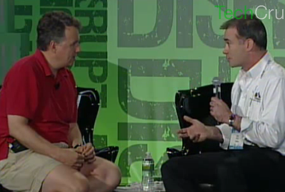
I will juxtapose the man on the corner with the man in the hot seat.  What is the difference between the man in the image above and the man in the image to the left?  The man in the hot seat has, in theory, the same intentions as the man on the corner.  He is asking for money and he is looking for help.  He believes he cannot make his dreams come true unless he receives a gift from someone else.  His future, indeed, depends on another persons good faith.  But that is about where the similarities end.

For those have not picked up on it, the man in the image at left is a person pitching Paul Graham (an investor in the red shirt) on a business idea in hopes he will invest money towards his vision.  But in contrast to the man on the corner, the man on the hot seat does not believe in handouts or in receiving something for nothing.  He believes in creating value through enterprise.  He knows that if you have something, anything – a product, a service, a distribution channel, knowledge, land, a water source, natural elements, really anything – you can offer it to another for a profit.  He chooses to live his life working hard to add value to society, not take away from it.  He has taken ownership and responsibility for his life, understanding he can choose to do anything he wants with it.  But with that decision he knows it is up to him, and only him to make it happen .  The man in the hot seat is an entrepreneur.

Looking everywhere at no one,
He sees everything and nothing at all – oh.
When he shouts, nobody listens,
Where he leads no one will go – oh.

Genesis – Man on the Corner

At times entrepreneurs find themselves looking poverty straight in the face.  It might be in a situation where their income (or lack thereof) cannot fulfill the demands of their debts, whether it is a roof for shelter, food for sustenance or gas for their travel.  They choose to risk their current stability for the return of a better life.  There is an eerie aspect of entrepreneurship and I think it’s due to its distant cousin of poverty.  The mere thought of poverty can be the biggest moving force an entrepreneur receives.   It is incredibly scary and immensely motivating at the same time.  Only in risk one really experiences reward.  So we endure the possibility of poverty for the reward of wealth.

For the record, I am quite privileged to have a roof over my head, food to sustain my health and a nice car to drive each day.  I am doing fine but at this point in my life I hover right above to line, choosing to forgo a stable job for a chance to determine my own destiny.  Also for the record I have stared poverty in the eye and experienced what it could be like.  I have had my electricity turned off and creditors calling my phone for not paying bills on time.  I have had to dig change out of my car to buy a $.99 hamburger.   As a late-twenties ambitious entrepreneur who hadn’t “made it” yet – old enough to be established on my own but young enough to have not built sustainable wealth for myself – it’s was a tough slog.   I’m a tweener as they call them.

When you leave a stable financial situation and leap towards your dream, you risk falling into poverty.  Or should I say you learn how to operate with poverty as a strong possibility in your life.  You learn how to acknowledge where your responsibilities lay in the equation of life.  You start to realize your decisions will make or break you.  It is through this experience I start to think about poverty in a new way.   Whenever I drive by the man on the corner, I cannot help but think: “I could be out there right now.  That could be me.  As I am sitting here in my car it is unbeknownst to me how I will pay rent next month since I just took the leap and started my life as a full time entrepreneur.  But I will find a way.  I will find a way to not only pay rent but to grow my business as well.  I will choose to do something, not sit and do nothing. ”  I argue it is at this point of realization you really become an entrepreneur.

So Here’s the difference between poverty and success:

Man on Corner waits; man in hot seat acts

The man on the corner waits for something to fall into his lap, hands or box.  He takes no responsibility for his actions and believes by just waiting, help will find it’s way to him.  The man in the hot seat acts, on everything.  He believes it is through doing something, anything really, value can be created.  And when he creates value, wealth will find it’s way to him.  It is by doing and acting we entrepreneurs find success.

Man on corner values nothing; man in hot seat values everything

The man on the corner values nothing, not even himself.  If he did value himself, he would be doing something other than sitting desperately on a corner asking for a handout.  He has lost the ability to place value on anything in his life, thus has nothing.  The man in the hot seat values everything, especially himself.  He has such a belief himself he is asking others to invest large sums of money into his enterprise.  And he believes so strongly in himself he knows he can bring the investment amount times X back to the investor.  It is through immense value in self an entrepreneur will be successful.

Man on corner plays victim; man in hot seat plays hero

The man on the corner has ultimately bought into the victim mentality, meaning their outer circumstances determine their inner self worth.  A victim does not take responsibility for actions and outcomes, therefore they do nothing to change their circumstances.  The man on the hot seat understands it is he who determines his destiny and thus plays the hero.  A hero understands they are unique and hold power to orchestrate a positive outcome for all involved.  By believing you as an entrepreneur are the hero, your self worth has nothing to do with outer circumstances.  This frees you up to act according to your vision and experience success.

I am not sure Phil Collins would agree with my interpretation of Man on the Corner but I am curious if you do.

Being a Founder is easy…

it’s actually properly executing and growing the vision (being a Finisher) which is extremely hard.

To every dreamer I have known
May Lady Luck take you home
I pray for every wannabe
Dreamin’ big and livin’ free like me

Kenny Chesney “Like Me”


As an entrepreneur and founder, I can relate to Kenny Chesney’s words in his song Like Me, from the album The Road and the Radio.   Along the road of being a Founder you meet a lot of wannabees, dreamin big and livin free.  Being a Founder, by definition, means all you have done is starting something.   You are a dreamer, thinking of all the ways the world could be better with your new  idea, software, device, app, project or team.  Founders are great and we will always need Founders.  In fact, every company ever started has had founders.  Apple.  Google.  Microsoft.  Facebook.  They all started with an idea from the mind of one or two people.

Founder –noun

a person who founds or establishes.


Finisher – noun
a person who brings (something) to an end or to completion; complete:


But what about being a Finisher?  Take a look at those simple definitions once again.   Founder starts – Finisher completes.  Seems to me Finisher’s are a lot less celebrated in our society, yet they are equally if not more important than a Founder to the success of an enterprise.   A finisher enables the project to be completed.  They lead the team which launches a new product or service and makes sure it gets into the right hands for success.  They are the one who establishes the appropriate processes so the system can function properly.  They line up investors for future growth or acquirers to fulfill the liquidation process for early stakeholders.  In short, Finisher’s complete what a Founder has started.  And in the end isn’t that what matters?  It is interesting that a Founder can hold a majority equity stake in company, but only earn his wealth if a finisher is present to help bring things to fruition.   Let it be known, some Founders are also Finishers, but it is extremely rare and it takes a lot of resiliency.  I would venture to say this is the main reason why the majority of startups fail to make it to “completion” – they in fact had a Founder, but no Finisher.

There are a lot of Founders in this world, for which I are thankful for since innovation starts with a vision.  But I think the world needs a heck of a lot more Finishers.  Which one are you?